Aa Gale Lag Jaa

There is a scene that gets me every time. Shashi Kapoor heartbroken, on roller skates, in a white safari suit, playing the accordion and yodelling (thanks to Kishore Kumar and RD Burman) as he sweeps around an empty skating rink at night. It should be ridiculous and yet it’s strangely affecting. And that sums up my feelings for this fabulous Desai film. Aa Gale Lag Ja is convoluted, goes off the rails at the end and relies heavily on coincidences, but I find it beautiful and touching as well. I recently re-watched it with the the excellent company of Beth and Ira, and couldn’t pass up the opportunity to revisit this masala classic for Kapoor Khazana.

I love the leads, it has one of my all time favourite soundtracks (indeed, it changed my views on accordion solos), and the writing is far more interesting than I expected from a retro filmi romance. And they don’t waste time on building up to a song – they just go for it.

Shashi Kapoor is Prem, a poor but honest roller skating enthusiast. He lives up in the mountains so roller skating, as well as life, is very challenging. The beautiful Sharmila Tagore is Preeti, a minxy medical student.

I appreciate Shashi’s wobbly attempts to skate. It lacks flair, but he is endearingly earnest. Sharmila is very good at fake skating and her pretend waterskiing in Evening in Paris was also excellent. I also applaud her efforts to look like she is gliding majestically under all that Spare Hair. The wig is bigger than she is! Prem is poor, Preeti is rich, they’re both good looking and there is no doubt about the results. Especially after he sells himself to science for an afternoon so Preeti can test hypothermia treatments on this most willing of guinea pigs.

After a song related mishap, the two spend a night fighting off hypothermia.  What an amazing coincidence! Given that Shashi’s innate hotness seems to dry out his clothes in no time flat, the ‘cure’ did raise some questions.

This episode has sparked much debate about whether Preeti was conscious, was it consensual, why didn’t someone keep their pants on … I say she looks rather pleased with herself the morning after and does not strike me as a woman with regrets. My diagnosis is that she woke up, saw what she saw and thought ‘Hello!’
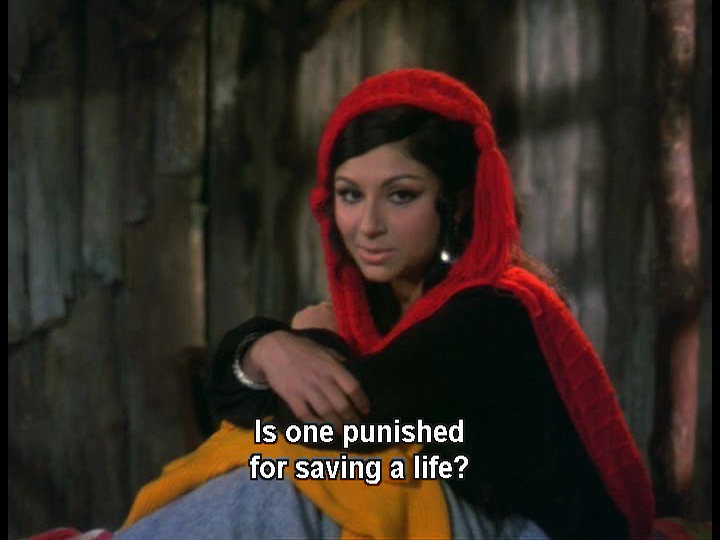
The youngsters want to marry but Preeti’s father Hirachand (Om Prakash) pulls a few swift moves to alienate the lovers. Preeti fell pregnant to Prem That Night and is sent to a sanatorium to have the child in secret. Hirachand and Prem’s ailing mother (Sulochana) play their parts in the drama and Preeti believes the child was stillborn. In a typically filmi twist, Shashi acquires his own son and loses his Ma. Everyone judges everyone else, and the misunderstandings send the protagonists off on their separate paths.

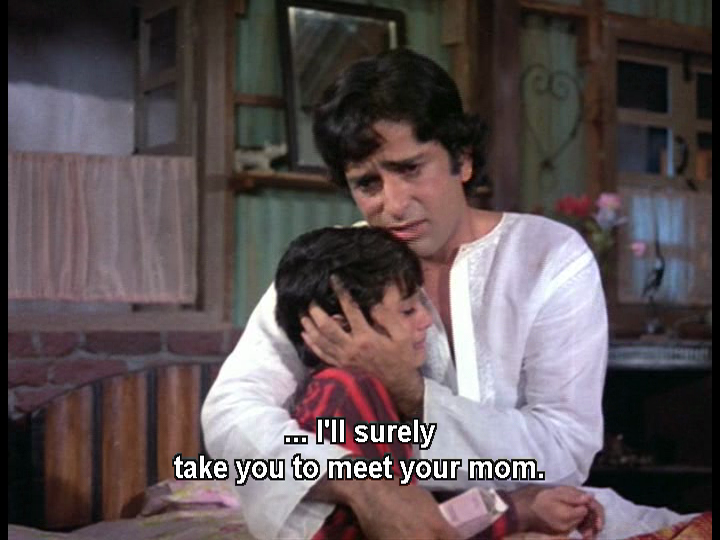
Apart from a spectacular display of acting – Shashi looks so joyous, and unperturbed yet loving, as that baby bawls its head off – this song is quite lovely and sets up the very caring single parent family.


Prem and son Rahul (Master Titoo, one of the few dreaded child artistes I like) have a really lovely relationship. Prem felt no need to marry a substitute for Preeti just so there was a woman to look after them both. He embraced his parenting role and did the best he could. I do think there could be a case for child cruelty when we consider the poor kid’s wardrobe, which features purple and ruffles as well as some hideous short and vest ensembles, but apart from that Prem was a thoughtful and loving dad.

Preeti crosses his path again, and has no idea that Rahul is her child, or that Prem had always loved her and never moved on. Prem thinks that Preeti jilted him to keep her luxe lifestyle and that she never cared about her child.

The ‘will she won’t she realise’ tension is heightened as her fiancé Amar (Shatrughan Sinha) takes over treatment of the crippled boy and so the families draw closer. Shotgun’s entrance is so amazingly filmi, I can’t believe I almost always forget he is in the film until that moment! And his treatment of what he decides is a psychological rather than physical condition is unconventional to say the least. The contrast between Prem and Amar’s economic circumstances couldn’t be more pointed.

Despite the high level of coincidence and near revelation, the performances of Shashi and Sharmila along with Master Titoo made me care so much about what would become of them. Shashi shows his pain and anger, but also his love for both Preeti and his boy. Sharmila is poised and beautiful, and she shows the uncertainty and hope when she sees her old flame. I also really like that the story is about a man who becomes a single dad while the woman moves on with her life and has no idea she has a living child.

Preeti lives with her father, who of course knows about the child, but there are no great histrionics about her lost honour or anything. She has had a long engagement to Shotgun and her future seems assured. Om Prakash is shown as a lonely old man in his opulent home, and the development of his relationship with grandson Rahul is fun as they bring out each other’s competitive and playful traits.  The winning enthusiasm of the child and his belief that his mother will come back for him one day makes his grandfather realise the gravity of his deception. There’s a lot of quiet heartache in amongst the more dramatic antics.

As for the who’s who and what of the story…There’s a Significant Song, a secret photo, Ticky (Amar’s sister, played by Ruhi) loves Prem, Prem loves Preeti, Preeti loves Prem (again), Amar loves Preeti, Rahul just wants everyone to be happy. We have the flaming roller skates of death, and then the happy roller skates of ever after. Almost everyone ends up on wheels at some stage, even the token thugs who hang around menacing young ladies.

But the mad masala trappings never really get in the way of the story so I think Desai and Prayagraj must have had some robust conversations of their own to make sure they kept the balance right. The dialogue by K.B Pathak is marvellous, shadowed with meaning and laden with emotions. When Prem and Preeti meet again, and he sees her as the rich girl who has done well for herself, the polite bitterness is pitch perfect. There is great use of eavesdropping, particularly in a ‘musical chairs’ scene that throws the protagonists into proximity and under stress where much is explained in small bites of barbed civility.

And then, I’m left with that image of Shashi on roller skates playing the accordion.

See this as a great example of Manmohan Desai’s masala excellence, for the beauty and appeal of Sharmila and Shashi, for the marvellous songs by R.D Burman and for the passionate and romantic love story that produced a happy family but didn’t feature a wedding.  5 stars!

Telugu Film History – Filmfare August 23, 1963

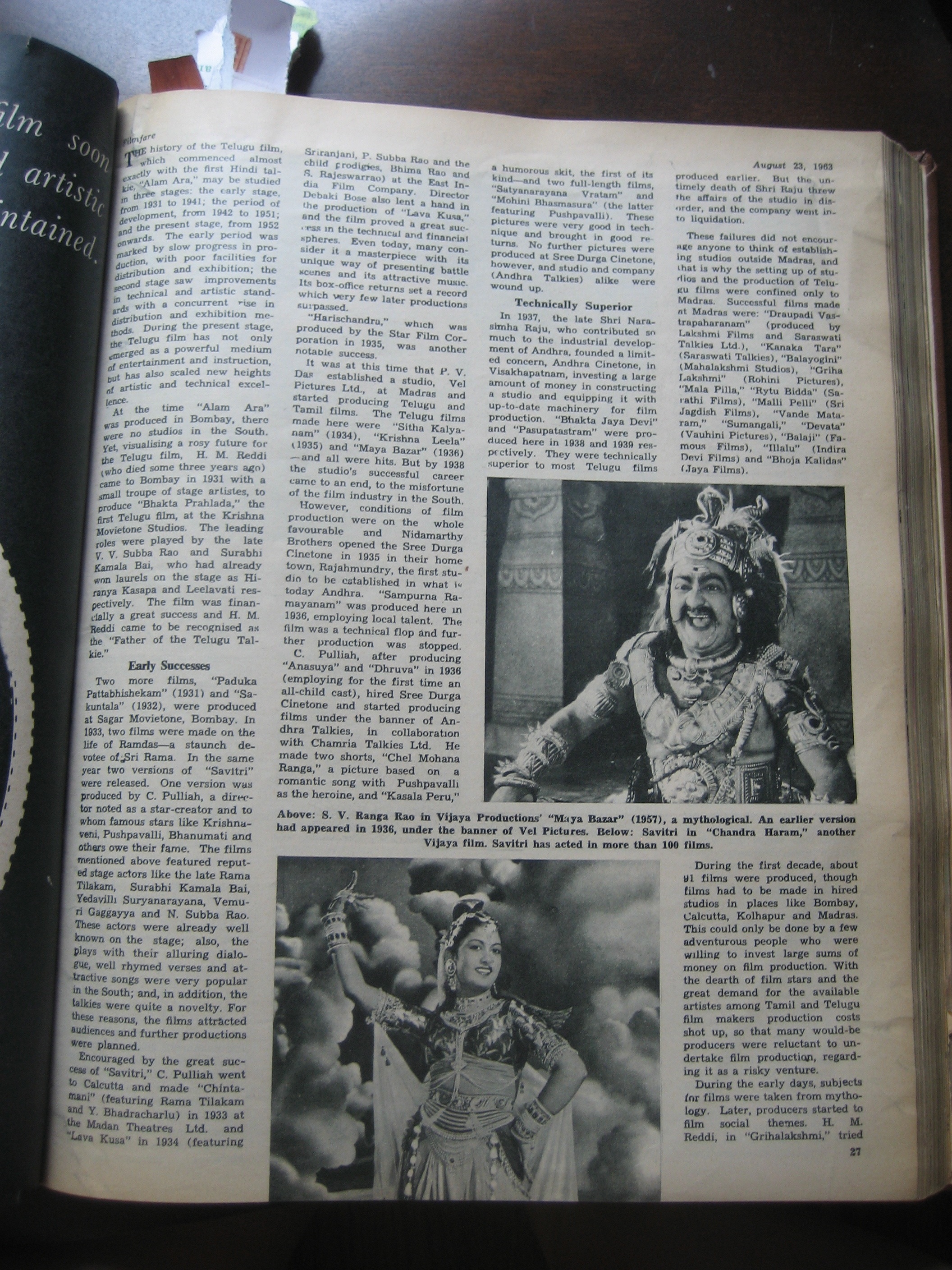
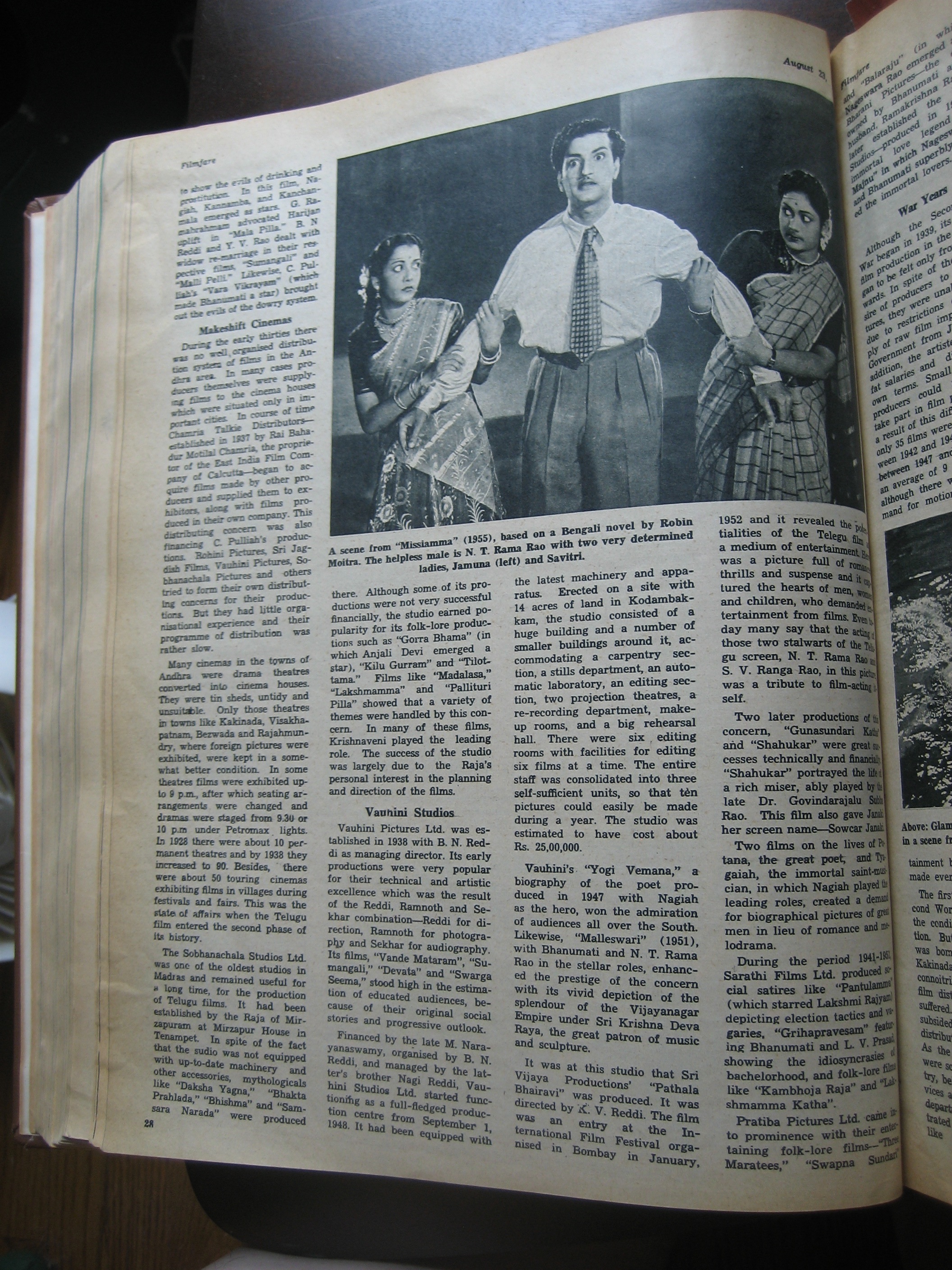
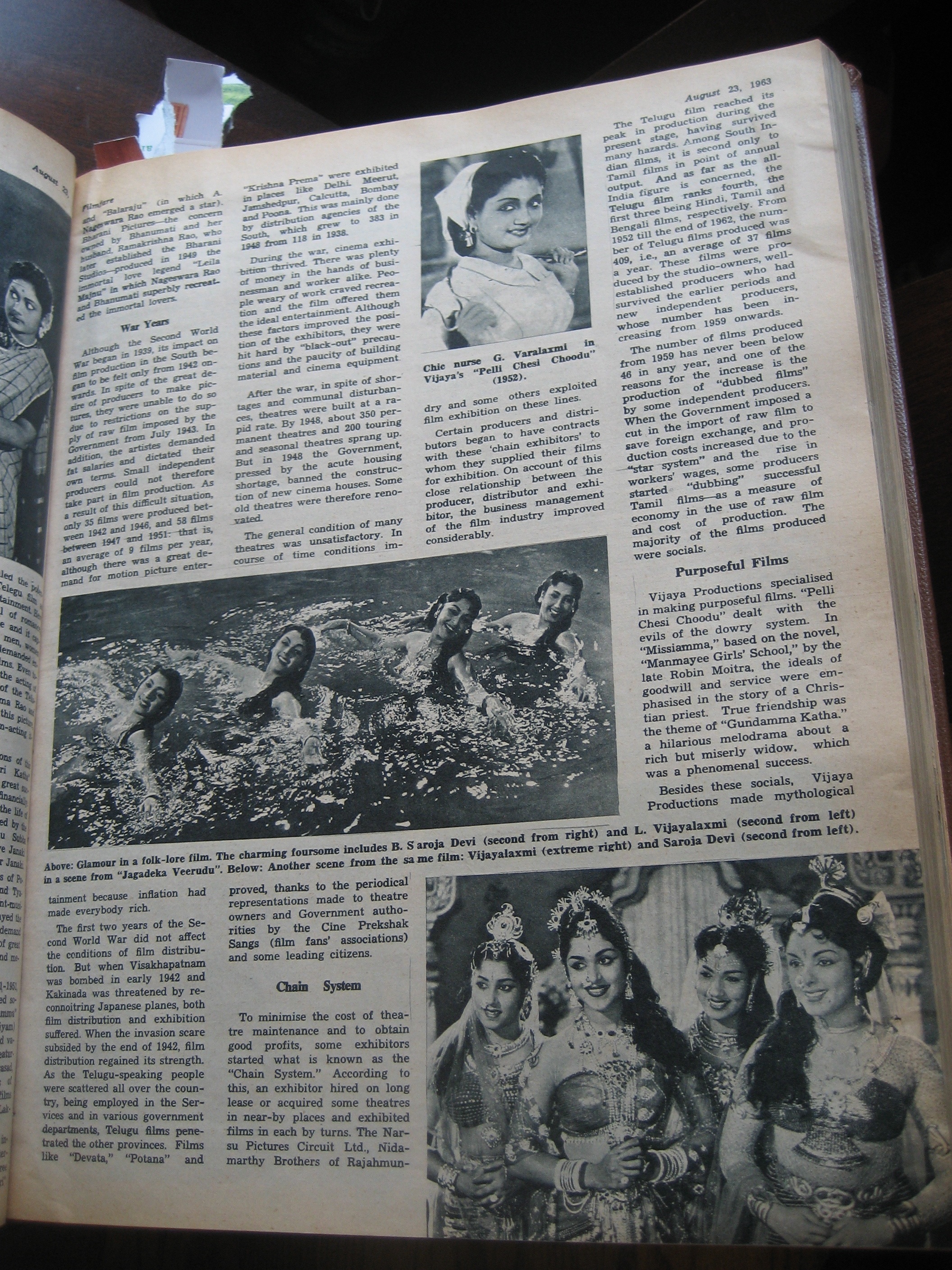
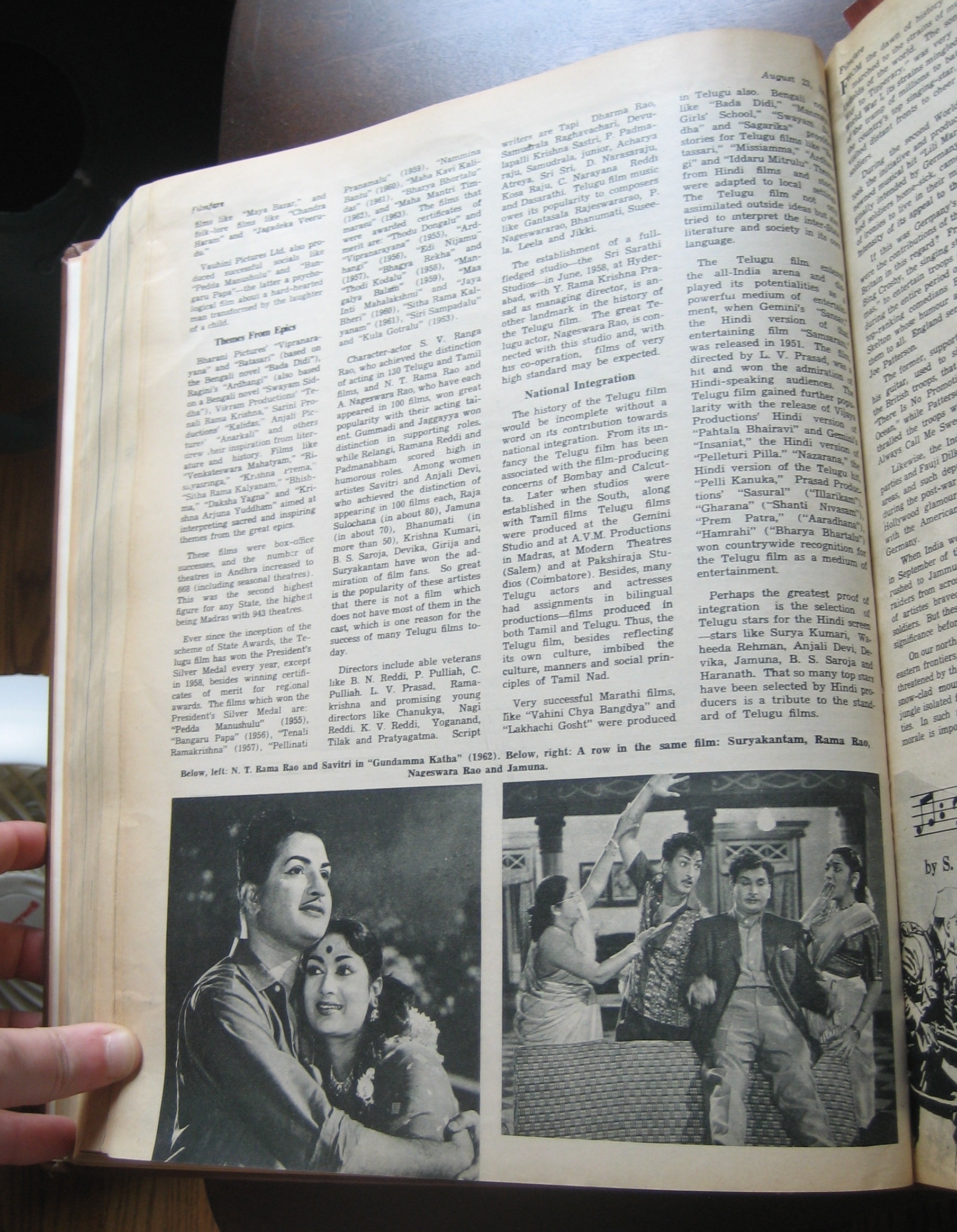
A kind reader with excellent research skills sent these photographs of a Filmfare article from 1963. If you click on the pictures below you should be able to see the full sized version and zoom in to read about the early years of this wonderful industry. If you’re observant you will spot a hand that may belong to our film historian/spy. The story starts in 1931 with ‘Bhakta Prahlada’, made by H.M Reddi and a troupe of Telugu stage artists who travelled to Bombay as there were no studios in the South. It also covers Vauhini Pictures and Vijaya Productions who made classics including Mayabazar and Missamma and provides some detail of the classical and mythological inspiration behind many successful films. I loved reading about the early cinemas and the ingenuity of film makers in an era before fancy technology. If you still need persuasion to see some vintage Telugu cinema, this may do the trick: “Telugu film has not only emerged as a powerful medium of entertainment and instruction, but has also scaled new heights of artistic and technical excellence.” Or you can just enjoy some lovely stills of favourites NTR, Savitri, ANR, Jamuna, SV Ranga Rao and L Vijayalakshmi, among others.

Telugu Film History - Filmfare August 23 1963 Title PageTelugu film history - Filmfare August 23 1963 Page 1Telugu Film History - Filmfare August 23 1963 Page 2Telugu Film History - Filmfare August 23 1963 Page 3Telugu Film History - Filmfare August 23 1963 Page 4


Thank you anonymous benefactor!

Narthanasala

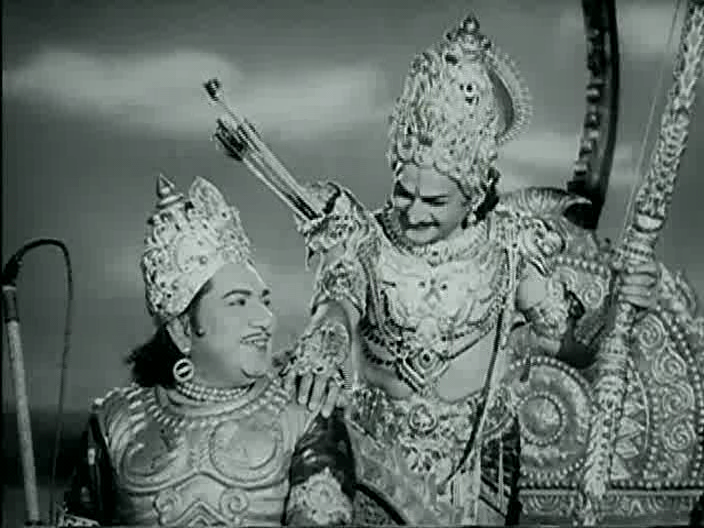
This 1963 classic has an exceptional cast, featuring NTR, Savitri and SV Ranga Rao, under the lively direction of Kamalakara Kameshwara Rao. Narthanasala renders a chapter of the Mahabharata in an accessible and highly entertaining style. The story as shown concentrates on the Pandavas efforts to serve out the 13th year of their exile, and how they deal with their tribulations. I’m sure there are many versions of this tale and this screenplay no doubt varies from those in some ways. My knowledge of the Mahabharata is basic, but all the information you need to know to enjoy Narthanasala is contained within the film, so don’t let that be an obstacle.

Arjuna is honoured by Indra, but manages to tick off Urvashi (Padmini Priyadarshini) when he rejects her advances.  She curses him to become a eunuch. I cannot blame her for being mislead after watching him watching her in this dance:

And she looks furious!

The curse is mitigated somewhat by a time limitation granted in recognition of Arjuna’s essential manly goodness. This coincides with the 13th year of exile when the Pandavas must take refuge in a kingdom and remain anonymous for that final year. The set up of the characters and how they would conceal their identities was simply done in a conversation that pretty much spells out who’s who. There are spies and lures set to draw the Pandavas into the open, and the cat and mouse game with Duryodhana adds an edge of tension to the waiting game.

Dharmaraju (Mikkilineni Radhakrishna Murthy) is occupied as an advisor to King Viraat, and has little free time to spend with his brothers and wife.  The twins Nakula and Sahadeva work with the livestock and are absent most of the time. This leaves Draupadi (Savitri), Arjuna (NTR) and Bhima (Olympic wrestler Dandamudi Rajagopal) on centre stage.

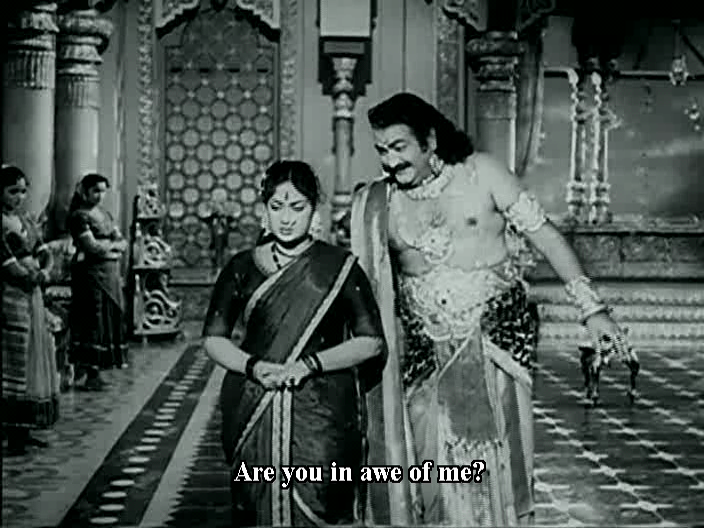
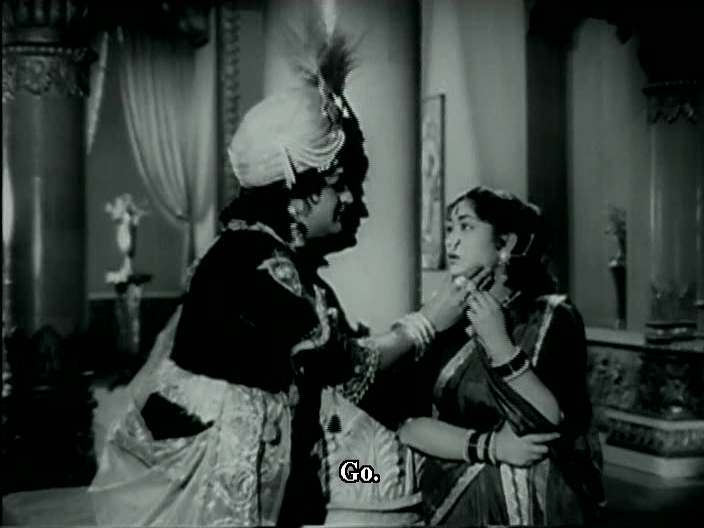
Draupadi is beautiful and deceptively delicate looking. Her husbands make a big deal of her having to undertake manual labour, but she is more resilient than they are in some respects. Although usually deferential to her husbands, when she needs to stand up for herself she leaves no doubt as to the consequences of drawing her anger.  Calling herself Malini she goes to work as a ladies maid and beautician for Queen Sudheshna (Sandhya). She pleads with the queen that she be protected from tasks such as being sent off to entertain strange men and serve in other households, and Sudheshna agrees. Draupadi’s awareness of her vulnerability is clear, and despite her efforts she does attract unwanted attention.

How she attempts to deflect and ultimately stop this harassment is the main focus of the drama, and she tries many approaches before demanding her husbands step in. Krishna intervenes when called upon, but the solution lies with the human characters. Draupadi’s affection for Arjuna gives their complex life a strong emotional core, and their scenes had an element of romance that her interactions with the other husbands didn’t. She has a rare laugh when talking to him about their son. Savitri is, as I have come to expect, excellent in a role that demands both high emotion and restraint.

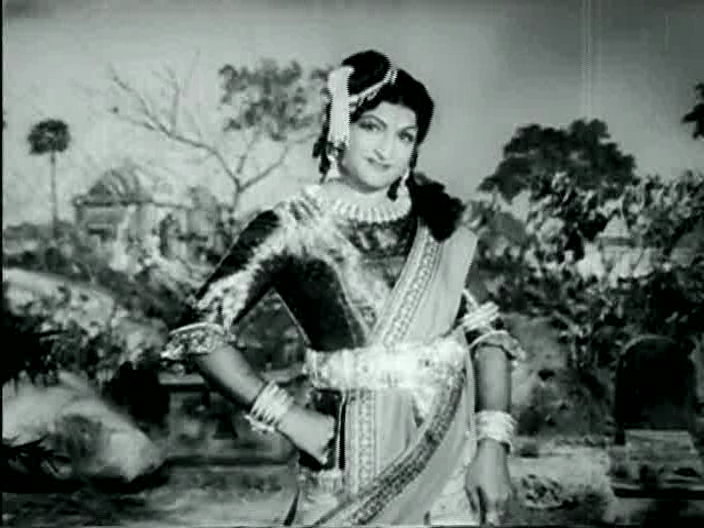
Arjuna is transformed into Bruhannala. He takes up the position as dance teacher to Uttara (L Vijayalakshmi) and embraces accessorising. He should have had those dance lessons as while Bruhannala’s expressions are flawless, his dance steps are not quite as graceful.

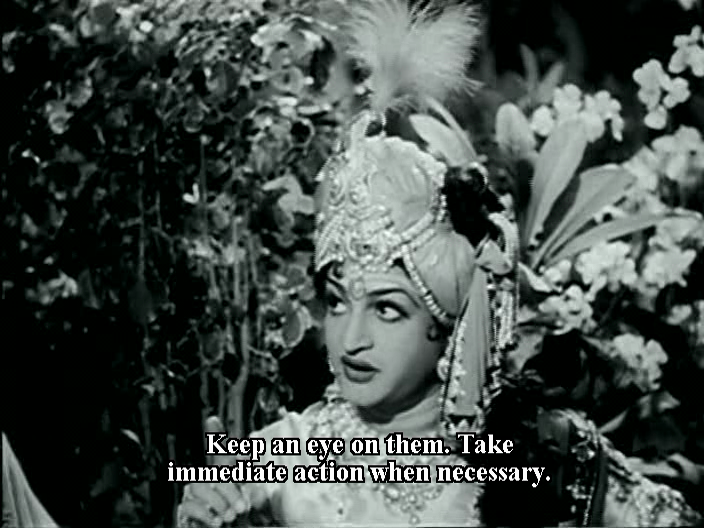
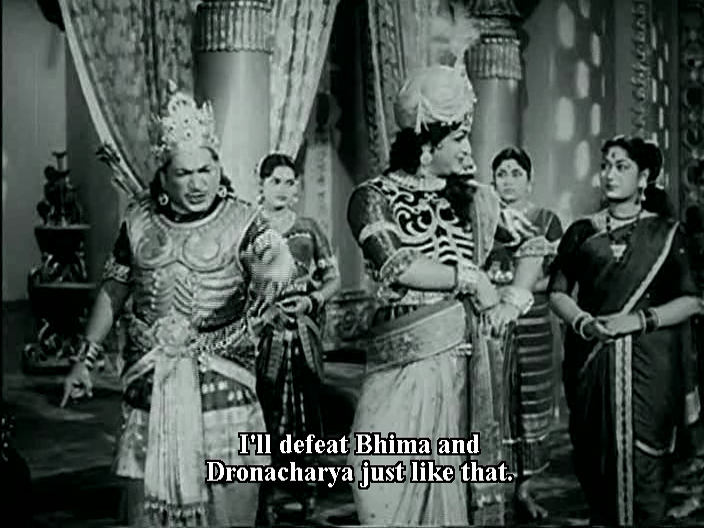
NTR looked knowing and effeminate as the eunuch, always slyly amused at fooling everyone around him. It falls to him to come up with the scheme to keep Draupadi from harm and to keep the Pandavas safe until the end of their exile.

The stolen conversations between him and Draupadi have an undertone of longing. When they touch there is chemistry; Arjuna, the husband missing his wife, is suddenly visible despite the fripperies of Bruhannala. When NTR re-appears as Arjuna he is quite regal although maintains the air of amusement. His scenes with Uttarakumar in the chariot are fun and he enjoys the consternation caused by his transition from Bruhannala back to Arjuna. It’s a warm, appealing performance, and the knowing looks to camera drew me into the asides and secrets.

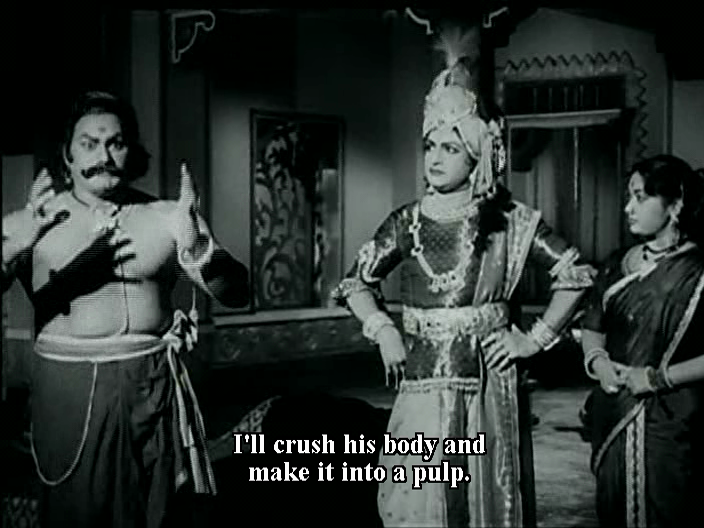
Arjuna is more philosophical about Draupadi’s situation and is prepared to manage each crisis as it happens. Bhima cannot contain his fury; he just wants to tear Keechaka apart.

He knows his own flaws and is guided by the more calculating Arjuna and Dharmaraju’s sense of justice. His powerful physique is an asset to the family but may also be the thing that gives them away. There wasn’t a lot of subtlety needed for this performance, but it wasn’t just posturing and roaring.

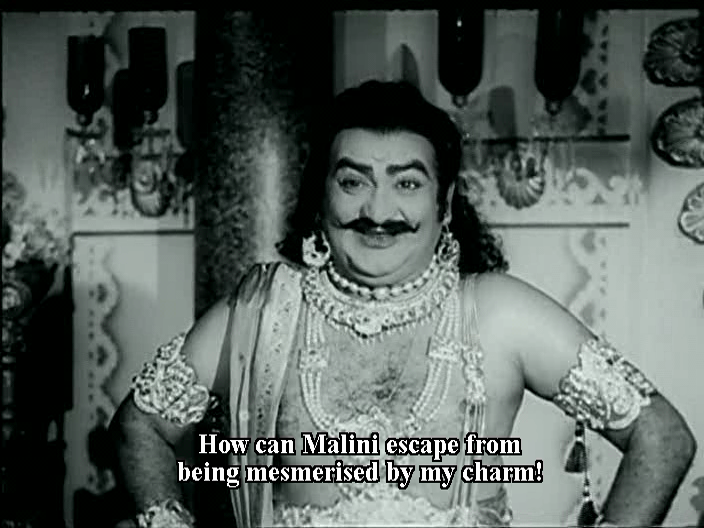
SV Ranga Rao is Keechaka, the queen’s larger than life brother, a jovial bully. His inability to control his lust does more than threaten Draupadi. It also jeopardises the safety of all the Pandavas who may not maintain their disguises under such insult, and threatens the kingdom as he forces the queen to give Malini over to him. He is literally blinded by desire.

How else could he mistake Bhima for Draupadi? His performance is excellent as he manages to be likeable and hateful. I was cheering when he got his just deserts.

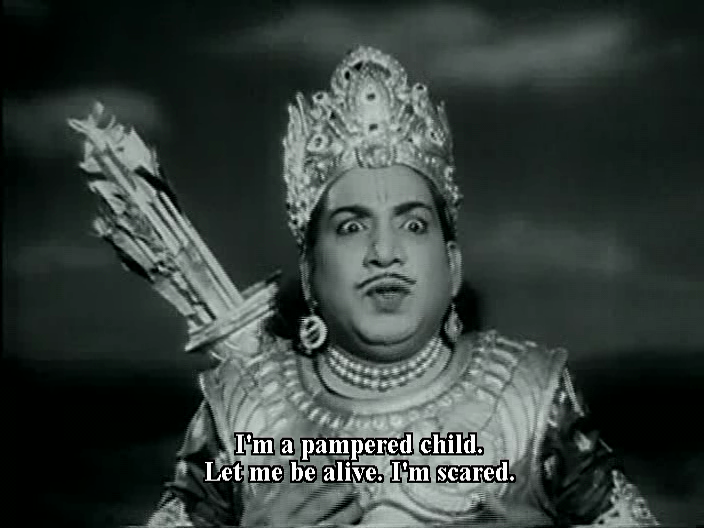
Relangi Venkata Ramaiah (a.k.a the ‘Clap Your Hands Behind Your Back guy’ from Mayabazar) is lots of fun as the pompous, cowardly but endearing Uttarakumar. He has delusions of being a great warrior and leader, and his preening and posturing amuses me as much as it does the Pandavas. He is followed around by his attendants, one of whom is Allu Ramalingaiah with perfect but unobtrusive comic timing. Uttarakumar is nice to his sister, and never gets angry or mean with the cooks despite their unfortunate comedic tendencies, so I like him.

L Vijayalakshmi is perfect as his sister Uttara. I really enjoy watching her dance and she has a sprightly, flirty, quality that enhances the role. She and Abhimanyu have a romantic subplot but really her purpose seems to be dancing and being decorative. This is only the third film I have seen her in, and I hope to find a few more.

The songs (original music by Susarla Dakshinamurthi) blend into the story and I wish they had been subtitled, as often they are used for exposition or introductions. The dancing is lovely, and the sets and costumes are opulent.  The decorations are extravagant and yet allow the performers to be the focal point. It’s also a ripping good story, and the pace of the direction matches the tempo of the drama to perfection. It’s just gorgeous.

4 ½ stars! (a small deduction for too many squeaky comedy cooks in the kitchen)

Heather says: Narthanasala is just delightful to watch. The film’s all star cast are excellent and the sets and costumes are fabulous. Since I’m not very sure about all the characters in this part of the Mahabharata, I really appreciate the opening scenes where everyone introduces themselves and explains who they are, the alias they are going to assume and what they are going to do for their time in exile. Very helpful.

The stand out performance for me is by NTR. He is excellent as Arjuna in the film’s opening scenes and his transformation into the eunuch dancing teacher Bruhannala is brilliant. It’s not just the delivery of his lines or his posture, but his whole demeanour which changes, and he is wonderfully feminine. He also has the best costumes and totally awesome eyelashes! This looked like such a fun role to play and NTR had the right amount of playfulness and hauteur to make it work.

Savitri is as beautiful as ever although I was a little confused about her character as Malini. Since they were supposed to be in hiding it seemed rather odd that she would say that she had 5 husbands and needed shelter for a year. Surely that gave the game away as to who she really was? It didn’t seem to be a requirement of their exile since none of the other characters seemed to reveal quite as much about their identity. However, I only have a very limited knowledge of the Mahabharata, so this could just be an essential part of the original. The film drags a little in the middle while waiting for Draupadi’s rescue from the funeral pyre, but the previous scene with Bhima in drag pretending to be Malini was excellent. Dandamudi Rajagopal is very good in his portrayal of Bhima/Valala and as a professional wrestler he certainly looks the part. Unlike Temple, I love the minions in his kitchen who I think are really very funny, always fighting and squabbling and behaving more like troublesome children. The comedy with Uttarakumar is very well done as well, in particular the scenes with Arjuna when he goes out to fight the Kauravas

The dancing is lovely and although the fight scenes were quite stylised they are enjoyable to watch. I loved this line from the battle between the Kauravas and Arjuna towards the end “He greets the elders with his arrows. That is what makes him so adorable!” And NTR was! I really enjoyed this film – 4 ½ stars.