Ra.One

Ra.One seems predominantly aimed at older kids, so I fall well outside the target demographic. But it was interesting to contemplate Shah Rukh, the father, as I watched him play a nerdy dad who wanted to do something his son would find really cool. And I think perhaps, Ra One is the thing he made for his own kids. As with almost all things parents do to try and impress their kids, it doesn’t entirely succeed and despite being well intended, can be cheesy and embarrassing. There are daft antics, crotch kicking jokes, bad hair and the occasional detour into gross humour or sleaze that – I know this will shock you – didn’t always entertain me. But a few things were just delightful and hit the spot.  

I avoided most of the pre-film promotion as I thought low expectations would be the key to enjoying it. Those expectations were raised almost immediately by the opening sequence – a very amusing filmi pastiche set inside a computer game. Priyanka Chopra (as Desi Girl) and Sanjay Dutt (as Khalnayak) were excellent at what I hope was intentionally bad acting, and SRK was very funny as a kind of Goth styled sword wielding Fabio. It was tongue-in-cheek, with lots of action and stunts, plus silly puns and recycled film dialogue. Sadly my hopes were dashed almost as quickly when the comedy began.

Shekhar Subramanium (SRK) is a Mr Bean type fool in a dodgy wig who creates havoc everywhere he goes. His son Prateek (Armaan Verma) – a child in desperate need of a decent haircut and a swift boot up the backside – is embarrassed by his loser dad. Shekhar is a successful (based on real estate as the family home is lovely) game designer and tries to make a game that his son will like. This section draaaaaaaaags on. It is clear that the son is a brat and the dad is sweet but misses the point. Kareena Kapoor as wife Sonia tries to keep the peace but the first half is more about the father son dynamic.

Prateek tells his dad to make a game where the villain can never lose, because villains are cooler than heroes. And so we come to the action at last. The science behind how the villain Ra One can escape his game is explained by a bit of hand waving and muttering of ‘digital rays’. That didn’t bother me as I think had there been a more rigorous scientific basis for the story it would have been even longer and even more plot holes would have emerged. Once Ra One emerges in the real world, the film becomes an action superhero flick and I was much happier.

Ra One is an evil entity and determined to finish off his first opponent from the game – Prateek – for good. Shekhar sacrifices himself to save his son, but he doesn’t exactly disappear from the film. Every villain needs a hero in opposition and G One represents the life force in the game. Shekhar programmed G One with his own values and equipped him with some favourite proverbs, part of his gift to Prateek. G One bears a physical resemblance to his creator but has much sleeker hair, blue contact lenses and a flash rubbery suit.

Ra One eventually settles into the form of a bare chested Arjun Rampal and the final showdown is inevitable. Arjun Rampal just has to posture and flex, which he does well, and he was certainly menacing. Ra One’s arrival in India was brilliant and loaded with symbolism, but that wasn’t carried through.

Evil versus good, death or life, emptiness versus selflessness. As with the science, Anubhav Sinha shies away from delving into those concepts. I’m not sure that would have made this a much better film, but I do think there was room to expand on some of the ideas and give a heightened sense of consequence when Ra One faced G One.

G One’s relationship with Sonia and Prateek is mostly played for laughs but there are some moments of ‘what if’ as the grieving family look for Shekhar in his creation. The film effectively navigated the relationship between the boy and his father/hero and wasn’t too syrupy. Shekhar’s death was discussed in plain terms, and while G One was comfortingly familiar (and kind of cool) he wasn’t just a vessel for the return of Shekhar.

Kareena was most effective in he second half, especially in her scenes with Shah Rukh and seemed more real when relating to him rather than the child. It says something that a scene involving nasal contents and ending with SRK saying ‘Like it? Keep it!’ could also have some underlying sexual tension. And be funny. The role was a mix of filmi Ma and minx that let her look glam and show some dramatic range. This was a solid performance that showed her off to good advantage.

Shah Rukh is more effective as the slightly robotic G One than as the exuberant Shekhar but that may just be my prejudice against the comedy wig talking. His acting was sometimes surprisingly restrained for a broad action entertainment like this. The scene where Shekhar sacrifices himself was quite moving, and all due to the change of expression in Shah Rukh’s eyes. He covers the gamut from slapstick to deadpan comedy and gave G One a slightly off tempo rhythm to his speech and movements. SRK seems to delight in uncle dancing or cheesy retro dance moves, and there are some excellent bad dance moments, including a Michael Jackson tribute. The pleather pants in that scene made me wish that he would get back on the carbs – he’s looking very thin, maybe as a result of wearing the rubber G One suit for months.

The Vishal-Shekhar music is pretty forgettable, although the picturisations looked OK. The choreography tended towards the inappropriate but I guess if you’re a 13 year old boy it would be just dandy. And I appreciated the shiny underpants on the girls in Chammak Challo as attention to detail is always a good thing, especially when there is so little fabric to go round.

While I found the choreography for ‘Criminal’ skanky (although par for the MTV course), there was something endearing about SRK trying to pop his non-existent booty. I was a bit distracted by the triangular slit cut into Kareena’s miniscule skirt that made me hope she had also been allocated appropriate underwear.

Tom Wu was a stand out in the supporting cast. I am not sure why a Chinese character had a Japanese name (Akashi) but whatever. Just don’t call him Jackie Chan! I loved his flubbed lip synch in ‘Criminal’, and he got to show off a bit more than just being a sidekick. Satish Shah was his usual ebullient comedy uncle type. The special appearance that got the biggest cheer was of course Rajnikanth! He did look a little frail and I hope he is resting up and getting ready for his next film.

The VFX are good and are well integrated into the action.  The gaming style is maintained in the way the characters move, their fights and the fast edits. It’s certainly a quality film in terms of production values. The fight scenes are excellent, my favourite being the South style showdown with machete wielding rowdies. The script could have used some work, and the first half could easily lose 30 minutes. The wardrobe department were clearly in control of a reasonable budget, but sometimes had no idea how to use it other than by throwing more stuff into the mix. This will give you a  sample of the visual delights that await.

Expect a mass entertainment aimed at adolescent boys and you’ll be in the right frame of mind to enjoy this for what it is. Yes it takes the shallow option on many questions, but it’s a superhero genre film. Would I really take life advice from men in rubber suits? 3 stars!
Kandukondain Kandukondain

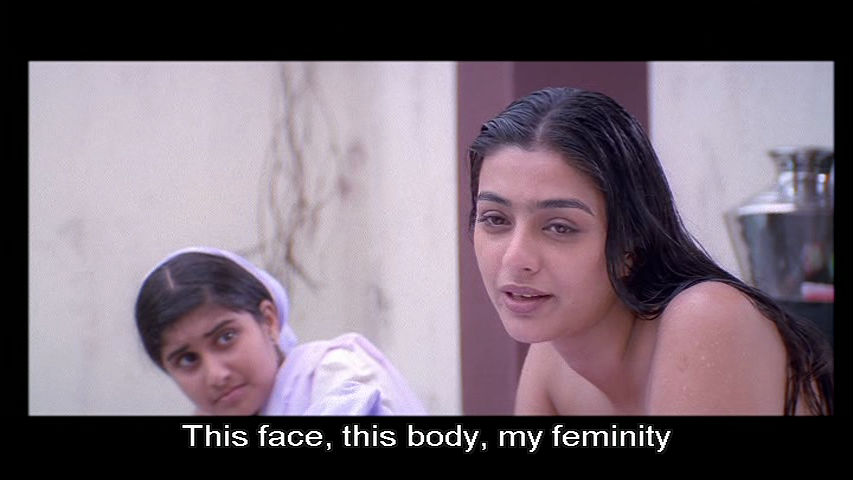
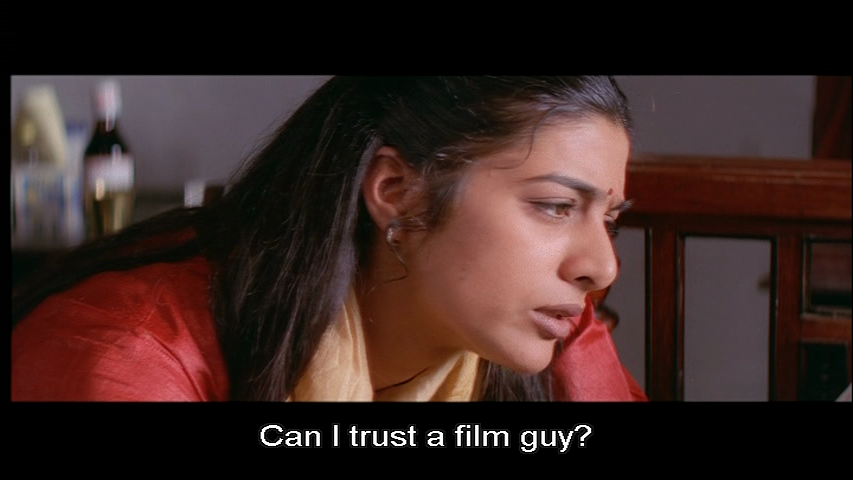
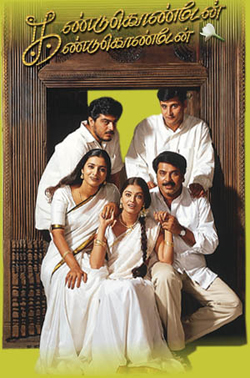
Kandukondain Kandukondain is an adaptation of Jane Austen’s Sense and Sensibility and one of the first Tamil films I saw. It’s still one of my favourites, largely due to the good performances and the strong screenplay. Tabu and Aishwarya Rai play the sisters – sensible, thoughtful Sowmya, and the mercurial Meenakshi. Rajiv Menon retains some of the novel’s ambiguity about whose way is ultimately better, and he and dialogue writer Sujatha focus on the characters and how they develop.

The heroines’ characters required little adaptation. Regency heroines and filmi ones tend to spend a lot of time waiting for the right man or angling for a suitable husband so it probably wasn’t much of a challenge. The suitably ladylike occupations of music and teaching are retained which happily allows for more songs than one might expect from Jane Austen. The female characters in the film are memorable, distinct and very appealing. And I do like the image of big burly film directors reading Austen or Georgette Heyer for their inspiration!

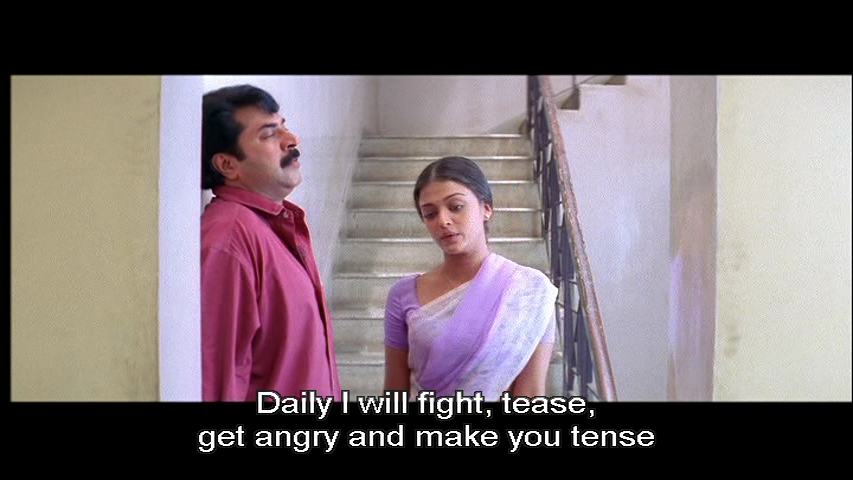
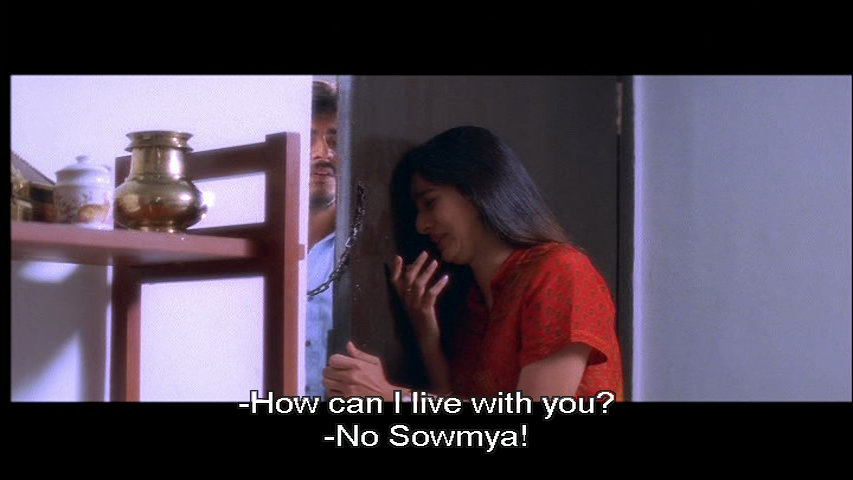
Tabu has a lovely gravity that makes Sowmya very sympathetic. There are small things that make her seem so real – in scenes talking to her ailing grandfather Tabu’s face was sweet and serene, but the sudden slight tension in her throat gave away her real feelings. Tabu’s performance was wonderful, and I totally believed it when Sowmya decided to open her heart to a persistent suitor only to find that she may have been mistaken.

True Love rarely runs smoothly and there are obstacles, real and imagined, that try Sowmya’s patience and resilience, challenging her apparent acceptance of her lot in life. Her confusion and disappointment over Manohar was palpable.

Sowmya thinks that her bad luck has relegated her to a life of service and domesticity in the family home. Her journey towards accepting that she has a right to her own love and happiness is one of the elements of the novel that I enjoyed. She avoids being a stereotypical Regency novel spinster – she is intelligent, personable and has a sense of fun. Sowmya also has a decent job and shows determination in pursuing a career and financial independence.

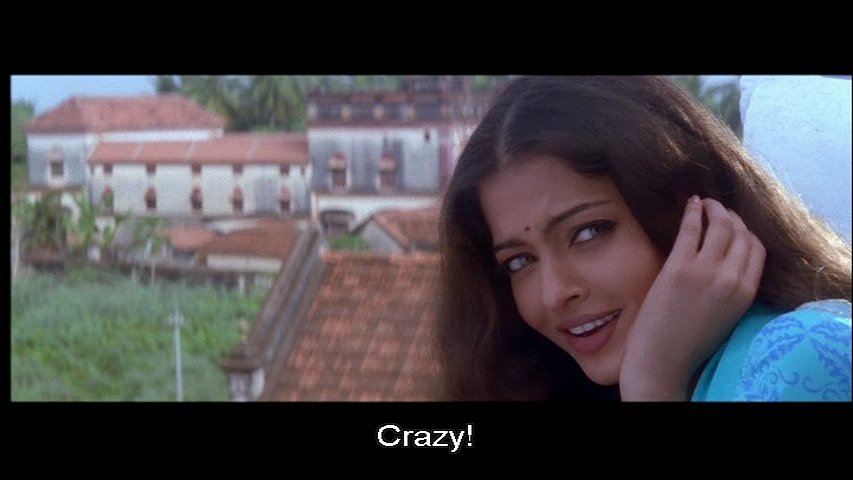
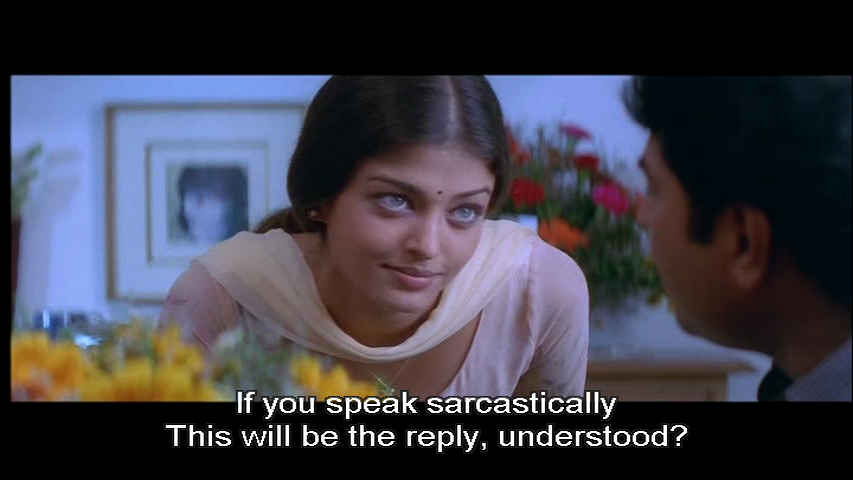
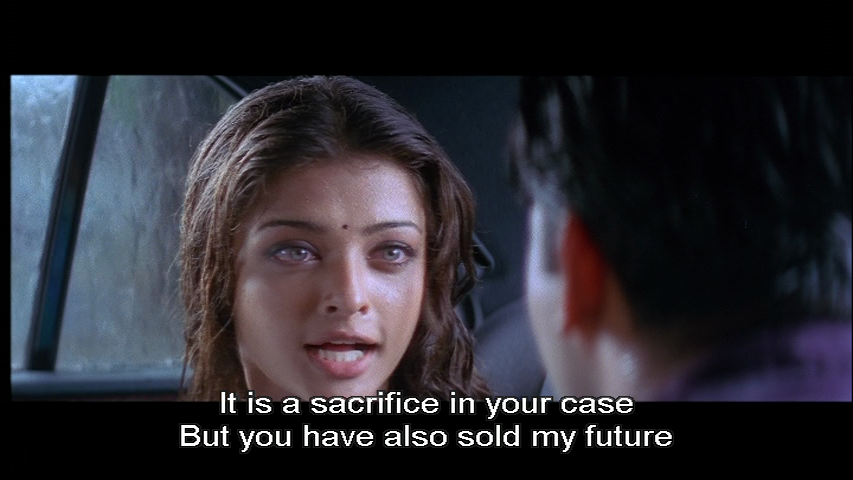
This is one of the films that made me decide Aishwarya is a capable actor but needs a director who can coach her. She has a lively spark that suited this version of Marianne Dashwood, and Meenu’s feisty streak was always in evidence. The opening song shows off Meenakshi’s extrovert nature, features some excellent dancers and lets Aish show off her animal impressions including a valiant attempt at tiger face.

Aish and Tabu had great rapport and details like the way they leaned in to speak to each other, or would catch each others hand as they talked were really charming. But Meenakshi wasn’t all sweetness.

When she was angry she let fly, and Aish was excellent in those high energy dramatic scenes. Meenu confronted her mother over a family secret, and threw Bala’s love back in his face with no compunction. But she wasn’t malicious so much as impulsive and emotional, and I think the script and the performance combined to show this clearly.

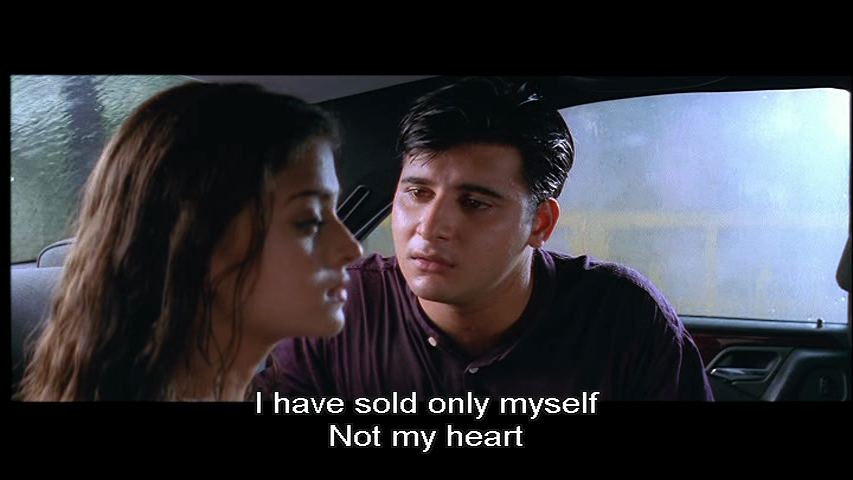
Meenu grows to realise that love encompasses respect and friendship, not just passionate attraction to a dream hero. She doesn’t exactly become her sensible sister but she decides what she needs from her life partner and chooses to look beyond the obvious. When Srikanth makes an offer he thinks she won’t refuse, things become crystal clear to Meenu. She sets about getting her way with all the vigour she had previously put into avoiding Bala.

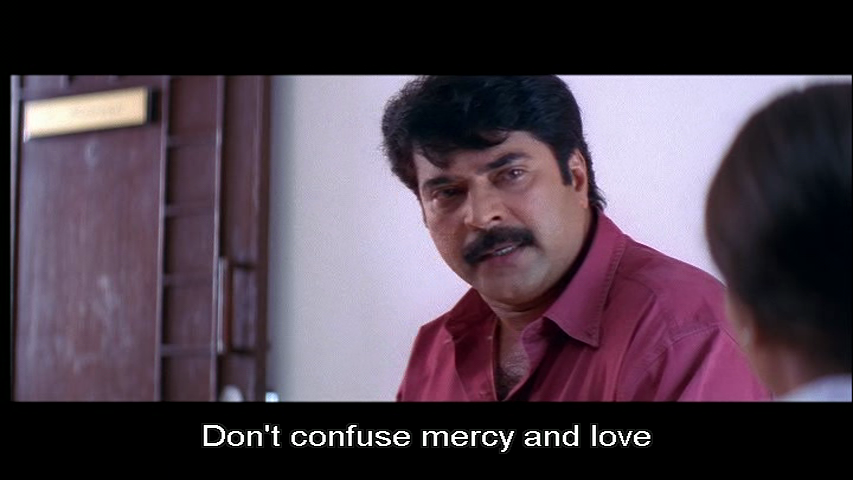
Mammootty is excellent as the embittered drunk with a loosely fitted prosthetic leg, Bala (based on Colonel Brandon). Living with his war injuries and a sense of disillusionment he seems intent on pissing his life away. He is drawn to Meenakshi’s beauty but I think it is her fiery temper and cheeky disrespect that really captures him. Mammootty transforms from angry man to shy boy and then seems to regain his love of life and enjoyment of people, resuming a full and happy life with no booze and less anger.

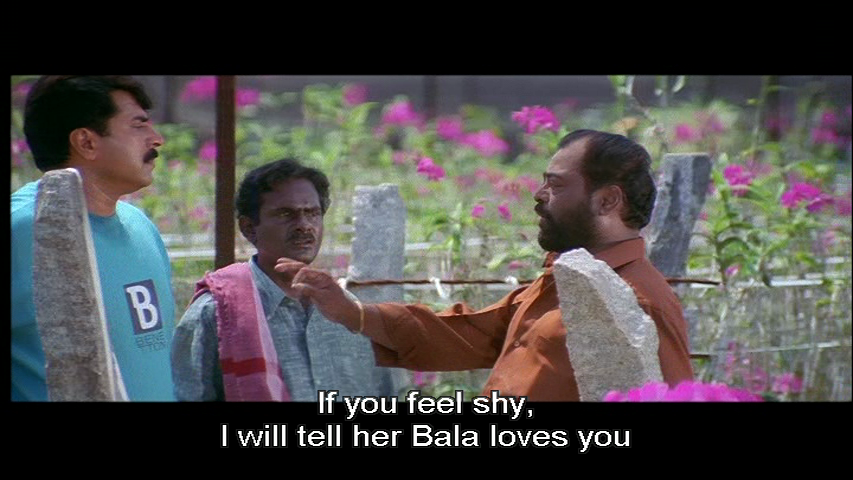
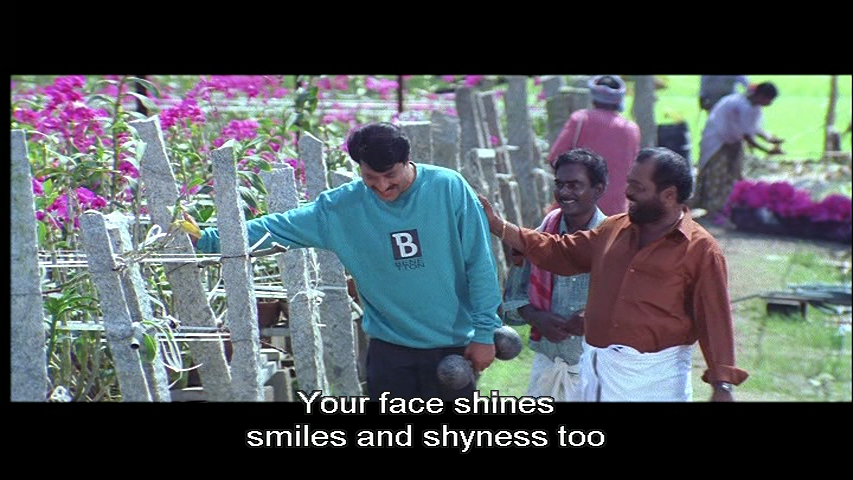
Unlike Colonel Brandon, he has loyal sidekick Sivagnanam (the excellent Manivannan) to provide strategic advice and moral support. The ‘talk to the hand’ scene was sweet and very funny. Bala had the maturity and patience to deal with Meenu, and the intelligence to realise that she would come round or not but he couldn’t force it.

He helps the family from decency, not to buy Meenu’s favour. His thoughtfulness and generosity made Bala a hero. And of course he does save her life.

When it looks like Bala might see his dreams come true, Mammootty shows the underlying vulnerability gradually give way to joy. It’s such a well judged performance and he supports Aish beautifully.

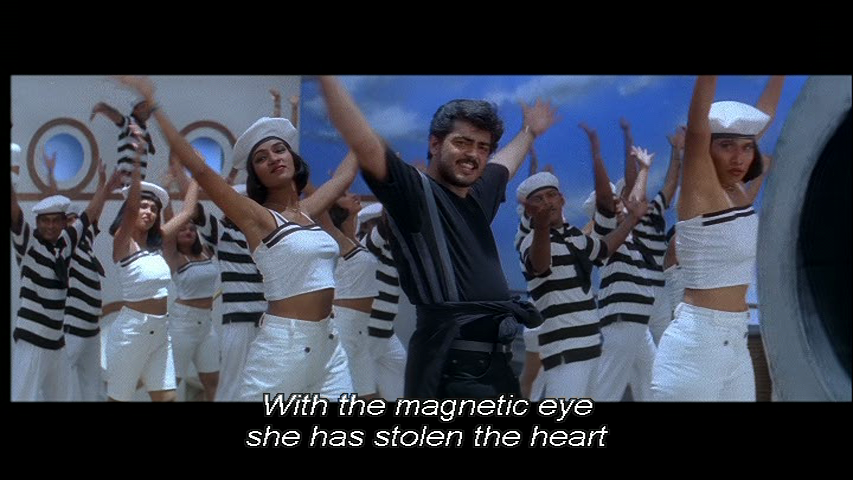
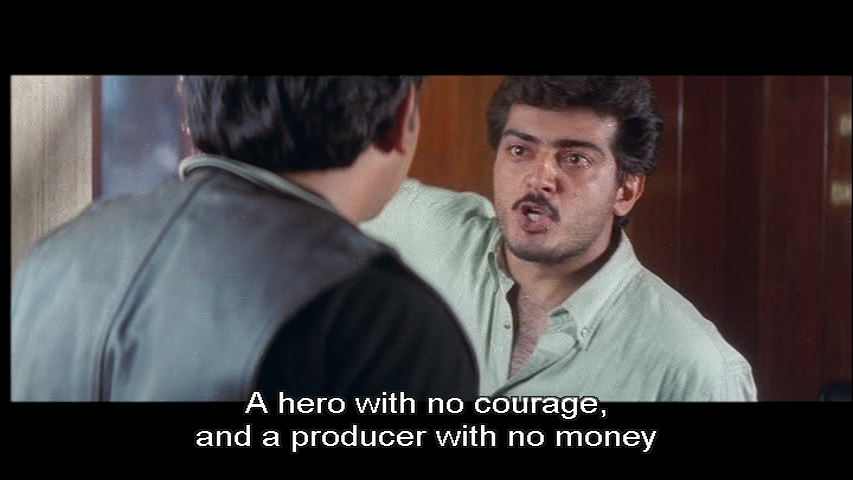
Ajith is hampered by the least successful storyline. In the novel Edward Ferrars is gentry with strong principles and a secret engagement he is unable to break, torn by his love for Elinor and his duty. Making Manohar an ambitious film director didn’t carry the same limitations and so he came across as more selfish and whiny than noble.

Manohar made the decision to leave Sowmya until he had made his first film. There was no need to make such a choice and it was silly. I struggled to see him as the right man for smart sensible Sowmya. The supposed ‘other woman’, the top actress and action hero Nandini Verma (Pooja Batra) was lots of fun but again her occupation and personality didn’t match the dynamic from the novel and it fizzled. Instead of being worried about being forced to marry an unsuitable woman and lose the one he loved, Manohar often looked quite content with his situation.

Well, until the day he decided he was finally ready to claim Sowmya. Ajith was adequate in the role but the lack of credible tension in his story left me unconvinced.

Srikanth (Abbas) was perfect for the film’s Mr Willoughby. I don’t think he is at all attractive but his entrepreneurial character and silly floppy hair fit the style of the society man on the make. And talk about making an entrance…

The wet shirt scene was completely unnecessary and did him no favours in the inevitable comparison. Srikanth was self centred, self satisfied and avoided responsibility. His relationship with Meenu was based on his surface appeal and her dreamy silly notions and very pretty face.  Srikanth was devoid of substance and sense, and seemed genuinely shocked when things fell apart.

The supporting cast are all very good. Shamili as little sister Kamala, Srividya as the mother who wanted the best for her girls and Manivannan as Bala’s friend were all great. Rajiv Menon and dialogue writer Sujatha gave the support actors lots to do which helped reinforce the domestic feel. Bala’s mother (I think) is obsessed with weddings, and long suffering Sivagnanam even gets the family cats married to keep her quiet. Thankfully the comedy is centred on necessary characters and incidents.

The soundtrack is lovely but the song picturisations are a mixed bag. Some look amazing and others are like something from a high school rock eisteddfod. Some have a bit of both!

Cinematographer Ravi K Chandran made the most of the lovely rural locations, and also captured the more enclosed and subdued lighting of the city. He certainly made his leading ladies look stunning.

It’s a beautiful film, with a quality AR Rahman soundtrack and some excellent performances. And it’s one of the more successful adaptations of a novel I know well and am very fond of.  4 stars!

Heather says: I’m generally not a fan of adaptations of Jane Austin. I fell in love with her books as a child, in fact Sense and Sensibility was the first I read, and so far nothing on either the big or small screen has lived up to my expectations. Kandukondain Kandukondain is no exception, although I do think it is one of the best adaptations I have seen.  Despite that, I failed to connect with the characters and although the whole film looks beautiful and has some lovely songs in the soundtrack, it’s not a film I really enjoyed.

Kandukondain Kandukondain is shot to make the best use of scenery and to accentuate colour in the landscapes as might be expected from someone with Rajiv Menon’s background.  The indoor scenes look just as good and I like the way the colour and light of the first half gives way to duller lighting when they move to Chennai and the family have to fend for themselves. In fact this is the best part of the film for me as I enjoyed Sowmya’s search for work which felt very realistic. Meenakshi’s singing and her career problems were also well depicted and I loved the way that Mahalakshmi was also secretly working. At this point I was able to forget any Jane Austin links and the characters started to come alive. But then the film went back to the respective love stories and I lost interest  again. I didn’t feel that the original characters from the book were well adapted into modern-day romances. While I thought the lives of the sisters were modernised and well written into an Indian setting, the men, (with the exception of Major Bala) seemed to be poor copies of the Jane Austin characters and I didn’t like them at all. Ajith was fine as the film director but like Temple I had problems with his decision not to marry until he had made his first film. Or rather not so much the reluctance to marry until he was established, which did have some legitimacy, but rather the long separation without any contact which just seemed ridiculous. Abbas looked too much like Tony Hadley from Spandau Ballet for me to be able to see him without grinning. Especially when he donned a cloak in one of the songs! His character isn’t supposed to be likeable but I couldn’t even find him charming here, and Meenakshi’s devotion to him was only based on his ability to recite poetry. Again this follows the book to some extent but there is so much more to the whole romance than that and for me it wasn’t well brought out in the film. Aishwarya was absolutely stunning as Meenakshi, but I thought there was too much beauty and not enough depth in her portrayal. However I think this is more the fault of the character she played rather than a problem with her performance, which was actually quite natural and one of her best. Despite the changes in the story, I wasn’t able to forget that Meenakshi was basically Marianne from the book and in that context she wasn’t my mental view of that character. Although Sowmya was a more individual character and I thought that Tabu gave a good performance, I couldn’t connect with her at all. By the end I really didn’t care if she managed to get married or not despite having originally felt some sympathy for her. I wanted her to get on with her life on her own terms and not be so reliant on a rather weak man. But then, that’s often a problem with both film and regency romance heroines. The one character that I really enjoyed watching was Major Bala. Mammootty was fantastic and I did empathise with his situation and his attempts to win Meenakshi. His performance was the definite stand out and his interactions with his friend Sivagnanam were some of my favourite moments in the film.

There is nothing really wrong with Kandukondain Kandukondain and I’m sure I would have enjoyed it more if I’d been able to just forget about Sense and Sensibility. But I would much rather read the original book again rather than watch the film.   It still gets 3 stars from me but they are nearly all for Mammootty and a beautiful soundtrack.


Loins of Punjab Presents

 I originally sought out Loins of Punjab Presents because I really like Nina Paley’s Sita Sings The Blues  and read that my favourite shadow puppet, otherwise known as Manish Acharya, had made a film. I watched it with a hint of sadness and regret in light of his untimely death. But that didn’t stop me enjoying this lovely mockumentary with a near perfect balance of sweetness and acidity.

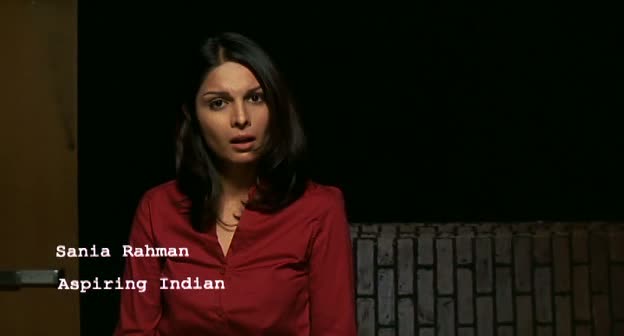
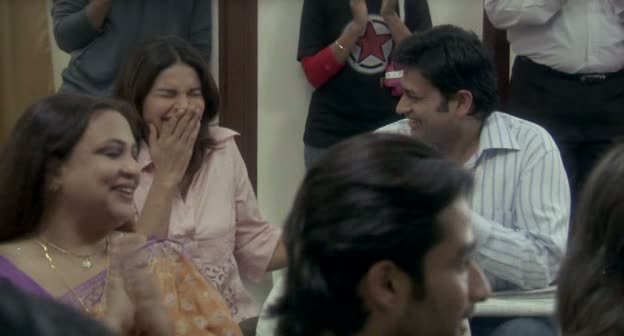
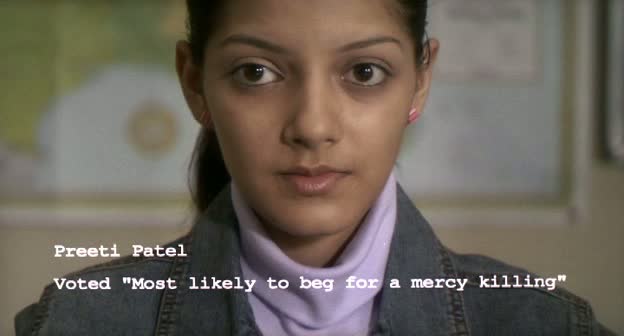
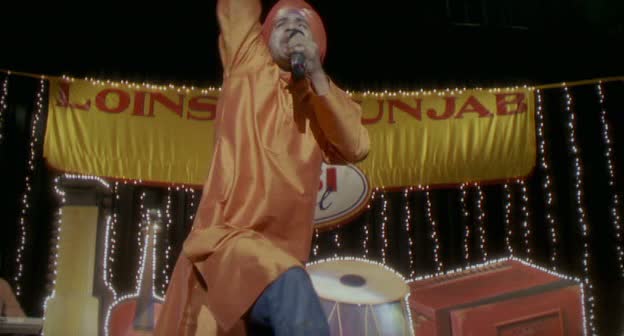
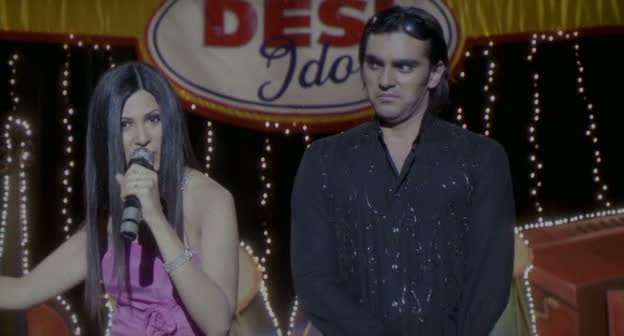
The film takes place around a singing competition, ‘Desi Idol’, sponsored by the Loins Of Punjab company. A local news crew is on site shooting a story about the competition. Their presence allows characters to talk directly to the camera, and the captions add some pithy observation. The characters are introduced out in the wild, but then observed at close quarters in the hotel where the competition is based. There is a villain, a hero, romance, drama, tears and laughter. Mostly laughter.

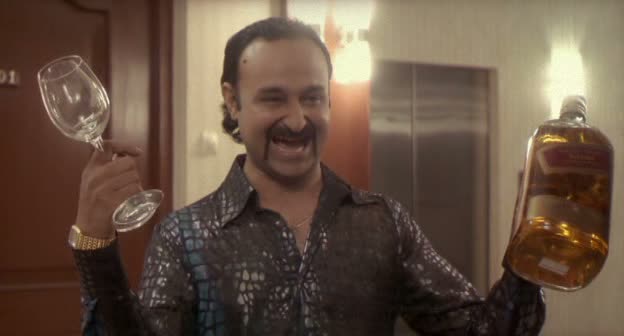
The master of ceremonies is the wonderfully repulsive and Gypsy Kings obsessed Mr Bokade (Jameel Khan). He is horrible yet noble when it counts. He just has no idea, and it is oddly delightful to see his unswerving belief in his own magnetism.

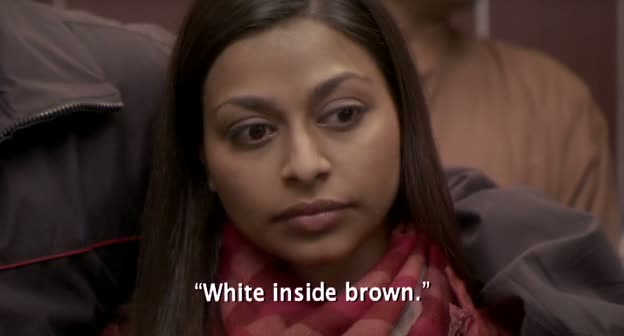
Bokade’s mangled explanation of insiders and outsiders and race relations is pure gold, and somehow it made perfect sense. His bewildered sidekick is the offical representative of the Loin King, the very anxious Mr White (Kunaal Roy Kapur).

Manish Acharya not only directed and co-wrote, he stars. Vikram Tejwani is the nice guy, a sensible businessman whose job has been outsourced to India. He likes to plan ahead, using his time wisely.

He researches film heroes and based on his data believes in the power of Amitabh Bachchan to appeal to all generations and to the judges. Manish Acharya gave Vikram a wry sense of humour that made him really endearing.

Sania Rehman (Seema Rahmani) is a struggling actress who decides that it might be easier to trade on her hitherto neglected Indian heritage and make it big in Bollywood. Her knowledge of Hindi is limited to a few phrases learned by rote and some filmi songs. She bluffs her way through and while her mistakes and vulnerability are usually played up for fun, she is a sympathetic character.

Seema Rahmani managed to play an average actress brilliantly, and subtly show the difference between Sania and Sania acting. It was clever and very funny.

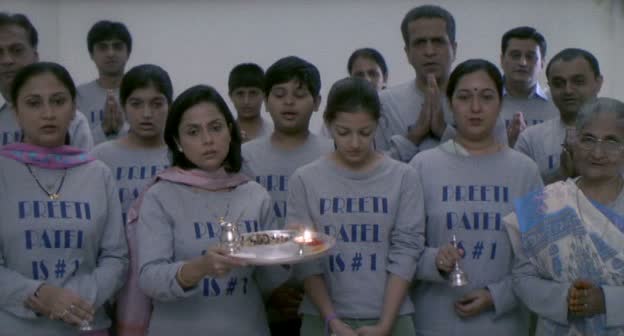
Preeti Patel (Ishitta Sharma) is talented, and overwhelmed by her large family and their expectations. Her parents are ambitious, protective and trot out every old chestnut about ambitious, protective parents.


Quiet and mousy when she isn’t singing, as soon as she takes the stage she lights up. Singing is an escape, and Preeti has the talent – does she have the will? Much of her performance relies on reaction and expression rather than dialogue or fireworks.

Josh Cohen (Michael Raimondi) is the white boy who loves India. He is naive, idealistic and frankly a bit of a drip. Not only did he ‘find himself’ in India,  he also found love with Opama Menon (Ayesha Dharker). He invented Joga, a ludicrous combination of jogging and yoga that is probably being sold on a cable TV station as I write this, and the couple are out to sell the big idea and make their fortune.

Opama is fond of Josh but not so happy with the negativity she encounters from other Indians when they see her with him. The singing competition brings out her insecurities as she is thrown into an almost all Indian environment and the judgements fly thick and fast. When Opama tells Josh to choose between Joga and music, their relationship is also in the balance.

Josh also has to face up to some aggro as people question whether a potential Desi Idol should in fact be desi. It shakes his rosy notions of being at one with everyone, but is resolved in an appropriately filmi way.

The wild card is Turbanotorious BDG (Ajay Naidu). He is angry, urban and loud and travels with his African-American partner Otto (Kory Bassett). I read a few reviews that described them as ‘best friends’ but I say, based on the loud and proud demands for a queen sized bed and the public handholding and other incidents, they were more than just friends.

Ajay Naidu played it loud and abrasive mostly, but his relationship with Otto and his family showed another side to the character. His response to being judged on appearance or first impressions is in your face aggression. And his insane energy turned the whole show upside down at a crucial point. Lesson to judges – do not even think about eliminating the Turbanotorious BDG! This clip isn’t in the film as such, but it is animated by Nina Paley so that seems very fitting:

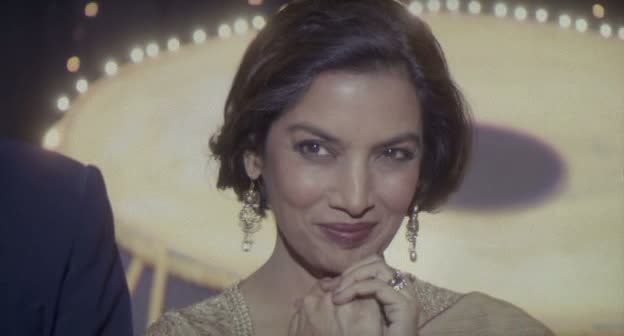
I promised a villain and this film delivers. Shabana Azmi is socialite Rrita Kapoor, the shark amongst the minnows.

She is determined to get one up on her rival by winning the competition and donating the winnings to charity. Rrita is polite, elegant, and always has a gleam of malice in her eyes. Her murmured hints and compliments derail the opposition and she cuts a swathe to the final showdown. I always like seeing Shabana in her rare masala film appearances, and she seems to be having a lot of fun as the posionous Rrita. But can a villain ever win in a Bollywood inspired film?

The three judges, played by Samrat Chakrabarti, Sanjiv Jhaveri and  Avantika Akerkar are dead ringers for the washed up and wannabes that infest reality TV. And I must give a special mention to Rani Bansal and Dhruv Singh who played the terrible Eurovision style MCs – they nailed the stilted pointless banter.

Shaan did a special appearance that got him the very special guest chair. I personally would have preferred a seating arrangment that didn’t include electrical wiring. Alexx O’Nell hammed it up as a hotel manager, but the rest of the supporting cast played it more or less straight and suited the fly-on-the-wall style of film.

The easy option would have been to sketch broad outlines and take a few cheap shots. Anuvab Pal and Manish Acharya gave it more love than that and allowed the actors to flesh out the characters. The laughs are all the sweeter for seeing people overcome their pain or sadness. The same jokes often deliver a rebuke for the human race’s apparently endless capacity for stupidity. When Sania and Vikram start stumbling towards romance, they seem genuinely shy and awkward, not just funny. When Turbanotorious BDG is told he is out of the competition, Ajay Naidu looks straight down the barrel of the camera with silent despair. An unassuming man called Saddam Hussein loses his job in the post 9/11 tide of fear and he and his wife struggle with the unfairness of it all. And there is a running gag with a paranoid elderly white man who thinks he has stumbled into a nest of terrorists. There’s commentary but it doesn’t derail the comedy.

The script plays with a lot of Hindi film tropes including the Angry Young Man. In one of my favourite scenes Vikram challenges Bokade who had disqualified Sania (at Rrita’s behest) because she didn’t really speak Hindi. Inspired by the Big B, Vikram launches into an impassioned plea about the diversity and democracy that is India, and when logic fails he appeals to the emotions. Then he caps it off with a bit of a song and dance before meekly resuming his seat. It is glorious!

And that is what I loved about Loins Of Punjab Presents. It takes filmi cliches and stock characters and translates them into something close to real life. There is a feeling of playful affection for the filmi heritage that really worked for me. There is also a bit of a wink, or maybe it was an eyeroll, that saves it from being too sweet for my palate. I’m a cynic who likes a good laugh and this delivers. If only there had been a proper big retro dance number. 4 stars!
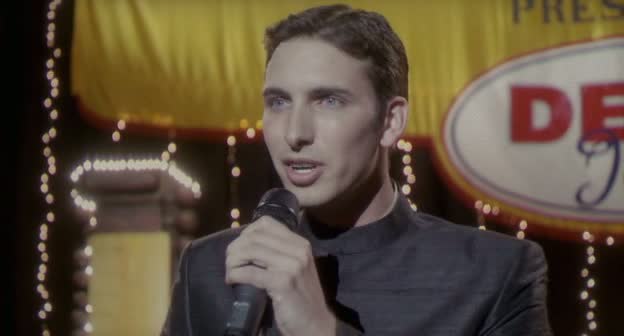
PS – if you’re the kind of person who likes to know what happens to your favourite characters after the film, the end credits will make you very happy.