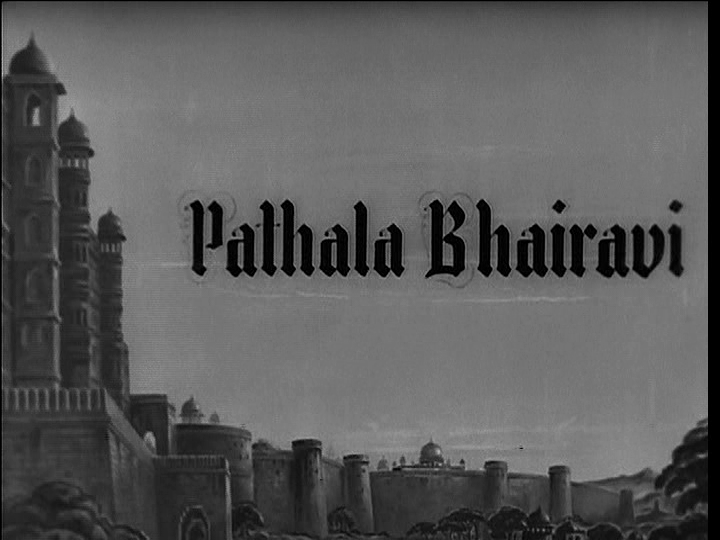
Patala Bhairavi (1951)

Patala Bhairavi is a wonderful fairytale complete with a pauper turned prince, a wicked wizard, a princess, a quest, flying castles, magic, disguises and divine intervention. This is not a stuffy staid classic; this is fun! I watched it without subtitles, but the story is clear and easy to follow. And the cast is fantastic – NTR, Malathi K, SV Ranga Rao , Relangi – and  a young Savitri makes a small appearance.  There are beautiful sets as well, and lovely music by Ghantasala. It really is a feast.

Thota Ramudu (NTR) lives with his mother Kanthamma the palace gardener (Surabhi Kamalabai) and his sidekick Anji (Balakrishna). He spies the princess Indumatha (Malathi K) and is smitten. Her father  is not as enamoured of the idea, and tries to deter the youngsters but love will not be denied.  The King dreams that the poor man will be his daughter’s saviour and decides to be merciful. After being released from the palace dungeons Ramudu vows to make his way out into the world and return with the requisite riches and glory to be deemed worthy.
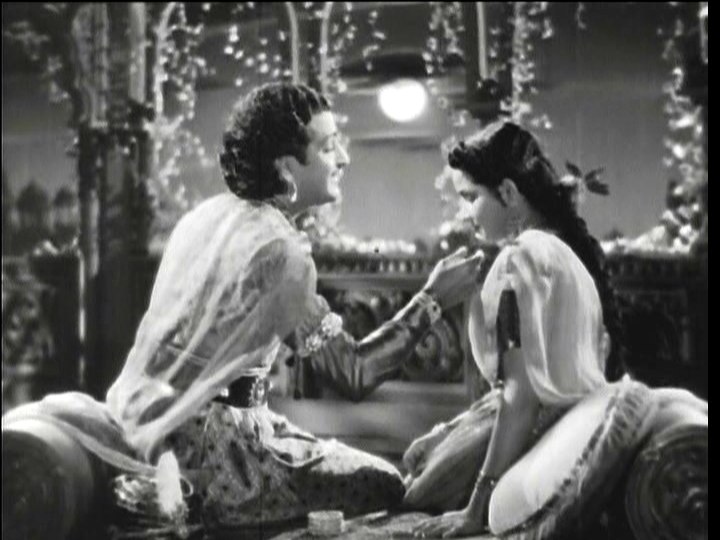
NTR is excellent as the hero. He stands up to the king’s bullying brother (Relangi), defends those in trouble and exudes righteousness without being stuck up. He gives his mother some trouble as he and Anji are silly boys when given half a chance, but he is fundamentally a nice guy.

Plus – he has snake wrangling and crocodile wrestling skills! It’s a fun role and he really embraces the swashbuckling hero style. He also gets to do romantic and dramatic scenes so there is a range of emotion and intensity. NTR balances it beautifully. Had the performance been tipped more towards silliness or self importance, it would have been a lot less enjoyable.

Indumathi is a proper princess. She lives in a palace, indulges in approved princess pastimes like singing to flowers and playing music, and after an exhausting day of these activities she sleeps in a peacock bed.

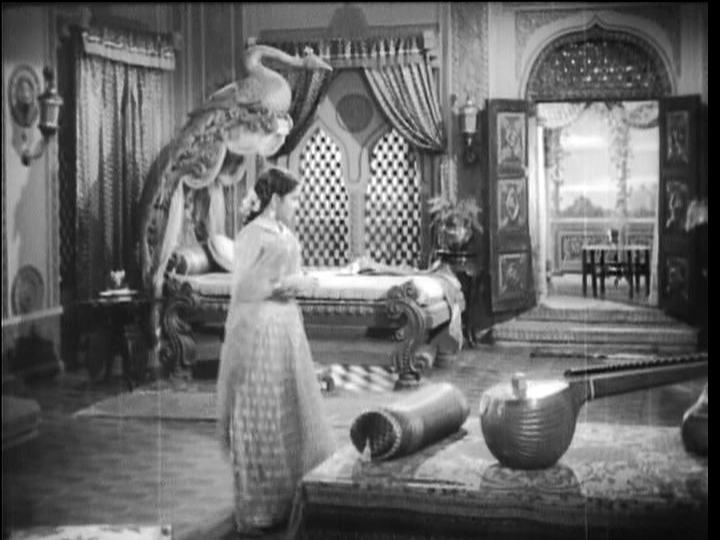
Indumathi doesn’t do much except wait…wait for her sweetheart, wait to be married, wait to be rescued. Malathi K made a strong impression in her later scenes when she is fearful and alone, but Indumathi is off screen for a lot of the film so she has little scope.
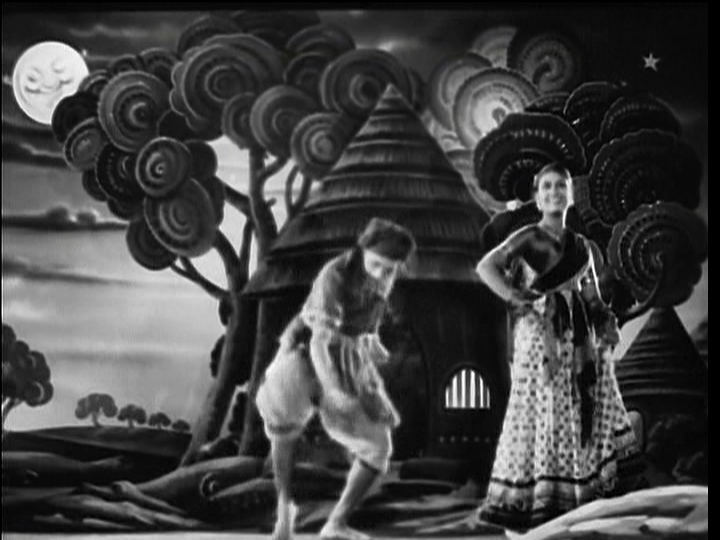
Relangi plays the king’s relative, and is NTR’s rival for Indumathi. There is little to fear on that front however as he delivers his habitual bumbling fool performance. He does have an eye catching hat though, so that was something. And he does his own singing. He and Balakrishna have ownership of the comedy track, and it is fairly amusing as the jokes are integral to their characters.

Anji is by Ramudu’s side for the adventure, and he contributes a little bit more than just comedy, although that is his primary purpose. In the battle of the sidekicks between Anji and the sorcerer’s apprentice Dingiri (Padmanabham), Anji wins the day. He is loyal and resourceful, if a bit dim, and without him the hero might have failed miserably. Considering I usually find the comedy sidekick more irritating than entertaining, I think he did really well to keep me from fast forwarding through his solo scenes.
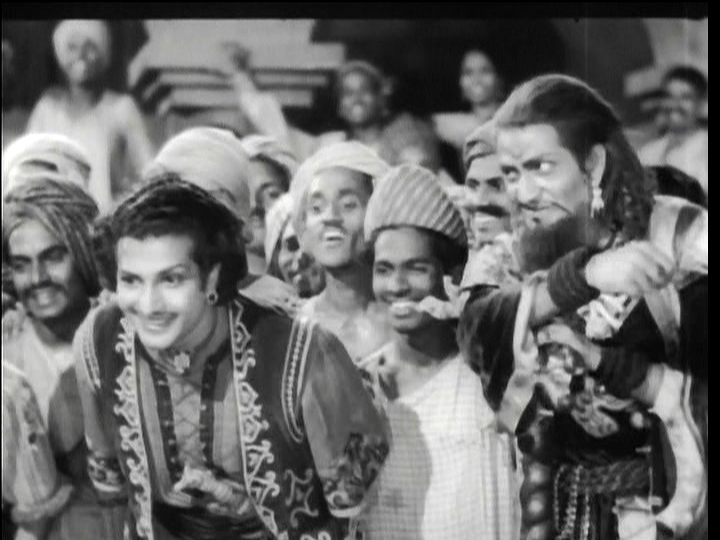
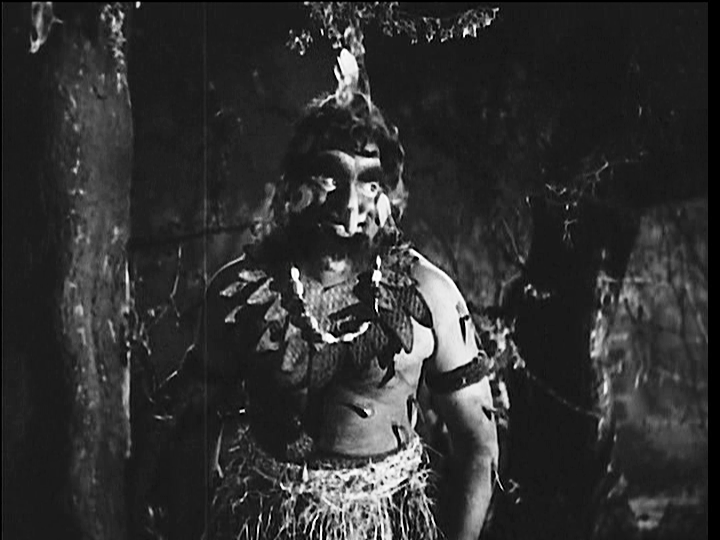
SV Ranga Rao is Nepala Mantrikudu, a sorcerer who needs to sacrifice an innocent young lad (I wonder who will fall into his hands) in order to gain control over an idol that can compel goddess Patala Bhairavi (Girija) to grant wishes. He has a fabulous cave lair with excellent statuary, and the hapless Dingiri as his assistant.

Nepala Mantrikudu is a determined man, who will stop at nothing to gain his desire. He even cut his own arm off once for a spell, and then used his magic to reattach it. I like his dragon headed telescope that sees whatever the user wants to find.
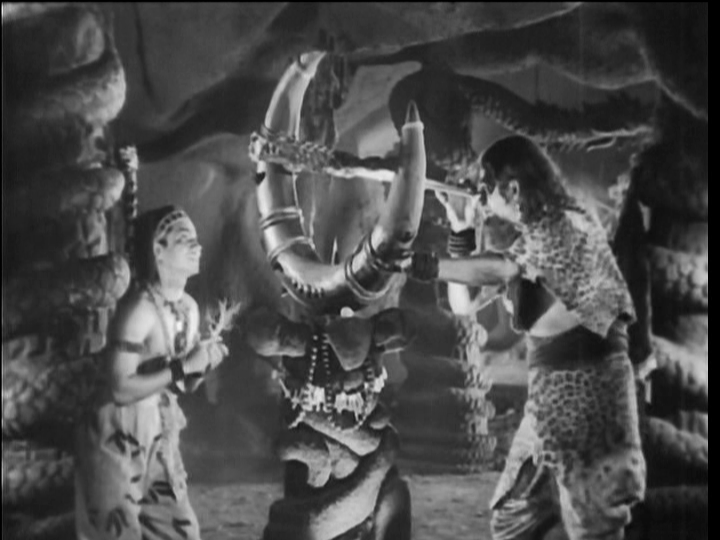
He impresses the yokels with a great array of tricks – including turning a rock into a monkey and then transforms the monkey into a dancing girl before giving Relangi similar treatment. Ramudu can’t resist the show, and that brings the protagonists together. I always like SV Ranga Rao as a villain because he can be amusing with a twinkle in his eye and then turn to seriously threatening in a blink. He adds most of the drama and menace to the story, and is larger than life.

Ramudu steals a magical vessel and tries to create his own wealth. But he lacks the ability to use it so, promised money and the princess, he goes with Nepala Mantrikudu to retrieve the idol. The quest involves a lot of near death moments for NTR including – the crocodile wrestling!
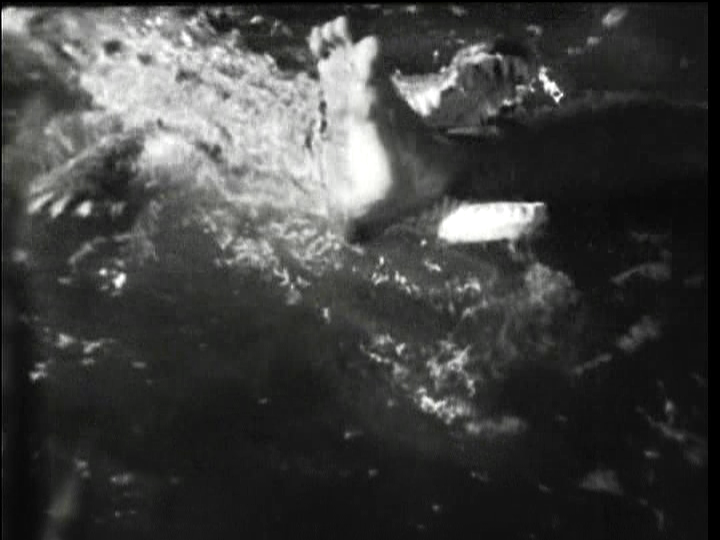
Not the most lifelike crocodile, nor the most convincing wound I have seen. I shall digress – I keep hearing rumours that Rana Daggubati may be in a remake of this film. I think he is a competent actor although I’m not sure he has the right acting style for this sort of caper, but I do think he might be excellent at shirtless crocodile wrestling scenes.

Ramudu emerges from his dip triumphant, and worded up about the magician’s treachery by a goddess in the crocodile pond. Of course the sorcerer and his intended sacrifice have different ideas, and Ramudu wins that encounter and the idol.

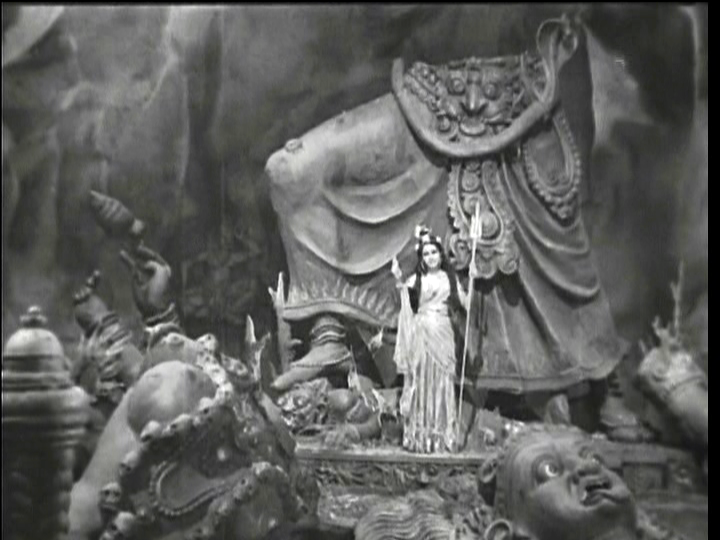
While he is rich (thanks to the goddess) on his return to Ujjain, he is not out of trouble. It takes more than decapitation to stop a dark sorcerer who has a history of sticking his limbs back on.
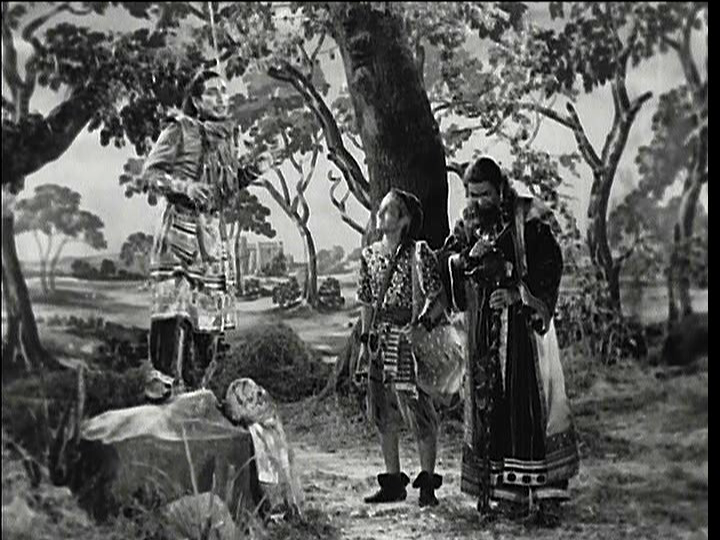
Old enemies unite against Ramudu and he loses control of the idol. What next?

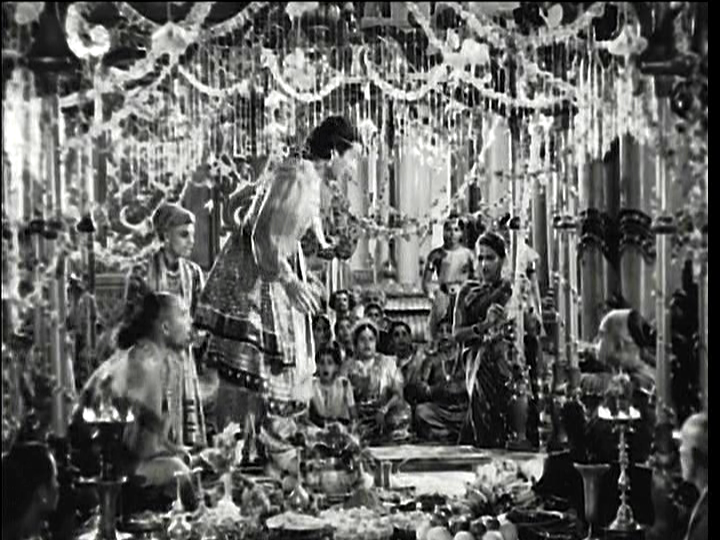
There are demons, bears, seven-league boots, invisibility cloaks, disguises, flying palaces, fisticuffs and so much more before the end of the tale.
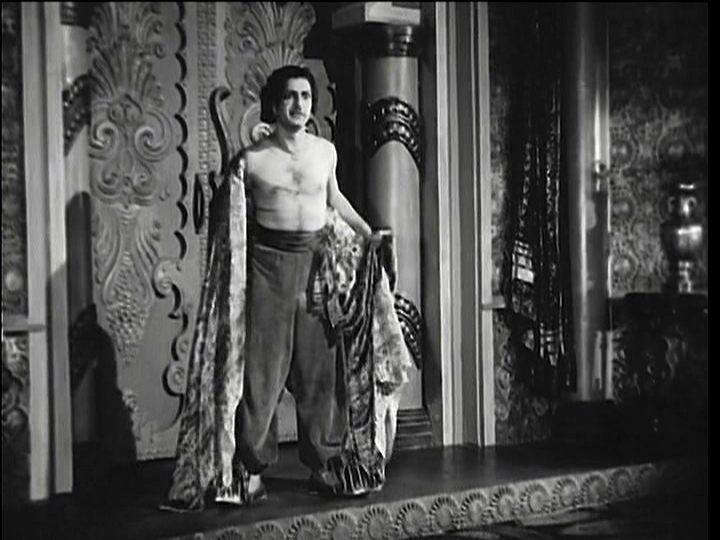
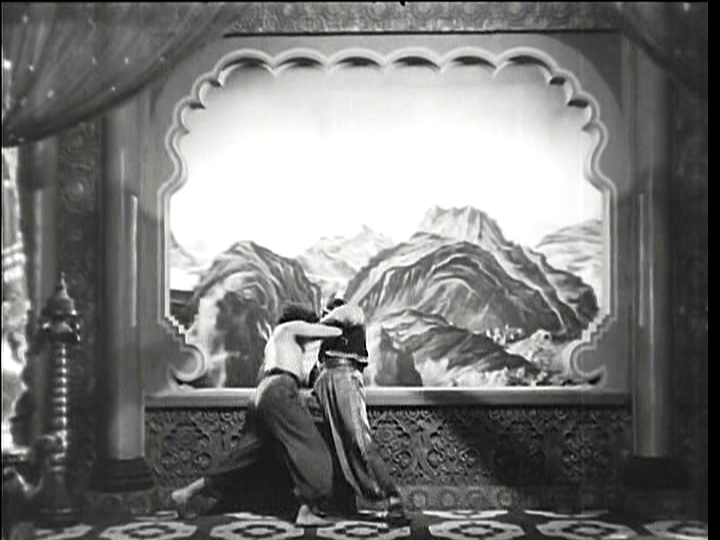
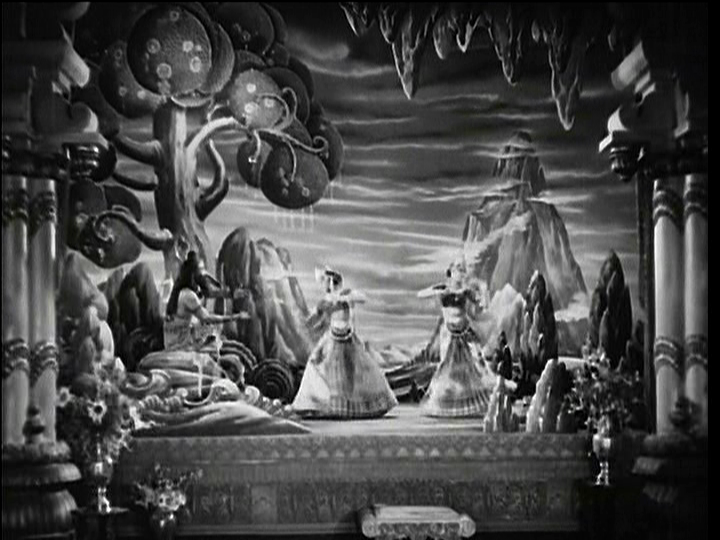
When I say the sets were lavish – there are 3 separate credits for set design, moulding and painting and I think they earned their keep. When Ramudu takes the royal family on a tour of his magically appointed residence, the building is stunning. This song includes some performances by his household dancers (including Savitri), and the sets are just delightful. I’ve screen capped if you can’t be bothered with the song clip.

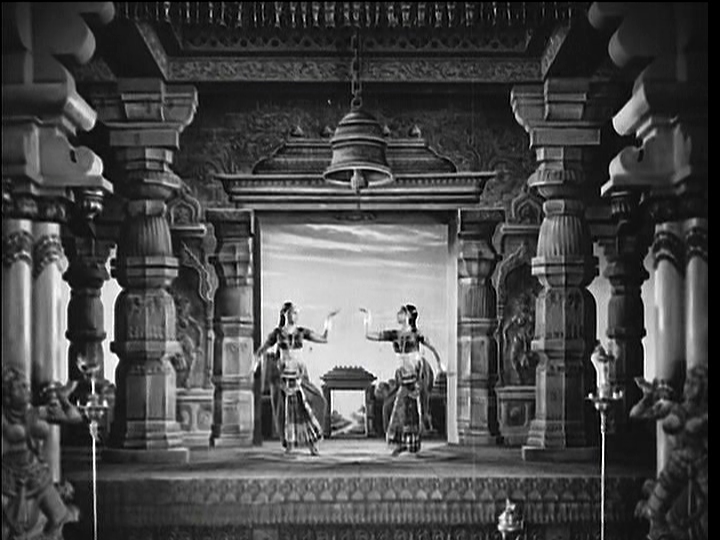


The visuals perfectly match the story book action and characters, with the painted backdrops reinforcing the fantasy element. The special effects are lots of fun (especially considering it was the 1950s).  I saw Sri Rama Rajyam on Friday night and despite the apparently huge budget for CGI, I found the effects more distracting than beautiful. I know that is a devotional film, and this isn’t but it made me think about the use of visual effects in films that are depicting an alternate reality. Patala Bhairavi keeps the people at the centre. When someone pulls on an invisibility cloak, other characters react to this amazing sight – the gimmicks support the story. In Sri Rama Rajyam, they chose to use CGI for things like birds, leaves, foliage, peacocks and deer to the point that it cluttered up the screen. It detracted from the story and from the actors. I appreciated the mastery of Kadri Venkata Reddy. He and the team including writers Subbanna Deekshitulu, Kamalakara Kameshwara Rao, Pingali Nagendra Rao art director Madhavapeddi Gokhale and DOP Marcus Bartley  have created a really beautiful fantasy realm with an engaging story.

Perhaps I am fond of this film because it reminds me of being a kid, watching Disney TV shows with my family on a Saturday evening. The good guys are nice, there are pretty jewels and costumes to admire, the music is lovely and the story ends on a high note. I would love to see it with subtitles but I enjoyed it immensely without. 5 stars!
Rockstar

Imtiaz Ali’s involvement persuaded me that Rockstar would be worth seeing despite my reservations about Ranbir Kapoor (I’m still bitter after enduring Saawariya and Bachna Ae Haseena). Plus I had a free pass, and a few hours to kill.

There are some things that are outstanding. The visual design, sets and locations are beautiful. I loved the scenes at the Hazrat Nizamuddin Dargah with their beautiful lighting and haunting music, and Ranbir shone in those introspective moments. The songs, which I didn’t particularly like before seeing the film, work a treat. The music and lyrics extend the story and characters, and so do the picturisations. I misted up a little seeing Shammi Kapoor on a cinema screen for my first time. He is Ustad Jameel Khan, a renowned musician who supports and mentors Ranbir’s character. There is a sweet scene as they ‘duet’ on ‘The Dichotomy of Fame’ and I don’t think Ranbir had to try hard to look like he was moved too.

There were even some ridiculous and some beautiful costumes so I was pleased on both counts.

But there are some significant problems, most of which stem from the writing and direction.

Ranbir is Janardhan aka JJ aka Jordan. He is supposed to be a simple innocent boy but comes across as socially retarded, he is a misfit in his slap-happy family, and drifting through college. He is a musician but is told that until he has suffered he can’t be great. JJ decides to fall for the college hot chick so she can break his heart. Despite the stupid premise that manufactured pain equals great art, the dialogue in these early scenes is quite funny and flows well. Eventually JJ and Heer (Nargis Fakhri) become friends. JJ is by turns clueless and a bit manipulative – on the one hand taking Heer too literally at times, but then admitting he fakes being drunk when he goes out partying. They sneak into a tacky soft porn flick, get drunk, and generally work through Heer’s idea of a bucket list before she marries and relocates to Prague.

Jordan, as he is now known, becomes increasingly famous and unhappy.

Ranbir tries, maybe too hard, to break from his usual lightweight charmer persona and is mostly surly. Imtiaz Ali wants us to find Jordan sympathetic but I couldn’t after a point. While I get that he is supposed to be inarticulate away from his music, Jordan is a self absorbed and often aggressive man. Jordan realises he is in love with Heer for real. Kicked out of his unhappy home, and down on his luck, he stays at the dargah. Thrown a life line by college canteen manager Mr Khatana and Ustad Jameel Khan, he is signed by Platinum Records boss Mr Dhingra (Piyush Mishra). With his success growing, Jordan negotiates a gig at a very fake looking Eurojam music festival in Prague – what a coincidence.

He pursues Heer and will not take no for an answer. To be fair, she is sending very mixed signals but it is all about what Jordan wants. He doesn’t exactly force her, but he refuses to accept her ‘No’ and is aggressive in his pursuit. He has no concern about her marriage other than how it gets in his way. Heer succumbs and they have an affair which doesn’t end well. His declarations of love were all about his feelings and desires, how he needed her to make him happy and complete.


Even his band was just a bunch of shadowy blokes up the back of the stage – there was no creative dynamic, no camaraderie. Separated from Heer, Jordan descends further into his morass of self pity and destructive behaviour.

Maybe his vile gold brocade dinner jacket was a sign. They certainly interpreted Rockstar as ‘someone with no dress sense’. JJ wears simple jeans and kurtas when he is with Heer, but gets a bit late era George Harrison meets Frank Zappa on his own. Was that meant to prove he needed her to be a good boy (and remember to wash his hair)? Ranbir did well with the physical transformation of Jordan and his best scenes were probably in the songs where he could just be the Rockstar, demanding the spotlight yet still showing ambivalence about fame and success.

Heer is self absorbed and indecisive, creating most of her own problems. She not only jeopardises her marriage, she is also afflicted with a blood disorder and told she will die. Of course the only cure is Jordan’s Magical Healing Cock. Yes, a doctor may despair but shagging Jordan is all it takes to restore her vitality. Well, until she is further punished for her transgressions by being separated from Jordan (and his MHC) and being made dangerously ill by the resulting pregnancy. Ah the wages of sin. When she collapses, her mother’s reaction is to scream for someone to call Jordan! Yes – like a quickie in the emergency ward would cure Heer. Nargis Fakhri was out of her depth once the love story took centre stage, although her scene joking about eloping with JJ before her wedding was funny and poignant. Heer needed a bit more oomph, less shrieking in place of emoting, and better writing. I’m trying not to mention her collagen plumped lips but they do arrive in shot before the rest of her face a few times, and may contribute to her inability to articulate the dialogue.

Filmi clichés abound, and some are quite clumsy.  If you’re going to hire someone who can’t dance, why introduce them as college hot chick by staging a dance show? There was another misstep with a ’tribute’ to Shammi in Kashmir where Ranbir showed he really doesn’t have any of the panache of his uncle.

The arena style gigs looked good even if Ranbir’s guitar was never plugged in, and the audiences were too well behaved. But then there was no sense of how Jordan created – we see him listening attentively to all these influences and then songs just emerge fully formed.  I would have liked to see more attention given to the musician rather than just worshipping the performer. It might have made Jordan more interesting or likeable.

Had it been a study of the effects of fame on an artist, this might have been compelling. The love story that is supposed to be the core of this film left me cold. I don’t feel I have enough understanding of Rumi to make an informed comment, but my gut reaction was that Imtiaz Ali has missed the point of the quotes he used in his film. I don’t recall Rumi defining love as possession, and that is what this story does. The early friendship is enjoyable, if very unlikely, but just when I should have been wanting them to get together I started to think the opposite. And there are so few other characters in the film to give any relief from this pair. Even the end credits bunch people into his family, her friends, his band…it is all about Jordan and to a lesser extent, Heer. So if you don’t care for their grand romance what else do you have?

The audience I saw the film with was small – maybe 50 people. Several didn’t come back after intermission, and another dozen or so crept out during the second half. Their only cheers were reserved for Shammi-ji and AR Rahman and I think that was about right. Rockstar had a lot of great ingredients, but I was left thinking that with less indulgent writing, a different focus and a bit more editing, it could have been so much better.

Arjun

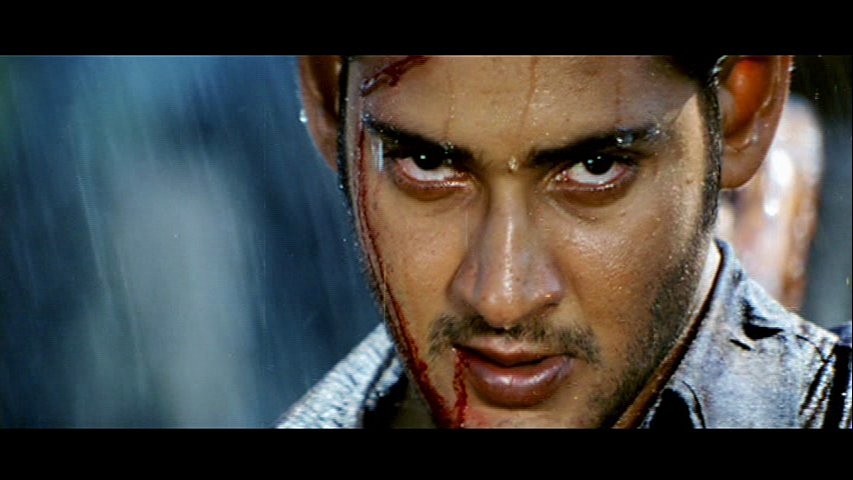
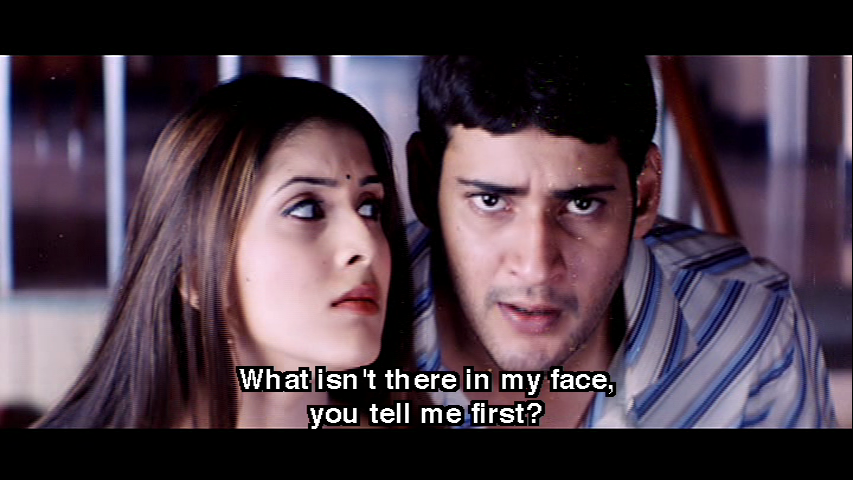
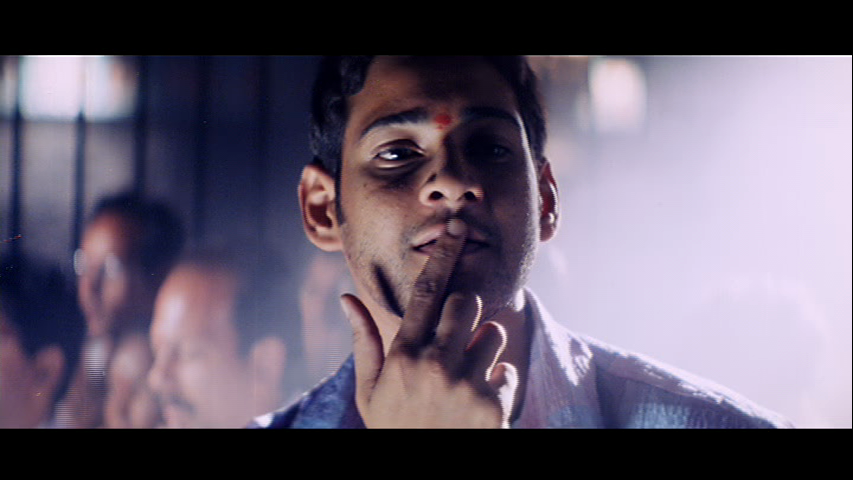
 Arjun opens with a bleeding and intense Mahesh Babu staring down the camera. We see a bloody blade, and a gang of rowdies running towards him as he waits in a downpour of rain. It’s a gripping start.

Which then gives way to a happy inspirational song and a flashback. After he kills those rowdies of course. A flashback narrative structure can often diminish the drama as the viewer knows the end point. In this case, Gunasekhar uses the form to heighten the tension. While things had obviously gone wrong, the details emerge gradually. We know Mahesh is waiting to deal with his enemies, but it takes time to discover who they are and what has happened.

Often in a big star vehicle, the supporting characters are mere sketches. But Gunasekhar has populated the film with memorable people played by excellent actors.  As in the previous Mahesh/Gunasekhar project, Okkadu, there is a strong web of relationships that makes it much more engaging. Arjun (Mahesh) is a protective twin determined to look after his sister Meenakhi (Keerthi Reddy). He isn’t one of those sociopath heroes who exist in isolation. There is a pleasantly lived in look to the family home, his office worker parents wear slightly dowdy clothes, and their story is firmly middle class. It’s refreshing to have a hero with a family and to see a sister be more important than a prospective girlfriend. But they are not angels.

Dolce – this is for you!

As always, a film hero who kills bad guys is not doing anything really wrong so we needn’t be troubled by morality. But there does seem to be recognition that there are always consequences. Certainly there is a different rule for the baddies, and especially if they kill good people.

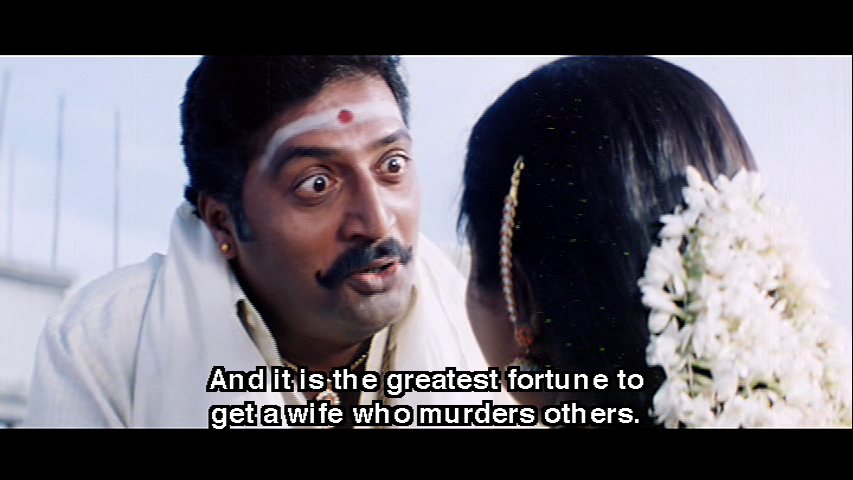
Prakash Raj is Bala Nayagar, a Madurai based bigwig. His wife, played by the still striking Saritha, is his perfect life partner Andal. She knows what he likes to eat, his moods, and when to kill people who annoy him. When their son Uday (Raja) wants to marry college sweetheart Meenakshi they are furious as his engagement to a rich girl had been fixed. The couple are enthusiastic but only moderately successful killers, and many of their schemes to remove Meenakshi fail to comedic effect.

Saritha and Prakash Raj seem to have a side bet on who can out-over-act the other and are great fun. But despite the often ludicrous shenanigans, they each have an intensity that makes them genuinely menacing at times. Prakash Raj can turn from jovial to chilling calculation in a blink and Saritha is his match.

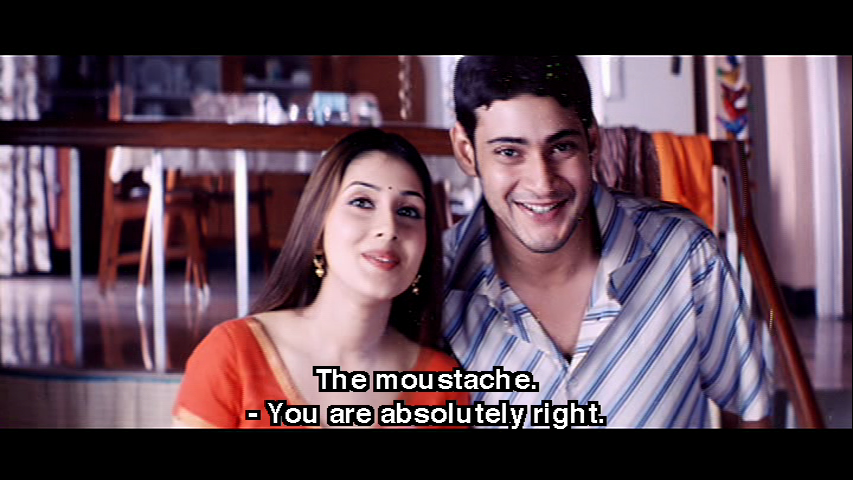
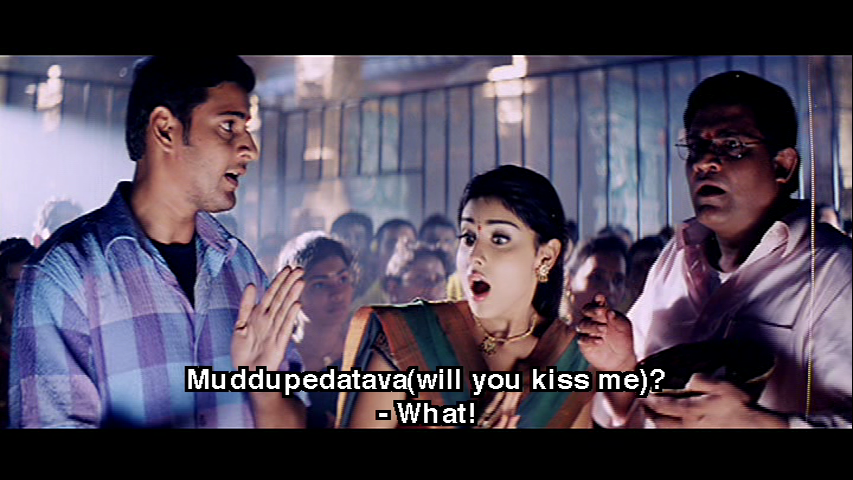
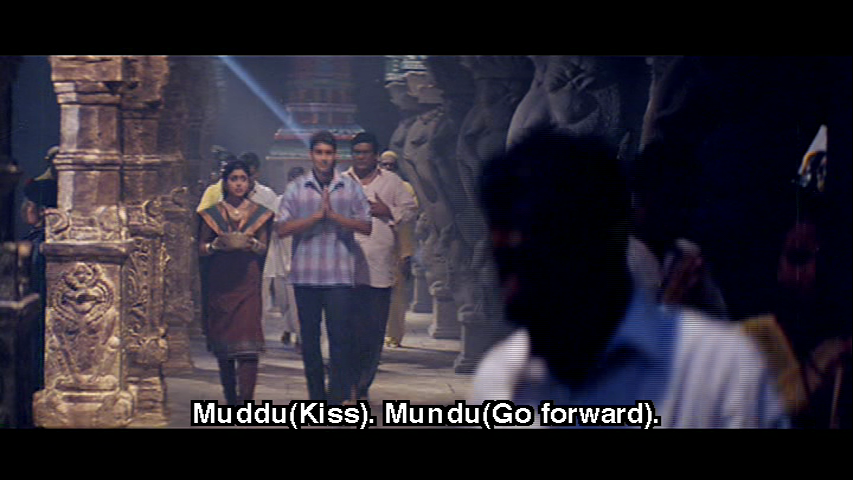
Mahesh also crosses paths with Rupa (Shriya) – a very annoying girl who invites her own downfall by….blowing a kiss at him. Yes! This cannot be allowed without some form of payback. How dare she! The only way honour can be satisfied is if he stalks her, then harasses her until she marries him.

The romances play out very differently. Meenakshi and Uday love each other but neither feels they can upset their parents’ plans. Arjun lays down the law – Meenakshi will not elope and if Uday wants her, he has to tell his parents and all must be done out in the open. This is how he introduces her to the Nayagars. The song gets full points for colour, movement and excellent use of locations. Plus – parrot costumes.

There is a theme of blood being thicker than water, and even before things start to take a turn, Arjun is determined not to abandon his sister once she is married. Meenakshi is in peril, often unaware of the danger and even defending her in-laws much to her twin’s dismay. Keerthi Reddy has a nice rapport with Mahesh although her role dwindles once she enters her in-laws home. She has some intense scenes as she shows her pain at her brother’s actions. Although Meenakshi is often passive, it rarely seems that she is passive through a lack of sense. As with some other characters in the film, it is a blend of mass genre cliché and soap opera – this time damsel in distress mixed with modern bride meets traditional family. The parallel of Meenakshi as a divine being and as his sister is not lost on Arjun. The goddess gives comfort and support when his sister turns away, and maybe a small nudge of coincidence.

Of course, Rupa lives in Madurai with her domineering dad (Tanikella Bharani). Arjun’s pursuit of Rupa at first seems more about putting her in her place than any romantic attachment, but it is amusing. I am also grateful to the subtitle team who kindly explained the wordplay.

Rupa is a really silly character but she does gain appeal over time.  She offers to help Arjun when he is at a low point, which makes him see her in a new light (perhaps the light of her doing what makes him happy). Shriya gives a very energetic performance, initially edging onto the Genelia Manic Pixie Dream Girl scale but kind of endearing once she settles. One thing I like about Shriya is that she never seems overawed by her co-stars, and she just goes for it and claims her bit of the screen. She withstands a varied but determined assault by the wardrobe team in the songs. As a couple she and Mahesh have some chemistry but mostly they seem to have fun in their dances. This is my favourite of their duets, choreographed by Lawrence.

Mahesh is superb. His anguish over Meenakshi and his playfulness with Rupa are equally believable, and no one emanates fury like he does. Thanks to a thoughtful screenplay, Mahesh has room to act as well as showcase his heroic chops.

He uses his lanky frame and the baby faced killer stare to great effect. Some scenes with Meenakshi were really emotional, and he showed the conflict and worry that drove Arjun. It helped give the eventual denouement a much greater urgency and sense of consequence. It also made his super killing powers seem almost believable as it was clear Arjun was desperate to protect his sister at any cost. He did seem to wear more layers of shirts as the film progressed. Was this a visual representation of his attempt to stave off external threats? Or just a change in the weather? But his shirts were not the only item of clothing to make me look twice.

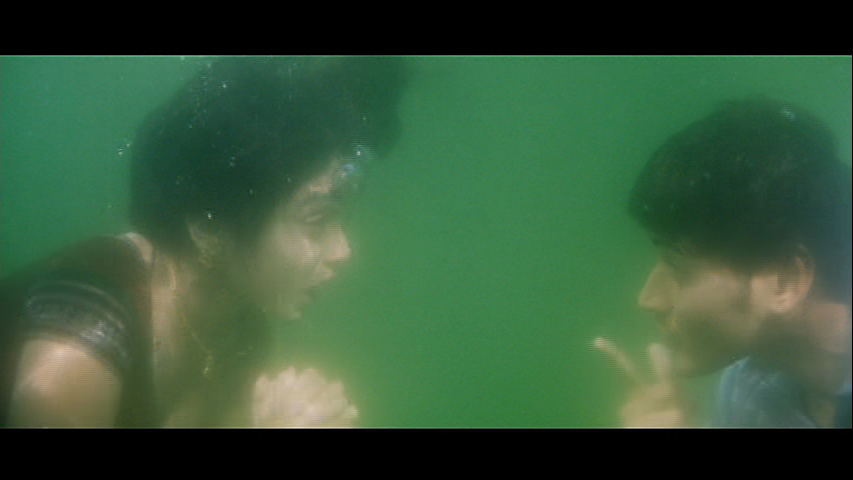
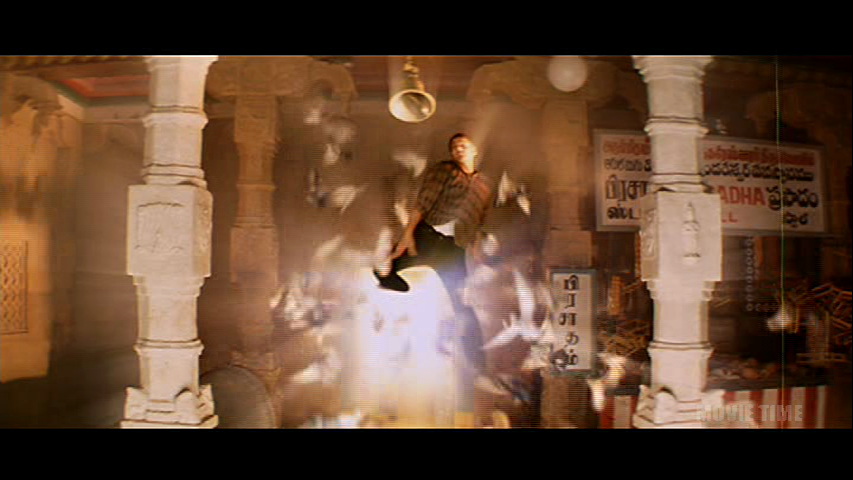
The excellent fights directed by Vijayan range from almost lyrical to frenetic. Even his mother gets Arjun to sort out bad guys for her so his skill and bravado have some basis in the story and aren’t just a post-interval acquisition. Arjun has a fairly laconic style, always looks like he knows he will win, and he can fight under water which is very handy indeed.

Admittedly, I have doubts about why no one can see him in what seems to be a fairly clear pool, but whatever. The climax of the film is dramatic, suspenseful, over the top and totally improbable but completely compelling.

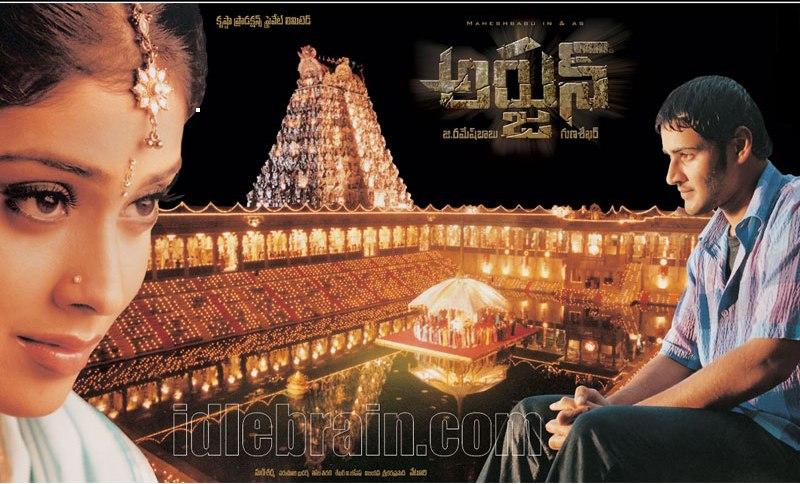
The Madurai set has stunning architecture and decorative flourishes and the crowds provide concealment, camouflage and distraction. The film combines the lush visuals of the temple set with opulent interiors, the intense jewel like colours of silk saris and excellent lighting. The camera work and edits are in keeping with the tone of each scene. The CGI, while a bit dodgy, was used for maximum impact. The soundtrack is OK but I remember the picturisations more than the music so I wouldn’t say Mani Sharma had done anything outstanding.

See this for fine actors, great visuals, exciting action and of course a hero you can count on. Mahesh delivers – Arjun is a winner! 4 ½ stars.

Heather says: While I didn’t enjoy this as much as Temple I think it’s an interesting story and the relationship between Arjun and his sister is well developed. Mahesh is excellent as the faithful brother who will do anything to keep his sister safe and happy and it’s really his performance which makes this more than just a run of the mill action film. I also liked Kirti Reddy  as Meenakshi and thought her early scenes with Arjun were convincing in showing the rivalry and the affection between the two

I did find it a little incredible that Arjun’s mother Kamala was quite happy to set her son up to face a room full of rowdy’s and then walk away and leave him to it.  While I appreciate her faith and confidence in her son, I’m more inclined to agree with Meenakshi’s view that it wasn’t a very responsible attitude for a parent to have. It was a quite a novel approach though and as Temple mentioned, did set up the fight scenes for the rest of the film very well.

I loved Prakash Raj here as the father intent on marrying his son to his best advantage, but he was totally outdone by Saritha as his wife. She was fantastic in her obsession with the 1001 crore dowry and her expressions as she was either murdering someone or extorting her husband to murder were brilliant. Combined with Kamala, this has to be the film with the blood-thirstiest mothers I have seen and they both added a totally new dimension to the filmi ma character. I loved them!

On the negative side though, I couldn’t understand the point of Shriya’s character at all. It doesn’t help that I really don’t like her as an actress, but the plot with Rupa seemed to be stuck on as an after-thought. I don’t think a romance was necessary, particularly since her character had no relationship to anyone else in the plot, and it could have been omitted without any disruption to the rest of the story. My irritation with Rupa in this film was inversely proportional to the amount of clothes she was wearing. In the opening sequence while she was teasing Arjun wearing skimpy clothes she was incredibly annoying and I really hated the first song with her. Later on, when she was more modestly dressed in a sari I was better able to ignore her and her presence wasn’t quite as grating.

While the main story of Meenakshi’s marriage and murderous in-laws was engaging and the action thrilling, there was a little too much fluff in the rest of the story for me to become totally engaged with the other characters. A winner in terms of Mahesh’s performance and worth seeing how Gunasekhar proves Arjun can walk on water. 3 ½ stars.