Jagadeka Veeruni Katha

Jagadeka Veeruni Katha

Jagadeka Veeruni Katha (1961) is a sumptuous fantasy drama directed and produced by K.V Reddy. It stars NTR with B Saroja Devi, L Vijayalakshmi, Jayanthi and Bala as the love interests, is loaded with songs and is beautiful to look at. It’s also around 3 hours long, clearly made for a time when a more meandering pace was appreciated.
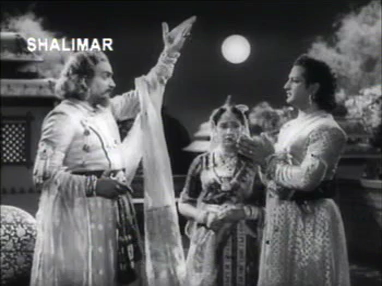
Jagadeka-Veeruni-Katha-Pratap and parents

The plot can be loosely described as follows. Prince Pratap (NTR) defies his parents and leaves the kingdom in search of love. His dream women are the devakanyas who represent the elements of Air, Water, Fire and…Snakes. Indra Kumari (B Saroja Devi), Nagini (L Vijayalakshmi), Varuna Kumari (Jayanthi) and Agni Kumari (Bala) like to bathe in a decorative pond, gossiping and singing the day away. Pratap finds them, but in return for his unwanted attention Indra Kumari turns him into a statue. Pratap’s mother goes into devotional overdrive and Parvathi (Kannamba) answers her plea. Pratap is restored to his princely self and Parvathi gives him the tip-off that if he stole Indra Kumari’s clothes, she would be stranded on earth and have to marry him. Marriage duly accomplished, he sets off with new wife and newly acquired best friend Rendu Chintalu (Relangi) to a neighbouring kingdom.

Jagadeka-Veeruni-Katha-ThreesokananduJagadeka-Veeruni-Katha-Men in drag

Threesokanadu (Rajanala Kaleswara Rao) is a petulant brat of a ruler and wants whatever he can’t have, including Indra Kumari. Devising numerous ploys to send her husband off on missions to Nagalokam and elsewhere, all he succeeds in is getting the remaining devakanyas hitched to Pratap. I don’t know why he thought dressing in a saree would help his cause. Relangi and Ekasa (Girija) have a comedy subplot in which they thwart the king’s plans and generally bicker.
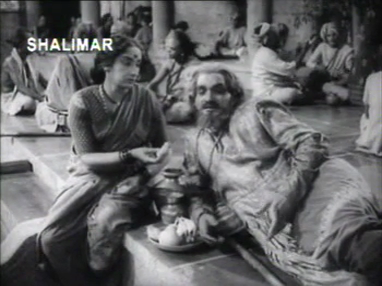
Jagadeka-Veeruni-Katha-hard times

Meanwhile, back in Pratap’s home his brother has conspired to overthrow the Maharaju and Maharani (Mukkamala Krishnamurthy and Rushyendramani), who are now living on the streets. Eventually they get wind of Pratap’s whereabouts and a tearful reunion is on the cards. The devakanyas trick their mother-in-law and get Indra Kumari’s saree back and leave for the heavens.

Jagadeka-Veeruni-Katha-wild with griefJagadeka-Veeruni-Katha-change of heart

Pratap goes wild with grief and the ladies seem to miss him too. Indra and the other lords of various heavens test Pratap and eventually he gets his wives back. Happy days.
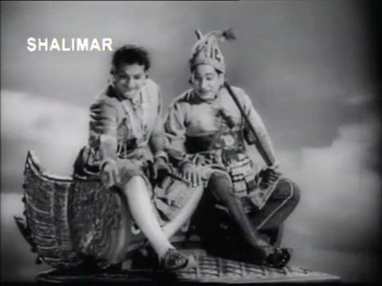
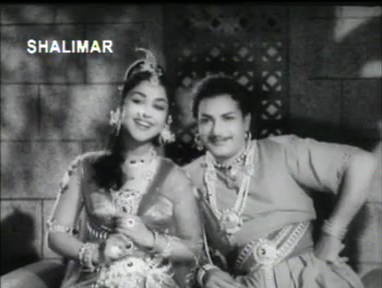
Jagadeka-Veeruni-Katha-NTR and RelangiJagadeka-Veeruni-Katha-NTR and Saroja Devi

It’s NTR’s film from go to whoa and he could do this kind of role in his sleep. Pratap is the perfect prince and goes from swooning to swashbuckling in the blink of an eye. He gets all the big speeches and a couple of key songs, and NTR dominates all his scenes. He always has a nice rapport with Relangi, and I liked them together as they showed the more human side of Pratap with a bit of humour.  Relangi’s character gets to do some useful and sensible things in amongst all his comedy bumbling too.

B Saroja Devi is the leading lady and does get the majority of screen time, but her character is not really developed beyond being designated as a heavenly beauty. The warmth in her interactions with the other devakanyas, and her chemistry with NTR is largely drawn from her own performance and not the script as far as I could tell.

Jagadeka-Veeruni-Katha-Indra Kumari and NaginiJagadeka-Veeruni-Katha-Pratap and Indra Kumari

One of my favourite filmi dancers L Vijayalakshmi gets a little bit of dialogue and a few not very snakey dances, but the other wives are not given a lot to do in the story. They all look stunning in their sparkly costumes, and I found their scenes together more lively than the ones where they had to stand around simpering at Pratap.

Given the heavenly origins of the leading ladies and the divine interference by Parvathi, there is lots of scope for special effects and magical plot developments. The devakanyas all have distinctive modes of arriving at their bathing spot. Nagini turns into a snake when her mood sours.

And faced with the demands of multiple wives, Pratap is magically cloned so he can spend quality time with his spouses.

Comedy demons perform a range of useful services, including transforming into a flying divan. Pratap is changed at different times into a statue and a baby. Aside from Marcus Bartley’s stunning camerawork with his trademark moonlit scenes, I was struck yet again by the skilful use of the limited 1960s technology to create some really effective illusions. There’s nothing that would fool today’s CGI savvy audience, but the sequences are creative and are perfect for the fable of a prince on a quest.
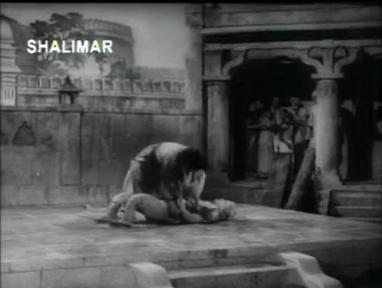
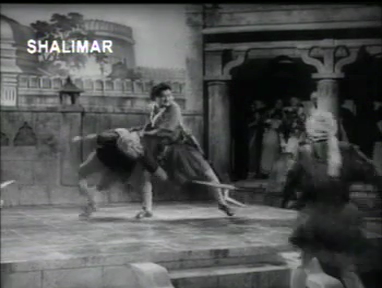
Jagadeka-Veeruni-Katha-lifelike rag doll 1Jagadeka-Veeruni-Katha-lifelike rag doll 2

Except maybe not the rag doll dummy used in some fight scenes.

The music by Pendyala Nageswara Rao is lovely and it feels like someone breaks into song every few minutes. The only character who does much by way of dancing is L Vijayalakshmi as Nagini. When Pratap arrives in her kingdom, this is how he is greeted.

And there are some lovely duets as well as more devotional songs.

The set design is lavish with all the intricate decorative motifs I’ve come to expect from this era and genre, including fabulous animal themed furniture and fittings. Plus some excellent work from the hat department. The film is available without subs on YouTube. I’ve also managed to track down an unsubtitled VCD, but the picture quality is poor. I can only imagine what it might have been like with a decent print and sound. Really Telugu film industry – get your act together and do something about these classics!

Considering so many things happen in this film, it’s almost remarkable how few of the incidents are essential to the plot. But if you can spare the time for a rambling adventure with a charming cast, gorgeous music, and beautiful visual design this is a sheer pleasure. 4 stars! (A small deduction for general crappiness of the print, irritatingly big watermark on that crappy print, and because comedy demons are to fantasy films what comedy uncles are to modern movies – a plague and a pox.)

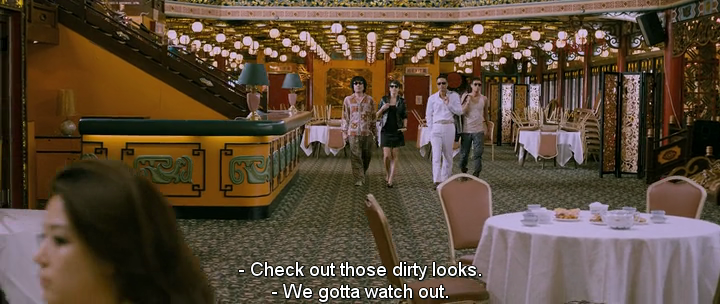
The Thieves (2012)

The-Thieves-Poster

Boasting a large ensemble of established and popular stars, and making use of locations in South Korea, Hong Kong and Macau, Choi Dong Hoon’s The Thieves is often spectacular. The plot is packed with incidents and conflicts, twists and turns, rarely lagging before hitting the next mark.  I was glad to see this as part of the 2013 Korean Film Festival as the action is best appreciated on a big screen. (Sidenote: Melbourne is fortunate to have so many excellent film festivals and I like to get along to support them. The Korean festival is brilliant – a small but interesting program and very well organised, with lots of extra events around the films)

Things start to heat up when Macao Park (Kim Yoon Seok) assembles a team of ten thieves to steal a legendary diamond. The Korean thieves know each other, as do the Chinese members, but they’ve never worked together. There is open conflict, and hidden resentments and betrayals. Once the pressure is on, who will stick to the plan and who will look out for themselves? Maybe they don’t know each other as well as they think.

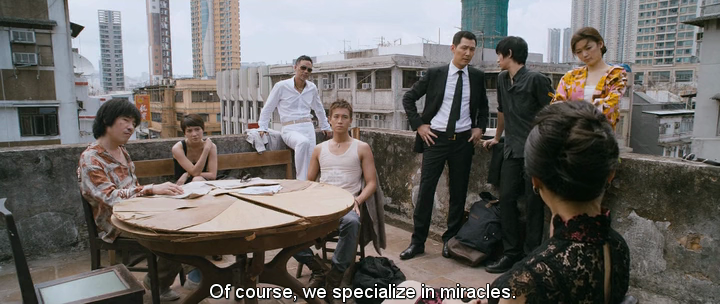
The-Thieves-Team ChinaThe-Thieves-Miracles

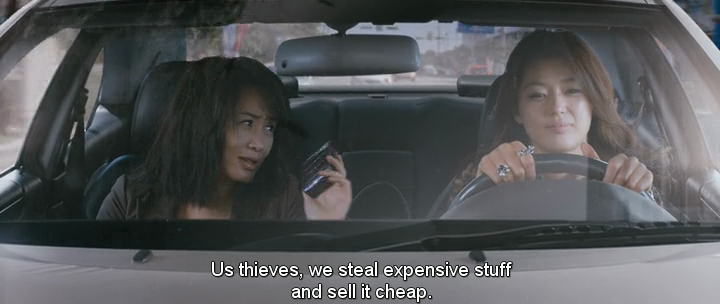
The Korean team consists of the leader Popie (pronounced Popeye) (Lee Jung Jae), cat burglar and wire expert Yennicall (Jeon Ji Hyun aka Gianna Jun), technical assistant and token cute boy Zampano (Kim Soo Hyun) and middle aged con artist Chewing Gum (Kim Hae Sook). They are joined by safecracker Pepsee (Kim Hye Soo), just released from jail after a gold heist gone wrong. Her partners in that gig were Macao Park and Popie. In China, Macao Park recruits veteran Chen (Simon Yam) and his sidekicks Jonny (Derek Tsang) and Andrew (Oh Dal Soo) plus another safecracker, Julie (Angelica Lee). The game is afoot!

The characters are clearly defined in terms of type (competent, eye candy, comedy fodder etc.) from the start but the personalities and history emerge throughout the course of the action. Personal and professional rivalries bubble to the surface, and almost everyone has their own agenda.  Often in this kind of film the nuances of characterisation are missing or overshadowed by the action. I was pleasantly surprised by the female characters, most of whom were more developed and complex than the guys. There is some romance between thieves, but not always what you might expect, and it doesn’t seem to distract the ladies from the task at hand.

The-Thieves-Yennicall at workThe-Thieves-Pepsee and Yenni

Jeon Ji Hyun is lots of fun as Yenni. One minute she is trading on her beauty, the next she could be doing a dorky victory dance or coolly rappelling down a skyscraper. Yennicall is often the butt of jokes but she is not as dumb as some might like to think. She just concentrates on what works for her. And Yenni is not just the token hot chick, she is a skilled thief with fairly good instincts even if she does seem a bit dim. Zampano has a crush on her and they have an oddly sweet relationship. She knows he is into her, she is out for herself, but they are friends and colleagues. Her rapport with Chewing Gum and her vague jealousy of Pepsee are well played. It’s a nice performance as Jeon Ji Hyun doesn’t mind playing against her glamour girl image and has good comic timing.

Pepsee and Julie are extremely competent and each has a strong back story that informs their present choices.  Kim Hye Soo gives Pepsee a tough façade over a wounded heart. Angelica Lee is all business and Julie’s sharp eyes rarely miss a trick. They are very different from each other on some levels, and I appreciated seeing diverse strong women in the story. Their rivalry is on a professional level, it has nothing to do with any of the men in the team. They can respect each other but that won’t get in the way of what needs to be done.

The-Thieves-PopieThe-Thieves-questions

Lee Jung Jae plays Popie with almost teenage angst. He wants to be taken seriously, to be the leader, he wants Pepsee to forget Macao Park and why doesn’t she love him instead. It’s a well-judged performance as while some of Popie’s actions and dialogue are incredibly silly, he plays a major part in what happens so needs to be credible. And I appreciated the stick on moustache which no one ever believed was real.

The-Thieves-the handoverThe-Thieves-Macao Park

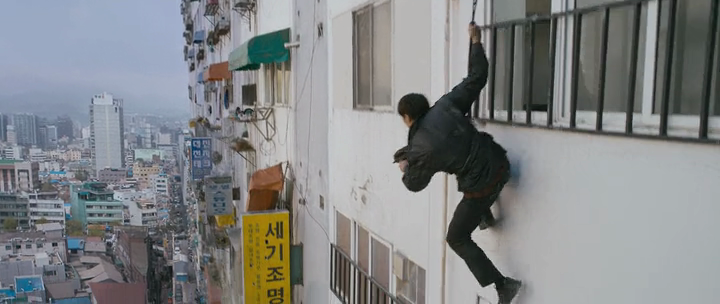
It’s a long wait to find out what drives Macao Park and exactly how his relationship with Pepsee went sour. The character is a brilliant strategist and thief, and he stays cool in the most trying of situations. That makes him less relatable and human and consequently I was a bit less invested in his situation than I was in the other team members. Kim Yoon Seok does well in the scenes where he can show some of the complexity and emotion under that calm surface, and he underplays most scenes to great effect.  He also gets the best and most explosive action sequence of the film culminating in a vertiginous fight on cables down the side of an apartment building.

The-Thieves-Aerial 1The-Thieves-Aerial 2

In between marvelling at the camera and wire work I was a bit distracted by the ease with which so many airconditioning units were dislodged. Maybe they don’t get really big pigeons in Busan.

The-Thieves-after the robberyThe-Thieves-Zampano and Yenni

Kim Soo Hyun is underutilised as Zampano, the guy on the other end of Yenni’s wire rig. He gets little to do, but makes the best of his limited role and some of his scenes with Yenni are charming. And of all the guys in the cast, the only one you’d really want to see shirtless is him, so that worked out well.

The-Thieves-Chewing Gum and Chen

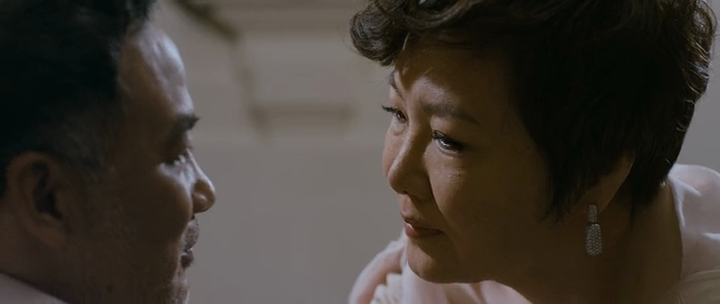
Simon Yam and Kim Hae Sook stole the limelight when they were sharing their little corner of the subplot. I always like seeing secondary characters with a sense of purpose or dreams of their own, and Chen and Chewing Gum gave the story some welcome uncomplicated affection.

Apart from the main ensemble, there is a sizeable supporting cast. Ki Gook Seo and Ju Jin Mo stand out as the dangerous fence Wei Fong and the dogged policeman on the trail of…well, everyone.  All of the threads lead back to a couple of key factors so as things unfold, some of the peripheral characters move in or out of focus.

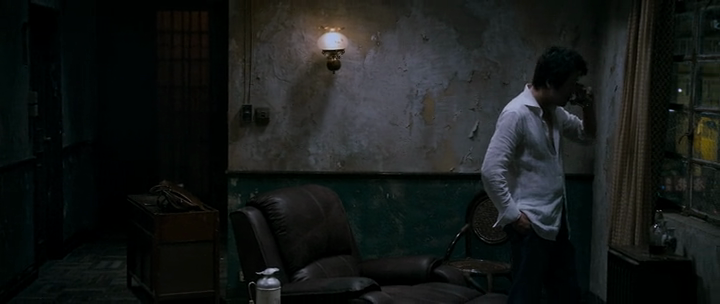
Choi Yeong Hwan makes great use of contrasts to set the mood with striking visuals and composition. The shady rooms and derelict factories where thieves do business are tucked away beneath the high gloss of Macau, with casinos doing the work of thieves in parting people from their money. You can almost taste the greed and aspiration. The action scenes are beautifully composed and edited, sometimes giving an aerial view of the moving parts ofa clever scheme and other times plunging into the action and confusion. In some scenes the film speed slows and speeds up to synch with the dramatic ebb and flow. Jang Yeong Gyoo’s soundtrack is perfect for this genre. Bouncy and brassy, sometimes even a bit funky, the music matches the pace and adrenalin of the action and visuals. It’s another very accomplished and confident effort from the team that made ‘Tazza: The High Rollers’.

The Thieves has so much going on that I am impressed the sense of urgency  and consequence was maintained even when the revelations were all out in the open. The blend of action, humour and drama is deft and the characters are well drawn. I enjoyed it immensely. 4 stars!

Library Wars (Toshokan Senso)

library-wars-2013-poster

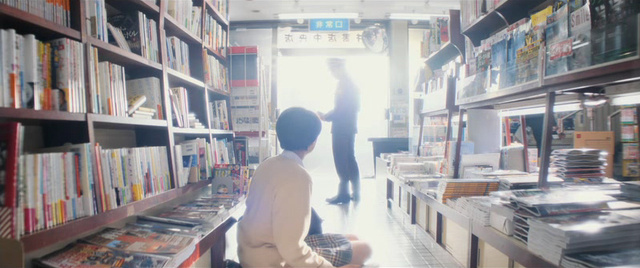
A law was passed in 1988 allowing all objectionable books to be collected and burned. The Media Betterment Committee was formed to remove from circulation all books that contained banned subjects, or books that could be blamed for crimes committed by people who had read them. Librarians were the last line of defence against this censorship. Sounds a bit dull, doesn’t it? Only the Media Betterment Committee has an armed force at the ready to go and retrieve banned books. It is not often that you hear a line like “Libraries are dens of iniquity. You must pay for your sins.”

Sato Shinsuke’s film isn’t all about censorship or government corruption and hypocrisy in a dystopian alternate history. It’s also an action packed romantic comedy. The MBC initiate a mission to retrieve secret documents that would reveal the illegitimacy of the law that empowers them. The Library Defence Force protects the high security library facilities and safeguards the collections. The documents have been bequeathed to them, and they know that getting them back to the library will be near impossible. Both teams are armed to the hilt, but only one side shoots to kill. One character says something along the lines of “If a government burns books, next they’ll burn people”.

library-wars-Dojo

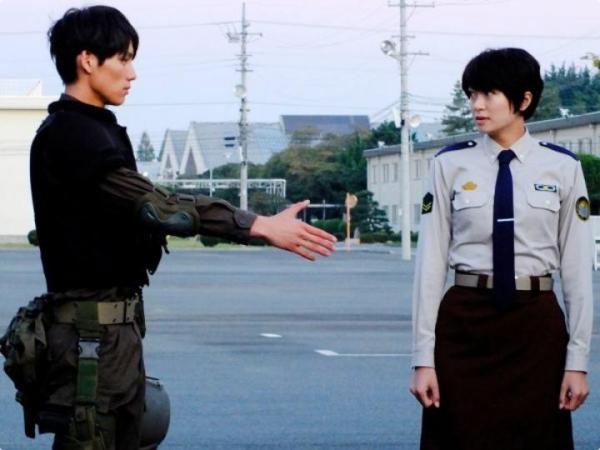
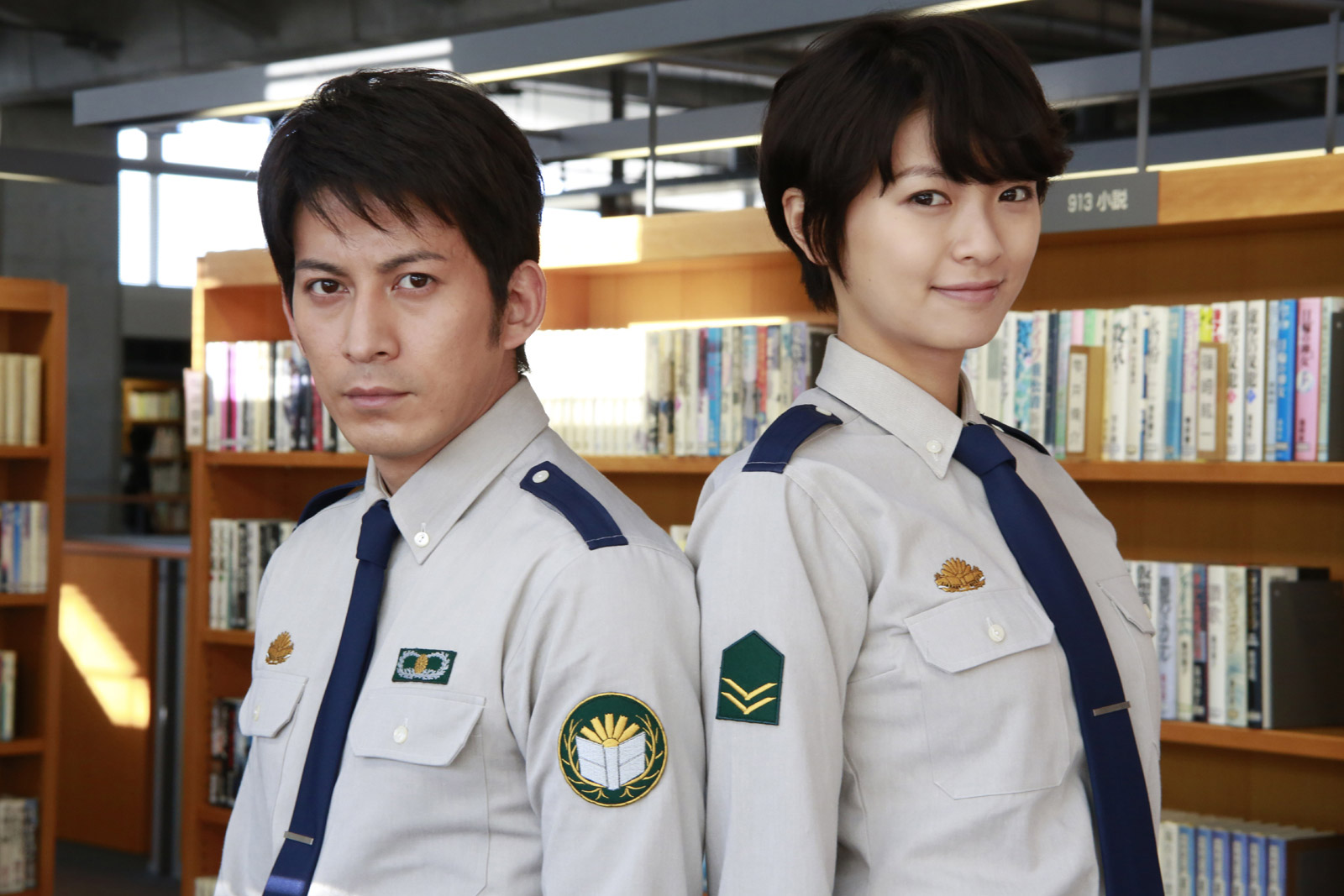
Instructor Dojo (Okada Junichi) is intense, a consummate professional, and not very tall. Okada is excellent in a fairly stoic role. His fight scenes are crunchingly physical and despite being the butt of many short jokes, Dojo is the alpha male in this crew. He is in charge of new recruits, putting them through a punishing training regime and conducting classes on the history and laws that frame the conflict with the MBC. He also seems to have an intense dislike of Kasahara Iku (Eikura Nana), the first female in the elite Task Force. Okada has a nice touch with the comedy scenes and his squirming reaction as Dojo hears himself described by Kasahara at her selection interview is hilarious. He gives the cynical Dojo a weary vulnerability at times along with his obsessive drive to defend the books.

Library_Wars-Eikura Nana

Eikura Nana is the enthusiastic but klutzy Kasahara. She was inspired by a Library Defense officer who came to her aid during an MBC book raid. She never saw his face but he changed her life.

library-wars-Kasahara and her mystery hero

She joined the force to try and find that ideal man and to be just like him (guess which him!). At first I was a little irritated by the scenes that repeatedly highlighted her incompetence and inability to keep up with the guys. But it emerged that brilliant technical skills might not be the only qualification for the job. Knowing what was right and putting yourself on the line to do it was as powerful in some instances. Eikura is charming and portrayed her character as impulsive and warm, with a sturdy resilience that kept her from giving up.

library-wars-Tezuka and Kasahara

Her sparring with Dojo and fellow recruit Tezuka was sometimes harsh, and I was a bit put off by the institutionalised bullying and the macho BS. But Dojo challenged Tezuka to be honest about why he was picking on Kasahara. He also reproached himself for not being strong enough to trust her, and for impeding her career because of his own weakness. Kasahara became a more valued individual and earned her place on merit. It’s still a man’s world but she made her own place in it.

Library-wars-2013-Dojo and Kasaharalibrary-wars-Okada and Eikura

Despite all the action and violence, this is often a very funny film. Characters play it pretty straight and lines like “The commander’s leg is transmitting” had the cinema audience in stitches, as did the librarians shushing each other while they gossiped. Okada and Eikura have a nice dynamic. Dojo and Kasahara’s relationship starts as just a student and (demanding and surly) teacher but develops and becomes more personal as they understand more about what drives each other. She brings out his vulnerability (which freaks him out) and he makes her realise that the LDF is no game and she needs to focus. When Kasahara says to Dojo that her ambition is to be as good as him he is touched.  Then she pauses and adds, “Or better”. Their reactions and the pace of their dialogue bring a lot of the heart and the humour into the story.

Tezuka (Fukushi Sota) and Shibasaki (Kuriyama Chiaki) are Kasahara’s rival and best friend respectively. They provide the outlet for less formal commentary and venting, and allow Kasahara’s comedic bumbling to the fore. Both actors do well with quite one dimensional roles and make the most of their big scenes. Tanaka Kei is lots of fun as Dojo’s sidekick Komaki. He respects his boss but has zero reverence and his ribbing and knowing expressions are a hoot, leaving Dojo exasperated and with nowhere to go.

library-wars-extreme-censorship

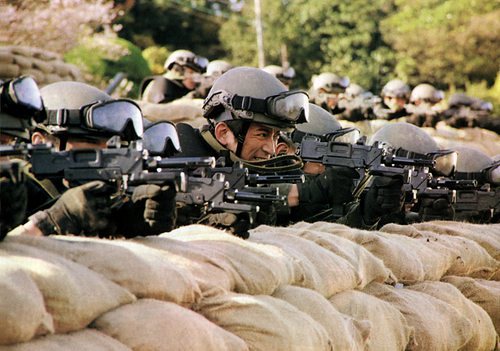
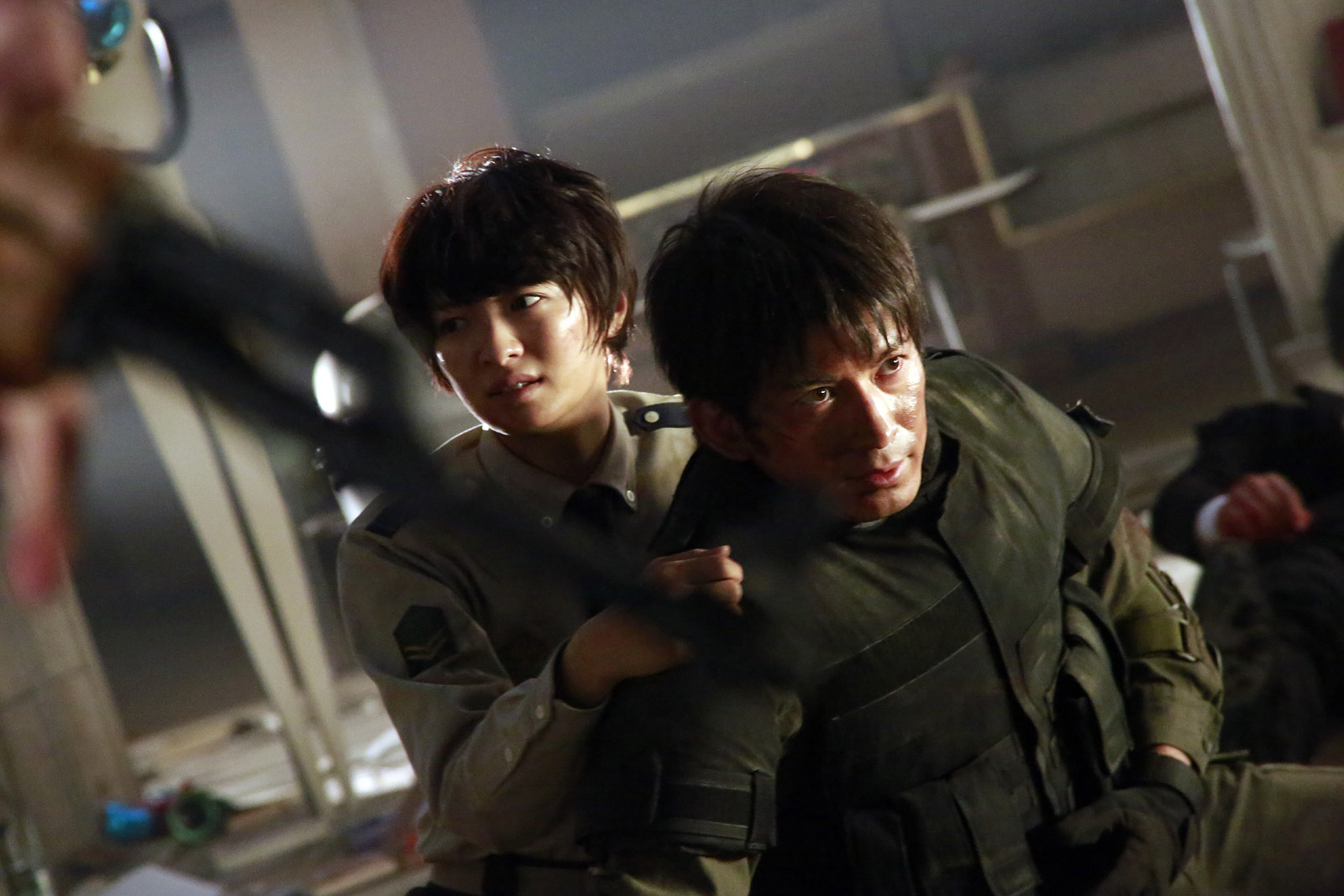
The combat scenes are full on, from the hand to hand fighting to the massive scale gun battles. This is a military style conflict and essentially the MBC and LDF are at war. The LDF are to defend only, and the tension in their ranks as they wait, knowing what is coming, is palpable. Kawazu Taro’s cinematography is excellent at drawing us into this bureaucratic and dangerous world,  and the film makes the most of both technology and skilled actors and stunt performers for the action sequences.

I read reviews criticising Library Wars for not being enough of a message film, but I think the censorship and public apathy theme is strongly presented and integrated into the storyline of Dojo and Kasahara’s relationship. The romantic elements were more about idealistic love than actual entanglements but the growing closeness of several key characters makes it easier to invest in the conflict. The film ends on a positive but open note, perhaps signalling future adaptations of the remaining novels in the series.

I found the subject and the characters engaging. The cast are good , especially the leads Okada and Eikura, and the warmth and laughs were a nice foil for the mayhem and destruction. Worth a watch, especially if, like me, you remember reading Fahrenheit 451 in primary school and thinking that was a fantasy.