Paleri Manikyam

paleri_manikyam_poster

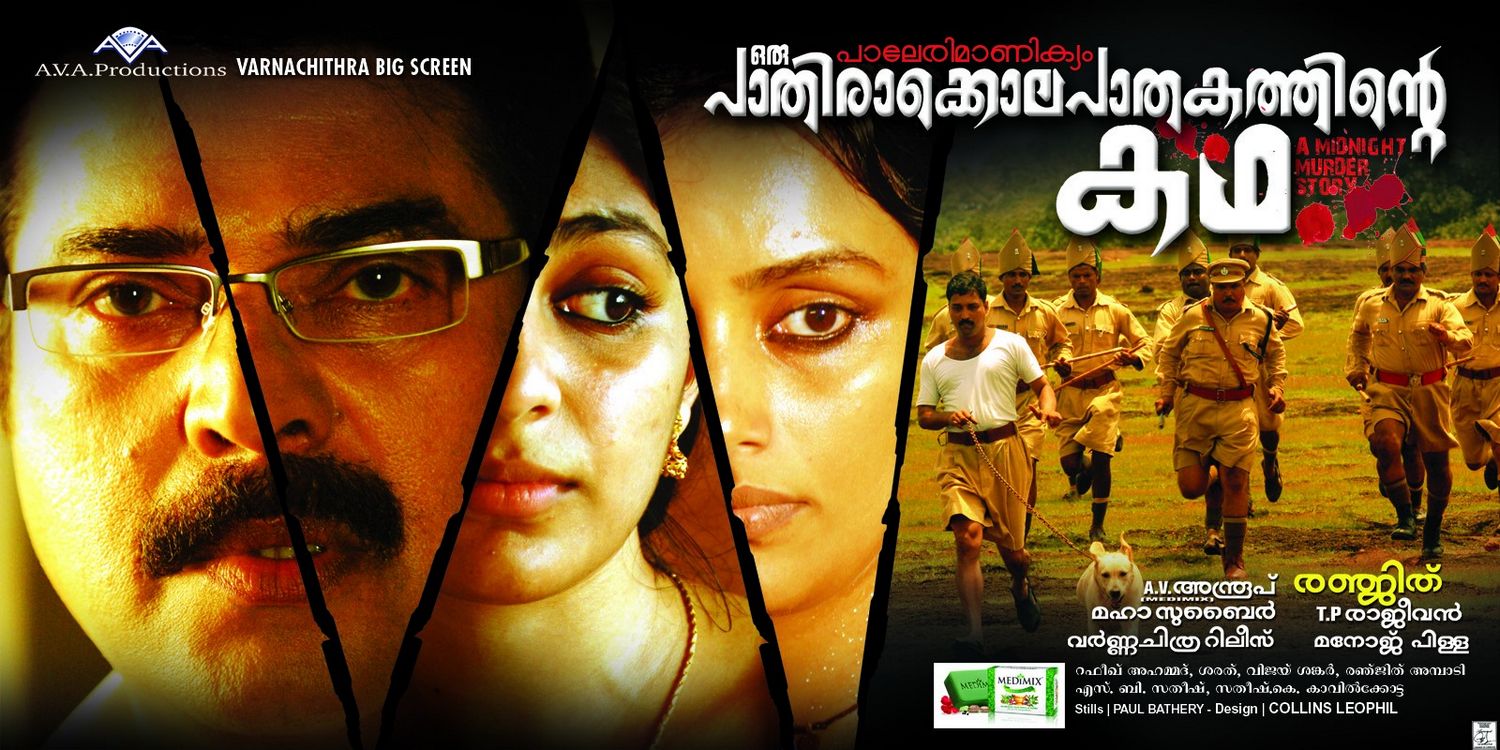
Haridas (Mammootty) is a detective and writer, on holidays in Kerala with his girlfriend Sarayu (Gowri Munjal). He is mildly fixated on an unsolved murder that took place the night he was born, over 50 years ago. A girl called Manikyam (Mythili) from his village of Paleri was raped and killed. Sarayu is a crime analyst and she offers to work with him on the mystery.

Haridas goes back to Paleri and does a lot of exposition by talking to the camera, and sometimes to Sarayu. He walks through events on the fateful night as he knows them, threading in amongst the action from that day. It’s a bit like a stage drama, with him as the narrator.

Her brother and father carry Manikyam to a nearby town for the police investigation. It’s obvious that her mother-in-law Cheeru (Shweta Menon) is lying about something and her husband Pokkan (Sreejith) seems by turn guilt ridden and vengeful.

Haridas and Sarayu discuss the initial investigation including that the post-mortem was rewritten and a crucial report went “missing”. Things keep getting murkier.

Pokkan and Cheeru seem shady, but it looks like someone was keen to get Pokkan out of the way and make sure Manikyam didn’t go to the village to watch the drama with everyone else. The powerful landlord, Ahmed Haji (Mammootty in the second of his three roles in the film) is an obvious suspect but no one seems to think the police will actually go there.

Soon there is a manhunt as the police follow their chubby, happy Labrador around the village. I did like that there was a small scene dedicated to the merits of various dog breeds as tracking animals, with the Telugu trained Labrador the clear winner. Maybe I’d believe that if it was tracking a biscuit…

Ahmed Haji’s flunkey Velayuthan (Vijayan V Nair) tries to escape the village, but insists he didn’t kill her. He says Pokkan killed his wife in a jealous rage on finding her with an ex-lover, and he helped cover up the murder by making it look like a suicide. Cheeru accuses Velayuthan of abducting Manikyam and eventually leaving her hanging for Pokkan to find on his way home. And then Superintendent Manalathu (Sasi Kalinga) coaches Velayuthan on who the third man is, naming Muthuvan Ahmed. There are conflicting stories everywhere, although Ahmed Haji seems to be a constant. So many people silently conspired to ruin poor Manikyam.

Haridas reveals he is an illegitimate son of Ahmed Haji. He only knew him as a name revealed on his 18th birthday. But he won’t back down from investigating just because of that connection. It’s interesting that despite Haji being such a feared figure, no one spotted the spitting image likeness of his bastard son. Or did they know, and say nothing? Haridas keeps digging, meeting people who had been living in the area when Manikyam died, including Keshavan the barber (now played by Srinivasan).

Haridas is researching for his own curiosity, not because he is passionate about justice for Manikyam. He wants to be the one who knows it all, and to put his own obsession to rest. No one seems overly outraged at Manikyam’s fate or disturbed by Cheeru’s fall from grace. I liked his account of the night his mum told him about his biological father, but loving your mum is not proof of moral compass ownership. Haridas is not so very different to his father – he is sleeping with a married woman and lying to his wife. He just does it in a more socially accepted way. I didn’t like Haridas as a character but Mammootty gives him such intelligence and a keen understanding of human nature that I couldn’t take my eyes off him.

Cheeru is devoted to her son Pokkan, but there is always something a bit evasive about her expression. It wasn’t a surprise to know that Ahmed Haji had demanded her for himself, but their story was not quite what I expected. She is excited and frightened by Ahmed Haji and their mutual attraction, and she has insane chemistry with Mammootty. Cheeru’s transition into prostitution is depicted as a matter of circumstances and lack of options rather than a huge moral failing. Shweta Menon is brilliant and makes the shifts in Cheeru’s emotional pitch and strength seamlessly.

I appreciated that the extended flashbacks gave Mythili an opportunity to do more than play dead. She created a vivid character and I could see why Manikyam’s death was still haunting the village in so many ways. It was all the more tragic seeing the happy new bride and realising what was happening around her. But I am not sure all the flashbacks to the actual rape were needed – it would have been as powerful and less voyeuristic to move on or show other angles of the story, or give more insight into how other characters reacted to the brutal event. I didn’t need to keep seeing it, and Mythili’s portrayal of her fear and pain was disturbingly realistic.

Gowri Munjal is effective and understated in her scenes, although Mammootty dominates the dialogue and focus. In fact in some scenes I was wondering if she was there, out of view, or he was happily declaiming alone. They have the chemistry of friends with benefits, not a raging passionate affair, and I liked her pragmatism about his lying ways. Sarayu’s marriage has drifted away and her partner lives overseas. Haridas doesn’t seem too fussed when her husband Goutham calls out of the blue, instead encouraging her to go hear what he has to say.

It’s almost pointless to say this, as it is the norm for Malayalam cinema, but Paleri Manikyam is visually lovely. I had to rewind a couple of times because I was too distracted to read the subtitles properly. Manoj Pillai has the camera duck and weave through the crowds of onlookers, letting the viewer spy on the goings on. At other times the visuals jump around from frame to frame, perhaps a representation of Haridas’ inner state. There are some lovely setups too including two boats passing each other, one with Manikyam as a corpse and the other with her as a bride just 11 days earlier. Ahmed Haji puts down a bottle only to have Cheeru fill that space in the shot; Cheeru as a refreshment to be consumed when he desired it.

There is a huge ensemble of actors playing varous people around the locale.  Writer-Director Ranjith adapted his screenplay from a novel which was in turn based on an actual event. He was so keen to find people who looked and sounded authentic, he ran training camps and chose three relatively unknown actors from the area. He also cast a heap (that’s a technical measurement) of established theatre actors. The standard is uniformly high. Sreejith is wonderfully expressive as the slightly slow and bewildered Pokkan, especially when he returns home a sad and broken man. I wondered what became of him. Musthafa is quietly fiery and a bit sarcastic as young Keshava, the barber who though Communism would overcome caste. The actor who played Manikyam’s brother was also excellent, his grief and anger palpable. The only unnecessary role was actually Mammootty’s third, that of his half-brother Ahmed Khalid. He could have been played by another actor without diminishing the story or Mammootty’s fine accomplishment.

The ending is downbeat and ominous, although many loose ends are tied up. See this for the intriguing structure and slow revealing plot given great voice by the talented cast. You’ll need some tolerance for the violence and the bleak view of a woman’s worth in those days (and ask yourself how much things have changed). 4 ½ stars!
Ab Tak Chhappan (2004)

Ab Tak Chhappan Poster

The film opens with a pile of clothes and shoes on a beach, and someone whistling “For He’s A Jolly Good Fellow”. A man is wading in the sea, maybe suicidal, maybe cleansing his sins. Or just washing off the bloodstains on a nice sunny day.

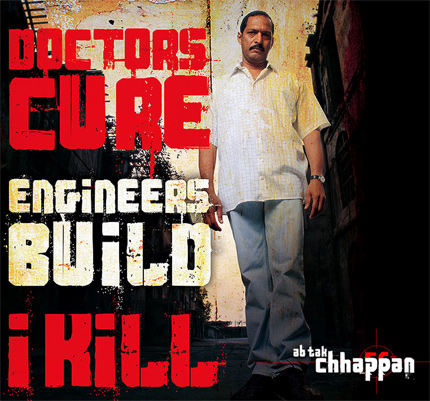
Sadhu Agashe (Nana Patekar) is an encounter specialist. He is honest and pragmatic about what that really means, and is untroubled by any ethical concerns. He is doing a necessary job as the legal system cannot stop gangsters, so extreme measures are required. The cops are basically just another gang in the Mumbai ecosystem. Within the department there are people jostling to take over his prime position. Imtiyaz (Yashpal Sharma) is a sook who wants to be the top cop but lacks Sadhu’s instincts and connections with the useful informers. Shukla (Nakul Vaid) is the wide eyed newbie, determined to deliver justice through state sanctioned murder.

Zameer (Prasad Purandare) is an offshore crimelord, running operations from his luxurious Malaysian retreat. He has a random Australian girlfriend and a strange attachment to Sadhu Agashe, who he often calls for a chat. The cat and mouse game between cop and crim is tense and disarmingly friendly by turns. New Joint Commissioner Suchak (Jeeva) has a different agenda from outgoing Mr Pradhan (Dr Mohan Agashe) and the department has to learn to navigate the new landscape. When Sadhu Agashe is put on the other side of the gun, he uses all the resources at his disposal to try to outwit his adversaries.

Nana Patekar is both ordinary and charismatic, and delivers a compelling performance that carries the film. Agashe is a public servant tasked to kill bad guys and has no obvious ethical issues with his job description. He believes he is taking care of a problem afflicting the general population, the people he swore to protect. His simplicity is deceptive, a man who acts first and stops to feel and care later. His relationship with wife Nammo (Revathi) is loving with lots of nagging and joking in a comfortable couple-y way. She is a political science teacher and yet exhibits no qualms about what her husband does, or the potential danger to herself and their son. I know they have been married for years but I still expected that when Shukla brought his fiancée Vaishali (Hrishitaa Bhatt) over for dinner that they may talk about what it meant, or at least how to get blood out of clothes. It was just such a non-thing in their lives. Revathi is elegant in a comfortable middle class way that suits Nameeta, not blingy or impractical looking. Revathi doesn’t get a lot of dialogue but her silent interactions and bustling about the home show Nammo is the cornerstone of his life. She is warm and grounded which plays well against Nana Patekar’s sharper edges. When people break the unwritten law that keeps family and dependants out of the fray, they mess with the only thing that could influence Sadhu Agashe to be moderate.

Yashpal Sharma and Kunal Vijayakar have prominent supporting roles and play the world weary seen-it-all-before cops to perfection. Justice is not their priority, hitting their targets (literally) is more important.  Nakul Vaid is suitably wide eyed as the rookie on the team. Agashe sees potential in the kid, and shares his jaded wisdom with his protégé but I wouldn’t say the boy was all that innocent to start with. Looking queasy when you shoot someone is not necessarily an indicator of moral fibre. Jeeva is threatening and oozes corruption as Suchak who disrupts the team with his new agenda. Mohan Agashe is weary and understanding as Sadhu’s old boss, the only man he really trusts and respects. Their conversations shed light on Agashe’s motivation and his view of the world, and point out the dangers if he sets a foot wrong.

Shinit Amin set his story in the non-glamorous Mumbai of films like Company and D, a dog eat dog city. Traffic is constant, everyone knows everyone else, the honour code is fairly strong. No matter what happens, gangsters and cops all stop to watch the cricket and even a hardened criminal should be entitled to a cup of tea and a lift home after he has been beaten to a pulp. There are rules. And then there are laws. The film was produced by RGV and it is like the sensible version of (the very disappointing) Department. There is an internal logic, cause and effect, nothing happens out of blind coincidence or guess work.

The background score by Salim-Suleiman is dramatic without being too obtrusive. Their soundscape helps create a sense of urgency and velocity as the protagonists travel through the hurly-burly of Mumbai.  The camera also navigates the rabbit warren of streets homes and office, giving a feeling of being a fly on the wall. Faces are often framed in close up but off centre, maybe to underscore the unknown and secret sides of human nature. Or maybe just because it looks cool. There is a lot going on in the background and periphery as people go about their work and daily business. It’s a lively yet very contained filmi world.

There is a lot of violence and death in the film, but it is almost understated. The characters hardly notice the carnage, so nor did I. I was more interested in the why than the what. And the implication of the corruption of the system and the internecine conflicts was far more frightening than a shooting.

This is a solid film with a well thought out plot and excellent performances. It’s not uplifting but neither is it completely depressing. It is a different way of looking at that filmi chestnut – where do you look for justice? And does doing something bad to prevent something potentially worse ever work out? 4 stars!

Goonda (1984)

goonda

A sophisticated archaeological dig uncovers a priceless idol. Numerous criminal gangs swoop to claim the prize, and the title of Best Gang Ever.

There are men in red shirts v men in white pants v overgrown scouts in khaki.  And then a relatively svelte man in black ninjas his way onto the scene – cartwheeling and backflipping like he’d just invented acrobatics. Who could it be?!?

Chiranjeevi teams up with A Kodandarami Reddy again for a mass film with a few little tweaks on the standard formula. There are multiple identities, daring deeds, family histrionics, a significant mole, and a lot of prancing around in parks.

Kalidas (Chiranjeevi) is the up and coming star of a crime gang. Kali is confident and quite happy with his lot which seems to include Mohini (Silk Smitha), the chief’s daughter. He has a fearsome reputation, a tight perm, and blue contacts. He represents the meritocracy while the leader’s nephew Kasi prefers nepotism to ensure his career progression. He and Kali have an excellent and yet not very good at all blindfolded fight to the (almost) death which I found oddly compelling and quietly soporific.

The lair is a cave with odds and ends of lounge furniture picked up on hard rubbish collection day. And despite being top secret and underground, apparently anything that goes on is clearly audible in Kali’s lounge room. A series of unfortunate events triggered by the jealous Kasi sees Kali leave gang life to go straight.

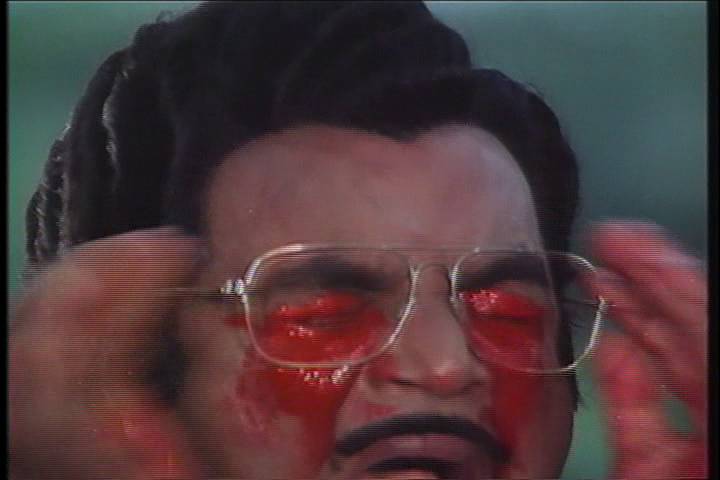
Kali rebrands himself as Raja a pop singer with much better hair, and coincidentally meets SP Anand (Satyanarayana Kaikala) on a train. Cue flashback and the genial policeman is Raja’s father, back when he was a little boy called Ravi.

Goonda-tragedy

Ravi was involved in an accident resulting in a neighbour losing his sight, and his furious dad chased him down the road firing warning shots over his head. So I can kind of understand the kid being terrified of his father catching up with him. Raja saves SP Anand from goons sent to kill him, and SP Anand makes Raja stay in his home. Will they ever recognise him? Will he tell them? Will they overcome evildoers and lively happily ever after?

Raja gets a job at the nightclub owned by baddie Kasiram (Allu Ramalingaiah), where Jaya (his childhood intended played by Radha) sings. I do enjoy a bit of disco yoga classical fusion.

I am less in love with Chiru’s wardrobe, which seems to be sourced from the ladies floral blouse department.

While growing closer to Raja, Jaya reveals her intense hatred of Ravi, the child who destroyed her family. Raja decides he has to win her love as his new self, and fix everyone else’s life into the bargain. Will they ever recognise him? Will he tell them? Will they overcome evildoers and lively happily ever after?

Thankfully Raja likes to get his shirt off, so Jaya recognises the Significant Mole. After some angst and a little bit of PR from the gossipy doctor, she and Raja resolve their differences. Love arrives differently for us all. Sometimes it is wearing a Blondie t-shirt.

Raja decides to secretly protect his dad, although he still won’t tell his family who he is. But Dharmaraju has tracked down Kasi, a witness to Raja’s past. Will they ever recognise him? Will he tell them? Will they overcome evildoers and lively happily ever after?

Raja utilises his old Kalidas skills to get the money for Jaya to settle a debt, and he is the anonymous benefactor behind a sudden offer of an eye transplant to restore her dad’s vision. Raja’s fighting style is as flamboyant and flexible as ever, so the action scenes are loads of fun. There is an excellent train sequence where it is clearly Chiru himself (at least for most of the time), leaping from carriage to carriage and flinging his opponents to the winds.

As is often the case in Telugu films, justice is not clear cut and may reside outside of the legal system. SP Anand has to deal with the consequences of his temper, both in the past and now he knows his son has returned. And Raja has to pay for Kalidas’ actions. I liked that no one really escaped from themselves. It’s a good way to mesh a family drama with a revenge motif.

The multiple identities give Chiru a good excuse to switch up the wardrobe options and he imbues each character with a different emotional tone. Kali is never conflicted about being a crook, and his change of lifestyle was more to please his father figure. He certainly managed to heal his wounded heart in record time. Poor Mohini – forgotten in just one dance sequence. Raja has firm views on Jaya’s brother Srinu being a wastrel and tells him he has no right to eat if he doesn’t earn his own way. Which is interesting in light of his criminal past but maybe he saw that as honest work, and better than taking money from a WOMAN. The horror! His views on the role of women are typical of the age and genre, but he does understand why Jaya mistrusts him and that he needs to give her evidence before she would change her mind.  And despite his love for his estranged family, Ravi also sees that his father was very unfair. He doesn’t examine his own decision to jump off a bridge too closely, but you can’t have dazzling insights into everything.

Jaya has a bit of backbone, and Radha always has good chemistry with Chiru. When she realised who Raja was, she was furious and articulate in rejecting him. And when she changed her views, she was again articulate and clear in what she wanted to happen with their relationship. She is a typical filmi heroine but I could respect that she was making some of her own decisions. The wardrobe team do torment her in some dance sequences, and I suspect they even repurposed Kali’s perm wig. In a way she is the character that triggers Raja into action. He could have made do with seeing his family occasionally under the guise of friendship, but he fell for Jaya and so he had to do something to gain her trust and affection.

Allu Ramalingaiah and Rao Gopal Rao are the muddling but nasty crims who run the club and there is an ongoing subplot of both stupidity and cruelty at their behest. There is also a large cast of supporting goondas, many of whom seemed most animated in their death scenes. Satyanarayana Kailkala and Annapoorna do what they have done so very many times as Ravi/Kali/Raja’s parents. Silk Smitha’s role was small but she did get to wear some fabulous sequinned shorts so she made an impression.

Despite being full mass formula, Goonda is a bit more low key and contemplative than some of Chiru’s other hits. The music and choreography is a bit lacklustre, especially considering that Chiranjeevi and Radha were no slouches in the dance department. The set design and costumes also show the spirit of making do. I think they spent all the big bucks on the train. See this for truth, justice, and two kinds of Chiru! 4 stars!