Udta Punjab

udta-punjab-poster

After a very wordy anti-drugs and pro-Punjab disclaimer riddled with spelling and grammar errors which may or may not indicate its sincerity, Abhishek Chaubey’s Udta Punjab opens with an intense, crass, loud and proud drug anthem.

Visually strong and often confronting, Rajeev Ravi’s high impact imagery is balanced with scenes of delicate loveliness. The take seems to be that Punjab is turning into a place with the morals of a Mexico or, ahem, Goa. Packages of heroin are making their way across the border nightly, and dubious shipments of pharmaceuticals are waved past by police. We see a young girl, one of many out of state workers coming to labour on farms. The divide between the worlds of privilege and subsistence is evident, and the film doesn’t shy away from the gory, violent, consequences of disrupting the status quo. It’s powerful stuff, and quite gripping. Unfortunately the second half revolves around unnecessary and unconvincing romance just when the main plot should have been in laser sharp focus to bring it all together.

Tommy Singh (Shahid Kapoor) takes the sex, drugs, and rock n roll mantra to heart. Sartaj (Diljit Dosanjh) is a mid-rank cop with flexible morals, happy to overlook the drugs as long as he gets his cut. Dr Preet Sahni (Kareena Kapoor Khan) specialises in treating addicts and wants to cut the problem off at the source. The nameless girl finds a package in the fields, and thinks she can make some fast money. The film shows the close but not quite intersecting paths characters take, passing each other without a blink or occupying the same space at different times. There is definitely a pervasive feeling that some lives are held cheap and existence for many people has become the wait for death. The sense of connection and community, what affects one will affect many, is clearly drawn out.

Sartaj’s brother Balli ODs on the drug that Sartaj had waved through a checkpoint. In the blink of an eye Sartaj becomes a crusader for justice and decides to help Preet take on the system. The girl is forced into prostitution and drug dependency, and one of the men she has to service is Sartaj’s boss. Tommy attempts to get cleaned up but his own friends get him using again, and fans have no interest in a more honest, introspective star. They want their bad boy back. After a near riot, Tommy runs away and encounters the girl, now also a fugitive. Sartaj falls for Preet, Tommy falls for the girl. All for love and love for all. Apparently all you need is a girlfriend and you will immediately develop moral fibre and a resistance to highly addictive substances. Poor Balli is locked in a treatment cell and all but forgotten, with no magical insta-love to rescue him.

I’m sure Shahid wasn’t at a loss for examples for playing a coked up celebrity. Tommy comes across as a very naughty boy, not a complex or dangerous man in the grip of addiction. Is it bad that in one of his meltdowns I found the elaborate toilet lid more compelling than the dialogue? He thinks rapping about his cock is HILARIOUS. When he ends up in jail, two young boys in the cell perform one of his hits before quietly admitting they killed their mother because she wouldn’t give them money for drugs. Shahid shows Tommy’s growing fear and uncertainty as he realises he is in serious trouble and tries to get off the gear. It’s when Shahid reverts to his bunny-teeth boy in love shtick that he seems most comfortable, and yet nothing made much sense. How can such a famous man with a memorably bad haircut travel across country with no money and not be recognised, even when wearing one of his own crew t-shirts? And what about the girl, who we are expected to believe could fully and easily recover from the trauma of being a sex slave and a drug addict just because Tommy likes her. And don’t mention the ballad.

Alia Bhatt’s performance is excellent, and reminded me a little of her role in Highway. She has minimal dialogue as the Bihari farm girl and even less as a sex slave. Her character is smart and strong, but the brutality of her life with the drug barons is overwhelming and Alia lets her expressive eyes go dull. The girl doesn’t ever give up on herself though. It’s a little disappointing that Chaubey seems to think Tommy is the cure for her, and sad for her that she will acquire a manchild for her troubles. And I could have slapped someone for the oh so clever name they reveal at the end of the film. I was half expecting her birthday to be on April 20th.

Kareena’s approach to Preet is less makeup = Serious Lady Doctor, plus coquettish hair tossing and simpering. Unfortunately her lightweight characterisation exposes her weaknesses when compared to the rest of the cast, and then her character turns stupid. In a film about the social cost of drugs, should a scene where Sartaj is accidentally injected with the same drug that nearly killed his brother be turned into comedy? And should Preet and Sartaj be all awkward about the dopey flirting and forget the medical issue of someone having ingested a highly addictive drug made in a shed who knows where with who knows what chemicals and being stuck with a needle that may have had someone else’s blood in it and so exposing the injectee to Hepatitis or HIV? No. Why would a doctor worry about that? It’s a shame as Preet had potential to be interesting and she certainly had the only fully operational moral compass.

I’ve sat through the trailer for Sardarji a few times now so having Diljit Dosanjh actually in the film I had gone to see was almost disorienting. He delivers a competent performance, and tries to generate some one-sided chemistry with Kareena. His character in some ways is the most complex, although the film moves on too quickly from moments of epiphany, self-loathing, and despair in favour of simplistic love and revenge.

The large supporting cast is good but while I recognised some familiar faces, I couldn’t put names to everyone. I took a violent dislike to one of the girl’s captors in particular, and wanted to get my Tight Slap Administrator gloves on with some of Tommy’s cousins. The production values are high, and I can appreciate the effort and care given to the visual design and soundtrack. Amit Trivedi has gone beyond his usual tweedly guitars and tried to extend Tommy’s character through his featured songs.

Maybe if you see the film as an allegory this second half works a little better, to a point. The girl is perhaps a representation of salt of the earth Punjab tempted by easy money and being screwed over by the drug cartels and cops, Tommy is the privileged class who can largely avoid consequences, Sartaj is the system that has neglected its duty to protect the people and uphold the law, and Balli is at the end of the line with no one to pass the blame or damage on to. But Chaubey leaves us with the message that all you need is romantic love. And a gun.

I was disappointed by the direction Udta Punjab took after such a powerful start. But I am happy to regard my ticket as a contribution to supporting and encouraging filmmakers’ freedom of artistic expression after all the ridiculous censorship shenanigans.

Gentleman (2016)


Gentleman_posterFans of the duplicate hero genre will not be surprised by the plot developments in Mohan Krishna Indraganti’s Gentleman, but it is an enjoyable film with some very good performances. Unfortunately the trailer doesn’t do the film justice. But here it is.

Aiswarya and Catherine meet on an international flight heading back to Hyderabad. In a stilted “hey I know how we can fill in the time” scene, the ladies decide to tell each other about the men in their lives.

Cathy tells her self-described cinematic story of meeting Gowtham, and falling head over heels. Now, Gowtham is the typical filmi hero stalkerish won’t take no for an answer guy, but Catherine sends him encouraging signals. Their dates are actually very cute, they have fun together, and they do seem to genuinely like each other. She had to leave him to go do a VFX course in the UK, and can’t wait to see him again.

Aiswarya tells Cathy about her perfect fiancé Jai. Where Catherine and Gowtham were endearingly real, Jai and Aiswarya are annoying, privileged and clueless. They can get in the sea. They go on a roadtrip for two days, and ostentatiously leave all their money in their checked baggage. Aiswarya makes up rules about not working or trading things for money and not calling home. This is to test them and their compatibility. So they whinge the whole way to their destination, except for a brief break for Rajnikanth impressions, and take advantage of the hospitality of poorer locals. In one of many brilliant decisions, Jai feeds Aiswarya magic mushrooms then freaks out when the hallucinogens kick in. Finally they decide they must be each other’s soulmates because really, who else could stand either of them?

Imagine Catherine’s surprise when she sees her new bestie walk up to Gowtham’s double at the airport. And imagine her shock when she goes to Gowtham’s home only to be told he was killed in an accident. Was there a connection between Gowtham and Jai? Was Gowtham’s death really an accident? What does her friend Aishu really know about the man she is going to marry? And now imagine the rest of the story! Or, just wait until the end when two characters do an awesomely committed bit of “As you know Bob” exposition and explain the entire plot for the convenience of an eavesdropping character and anyone in the audience who hasn’t worked it out.

Gentleman-Catherine and Gowtham

Niveda Thomas is fantastic as Catherine. Her acting is quite natural, and she has a healthy realistic beauty. Her chemistry with Nani was great, whether he was playing her boyfriend or the suspiciously perfect man going to marry her rich friend. When she started to question Jai’s integrity she took action herself and was as rational as someone so invested in the outcome could be. I also have to give some credit to whoever styled her for choosing a wardrobe that a normal young woman would wear instead of having her teeter around in high heels and higher skirts. Niveda has screen presence beyond what I’d expect for a 21 year old woman in an industry not known for developing actresses beyond their cup size.

Gentleman_Jai and Aiswarya

Surabhi was less impressive as Aiswarya, but that was likely due to the limitations of the character. Aishu was ignorant of the suspicions about her fiancé so was mostly the bubbly happy bride to be. She certainly looked the part of a pampered girl with an optimistic nature, and her scenes with Nani were generally good (if nauseating).

Nani’s characters developed from different directions. Gowtham was a bit of a pest who revealed his heart of gold as Cathy got to know him, while Jai started sweet and considerate, then revealed more of his ruthless side. Nani is always likeable, but he managed to make Jai creepily perfect so that everything he did after a certain point became suspicious, regardless of how innocuous it was. Even his 70s cop show blow wave seemed to indicate menace. Gowtham seemed less calculating, more of a take it as it comes kind of guy, and a bit glib. Gowtham’s fight scenes were very tongue in cheek and entertaining, which suits Nani to a T.

Sreemukhi is Nitya, a straight talking journalist who takes an interest in Jai’s business dealings and seeks Catherine out to help confirm her suspicions. They had a nice dynamic and it was good seeing another sane career woman in the ensemble. Srinivas Avasarala is good as Vamsi, Jai’s suspiciously agreeable cousin who doesn’t seem to mind being ignored continuously in favour of the golden boy. Vennela Kishore was amusing as highly strung work supervisor and Youtube legend. Tanikella Bharani has a small role as Jai’s uncle Mohan. It’s a blink and you’ll miss it gig so maybe he was just doing a favour for a mate. Vinay Varma is Catherine’s creepy uncle David, and I shed no tears for his character. This film was very smart in how it showed their relationship and Catherine’s reaction without getting into voyeuristic rapeyness. It was all wrong, and no more needed to be said. Rohini played Gowtham’s mum, and every time I see her on screen I just love her. Her acting is excellent, and she and Nani still had the rapport that I loved so much in Ala Modalaindi.

Saturday Night Fever had a dorky fun feel, with the main cast doing enthusiastically uncoordinated dancing that helped gloss over the song’s lack of freshness. Mani Sharma’s songs are standard formulaic film fare, and most add little either visually or musically. The engagement song at Aiswarya’s house (Dintaka Dintaka) was nice mostly for seeing the character actors get their moment in the spotlight.

I liked the use of graphic novel style effects in some early scenes but that seemed to go by the wayside later on in favour of standard dodgy looking breaking glass VFX and the like. Odd considering Catherine’s career, they didn’t seem to invest in getting that right.

While I was overjoyed to have subtitles, there were some silly errors in them. Broachers for brochures, one excellent instance of comma for coma, and my favourite – missionary for masonry (as in, the reinforcing rod is embedded in the missionary masonry). It did deflate a very tense scene.

See this for a complex and yet fast moving plot carried by Nani’s rock solid skills, and Niveda Thomas’ excellent heroine who does stuff that won’t make you facepalm all through the film.

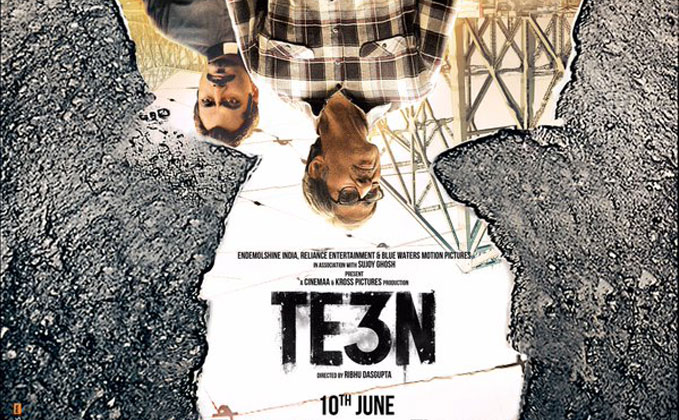
Te3n

te3n-poster

Ribhu Dasgupta’s Te3n is an official fully credited remake of South Korean thriller, Montage (2013, dir Jeong Geun Seop). I’ve seen the original so I was more interested in the how than the who or the what. Te3n is a solid remake of a decent film, so I still enjoyed it despite a couple of changes that I don’t think were at all necessary from a film or narrative perspective.

John Biswas (Amitabh) is an old man haunted by the death of his granddaughter Angela. She was killed in a botched kidnapping 8 years go, and the perpetrator was never caught. He spends his days haunting the police station and has nothing else in his life to sustain him. His wife Nancy (Padmavati Rao) is wheelchair bound and never leaves the house. John seems forgetful and vague, giving no energy to his present day and dwelling on the past. But when another child is kidnapped in exactly the same way, he believes he can catch the criminal and get justice (and revenge) for Angela. Sarita (Vidya Balan) has inherited the Biswas case file, and is leading the investigation into the latest crime. Sarita is smart but unimaginative when it comes to solving a complex problem. She will follow the leads and interpret the evidence in a logical and common sense way, not questioning whether she is being lead down the garden path. Martin Das (Nawazuddin Siddiqui) was the original investigator but he left the police force to become a Christian priest. He feels the guilt of his previous failure and the damage done to the Biswas family, and can’t keep away from the new case when Sarita starts her investigation. Although he used to do a fair job of evading John who only wanted to talk about the old crime. Martin’s zeal is less about John or Angela and more about his own personal guilt and need to atone.

It is almost a shot for shot remake of the original despite the new location, so I can’t really say much about Dasgupta’s directorial style. There were changes made in terms of which character did what. (In Montage, the mother of the first little girl is the one who purses the investigation and the police characters are a little different.) I feel that needed some more solid rewriting which didn’t quite happen. And because the film elevates Amitabh above all else, it ultimately buckles a little under the weight of a Star in what is otherwise a solid thriller.

Amitabh shows the best understanding of his character and the genre. I really liked his performance, and thought he built up the layers in John’s character well. There are scenes where he just becomes an old man, bewildered and a little out of step. As he steps up his own investigation, he sharpens up and seems to come into focus more. Because I knew that the original was slightly different, I was looking closely at the changed characters to see if the alterations were for the better. They really added nothing, except maybe funding, as I suppose it is still easier to get money for your movie if the Big B is your star than if Vidya is. But it also made me ask if women are overlooked in society the same way old people are. Maybe since they were both invisible to the people that mattered it actually did make sense.

I never fully understood why Martin had taken vows or why Sarita was a bit flirty with him, but I didn’t feel I needed to know all the details to appreciate the present circumstances. It felt like they split the original ex detective character a little between Martin and Sarita, and added some more emotional baggage for the sake of it. Both Vidya and Nawazuddin have garnered huge audience and critical support for their undeniable talents, but the material here lets them down a little. Their characters were sketchy despite their best efforts to add nuance and a sense of connection.

The story translated well to Kolkata. Pardon my saying so, but the Indian police and legal systems are not exactly a byword for judicial excellence so the scenes where things went wrong seemed almost inevitable. The bureaucracy and sheer time spent in nothing much happening also seemed quite realistic. Sarita was surrounded by mountains of old files and new ones, everything showing that the Biswas case was just one of many. The streets and old houses added to the mood with hints of things happening under the surface, out of sight. Despite the huge city setting, the characters all live their lives in quiet little pockets of their own making. The neighbourhoods and houses are lived in and have a sense of history and context that we are just glimpsing as we skim past.

The use of sound was excellent except for when a song like Grahan was forced into the mix. I did like the recurring use of Kyun Re during montages of uncertainty. I don’t know that the Amitabh version was needed as it was subtle as a sledgehammer, but it suited the moment. The ambient sounds and silences were far more powerful than the pretty generic musical stylings.

The investigations – John’s and the official one – are both quite logical and it all makes sense. Korean and Indian movies often share a sense of outrage at the lack of justice for victims of crime, and then go looking for that reparation outside of the system.

See this for a fairly restrained big budget take on an indie film subject, and for the well structured plot. It’s not the usual high level histrionics and it does showcase late career Big B in a role that lets him comfortably play to his strengths.