Don’t look now but it’s almost Megabirthday! Again!
As usual I am struggling to choose just one research topic. So far I have:
Break dance, Shake dance, or Snake dance?
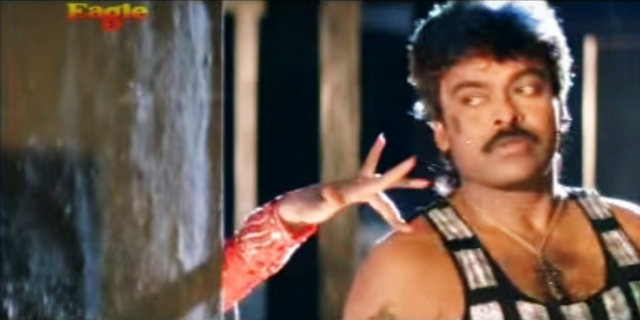
Chiru the Cowboy (aka Beth’s perennial request)
Where did he get that hat, where DID he get that hat?
Thoughts? Suggestions?
If you post something festive for the big day, please let me know and I will add it to the er, archive. As usual I will tweet a song a day for the month of August, so join in or follow along on the hashtag #megabirthday2016. The more the merrier!
And just because I can, and you may need the inspiration, here is some Chiru with multicoloured backing chickens and Soundarya.
Pa Ranjith’s Kabali is a film that could have been made in 1986 and that is not entirely a bad thing. Rajinikanth stars as Kabali, a gangster released after 20 odd years in jail. His wife and unborn child are dead, killed by rival gangs. What will he do? It’s a lumbering gangster vs gangster story on a large scale, but with a very traditional approach to conflict resolution. A less extravagant looking film than Rajini’s recent outings, it makes up in international locations what it lacks in CGI pyramids.
Rajini is such a good actor I was pleased to see him in a more pared down movie. When Kabali was speaking to foes or minions he laid on the mass mannerisms with a trowel. But when he was with friends he was more nuanced, even funny, and I could kind of see why people loved and followed him. I liked the slightly anachronistic feel, as though time took a while to get going for Kabali again so he was still acting like it was the 80s. Kabali always wore a suit, and that is explained in more detail than almost anything else in the story. I did like the outfit with the scoop necked double breasted waistcoat and hat. Sidenote – I am pretty sure I saw a guy wearing one of Kabali’s pre-transformation 1970s shirts in a 2016 scene.
Now free, Kabali has flashbacks to seeing his wife. He would see Kumudhavalli (Radhika Apte) around the house and familiar places, chiding him then breaking into a loving smile. The way he drifted back to his past or lost track of where he was during these visions made his love and the depth of loss evident. Although his future and present never quite seemed as clear or in focus.
Radhika Apte had the small but important role as Kumudhavalli. Their relationship was established back in the day when Kabali was getting started as a community leader, and she left everything to marry him regardless of their class or caste differences. Unfortunately Pa Ranjith has little idea of how to structure a narrative taking place in multiple time periods and does a lot of telling before showing a flashback, then more telling again. Their scenes together are really nice and Radhika gives her character enough spirit to make an impression even in a limited time. She is 30 playing as a contemporary of a 65 year old, but the make-up team did what they could to remove those differences and Rajini’s wig guys got to trot out some old favourites.
I liked Dhansika as Yogi, although her character went off the boil once she had established her true identity. I couldn’t quite believe an ice cold mercenary could so quickly forget how to deal with a stranger at the door, and her kill rate dropped alarmingly. But Dhansika played her with more edge than I’m used to seeing, and I liked her performance. I also liked the guy assigned to look after them in Chennai who believed there was never not enough time to flirt a bit with the hot gun toting chick.
Kabali is a leader of a gang that only did good deeds (for Tamil people only, of course), but still killed his enemies without hesitation. He was a hero to Tamilians living in Malaysia and committed to helping them stay and thrive, but his views on other races in Malaysia went way past pro-Tamil jingoism and into bigotry on a number of occasions. And how was he going to actually make any money to keep things going? He had rules about not getting into drugs or hookers, but no clear business plan.
Rival (and Evil) Gang 43 had a business plan (import ALL the drugs), and a leader who may have been auditioning to be a Bond villain. Tony Lee (Winston Chao) had an inexhaustible supply of brocade jackets and contrasting bowties (I liked the high buttoned big lapelled peacock blue ensemble best, or maybe the pink), a robust vocabulary of curse words in multiple languages, and a desk shaped like a komodo dragon. Winston Chao looks like he is having a ball and really goes for it in the big moments, while generally being cool and psychotic. He and Rajini play off each other well and despite Tony being utterly despicable I looked forward to his scenes.
Santhosh Narayan’s soundtrack is firmly of the present day, and it suits the fast and crunchingly aggressive world of the story. Also I liked the blending of hip hop and more usual blokey Tamil hero dance styles. Rajini stuck to enigmatic walking and meaningful pointing.
Pa. Ranjith didn’t quite solve the problem of how to reveal the various twists so he had a crack at everything multiple times. Rajini did most of his acting sitting down, which made this quite a talky gangster flick. And these two things combined to make this a bit slow, and not as suspenseful as it should have been. There is a distinct lack of logic that means people and things are there or not there just because. I gave up wondering if the school actually did anything education related! All any student seemed to learn was The Free Life Salute which I don’t believe would be very useful. The fight scenes felt quite slow and sometimes repetitive. A better fight director or sharper editing might have made the difference, and at least given more variety of ways to splash the fake blood around.
The supporting cast is almost a who’s who. Nasser, John Vijay, Kalaiyarasan and hyperactive Dinesh Ravi are among the ranks of the notional “goodies”. The baddies boast Kishore, Mime Gopi (yes he was a mime) and a host of others. But remember this is a Tamil gangster movie so don’t go getting attached to anyone. That’s all I’m saying.
The subtitle team did a great job (thanks rekhs and harini!). Maybe because there wasn’t much challenge in the dialogues, there were also some descriptive captions of all the many types of laughter Kabali had at his disposal. Some of my favourites were: “Smug chuckle”, “Sarcastic laughter” and “Tickled pink laughter”. Yours?
If the film was a little shorter, and some of the show and tell had been show OR tell, Kabali could have been very good indeed. See it if you miss the mid 80s gangster genre, or you enjoy watching a larger than life on screen superstar. When it’s good it’s good, and when it isn’t you still have Rajini and Winston Chao…and those natty outfits. Magizhchi!
There is something almost hilariously over the top about the set up for Yaadein, as the title credits declare this a “one actor only film”. But it is Sunil Dutt at the helm and in front of the camera, and he made some very interesting films and film choices over the years. Yaadein is neither as bombastic nor simple as it seems at first glance, and doesn’t come across as a vanity project.
The camera tracks through an empty house with a lovely romantic melody accompanying the fluttering draperies and stylish interiors. A man comes home on this dark stormy night and finds the house empty, his wife and children gone. Being a Hindi film hero, Anil (Sunil Dutt) assumes the worst.
He wanders around calling for his wife Priya but the place is deserted. He looked quite terrified when he wandered into the kitchen and there was no dinner left for him. What on earth!
He gets a phone call and spends a few minutes chatting with someone and seems to be cheered up after the call. But his game of manic hide and seek around the house soon turns to melancholy as he flirts and declares his love for…a statue. And then through phone calls, a note, and a lot of talking to himself we learn that he and Priya had a huge row recently, that she is good as gold and he is not so much and there seems to be another woman in his life.
Dutt uses lots of tricky camera angles, shifting perspectives, lots of sound effects, and uses objects to trigger more of Anil’s introspection and reactions. It’s appropriately noir-ish when Anil’s thoughts turn dark. Akhtar ul-Iman wrote the script and I wish that I’d had subtitles as I missed a lot of detail, but think I got the gist of it. Anil is demanding, pleading, bargaining and eventually depressed as he works through something akin to the Kübler-Ross model.
He is full of bravado when he yells at the empty house that he can cook with his own hands and straps on an apron. Then he moves on to trying to boil a kettle. Well. He is going to need building maintenance to sort out the flood in the kitchen. He is useless, especially when distracted by memories of Priya.
He relives their early relationship when he was first bowled over by Priya, wandering around extolling her virtues and mumbling “Kya Ladki Hai!”. Anil is a sensual man who appreciates the heady days of new love and physical passion. He was overjoyed at the birth of his son but hadn’t stopped to think about actually raising a child and what that might mean to his lifestyle. Especially the no late nights rule, which he breaks almost immediately, and the separate beds. At one stage Anil does a very cheesy striptease, and although there is no Priya in the scene I could feel her total lack of interest.
Despite this being a One Actor Film, there are other actors involved. There are phone calls, party guests and other characters heard but not seen in flashbacks. I couldn’t recognise all the voices and caricatures though. We see Shyama, the probable other woman as one of many airy gas filled guests at a party. I love the stylised caricatures and balloon people that stand in for other characters. A party scene is filmed in front of a very 60s cartoon panel depicting a jazzy party. Vasant Desai’s music is lush and melancholy, a perfect match. And Sunil Dutt really doesn’t miss a beat no matter what he is acting at.
His longing for Priya is palpable but when she refuses to have sex he pokes her with a hairpin and has a childish tantrum. He was a spoilt manchild himself and while he loved his kids he resented the way they forced new priorities and demands that aren’t all about him into his blissful life.
The emotional waves seem to flood in a bit suddenly. I mean, he could have just called her parents and asked if they knew where she was, or gone out to have a look. He seems so utterly sure they are gone forever despite all the things she has left in the house – her hairbrush, clothes, jewellery, her lipstick that he tastes as though he is kissing her again. But the emotions do ring true even if I think the person having them might be overdoing it. He does go a bit over the top but we are not seeing Anil’s physical reality, more his remembered events and emotions with all the distortions of time and memory, and with himself firmly at the centre.
He passes out after a particularly energetic flashback to his kids tormenting him. Finally he is attacked by toys. The snarling mechanical lion is not all that terrifying but Dutt emotes fiercely enough for both of them. His disturbance turns into a full blown breakdown, and he becomes suicidal partly because he has been abandoned and partly because he knows he doesn’t deserve another chance.
Sidenote: There is a very silly game based on the actor William Shatner. The rules are simple. If someone shouts “SHATNER” at you, you have to overact whatever you are doing at that moment. And at times I wondered if there was a prototype of that game called “DUTT”.
Despite her absence, it is the woman who shapes the movie. The gap she leaves in Anil’s life, the way he has taken her for granted, the infidelities and inconsiderate behaviour he regrets. He realises he was incredibly lucky to have her and it is devastating to him, who has always been so suave and devil may care, that losing her may be all his own doing. Everything that is good and real in his life is represented by his unseen but ever present wife. But will she return? And what will she do if she sees the mess he has made of their home? I’d have turned around and walked back out if it was me!
Despite the heavy subject and the intense focus on Anil, Yaadein is not a chore to watch and it doesn’t feel claustrophobic. There is suspense, humour, some facepalm moments, and some beautifully sensual and romantic scenes. I’m not sure I’d watch it over and over, but I certainly recommend it as an engaging artistic project made by an interesting director who had a clear and individual vision. 4 stars! (a little upgrade from my original thought of 3 ½ for the sheer vision and commitment)


 Cinema Chaat