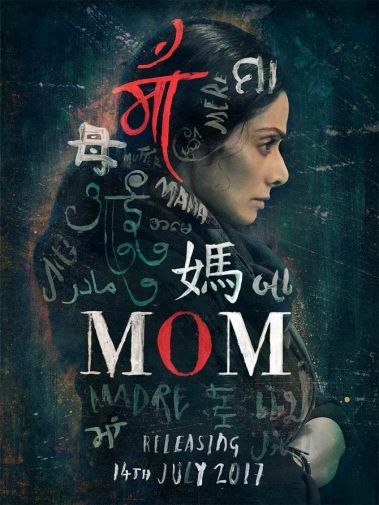
Mom (2017)

Mom

Mom starts out with an interesting take on the step-mother/daughter relationship but takes a turn midway to end as a standard revenge film with a haphazard second half and an overly mawkish finale. Thankfully Sridevi is outstanding as the mother hell-bent on revenge, and Sajal Ali, Nawazuddin Siddiqui and the rest of the cast are all excellent, making Mom better than average, despite the film’s flaws.

The first half of the film explores the tension between Devki Sabarwal (Sridevi) and her step-daughter Arya (Sajal Ali). Arya is the daughter of Anand (Adnan Siddique) and his first wife, and she bitterly resents Devki for taking her father away from her and her memories of her dead mother. Although Devki and Anand have been married long enough to have a child of their own, Arya still isn’t reconciled to her step-mother and the resulting acrimony affects every moment the family spends together. Adding to the tension is the fact that Devki is a teacher and Arya is a student in her class which allows Arya to continue the teacher/student formality even when they are at home by always addressing her step-mother as ‘madam’. The difficulties of dealing with a moody and resentful teenager are compounded by Arya’s animosity towards her stepmother, while Anand is caught in the middle trying to keep the peace. Generally Anand is a passive character who drifts along seemingly not too bothered by his daughter’s rudeness which I presume is to allow Devki the space to take centre stage later in the film. However, the relationship between Devki and her step-daughter is handled well with the family dynamic appearing authentic and the dialogues realistic, and perhaps it’s not too far a stretch that Anand avoids the situation at home rather than getting too involved.

Everything changes one night when 18-year-old Arya goes to a Valentine’s Day party at a farmhouse and doesn’t return home. She is abducted by four men in a black four-wheel drive, and Ravi Udyawar brilliantly builds and maintains the tension as he switches between a frantic Devki desperately trying to contact Arya by phone and horrifically effective overhead shots of the vehicle slowly cruising along deserted roads. The soundtrack adds to the sense of menace and there is a chilling, heart-stopping moment as the car stops and the men change who is driving. It’s horrifying because we know what is happening but all the more effective as nothing is ever shown of the violence until Arya is dumped at the side of the road.

Reading about the film and watching the trailer I was worried that Mom might go down the route of so many films about rape but Ravi Udyawar gets this part of the film totally right and sensitively handles an assault which is too often inappropriately sensationalised or set up to blame the victim. The anguish and despair felt by Devki is also well portrayed, as is Arya’s reaction, while for a change the police are rather more sympathetic although the process of gathering evidence does seem fatally flawed.

When the courts offer little in the way of justice, Anand puts his faith in an appeal and a more rigorous series of tests, while Devki has a more practical approach to her daughter’s rapists gaining their freedom. Anand’s reaction here does seem rather less plausible, but to some extent does fit with his earlier ‘ostrich in the sand’ approach to his daughter. Devki is aided by a private detective, Daya Shankar Kapoor aka DK (Nawazuddin Siddiqui) who is sympathetic to her mission. But with detective Mathew Francis (Akshaye Khanna) suspicious of Devki and Arya still as distant as ever, it seems that Devki has set herself an impossible task when she sets out to seek revenge.

Devki is shown as a strong character right from the beginning. She promptly and efficiently deals with an unpleasant incident in her classroom and appears determined to break down the barriers between herself and Arya, despite her step-daughter’s frosty attitude and carefully maintained distance. Sridevi looks radiant too while the scenes between her and Adnan Siddiqui have a genuine warmth and easy affection that speak of a good relationship. After the assault, her reaction to her daughter’s injuries is wonderfully histrionic but perfectly apt for the situation while her trepidation and uncertainty come across clearly as she embarks on her revenge. However, the screenplay doesn’t help here as DK insists that they meet in secret and the pair then proceed to arrange rendezvous in conspicuous public places where they speak to each other without seeming to take any precautions at all. Even the association with DK seems rather unlikely given their first meeting, but Nawazuddin Siddiqui runs with it regardless and manages to give his character plenty of appeal despite his slightly disreputable appearance. His DK is a more sympathetic character than first appears and he is excellent at conveying his own horror and understanding of the situation to Devki. The dialogue between the two tries to give some rationale for Devki’s actions and there is plenty of symbolism included during their meetings, but it’s really the performances from the two actors that allow any suspension of disbelief and make it even vaguely possible that Devki could act as she does.

Akshaye Khanna does the best he can with the role of the police officer assigned to Arya’s case but his character has little to do and doesn’t seem to know which side he should be on either. Mathew Francis seems to be a capable enough office but his investigations are only shown briefly and he never seems to be a serious threat to Devki’s plans. I also have some issues with the portrayal of transgenders and the completely evil nature of Abhimanyu Singh as one of the perpetrators which seems too over the top in a film that already has plenty of extreme emotion.

Anay Goswamy’s cinematography is excellent and the music from A.R.Rahman evocative and perfectly suited to each mood of the film. Where the film falls down is in the predictable nature of the second half and its failure to address the topical issue of violence against women except by suggesting the usual vigilante payback as the way to go. Naturally it makes for a more exciting film this way, but it would have been more satisfying to see more of the family’s reaction, more of Arya’s own story and her father’s struggle for justice. Better too, if Ravi Udyawar had stuck to the fractured relationships and the impact of assault, rather than following the well-trodden path of failed justice and pay-back. Even the scenes of revenge (as clichéd as they are) are glossed over swiftly and the police investigation relegated to a few brief dialogues with a bizarre about-face by Detective Mathew Francis appearing out of the blue, just in time for the film climax. Sridevi is always worth watching, but her co-stars here are all equally good, even though Girish Kohli’s screenplay limits their contribution to the story. Worth watching for the excellent performances, technically good presentation and well executed first half, just don’t expect anything more than a typical masala ending.
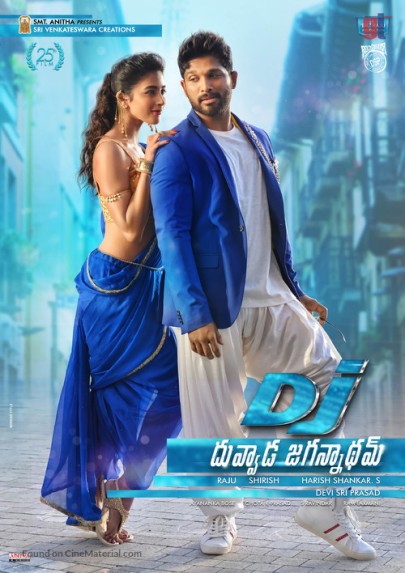
Duvvada Jagannadham (2017)

duvvada jagannadham poster

In his latest release Harish Shankar sticks closely to the standard formula for Telugu hero-centric films, which makes Duvvada Jagannadham rather less exciting than it could have been. There is hardly any suspense and few surprises as the hero flexes his muscles, obliterates the bad guys and romances the heroine while recouping lost money for the victims of a property scam. What makes it watchable are the excellent performances from Allu Arjun, Rao Ramesh and Subbaraju who add life and energy to an otherwise pedestrian plot. The story might be plodding along, but the cast give it their all, and with many other veteran performers including Murali Sharma and Posani Krishna Murali, and some good songs, DJ ends up as a reasonable timepass.

The story opens with a young Duvvada Jagannadham Sastry picking up a gun and executing a gang of thugs who attack policeman Purushottham (Murali Sharma) in his local market. Not content with his body count so far, he then turns the gun on a suspected rapist in the police station and shoots him too. Bizarrely the police officer in question rapidly recovers from his previously incapacitating wound and then doesn’t bat an eyelid at the young multiple murderer, instead enlisting him as a vigilante in his never-ending war against crime. Because of course there is nothing abnormal about a young boy killing in cold blood (and also being a fantastic shot) – not in this film at any rate.

Moving quickly among to the present day and Duvvada Jagannadham (Allu Arjun), aka Sastry is a Brahmin priest who runs an all-vegetarian catering business in Vijayawada along with various members of his family. Sastry is devout, speaks in very precise Telugu and is passionate about his cooking, although he doesn’t take life too seriously as demonstrated by a recurring joke about using asafoetida in tamarind rice. Bunny is good here, particularly with the comedy scenes and dialogue, while the trio of Sastry, his father (Tanikella Bharani) and uncle (Chandramohan) make a good team as they feed the hungry hordes of wedding guests around Vijayawada.

However, when Sastry answers his phone he becomes a totally different person – his posture is different, his voice deeper and the language less classical. Going by the name of DJ, Sastry’s alter ego is still a vigilante killer working for Purushottham eliminating criminals permanently from the streets of Hyderabad. DJ is super stylish and ultra cool, which ensures that Bunny remains ‘the stylish star’ despite spending much of the film in more traditional attire. Naturally DJ is also an accomplished killer, although quite where he learnt his skills is as much of a mystery as his motivation to cleanse Hyderabad of all criminals. The action scenes here are all beautifully choreographed by Ram Lakshman and Bunny carries out the various impalings, defenestrations and executions as smoothly and effortlessly as he performs his dance routines, and with just as much style. Sadly, there isn’t much else to the character of DJ beyond the dapper surface and efficient bloodshed. There is no rationale behind why his character is driven to such violence, particularly since he has been raised as a priest and generally seems to be a kind-hearted and benevolent priest at that. There is a brief comment by his father at the start, questioning why his son has so much rage, but this is not explored at all, and of course Sastry never shows any sign of the explosive ferocity that is characteristic of DJ.

Naturally there is also a heroine, and as might be expected from the formulaic plot, Pooja Hegde’s presence is completely superfluous to the story with her only purpose seemingly to be to appear in as many skimpy costumes as possible and dance in a few songs. The brazen character of Pooja seems unlikely to appeal to the traditionally minded Sastry, and although her designer credentials might interest DJ, her nasty, childish behaviour when they first meet is unlikely to impress. The camera spends more time focused on Pooja’s navel than on her face and it’s a shame that the only real emotion she gets a chance to display is when she’s shopping in Abu Dhabi – her excitement here is the only genuine moment her character has throughout the entire film. Still, she does look stunning, and has good chemistry with Bunny in the songs, but it’s a shame that she has no opportunity to do anything more.

DJ becomes personally involved in the case of a property scam where the real criminal Royyala Naidu (Rao Ramesh) hides behind a proxy (played by Prabhakar). Royyala’s son Chintu (Subbaraju) also becomes involved when Royyala conspires with Pooja’s father Minister Kusuman (Posani Krishna Murali) to marry their respective children. Subbaraju is excellent as a crook with an unusual idiosyncrasy, particularly in the final showdown with DJ and Royyala.

Throughout the film Bunny excels with his comedic dialogue as Sastry and does a good job of keeping the two sides of his character quite separate and different. As always his dancing is superb on every level and I did appreciate his collection of sparkly sneakers in various colours too. Devi Sri Prasad’s songs are good, although the song sequences aren’t connected to the plot of the film and seem to be simply added in as part of the standard formula – “fight scene/ family scene/ romantic moment/ song”, and repeat. However, the dance sequences add in energy and give Pooja and Sastry/DJ a chance to develop their romance that otherwise appears rather lacklustre.

Duvvada Jagannadham is disappointing, but the action sequences are impressive, the songs are excellent and Bunny is always watchable. There are some good dialogues that were well appreciated by the audience here in Melbourne, and the comedy with Bunny, Vennela Kishore as his cousin Vighneswara Sastry and the rest of the family is generally pretty funny. The major issue here is the formulaic plot and uninspiring screenplay that feels dull despite the good performances from the cast. However it’s not all bad and there are some scenes that work very well, it’s just that it doesn’t all gel together as it should. Worth watching for Bunny, the songs and the action, just don’t expect too much from the plot.

Rangoon (2017)

Rangoon poster

Rajkumar Periasamy’s debut film is a crime thriller that mixes gold smuggling and kidnapping with friendship and betrayal to tell the story of Venkat (Gautham Karthik) and his two friends Kumaran (Lallu) and Tip Top (Daniel Annie Pope). The film moves between the lush landscapes of Myanmar with vibrantly green fields, sparkling water and gigantic gold Buddhas, to the crowded backstreets of Chennai and the Burmese area of the city near Sowcarpet. There is plenty of fascinating detail about the Burmese Tamil population that adds more layers into a story made engaging by numerous twists and good action sequences. Rajkumar Periasamy packs a lot into the run time of just over 2 hours and with the stunning scenery and excellent soundtrack it’s definitely well worth a watch.

The story starts with a young Venkat as he makes the move with his mother and sister from Myanmar to India, where his father has found work. The year is 1988 and the family move to a mainly Burmese Indian area of Chennai where the food is familiar and the locals all have a similar story to tell. Venkat immediately makes friends with Kumaran when he sees him playing Venkat’s favourite game of Chinlone and the two quickly become inseparable, especially after Venkat’s father is tragically killed shortly after their arrival in the city. Venkat grows into a fairly typical unemployed young man who worries his mother and amuses his friends, but there is little work in his area and his disillusionment means he jumps at the chance of a job when Kumaran introduces him to local gold merchant Gunaseela (Siddique).

However, all is not as it seems and in reality Gunaseela is a gold smuggler who is impressed by Venkat’s enthusiasm and business skills. Gunaseela slowly draws Venkat into the business by taking him to Singapore and showing him the basics of the smuggling trade. Venkat is given the responsibility of looking after his own shop and Gunaseela uses Venkat’s sense of responsibility and loyalty to further draw him into the illegal business. However, despite the shady method used to get the gold, the responsibility turns out to be the making of Venkat and he runs his shop as ethically as he can under the circumstances. It’s the small details Periasamy adds that make this part of the film so convincing, such as the way money is transferred to the dealers in Singapore via a totally unrelated shop and the various methods by which Gunaseela’s gold biscuits are smuggled into the country. The brashness of the smugglers and their nonchalant attitude to the police also ring true while a gold traders association where Gunaseela is a member is as dodgy as they come.

Where the film falls down though, is in the introduction of Natasha (Sana Makbul) as the love interest whose attractions are such that Venkat vows to turn respectable and give up the smuggling trade for good. Natasha is a singer and Venkat notices her when she sings the first lines of her song in Burmese. But Natasha’s background isn’t explored in any detail, and instead, as is usual for heroines in Tamil film, once she is established as the reason for Venkat’s decision to change his career, she is rapidly side-lined and only appears to act as a voice of conscience whenever one is needed. Venkat’s friends too get little in the way of character development which becomes something of a problem later on when the three head to Myanmar for one last big deal. Their motivations for coming on the trip are rather murky and some of the reactions don’t ring true, mainly because it’s hard to decide how they should be reacting, given the little that has been shown of their personalities. However, although most of the characterisations are superficial, both Venkat and Gunaseela fare rather better, and their relationship in particular is nicely explored with enough emotion to make it feel authentic and plausible.

There are some excellent twists in the second half but the fast-paced action takes centre stage and the film loses some coherence as characters appear and disappear before their relationship to the plot is established. However, the action is exciting and often unpredictable while the fight scenes are well choreographed, even if very much in the usual ‘hero beats unlimited number of attackers despite being unarmed’ style. The chase sequences where the police and Directorate of Revenue Intelligence attempt to catch Venkat and his friends are also excellent and the tension rises nicely as Venkat starts to run out of time to solve his problems, and his friends and family start to suffer as a consequence. The plot twists are well handled too, and are frequently unexpected, almost shocking at times, which adds to the tension of the second half.

Gautham Karthik really is good here and gets his emotional reactions just right, particularly when he returns to the land of his birth. His confusion and despair later on is perfectly done and fits well with his character’s loyalty and determination to ‘do the right thing’. He does have a voice-over which is occasionally annoying as the dialogue doesn’t relate well to the action taking place onscreen, although that may be a subtitle issue (I’m not convinced though, as generally the subtitles for Rangoon were excellent and included English idioms and slang terms appropriately). What works best is his relationship with Gunaseela and the father/son rapport they develop. This is helped by the jealous reactions of Gunaseela’s right hand man who lingers in the background as an ever-present threat, while Siddique is smooth and supportive right up until things don’t go his way.

The rest of the cast are good and although Lallu and Daniel Annie Pope don’t get a lot to do until the second half, once they get a chance both are impressive despite their limited dialogue. The background music and songs from Vishal Chandrasekhar and Vikram RH fit well into the film while Anish Tharun Kumar does an excellent job with the cinematography ensuring an exotic feel to the portions set in Burma and Singapore while keeping a local and more homely feel to Chennai. Plus there are lots of shots of the food which looks amazing!

Rangoon

The story of Rangoon is excellent and the action well integrated into the screenplay, but the film really didn’t need the romance which comes across as a commercial gimmick without adding anything important other than a couple of good songs. The support characters too needed more time onscreen together to develop their relationships with each other and the major characters, but the two main characters of Venkat and Gunaseela more than make up for these minor flaws, while the film’s various twists keep it entertaining right up to the end. I really enjoyed Rangoon with its mix of drama, action and thrills, and the different landscapes and detailed settings kept the background interesting and realistic. Recommended for the twisty plot, good performances and fast-paced second half.