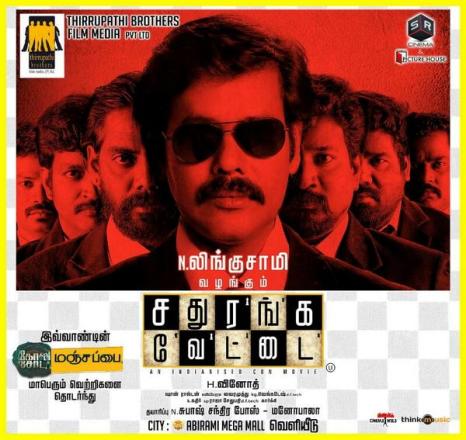
Sathuranga Vettai

sathuranga vettai poster

H. Vinoth’s Sathuranga Vettai is an amusing crime caper that follows the exploits of con-man Gandhi Babu as he persuades a large number of gullible people to part with their cash. Naturally, this does not come without consequences and the later part of the film deals with Gandhi’s redemption and his attempts to break free from his life of crime. This is an impressive début for H. Vinoth and despite a tendency to veer into overly dramatic territory towards the end, the film well worth watching for some great dialogue, good characterisations and Natarajan Subramaniam and Ishaara Nair in the lead roles.

The film is divided into different chapters, each describing a con run by Gandhi Babu (Natarajan Subramaniam) and his merry band of helpers, Guru (Dharani Vasudevan), Kumar and Selvam. The first starts with Gandhi and his gang persuading businessman Chettiyar (Ilavarasu) to buy a rare snake which, they tell him, can be sold on at a much higher price. Of course, the snake is a pig in a poke and is anything but rare, but what is more surprising is how superstitious and gullible Chettiyar is, given that he is supposedly a rich businessman with thriving rental and retail investments. I found it hard to believe that he would really believe that a snake could understand him and lose weight because it was homesick, but it did make for some great comedy in the first few scenes. The film also quickly introduces Gandhi’s simple philosophy – the easiest way to deceive people is to find those who are greedy and want to make a fast buck and in his defence, there does seem to be plenty of greedy people out there.

The second con is better realised and seems rather more plausible. This time Gandhi and his followers set up a mass marketing Ponzi scheme selling miracle water to gullible investors. A young woman, Bhanu (Ishaara Nair) approaches Gandhi for a job as she cannot afford to invest in the scheme and Gandhi immediately sees her potential. Her innocence and flair for persuading others to invest makes Bhanu a valuable asset for the gang, but she has no idea that they are all snake-oil salesmen and that their venture is all a con. Gandhi’s seeming altruism leads Bhanu to start to fall in love with the con-artist but once his true activities are revealed, Bhanu is left to deal with the aftermath as Gandhi and his gang skip town with the money.

The next con sees Gandhi arrested and jailed for his crimes. While he is tortured by the police, his gang work hard to bribe the various complainants and ensure Gandhi’s release.

Although their efforts pay off, Gandhi is kidnapped by a gang lead by Vallavan (Vallavan) who have been employed by one of the victims of Gandhi’s previous con. Suddenly the fruits of Gandhi’s criminal past are brought home to cause him more problems and the only way he can escape the gang is to work another con for them. After a convoluted series of deals and double deals Gandhi manages to escape and finds Bhanu who still has feelings for him. But the gang is still on the look-out for Gandhi and his idyllic life with Bhanu is shattered once Vallavan and Senthil catch up with the couple and force Gandhi to carry out one last con.

The story is a good blend of action and drama, with enough comedy to keep the proceedings from ever getting too serious. The final scenes are overly melodramatic as Bhanu goes in to labour while gang member Thillagar (Ramachandran Durairaj) is told to kill her as the rest of the gang force Gandhi to dig his own grave. However, the rest of the film isn’t quite so theatrical, and some of the cons are entirely plausible and seem quite realistically portrayed.

Natarajan Subramaniam is excellent in the lead role and seems perfectly cast as the smooth-tongued salesman with the gift of the gab. He dons different disguises and different accents as part of the role, while his ability to appear cold and calculating works well to give the character credibility. It makes his gradual change of heart once he finds Bhanu and slow realisation that there could be another way of life seem more plausible. H. Vinod gives Gandhi a tragic back story which didn’t seem to be totally necessary but again does make his final redemption more likely, given that up to his meeting with Bhanu his general philosophy is that nothing you do is wrong as long as you don’t feel guilty. His early experiences, described here in animation, do at least give Gandhi an emotional response to work with and overcome his otherwise cold persona. One of the best things about Gandhi’s character is that although he is a criminal, he is totally hopeless when it comes to physical violence. As a change for the usual ‘hero’ in this type of role, Gandhi is regularly beaten up and has no capacity to defend himself whatsoever outside a verbal stoush. That seems quite likely for someone who relies on his wits and ability to run and makes Gandhi a more sympathetic character than expected.

Ishaara Nair is also excellent although at times her character does seem a little too good to be true. She has good onscreen chemistry with Natarajan and the two work well together as a couple, even if for much of the time I felt that Bhanu was much too good for him and deserved more. The rest of Gandhi’s gang are good, particularly as sellers of the miraculous magic pearls, although they have limited screen time. Vallavan and his gang have more to do, and Ramachandran in particular is excellent as a gangster with a heart, even though he keeps it well hidden from the rest of the gang.

Overall this is a clever and rather different film that relies on good writing and excellent characterisations to tell an engaging story. The sheer ordinariness of the characters works in their favour and the simple con schemes are plausible enough to keep the story more realistic than most. The music from Seth Rogan mostly fits well into the narrative with the songs featured on Bhanu and Gandhi’s relationship, apart from one early in the film that’s set in a bar that doesn’t work quite as well. K.G. Venkatesh ensures the film looks good too with plenty of beautiful shots of the countryside surrounding Madurai. H. Vinoth has delivered an excellent first film that delivers in terms of both story and characters. 4 stars.

Chotushkone (2014)

chotushkone poster

I love this film! It’s such a perfect integration of story, characters, location and music that unfolds seamlessly, often unexpectedly, to deliver an excellent dramatic thriller. Srijit Mukherji’s screenplay weaves in and out of present and past with a story of four separate directors en route to meet a director with ideas for a new film. It’s clever and engaging, even more so on second or third watch when it’s easier to appreciate the detailed clues that were missed first time around. Chotushkone won several National Awards and is one of those ‘must-see’ films that really is much better onscreen than it sounds on paper.

My favourite thing about Chotushkone is cinematographer Sudeep Chatterjee’s use of light and colour to enhance every scene. The film starts in sepia, but there are portions in black and white, and when the directors each narrate their idea for a screenplay, the action takes place coloured red, blue and green. Each scene has so much detail that I keep pausing my DVD to fully appreciate the set dressing and how appropriate each element is for that stage of the drama. Literally every time I watch this film I spot something new!

It’s also gorgeously filmed throughout. Every shot has wonderful balance of light and shade and Sudeep uses interesting combinations of objects and shadows to frame his subjects. In fact, the first time I watched the film I almost lost track of the plot as I was so invested in the look of the film, but fortunately the actors are all fantastic and the story becomes completely gripping after the slow build-up that introduces the characters. It’s a wonderful visual feast, but the film also excels in the soundtrack with Anupam Roy providing beautiful music that fits the screenplay and enhances the action without ever becoming intrusive or distracting. This is my favourite, but all of the songs are lovely and I’ve been addicted to the soundtrack since watching the film.

The film opens with a suicide set in an opulently decorated house that appears to have fallen on hard times. The furnishings are exquisite but the wall paper is peeling and there is a general air of decay. The staging of these opening scenes is beautifully done, starting with the elegant writing of a letter using a fountain pen and ending with the discovery of the body, with sepia tint delivering a timelessness to the images. It’s not clear whether the opening events take place prior to the next scene, or after, or even if they are related at all, given that the story moves on to different characters in a bar and is shot in black and white. However gradually all the pieces come together and the different components of the story build into a comprehensive whole.

Joyobroto (Parambrata Chatterjee) is a young film maker who has negotiated with Mr Gupta (Koushik Ganguly) to produce a new film composed of four separate short stories by different directors. The only condition is that each film has to address the theme of death. Joy approaches three older and well-known directors to take part in the exercise, although in some cases it takes his considerable powers of persuasion to get agreement. Trina Sen (Aparna Sen) was once a famous actor but has moved on to directing films, Sakyo (Goutam Ghose) is an award-winning director of art-house films while Dipto (Chiranjeet Chakraborty) has made a couple of commercial potboilers after he too had a career as a cinematographer and then actor. As they start their road-trip together the previous relationships between Trina, Dipto and Sakyo become clear and the possibility for disaster looms large given the old arguments that still scent the air.

As the four travel they each relate their individual stories for the film. Each story is good as a tale that involves death, but there is plenty of symbolism in each as well (Dipto’s protagonist who is literally ‘dying’ for a cigarette, when all the while there is the censor’s ‘smoking kills’ message at the bottom of the screen) and Srijit appears to be telling a series of stories within the concept of making a movie which itself is composed of a series of stories. It’s a veritable labyrinth as the black and white portions of the film are also telling another story – that of Nilanjana (Payel Sarkar), Ritwik (Indrasish Roy) and Amitava (Rahul Banerjee) who are also all making a film together. The beauty of Chotushkone is that this all makes sense within the concept of the overall plot, while gradually the big picture emerges from the different strands. There are a couple of side stories that add more background to the characters – that of Trina and her husband (Barun Chandra), Sakyo and his daughter who is pushing him to make his latest deadline and Dipto’s son (Anindya Chatterjee) who is at loggerheads with his father about Dipto’s romance with Mimi (Koneenica Banerjee), a woman half his age.

The cast are all excellent and fit into their roles well. Aparna Sen has a world-weary attitude that suits her character while Chiranjeet Chakraborty and Goutam Ghose play well off each other as the two friends with quite different attitudes to film-making. Each has their own foibles that make them realistic characters and their easy relationship speaks of their long-time friendship. Parambrata Chatterjee is superb as the glue that holds everyone together despite the bickering and complaining, and perfectly suits the persona of a younger film director trying to keep his idea alive while dealing with three quite prickly personalities. Koushik Ganguly also stands out in his small but effective role as the film’s potential producer, particularly at the end of the film when all is revealed.

This really is a beautifully made film that tells a good story using a novel approach. There is plenty of sub-text to chew over on repeated viewings while good performances from the cast ensure the film is engaging at all levels from start to finish. It does start rather slowly, but the intricate framing of each scene helps keep the film interesting and once the main characters are introduced the film is completely mesmerising. I thoroughly enjoyed Chotushkone and the more I’ve read about the actors and the industry the more I appreciate just how much Srijit Mukherji has managed to fit in to his screenplay. Highly recommended for a detailed and engrossing thriller that ticks all the boxes. 5 stars.

Ittefaq (2017)

Ittefaq poster

In this 2017 version of Ittefaq, Abhay Chopra takes elements from the 1969 original and spins them into a police procedural that ticks most of the boxes. There are two conflicting stories that police detective Dev (Akshaye Khanna) has to unravel to find the identity of the killer, but he only has three days to solve the puzzle before he has to let his main suspect walk free. There is a good amount of suspense in this stylish thriller and a better than average story, but it’s Akshaye Khanna as the determined detective that makes Ittefaq worth watching on the big screen.

The film starts with a car chase as famous UK writer Vikram Sethi (Sidharth Malhotra) attempts to escape the Colaba police force, who want to bring him in for questioning over the suspicious death of his wife. They finally catch him in an apartment belonging to a lawyer, Shekhar and his wife Maya (Sonakshi Sinha), but when the police arrive they find Shekhar has been murdered and Vikram is standing over the body. Dev (Akshaye Khanna) is called in to investigate the death of Vikram’s wife Katherine (Kimberley Louisa McBeath) and Shekhar’s murder, with Vikram the prime suspect.

Vikram and Maya both have quite different stories of what happened in the apartment and each version is shown in Rashomon style flashback as Dev asks the relevant questions. Maya tells a story of being held in her apartment by a violent and agitated Vikram before her husband arrived, saving her but ultimately being murdered by Vikram. Vikram on the other hand explains how he was injured after his car crashed and was looking for help, but Maya acted suspiciously from the start. It’s an interesting puzzle that relies on the credibility of each witness and how believable their respective stories appear.

The first half builds suspense as Vikram and Maya recount their version of events while the police search for the truth. For a change, the police aren’t the usual vicious thugs or bumbling incompetents, although there is some comedy relating to the police officers who are first on scene at the murder. However, the comedy here is well thought out and gives the subordinates personality that ultimately makes the film more interesting – making tea at a crime scene, snacking on soaked almonds and joking about a guard dog are all relatively normal activities that contrast with the strange events of the crime.  While Dev barks out questions and mulls over the evidence with the forensics technician, his police officers are changing the light bulb in Vikram’s cell and discussing their views on the murders – which all helps to cloud the truth. The various red herrings and clues scattered through the dialogue work well to further deepen the mystery and the addition of a suicide potentially linked to Vikram and his wife add more potential suspects that Dev has to investigate.

After a good first half, the second has a few more issues as a number of holes start to appear in the narrative. Dev’s piecemeal questioning of Vikram and Maya over the three days doesn’t stand-up to expected police procedure while a possible witness in Maya’s maid seems to go nowhere, but despite these shortcomings, the final outcome remains in doubt right up to the climax and big reveal. Part of this is due to the excellent poker faces from Siddharth and Sonakshi whenever they are interviewed by Dev. Both seem equally credible, and the switch between the two respective views in the flashbacks muddies the waters further. Sonakshi appears furtive and ill at ease during Vikram’s account, while in her own flashback sequences she is every bit the terrified woman held hostage in her apartment. Siddharth too is excellent as he switches between violent intruder and frantic victim while appearing completely sincere and totally devastated by his wife’s death during his interrogation. Of the two, Sonakshi’s character has less dialogue and isn’t as well developed, but both actors are good in their respective roles and manage to make their characters a believable witness and a plausible suspect depending on the viewpoint.

Akshaye Khanna is wonderful as Dev, playing the character fairly straight but with the intensity that’s expected from any fictional detective. Abhay Chopra gives him some background too by adding in a few crucial moments between Dev and his wife (Mandira Bedi) that allow a more human side to his character and lighten the mood when the drama threatens to get too repetitive. Akshaye also gets some of the best dialogue which works to ensure Dev appears as a detective who is smart enough to solve the crime despite the dual handicaps of his less than stellar associates and the restricted time he has to work on the case. It’s great to see Akshaye back in a role that plays to his strengths and he is charismatic and convincing as Dev, while ensuring that the focus is on the investigation, rather than simply the character.

Michal Luka helps create atmosphere by some excellent use of lighting, both in the flashback sequences and during the investigation, while the background music from Tanishk Bagchi adds to the mood without being intrusive. The running time is fairly short too at only 107 minutes, which means Abhay Chopra has to move the story along and establish the characters quickly, all of which helps to add tension although ultimately not quite as much as the story needs. The end too isn’t quite as satisfying as expected, although it is surprising with a clever break in the case that comes from a more unexpected direction. Overall Ittefaq does keep you guessing and although you may not be on the edge of your seat throughout, it’s still a respectable enough thriller with solid performances and good twists. Worth watching as a reminder of just how good Akshaye Khanna can be and then wonder why on Earth we don’t get to see him more often!