
Geetha Govindam (2018)

Geetha Govindam

Parasuram’s Geetha Govindam takes a while to get going, but once it’s up and running, this romantic comedy is better than expected, mostly due to the excellent performances from Vijay Deverakonda and Rashmika Mandanna. It also helps that the heroine is a strong character who doesn’t get repeatedly shunted aside by the hero, and that the story takes an alternative approach to the usual stalker plot. Add in some catchy songs, another good performance from Rahul Ramakrishna, and Geetha Govindam is definitely well worth a watch.

The film starts with Vijay Govind (Vijay Deverakonda) relating the story of his romance to a passer-by (Nithya Menen) as she waits for her car to be repaired. This seem to be a rather outdated way to introduce the story, but there is a reason for Nithya’s character, although that isn’t clear until the very end of the film. However, instead of diving right into the story, there is a prolonged and rather slow introduction that sets up Vijay’s character. For the most part he’s a fairly typical young bloke who enjoys hanging out and drinking with his friends, but Vijay also has a rather idealised view of marriage that makes him appear naïve and innocent. That doesn’t stop him following a girl and staging a mock fight scene in an attempt to make her fall for him, but he’s also flustered by the amorous advances of one of his students at the local college where he teaches. Vijay also has a bad habit of listening to his friend Krishna (Rahul Ramakrishna) who has a rather more direct approach to women and acts as the devil on Vijay’s shoulder, enticing him into bad decisions. The angel on Vijay’s other shoulder is his father (Naga Babu) who has brought him up to respect women and act responsibly. The question here is which voice Vijay will follow when he sees Geetha (Rashmika Mandanna) in a temple and is instantly attracted.

After a less than auspicious start, Vijay’s luck turns when he’s travelling home for his sister’s engagement and Geetha ends up on the same bus. Unfortunately for Vijay, Geetha still isn’t in the slightest bit interested and when he starts to talk to her on the bus she shuts him down immediately, calling him out for asking stupid questions. I love this interaction as Geetha demonstrates she won’t take any nonsense from Vijay and that she is quite able to stand up for herself.  A partial softening on her stance as the journey goes on, is abruptly banished when Vijay does something stupid, egged on by the drunken ramblings of his friend Krishna. From here, things go seriously downhill, made even worse when it turns out that Geetha’s brother Phaneendra (Subbaraju) is engaged to be married to Govind’s sister (Mouryani). Geetha wants her brother to avenge her honour and Phaneendra is out for blood while Vijay’s father asserts that he would literally die if Vijay ever did anything to smirch his reputation. Vijay now has a serious problem on his hands. Worse still, he has to rely on Geetha not revealing the true story, when she has every reason to shame Vijay in front of his family.  To add to his woes, Vijay and Geetha are tasked with delivering the invitations and doing all the shopping for the wedding, which throws them together repeatedly back in Hyderabad.

Geetha thinks that Vijay is an irresponsible womaniser and sees evidence of his debauchery everywhere. Vijay on the other hand is desperate to prove that he’s actually a nice guy and that everything that happened was an accident. This gives plenty of opportunity for some excellent comedy but still allows the point to be made that Geetha has every right to be angry and upset – a point which Vijay also acknowledges. His continual ‘Madam’ and ‘sorry’ are used to good effect as is his claim that he did not mean it wantedly (I think the subtitles meant wantonly which would make more sense!).

The friction between Vijay and Geetha works well due to excellent chemistry between the two actors. Rashmika is perfect as an angry young woman who sees no reason to believe anything her brother-in-law-to-be says and her responses to his protestations of innocence are delivered with just the right amount of distain. Rashmika is just as good here as she was in Kirik Party with the added bonus that she is onscreen for the entire film here. Naturally she does start to fall for Vijay – with all that charm and a very cute smile, it would be hard to resist, but Rashmika ensures her characters change of heart is kept convincing and reasonably plausible. Even if all it takes is 1 explanation and a song.

Vijay Deverakonda completely sheds his Arjun Reddy persona and totally owns the film as a man desperate to redeem himself in the eyes of the girl he really likes while making sure he doesn’t incur the wrath of her brother or jeopardise his sister’s wedding. There is some excellent comedy here as Vijay wriggles and grovels, willing to try almost anything to prove to Geetha that he’s not the man she thinks he is. While it’s impressive that Parasuram manages to take a fairly standard character and bring something new to the story, Vijay really takes on all of his characters failings and makes them believable. There is really no rational explanation why the nice and well brought up Vijay would do some of the things suggested by Krishna, but Vijay Deverakonda makes it seem not only plausible but perfectly logical nonetheless.

While the relationship between Geetha and Vijay is well done, there are a few misses in the film too. Vennela Kishore pops up as a potential bridegroom for Geetha, but his character is oddly written and doesn’t fit well into the rest of the story. The slow introduction is also an issue and there are a few scenes that are just too unlikely to work. These end up as distractions rather than adding to the story, and as a result some of the second half feels overly long and drawn out. Adding Nithya Menon’s character to a frame narrative is also an odd choice and really not necessary while a few of the other characters, Ravi Prakash’s police officer for example, don’t add anything to the plot either.

Overall Geetha Govindam is funny and entertaining, while the romance is just different enough to keep the story interesting Gopi Sundar’s music is well incorporated into the film and the songs are catchy and well choreographed to show the two leads to advantage. Worth watching for Vijay’s charm and Rashmika’s confidence which make this one of the better Telugu romantic films of the year so far.
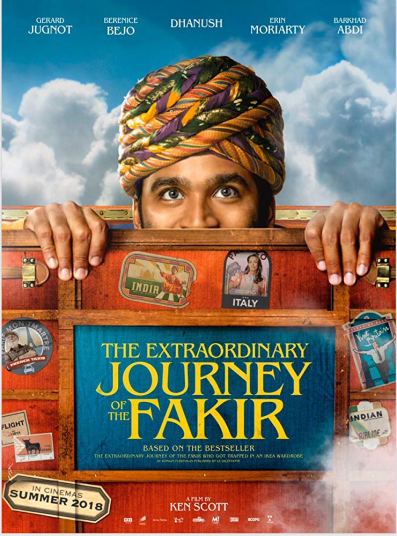
The Extraordinary Journey of the Fakir

The Extraordinary Journey of the Fakir

Ken Scott directed this joint English/French film based on Romain Puertolas’s best-selling novel with the even longer title: ‘The Extraordinary Journey of the Fakir Who Got Trapped in an Ikea Wardrobe’. Dhanush stars as Ajatashatru Lavash Patel, aka Aja, a con-man from India who embarks on a fantastic adventure across Europe while trying to get back to Paris. The film is a feel-good fantasy that’s occasionally a little too sweet and simplistic, but the colourful locations and an engaging performance from Dhanush ensure that it’s entertaining throughout. The Extraordinary Journey of the Fakir released in Melbourne as part of the Indian Film Festival after debuting in France earlier this year, and is slated for a summer release in Australia.

The film starts in India where young Aja (Hearty Singh) lives with his mother Siringh (Amrutha Sant) and drives her to distraction with constant questions about his missing father. Siringh works in the dhobi ghat and to supplement their meagre income, Aja cons tourists on the streets of Bombay. Along with his two cousins, he steals wallets and picks pockets by distracting tourist with his magic tricks. Perhaps Aja’s greatest revelation occurs when his school lessons teach him that he is in fact poor, something that had previously never occurred to him, and which totally changes his view of the world. Another critical moment comes when he picks up an Ikea catalogue in the doctor’s surgery and instantly finds the perfect ideal for his imagination. He pictures his neighbourhood just like a catalogue page and has memorised every collection despite the difficult Swedish names. Naturally then when he discovers that his father was actually a street performer from Paris, part of his wish list is to visit Ikea and finally see all the marvellous collections for real. His mother had always talked about going to Paris, so when she dies, Aja decides to finally make the trip.

Aja’s father had sent love letters to Siringh, and armed with these, his mother’s ashes and his new passport, he sets off for Paris to find his father, and to visit Ikea. By chance he meets Marie (Erin Moriarty), an America ex-pat living and working in Paris, and immediately falls in love. They arrange to meet the next evening at the Eiffel tower, but with no money, Aja elects to stay in the Ikea store overnight, and that’s where his troubles begin. He hides in a wardrobe which is subsequently shipped off to England with Aja inside. The wardrobe is part of a load in a lorry which also contains a group of illegal immigrants and reality starts to encroach on the fantasy as they describe some of their experiences and the sad fates of others who had started the journey with them.

Aja is picked up by English customs, who then send him to Spain, along with many other displaced persons they want to deport. They all end up stuck in the no-man’s land of the airport since the Spanish authorities also deny them entry. Ken Scott keeps up the whimsey with Aja but still manages to convey the despair and hopelessness of the refugees stuck in limbo while various governments argue their fate. It may be a rose-tinted version, but the rows of sleeping bags still speaks to a problem that is all too real and still current across many countries.

Aja manages to escape and travels to Italy where he meets film star Nelly (Bérénice Bejo) before falling foul of pirates and ending up in Libya. Here, he reunites with Somalian refugee Wiraj (Barkhad Abdi) before finally making his way back to Paris. His travels are all by the most unlikely methods – a suitcase, hot-air balloon and of course by wardrobe, which keeps a fantastical atmosphere to the story, while Aja’s ability to always land on his feet adds a fairy-tale quality to the tale. Dhanush keeps the child-like innocence portrayed so well by Hearty Singh, but adds some street smarts and an ability to engineer his way out of every difficulty. It’s his warm-hearted portrayal of a rather naïve con-man that makes the story magical and more than just a series of mishaps and contrived co-incidences.

There is plenty of comedy included in the adventures as Aja struggles to cope with officials, foreign customs and occasionally his own ineptitude while trying to make it back to Paris, and Marie. Dhanush is charming and perfectly cast as the well-meaning and kind-hearted magician who seems to strike bad luck at every turn. Until he improves his karma, of course. He fits into the role well, and as always puts his heart and soul into the performance, making us all want him to get back to Paris and win the girl, even though she’s rather drab and dull in comparison. Erin Moriarty is pleasant enough as the love of Aja’s life, but there is little life or sparkle in her character and it’s her friend Julie (Sarah-Jeanne Labrosse) who makes more of an impression, despite a dodgy storyline about her attempts to embrace an alternative life-style. Bérénice Bejo is much better as the Italian star and she even gets a dance routine with Dhanush, who burns up the dancefloor in his usual signature style.

Cinematographer Vincent Mathias splashes colour across the screen and makes Paris look magical, as we see it though Aja’s eyes. Italy gleams in the bright sunshine, and even Libya is colourful with all the migrants scattered across the sand dunes. There is a richness and vibrancy to every scene and the story is appealing with a good mix of comedy, adventures and magical fantasy. It is overly naïve at times, and there are rather too many chance meetings and lucky breaks for Aja, but if you want an amusing and non-taxing adventure with a feel-good storyline and charming lead, you won’t go far wrong with The Extraordinary Journey of the Fakir.

Vishwaroopam II

Vishwaroopam 2 poster

Kamal Haasan’s sequel fills in much of the backstory from Vishwaroopam and there are flashbacks a plenty as RAW Agent Wisam (Kamal Haasan) faces off again against terrorist Omar (Rahul Bose) and his dirty bomb threats. Despite all the explanation, it’s best to have seen the first film to understand the sequel, although the few brief glimpses of key scenes – the warehouse fight, Vis in full dance-instructor mode, are enough to jog the memory so a re-watch prior is not necessary. Fleshing out the background does help put everything into perspective but sadly VII has nowhere near as much finesse and style as the first film. Along with jolting between the past and present, the sequel plot doesn’t get anything like the same attention to detail and the ‘bomb’ situation in VII is over almost before it begins. However, the flash-back sequences are good, Kamal Haasan is still impressive in the action sequences and Rahul Bose is fabulous as Omar suffering the effects of radiation poisoning.

The film starts just after the end of Part 1, with Wisam (aka Vis) taking the body of Dr Dawkins back to the UK, accompanied by his wife Nirupama (Pooja Kumar), fellow agent Ashmita (Andrea Jeremiah) and his handler Colonel Jagannath (Shekhar Kapur). Once on English soil Wisam butts heads with Eshwar Iyer (Ananth Mahadevan), in charge of Indian special operations in the UK in a side plot that is never fully developed. It feels as if there are a number of scenes missing and Eshwar is another character who is gone before he’s made any impact. Of greater urgency is the terrorist’s plot to blow up the shipwrecked SS Richard Montgomery near Sheerness, which leads to a couple of well-choreographed action sequences including one underwater. Full marks for incorporating a real historical incident (the ship sank in 1944 carrying a full load of explosives and has never been fully salvaged due to the risks involved in recovery) but marks off for the lack of suspense since the mission to retrieve the terrorists’ explosive device fails to deliver any tension, despite Nirupama having to dive through the ship’s unexploded ordinance.

And that’s the problem with much of the action this time around. The hunt for Omar and Salim is side-lined for needless scenes including several suggesting some kind of jealousy between Ashmita and Nirupama. These really didn’t work at all and I can’t decide if that was due to the bad dialogue or just the body language from the two actors which suggested that they were both uncomfortable with this angle as well. The romance between Wisam and his wife also occupies far too much screen time for an action flick, especially when it’s at the expense of developing the villains of the piece, who only appear briefly towards the end. In addition, most of the scenes set in the present day appear as set pieces – short bursts of action or dialogue which don’t relate well to each other or to the flash-back sequences. On the whole the flash-backs actually work better, perhaps because they are shedding light on characters motivations and revealing what happened to key players but also because there is more energy in these scenes.

One thread that does work well in the present day is the introduction of Waheeda Rehman as Wisam’s mother. On the wall are pictures of a young Kamal Haasan and youthful Waheeda while the beautiful song Naanagiya Nadhimoolamae plays over her reminisces of her son’s dancing skills. This scene is made all the more poignant by the fact that she has Alzheimer’s disease and doesn’t recognise Wisam as her son. Waheeda Rehman is excellent and still so incredibly elegant, and it makes perfect sense that she should have taught her son all he knows about dance.

The action moves from the UK to Delhi, where finally Omar and Salim (Jaideep Ahlawat) get time onscreen, but it’s too little too late. The film suffers from not having a clear track featuring the villain in the present day, especially when Omar has already had so much presence in the flashbacks. Instead we get various, almost faceless terrorists who are dispatched quickly without too much fanfare. While there is plenty of blood and gore, most of this seems coldly clinical although there is one nicely executed sequence where a splatter of blood turns into a map. Omar’s artificial eye gets another work-out and Rahul Bose’s harsh rasp is chillingly effective, as is the make-up departments dedication to creating slowly dissolving flesh caused by radiation sickness. However, the final showdown seems almost cartoonish in its delivery and execution, especially given that it all happens so very quickly and comes to a sudden conclusion.

After the brilliance of the first film and all the hype (and long wait) for the second it was perhaps inevitable that Vishwaroopam II would fail to fully deliver. Vishwaroopam was a sophisticated spy drama with excellent special effects and clever dialogue that broke away from the more typical masala action film, while VII seems to slip back into more standard fare. While VII does retain some of the original ideas, the dialogue seems more laboured, while the central plot is buried behind the many flashbacks and explanation scenes. Although the actors all reprise their roles well, there seems to be less energy this time round and despite their greater time onscreen, the characters of Ashmita and Nirupama aren’t as well utilised in the plot. Although VII isn’t terrible the screenplay is haphazard with the plot more of an afterthought to flesh out those extra scenes that didn’t fit into the first film – and therein lies the problem. VII isn’t a film that stands up by itself and although it works as a sequel, it really needed to be more than just that.