Kolamavu Kokila

Kolamavu Kokila

Nelson’s début film is a dark comedy that unusually for Tamil cinema, has a female lead and a strongly female-centric storyline.  Nayanthara is the titular Kokila who gets caught up in the drug trade when she needs to raise some money fast, but the success of the film is really down to the strong performances from Saranya Ponvannan and Yogi Babu, along with the family dynamics which help to keep the story grounded. I did struggle a little with some of the comedy as my DVD is not subtitled and the only subs I could find online were patchy and rarely made sense, but for the most part the story is self-explanatory and relatively easy to follow.

The film starts with gangster Bhai (Hareesh Peradi) flexing his muscles and getting rid of a police officer who has been interfering with his cocaine operation. Having convinced us that the drug dealers are a vicious bunch best avoided, the film then introduces Kokila (Nayanthara) who is looking for an increase in her sales assistant salary. She’s the main breadwinner in her family as her father’s job as an ATM security job doesn’t pay well and with her sister at college, every penny counts. However, her sleazy boss suggests that the only way she will get a raise is if she meets him after work and makes it worth his while, so Kokila promptly leaves her job to look for something more rewarding. She ends up working as the manager of a massage company which pays much better and seems to have less risk of sexual harassment. But things take a turn for the worse after Kokila’s mother (Saranya Ponvannan) is diagnosed with lung cancer and the family needs to raise 15 lakhs for her treatment.

These introductory scenes work well to introduce the different characters and give a quick sense of who they are. Although Kokila’s father (R.S. Shivaji) has little part to play in proceedings, his passive acceptance of his lot in life illustrates just why the family is in the situation of needing more funds. The interactions between Kokila’s more aggressive mother (Saranya Ponvannan), her sister Shobi (Jacqueline Fernandez) and her father are excellent vignettes of domestic life. Kokila is protective of her father against the rest of the family’s dismissive comments perhaps because Kokila understands the difficulties of working in a dead-end job every day. This introduction also shows Kokila as a strong personality who stands up for herself against her boss’s sordid suggestions, but unfortunately, she loses this confidence later in the film and seems terrified of her own shadow.

Nelson doesn’t let his leading lady jump straight into the drug trade as an easy fix for her problem. Kokila tries a number of different ways to raise the money first. She speaks to relatives, asks for an advance for work and even approaches an NGO, but during a visit to a broker to see if she can sell some land, she inadvertently helps the police apprehend a drug pusher in the building. His boss, Bobby, insists that Kokila make good her mistake and sends her in to retrieve the hidden drugs. So, when all else fails, Kokila decides to approach Bobby and work as a drug mule to raise the cash for her mother’s treatment.

Bobby introduces Kokila to Mohan (Charles Vinoth), one of Bhai’s gang members, who decides that she looks innocent and unlikely to be suspected of carrying drugs, and he immediately employs her to take cocaine to his partner Alphonse (Rajendran). However a number of close shaves with the police lead Kokila to decide she wants out of the operation, but of course it’s much harder to leave than it is to join the business. Finally, after an altercation with Mohan, Bobby comes up with a final delivery of 300kg of cocaine that Kokila must deliver before she can leave.

What makes the film work so well are the peripheral characters. The story starts off well, but a combination of unlikely scenarios and a few too many coincidences mar the second half. Also, Kokila seems way to meek and nervous to ever go against the gangsters so it doesn’t make sense that she would take such tremendous risks and try to beat them at their own game. Nayahthara always has the same expression, downcast eyes and a stammering voice when dealing with Mohan and Bhai, and this continual overly meek appearance that ensures that there is very little tension or suspense as the story unfolds. There is never any glimpse into what Kokila is really thinking, and although she deceives the gangsters it seems to be almost by accident, since she always seems so scared of everyone. I wish there had been some acknowledgment of her plans and visible reactions from her when she did outsmart the gangsters which would have put an entirely different spin on the whole shenanigans. Instead it’s Saranya Ponvannan who steps up and really makes her presence felt as a determined and very capable ally in Kokila’s fight against the gangs. She’s scared but feisty and steps out of her usual mother role to play a very competent scam artist! She is the strong character here, and I love how she deals with potential rapists while the rest of the family appear shell shocked by her capacity for violence. It’s a brilliant portrayal that literally saves the second half of the film.

Yogu Babu is also excellent here and he provides most of the comedy in the first half, first appearing as grocery store owner Sekar who is in love with Kokila and is determined to marry her. Although much is made of his appearance and the unlikely match-up between him and Kokila, the real jokes start when Sekar gets mixed up in the family’s attempts to deliver the 300kg of drugs. Also dragged in is Shobi’s suitor Lakshman Kumar (Anbu Thasan) who mostly seems mentally deranged to me but that could be partly due to the lack of subtitles.

The character of Shekar fits well into the narrative and  Yogi Babu has perfect comedy timing, particularly when he realises exactly what is happening and the danger he has mistakenly stumbled into. I also love this song where he declares his love for Kokila. A brilliant tune from Anirudh and simply perfect choreography!

The film looks incredibly stylish and cinematographer Sivakumar Vijayan sets up each frame beautifully. He contrasts colour and shape to produce some stunning images while still capturing Kokila’s reluctance to smuggle drugs and her family’s desperation. The images are also an excellent contrast to the sleazy world of drugs and the grubby men involved in the trade. Nelson uses these contrasts to good effect, and if only the character of Kokila had had the same light and shade this would have been a much better film. Instead, while there are many excellent individual scenes in the film, overall it starts to drag towards the end when the interactions between Kokila and the various gang members become repetitive and less convincing. On the plus side though, Nayathara is excellent in scenes with her family and in the first half her characterisation works well with the story. Also good is Anirudh Ravichander’s soundtrack and I really love the songs here. There is a good mix of haunting melody and more upbeat music, including the excellent Kabishabaa Coco (aka the gibberish song!)

Although Kolamavu Kokila isn’t perfect, there is enough here to make it a worthwhile watch. Using a heroine instead of a hero is inspired and the black comedy around the central figure of Kokila works well. There is a good story here and it just needed a little more variation in Kokila’s character to give it some extra tension and suspense which would make it a great story. Despite the one note in her characterisation, Nayanthara holds the film together well and does make an empathetic central character. As a début film it’s definitely better than average and well worth catching for Nayanthara, Yogi Babu, Saranya Ponvannan and the awesome soundtrack. 3 ½ stars.


Kolamavu Kokila

Vinaya Vidheya Rama (2019)

vinaya vidheya rama

Boyapati Srinu specialises in films that are all action and little plot, but even by his standards Vinaya Vidheya Rama is a nonsensical mess. The film has zero logic and even less of a story than usual, along with a completely muddled-up timeline and ludicrously impossible situations. I don’t expect much logic from mass masala movies but I can appreciate their usually well-choreographed fight scenes, good music and memorable choreography, but even all of these fall significantly short in this overlong, systematic bloodbath of a film. A quick perusal of the plot (such as it is) makes it seem that Vinaya Vidheya Rama might fall into the ‘so-bad-it’s-good’ category, but it misses this too by a mile, and not even the best efforts of Ram Charan can save the film from being anything other than a drearily predictable watch.

The opening scenes are also the best and since they almost make sense the film initially lulls you into a false sense of anticipation. Four orphans living on the railway in Vizag find a baby and on discovering he has been bitten by ants and also apparently has a head injury, they take the infant to a local hospital. Amazingly they’re allowed in, don’t have to wait and receive excellent care and attention from the attending medical staff with the eventual outcome that the doctor (Chalapathi Rao) adopts all five children. The four kids decide to send Rama to school while they raise the money to keep him there, but an early run-in with some child-napping thugs leads to the infant Rama disposing of the gang and vowing to send his brothers to school instead. This sounds ludicrous, but honestly, it’s far from being the most ridiculous idea in the film.

The brothers grow up and get married but creepily all continue to live together with their wives and assorted children. Only one of the brothers is ever called by name, and he’s also the only one who has any gainful employment, which might explain their unusual living arrangements. Bhuvan Kumar (Prasanth) is an election officer which brings him into contact with a warlord living in Bihar who objects to the government elections in his area. This necessitates the usual argy-bargy between the government officials, supporting police, local townsfolk and the generic thugs employed by Raja Bhai Munna (Vivek Oberoi) with the inevitable outcome that Rama (Ram Charan) has to head up north and save the day.

There is also a vague romance with Kiara Advani as an arranged marriage candidate. Boyapati Srinu tries to be topical by making her mother (Hema) a violent advocate for feminism but this falls completely flat and is at times actually quite nauseating while her husband (Prudhvi Raj) is portrayed as a hen-pecked loser who somehow stumbled into marriage. It’s not funny, it’s not even necessary for the story and the whole entirely pointless romance should have been left on the cutting room floor.

However, the romance is the basis for including the songs – mostly set as fantasy-dream sequence numbers. Although Charan dances up a storm, the female backing dancers are often out of time and incredibly stiff, which significantly detracts from his performance and makes these songs just as difficult to watch as the preposterous story. Devi Sri Prasad doesn’t break any new ground with the music either and the songs are mostly generic dance numbers that don’t leave much of an impression.

It doesn’t get any better. The story timeline keeps switching between pre- and post- Bhuvan going to Bihar and it’s frequently unclear just exactly when any particular scene is taking place. After a while I just ceased to care. Things get even more bizarre when Rama somehow manages to get from an airport in Gujarat to Bihar on top of a speeding train and then on horseback in less time than it takes for Raja Bhai Munna to threaten Rama’s brothers and their wives. That’s all the way across India in minutes standing on the top of a train and using a smartphone app for directions to the location of his brother’s phone. There’s always some suspension of disbelief required for any action movie but it’s a whole new dimension of disbelief that’s required for a Boyapati Srinu film!

Having arrived at his destination, Rama then proceeds to slaughter thugs like they were mosquitoes and claims to kill 300 men before finally being captured and imprisoned in a belt and chain affair that never looks as if it would be effective. There’s no doubt that Rama will win the day, but of course there has to be a lot more speeches and posturing before that happens – interestingly the best posturing comes from Bhuvan Kumar’s wife, Gayatri Devi (Sneha) whose determined defiance is more effective than all of Rama’s intense and overly dramatic speeches.

The fight scenes are brutal, bloody and in true Boyapati Srinu fashion, no object is unable to be used for impaling, dismemberment or general destruction. I have to admit that there are moments when the fight scenes threaten to be entertaining, but then they degenerate back into formulaic action that is dull because it’s been seen many, many times before.

I wanted to like Vinaya Vidheya Rama because a film this silly should be entertaining, but for every fleeting moment that worked, there were hundreds of others that just didn’t. Apart from Rama, none of the characters are anything other than a brief sketch and to add to the tedium, all of Rama’s brothers (Aryan Rajesh, Ravi Varma and Madhunandan) spend the entire film talking about how amazingly wonderful he is. Vivek Oberoi’s villain says and does the usual things along with his army of ineffectual thugs, and while in general Vivek is fine as a bad guy, the character is so loosely drawn that there is never anything juicy enough for him to really get his teeth into.

Despite all the explosions, fights and general mayhem, Vinaya Vidheya Rama is surprisingly unexciting, made even more tedious by the unrelenting vagueness of the story. It’s a shame because there are the odd moments of light – the four young kids are good at the beginning, and the wardrobe department has done a good job styling Charan for the songs. But at the end of the day it’s not enough and even for fans this one is a tough watch.

Petta (2019)

petta

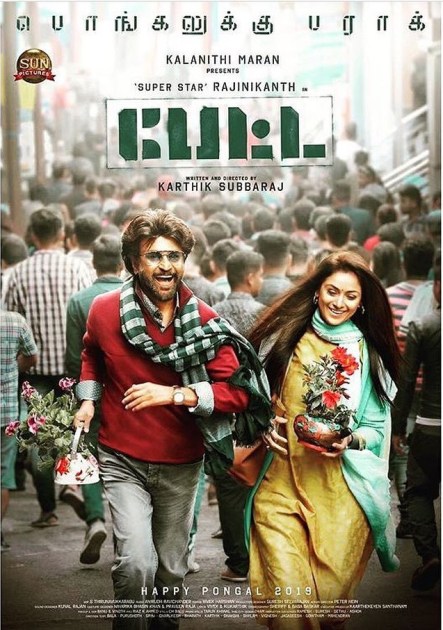
Karthik Subbaraj is a self-confessed Rajinikanth fan (he even mentions this in the movie credits) and his latest film can best be described as a fan’s ode to the Superstar. Petta is a step back in time to the classic Rajinikanth of the nineties with punch dialogues, trademark poses and bucket loads of swagger and attitude. The mass style brings the superstar persona to the forefront and, particularly in the first half, relies heavily on Rajni’s charisma and screen presence to deliver an action-packed masala adventure. Although there are still plenty of twists and turns, the first half of Petta is a departure from the previous style of film making from Karthik Subbaraj and the characterisations and detail of the story suffer as a result. But with Petta being such a marvellous return to form for Rajinikanth, the film is still an absolute treat for fans.

The film follows the exploits of Petta (Rajinikanth), a man who comes to take up the position of hostel warden at a boarding school on the recommendation of the local minister. He gives his name as Kaali and immediately goes about restoring law and order in the hostel by evicting a group of bullies terrorising new students. Chief of these is Michael (Bobby Simha), the son of a local rowdy (Aadukalam Naren) who is also involved in various black-market schemes in the area. Petta brings order and structure to the hostel while at the same time assisting one of his students Anwar (Sananth Reddy) with his love affair. The results in a brief romance with Mangalam (Simran) and elicits some excellent advice – when faced with a problem, first play your favourite music and dance before making any decisions. The perfect maxim to live by!

The first half of the film sets up the character of Petta as a righteous man who is willing to do what it takes to win, but who is ultimately on the side of good. Classic Tamil hero stuff and Rajni plays the tough hero persona with his usual flair. Along the way he plays old Tamil movie songs on an ancient radio and indulges in trademark Rajni antics with cigarettes, sunglasses and various other props. Many of his poses recall his earlier blockbuster films while the dialogue is sharp and on point, raising plenty of cheers from the audience in Melbourne. Karthik Subbaraj has written the character to recreate the perfect storm that is SuperStar Rajinikanth, but this means that the other characters have little back story and even less time in front of the camera. Petta is front and centre of every frame – beating up bad guys, making the perfect dinner and setting the world to rights – just as we want him to do, but the lack of a build-up or real motivation for Petta makes some of these scenes just a bit too predictable.

Petta has a mysterious past and eventually it catches up to him in the second half necessitating a move to Uttar Pradesh. Here the plot starts to thicken and Karthik Subbaraj remembers to add his signature twists to the storyline. Nawazuddin Siddiqui plays Singaaram, a long time enemy of Petta who is out for blood and determined to get rid of Petta once and for all. His son Jithu (Vijay Sethupathi) is well placed to take on the task as he’s the chief rowdy in charge of Singaraam’s various dubious enterprises and has no issues at all with either murder or mayhem.

While he’s a fantastic actor, Nawazuddin Siddiqui seems a bit too pathetic and weedy to be an effective villain in a Tamil movie. Although his personality is bitter and twisted, his lack of physicality doesn’t play well, and his reliance on guns and explosives rather than his bare fists somehow seems to be cheating. Or maybe I just watch too many mass films! Vijay Sethupathi on the other hand is excellent and his entrance provoked just as many cheers from the audience in Melbourne as did Rajinikanth. He is perfect as a vicious thug who is still able to think on his feet and the scenes between Vijay and Rajinikanth are simply superb. The various twists and turns add more interest to the story and it helps that Jithu and Singaraam get more backstory with a flashback sequence and some good dialogues.

Rajinikanth looks amazing in this film and he moves more freely here in the dance and fight sequences than in his other recent films. S. Thirunavukarasu’s (Thiru) lighting and cinematography is beautifully done to maximise the different settings, particularly when the action moves north and the characters are surrounded by a festival in the streets. Peter Hein’s action sequences work well and the various locations too. The different areas of the hostel, a street market and a warehouse full of chairs allow him to create some novel situations and moves while a sequence with Petta practising with nunchucks in front of a fire is brilliant. Anirudh’s music fits well into the style of the film, especially with the wonderfully upbeat Aaha Kalyanam and SP Balasubrahmanyam appearing on the track Marana Mass. Sadly there was no credit given for the subtitles, but these were generally OK, although again very much of the literal translation type, so didn’t always make sense. Also in white which was frequently made illegible by the background. However at least the subtitler made the effort to identify the various classic songs used so that was a win – and as always, I’m very grateful for subtitles, full stop.

Unlike Karthik’s earlier movies like the excellent Iraivi, the female roles here are all of the ‘blink and you’ll miss them’ variety and despite the additions of a couple of romances they are totally superfluous to the plot. Malavika Mohanan has the best realised role while Trisha, Simran and Megha Akash have very little to do. The flashback sequence has a brief appearance by Sasikumar and J. Mahendran and the usual ensemble of support actors make up the various gang members on one side or other of the conflict.

What really works about Petta is the interplay between Rajinikanth and the various characters in the second half. The mixture of violence, punch dialogues and occasional comedy all fit perfectly into a plot that keeps changing tack. Singaraam may not be the best chief villain, but his nasty weaselly ways are novel and Nawazuddin Siddiqui has some great expressions as he flits between giving orders to kill and worrying about where Petta will pop up next. While it’s fantastic to see Rajni in such good form, it’s in this part of the film where everything comes together – star, story and support cast, to produce an almost perfect whole. This probably is a film that has something for everyone, with enough old-school Rajni to please his fans, a good character driven story in the second half for those who prefer his later incarnations in films such as Kaala and some characteristic Karthik Subbaraj storytelling for fans of the director. All this and Vijay Sethupathi too – highly recommended!