Bell Bottom (2019)

Bell Bottom

Jayathirtha’s latest film, Bell Bottom, is a retro whodunnit that takes its inspiration from Dr Rajkumar’s CID 999 films of the late sixties. In fact, the film even features the poster for Goa Dalli CID 999 and our young hero is seen gaining motivation from watching Dr Rajkumar track down the bad guys in the cinema. The dialogue, fashions and plot all hark back to these excellent action films, and as a result Bell Bottom has an instant cool vibe and classic feel. The film is set in the early eighties (although the fashions look more seventies style to me), and features Rishab Shetty as Detective Divakar, a rookie detective tasked with solving a baffling series of thefts.

Divakar (Rishab Shetty) spends his childhood reading detective novels and watching spy and police thrillers in the cinema, so it’s hardly surprising that his ambition is to become a private detective. His father (Achyutha Kumar) is a police officer, but Divakar wants nothing to do with the police, not even as a stepping stone to learn the basics of the detective trade. So, it’s a sad day when he eventually bows to pressure from his father and finally takes a job as a police constable. Luckily for Divakar, after learning all about the less pleasant side of being the most junior police officer in the station, his boss (Pramod Shetty) puts him in charge of a missing persons case. It’s not long before Divakar cracks the case, discovering a murder and catching the perpetrator by using the skills he’s picked up over his years of reading novels. When recovered jewellery and money goes missing from the safe inside a number of police stations, right under the noses of the station inspectors, naturally then it seems that there is only one person who can find the thieves – Detective Divakar!

Once he gets the go ahead to change out of his uniform, Detective Divakar gets into the swing of things in garishly patterned shirts, stylish bell bottoms and a selection of trendy knitwear, all of which he pairs with cool sunglasses and his nifty motorbike. The wardrobe department have pulled out all the stops and found/recreated some amazing outfits which are classic eighties style and truly awesome! My favourite is the yellow shirt with stripes that features two breast pockets patterned with a central square, but there are so many wonderful options to choose from. When Detective Divakar wants to actually do some detecting he changes into a mackintosh and fedora, accessorised with a pipe and natty scarf, but it’s his Rishi Kapoor style sweaters that seem to be his outfit of choice for his day-to-day detecting work. Rishab is excellent as the wannabe detective, adding plenty of arrogance and enthusiasm, but also allowing some of Divakar’s self-doubt and naiveté to show though too. It’s a great performance and shows that Rishab is as happy in front of the camera as he is behind it, giving his all here in a very impressive performance. Much of the comedy relies on the snappy dialogue from DK Dayanand and Jayathirtha but Rishab does a great job with the timing and facial expressions to ensure the laughs keep coming.

Divakar is smitten by Kusuma (Haripriya) as soon as he sees her, and is just as impressed by her clever wit as by her appearance. Kusuma is the local bootlegger but despite Divakar’s position with the police force she seems quite happy to be romanced by him. Of course, the police are some of her biggest customers, so she doesn’t have too much to worry about regardless of her illegal activities. Haripriya really gets into her role too, and she is brilliant as Kusuma, a strong woman who knows what she wants and is prepared to go out and take it. It’s good to see a Kannada film that doesn’t just add a heroine for the sake of it, and Kusuma is much more than just Detective Divakar’s love interest. Haripriya delivers an excellent performance here ensuring Kusuma is a dynamic and independent woman who doesn’t need Detective Divakar quite as much as he needs her.

Detective Divakar is faced with a difficult problem. In each case the thieves have broken into a police safe overnight without leaving any trace behind. Divakar has plenty of suspects but no way to determine who is the guilty party. Could it be his girlfriend Kusuma whose bootlegging activities might have given her some criminal connections? Or perhaps a group of blind beggars who turn up at the police stations regularly to beg? Perhaps his police assistant could be involved (Prakash Thuminad) Or could it be a shonky Shaman, a dodgy seller of religious paraphernalia or an ex-con (Yogaraj Bhat) with 5 wives and a small army of children to feed? Divakar has plenty of suspects but no clues and a fast approaching deadline of when the stolen goods need to be produced in court as part of criminal proceedings against the original crooks.

Jayathirtha stays true to the style of films such as CID 999 and Gunmaster G9 with a similarly convoluted plot and plenty of red herrings along the way.  The background detail is superb and reflective of the era, with good attention to detail. I love that Detective Divakar has a pocket watch with a picture of Dr Rajkumar inside – it all ties up so beautifully with the main theme. Although the climax is incredibly unlikely, again it fits with the spirit of the genre, so I didn’t mind the ridiculous solution to the problem. However, the film does wander a little towards the end, and this part of the film could have been more focused without losing any of the comedy or overall impact. Apart from this small issue, I loved the rest of the movie. The comedy is well integrated into the plot, the music from B Ajaneesh Loknath is catchy and suits the time period while Arvind Kashyap effectively captures small town life though his camera lens. Everything comes together well to re-create a snap-shot of eighties detective fiction, even including the classic detective trope of chainsmoking, so noticeable nowadays due to the warning notices onscreen and the gradual acceptance of smoking within communities. It’s another small detail that really adds to the whole retro-feel of the film.

Bell Bottom is an entertaining mix of action and comedy, wrapped up in nostalgia and delivered with style. The entire cast are excellent and the story and dialogue are pitched at exactly the right level. I really enjoyed this one, and I hope they decide to make some more Adventures of Detective Divakar – I’d definitely sign up for another Eighties detective mystery. And why is the movie called Bell Bottom? Well, it’s an important part of the plot, so you have to watch the movie to find out!
Gully Boy

poster

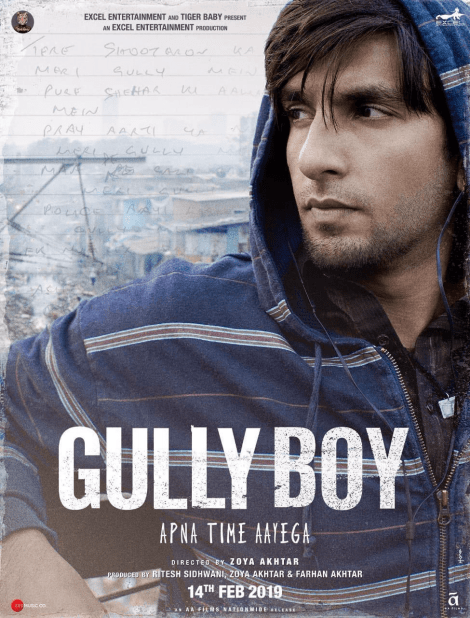
While there are similarities between Zoya Aktar’s Gully Boy and the 2002 Curtis Hanson film 8 Mile, that’s probably inevitable given the subject matter. Gully Boy tells the tale of a rapper from the wrong side of the tracks who finds fame and fortune after stepping up to the mike and battling his way to the top. Overall it’s a softer and cleaner tale than 8 Mile, but Ranveer Singh is remarkably good as a struggling student from Area 17 in Dharavai, while Alia Bhatt is equally impressive as his love interest, Safeena. The film is reportedly a loose biography of Mumbai rappers Vivian Fernandes aka Divine and Naved Shaikh aka Naezy, who both appear on the soundtrack along with a host of other local rappers. Even if you’re not a fan of rap music, this is a good story that effectively shows the class/caste divide in Mumbai and the barriers that make it difficult for anyone to cross that line.

Ranveer plays Murad, aka Gully Boy, a management student who lives with his father Aftab (Vijay Raaz), mother Razia (Amruta Subhash), younger brother and grandmother in Dharavi. Into this already crowded household, Murad’s father brings a new, younger wife, and this deepens the antagonism between Aftab and Razia and ups the constraint between father and son. Zoya paints an effective picture here of a divided family and escalating tension that puts even more pressure on Murad and leads to him trying to find avenues of escape. One of these is his relationship with Safeena (Alia Bhatt), a medical student who is trying to escape her mother’s (Sheeba Chaddha) strict ideas about her daughter’s behaviour. Safeena’s father (Ikhlaque Khan) is a doctor and Safeena is therefore in a different social class than Murad, but Safeena is determined to be with her long-term boyfriend and is resourceful enough to manage brief meetings and keep their romance hidden.

Murad also hangs out with his friends, but these relationships seem likely to get him into more trouble. Moeen (Vijay Varma) involves both Murad and Salman (Nakul Sahdev) when he steals cars, but Murad draws the line when he discovers Moeen is also dealing drugs using orphaned children as the couriers. Luckily for Murad he meets MC Sher (Siddhant Chaturvedi) after seeing him perform at a college festival. Murad becomes friends with the rapper and slowly is encouraged to put his own words to music.

Murad is shy and finds it difficult to respond with the instant come-backs needed for rap battles, so it seems as if his career may be over before it’s truly begun. However, a meeting with an overseas student Sky (Kalki Koechlin), looking to make a video in Dharavi helps boost his image and his confidence when the music video goes viral. The addition of Sky is interesting as it didn’t seem that MC Sher and Gully Boy really needed the boost, but the video is sensibly made to reflect what would be possible in this situation, and I loved the scene in Sky’s apartment where Murad paces out the bathroom which is bigger than his entire house in Dharavi. I wondered if the character of Sky was a nod to Zoya herself and her own outsider status in Dharavi given that her previous films (Dil Dhadakne Do etc) deal with the ultra-rich. Gully Boy is almost the total opposite of these films, with nearly every character having a very ‘ordinary’ background with everyday problems of how to pay the rent, or have enough money to put food on the table. The revelation here is that Zoya does this so well and with restrained empathy that lets the lives of her characters talk for them by using their living spaces, clothes and transport as part of the development of the story. There is an authenticity to the film that draws the audience in and allows the characters to develop naturally without any of the usual Bollywood theatricality.

Although the basic story is predictable, it’s the journey that is important and Gully Boy is as much about class division as it is about music and relationships. Near the start of the film, a tourist group comes into Dharavi, trampling through Murad’s house, taking pictures and making insensitive comments about their house and living arrangements as if they’re looking at animals in a zoo. I guess this is part of the reality of living in one of the most famous slum areas of the world, but Murad and his family seem totally unfazed by the invasion and it really brings home the limitations of Murad’s world. Later scenes are even more telling. When his father is injured and unable to work as a driver, Murad takes over his job driving a rich family around the city. In this role he’s essentially invisible and is treated as an extension of the car he is driving. When the daughter wants to take a break from studying, her father uses Murad as an example of where she doesn’t want to end up, even though Murad is a final year student himself. What seems most odd to my Australian eyes is Murad’s calm acceptance of the situation. When he’s moved on from trying to listen to the music outside a venue simply because he’s a driver, his acquiescence without any words or emotion is truly shocking, even though he vents his emotions in the car as he raps along to a track on the radio. Partly this is because Murad is shy, but mainly it’s an ingrained acceptance that this is the way the world is, and nothing can ever change it. As Murad’s uncle states, he comes from a family of servants, so that is what he will be too.

The film has a number of these ‘divides’. Murad and Safeena meet on a bridge that spans a sea of rubbish, and eventually it just becomes part of the background and not even noteworthy. On a smaller scale, Aftab and his new wife keep a door between the rest of the family and their relationship, ensuring Razia and her children have no ability to raise their issues or even develop any kind of relationship with Aftab’s new wife. It’s these minor character that are essential in keeping the film realistic and genuine, particularly since all of these interactions have an effect on Murad, his behaviour and ultimately, on his music. Siddhant Chaturvedi is outstanding as MC Sher, and his confidence and love of music is infectious. Both Vijay Raaz and Vijay Varma also excel in their roles, giving them depth and a reason for their actions beyond the usual ‘Bollywood villain’ trope.

Although the story is Murad’s, it’s one that has been told before, and I found the character of Safeena more interesting. While Murad dreams of making it big in the rap world, Safeena want to be a doctor and will do almost anything to make that happen. She is constrained by societal expectations that she will marry and stop her studies, which makes Safeena constantly rebellious and determined to live her life as she wishes. She is also passionately in love with Murad, to the extent to beating up her rivals, including smashing a bottle over Sky’s head when she believes that Sky and Murad are having an affair. But despite her love of Murad, her devotion for her studies is even more intense and I thought it completely reasonable that she is prepared to adhere to her mother’s rules if she can just keep studying and not get married. Alia’s Safeena has all the passion and fire that seems to be missing at times from Ranveer’s safer and more considered performance as Murad. This is an terrific performance from Alia who gives Safeena a mix of seriousness and spontaneous episodes of violence as well as a passionate devotion to Murad in an interesting mix for a young Muslim woman.

Ranveer Singh is excellent as the shy and rather self-effacing Murad, which is even more amazing when contrasted with his last film. There is none of Simmba’s brashness and Ranveer does a superb job of bringing Murad’s helplessness and vulnerability to life. His gradual transformation from shy wannabe to confident performer is perfectly nuanced and he gets the interactions between his mother and father just right. He’s also incredibly good in the songs which are arguably the best thing about the film. The music here is is powerful and effective with lyrics that burst off the screen, even through the subtitles. Vijay Maurya’s dialogues complement the songs perfectly and it’s this combination that is an essential part of the film’s authenticity. I love the soundtrack – both the songs and Karsh Kale’s background score and it’s such a relief that a film about music gets that part of the story so right.

Although Gully Boy is a Bollywoodised version of hip hop in Mumbai, the music still sounds real and true and while the language has been cleaned up, the rest of the story still has a street vibe and an edginess that’s not usually present in mainstream Hindi films. I loved this film, along with the rest of the audience in an almost full screening in Melbourne – and it’s a long time since I’ve seen that for a Hindi release. Great songs, excellent support characters and impressive performances from all make this one to catch in the cinema. Highly recommended.

Ek Ladki Ko Dekha Toh Aisa Laga

Ek Ladki Ko Dekha Toh Aisa Laga

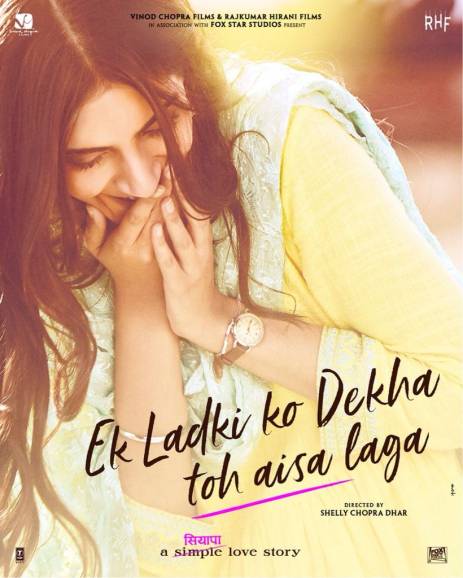
Ek Ladki Ko Dekha Toh Aisa Laga deserves praise for daring to tackle same-sex relationships in a film industry where gay people have mainly seem to appear only as comic relief. Although Shelly Chopra Dhar’s film is a sanitised and strangely unemotional journey, showing even a fraction of the prejudice and discrimination faced by anyone who does not follow cultural norms is surely a step in the right direction. The story is kept safe and family-friendly with the actual romance not getting much attention, while most of the light and shade comes from the excellent support cast. Rajkummar Rao is outstanding, Anil Kapoor and Juhi Chawla bring warmth and real affection to their roles while Abhishek Duhan manages to encapsulate every negative thought or emotion pertaining to homosexuality within his character. This is definitely a film worth watching, although I wish it had shown more of the heartache and allowed the lead character to fight her own battles rather than relying on the various men in her life to shape her destiny.

Sonam Kapoor plays the character of Sweety, the daughter of businessman and garment factory owner Balbir Chaudhary (Anil Kapoor). She lives with her father, brother Babloo (Abhishek Duhan) and grandmother (Madhumalti Kapoor) in the Punjabi town of Moga but her path crosses with Sahil Mirza (Rajkummar Rao) during a visit to Delhi. Sahil is the son of a rich producer, but he’s trying to make his own way in the world as a writer and playwright. Unfortunately, the film he wrote for his father has been wildly panned and his new play doesn’t seem destined to reach any great heights either, given the small theatre where it is being produced and a seemingly limited budget. However, a chance encounter with Sweety intrigues Sahil and as he aids her escape from her brother, he decides he wants to know more about her self-described long and complicated story. A few vague ideas about producing a play in a regional town with local actors is enough for Sahil to travel to Moga with the theatre caterer Chatro (Juhi Chawla). Once in Moga he finds Sweety easily enough but as he learns more about her Sahil becomes drawn into her struggle to be the person she really wants to be.

What works really well in the film is the character of Sahil, and Rajkummar Rao is fantastic, infusing Sahil with understanding, empathy and a good sense of humour right from the start. Although initially he is smitten with Sweety, his transformation to her champion is very believable and done with plenty of humour and warmth. Even his brief interactions with his own parents have some clever by-play that gives further insights into Sahil’s character and provide an interesting contrast with Sweety’s family. Anil Kapoor is another major strength in the film and he strikes exactly the right note as a wealthy businessman who only wants the best for his daughter. In a nice parallel he has had to hide his love of cooking all his life as his mother doesn’t find the kitchen an appropriate place for a Punjabi man. Although I did find that odd given that most top chefs are in fact male. Perhaps it was more of a status thing (which didn’t come across with the subtitles), but it does mean that Balbir has experience of hiding the thing he loves from his mother, something that gives him the ability to develop an understanding of his daughter’s problems later in the film.

I love Juhi Chawla and she is brilliant here in a role that allows her to showcase her excellent comedic talents. Her Chatro is convinced she is a mind-shattering actress, although no-one else believes in her talent. She is a superb cook however, and this is the talent that’s appreciated by Balbir and leads to some hilarious interactions between the two. Chatro is confident in her abilities – whether it’s cooking or acting, and Juhi makes her a wonderfully warm and likeable character to boot. It’s no wonder Balbir is smitten, and the scenes between these two brilliant actors really are the absolute highlight of this film for me.

Sonal Kapoor is a little more disappointing as Sweety, which is a shame as writers Gazal Dhaliwal and Shelly Chopra Dhar have given her some great material to work with. The stories Sweety tells Sahil about her life and the difficulties she has faced should have been some of the most heart-wrenching moments of the entire film, but the emotion never goes quite deep enough. Although this is probably the best performance I have seen from Sonal, there doesn’t seem to be any real pain behind her dialogues. Although she is obviously trying hard, Sweety appears just sad, not anguished or distraught, even when she was discussing such monumental decisions as ending her life or marrying anyone just to get away from the constant pressure from her family. While I can accept that a lifetime of repression would make someone less prone to show their emotions, to make the film more effective, I really needed to feel her pain much more deeply that she ever manages to express here. Where Sonam is better however, is during the climax of the film where she responds to her father disapproval, and here she brings the emotion and drama that’s missing elsewhere in her performance.

What I really like about the film is the depiction of how difficult it is to reveal homosexuality to family, friends and the community in India. With the recent decriminalisation of homosexuality in India, perhaps there will be some changes, but given how much prejudice and shame there is still attached to same-sex relationships in the West, I feel this will be a long and difficult process. The first Hindi film I saw that touched on this subject was Onir’s excellent My Brother… Nikhil, which also starred Juhi Chawla, but this I think is the first main-stream Hindi film that has tackled the subject of lesbianism within India. In Margarita, with a Straw for example, the character was only able to embark on her same-sex relationship when she left the country and was studying overseas. From that perspective I think that this is an important film, as it does bring to light the difficulties experienced by people who identify as LGBTQIA and openly shows the prejudice and discrimination they receive. The need to keep everything secret and repress their sexuality is clearly discussed, even if only briefly. Sweety’s brother Babloo is vehemently opposed to her relationships and this character allows some of the range of hate against homosexuality to be exposed, even when disguised as concern for the person or their family. Babloo is an unpleasant character, but there is a lot of truth in Abhishek Duhan’s portrayal and I felt that he totally nailed the animosity and disgust his character felt while projecting care and consideration for Sweety and the entire family. This bigotry is effectively done and is one of the important points that Shelley Chopra Dhar gets across so well in the film.

I also love the response of the audience to Sahil’s play about Sweety and how Shelley Chopra Dhar captures the conservative ideas and morals of a small town. The contrast between young girls with their faces full of rapt attention as they followed the story, with the adults in the crowd who got up and left with angry gestures, sums up the story beautifully and illustrates just how far communities need to change to overcome these unreasonable and biased attitudes.

In this way it’s the subject matter and the idea of the film that is important, and in this I think Shelly Chopra Dhar has exceeded expectations. The film itself doesn’t fare quite as well, given the rather conservative approach to Sweety’s relationship. Her partner Kuhu (Regina Cassandra) only appears onscreen briefly, which is rather a shame since Regina sparkles when she is on camera and I would have liked to see more of her character and even heard Kuhu’s story too. Instead the film concentrates on the family relationships, which is not necessarily a bad thing, but some of the romance needed to be included to give some balance to the story. I can understand that the director probably didn’t want to alienate main-stream audiences, but it does mean that the film is lacking emotional attachment.  It’s still an enjoyable film and one that can be watched without delving too much into the politics and societal issues, which hopefully means it will reach a wide audience. It deserves to.