Virus (2019)

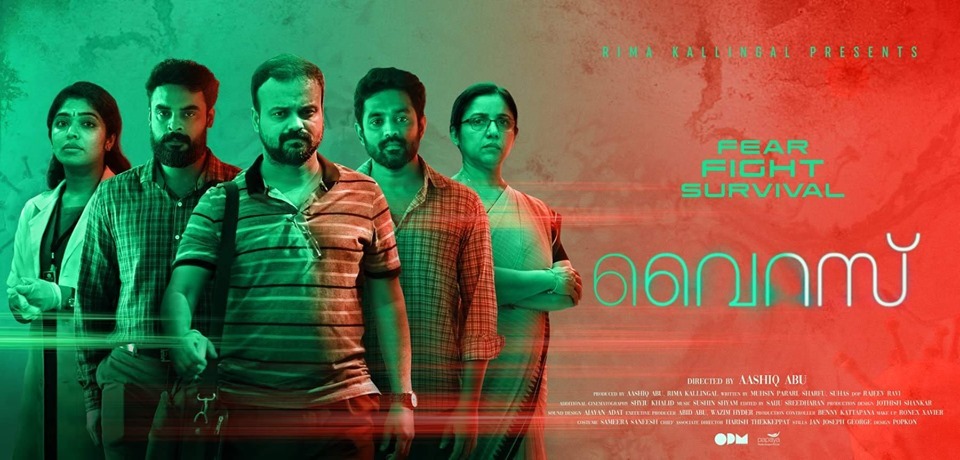
Based on a true story, writers Muhsin Parari, Sharfu and Suhas have taken the subject of the 2018 Nipah outbreak in Kerala and delivered a tense and suspenseful drama that is all the more powerful for its basis in fact. Although at times the effort to appear like a Hollywood disaster movie makes some of the screenplay seem a tad forced, for the most part this is a solid delivery of a fascinating story. The attempts to control the outbreak and the forensic analysis to discover the source of the virus are cleverly written to demonstrate the dedication and compassion of all involved, and it’s the realism and depth of detail that make this such an engrossing watch. Director Aashiq Abu has an all-star cast, but what really shines through is the story and ultimately the response of the hospital and government staff at the time who did such an amazing job of containing the infection and preventing mass exposure.

As someone who works in a hospital in Australia, the opening scenes in the casualty department of the hospital in Kozhikode appear completely shambolic with doctors and nurses struggling just to get near a patient let alone treat their problems.  But over the years I’ve worked in a number of hospitals in India myself and I recognise that the apparent chaos is actually all under control despite appearances to the contrary, and that somehow the doctors and nurses manage to see every single patient over the course of the day. In Kozhikode, as junior doctor Abid Rahman (Sreenath Bhasi) is starting his shift, the patients seem the usual collection of injuries, illnesses and infection cases, but then there is a young man admitted suffering seizures, hallucinations and who is rapidly getting worse. One of the nurses, Akhila (Rima Kallingal) tries to take care of the patient, Zachariah (Zakariya Mohammed) but her efforts and those of the medical team are in vain, and just as Zachariah’s condition deteriorates further, more patients start to appear with similar symptoms.

It takes some time for the pieces to start to come together. The cases are spread across two districts so the similarities between patients’ symptoms are not immediately recognised, but when Akhila herself becomes ill the situation suddenly escalates to a full-blown emergency with the main objective being to control the spread of the disease. The story from here unfolds gradually, following the medical staff as they treat patients and Kozhikode Distric Collector Paul Abraham (Tovino Thomas) and Health Minister Prameela (Revathi) as they start the search for the source. But we also see the hospital orderlies and cleaners who are willing to risk their lives to try and help stop the spread of the disease, and the impact these decisions have on their families too. Dr Suresh Rajan (Kunchacko Boban) confirms that the patients have contracted Nipah, which has no treatment, no vaccination and a 75% fatality rate, with the only option being containment and quarantine. For those who already have the disease there is little hope. Paul starts the process of tracking down the “Index patient’, aided by Dr Annu (Parvathy) and as each patient is admitted there are flashbacks to possible contamination moments which highlight the relentless spread of the disease through close encounters with possible carriers.

Nothing is omitted – the struggles to calm the fears of medical students and hospital staff are here as well as descriptions of the difficulties of disposing of the bodies of the deceased. These are still infectious and need to be incinerated safely which causes further distress to grieving families who aren’t even allowed the dignity of a funeral for their loved ones. There is a conspiracy theory thrown around that this could be a form of terrorist attack by germ warfare, but mostly the tension comes from a combination of the race to find the cause, and the plight of the patients and the doctors trying desperately to save them.

The film works so well because it is incredibly realistic and down to earth. The reactions are all natural and even the attempts to increase tension with the conspiracy theory and sensational TV interviews could all be plausibly grounded in fact. Every single character is beautifully drawn with each actor perfectly cast for their role, so that Virus often seems more like a documentary than a film. Taking each character and giving them plausible background is inspired – like hospital porter Babu (Joju George), initially seen negotiating for wages which have not been paid and whose wife and children are stigmatised while he is away. These details, even down to a broken strap on his backpack give authenticity to the story and draw the audience deeper into what is happening onscreen. There are so many excellent but fleeting performances. Soubin Shahir is good as a patient whose infection initially baffles the doctors as he seems to have had no contact with any of the confirmed cases, while Madonna Sebastian appears even more briefly as a junior doctor who contracts the virus. Poornima Indrajith, Asif Ali, and Sharafudheen all appear in critical roles while Savithri Sreedharan, who was so good in Sudani from Nigeria is brilliant in her few short scenes as the mother of the index patient. Zakariya Mohammed brings so much humanity to his role as the first identified case of the virus with an incredibly poignant closing scene delivering the perfect finale to a film that really is all about compassion and caring.

This is a brilliant depiction of real-life events and I found it compelling but chilling to realise that this outbreak actually happened. The film unfolds as if watching the events in real time and I was awed by the immediacy of the hospital and government response and impressed by the success of their quarantine. Aashiq Abu has done an amazing job with bringing this story to life onscreen and while Virus may be a factual telling of the story, it’s the characters that are most memorable and have the biggest impact. Highly recommended.
NGK (2019)

NGK

Spoiler alert

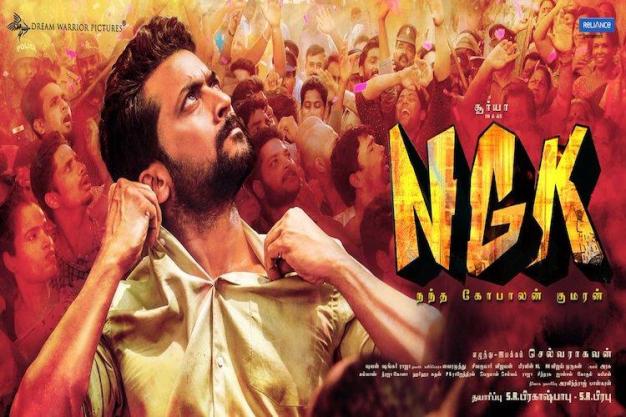
I’m a big fan of both Suriya and Selvaraghavan and was intrigued to see how Selva would deal with a main stream hero given his usual character-driven and more unconventional style of film making. As it turns out, Selva has made room for both heroic gestures and quirky plot points in this tale of a young man’s rise to prominence in a political party, although ultimately neither meld particularly well together. In the end, the darkness of the storyline ensures NGK is still definitely a Selvaraghavan film, although only working in parts despite an understated, yet powerful performance from Suriya. There is a lot to unpack here, and I apologise for the spoilers which I haven’t been able to avoid in order to discuss certain aspects of the story.

Nandha Gopala Kumaran aka NGK (Suriya) is an organic farmer, living in a small town with his parents Ramanan (Nizhalgal Ravi) and Viji (Uma Padmanabhan). He’s married to Geetha (Sai Pallavi) and in the initial scenes both are completely besotted with each other to the point of irritating Viji with their romantic overtures. Kumaran is an organic farmer who has given up his city job to work the land with a group of like-minded idealists, but their livelihood is threatened by local traders and businessmen who want the farmers to buy their chemicals. Kumaran gets the idea of approaching his local MLA (Ilavarasu) from a neighbour Giri (Bala Singh) who works for the party. Giri has been beaten up by party men because he refused an inappropriate request from MLA Pandiyan’s but despite this, Giri still supports the party ideas. Straight from the start, it’s shown that the party elite are corrupt, lacking morals and purely interested in getting and keeping power. Kumaran uses his friend Raja (Rajkumar) who also works for the party to get an audience with Pandiyan, who agrees to stop intimidation of the farmers, but only if Kumaran enters politics and brings 500 of his own supporters into the party.

Interestingly, in these early scenes, Kumaran seems disgusted and repelled by Pandion, and is further antagonised by his bullying and repeated humiliations. But at some point Kumaran decides to kowtow and do everything Pandiyan wishes, including cleaning his toilet and supplying him with home-cooked food. What would help this transformation would be an explanation of why Kumaran decided to conform. Was it because he realised the power of politics and what he could potentially do if he managed to move up the ranks? Or was it simply to stop the humiliation, or perhaps even an attempt to shame Pandiyan into more moral behaviour? Sadly, none of the reasoning behind any of Kumaran’s choices are explained, although there are some pivotal events that we can assume helped shape his actions.

In the course of his transition to political power, Kumaran meets Vanathi (Rakul Preet Singh) who is a UK-educated political analyst tasked with helping the party win upcoming elections. Vanathi is impressed by Kumaran, presumably realising that his earnest demeanour and good looks will make him a good candidate to win over the voting public. Vanathi is an interestingly grey character who’s not above dirty tactics to discredit the opposition, although these are more about revealing the ruling party’s indiscretions rather than fabricating evidence to implicate chief minister Killivazhavan (Devaraj) and his minions. As Kumaran becomes more and more involved with the party, and by implication with Vanathi, Geetha starts to become jealous and finally accuses Kumaran of having an affair. Astonishingly (this is Suriya after all), Kumaran quickly admits his infidelity but it’s all the more shocking because there has been no hard evidence on screen and no real reason for the affair – after all, Kumaran had a wife he was supposedly besotted with waiting for him at home. Then too, his revelation is made somewhat passionlessly, but immediately followed up with a nasty challenge to Geetha asking her what she will do about it. So, was he just scratching an itch because he was away from home? Did he fall in love with the clever and politically sharp Vanathi – a world away from the more innocent Geetha? Or was it a more calculated ploy, to seduce the woman behind the party’s campaign for office for his own ambition?

Rakul Preet Singh is good in a role that starts off well, but which fades quickly once she (sigh) inevitably falls in love with Kumaran, despite her initial tough, woman-of-the-world persona. At least Vanathi has a reasonable character arc and she stays true to her own ideals throughout, apart from an unfortunate lapse during a dodgy romantic song which doesn’t fit with the rest of the screenplay at all. She still has values and these stand her in good stead as Kumaran becomes more manipulative and Vanathi gradually seems to realise what is happening. Sai Pallavi on the other hand doesn’t doesn’t fare as well as Geetha. Her initial interactions with Kumaran are too cloyingly sweet and over the top, while Geetha’s suspicion of an affair seem to come from nowhere, leading to some odd behaviours when she meets Vanathi. Her initial reaction to Kumaran’s affair is also strangely overdone, while the apparent acceptance in later scenes also doesn’t ring true, making Geetha a rather unsatisfactory and jarring presence onscreen. It’s odd since Selva’s female characters normally have strong characters and some reason for what they do, but here the women are all muted and take a very definite back seat to the main story.

Kumaran gradually changes throughout the story from an all-round nice guy to someone able to plot and scheme his way to success. What I can’t decide is if he turned to the dark side to win power to be able to help his people, or if he truly becomes corrupted to the point where he is prepared to use anyone to achieve his ends. The final scenes with Geetha and his parents suggest the latter, but I need to watch the film again to find more clues to his behaviour. I did pick up some. Selva uses changes in the lighting scheme here as he did in Pudhupettai to indicate some of the personality changes – changing from green to red lighting during a fight scene in an improbably cavernous bathroom, presumably to suggest Kumaran’s move towards more selfish motives. There are also questions around what really happens when Kumaran’s friend Raja dies, and his initial meeting with Vanathi definitely has more subtext, but I was concentrating too much on reading the subtitles to pick up on all the subtleties.

The glue holding the story together is Suriya, who forgoes his usual mass-style hero for an ambiguous character who definitely moves towards the wrong side of politics. It’s a subtle and almost low-key performance, although there is plenty of passion on show as Kumaran makes energetically impassioned speeches about farming and freedom, land and human rights, and inevitably ‘the common man’. Suriya gets across the definite sense that Kumaran is acting in all of his grand speeches, while still leaving his true motivation rather more ambiguous until the end, where his corruption appears to be complete. Here Selva has ensured that the film is very much about the star, and Suriya feels the space completely, including the requisite action scenes, dance moves and compelling charisma that end up defining the character too. Although the rest of the cast are good, they aren’t as memorable as Suriya, with the exception of Ilavarasu and Devaraj who have their own personality quirks.

Sivakumar Vijayan does a good job with the cinematography and overall the production is excellent even down to having readable subtitles in yellow font. Awesome! Yuvan Shankar Raja’s background soundtrack is good, and the few dance numbers are catchy enough, with the only real let down being the inappropriate romance track with Kumaran and Vanathi. It’s not a bad song, just oddly placed and bizarrely shot to show a romantic side to two characters who otherwise don’t appear passionate about each other at all. There are the characteristic dark themes and odd actions that remind you that this is a Selva film, but with Suriya front and centre, this is a more commercial and smoother film than his usual fare. The blend isn’t perfect but there is plenty here to keep you entertained, even enough for repeated viewings to see more of what is going on in the background. No doubt that will provide more clues and a clearer picture of just exactly who is NGK. I really enjoyed this, despite my issues with Geetha and occasional frustrations at not being able to decide exactly all the why’s. But then that is part of the genius of Selvaraghavan, to refuse to spoon feed his audience answers and keep everyone guessing. And even here with a mainstream hero in a more traditionally told story, he very nearly pulls it off.

Kavaludaari

Kavaludaari

Hemanth M Rao’s début film was the excellent Godhi Banna Sadharana Mykattu, and he’s followed it up with another gem that’s just as good. Kavaludaari is a crime drama that moves between a thriller and a character-rich neo-noir drama as a traffic cop tries to solve a decades old murder with the help of a retired alcoholic police officer and a journalist with a fixation. It’s beautifully directed and shot, cleverly written and with excellent performances from the entire cast, definitely one not to miss.

The film opens in flashback to the seventies in the immediate aftermath of a robbery and murder in an archaeological office. There is a body on the floor, missing antique jewellery and a raft of suspects, one of whom disappears with his wife and daughter on the night of the crime. In the present, traffic cop Shyam (Rishi) wants to move into the Crime Branch but is met with a firm refusal every time he asks. But then bones are discovered in a construction site, and Shyam is drawn into the mystery. The bones are found to be old, and no-one is interested in investigating a cold case which may not even be a crime. But when Shyam finds a journalist, Kumar (Achyuth Kumar) at the discovery site in the middle of the night he’s drawn into the mystery, despite being warned off the case by his boss.

Shyam has connections and in a beautifully shot scene, he starts going through old case files abandoned in a storeroom. Evocatively, Hemanth M Rao shows a classroom full of shadowy people sitting on the benches who slowly get up and leave as Shyam finds, reads and rejects their file. Finally only one family is left, Gurudas Naidu (Sidhaartha Maadhyamika), his wife Vijayalakshmi (Samanvitha Shetty) and their young daughter Vaidehi (Naila). Mr Naidu was the archaeological officer who disappeared on the night of the robbery and murder, and it seemed as if he was the most likely culprit. But when the bones are confirmed as being the Naidu family it seems as if they were likely murdered as well.

In an effort to find out the truth, Shyam tracks down Muttanna (Anant Nag), a retired police officer who has turned to drink after the death of his own family. Muttanna was the original investigating officer who knows about the other potential suspects in the earlier case, driver Fernandes (Sampath), the Naidu’s servant Bablu (Bharath Gowda), the family cook and the office caretaker to name just a few. But Muttanna has his own problems and is not interested in helping Shyam until his persistence finally cracks through Muttanna’s armour. At the same time, Kumar is investigating Naidu’s disappearance but he’s also on the run from a couple of loan shark heavies who’re looking to call in the loans. With Kumar drip-feeding Shyam information when he can and Muttanna’s reluctant assistance, Shyam gradually starts to uncover more of the puzzle. But when Kumar’s daughter Priya (Roshni Prakash) reports him missing as the real culprit send out thugs to muddy the waters, Shyam appears unlikely to be able to crack the case.

Shyam is introduced by a series of interviews with prospective brides, which is a good way to find out he’s basically a very ordinary bloke. He’s nice enough but has little social life and just isn’t particularly charismatic with women. He is determined though and Rishi portrays this stubborn obsessiveness brilliantly while still allowing his character to appear unsure and out of his depth. Rishi was excellent in Operation Alamelamma and he’s even better here where there is a good mixture of character development, action and drama to get his teeth into. Anant Nag is equally good as the retired cop with a drinking problem and reluctance to get involved. He’s a loner by choice and happy to stay that way until the night Shyam climbs over his wall and forces him to help. The developing relationship between the two men, mentor and mentored is an essential part of the story and yet is so understated and natural appearing thanks to the excellent writing. Achyuth Kumar does a great job with a complex character despite limited screen time, while Roshni Prakash and Suman Ranganathan are very good in small but essential roles.

What really stands out here is the writing. The film is long but at no point is it boring, and nothing on screen is wasted. There is a point to every character and every single action, while the twists unfold perfectly to slowly reveal the plot. Just as in Godhi Banna Sadharana Mykattu, Hemanth M Rao slips some humour in to his characters and there is even a whiff of romance but the story is key and he never loses sight of the plot threads. Advaitha Gurumurthy was a cinematographer for U turn and he captures some of that same unworldliness here, while keeping up the suspense with good use of shadows and different camera angles. The film looks slick and polished but still very realistic thanks to good attention to detail and smooth editing. Even the subtitles are well done, although sometimes hard to read, but the English is good and makes perfect sense. The soundtrack is also excellent. Charan Raj’s music is wonderfully expressive and emphasizes the more emotional elements of the story. Ide Dina, for instance, is a beautiful song that portrays Muttanna’s sense of loss exquisitely while still retaining some of the joy from his previous life.

Kavaludaari was recommended to me by a number of people, and although it took a while before we finally had a few shows in Melbourne (thanks Roopesh!) I’m so glad that we did. This is a brilliant film, beautifully shot, cleverly written and with a great cast who all do an excellent job. Crime dramas are one of my favourite genres which  means I am a tad biased, but this really is one of the stand-out films of 2019 so far. Don’t miss it!