Suhaag (1979)

Whatever you do, don’t confuse this classic Manmohan Desai masala treat with this.

(General Beverage Warning: We advise persons of a nervous disposition not to watch the clip and also warn anyone holding a beverage to put it down as we do not wish to be responsible for any damage to electronic devices.)

Suhaag opens on a dark and stormy night, as Durga (Nirupa Roy) gives birth to twin boys. Denied legitimacy by their father Vikram (Amjad Khan), Durga is forced onto the streets but not before vowing her sons will take revenge. In desperation Durga follows Jaggi (Kader Khan), the first man she meets straight to a brothel where he sells her to the madam. We don’t know why anyone would want a crying, knuckle-biting nahiiin-ing prostitute but they seem to. Her first client is an undercover (really!) police officer who bungles the arrest, allowing Jaggi to escape with one of the babies. So now we have a villainous father, virtuous mother and twins separated at birth!

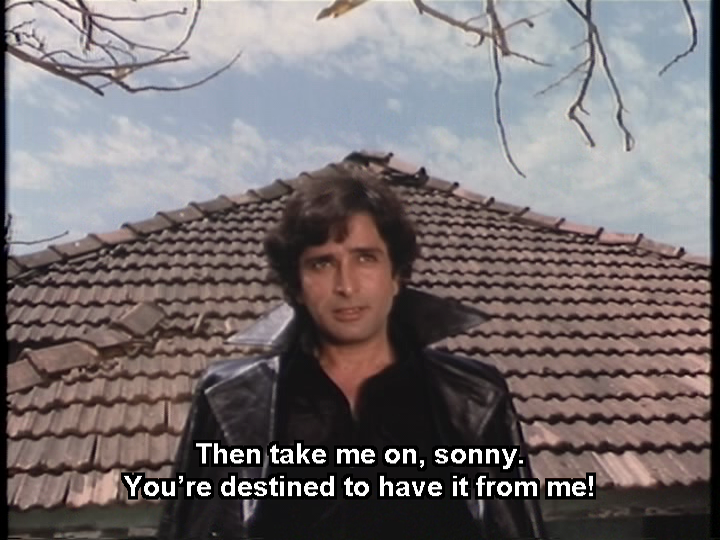
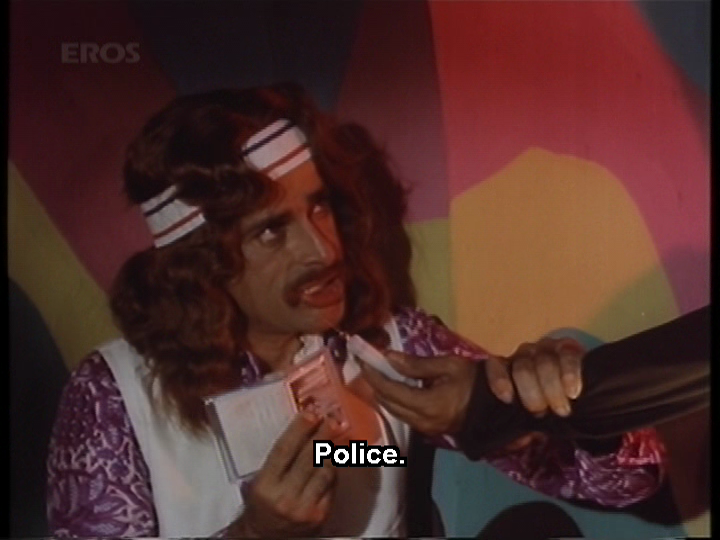
Years go by, depicted in a neat montage. Amit was sold by Jaggi to a begging gang run by (according to the subtitles) Pascal (Jeevan) before becoming the chappal obsessed Amitabh. Kishan grows up with the support of his mother and the helpful Inspector Khan. After many years, the brothers clash in a fight sequence with lots of banter and silly choreography.  Jennifer Kapoor had fun playing dress-ups with her husband as Shashi models an excellent superfly pleather suit as well as his police uniform.  Amitabh wears his neck scarves and white flares with customary panache.

We learn that Kishan is a ranking police officer, while Amit is a hard drinking petty crim with a good heart but weak resolve. Amit is in love with Basanti (Rekha) and spends a lot of time disrupting her workplace – the local brothel. These two really do have some chemistry. Check out the expressions in this song as he reminds her she can’t dance forever so she may as well pick him.

In a raid to track down cop killers, Kishan  invades Basanti’s brothel, and rescues Amit into the bargain.  The men quickly become friends. Kishan is cranky and intolerant, used to giving the orders, and likes having another guy around to absorb some of his mother’s fussing. Amit is drawn to the warmth of a family and home, and sees what he might have had if not for his orphan’s fate. Durga does lots of pining over her lost son as she stuffs food into Amit and Kishan. There was no significant song, birthmark or locket to help identify the lost boy, so there was ample opportunity for the Coincidence Department to run amok before the truth came out.

Kishan goes undercover to a disco run by Gopal (Ranjeet in an eyepatch!) and there meets Annu (Parveen Babi). He takes his policing very seriously, even when Boney M’s Daddy Cool kicks in.
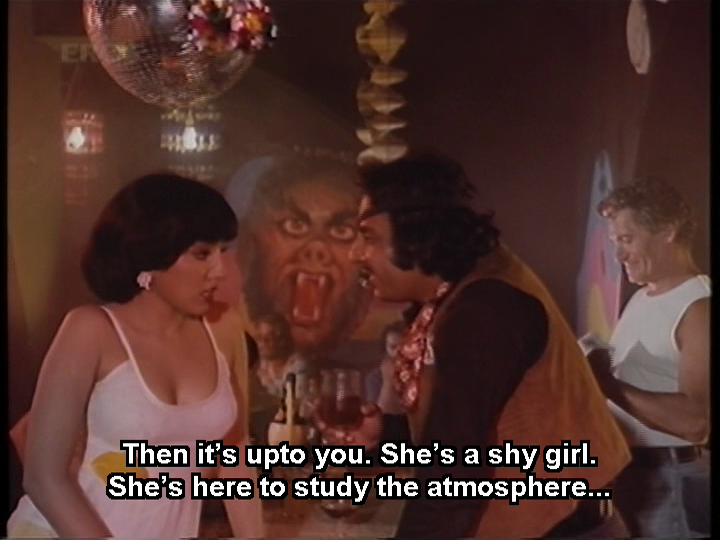
Many masala laced incidents ensure that Annu and Kishan are headed for marriage. Amit acts as go between and Amitabh gets to show his comic flair in these scenes as he tries to please Kishan and his adopted Ma. It wouldn’t be complete masala without another set of separated siblings – and guess who Annu’s sister is? Basanti!

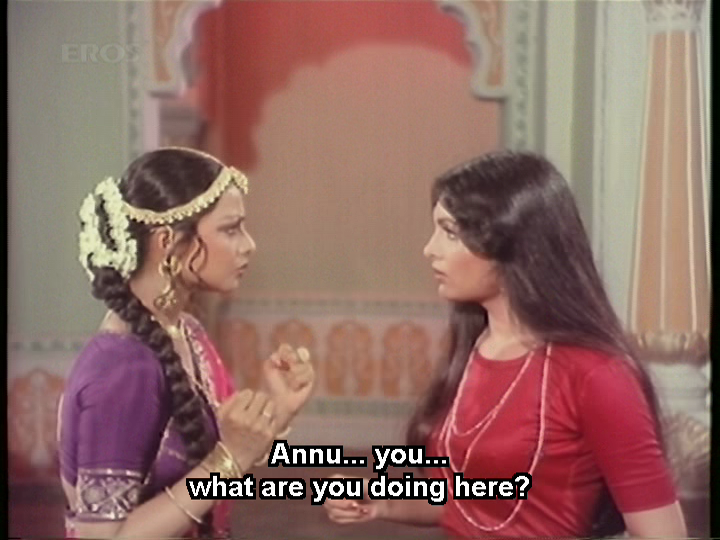
The heroines are minor characters, but do have some important scenes. Parveen is the lightweight – she doesn’t do much other than fall for Shashi and play a fun but unconvincing drunk scene. Rekha’s Basanti is shown as a more complex woman and one who could be the perfect life partner for Amit. When he needs to clean up his act and stop drinking, he relies on her to help him through the first night of sobriety.
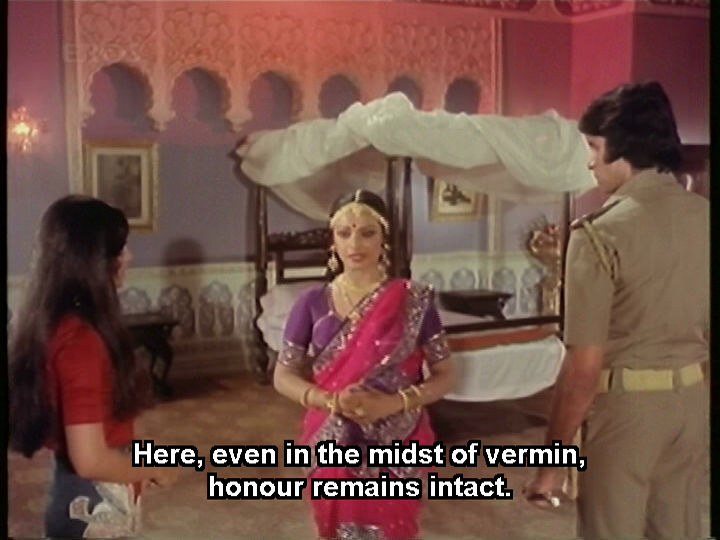
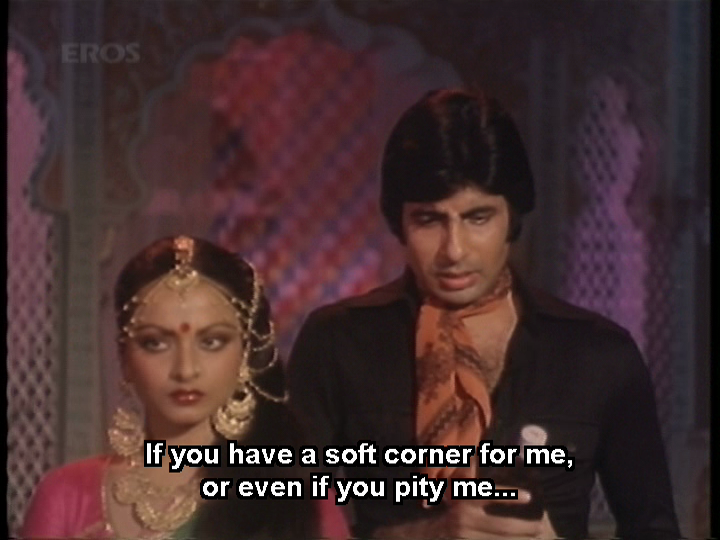
She isn’t a plaything for men despite her occupation and has her own very good reasons for working in the brothel. Nirupa Roy as Durga is a frustrating character. On the one hand she is strong enough to be a single mother and raise a successful son, and imposes her will on the impulsive Amit. But she is so spineless and wishy-washy when it comes to Vikram, it just beggars belief.

The film plays with many masala conventions (read this excellent post by Beth at Beth Loves Bollywood). Amitabh and Rekha appear as Annu’s Punjabi brother-in-law and sister and no one recognises them, Amit directs dialogue at the audience, Shashi flashes a smile at the camera after meeting Annu. There are lots of teasing references to family in the dialogue – Amit calling Durga Ma, Vikram calling to threaten the zealous policeman and identifying himself to Kishan as ‘tumhara baap’, and a whole lot of bromance. Vikram has a very ornate lair replete with design features like a dragon wall decoration and a stuffed tiger – although it suffers from some serious design flaws including being above ground and having abundant natural light which isn’t really lair-like. He has a kind of ticket booth in the middle of the lair, and retires behind the smoked glass to deliver his edicts. Who thought that one up? And there’s even some extremely dubious Bollywood Medicine.

Things accelerate once Vikram decides to eliminate the pesky policeman Kishan , and hires Amit to kill him. Jaggi is back on the scene, and it turns out Gopal is his son so we  have the whole gamut of family drama. There is a pivotal incident at the Navratri celebration which results in Kishan suffering chandelier related blindness, and demanding Amit avenge him.
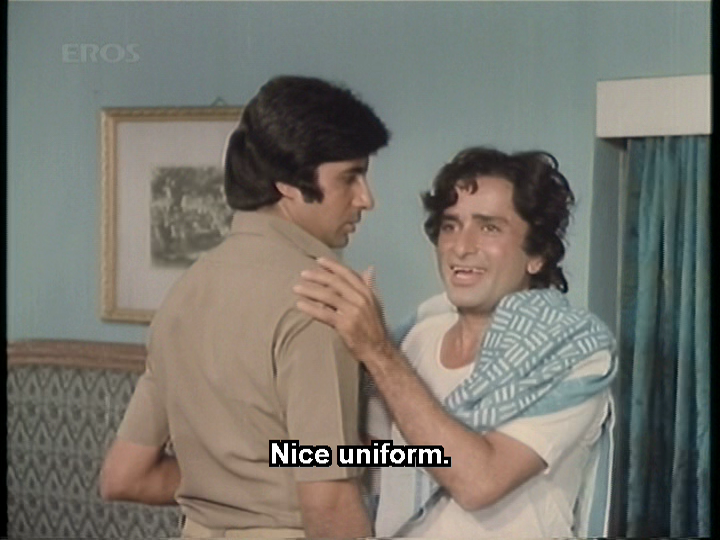
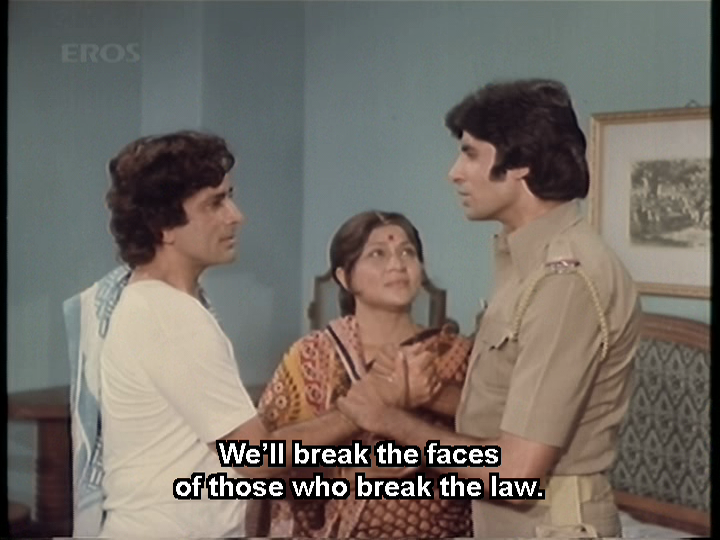
Kishan refuses to give up despite his injury, although we did wonder how helpful Amit’s hand signals would be to a blind man:

All the tangled threads start to draw into one gigantic ball of string as the film nears its end. Why Durga would be so complaisant about taking Vikram back into her life is beyond us, but that is truly not the strangest thing that happens. Amit and Kishan discover their relationship, and Durga cries. We learn how Gopal lost his eye, Annu and Basanti are reunited, helicopters, explosions, Vikram reveals his true colours before repenting, Durga cries, Pascal schemes, and Amit and Kishan kick some villainous butt. And don’t forget the dubious medical procedures. Did we mention Durga cries?

There is a pleasing symmetry in the love stories of Amit and Basanti, who might represent the better versions of Vikram and Durga if things had been different, and of Kishan and Annu who are every filmi Ma’s aspiration. The ending of the film resolves most of the loose ends and there is a sense that some justice has been served even if there are questions as to how and why and WTF?

The soundtrack is vintage Laxmikant Pyarelal and their lush big band sound is perfect for both the rollercoaster plot twists and the more intimate moments. The songs are excellent and serve to further the story so are an integral part of the film, and the stars all seemed to have a great time performing them.  The set design and costumes reflect a big budget and minimal restraint, which is very pleasing to see!

Temple says: The first time I watched Suhaag I was mildly annoyed by what seemed to be excessive coincidences. Once I thought about it further I have come around to thinking those coincidences help give the film a satisfying internal logic and structure as things link together. As I wrote that I pictured a helix…Good heavens! It may be Masala DNA! It does actually make sense to me that if you live and work in one area all your life then you do know everyone or at least cross paths with the same people over and over. Coincidences in this film arise from people and what they know rather than lockets and birthmarks, and I enjoyed seeing the minor characters having their own stories going on throughout the film. Most of the characters behave in ways that are consistent with their earlier actions and so they have a whiff of credibility, albeit in bizarre circumstances. Even Durga behaved consistently, although I do think she was stupid about a few things. If I have a disappointment it is that Parveen’s character was dull but there was so much going on, I don’t think there was room for more complexity. I liked the Amit/Basanti relationship as the writers gave Rekha a lot more to work with than they might have, Amitabh was in his element and they got a couple of great songs into the bargain. Rafi’s voice was perfect for Amit’s mix of sentiment and cheek. I am a fan of Shashi Kapoor and his pairing with Amitabh (aka the Shashitabh) is a delight. It’s strange to think that this frothy entertainment released in the same year as the much darker and also amazing Kaala Patthar. The heroes get some snappy dialogue (Amit and his chappals is just classic), and the humour is actually funny. That’s reason enough to praise Manmohan Desai! I have to admit that I didn’t think twice about the ‘only in Bollywood’ medicine, or villains escaping a blazing warehouse in a boat…on dry land… so perhaps my masala consumption has had a lasting effect. Nevertheless, I have watched this film so many times and I always enjoy it and never fast forward. I give Suhaag 5 stars!

Heather says: Suhaag isn’t one of my favourite Shashitabh films, nor do I think it’s one of Manmohan Desai’s best. This is despite the fact that it has every single Masala plot point possible, which really should ensure a great film. Perhaps it’s the sheer number of co-incidences which litter the story at every turn, or that occasionally it feels as if the actors have played these roles so often that I’ve seen it all before. But it just doesn’t work as well for me as many of Manmohan Desai’s other excellent films. My biggest problem with Suhaag however is the very dodgy medicine when Kishan is blinded. Now normally I can just brush this off and treat the absurdness of typical Bollywood medicine with the disregard it deserves, but I just can’t in this case. It really annoys me! My subtitles call Kishan’s problem cortical blindness, which should mean that the part of the brain that sees is not working. In which case an eye transplant, even if that were possible, would do no good whatsoever. Temple has told me that her copy calls it corneal blindness which is just as ridiculous for a whole heap of different reasons. Even with careful listening I can’t work out what the doctor says but since his other pronouncements which follow are also totally anatomically and physiologically incorrect it doesn’t really make any difference. I’m not sure why this particular Bollywood medicine irritates me so much but it really does taint the whole film for me, no matter how many times I’ve watched and tried to ignore it.

Despite the problems I have with the second half of the film, there is still plenty that I do like. The costumes are fab and I love the interactions between Amit and Basanti. For me Rekha is the standout in Suhaag with spot on characterisation. She is as dazzling as ever, and the film comes alive whenever she is on screen. Shashi and Amitabh are always watchable together and make the most of their partnership particularly in the comedy scenes. The inclusion of more than one bad guy and so many threads to the story ensures plenty of Masala mayhem and I do enjoy the first half of this film. I just skip the rest. 3 ½ stars from me.
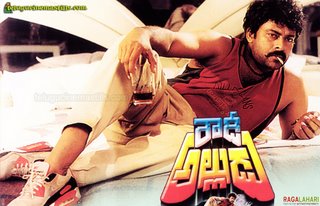
Rowdy Alludu

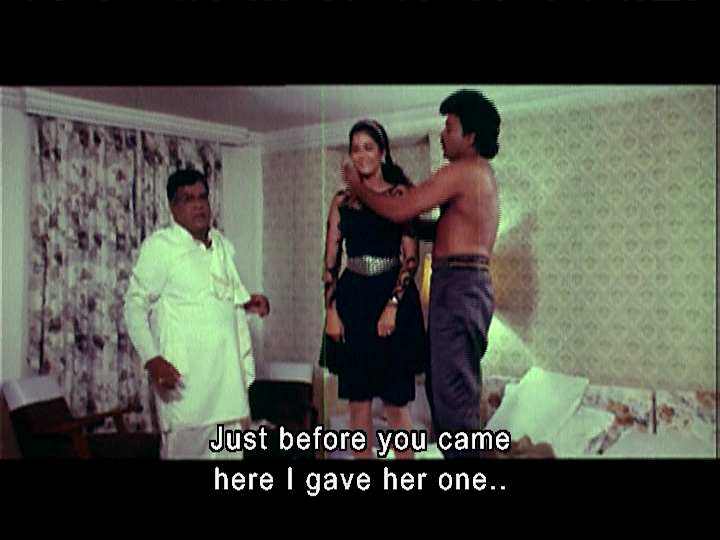
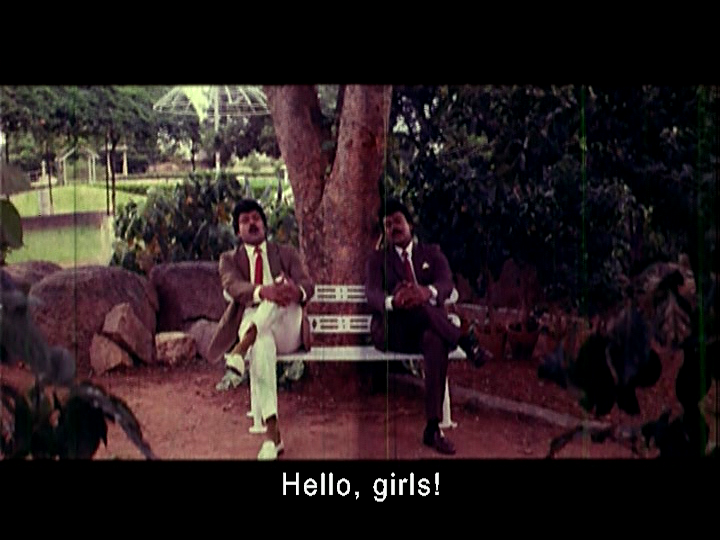
There are few things we like more than a Chiru movie, unless of course it’s a double role Chiru movie! Rowdy Alludu features Chiranjeevi taking on two classic characters; the smooth and suave businessman Kalyan and the strong, streetwise auto driver Johnny.  Add to this a dash of romance, intrigue, dastardly deeds and plenty of action and you have the perfect masala mix.

The movie starts with the above statement (which we took as A Sign) and there are a number of sections where there seem to be missing scenes as the action appears to skip. We really hope that there is someone in Hyderabad collecting and restoring, or at least preserving, all of these older films as quite a few we have watched recently have a similar problem.

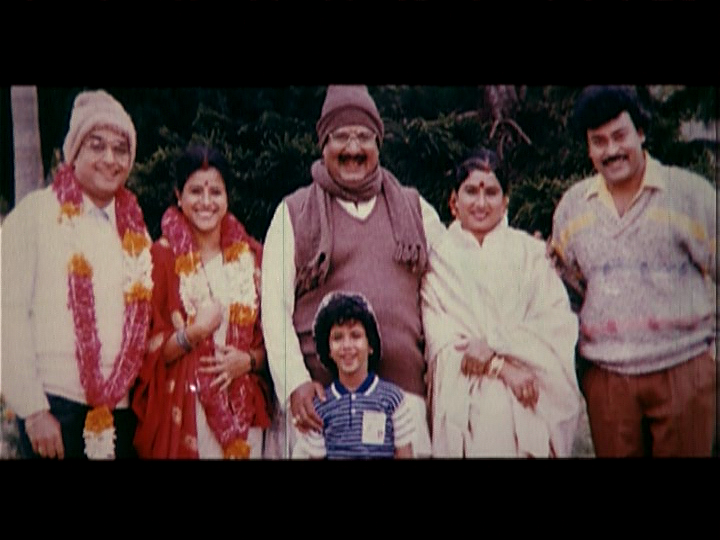
Kalyan arrives back from the USA to take over the family hotel business from his ailing father and naive brother-in-law. With the help of his father’s trusted employee Mr Madhavayya (Raogopalrao) he discovers irregularities in the accounts and it’s not long before he has a few suspects in mind.

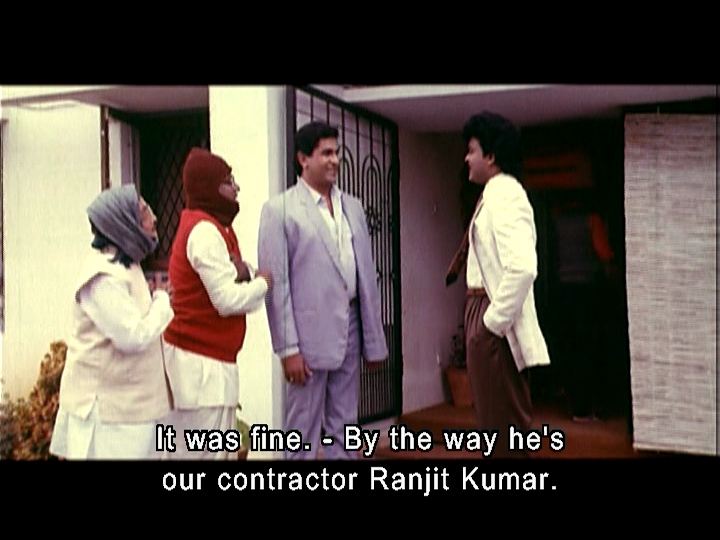
However, before he can investigate further, the whole family heads off to Ooty for a holiday. This seems to be an excuse for the wardrobe department to go mad buying a natty selection of sweaters for Chiru. Meanwhile, the fraudsters make efforts to cover their tracks and enlist the help of their partner in crime, the cat owning axe-murderer and construction contractor, Ranjit Kumar.

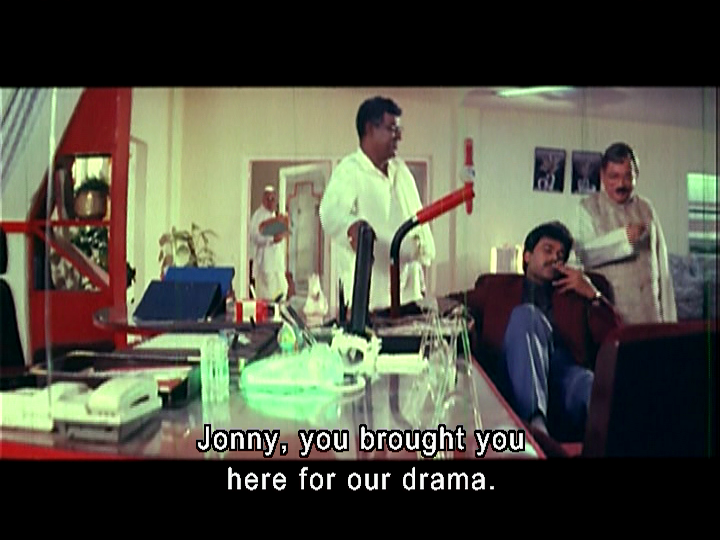
On a trip to Bombay, Venkat Raidu (Kota Srinivasa Rao) and Papi Kundalu (Allu Ramalingaiah) find Johnny, an auto driver who is the exact duplicate of Kalyan. They hatch a plot to get rid of their boss, put Johnny in his place and then take over the company.

Never one to resist a beautiful woman, Johnny dances up a storm to a bonus Bappi Lahiri song with the amazing Disco Shanti. Despite the fact that this was a film released in 1991, Disco Shanti’s outfit looks to have been stolen from Sam Fox circa the mid eighties. Luckily they are in fine form, and more than ready to take on the dubious choreography and make it their own. This may be the song that taught young Charan how to handle a fire hose.

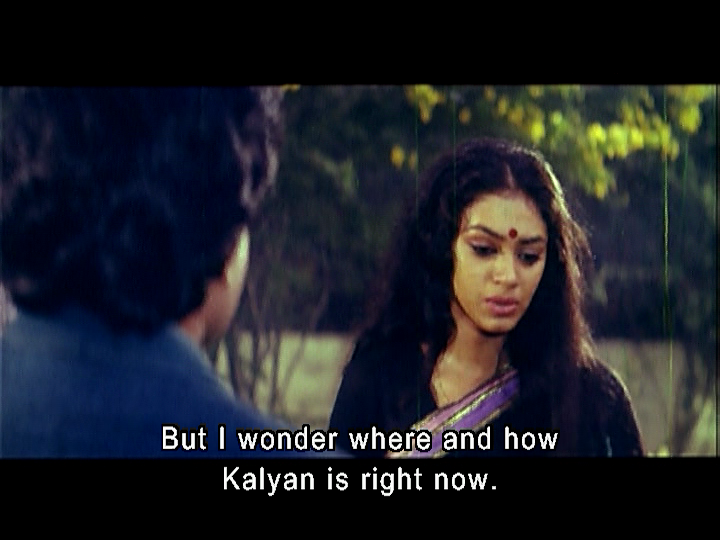
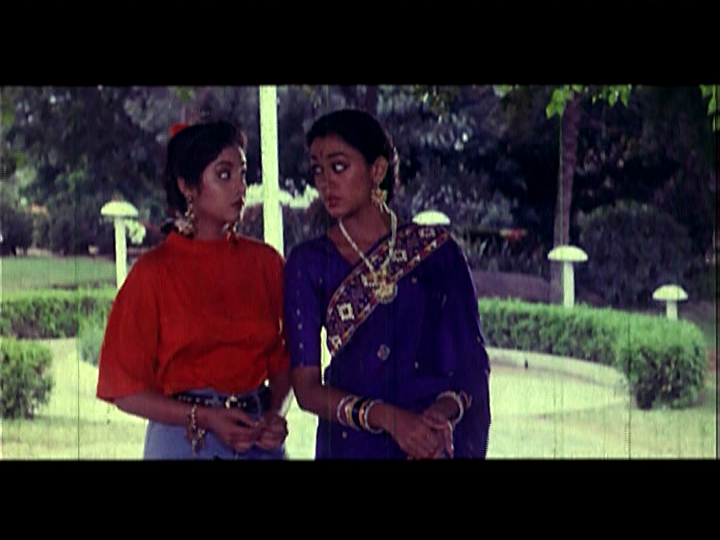
Kalyan is in love with Madhavayya’s daughter Sita (Shobana) who has the good sense to be a lawyer. This comes in very handy later on when the hapless Kalyan is accused of murder and thrown into jail. Rekha (Divya Bharti), the daughter of Venkat Raidu, hatches a scheme to marry Kalyan. Rekha does genuinely seem to love Kalyan but her father just sees the marriage as a way to control his nephew and the company. Naturally when she throws herself at Johnny thinking he is Kalyan, Johnny is delighted while Venkat Raidu desperately tries to separate the two.

Shobana doesn’t get much screen time at all, although she does make a lovely pairing with Chiru. Most of the romance is provided by the interactions of Johnny and Rekha, relying heavily on comedy, mistaken identity and innuendo. Divya Bharti throws herself at Chiru with wild enthusiasm  and really, who can blame her.

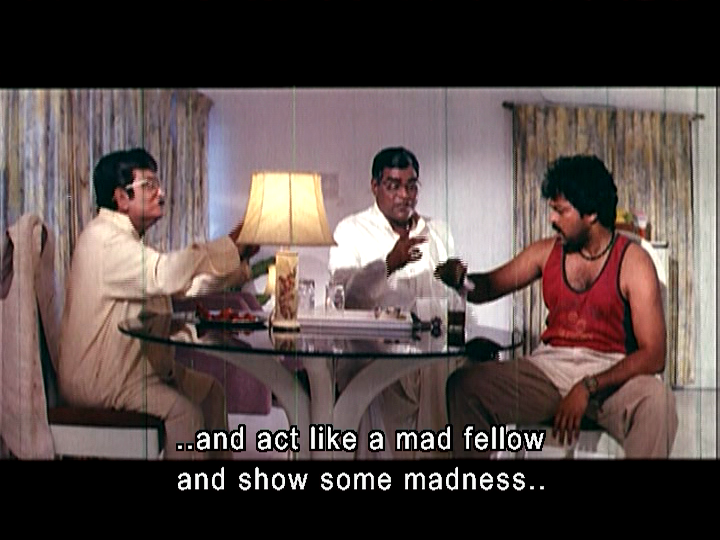
The success of the film rests on the portrayal of the two characters by Chiru. He exudes class and style as Kalyan and is also convincingly vulnerable when his family is attacked.  Johnny is as rough and tough as they come and Chiru makes him a different character in every respect. Kalyan has a blow-waved mullet and neatly pressed trousers, Johnny has a more exuberant moustache and prefers the timeless plaid and denim combo. Johnny’s attempts to impersonate Kalyan are laughable, but since he is supposed to convince everyone that Kalyan has become crazy that works perfectly. A very youthful and bald-spot free Brahmi makes an appearance as the psychiatrist enlisted to pronounce Kalyan insane, but most of the comedy falls to Chiru as Johnny and he does an excellent job.  The two fraudulent employees also ham it up with their inept schemes and it’s left to Ranjit Kumar and his henchman to provide the real menace.

The songs are mainly featured on Chiru and Divya Bharti and are upbeat as expected from Bappi Lahiri, with some interesting choreography by Prabhu Deva among others. There is one romantic song with Shobana in Switzerland which is quite subdued choreographically, but still contains potentially scarring images of mouth to mouth grape transfer technique. Chiru and Divya have an interesting encounter with some rather obvious symbolism of melting candles, dripping wax and a lot more besides. And we would love to know what the meaning was behind poor Divya getting hit in the face with suspended fruit.  More fruit! There was a theme here, but we just don’t know why. The costume designers also seem to have gone crazy in the local DIY store for some of the outfits and must be applauded for their belief that almost anything can be used as a headdress.

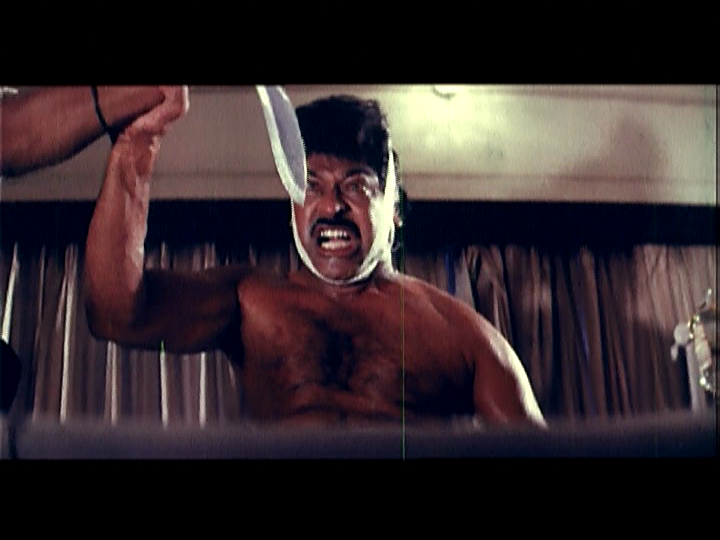
We enjoyed the scene in the hospital when Kalyan’s father’s heart beats in Morse code. There doesn’t appear to be any reason for this but is one really needed? Did it say anything significant? Are there any Telugu Morse Code experts out there? Johnny is obviously a man of steel as he is able to emerge from a coma and go straight into a major fight without so much as needing a bandage change.

We know that the story doesn’t have to make sense, but the police do seem to be particularly inept On learning that Kalyan has been arrested and  subsequently escaped, Johnny promptly flies back to Hyderabad. Surely the police would have been deployed at the airport looking for the escaped felon Kalyan? And since Kalyan and Johnny were identical it seems likely that the police might just have spotted Johnny returning to the city of his crimes. Perhaps they were looking for someone escaping from Hyderabad rather than entering the city so he was able to sneak in while their backs were turned.  Or are we over-thinking this?

Chiranjeevi is in his element and much of the film’s appeal lies with him, but his co-stars all turn in excellent performances to make this very entertaining. There is so much packed into this film with plenty of twists, plots and counter plots making it chock-full of masala goodness.

Temple says: This is not my favourite Chiru film, but it is very entertaining. All the requisite elements are there – fighting, flirting, bad denim, a sobbing mother, songs and multiple double-crosses. The comedy track is well integrated into the main story, and both Allu Ramalingaiah and Kota Srinivasa Rao make the most of their characters. Brahmi’s appearance is forgettable as he really doesn’t do much apart from fulfill what seems to be a law that he must appear. Divya Bharti plays an airhead and manages to be likeable enough but between her squeals and the wardrobe excesses, I was a bit over her character in a very short time. Shobana has less screen time but makes a stronger impression for me, as she down played a lot of her scenes and gave Sita a bit of presence. She might not have gotten a big dance number, but seeing what the costume team did to Divya, that may not be something she regrets. Chiru manages the characterisations of Johnny and Kalyan very well, and aside from obvious styling changes, his facial expressions and enunciation help keep the two roles quite distinct. It’s a fun film, if not a great one, and the songs are certainly memorable! I give this 3 and 1/2 stars.

Heather says: Perhaps it was the return to Telugu Masala after a month of watching only Tamil movies, or maybe just because it’s twice as much Chiru, but I really enjoyed this film. The songs were particularly entertaining although I’m not sure if I can say that’s because of the dancing or just due to the unbridled enthusiasm of the wardrobe department! This was one of the films that made Divya Bharti a star in the south but I found her a little too loud and over-excitable. I thought Shobana’s performance was superior and it’s a shame she didn’t have more screen time. The film however belongs to Chiru and he separated his two characters very well, with differences in speech, posture and attitude clearly defining Kalyan and Johnny. I did appreciate the tasteful sweater collection used by Kalyan compared to the more garish choices often seen in Hindi films of the same period. The bumbling conspirators Venkat Raidu and Papi Kundalu are inept and amusing, while their partner in crime Ranjit Kumar seems to be an amalgamation of a number of classic James Bond baddies. Overall the story works well and the various twists and turns are satisfactorily dealt with to make this a fun watch. 4 stars from me!

HELP!

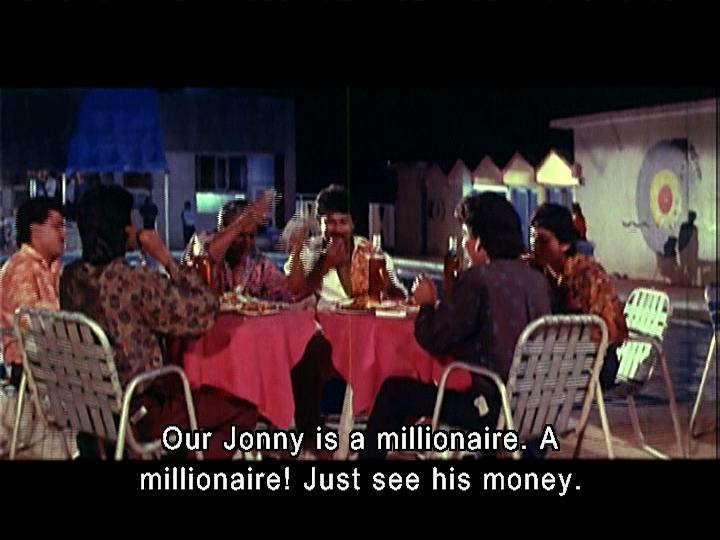
Our good friend Memsaab is trying to identify a particular function room and hotel swimming pool that feature in a lot of Hindi films. So imagine my delight when I saw The Pool in this film!

But I still have no idea which hotel it was at. Do you? Surely that distinctive wall decoration (on the right of the picture) has to ring a bell with someone. Please let us know! Temple

Jagadam

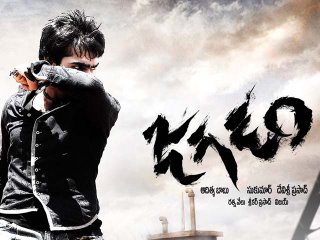
Ram’s second film, Jagadam, is a dark and violent gangster film and is certainly very different from his debut role in Devadasu. Supposedly loosely based on the Brazilian film City of God, it’s less an exposé of gangland life but purports to be a moralistic tale of the consequences of violence.

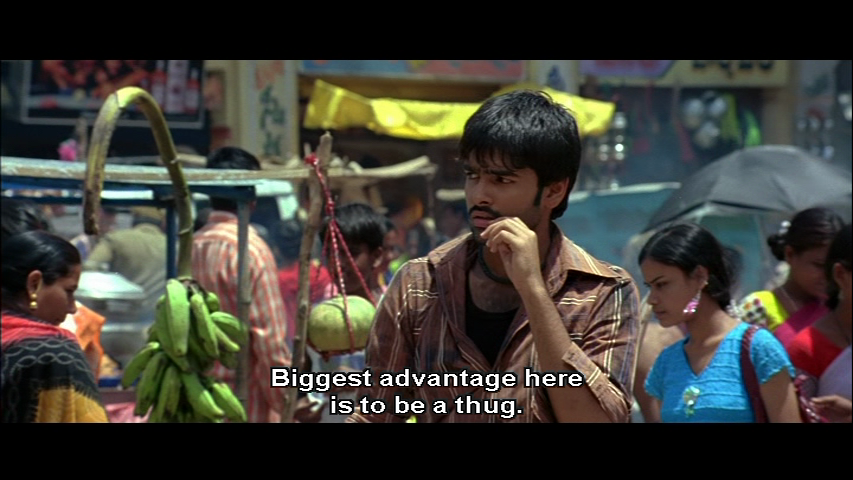
Ram plays Seenu, a wannabe rowdy who becomes fascinated by violence as a child.  Perhaps this is because the area around him is rife with thugs and petty crime, or maybe just because he is a rather warped child. The local community, including the corrupt police, both fear and revere the rowdies who control the area. Seenu dreams of becoming like his hero, the local Don, Manikyam (Pradeep Rawat).

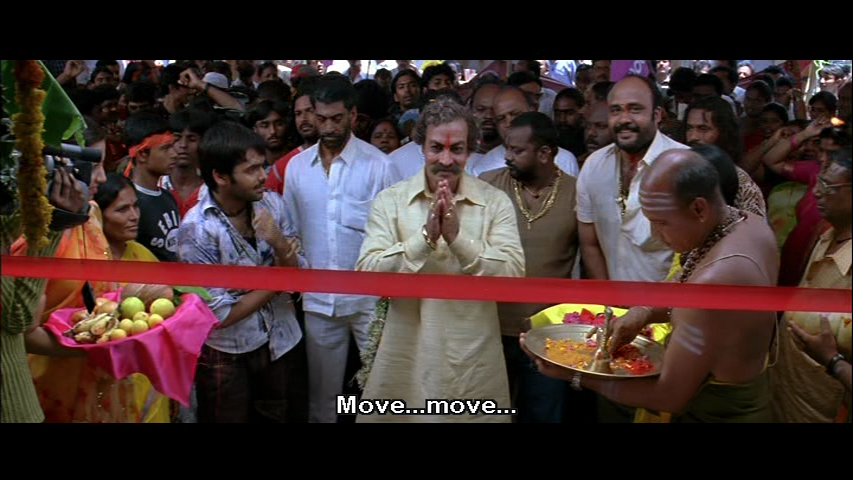
Seenu has a talent for fighting which comes in handy as he works his way up the ranks from small time thugto head his own group of initially ineffectual youths.  His recklessness and lack of anything approaching common sense is amply demonstrated in one of the early scenes when his gang is outnumbered by a knife-wielding mob. Seenu is the only one who doesn’t retreat and ends up at the front of the group – the position that, in his eyes, makes him the leader. As such he is prepared to fight and of course, since he is the hero, wins against such impossible odds.

All of this is fairly normal gangster fare, but the film introduces some more interest in the character of Seenu’s younger brother Chinna. He idolises his brother and is fascinated by his knives and guns. The way in which this adulation is used to develop the story line in the later scenes is one of the strengths of the film, which otherwise is yet another blood soaked gangland war saga.

In the middle of Seenu’s rise to notoriety, he falls in love with Subbalakshmi (Isha Sahni). Subbalakshmi appears to be an intelligent girl; after all she is a Mahesh fan, albeit an obsessed one. Unfortunately director and writer Sukumar has given her every single characteristic we deplore in a filmi heroine. She is whiney, irritating and not just totally useless but an actual liability in a fight. She wears skimpy clothes when wandering round unsavoury areas at night. And as the final insult, Subbalakshmi tells Seenu that when a girl says no, she doesn’t actually mean it. At this point we were ready to slap her ourselves.

Why she falls in love with Seenu is a mystery as well, since he is totally inept in wooing her. He follows the usual stalker method and just assumes that since he likes her she will automatically love him back. Sadly, this does seem to be her only motivation, although perhaps his willingness to dress up in the latest Mahesh costume she bought for him was a factor. She also has an interesting, if not recommended technique for removing a foreign body from Seenu’s eye – hm!

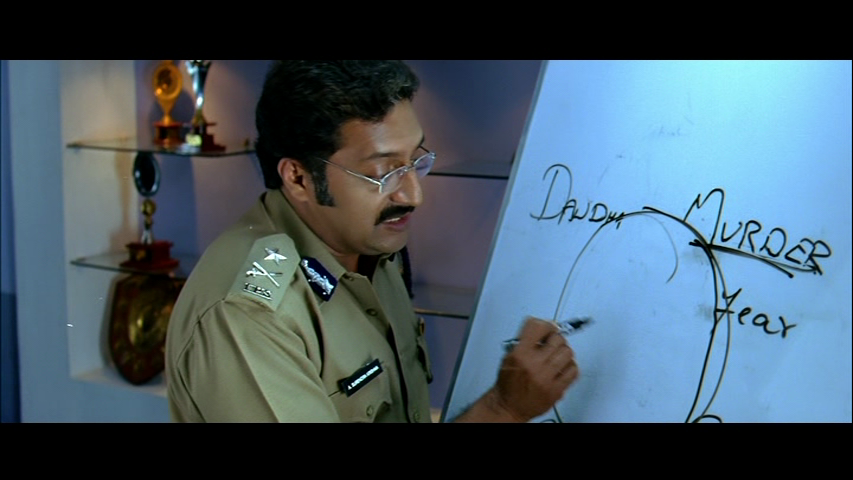
We do like that the intermission is called an interruption, but it does mark the point where the film starts to lose its way a little. Seenu eventually has a falling out with Manikyam and ends up crossing machetes with Manikyam’s source of political funding; the industrialist Yadav, slimily portrayed by Satya Prakash. The story is totally unbelievable at this point as the difference between the well equipped seasoned killers employed by Manikyam and Seenu’s youthful gang is ludicrous. However this doesn’t stop various members of the community approaching Seenu for his rather simplistic aid. Meanwhile Chinna has been avidly following his brother’s exploits and admiring his lifestyle, much in the same way that Seenu idolised Manikyam.  When finally Seenu heads off to kill Yadav, his younger brother wants to watch but events do not unfold as anyone anticipated. This does however mean that we get to see Prakash Raj in his familiar cop avatar expounding truth and justice and using a white board to illustrate the ‘cycle of violence’.

Ram plays the cocky and arrogant character of Seenu with ease. He manages to bring enough of his chirpy ‘boy next door’ persona to the rather dark role and makes Seenu a more sympathetic character despite his arrogance and obsession with violence. Seenu’s friends are from the usual pool of young actors, and in the main they manage to bring some individuality to their various characters. Pradeep Rawat is good in his fairly small role as Manikyam, and gives his scenes some badly needed menace. Ravikumar Chowdary also turns in a convincing performance as Ladanna in the first half, but disappears towards the end of the film. Ragubabu and Saranya are rather wasted as Seenu’s parents and Satya Prakash has very little to do in his role as Yadav. Isha tries, but her character has few redeeming features so she has to settle for pouting and crying in equal measures.

The music by Devi Sri Prasad is fine but not particularly memorable. Ram is a good dancer and the choreographer has utilised his skills well in the songs. We are happy to see that he shows plenty of commitment to the chicken step and is not afraid to dance while totally covered in mud. It’s always good to see this level of dedication even if it doesn’t totally make sense.

Overall the film doesn’t succeed as an edgy drama, nor does it succeed in its supposed anti-violence message . The moralistic tone at the end fails since it doesn’t seem as if Seenu will ever have to pay for his actions. Within the cycle of violence there is a sense that Seenu could stop any time he wants to, but at heart he is still that kid fascinated by killing. While it starts as an interesting attempt and is worth a watch for Ram’s performance, the film ultimately fails to rise above the standard gangland shoot ‘em up fare.

Heather says: Jagadam tries to be different and send a message about the inevitable consequences of violence. It just doesn’t succeed, as the story still glorifies aggression and shows that a life of crime gets you the girl, plenty of money and adulation from your peers. Take away the gang fights and there is really very little of substance left. The romance is just uninteresting and there is no chemistry between Seenu and Subbalakshmi. I really didn’t care about the couple at all and thought it detracted from what could have been a much edgier drama. Ram’s performance is what makes this watchable and I think he does an excellent job of showing the arrogance and sense of indestructibility that many young people display. His anguish at the end as he realizes the price he has had to pay for his lifestyle is well portrayed and believable. But then it’s promptly diluted by the horrific fight scene immediately afterwards. The sympathy shown by the police chief is at odds to the rest of the film as well, although it does fit better with the pacifist message that seems to have been intended. I’m professionally qualified to say that the best way to remove a foreign body from an eye is not to lick it. Be warned – saliva and eyes should never come into contact! Overall the film just fails to be anything other than average, so it gets 3 stars from me.

Temple says: This is 2 and a bit hours of ‘meh’. Once again, it seems the message the film is supposed to contain is not the message I get;  it glorifies violence, showing it to be the solution to many problems and the province of heroes. I know Seenu loses people he cares about but, as he hasn’t developed any sense throughout the film, there doesn’t seem much hope for character transformation despite a scene supposed to convince us of his redemption. Prakash Raj made the most of his character and opportunities but clearly his whiteboard was wasted on the director! Ram is quite memorable, partly because of his likeable presence, but mostly because of his annoyingly asymmetrical shirts. I don’t think contrast piping and looking like you’ve got your buttons done up wrong is really going to strike fear into your enemies or impress the ladies, but the costume designer had other ideas. Despite a handful of scenes that were strong and sometimes moving, the film just wasn’t grim enough to make the violence angle feel real and wasn’t entertaining enough for it to be a good popcorn film. The overt statement of the anti-violence message was at odds with the implied approval of the hero’s character and decisions. It just didn’t get the balance of light and dark right for my tastes. I give it 2 and 1/2 stars, mostly because despite seeing it twice now I can’t recall much outstanding or noteworthy apart from Ram, those shirts, and the eyeball licking scene. And that’s probably not a recommendation.