Polladhavan (2007)

Polladhavan

Frustratingly the only copy I have ever been able to find of Vetrimaaran’s debut film is a relatively poor quality VCD  that doesn’t have English subtitles. It’s particularly annoying knowing how well written the dialogues were in Aadukalam (even via subtitles) and I’m sure there is much I have missed in Polladhavan as a result of not understanding the language. However the story is still clear and easy to follow, with plenty of scenes that suggest a similar attention to developing the flawed characters and their relationships as in Vetrimaaran’s subsequent film.  Although there is much that initially seems familiar about the story, as the film progresses it breaks away from the typical gangster film mould and becomes as much about family as the struggle between Prabhu (Dhanush) and the gangsters who have stolen his beloved motorbike. There is plenty of tension and suspense, and the path to the final bloody showdown is rather more convoluted than expected. It’s a good story, entertainingly told and really deserves to be more readily available to a wider audience.

Dhanush appears in his by now very familiar role as Prabhu, an unemployed layabout, content to spend his days playing carom and hanging out with his friends Kumar (Karunas) and Sathish (Santhanan) or annoying the local bike dealers by repeatedly viewing a Pulsar motorbike. He has no hope of ever being able to afford the object of his desire but continually attempts to get a cheaper price along with a long instalment plan for payment and seems convinced that he will one day be the proud owner of the latest model. Nothing wrong with having a dream!

Prabhu is at odds with his father (Murali) who wants him to get a job, but is supported by his mother (Bhanupriya) who slips him money behind her husband’s back. There are the usual family arguments about money and Prabhu’s failure to contribute to the household, but things change after Prabhu confronts his father following a drunken night out. Prabhu accuses his father of not supporting his attempts to find work compared to his friends whose fathers who have paid bribes or bought them a start in their chosen career. Although this seems a very strange argument to me, it strikes a nerve with Prabhu’s father and he cashes in the money set aside for his daughter’s wedding and gives it to Prabhu instead.

Naturally Prabhu immediately goes and buys the bike.

What is interesting is the way this argument and Prabhu’s subsequent purchase of the motorbike change the family dynamic.  While Prabhu’s mother accuses him of wasting the money, Prabhu’s father supports his son’s right to do whatever he chose, even if he doesn’t agree with that choice. The family arguments feel realistic and plausible and Prabhu’s conviction that his bike will help him get a job seems typical of any young man in similar circumstances. Body language is key and Vetrimaaran uses different angles and distance shots to convey the changing relationships. It helps give the film an authentic sense of a typical family which makes the subsequent scenes of violence a complete and striking contrast.

Amazingly Prabhu’s purchase has the desired result and he manages to get a job, further aiding his reconciliation with his father. The development of their relationship is shown in small moments such as when his father chases away the neighbourhood children playing on the bike, or by his father’s smile when he sees job adverts circled in the newspaper.  It’s effective and develops relationships while avoiding a big family make up scene that would only have interrupted the flow.

As well as dreaming about owning a motorbike, Prabhu has spent the last 2 years infatuated with a girl he sees at the local bus stop. The bike and his job give Prabhu the confidence to finally approach Hema (Divya Spandana) and after a shaky start the two begin a relationship. However, after a good beginning with plenty of humour and promising signs of a personality for Hema, once the action ramps up the romance is relegated to the background with Prabhu’s first love (his motorbike) taking precedence in the story.

As things are going well for Prabhu, in a semi-parallel storyline local gangster Selvam (Kishore) has problems with his younger brother Ravi (Daniel Balaji). Selvam deals in drugs and is involved in various other illegal activities as he runs his area with help from his best friend Out (Pawan). Ravi wants a bigger role in his brother’s endeavours despite his quick temper and apparent general unsuitability for any responsibility. Prabhu crosses paths with Ravi a few times in chance encounters, but most notably on a night when the gang is involved in a murder and Prabhu’s bike is stolen. The two events may, or may not be connected but Prabhu really doesn’t care – he just wants his bike back!

Some of the best scenes occur when Prabhu’s search takes him to different crime operations with a fascinating look at how bikes can be hidden and smuggled around the country. These brushes with the shady side of Chennai bring Prabhu into closer contact with Selvam and his brother Ravi, and the situation escalates as Prabhu discovers exactly what has happened to his bike.

Dhanush gets everything just right here in his portrayal of a young man gradually developing maturity and responsibility but easily distracted by events around him. His spiral into violence is clearly shown as a reaction to circumstance with the infatuation with his bike a convincing reason for the decisions he makes. I had friends who were just as obsessed with their bikes (and I have to confess to a certain amount of obsession with my own!) so it totally makes sense to me that Prabhu would go to such extremes to get his bike back. Ravi is a more typical Tamil film gangster, but his brother Selvam is an interesting character who seems to be a ‘gangster with a conscience’. The interplay between Ravi, Selvam and Out is well done, and once Prabhu is added in to the mix, the story evolves quickly with plenty of suspense thrown in for good measure.

The final scenes revert to more typical gangster film fare with the inevitable final showdown, but Vetrimaaran keeps it interesting by giving his bad guys realistic personalities and reasons to act in the way they do. The fights are short, bloody and more convincing than usual which also avoids sensationalising the gangster element of the story. Although there are a few fights where Prabhu defeats 3 or 4 henchmen, at least it is only 4 rather than 20, and Ravi isn’t a big burly guy either so his fight sequences with Prabhu seem slightly more credible. Apart from the rather Salman Khanesque way Prabhu loses his shirt in the final fight, which is a little OTT but is also a lot of fun too!

While the fight scenes work well, the songs are less successful. Although the music by G.V. Prakash Kumar is catchy enough, the picturisation and choreography are generally mediocre and mostly the songs don’t fit well into the narrative. However the rest of the film looks good, at least from what I could see from my poor quality copy, and the strong cast all deliver good performances. Vetrimaaran’s strengths lie in developing characters with depth and attention to detail in building relationships, and both are used to maximum effect here.  The story may not always flow as well as it could but when it comes to the characterisations and the overall plot, everything works perfectly. The screenplay rarely lags and there are enough twists and surprises to keep the film engaging right to the very last frame. While Polladhavan may not be perfect it is a great first film for Vetrimaaran and well worth watching for a gangster film with a difference. 4 stars.
Nagadevathe (2000)

nagadevathe-poster

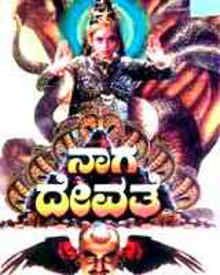
Sai Prakash’s 2000 film Nagadevathe is snakecentric, packed with special effects, and Soundarya and Prema are more than capable of shouldering the lead roles. The film is available on Youtube in Kannada, Tamil and Telugu so you can choose your own adventure without subtitles, and it has also been dubbed into Hindi under the title Naag Shakti.

The story as I believe it to be goes something like this. Gauri is regarded as a bad luck omen in her village, possibly just because she is barren. She and her husband offer hospitality to Shiva and Parvati who are pretending to be travellers. The gods tell Gauri why she is infertile – she accidentally killed a clutch of snake eggs and has been cursed. But they tell her how to stop them from continuing to punish her. Soon after, Gauri discovers she is pregnant. A difficult labour nearly ends badly but a glowing mystical snake appears and turns into Nagamma (Soundarya), who ensures a safe birth. There is a backstory involving a man who foolishly kills a snake and is cursed, his household goods transforming to snake mounds. He and his family do penance and after giving the deceased snake a proper funeral, his home is restored. Nagamma moves in to the termite hill to keep an eye on them or something. A shrine is built around the main snake mound and over time, more and more people come to pay their respects to the snake goddess. Nagalakshmi is born to be a devotee of Nagamma, and they have quite a warm and personal bond right from Nagalakshmi’s birth. Grown up Nagalakshmi (Prema) meets Shivaji (Sai Kumar) and love blossoms. There is some kind of conflict between their families and I couldn’t work out if it was an old feud, the rich boy poor girl thing, or just garden variety mother (deliberately turning her son into an evil possessed snake) issues. Nagamma tries to protect her favourite humans, and they could all benefit from some better decision making. Things get worse before they can get better, and the effects team are kept busy with magical healings, snake assists, helpful talking parrots, attack vultures, heaven, hell and the kitchen sink.

I enjoy the snake film genre for a few reasons. Often the female characters are more prominent and powerful or more nuanced, or both, and that makes me happy. There is usually a pervading sense of right in the film’s world as the snakes are able to enact justice that is missing for the masses. Snakes may act out of common sense or compassion, unlike many non-magical humans. Snakes are alert to every opportunity to get their groove on, with varying degrees of success along the scale from Jeetendra to Sri Devi. And the outfits are frequently a bit special. On many levels, from the very shallow to only slightly less shallow, Nagadevathe delivers.

I think Soundarya is lovely and in this film she maintains an air of benevolent authority in even the most trying times. Given that she often only has her face to act with (the rest of her having been replaced by a giant CGI snake), she does very well.

In one scene reminiscent of Ammoru, Nagalakshmi has summoned guests to eat at a special pooja. They are turned back by the Evil In-Laws but Nagamma calls on her sister deities to come along. She gets the undivided attention of the effects and saree teams as she personifies water, wind, earth, fire and more.

I admit to some disappointment that despite a most excellent spangly body suit, the obligatory “nagin assailed by been-wielding baddies” scene resulted in a disappointing dance. More like she was rolling around on the floor looking for a lost (blue) contact lense at times.

I liked Prema a lot in Devi, and her performance is solid. She has a flirty but down to earth tone with Sai Kumar, and a nice rapport with Soundarya. Prema is tall and elegant looking but has an energy that lends equally well to comedy and romantic shenanigans. Nagalakshmi has the strength and faith to stay on task and Prema really showed the power and intensity of her determination as well as her softer side. I could see why the snakes would want to chip in at her wedding. She was a good friend and fundamentally nice without being a pushover. Nagalakshmi knows what’s what and once she finds out the truth of her situation she takes steps to protect her loved ones and engage some divine assistance to sort out the problem. I recalled musing on the toxicity of Chiru’s bodly fluids in Punnami Nagu, and Shivaji also appears to have a lethal, um, bite. I have never been so glad to see so many silly interruptions of a wedding night.

Sai Kumar is Shivaji. He seems so nice and yet… When his snake nature dominates he is predatory and poisonous. Now I was confused as to how a snake goddess could be unaware her favourite disciple was marrying a serial killer faux snake, but maybe there are cosmic rules about that kind of snake-by-venomous-inoculation. Shivaji was unaware of his snakey activities and oblivious to the black magic worshipping going on around him. Nagalakshmi was often in peril and I was quite worn out from yelling at the screen for her husband to either wake up to himself or to get away from her. I’m more used to seeing Sai Kumar as a villain or an elder statesman so seeing him as a romantic lead was novel. Even if the effects team did seem to take too much pleasure in distorting his face into a snakelike mask.

The support cast includes stalwarts Babu Mohan, Tanikella Bharani, and other familiar faces doing familiar shtick. I couldn’t put names to all the faces but I was largely able to place which characters were Good and which were Not Good.

I did get a little confused at times since without the benefit of subtitles, I rely on the visual cues. Thankfully the signs are generally clear and umabiguous. Nagamma’s arch enemy is an evil mystic who favours an eagle motif and prances about in a shiny red outfit with a fluttering black cape. I liked that his cape was attached to the sleeves of his onesie as that helped ensure some vigorous and character appropriate flapping. The effects team worked themselves into a lather of laser eyes, snake shaped shadows, nasty afflictions, sparkly things, space monsters and of course giant multi-headed cosmic snakes.

Some key scenes are very similar to ones from Devi (1999) or even Ammoru (1995). Although this time around Prema was not the cosmic snake, and Soundarya was the powerful goddess. The story is laden with a bit of everything and the commitment to the theme is unquestionable. I can’t say the commitment to logic is equal.

See this if you like to see competent actresses take centre stage and if you enjoy a bit of a spectacle en route to a good comeuppance. 3 ½ stars!

Midhunam (2012)

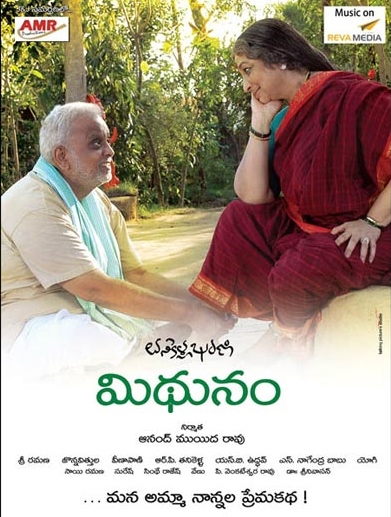
Midhunam Poster Over the past few years of watching Telugu films I’ve seen Tanikella Bharani on-screen in many roles, but most usually as the sensible father or responsible authority figure providing support to the hero or heroine. He appears as such a natural actor and fits those roles so well that I was surprised to find out that he is also an accomplished writer, dramatist, poet and now film director. In Midhunam, Tanikella Bharani has adapted a short story by Sri Ramana, writing the screenplay and dialogue and also directing the film. It’s a lovely little story about an elderly couple living alone in the country that focuses on relationships and shows that love doesn’t fade with the passing of time. It’s rather unusual in that there are only two actors for the whole two hours, and the film concentrates on their day to day activities and interactions without any momentous dramas or major events. It’s beautifully done, and is well worth a watch for a well-drawn picture of a happy marriage and a glimpse of rural life.

Appadaasu (S.P Balasubrahmanyam) and his wife Buchchi (Lakshmi) live by themselves on a small farm in the country. They have five grown up children who have moved to the USA but who keep in contact with their parents by phone. The couple seem to prefer their solitude and isolation, with Appadaasu shouting at a persistent caller who keeps knocking on his door, and yelling at his son down the phone when he calls unexpectedly. Buchchi on the other hand does seem to miss her children, but doesn’t have any wish to move away from her home despite the hard work it takes to keep everything maintained. She keeps a mobile phone hidden in one of her pots in the kitchen to talk to her children without her husband’s interference, although this seems more to be a way of outfoxing her husband rather than actually something that is completely necessary.

The couple squabble incessantly about literally everything, but their arguments seem to be more as a result of knowing each other too well and being very comfortable with each other rather than from any genuine acrimony. They are like small children, pushing at each other until they get a reaction, but not taking any of it too seriously. It feels comfortable and natural, just like any married couple after a number of years together. There is also a lot of laughter as they play tricks on each other and each tries to get the upper hand. Buchchi seems to be the more sensible one but she strands her husband on a top shelf by removing the ladder so that she can make coconut chutney in peace, and teases him later on by dressing a scarecrow in his clothes. Their love for each other shines through all of the bickering and teasing, and is the central thread around which everything else is woven.

Appadaasu is a man who takes his food seriously and much of the film is either about growing food, the preparation of food or eating.

The couple harvest everything they need from their farm, and they have impressive crops which do look very appetising. In fact the major focus on food might be one of the reasons why I enjoyed this film so much! At one point one of the sons proposes that the family come home for a wedding, and Buchchi immediately starts cooking enough food to feed an army. This is accompanied a song which celebrates pickles amongst many other traditional foods and is just mouthwatering!

There is an old radio on the wall and the programs and old songs are incorporated into the film, adding to the story. Both Appadaasu and Buchchi have conversations with their cow Savithri, who is almost a third member of their family and serves as a sounding board for some of Appadaasi’s ideas.  In between all the cooking and eating, Appadaasu expounds his philosophy that retirement from his teaching job doesn’t mean that he doesn’t work. He makes sandals, cleans cotton, throws pots and does a myriad of other tasks that emphasise his practical nature and willingness to do whatever he feels his wife wants. Actually asking and doing what his wife really wants naturally isn’t an option, and Buchchi makes sure that Appadaasu knows when he’s missed the point completely.

S.P.  Balasubrahmanyam is perfect in the role of Appadaasu. He’s cheeky and mischievous but also appears suitably serious when necessary. His expressions are wonderful and he fits the part of a cantankerous but loving husband perfectly. Lakshmi is also well cast as Buchchi and is the ideal partner for S.P. Balasubrahmanyam. The two have great chemistry together and the rhythm of their dialogue sounds as if they really have been together for years. That’s down to some good writing too, but the body language, delivery and tone from both actors ensures that they do appear to have grown old together and are very familiar with each other as a result. The use of older songs helps set the mood of the story, as does the beautiful location and wonderful farmhouse. I’ve just spent a week staying at a farmhouse near Tanjore, and much of the décor was just the same as my own recent experience. The film feels authentic due to this and many other small touches which is part of why it works so well. The cinematography by Rajendra Prasad Tanikella (a relative?) is also outstanding with beautiful use of light during the night scenes and great shots of the farm and surrounds.

This is a sweet film that simply follows the ups and downs of life for an older couple and shows how a marriage might be after more than 50 years together. It’s charming and yet meaningful with the contrast between Appadaasu and Buchchi’s life and the imagined lives of their children overseas just one of the ideas explored. There is jealousy, anger, forgiveness, tenderness, love and sacrifice, all mixing together to add colour and life to the description of a successful partnership and just what that partnership really means. A beautiful film that deserves a wide audience. 4 stars.