Brahmotsavam (2016)

Brahmotsavam

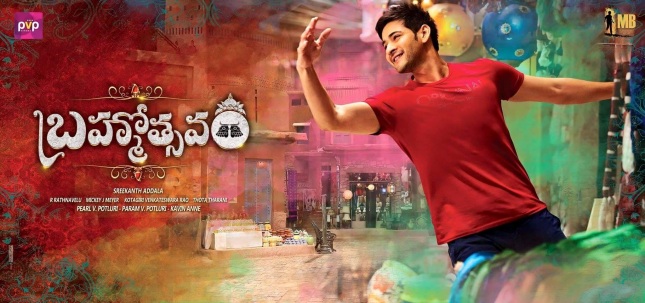
Srikanth Addala’s Brahmotsavam is a real mishmash of a film, where random family scene follows random family scene with the emphasis on feel-good values and upbeat emotions rather than anything inconvenient like a storyline. This is one film where the subtitles didn’t seem to help at all and much of the dialogue made absolutely no sense, but a few other audience members explained that not only were the subtitles inaccurate, but that the script was fairly random too and they were just as confused. It doesn’t help that most of the characters don’t have actual names but are called brother, brother-in-law or sister-in-law (and there are a lot of them), making Brahmotsavam less of a celebration and more of a memory test. Mahesh is always watchable and the strong cast are all charismatic, but with nothing much actually happening over more than two and a half hours, Brahmotsavam is sadly uninspiring.

The film starts with a family celebration, which I think was a wedding but could have been almost anything – maybe just breakfast – given the families propensity for breaking into song and dance at any moment.  Whatever the occasion, Sathyaraj likes to ensure that the whole family celebrate it together – that’s all his brothers, their wives, children and his brother-in-law Rao Ramesh. Everyone is sickeningly happy all the time except for Rao Ramesh who suffers from intense (but understandable) familiyitis and resents Sathyaraj’s success with the paint factory he runs. Naturally everyone in the family works at the paint factory when they’re not singing and dancing around the family home, and they’re all deliriously happy to be working there too. It’s actually a little odd to see Mahesh in such ultra-happy family mode for most of the film, but when he sheds the happy and has to show a range of emotions he really is excellent. More of this would have made for a better and more enjoyable film.

Just to add to his individuality a small animated figure appears to speak to Rao Ramesh any time he is particularly exasperated with his brother-in-law. Since most of the time this imaginary figure berates him for his lack of appreciation for Sathyaraj and the family gatherings this has the effect of making Rao Ramesh even more miserable and less willing to participate. After the first 15minutes I was totally on Rao Ramesh’s side and could completely understand how the continual en masse family gatherings could very easily make anyone want to run screaming for the hills as fast as possible. Rao Ramesh is much more tolerant however and manages to last almost until the second half before he snaps and leaves the family group.

As part of the celebrations, Kajal arrives from Australia for a few months and her father decides it would an excellent idea if she stayed with Sathyaraj and his family rather than spend the time with her own relatives. She’s gorgeous and confident, and Mahesh is smitten the moment he sets eyes on her. However, since she lives in Australia where the accepted practice if you like someone is to tell them you’re interested, Kajal is rather taken aback by someone staring relentlessly at her at every available opportunity without speaking. Living in the same house makes it ridiculously easy for Mahesh to stalk Kajal without appearing to do so but after a few uncomfortable moments Kajal seems intrigued by her silent admirer. The romance progresses as expected but despite Mahesh and Kajal seeming to get on well together, Kajal decides that she wants more from life than to be the wife of a paint manufacturer and decides to move on. She has ambition and is prepared to sacrifice what’s basically a holiday romance for her in order to ensure her dreams come true. I like this assertiveness in her character and Kajal is appropriately confident in the role, while still remaining respectful to the family and her father. It’s a good performance and I like this more mature and sensible Kajal.

Luckily for Mahesh, Samantha turns up in slightly manic friendly overdrive mode and the pair set off pair set off around India in the search for Mahesh’s roots. One of the first family members he meets is the hapless Vennela Kishore and the couple decide to drag him along with them on their road trip. It seems strangely unnecessary but at least Vennela Kishore and Samantha speak to each other which does help to make sense of the second half. Samantha is just a little too zany to be convincing but her energy does help lift the second half. The problem here is a lack of definition for her role and a fluffy backstory that does little to establish her character.

The biggest issue with Brahmotsavam is the addition of too many random scenes which are only peripherally connected to the main ‘plot’ (such as it is) and don’t serve any purpose. For example, at one point Mahesh and his parents are talking by video connection to his sister in the UK. His mum is showing off various sarees while Mahesh teases his sister and the talk finally comes round to how much they miss her and wish she was there. Big family moment – lots of tears, virtual hugs and emotion. And then that’s it – she’s never mentioned again. So much of the film starts with an apparent purpose and then fizzles out without ever going anywhere, making it difficult to work out what (if anything) is relevant.

The first half is also very song heavy with most of the songs coming one after another with little reprieve, including one where Mahesh and his backing dancers frantically try to get insects out of their clothes. That is definitely one of the high points and got the most cheers from the fans in the audience, but possibly not for the choreography. The second half settles down to a standard road trip and there are fewer songs which makes this part of the film flow more smoothly. It’s still a series of random encounters, but at least that does fit in more with the idea of a journey to find yourself while Samantha keeps everything moving along nicely.

There are a few positives to the film. The songs by Mickey J Meyer are good if oddly placed, and Gopi Sundar’s background music is generally effective and not too intrusive. The film looks beautiful and R Rathnavelu’s cinematography captures the warmth of the family home and the stunning landscapes as Mahesh and Samantha travel around India. All the main leads are fine, if somewhat incomprehensible for much of the film, and Mahesh certainly delivers in terms of emotion but the star of the show is undoubtedly Rao Ramesh with his grumpy and often bewildered demeanour. However, the lack of a comprehensible storyline and the random pointlessness of many scenes means that Brahmotsavam is probably best enjoyed on DVD where it’s possible to skip the vague dialogue, watch the songs and admire the beautiful scenery without worrying about the deficiencies in the story.

Srimanthudu (2015)

Srimanthudu

Mahesh Babu’s latest is a commercial masala movie that manages to fit in some better than expected moments while still remaining true to its mass roots. Writer/director Koratala Siva has penned a good story and although the film could have done with some snappier editing and less one-sided fight scenes, overall Srimanthudu is an entertaining watch. Along with Mahesh Babu and Shruti Haasan, the film features a cast of thousands with almost every Telugu actor appearing at least briefly on-screen, but for a wonder there is only Ali as the mandatory comedy uncle and even he has a very truncated role. That alone makes it a step above the usual fare, and with Mahesh at his charismatic best and some great songs, Srimanthudu is well worth a trip to the cinema.

Mahesh plays Harsha, son of a millionaire businessman and the heir to both the company and his father’s fortune. However that’s not what Harsha wants and he refuses to conform and take over the business despite his father’s continual gentle pressure. The scenes between Harsha and his father Ravikanth (Jagapathi Babu) are a little clunky, but the sentiment hits at the right level with Harsha treating his father with respect despite disagreeing with him on almost every topic. Although Ravikanth is very much a family man, he is cold and distant with no interest in anything outside his millions, while Harsha is diametrically opposite, more interested in his father’s employees and their ambitions. Harsha isn’t totally adverse to those millions though and they do come in handy whenever he needs some cash for his various schemes.

When driving his mother (Sukanya) and sister to the temple one morning, Harsha sees Charu (Shruti Haasan) outside her hostel and drives round the block a few times to get a better look. Luckily for Harsha, Charu also turns out to be cousin to his friend Apparao (Vennela Kishore) and she turns up at his birthday party. She’s beautiful and quirky but her biggest draw for Harsha is that she’s studying rural development at college – something that sounds just his cup of tea. Naturally Harsha enrolls in the same course and while Charu is initially rather disheartened to discover that Harsha is really there to study and not just stalking her, romance does blossom between the two.

As Harsha is falling in love and discovering his true calling, the film jumps to a small rural village where a school has collapsed and Narayana (Rajendra Prasad) is running around with a permanent expression of dismay as tragedy after tragedy occurs. Head villain Sasi (Sampath Raj) and his team of muscle men are slowly sucking the life from the village as their beer factory uses up all the water, and Narayana is doing his best to halt the decline as families leave the village and farmers commit suicide. Sasi is also in league with his brother, Minister Venkat Rathnam (Mukesh Rishi), whose son Radha (Harish Uthaman) is threatening Harsha’s father, so it’s inevitable that Harsha will get involved and use his new knowledge of rural development to save the day. Along with his excellent skills in dishoom of course!

Multi-layer Mahesh has shed his multi layers for Srimanthudu and he mainly appears in a single shirt or elbow baring T-shirt, although the biggest cheers went to his appearance in a knee-baring lungi. He is a one-man unstoppable army and the fight scenes are more comical than exciting as Harsha dispatches any and all comers with ease. There is one fight scene at a wedding function which is cleverly choreographed, but the rest are a montage of villains hitting the ground and bouncing wildly in all directions while Harsha has no difficulty lifting men twice his size over his head and flinging them into the dirt. No one manages to even lay a finger on him until it becomes necessary for the plot, and even then it’s during a shady ambush where Harsha still comes out on top. It’s mayhem, but it’s Mahesh mayhem and I loved every minute!

Shruti Haasan has a role with some substance and she’s generally good as Charu, even managing to hold her own against the star power of Mahesh. It’s good to have a heroine who doesn’t fade into obscurity as soon as the action ramps up, and Charu’s character does have enough depth to move beyond the romance track. The love story itself is well blended into the village make-over story line, while Mahesh and Shruti have good chemistry together adding a touch of plausibility. Shruti also has some lovely outfits, although she does fall foul of the costume designers in the Charuseela song. Seriously, no explanation is possible for the studded shoes, while the female choreography just adds insult to injury. The other songs are all much better with Poorna appearing in the first Rama Rama song, while Shruti gets to strut her stuff in the rest. The music by Sri Devi Prasad is catchy and the choreography generally very good – I loved a brief flash-mob style interlude in the bangle market during one of the songs while Dhimmathirigae bursts onto the screen in a riot of colour and is just as awesome as this teaser suggests.

The accomplished support cast is excellent although with so many good actors quite a few seem underused. I would have liked to see more of Subbaraju, who briefly appears as one of Harsha’s relatives with a spiritual disposition, while Rahul Ravindran has a potentially interesting role as a rival for Harsha that sadly isn’t expanded any further. However Jagapathi Babu and Rajendra Prasad have better developed characters that allow shades of grey while Mukesh Rishi and Sampath Raj are just as black and despicable as such villains need to be.

Srimanthudu may not be a perfect film, but it is a welcome return to form for Mahesh and infinitely better than last year’s Aagadu. The film is a tad overlong and somewhat slow to get going in the second half, but at least Koratala Siva avoids any suggestion of appearing preachy by keeping the attention focused on Mahesh rather than the development work he is doing in the village. Nothing to complain about there! Mahesh is excellent throughout and with a story different enough to maintain interest and great performances all round, Srimanthudu is one of the better films I’ve seen this year. Recommended for Mahesh, Shruti Haasan and those crazy fight scenes.

Son of Satyamurthy

Son of Satyamurthy

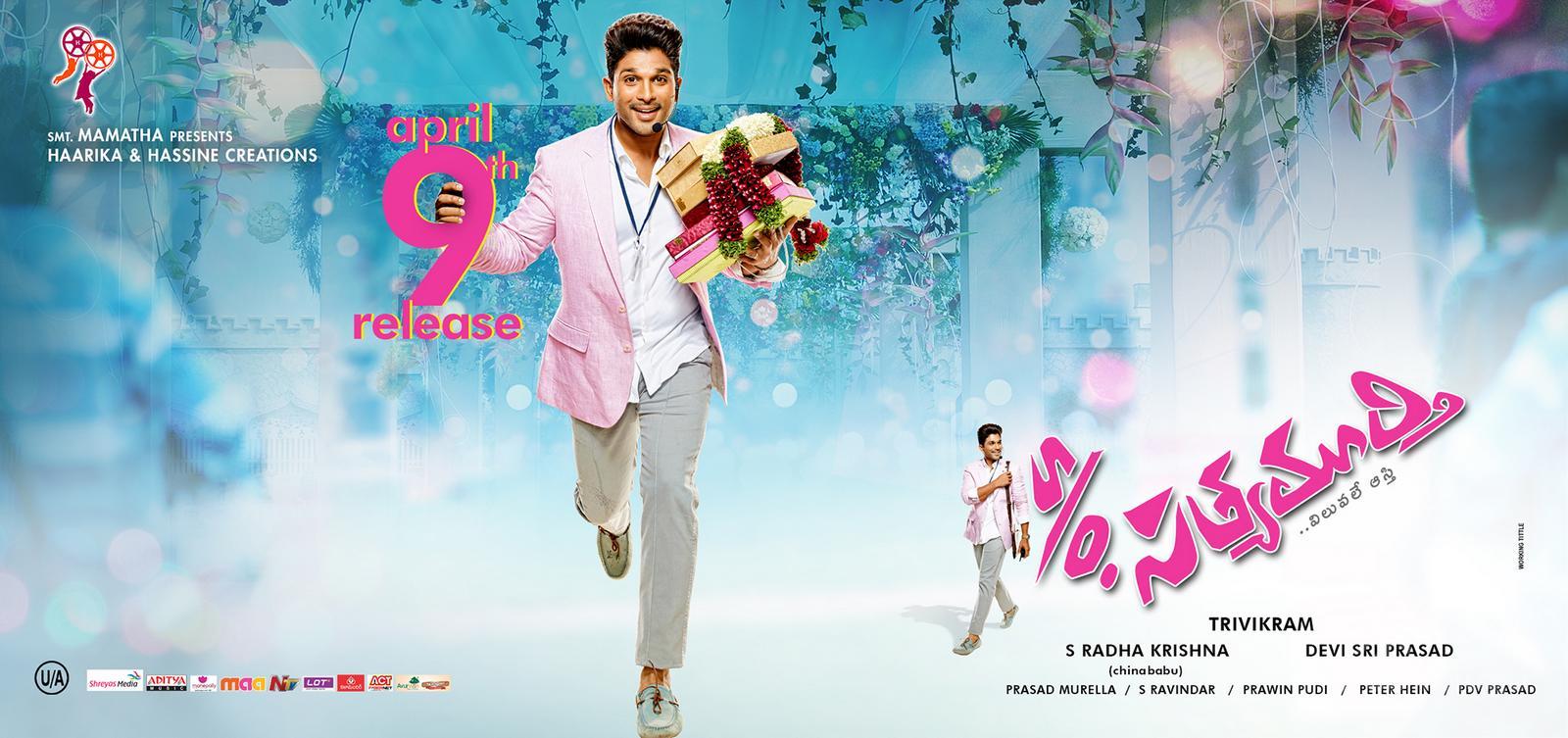
After their previous success with Julayi, Allu Arjun and Trivikram are back together again with Son of Satyamurthy. The film features appearances from Ali, Brahmi and most of the Telugu film industry stalwarts, but despite the plethora of comedy uncles, it strives for a more serious tone and is a more traditional family drama. Bunny puts in a restrained performance compared to his earlier films, and it appears that Trivikram has concentrated on character development rather than glitzy glamour and full-on action of most Telugu cinema. The storyline has plenty of potential and I loved the inclusion of villains who are not wholly evil but have the capacity for reformation, but there are a few misses. The film is undermined by the inclusion of a few unnecessary characters that reduce the overall impact and at times the sheer number of protagonists threatens to drown the main storyline. However the central theme of a young man determined to stick to his father’s principles stands strong and Bunny does a fantastic job in a more serious role than usual.

S/o Satyamurthy

Prakash Raj is Satyamurthy; a rich man who is happy to lend money to all and sundry without judgement or seemingly any expectation of repayment. He has strong principles and his values have been absorbed by his family even if they don’t always agree with his open-handed policies. And perhaps they had a point, since Satyamurthy’s sudden death reveals a large amount of debt. The family lose their affluent lifestyle and downsize their house, possessions and expectations when Satyamurthy’s son, Viraj Anand (Allu Arjun), refuses to default on the loans and insists on doing the right thing – as his father would have wanted.

In an odd addition, Vennela Kishore plays Viraj’s older brother who is incapacitated by his father’s death, but as his character is played mainly for laughs (which are never very funny and don’t add anything to the story), there doesn’t seem to be any real need for his inclusion. Similarly, Ali appears as Parandhamayya, some sort of assistant to Viraj in his new job, who is another character who could have been omitted without losing too much from the story. I rarely find Ali’s brand of comedy funny but here he is less slapstick than usual and generally rather muted, so while I can’t see much point to his character at least he is tolerable and occasionally amusing.

Although businessman Sambasiva Rao (Rajendra Prasad) blackballs Viraj, a friend helps by giving Viraj a job as a wedding event manager. Viraj is dumped by his own fiancée when loss of his fortune makes him less desirable as a husband, and naturally his first event is the marriage of his ex, Pallavi (Adah Sharma). This makes Viraj deal with his loss of wealth and prestige fairly early on in the film and also reinforces the contrast between his own morals and those of Pallavi’s rich but dishonest father (Rao Ramesh). In classic filmi style, Viraj manages to reconcile the various family members and in the course of events falls in love with one of the wedding guests. M.S. Narayana appears in his final film appearance here, and it is bitter-sweet to see him in one of his classic drunken uncle roles, especially when his role fits well into the storyline.

Bunny’s Viraj is a sensible and responsible young man and he does a great job of making his character principled without becoming preachy or overly moralistic. The only misstep is his tendency to invoke stories of Hindu Gods that sounds a little odd coming from someone who hadn’t previously demonstrated any evidence of a virtuous attitude. It would have made more sense to me if he’d quoted his father instead, but perhaps that is due to my lack of Telugu and reliance on the subtitles which may not have been too accurate – going by the atrocious spelling as a general guide to overall quality!

Subbalakshmi, aka Sameera (Samantha) is the wedding guest that Viraj takes a fancy to, and to her credit she immediately realises that Viraj is a keeper. In a move away from standard filmi heroines, Sameera is introduced holding a drink and a cigarette, and for some reason she is also a diabetic, although there didn’t seem to be any particular point to this other than as a brief comedy scene. I generally like Trivikram’s approach to his heroines, but he seems to lose interest once he moves on to the action and sadly Samantha disappears for much of the second half. However she is excellent in her role and has great onscreen chemistry with Arjun.  The couple look good together in the songs too, which pepper the first half and allow Bunny to demonstrate why he truly is the ‘stylish star’. There is some annoying hair discontinuity, but since the worst bouffy hair only appears in the songs it’s actually no bad thing that Bunny’s hair length is shorter for the rest of the film.

Rajendra Prasad and Upendra are the other standout performers and they both help bring the film to life. Much of the comedy is between Rajendra and Bunny, and is much funnier than the specific comedy threads with Brahmi and Ali. The two bounce lines off each other to good effect and are really much better than any of the assorted comedy uncles who fall flat in comparison. Upendra appears as the villain of the piece, and is as vicious and violent as required (per Telugu standard bad guy guidelines) but shows a different side when dealing with his wife and sister. He’s an interesting character and Upendra is excellent in the role, switching from demonic goggle-eyed evil one moment to concerned husband the next, but with so much else going on his role isn’t developed as much as I would like. Sneha is also very good as his sweet and serene wife, but Nithya Menen seems a little wasted in her role as a rival for Viraj’s affections. That’s a shame too as her character starts off well with an interesting plan of attack but it’s lost in the hodge-podge of action and Brahmi comedy that makes up the rest of the film.

There is a lot going on in Son of Satyamurthy and it does evoke films of yesteryear with the convoluted storyline, sheer number of characters and focus on honour, values and moral principles. The songs from Devi Sri Prasad aren’t too memorable, but they are well choreographed and smoothly flow into the storyline. Bunny dances better than ever and also looks amazing with Peter Hein’s fight choreography. Interestingly the fights aren’t as brutal and violent as usual (there is a hose as a weapon for instance), but the wirework and acrobatics are outstanding and very effective. I really enjoyed Son of Satyamurthy and although it would have benefitted from fewer characters and less formulaic comedy it’s an entertaining story with some excellent performances. Well worth seeing on the big screen to really appreciate Bunny’s dancing if you can.