Yamadonga

And so we come to the third film in our “South Indian Cinema Induction Programme” – Yamadonga.
Yamadonga features enough gilt to dazzle even our well trained Bollywood eyes, demonic antics from Lord Yama and some fantastic and well choreographed fight scenes. This is a film from the same director as Magadheera, and SS Rajamouli certainly knows how to entertain. His stories are engaging and full of action. This is no exception!

Yamadonga also features NTR Jr, grandson of NTR and renowned as one of the best dancers in the business. NTR Jr although a fine figure of a man, somehow just does not look like a dancer despite his much vaunted weight loss and fitness regime of late. And then he just pulls some astonishing moves and we are left gasping and dumbfounded :‘how did he do that – that’s just not physically possible!’ His ability allows the choreographers to push their limits, and those of the poor backing dancers, in order to showcase the amazing technique of this star. His extensive classical dance training is evident in the balance and control he exhibits in both dance and fight choreography. He certainly seems to exemplify the current mould of South Indian Cinema leading men as an all dancing all fighting all action Hero.

The film starts with an amulet which has been blessed by Lord Narasimha and is given to the young Maheshwari, known as Mahi. She gives it to a boy she meets at the fair who appears to her as a prince on a flying horse when he rescues her from a broken merry-go-round. This is Raja, a thief even at this young age, who later tries to sell the amulet. On finding out it is worthless in monetary terms he throws it away, but it always makes its way back to him, in sometimes quite bizarre ways.

12 years later, the young girl is now treated as a servant by her grandfather’s family who have taken over the house and fortune left to her when he died. Raja is a con-artist and thief who stumbles across an attempt by Mahi’s family to eliminate her and assume total control of her fortune.

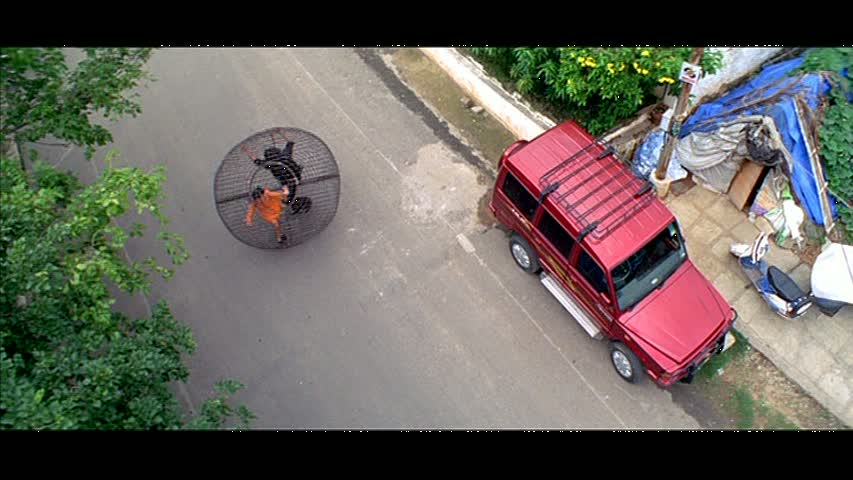
Raja and Mahi cross paths again when she is on the run from kidnappers (hired by her family) and mistakenly takes the dress Raja has been sent to steal. As he defends the dress (and incidentally Mahi) from the kidnappers, she once again sees a prince come to rescue her, but has no idea they have met before. Who else but Rajamouli would have his heroine hurtle around the street inside a gigantic wire ball, with the hero in pursuit battling goons, disrupting traffic and generally creating mayhem as he rescues her!
Raja tries to get rid of Mahi before he finds out that she is an heiress, whereupon he changes tactics and tries to ransom her to the family who really don’t want her back. Earlier, following a failed heist, Raja and his friend Sathi ended up drunkenly abusing Lord Yama, who overheard (of course he overheard – he’s a God!) took offence, and decided to arrange for Raja’s death. Once in Yamaloka (or Heaven as our subtitles call it) Raja manages to create havoc as he ends up in control of the realm. In order to get rid of him, Lord Yama has to return him to life. Things get even more complicated when Raja sees the truth and genuinely falls in love with Mahi, and Lord Yama comes to Earth to try and make Raja sin so that he will have to return to Heaven. There are many twists and turns with some great dancing and inspired fight scenes before Raja finally gets the girl and she gets her prince!

The movie does drag a little before the intermission when Raja is in Heaven. This whole sequence could have been shortened in our opinion without losing any of the story. However it does allow for a couple of great dance sequences and a chance for yet more gold and sparkle.
The dance scenes are a real highlight of this film. NTR Jr is a beautiful dancer and SS Rajamouli has made very good use of his talents. There is even a picturisation cleverly worked to look as if NTR and NTR Jr are dancing together– an awesome idea, sadly not fully realised due to some pretty clunky CGI work in a couple of spots. Rajamouli’s team make excellent use of modern technology with the sweeping camerawork adding to the sense of speed and movement in the dances.

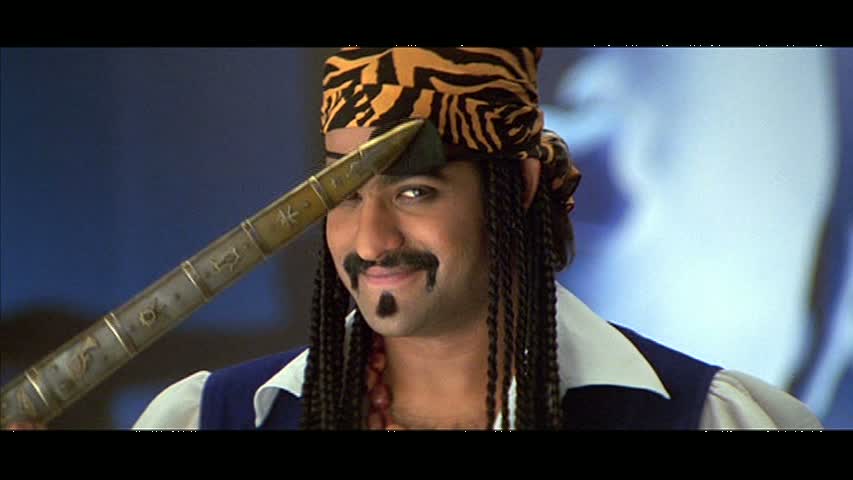
SS Rajamouli’s love of CGI tigers is shown again in one of the best filmi hero entrances when the tiger transforms into NTR Jr!
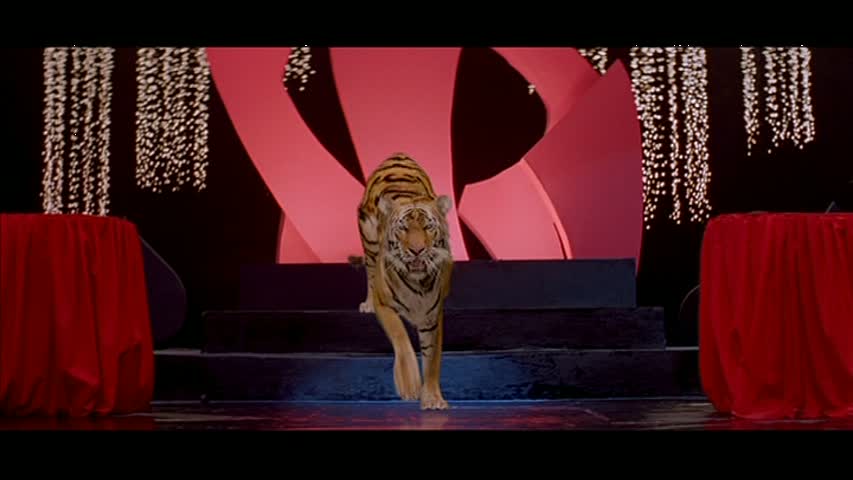
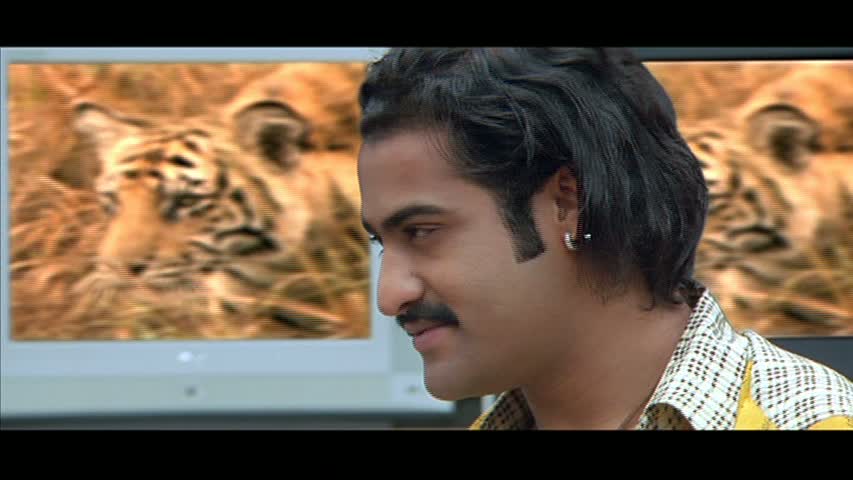
The tiger/leopard/big cat of your choice theme is used throughout the film:
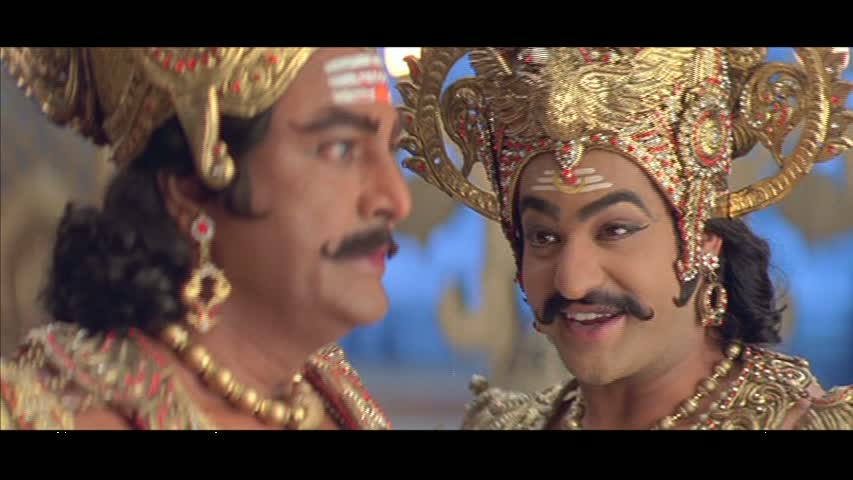
Heaven is wonderfully sparkly and golden, and you can imagine the artistic director just covering anything that didn’t move fast enough in gold paint. Lord Yama and Raja (when he is in Heaven) are fantastically costumed.

Priyamani as Mahi is beautifully moving as the girl badly treated by her abusive, grasping family and just joyous when she is falling in love with the oblivious Raja. She is an actress we will watch out for, after this and her pivotal performance in Ravanan. Mamta Mohandas makes the most of her role as the “other woman”, the scheming fence and loan shark Dhanalakshmi, and is great fun in scenes where Lord Yama assumes the form of Dhanalakshmi in order to tempt Raja. There are many clever visual and musical motifs recurring throughout the film, adding to the feeling of destiny at work.

Heather says: This is another fantastic film from Rajamouli. He really does know how to tell a story! This is also a great showcase for NTR Jr who combines his awesome dancing skills with some very good acting.  In particular his comedy is very well executed, and between Raja, Lord Yama and Chitraguptudu (nicely played by Brahmi) the comedy is very well integrated into the story.  Mahi’s character was also beautifully and sympathetically played by Priyamani.  Despite playing a downtrodden character for most of the film, she managed to show Mahi as capable of fighting back, and was excellent in her scenes with NTR Jr.  Also a word of praise for Mamta Mohandas who really was a delight to watch and did a fantastic job as Lord Yama pretending to be Dhanalakshmi.  This was the first NTR Jr film I watched and he totally blew me away with his dancing.  Needless to say I now have seen most of his films!  Yamadonga does tend to drag a little in the middle when they are in heaven, but the glorious costumes somewhat make up for the slower pace.  Overall an excellent film and I give this 4 1/2 stars.

Temple says: Yamadonga is a very engaging film, despite the flaws in pacing. I watched it again recently with a friend and it still keeps my attention. One major distraction for me was, I am somewhat ashamed to admit, the appalling hairstyle of NTR Jr. I don’t mind the long hair, but if you’re going to straighten your hair, do it properly! And that includes the back of your head! Anyway – apart from the unfortunate 70s era blow-waved Tarak, the rest of the film looked brilliant. Heaven looked so sparkly and fancy and rather like a Faberge egg – it was gorgeous and the attention to detail was lovely. I enjoyed little touches like Yamadharmaraja handing his mace to two soldiers who immediately buckle under the weight, and the cavalcade of NTR avatars. I really liked the wardrobe for the leading ladies too – the colours and fabrics looked great and seemed really appropriate for each character. The songs were a highlight, particularly for the dancing. Priyamani made a fantastic effort to keep up with NTR Jr and her energy was so appealing. On the downside, I really didn’t like Ali’s character in this film, and found his “comedy” track to be irritating. He is my least favourite Telugu comedian at this stage – perhaps because his characters are often a bit sleazy or negative. The film loses a star from me because of the draggy midsection and the really stupid tribal statue skit. I give this 4 stars.

Maryada Ramanna

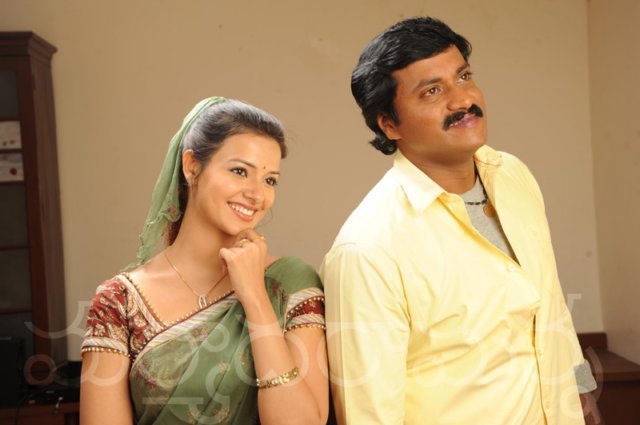
Maryada Ramanna was released on Friday with a lot of expectation – the latest film from SS Rajamouli, and starring Sunil who is better known for his role as the comedy sidekick. Could they pull it off after the huge success of Magadheera?  We went to see this in the cinema with a little trepidation – would we follow enough of the story and actually get the comedy, since neither of us understand Telugu? Fortunately for us the combination of excellent direction and storytelling, with a great performance from Sunil ensured we were amused and entertained from the very first moments.The plot twists and turns are generally easy to follow, although not understanding the dialogues we did have to puzzle over some of the longer speeches.

There are many stand-out scenes, from the opening song where Sunil appears to channel some Chiranjeevi style,  the hilarious train platform scene, to the final dramatic showdown.   The talking bicycle which sounded strange in the promos is actually used to good comic effect, as are the many other props and devices throughout the film.

The film isn’t just about comedy mayhem though, there are some beautiful quiet moments captured along the way, including a stunning scene illuminated by the flickering light of fireflies.

The song and dance tracks are well integrated into the narrative and serve a purpose within the story. The supporting cast , especially the two murderous brothers, are excellent and everyone makes a good contribution to the film. Saloni makes the best of what she has to do, and is certainly quite charming in her scenes with Sunil.

For those of you debating whether to see this film without subtitles, we think you should give it a go. Of course it is a different experience when you can understand all the dialogue but this film proves that a good story, great director and excellent performances will always keep you engaged.

Mayabazar

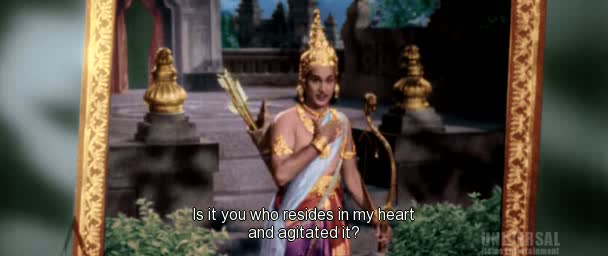
There is always so much debate about whether classic B&W films should be colourised.  Opinion does vary depending on how well the colour is handled.  However, don’t hate us; we do think Mayabazar is beautiful in colour. It is such a jewel of a film, and the pastel and gold palette really suits the mythological genre.  It’s reminiscent of religious themed calendars and colourful drawings of gods and their consorts.  The pretty, stylised effect is perfect in this instance, and it is appropriately gaudy without being garish.  It was also a huge relief to see this classic and find that the reputation is more than deserved, and to actually love it. As soon as we mention we love Telugu films, one of the first recommendations  of a “must-see” film is always Mayabazar , and we are grateful to all the people who kept bringing this to our attention.

Although the story itself is entirely fictional, it is based on characters from the Mahabharata.

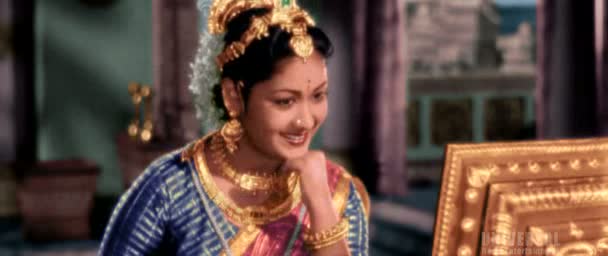
Sasirekha and Abhimanyu have been meant for each other since their childhood. Each family understands this, and the children grow up secure in knowing who their future life partner is. While they are separated, Sasirekha is given a beautiful gold box and told to open it when she is alone.  When she does this, she sees her Abhimanyu and they warble their love in a pretty song.

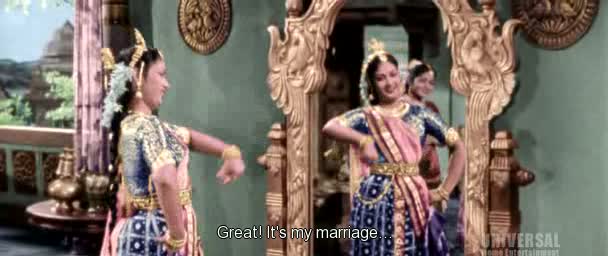
A discordant note emerges when Revathi looks into the mirror and sees not a loved one, but only jewels and riches. This weakness and greed creates a fissure in the happiness of this family and allows Revathi to be exploited by those who do not want to see the Pandavas regain their ascendancy.  This sequence was beautifully filmed and served to show the audience the inner desires of each character who looked into the mirror in a pointed yet aesthetic way – years ahead in time and light years ahead in style from Harry Potter!

Savitri is a joy to watch as Sasirekha – a sassy princess indeed, who knows what she wants. When Sasirekha is spirited away, and impersonated by jovial demon Ghatotkacha (S.V Ranga Rao) who has vowed to stop her forced marriage, Savitri’s performance is a delight.  Her body language reflects the much heavier build and demeanour of the demon, and she toys with the unsuspecting family and servants.

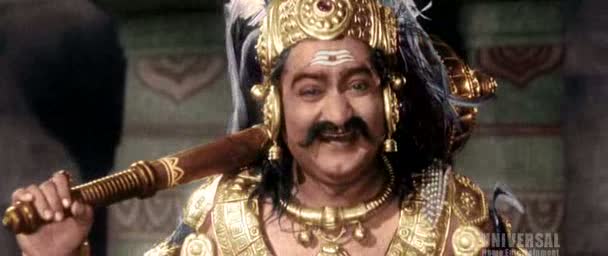
S.V. Ranga Rao is wonderfully theatrical and hammy, and amuses along with his army of loony rakshasas.  Allu Ramalingaiah does a great line in slapstick. The comedy track is actually funny and integrated with the narrative.  A highlight would have to be Ghatotkacha’s merry song as he scoffs down the entire wedding feast.

And how about those special effects?  The dire (but kind of awesome) Hindi film Ajooba  ( reviewed by the excellent Beth) is one of our guilty pleasures, mainly because of the appallingly not-very-special effects. It should seriously embarrass some modern film makers to see the quality of visuals in this 1957 masterpiece.   The tricks played by the magician and the Rakshas demons on Shastri and Sharma did appear really magical and would have been amazing for cinema audiences in the fifties.

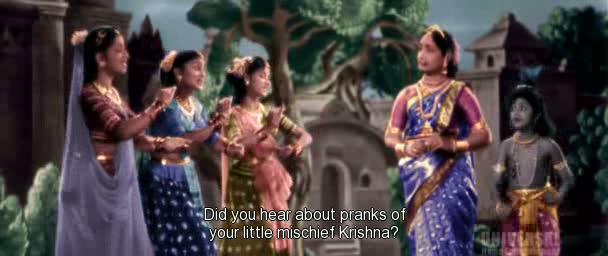
And as befits a film involving Krishna, love is in the air everywhere you look around!  Couples romance, fight, scheme and gossip all under the watchful and understanding eye of the gently amused Krishna. He even gets to watch a dance based on his own childhood, enjoying the scenes with all the tolerance and affection he shows for his loved ones.  His kindness and strength underpin the romance and squabbling, as he teaches a lesson to wrongdoers, and supports the Pandavas who are being unfairly treated.

And he’s funny. We don’t get a lot of humour from God in Christian literature and film and it was surprising and touching to see a much more personal relationship with the deities.

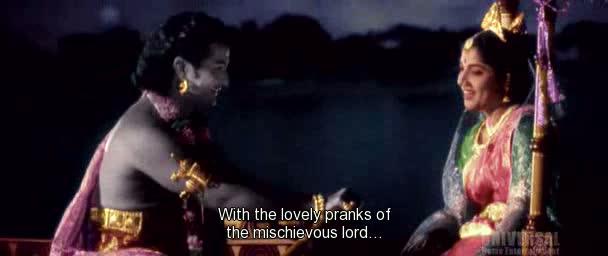
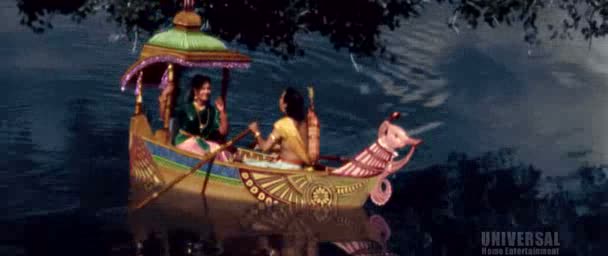
Krishna is a participant as well as an observer during the lovely romantic scenes where all three couples take to the lake on a beautiful moonlit night.  Although Temple, as a former rower, was rather concerned for their welfare as the boat did appear to get lower and lower in the water.

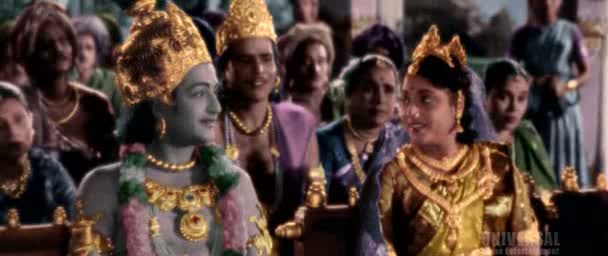
Another delight in Mayabazar is seeing the forefathers of so many of today’s stars.  N.T.Rama Rao is charismatic and appealing as Krishna. He exudes calm amusement, drops a few excellent oneliners, and generally conveys a mischievous but essentially good persona.  ANR is suitably heroic as Abhimanyu. Allu Ramalingaiah is clearly very comfortable with his comic turn, and makes the most of his time on screen.

The music is beautiful, the jokes are funny, the acting is brilliant and charismatic, and it is so light hearted – not what we expected from a story woven around the Mahabharata.

Heather says: A true classic.  I can see why this is such a loved film.  It features all the Telugu film industry greats of the time and it was a privilege to be able to watch an evenly paced movie with incredible performances by all the actors.  Such a classic story and with all the magical twists it seemed totally new and very special.  It was also a real plus to be able to see actors such as NTR Rao, ANR,   etc and relate them to their children and grandchildren who are setting screens alight today.    I will definitely keep an eye out for more from these actors and hunt down more Telugu ‘classics’ to watch.  The colourisation added another dimension, although the black and white version is just as watchable.  A full five stars for this timeless classic.

Temple says: I can see why this film is so well loved by generations of movie audiences. The production values and the performances are  just amazing, and the songs are beautiful and melodic. Its quite a privilege to be able to watch so many of the greats of an era appear in a work of this calibre.  I had a preconception that the mythological genre might be a bit heavy going or ponderous, but this film just sparkles in so many ways. The colourisation is quite deft in my opinion, and highlights the richness of the costumes and sets, creating a truly opulent and fantastical look to the film. NTR was a revelation as Krishna, Savitri steals every scene she is in, and S.V. Ranga Rao is hilarious. The DVD re-release comes in a 2 DVD pack, and includes both the colourised version and the original B&W. I highly recommend it! This gets 5 stars!