Yevadu (2014)

Yevadu

It’s unfortunate that Yevadu didn’t get a cinema release in Melbourne earlier this year, as I think it would be a better watch on the big screen with a fan audience. Vamsi Paidipally’s film takes the central concept from John Woo’s Face Off as a basis for his story, but other than that it’s a fairly standard mass revenge saga with plenty of associated mayhem. Charan plays the wronged Sathya, initially out for his own revenge, but then drawn into a different battle. The ideas are good, but the execution is flawed and Yevadu is no place for any rational thought. However if mindless entertainment with plenty of fights and some great dancing is what you are after, then it could definitely fit the bill.

Yevadu starts off well with Allu Arjun in the role of Sathya and Kajal Aggarwal as his fiancée Deepthi, although it’s rather a long set-up for the main story. Deepthi has been chosen by local Vizag Don Veeru Bhai (Rahul Dev) as the latest object of his desire, and saying no is apparently not a viable option. Veeru relies on intimidation and kidnapping his victims rather than natural charm, and while Sathya is happy to take on Veeru Bhai and his gang, Deepthi is rather more sensible and persuades her fiancé that it would be safer to leave Vizag. However Veeru Bhai’s brother (an enthusiastically vicious Ajay) and his merry band of gangsters catch up with the couple and Satya is left to die on the burning bus after Deepthi is murdered in front of his eyes. It’s a fairly brutal beginning but it neatly establishes the character of Satya as an angry and potentially violent man, but also one who is passionate and prepared to do anything for Deepthi.

Miraculously, Satya manages to survive, but is so badly burned that the only hope for his survival is some rather drastic surgery. Fast forward a few months and Sathya is heavily bandaged but recovering in a hospital. The big reveal is that he has been given a new face – amazingly without any scars, and has also managed to acquire a new body and a different voice to go with his altered look. Sathya (now Ram Charan) hasn’t become any more rational or any less angry however, and he runs away from miracle worker/ surgeon Dr Sharada to find Veeru Bhai and make him pay for Deepthi’s murder.

This part of the film almost makes sense, if you ignore the dodgy medicine and coloured contact lenses.  Charan portrays the part of a driven killer with plenty of maniacal determination that naturally follows on from the perpetually angry Sathya of the opening scenes. Sathya has lost everything he ever cared about and the only thing that matters is killing the men who murdered Deepthi, so a certain amount of focused aggression works well. However no amount of cleverly constructed vengeful violence can disguise the massive plot holes or complete lack of plausibility in much of the story.  Sathya somehow finds a change of clothes after leaving the hospital, as well as his motorbike and a camera, long before he goes back to his old flat where he might conceivably have picked such things up. That is, if they were still there after his months of recovery in hospital –  rather a stretch since everyone thought Sathya was dead. Thankfully there is plenty of great dancing to distract from the flimsy story.

Sathya does what any self-respecting Telugu hero would do and goes about taking his systematic revenge. Along the way there is some comedy with Brahmi and a very out of place looking Amy Jackson, but neither of these makes much impression and both serve mainly as a distraction for Veeru Bhai and his gang. Rahul Dev does plenty of sneering and lusting after various women, but after his initial introduction he’s not particularly impressive as a gangster. His gang aren’t ever shown indulging in any typical gang-like activities either, and there is no particular menace associated with any of the heavies. Ajay even sheds his violent persona and becomes part of the comedy, which suits him just as well but also dilutes any sense of threat from the villains.

Everything follows a straightforward and suitably vengeful path until the interval, when Vamsi Paidipally attempts to justify the face transplant idea and Sathya suddenly comes under attack from a different gang of thugs. It’s a change in direction, but that’s all as the film doesn’t become any more plausible or less over-dramatic, and there are just as many plot holes and inconsistencies.

While the disjointedness of the film is  odd, the problem I have with Yevadu lies more in the characterisation of Sathya. The story would be more convincing if there was a greater difference between the personalities of Charan (the original owner of the face) and Sathya, and additionally if each stayed true to those personalities throughout.  Sathya’s cold, controlled fury and drive to eliminate Deepthi killers to the exclusion of all else  suits the initial story, but much of that drive and anger vanish in the second half. While a certain loss of focus can be explained by the lack of a personal connection, Sathya becomes softer and too much like the character portrayed by Charan in flashback. Equally, although the character of Charan starts off as possibly a more intellectual character, as the story unfolds and he gets involved in fighting against the takeover of an area by a gang of thugs, Charan becomes just as cold and angry as Sathya. Keeping the two personalities more separate could have enhanced the idea of a changed face while the personality was still the same, but as it is Charan and Sathya are so similar that the change in face is almost irrelevant.

The second storyline is even more predictable and clichéd than the revenge story of the first half, although Vamsi Paidipally tries to compensate by increasing the volume of the background music and by repeating every significant shot at least three times. Subbaraju, Shashank and Kota Srinivasa Rao bring their usual competence to the roles of the villains but there isn’t anything novel about either their plans to bring a community to its knees or Charan/Satha’s attempts to foil their plans. The second half also suffers from a clunky romance with Shruti Haasan, which feels shallow and contrived after the intensity and passion of the earlier romance between Sathya and Deepthi.

In spite of my reservations about the characterisation and the relatively predictable second half, Yevadu is still a film that entertains. It’s all much larger than life, but the action scenes are well done and Sathya’s inventive methods of revenge are excellent. The various villains are mainly comical rather than particularly intimidating, although some of the minions are nicely evil, while the excessive over dramatisation is just fun! If you can leave logic behind, embrace the absurdity, and revel in revenge then Yevadu could be the perfect masala watch. 3 stars.

Govindudu Andarivadele

Govindudu Andarivadele

Soaring melodrama, fantastically colourful sets and Prakash Raj are the stand-outs from GAV. Add in Charan, who has definitely improved on his emoting, and you have the bones of Krishna Vamshi’s family drama that mostly delivers what it promises. There are plenty of emotional scenes as Abhiram (Charan) attempts to reunite his family in England with the rest of his estranged relations in India, and of course there’s some local trouble and a romance thrown in for good measure. While most of the film seemed to live up to Krishna Vamshi’s preoccupation with family values, there are a few scenes here that seem to be a hold-over from a less pc era, and stand out as glaringly sexist and just plain wrong. However the rest of the film is entertaining enough despite a storyline so overused that the lack of subtitles was really never an issue!

The story opens with a déjà vu from K3G as Abhiram demonstrates just how well he can play rugby when the opposing team fail to follow the rules of the game and actually attempt to tackle. Real rugby players end up covered in mud and crushed under a few tons of Welsh full-back in my experience, but apparently not in Vamshi’s world. Abhiram lives in a very nice pad in London with his father Chandrasekhar (Rehman) and his little sister whose name I didn’t catch. Unfortunately Chandrasekhar misses out on an appointment to be Dean of Medicine at a London University and interprets this as karma due to an old rift from his own father.  No academic politics in Vamshi’s world either then, I presume!

Overnight Abhiram decides that he will be the one to make all right for his father, and heads off to India to do what he can to bring the families back together. Sadly though, he doesn’t take time to remove his rather odd pony-tail which I can only assume must have been an attempt to look ultra-hip and cool – London-ishtyle. Not my favourite look for Charan, but it did grow on me as the movie went on.

GAV - Charan

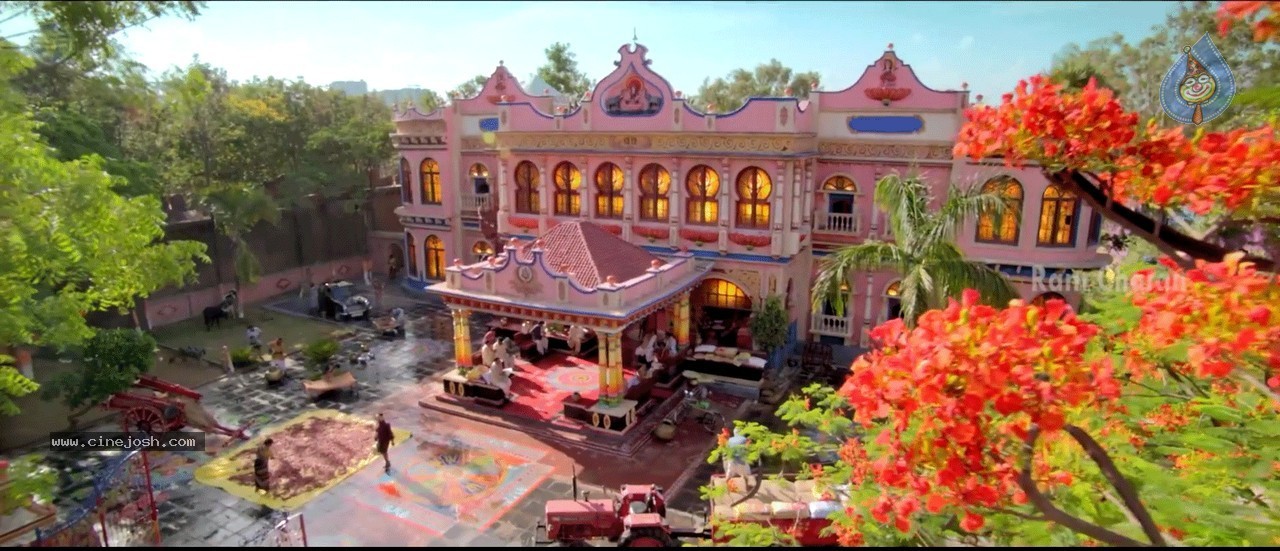
Things definitely look up once Abhiram makes it to India, does all the usual touristy things, and then heads off to his grandfather’s village. Following the standard family reconciliation template, Abhiram makes contact with the rest of his family anonymously by pretending to be a visiting agricultural student who wants to learn from family patriarch Balaraju (Prakash Raj). Balaraju runs his family and the village with a benevolent but very traditional hand while stopping his brother (Kota Srinivasa Rao) from clearing and developing the area. Living in the wonderfully pink and majorly over-decorated mansion is also Chandrasekhar’s wastrel brother Bangari (Srikanth): a man with an unfortunate propensity for mesh singlets and garish shirts. Oh, and he drinks, gambles and tries to kidnap and rape his potential bride, Chitra (Kamalinee Mukherjee). This is one of those scenes that really should never have made it in to a film in this day and age, and it does feel completely anachronistic with the rest of the story. Equally disturbing is Abhiram’s use of some photographs he has taken of his cousin Satya (Kajal Agarwal) dancing in Western clothes as a way to blackmail her. This is straight out bullying and sexual abuse, and I find it hard to believe this got past the censors in an otherwise ‘family-friendly’ film. Thankfully Satya does manage to effectively deal with Abhiram’s harassment, but it makes their subsequent romance initially less believable and Abhiram appear as a bit of a prat.

The rest of the film is much better, and that’s mainly due to excellent performances from Prakash Raj and Charan. Prakash Raj is perfect as Balaraju and he knows exactly how to play the strict but compassionate head of a large family. He never puts a foot wrong and wrings every possible drop of emotion out of his time on screen. He even manages to make stick fighting and motorbike riding emotional events, as he unknowingly bonds with his grandson. Jayasudha is just as good as Abhiram’s grandmother, and again she manages to take her overly emotional scenes and tame them down to something more realistic and believable.

Charan gets a chance to show that he can play more than just an action hero and he definitely rises to the challenge. His Abhiram has more shading than other characters I’ve seen Charan play, and he conveys plenty of emotion and feeling in his speeches, even though I couldn’t understand a word! Despite the initially rocky start, there is plenty of chemistry and some major sparkage in the romance between Abhiram and Satya. Charan is one of the few actors that interacts well with Kajal in this respect and their romance really does light up the screen. Charan does manage to stick close to his real love though, as seen in this song mainly set in and around Petra. I wonder if it’s written into every contract that he must get at least one scene with horses? Kajal gets rather short-changed in the choreography here, although Charan doesn’t actually get to dance much either and sadly most of the songs have more emoting than dancing.

The rest of the cast are all capable and fit well into their roles. Rao Ramesh, Posani Krishna Murali and Adarsh Balakrishna are part of Kota Srinivasa Rao’s opposing family but never feel terribly menacing. Adarsh’s character is mainly just very shouty and aggressive, and the various fight scenes, which appear to have been structured around rugby tactics, aren’t up to Peter Hein’s usual high standard. The film looks gorgeous though. The pink palace is amazing – Satya has a stunning peacock painting on her wall, and most of the other rooms are similarly adorned with fantastical artwork and gorgeous furniture. I would live there!

GAV - the pink palace

The emotional quotient does head into overload at times and the ending is particularly excessive, but that doesn’t really seem to matter since the whole point of the story is overblown sentiment. As a straightforward family drama GAV works well enough despite the cliché-ridden storyline and the strong performances help push it over the line. Well worth watching for Prakash Raj and Charan, particularly when you can marvel at the wonders of the pink palace as a bonus.

Aagadu (2014)

Aagadu

After the major disappointment of missing 1-Nenokkadine, it felt as if it had been a very long time since I’d been able to indulge in the wonders of Mahesh on the big screen. As an added bonus Aagadu was being shown in my local cinema, the wonderful single-screened art deco Astor, which has the luxury of a dress circle and velveteen-couches for lounging while waiting to get into the auditorium. Plus the bonus of subtitles!

Going to the Astor is always an ‘experience’ and even more so for Mahesh.  There were massive posters with accompanying garlands, samosas for sale in the foyer, and even that rarest of things – allocated seating! Regular visitors to Telugu film nights in Melbourne will understand what revelation this was – no pushing and shoving to get in and try to find a seat that hasn’t been ‘saved’ by the first twenty people through the doors? Not this time! First night, first show and there was an orderly ticket collection queue, a leisurely stroll to your seat (with ushers!) and plenty of time to soak up the atmosphere with the sell-out crowd.

Aagadu

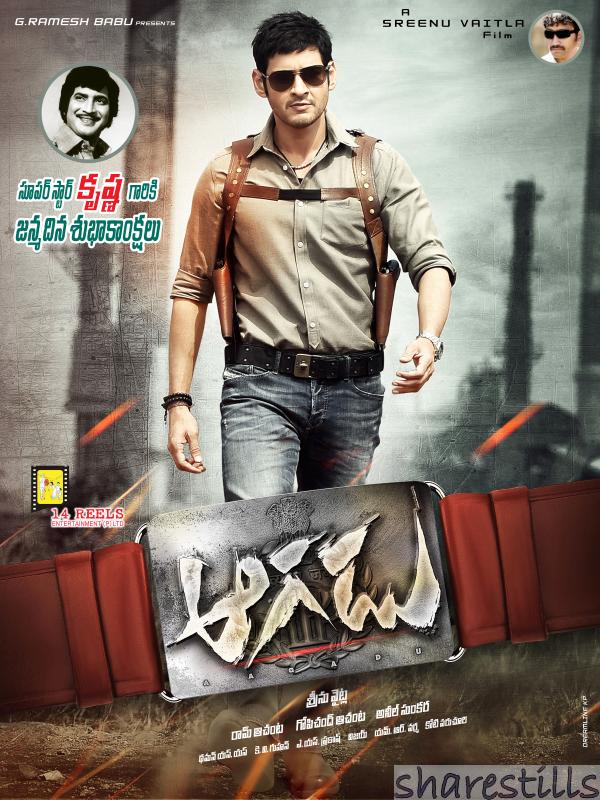
Aagadu sees Mahesh reunited with Dookudu director Srinu Vaitla, although the partnership doesn’t deliver such an entertaining film this time round.  Along with a number of familiar faces in similar roles, the usual mass themes pop up time and time again, so the plot feels tired even before it gets past the first half hour.  Still, it starts off well enough. Young Shankar is rescued from the streets by Police Inspector Raja Ram (Rajendra Prasad) who adopts him into his household based on Shankar’s non-tolerance approach to crime. Naturally this family relationship doesn’t last long, and Shankar is cast off by Raja Ram in suitably dramatic fashion after taking the blame for something he didn’t do.

Aagadu

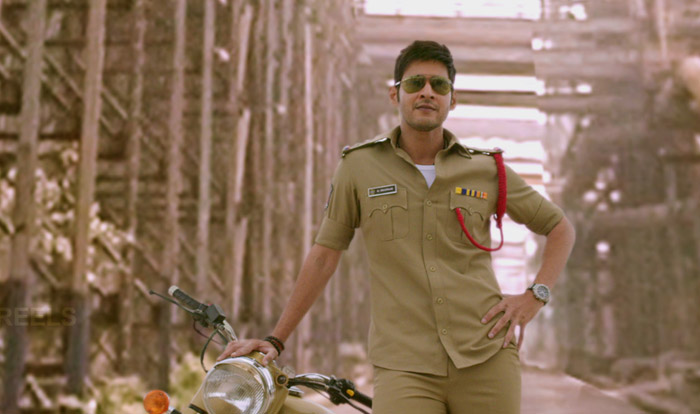
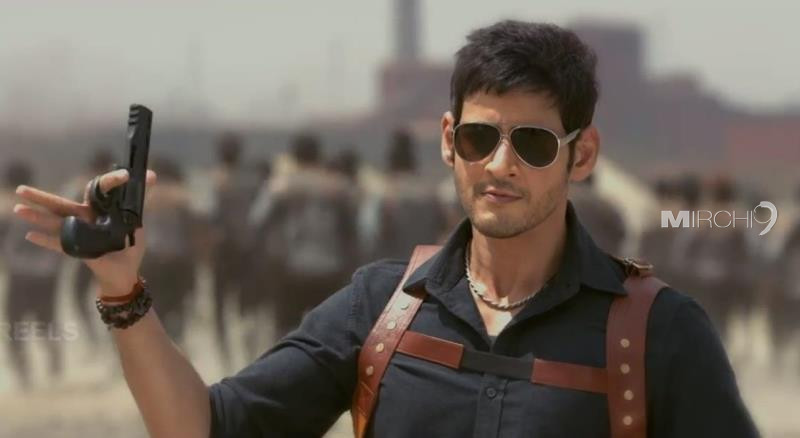
Despite these early troubles Shankar follows in his adopted father’s footsteps and grows up to be ‘Encounter Shankar’; a man so feared that the mere mention of his name is enough to turn big, bad gangsters into quivering cowards.  As expected once he appears on-screen, Mahesh Babu throws villainous thugs around with gay abandon while indulging in snappy dialogues and keeping his uniform creases sharp. Mahesh is in his element here and it shows. He looks even more baby-faced than ever as he single-handedly beats various thugs into submission and revels in his indestructible super-cop persona.  Pretty similar to the way he did in Dookudu really.  The opposing gangsters have learnt nothing and still tend to attack one at a time (they can’t ever watch any movies or they would know better), and there are plenty of barrels, containers, and various other items for them to crash into. The outcome is always a forgone conclusion but it is the getting there that counts, and the action scenes are excellent.

Aagadu

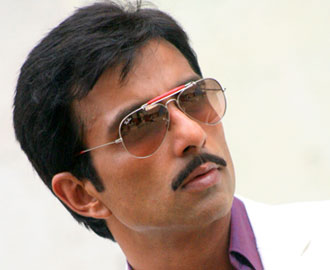
Encounter Shankar is sent to Bokkapatnam, where crime lord Damodar (Sonu Sood) is terrorising the locals and keeping the police firmly under his own control. Sonu Sood seems a little off his game here and is never quite menacing enough to be the big bad movie villain needed to offset Mahesh’s heroic cop. An early attempt to give him a ‘quirk’ falls flat and apart from one or two moments of sneering he’s a bland and relatively innocuous character.  Srinu Vaitla seems determined to include as much humour as possible, but his inclusion of the gangsters into the comedy motif works against any possible build-up of menace and just isn’t particularly funny.  Even Damodar’s gangster lieutenants are roped in with Raghu Babu, Posani Krishna Murali and Prabhas Seenu dropping their initial villainous personae for dumb comedy routines that do nothing to help the story.

AagaduAagadu

There is more comedy in the form of M.S. Narayana who is reasonably amusing as a data broker, although the best comedy moments go to Mahesh as he befuddles the villains with reprises of his own movies.  These gangsters really don’t seem to get out to the cinema much!  The usual suspects turn up in the support cast including Nasser who seems wasted in a role as a mildly corrupt cop, while CinemaChaat favourite Ajay fares a little better in a more serious than usual role and Vennela Kishore has a reasonable role as Encounter Shankar’s main assistant.  Brahmi turns up late in the film and it says a lot that he is sorely needed to bring some relief into an otherwise dull and predictable second half.  He plays a broker who ends up as the fall guy for the police operation, but it’s really just the usual slapstick with the addition of a reasonably funny dance mix from recent films, although even that seems a copy of a similar scene from Dookudu.

Aagadu

Tamanna plays the love interest and starts off as a relatively feisty character that seems to have potential. Unfortunately it doesn’t last, and after she succumbs to Shankar’s trite dialogue she is rewarded by relegation to appearing only in the songs.  There is absolutely zero chemistry between Tamanna and Mahesh but she does get to wear some pretty skirts and twirl around mountains and deserts while Mahesh does some enigmatic walking, so it all works out OK in the end.  I liked the soundtrack and the catchy songs are all well-choreographed and pictured, often with some very enthusiastic backing dancers.  Shruti Haasan makes an appearance in a rather athletic item number which got just as many cheers as Mahesh’s entrance, but Bhel Puri has some of the best costumes.  The backing dancers get to morph from Marvin the Martian to Jack Sparrow while Mahesh sports his classic shirt and jacket combination, although I’m not so sure about his red number with go-faster white stripes.

Overall Aagadu is disappointing, as Srinu Vaitla rehashes ideas from his previous movies and includes too much comedy and an excessive amount of punch dialogue in his formulaic screenplay.  The first half is entertaining enough, but the second half drags until the fast, final showdown which is over almost before it begins.  Mahesh is very watchable and almost manages to carry the entire film with his charismatic screen presence, but even his excellent performance and the best attempts of the rest of the cast aren’t enough to lift Aagadu above average. Best watched in a packed cinema with a large group of Mahesh fans, but in their absence, still worth watching for Mahesh, good action scenes at the start and the songs.


Temple says:

Aagadu is similar to other Mahesh films, particularly Dookudu, only longer and much less entertaining.

I found the first half quite dull as the slapstick and comedy uncles piled up and yet the plot never shifted gears.  The ‘comedy’ is broad and overstated – not Mahesh’s finest work. He can be very funny but Aagadu plods along, reusing the same shtick too many times, and Sankar lacks the sarcastic spark Mahesh has brought to other films (like Khaleja or The Businessman). The excessive punch dialogues were meant to be a running gag, but instead seemed a gratuitous reminder of how many other good films I could have been watching instead.  And it’s not an easy film for a new fan as the jokes are very Mahesh-centric, including a nice tribute to his dad, and would largely go over the head of anyone who wasn’t familiar with the oeuvre. The second half is more successful as Sankar FINALLY starts enacting his plans for revenge. Plus I quite enjoyed seeing Brahmi get slapped around. If I had to watch his tedious antics, I was glad to have the vicarious satisfaction of the tight slap.

Despite high production values the CGI work is often poor, both in execution and judgement, and breaks the effect of otherwise excellent action choreography. There is one scene where suddenly Sankar is CGI’d onto a tabletop during a fight and he may as well have been surrounded by a dotted line with a legend saying ‘cut here’. And the subtitles, much as I appreciate the effort, were a bit dodgy. ‘Frightended’ was a highlight, and anarchy had clearly swept through the personal pronoun department. Although I liked the description “Pant. Shirt. Shirt. Shirt.”as I think that is indeed how Mahesh dresses.

Well, at least the Astor has excellent choc-tops. And I hope that nice man The Mahesh Fan and I were talking to after the movie found his way to Doncaster.