Chanakya Sapatham (1986)

Chanakya-Sapatham-title

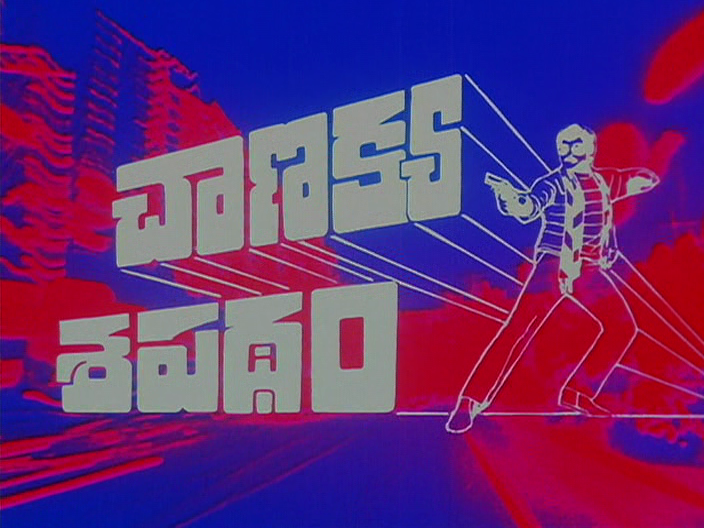
One of a half dozen films K Raghavendra Rao churned out in 1986 (including the awesome Kondaveeti Donga), Chanakya Sapatham again pairs Chiranjeevi with Vijayashanti in a ripping yarn of smugglers, flight attendants and the Indian Customs department. I wouldn’t go so far as to call Chanakya Sapatham a neglected masala masterpiece but I do think it deserves some love.

Shashi or Sasirekha (Vijayashanti) is a flight attendant, unwittingly caught up in a smuggling operation by BOB CHRISTO! Bob, with his trademark poor judgement, hides a pouch of diamonds in her blouse (no, I don’t know how she didn’t notice) and when he  tries to get it back, Shashi puts up a decent fight and Chanakya (Chiranjeevi) leaps to the rescue. It’s like the finale of Doodh Ka Karz only with flying Chiru instead of snakes.

Naturally Shashi is swept off her feet by the dashing customs officer in his very snug uniform. They fall in love through a Kodak moment and product placement. Oh the visual metaphors.

Rana (Rao Gopal Rao) is the main villain. Bless the Paruchuri brothers for going to the trouble of trying to think of vaguely sane reasons for him to do some things, and then make him explain himself. It was unnecessary but greatly appreciated.  Rana’s chief henchman Ranga is a flamboyantly unpleasant creature and Rana’s son is a nasty piece of work. The son (Sudhakar) works for the airline, or at least owns a uniform, and was in on the smuggling but hasn’t quite got the wattage to do much off his own bat. They have little depth of character, so I was pleased to see they have that nice tricolour chandelier in their house, and I think I also recognise the stuffed tiger and the mysterious beep boop machine from previous outings.

Rana runs a Natural Health Remedy Centre. I liked the apparent lift and shift substitution of ‘karate school’ for ‘yoga school’ as a background for some of the fight scenes.

Chanakya is hot on Rana’s trail, but frustrated at every turn by the sleazy businessman’s connections and ability to weasel out of any trap. But how do they not see Chiru in surveillance mode? His pants are so blindingly white.

Both Shashi and Chanakya are close to their families.

Shashi’s sister Savitri was married but due to dowry issues (Shashi was robbed on the way home from the bank), the in-laws turned her out. Financial pressures are causing strife at home, and Shashi is the only one who seems to have a chance of fixing things. The baddies have their eye on her as a way to get to Chanakya, and offer her a smuggling job that would pay for Savitri’s dowry and put the family back on an even keel. She traps the smugglers and gets a reward which she intends to use to pay the outstanding dowry and get her sister settled.

Chanakya’s family are close and affectionate, and I liked their domestic scenes. There are so few times when an older married couple get to show an affectionate or playful  side, and I really liked those moments between Kaikala Satyanarayana and Annapurna. Chanakya is the only child and, of course, the centre of his parents universe. When Rana sets Nagarjuna up to be arrested as a smuggler Chanakya is bent on revenge and justice, which may actually be more or less the same thing in this instance.

Chanakya and Sasirekha are united by their mutual attraction and also the mission to shut Rana down. I liked that they were both smart, both tried to take care of things themselves, but could accept or even ask for help when they had to. Chanakya understood her reservations and made an effort to address her concerns quite plainly to avoid further tension.

The relationship development  was all quite sensible (for a film) as well as providing fuel for some excellent  concepts for Chakravarthy’s songs.  Apart from the usual hillside prancing, the songs take place around a giant camera, a plane made of flowers with dancers dressed as airplanes, and in and out of a tray of photo developing chemicals, or even just surrounded by neon tube lights.

Yes, this is a movie that embraces the technology of 1986. And Shashi generally looks fine (for 80s filmi fashion), even in the more imaginative sequences. Vijayashanti demonstrates she has nailed the saree run with hair toss. My biggest disappointment was Chiru’s footwear which was less than spectacular and relied heavily on the monotone ankle boot. But I rarely enjoy product placement as much as I did in this film – well done Luma Lamps people, well done.

Vijayashanti is always a pleasure to watch, and I like her rapport with Chiru. They’re well matched in the choreography, and neither of them lacks energy or commitment to the role. Shashi is smart and while she wants to sort things out herself, she appreciates Chanakya’s sincerity in wanting to help her and considers his offer rationally. I liked that he had to put his cards on the table before she would accept his gift and they didn’t play silly games. Also, this is a remarkably non-rapey film for 80s mass. The villains stay on task and when they threaten Shashi it is because they need her to do something for them, not run around screaming.


I liked the very specific design and fit-out for some action scenes. I would never have thought to create a factory full of…exploding ice…but it came up a treat. I always enjoy a good fight in a factory full of stuff that is only there for the hell of it. More exploding ice! A statue! Things in barrels! A luge run! And a later fight on the beach uses swings. So fun! There is more than a nod to Jackie Chan and the Hong Kong school in some of the fight choreography and Chiru has the right attitude to carry it all off – he milks those bendy iron bars and flying kicks for all they’re worth, and then some.

The earlier action scenes are funny but still a bit exciting. The finale starts out with an unfortunate tendency to Comedy before the drama and action ramps up again.

I could have done without most of the last 30 minutes, well maybe except for the bit where Chanakya rocked up not only in disguise but in a lotus submarine. But then the movie redeemed itself with what may be the best use of a wheely board and improvised ski poles since Shashi Kapoor in Duniya Meri Jeb Mein.

Vijayashanti and Chiranjeevi are a delightful on screen pair, and while Chanakya Sapatham doesn’t break new ground it does what it does so very well. 4 stars!

Chanakya-Sapatham-Karate

Jalsa

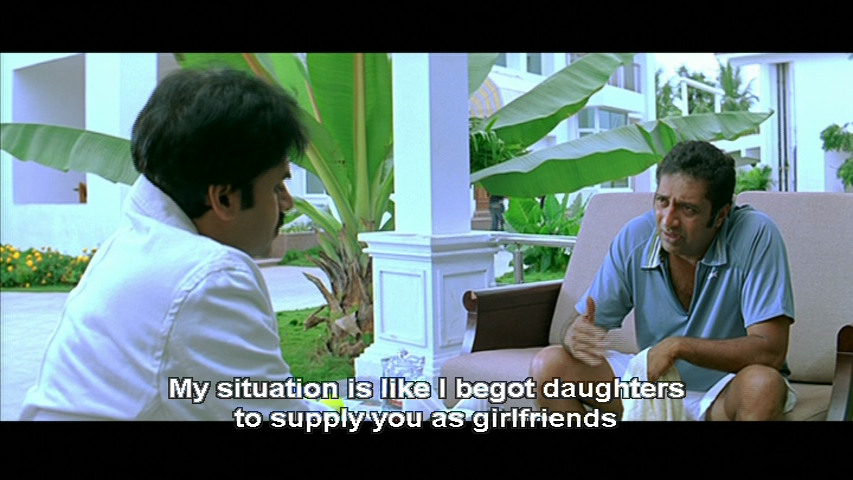
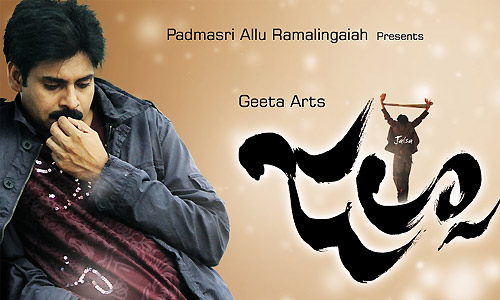
Jalsa-posterTrivikram’s Jalsa wanders all over the place with an uneven blend of romance and action packed drama. I had to check that it really was made in 2008 as the plot, and treatment of female characters, is very retro and not in a charming vintage way. Pawan Kalyan gives a good performance but unfortunately he can’t save the script and some glaring plotholes. Like the hero, Ileana D’Cruz rides out some stupid plot turns and inconsistencies in her character to hit the right notes in the more thought out scenes.

Jalsa-Prakash Raj

Sanjay Sahu (Pawan Kalyan) goes to ask his girlfriend’s (Kamalinee Mukerjee – don’t blink or you might miss her) father (Prakash Raj) for permission to marry Indu. He refuses and she is married off (to Kamal Kamaraju). Sanju goes back to his longest standing relationship, the one with the bottle. But then he meets Bhagi (Ileana) who falls for him on sight and eventually he returns her feelings. The story jumps forward and Bhagi finds out that Sanju had previously wanted to marry her sister. Naturally she is disturbed by the news, and flashes back to a history of getting her sisters hand-me-downs. Her dad assigns Pranav (Brahmi) to keep Bhagi safe from Sanju so you know this is serious. Unfortunately Pranav’s presence spurs Sanju on to some childish behaviour and the movie gets bogged down in comedy uncle shenanigans.

The first half sets up the romantic angle and then everything takes a sharp left turn as Sanju’s secret past as a naxalite is revealed. He is presented as the ‘good’ kind of terrorist who doesn’t want innocents to die. But still, he embraces violence so…. I think I find the rebel Sanju more interesting than the drunkard but I can’t say I wholeheartedly like either aspect of his character. The flashback also reveals his prior connection to Prakash Raj’s character as well as the villain Damodhar Reddy (Mukesh Rishi).

Bhagi is introduced as she plays an energetic game of squash at the gym, then races her friend Jo (Parvati Melton) to the car. They are confronted by a creep chases the terrified girls into the path of a very drunk saviour, none other than Sanju. I’m not convinced that moments after avoiding a threatened gang rape their thoughts would have turned to romance and bickering over who gets the guy. Bhagi starts out characterised as innocent and a bit dumb, but Ileana bounces daft lines back and forth with her friend Seenu (Sunil) as Bhagi tries to deal with her one-sided attraction to Sanju. Later as Bhagi becomes more assertive and playful Ileana has more fun as she plays off Pawan Kalyan, and also shows more range and depth. I quite liked Bhagi but I got the feeling the role was written piecemeal to suit particular scenes rather than conceived as a character in her own right.

Sanju is the guy who beats up all the guys who tease girls at college. It is nice that the hero defends people against bullies but I am tired of seeing women only allowed to be safe if the biggest bully lets them. He also goes on a rant about how aggravating it is that he can’t slap his future wife to control her for fear of the law and women’s groups. It was done for dramatic and ‘comedic’ purposes and it just doesn’t mesh with the thoughtful side of Sanju. He was a smart guy who chose to become a naxalite through tragic family circumstances but then seems to just forget all about it once he got into college. It really made no sense. And why does he always wander around with his belt undone? Despite my issues with the writing and the rape jokes, Pawan Kalyan is very funny in some of Sanju’s drunk monologues, with a deft balance of verbal and non-verbal comedy beats. The fight scenes are choreographed to his strengths, whether a precision martial arts style or a scrappy street brawl, and he gives them an elegance and energy that is totally missing from the lacklustre songs. I did like it when he punched a car and all the doors flew off. His choreo seems to be limited to ‘shuffle-shuffle-jiggle-wave your hands around’ but I suppose it helps him avoid direct comparisons with You Know Who.

There is a drawn out ‘comedy’ sequence where Sanju tells Brahmi’s character that he plans to drug and rape Bhagi. Then says he is only joking because it is no fun to rape an unconscious woman when you could have one running around and screaming. This kind of ‘joke’ is rife in 80 and 90s films, but at least I can pass that off as The Bad Old Days. Sanju’s plan to win Bhagi back seems to be to ruin any other chance for her until she caves in. And her sister insists Bhagi accept all this as it is Sanju’s way of expressing his love, and if a boy does that it is OK and you have to let him because he is a boy. Jalsa was made in 2008 by a smart director with a hero who is by all accounts quite intelligent so I cannot find it in me to make the same excuses for how this plays out.

One of the things I do really like is Mahesh’s laconic narration. His slightly lazy drawl hits the right notes of comedy, empathy, and sarcasm as he reveals more about Sanju than is evident in the drama.

Prakash Raj gets some nice bromantic moments with Pawan Kalyan but his character makes so many poor decisions that I lost all patience with him. Mukesh Rishi plays his usual imposing villain. He thinks nothing of killing an out of town Don on the way back to jail from his rejected bail hearing. Tanikella Bharani is creepy sidekick Bulli Reddy, his fixer. There is a tedious running gag between Sunil’s Bunk Seenu and Dharmavarapu Subramanyam’s greedy psychiatrist that I would have solved with a diagnosis of One Tight Slap, three times a day until the course is finished. Brahmi does his shtick, but is never more than mildly amusing. If you are looking for miracles to attribute to the Powerstar, he does seem to detoxify Ali who gives a fairly restrained character based performance. I generally enjoy Ali’s appearances in Pawan Kalyan’s films but typically loathe him in everything else so this is a mysterious but good thing.

Telugu Movie Science has long been on the cutting edge of creativity and the laws of physics are tested in Jalsa’s action scenes. As usual the showdowns involve an orderly lineup of hairy rowdies patiently taking turns to be beaten up. But no one can deny that disputes settled the old fashioned way – a swordfight – tend to have a definite outcome.

I can see why Powerstar fans, the most passionate movie fans EVER, often enthusiastically recommend this film. Pawan Kalyan is given ample scope to show his acting depth as well as his comedic and action chops and he really does shine in some scenes. It is just a pity that the story doesn’t really hold up and the direction seems more focussed on set pieces and not enough on bringing a balance to all the disparate elements. 3 stars.

Pilla Nuvvu Leni Jeevitham

Pilla Nuvvu Leni Jeevitham

Pilla Nuvvu Leni Jeevitham is the début film for Sai Dharam Tej and as to be expected for the launch of Tollywood’s latest hero, it’s a mass action adventure with plenty of comedy and a smidgeon of romance. Although there is a fine and distinguished support cast, the camera focuses mainly on the latest member of the mega family to make an appearance on the big screen, and Sai Dharam Tej succeeds in holding attention centre stage for the 2 hours and 12 minutes screen time.  Chiru’s nephew has inherited the mega-family dancing genes and more than a little of his uncle’s charisma, although for most of the film he reminds me of a Labrador puppy, boisterous, exuberant, and just needing a little bit more time to grow into his personality. It’s not an outstanding movie, but it’s perfectly fine for a debut, and director A.S. Ravi Kumar Chowdary delivers an entertaining hero-centric story that does have a few unexpected twists along the way.

The film begins in fairly traditional mode with two politicians, Gangaprasad (Sayaji Sjinde) and Prabhakar (Prakash Raj), vying with each other for the position of Chief Minister.  Gangaprasad is outed as corrupt by investigative journalist Shafi (Shafi), who seems content to announce such major news on an apparently relatively small TV network. Perhaps that is why Gangaprasad feels that no-one is likely to notice if Shafi disappears immediately after these revelations, and sends his tame thugs to dispose of the journalist and his wife. How could anyone be suspicious of the politician involved, if the journalist revealing corruption goes missing immediately after said revelations? Hm. Gangaprasad also orders the death of Siri (Regina Cassandra), which is the threat that starts the politician’s eventual downfall, although the reasons why her death is necessary aren’t explained until later in the story.

Maisamma (Jagapathi Babu), the rowdy sheeter (according to the subtitles – I have no idea what a rowdy sheeter actually is, but it seemed an adequate description) charged with carrying out these orders receives a visit from Seenu (Sai Dharam Tej) who asks to be killed by the gang. The explanation involves a flashback to the story of the romance between Siri and Seenu, but despite that being the ostensible reason for the whole charade, the romance is given short shrift overall. There is very little chemistry between the two actors, probably because in true college romance formula, Siri initially can’t stand Seenu and it takes some time for their relationship to develop. Once a couple, they also don’t spend much time together at all; not even in the songs, which are focused more on showcasing Sai Dharam Tej and his undeniable skills in that area. Needless to say, although he’s a rowdy with a penchant for dealing in death, Maisamma is reluctant to kill by polite request, and demands an explanation which forms a large part of the rest of the first half.

The tone of the story is set early on when Seenu breaks into dance to illustrate his romance with Seenu and the gang of rowdies join in. I loved this, partly because there is nothing more amusing than watching big tough guys try to dance, but also because they all look as if they are really enjoying themselves. So good to see these guys do more than just hang around looking grim and then being beaten into a pulp by the hero. The comedy continues with Maisamma’s right hand man, Raghu Babu who along with Prabhas Sreenu and Ahuti Prasad, provides most of the humour for the film. No sign of Brahmi or Ali, thankfully, and the comedy feels much fresher as a result, even though it’s mostly the usual slapstick and innuendo. Sathya Krishna is excellent and very funny in a small role as Raghu Babu’s wife, and demonstrates just why I think she deserves larger roles in more films.

The second half does drag a little as Seenu manipulates everyone into doing what he needs them to do, but overall it’s funny and there is just enough action to keep the film moving in the right direction. Part of the lull may be because the first three songs are over quickly in the first half, and of the remaining two, one is used over a fight scene. That does work well and is clever use of the track, but does mean there is less peppy dancing later in the film. However Jagapathi Babu and the rest of the support cast are excellent as they try to chase down Seenu and Siri, and along with Sai Dharam’s Tej’s enthusiasm the lulls are temporary.

Perhaps the biggest selling point of the film is that Seenu isn’t a hero with amazing fighting skills, although he can fight when he has to, but rather he relies on his wits to get him out of trouble. Although his manipulations get ever more unrealistic and the comedy becomes improbable, Seenu has enough charm to carry it off. His dancing to Anoop Rubens excellent soundtrack is an advantage, and although he isn’t quite as smooth as his cousins, Sai Dharam Tej is definitely someone to look out for in the future. Regina Cassandra is also very good in a role that doesn’t give her too much scope, but she showcases a wide range of emotions effectively and looks to be capable of more. With an entertaining storyline, excellent support cast and likeable hero Pilla Nuvvu Leni Jeevitham is worth catching in the cinema for some good choreography and more than a few laughs.