Saroja

Saroja is a fairly standard thriller with a decent dose of dramatic tension thanks to some very good performances and loads of visual flair. I ordered the Tamil DVD but was sent the Telugu dub, which apart from the obvious difference also cast Srihari instead of Jayaram in a pivotal role. I quite like Srihari as an actor, and as I speak neither language subtitles are subtitles, so I was happy enough. I’ll be referring to characters by their names in the Telugu version.

Prakash Raj is Viswanatham, a successful Hyderabadi businessman. He is a self centred man, in an uneasy marriage and not giving his teenage daughter Saroja as much attention as he gives his breakfast.
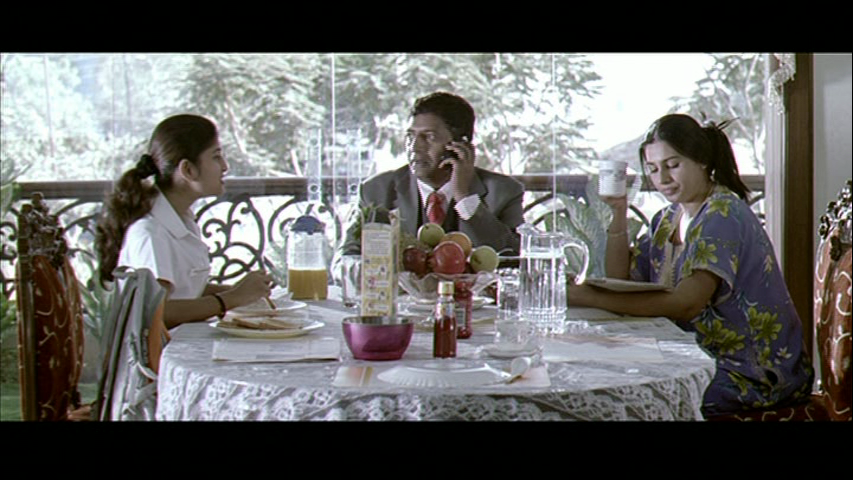
That is until Saroja (Vega), is kidnapped. It’s one of my favourite Prakash Raj performances as he conveys fear, despair and regrets with only a scant amount of dialogue. His reactions and expressions are just perfect. There is a scene where he and his wife are watching home movies of Saroja. They can’t look at each other as they have an intimate conversation that is realistically awkward and painful.
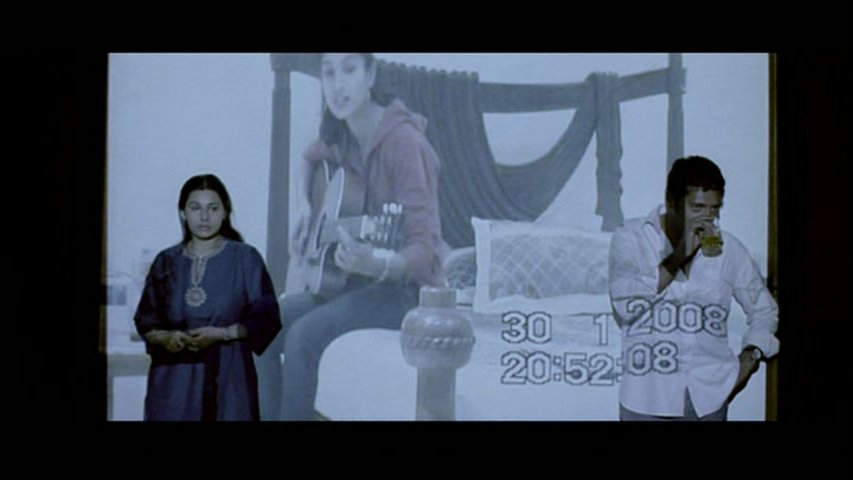
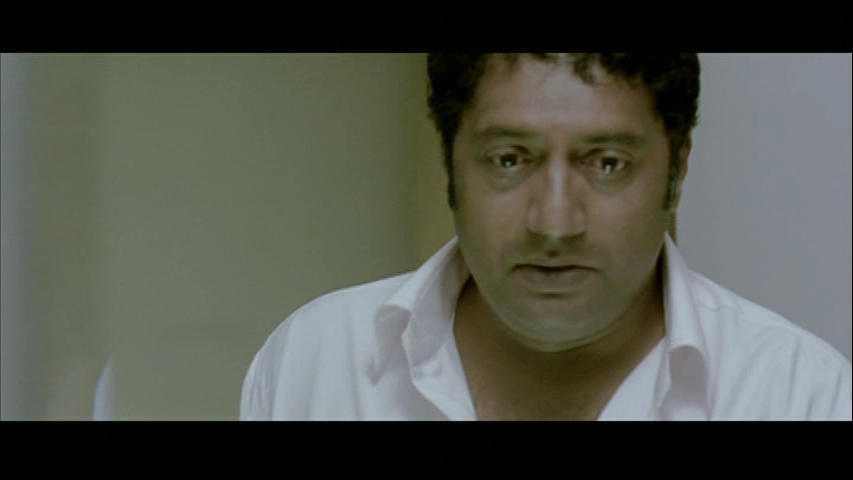
The depth of characterisation established so simply helped me care about what happened to Saroja since it meant so much to her father.

Saroja gets an intro song about girl power and the evils of alcohol, which she delivers after sneaking out of her window to get to the gig. She is largely absent until late in the film as the drama is centred on the police operation to find her, but her character is established as resourceful and independent.

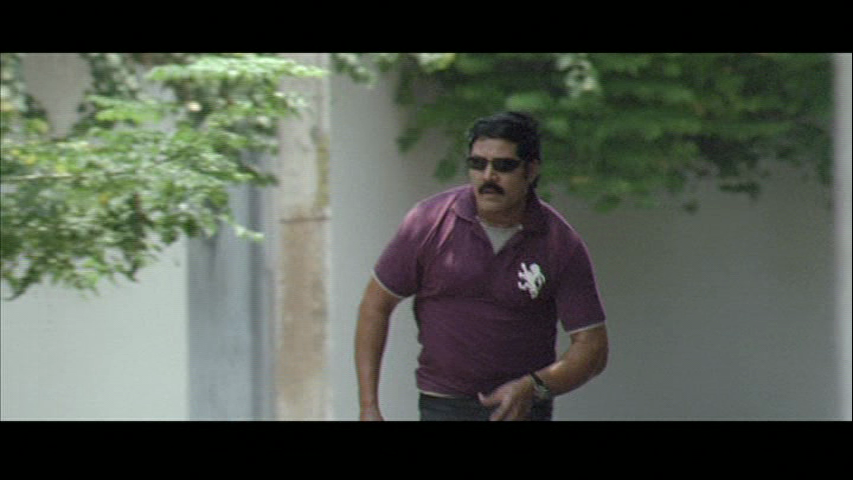
Srihari is Viswa’s friend Ravi, a charismatic policeman who takes on this very personal case. Srihari running isn’t exactly a greyhound so the chase scenes had me worried, but he is an authority figure and pillar of strength. Ravi orchestrates the police activity to recover Saroja and is on hand to witness the devastating effect the kidnapping has on his friend. There is a bit more complexity to his role than just a standard crusading cop though and Srihari and Prakash Raj share some excellent eye to eye moments. I don’t really buy his excuse for something he does, but it wasn’t a big deal overall.

There is a second storyline that will collide with the straightforward police procedural. It centres on a group of friends, totally unrelated to Viswanatham and his concerns.

Vaibhav is Rama Swamy.  The girl he loves (Kajal Aggarwal in a brief appearance) gets engaged to his friend Ajay. He is trying to make the best of his lot and comes across as a moody but not unpleasant guy. Ajay (Shiva) is a soap actor who thinks he is a little more special than he is, and tries to get by on what he considers to be charm. He gets some of the better intentionally funny lines as he cites his TV serial commitments as a reason for avoiding anything he doesn’t want to do. Rama’s older brother Renga Swamy (SP Charan) is the average guy – happy, married with a daughter, middle class, comfortably podgy. Premji Amaren (brother of the director) is the comic relief, Ganesh, and almost every time he opened his mouth I wanted to kill him. To be fair, his straight dramatic scenes were good and a few of the jokes were funny.  Every time he saw a pretty girl, badly dressed angels would cavort around her, and the angels got grumpier as they had to keep reappearing for different girls.
But the comedy track mostly involved Ganesh acting stupid and grimacing wildly. If you find a man screaming his lungs out at the sight of a rat, or telling everyone loudly why he has to be quiet, funny maybe you’ll like him more than I do.

The boys set out on a roadtrip from Chennai to Hyderabad to go to a one day match. After driving for a few hours, including about 257 snack and pee breaks as well as a run in with Brahmi, they are delayed by a major road accident and decide to take an alternate route.

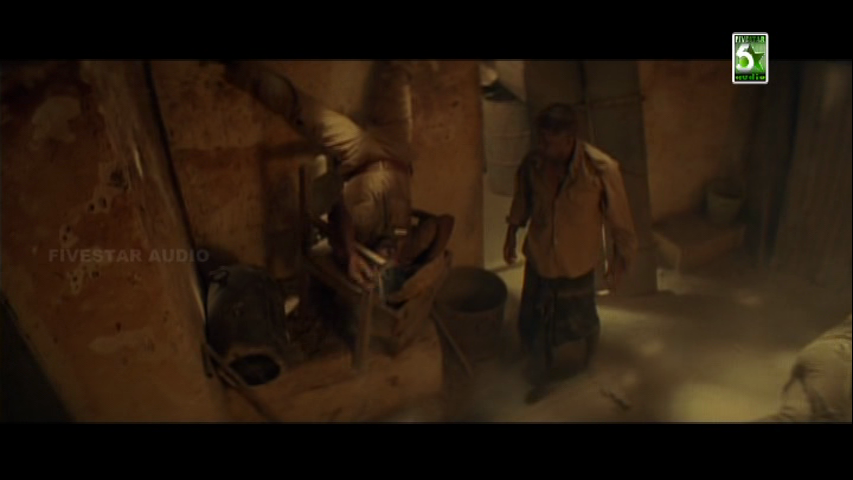
The storylines intersect when the guys take a wrong turn in the dark and end up in a spooky factory complex occupied by the imposing Sampath (Sampath Raj) and his gang, who have Saroja captive. The adrenalin rises from this point until the film’s conclusion as the boys try and extricate themselves from their perilous situation and accidentally seem to be rescuing the girl. There is always time for a dance break though! Kalyani (Nikitha) and Sampath entertain the troops and I have to say seeing all the bad guys in a dance number was a lot of fun.

The ‘heroes’ and the baddies are ordinary guys and the fights and chases are consistent with that. There are no amazing flying leaps and stunts, but there is a strong feeling of the fear and effort in those scenes which is amplified by the lighting and composition of the shots and Saravanan’s cinematography is impressive. Even when things got less believable, the characters remained true to themselves and didn’t develop superpowers. There is some question in my mind as to how well these guys could navigate an unfamiliar place in the dead of night, but whatever. I thought Vega was convincing and in most scenes looked like a school girl. There were signs of a romantic attraction between her and Ram that I thought was a bit not right in view of their character ages. It’s just a fleeting thing but was it necessary for it to be there at all?

The Yuvan Shankar Raja (Venkat Prabhu’s cousin – what a family) soundtrack is good and the range of musical styles supports the full span of the drama. While the songs are well placed in the story, I’m not sure all the picturisations were necessary. The montages sometimes caused a break from the overall mood as they were even more stylised than the rest of the film. The direction relies on gimmicks but that visual interest and excitement helped to give a standard plot a bit of freshness. The story doesn’t completely rely on the visuals so I didn’t feel it was too glossy for its own good. The performances, especially Prakash Raj’s, are compelling on their own.

It’s a film where the outcomes probably won’t surprise anyone, but the way those things happen might. If you want a modern looking comedy/drama/thriller that’s not too heavy on gore and showcases some good character actors, give this a go.  4 stars!

Heather says: Saroja has all the right ingredients to make a good film with an interesting story, excellent cast lineup and snappy dialogue. But it suffers a little from a very long set up with perhaps too much detail in some scenes and not enough in others. There are also a few scenes where the action takes place in poorly lit sets and I found it very hard to tell what was going on. However, once past the slow beginning, it’s a very enjoyable watch as it blends comedy with action and drama in a way that is rare in Tamil cinema. I do like the way the action is preceded with a date and time stamp in the opening sequences as it gives the feel of an American cop show and plants the idea that time is important. Although perhaps this isn’t followed up quite as well in later scenes. The introductions to the various characters are generally good, but I would have preferred director Venkat Prabhu to spend a little more time with Saroja’s family. It is clear that Viswanathan is caught up in his work and doesn’t have time for his daughter, but I think a little more information about the family dynamic would have made their characters more sympathetic. It took more time to get a feel for Saroja and her father as a result, although this may very well have been intentional, as we learn about the family as the film goes on, just as the four friends do.

The interaction between the friends is well done, and feels very realistic. Perhaps it’s not quite as realistic though that they remain undiscovered sneaking around the bad guys’ lair with all of their arguing and long conversations. But the comedy in these was good and the story was well played out in these scenes. The action sequences, at least those that are visible, are also well choreographed and there are some really good ideas in the execution of the various fight sequences.

I liked the twist at the end which I did not see coming at all, although I thought the justification by the villain was rather weak. In it for the money alone might have worked better, but it was still a good ending. I also enjoyed the comedy with Ganesh seeing angels appearing around pretty girls. All of the four characters worked well for me as they each had some endearing character traits and some really off-putting ones – just like in real life. They seemed like much more normal guys than typical filmi heroes which makes the film more interesting to watch.

This is the first of Venkat Prabhu’s films I’ve seen and it’s inspired me to find his others. I’d say skip over a lot of the set-up and then sit back to enjoy a really good action comedy. 3 ½  stars.

Pithamagan

Pithamagan is not a film for the faint hearted. Like other Bala films, it deals with society’s poorest and most disadvantaged – in this case, he delves into the world of cremators, petty con artists and drug pedlars.  And yet it’s very watchable, with excellent performances from Vikram, Suriya and the rest of the cast making Pithamagan much more than just another film about the miseries of being poor and outcast.

The focus of the film is the relationship between Chittan, an orphaned cremator and Sakthi who is a small time criminal. Chittan is born in a graveyard and brought up there by the cremator who seems to do his best for the child. However Chittan grows up to be unable to deal with society; he cannot communicate in words, and is unable to understand the basic tenets of normal behaviour.

After his guardian dies, Chittan ventures into the local town where he creates mayhem before being rescued by Golmathi, a local cannabis dealer. He ends up following Golmathi home, and since she has a kind heart and feels sorry for another orphan like herself, she helps him to find a job. This turns out to be at a cannabis farm and when it is raided by police, Chittan ends up in jail. There he meets Sakthi who also feels sorry for Chittan and tries to help him cope with life inside prison. Sakthi is a petty crook who runs street tricks and confidence games which seems to have given him a performers approach to life. He has a sunny disposition and a positive outlook despite his circumstances and occasional rather interesting dress sense.

After Sakthi is released from jail he works with Golmathi to secure Chittan’s release, and along with Manju, a student who was once victim to Sakthi’s confidence tricks, the friends then spend most of their time together. They work on improving Chittan’s appearance and behaviour, and try to get him away from the drug trade with mixed results.  However, the local drug baron has other ideas and the final conclusion is as bloody and gruesome as you might expect.

While the story itself is rather predictable, overall the film works well and this is down to the chemistry between Vikram and Suriya. Vikram seems to be able to take any disability and make it instantly realistic. I really believed that he was blind in Kasi and here he is totally convincing as the mentally disturbed Chittan. His facial expressions are just perfect and he really does appear to be totally wild and uncontrolled. It’s hard to define exactly what Chittan’s problem is, but as a scientist (and brain researcher!) I’m immediately intrigued and want to analyse the cause of his condition.  Is he simply a wild child – raised without the benefit of society and therefore unable to function within its rules? Or is it more organic and he has a functional neural developmental problem? I tend to favour the latter as the cremator who took him in was able to speak and obviously had some idea of how to interact with the townspeople. So the total inability of Chittan to communicate and relate seems to be something more than just growing up with little social contact. It also doesn’t explain why he was able to fight so well, but obviously that was essential to the plot and we can’t ask for too much realism I guess. I love that he left the policeman upside down in the shot below – the fight scenes really were good in this.

I also find it interesting that in so many of Vikram’s films, his character is somewhat crazed, and he is completely convincing each time! But as good as Vikram’s performance here is, I think that Suriya manages to equal it. This is the first film where I have really ‘got’ Suriya’s appeal. I’ve seen him in a number of films and while I thought he was good as the cop, or the good guy, or even as the bad guy, I’ve never felt that he’s been anything more than that . But Suriya is absolutely fantastic in this film. He is funny and charming, and breathes life into the story. Most of the comedy comes from Sakthi and his various cons, and without this balance Pithamagan would have been very grim indeed. Suriya’s character has plenty of flaws but at heart he is kind and his relationship with Chittan allows this side of his character to flourish.

Sakthi’s friendship with Chittan is cleverly developed throughout the story and makes it credible that the two would end up as constant companions. Chittan seems initially perplexed by Sakthi’s benevolence towards him but soon realises the benefit of a friend. And later, Chittan’s obvious jealousy when Manju is spending time with Sakthi is both childlike and logical since Sakthi has become the centre of his world.

Sangitha is perfect as Golmathi with her paan-stained lips and philosophical approach to life. Her character is another orphan and her initial pity for Chittan seems similar to how she would feel for a stray dog. But as a drug dealer and someone who is shunned by the local community (unless they want her product), she is able to empathise with his alienation and is the first person to start opening up his world. Golmathi’s emotions and reactions are all plain to see on her face which helps make her character much more sympathetic.

On the other hand, the first time I watched this film I really didn’t like Laila’s character and felt that she over played the schoolgirl. But on re-watching, I think she was supposed to be a fun character with a sense of adventure and an awareness of the possibilities of life which was intriguing to Sakthi. However I think Manju is a much less believable character than the others, and her presence is often more irritating than anything else. Initially her father seemed to be quite strict, even taking her to the jail to beg for Sakti’s forgiveness for her actions, which in itself seemed a really strange thing to do. But then later on in the story, her family seem to let her do whatever she wants, despite knowing that the man she is involved with is a convicted criminal. They do turn up to support Manju in the end, by which time it seems to be too late and is perhaps just a way to make a contrast to the other characters  whose only family is each other. Manju’s presence also provides another dynamic to the relationship between the two men since she becomes a barrier between them. But my biggest issue with her character is her inability to articulate what had happened to Sakthi, and this is a major flaw in the story for me. While I’m quite sure that in real life people become too distressed to be able to communicate, here it just didn’t seem to suit her personality, even allowing for her youth. It was also just a bit too over the top and filmi for a story that relies so much on gritty realism – at least for most of the film.

There is one other odd note, which is the protracted interlude with Simran. This completely changes the nature of the film and lasts just a bit too long. In fact it reminded me of the Hindi film Shakti, where Shah Rukh Khan turns up for an item song and ends up taking over a large part of the final scenes. While the song here is fantastic, and I love it, it stops the flow of the story and the subsequent scenes initially feel out of place as the pace abruptly changes again. But here it is anyway, since both Simran and Suriya are brilliant and it’s very funny.

I think Pithamagan is an excellent film despite a few flaws with the pacing. The friendships are successfully portrayed and the action is fast and well choreographed. Vikram’s grunting and animal noises are interesting and effective, and so much better than his singing which is absolutely brilliant in its tonelessness. I wonder just how hard Vikram had to work to make it sound that bad! The music by Ilayaraja is quite beautiful but not particularly memorable, especially since it’s often used as a backdrop for more of the story. Overall though it’s the performances that make this film worth watching and I would recommend it for Vikram and Suriya who are both outstanding. 4 stars.

Thillana Mohanambal

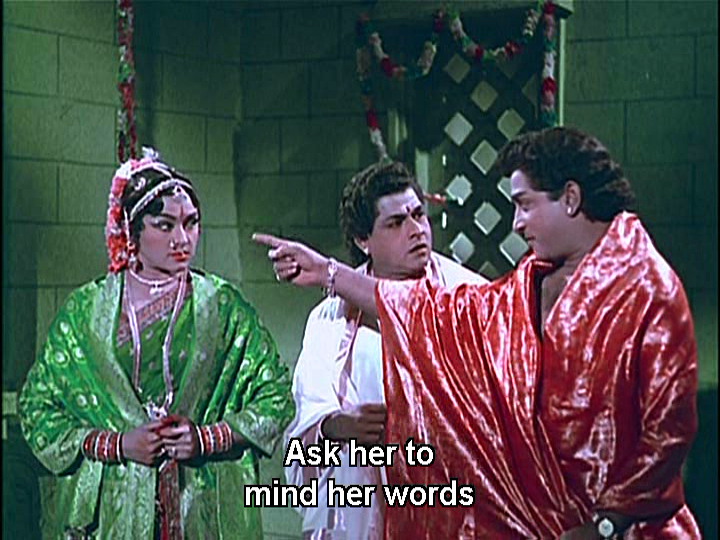
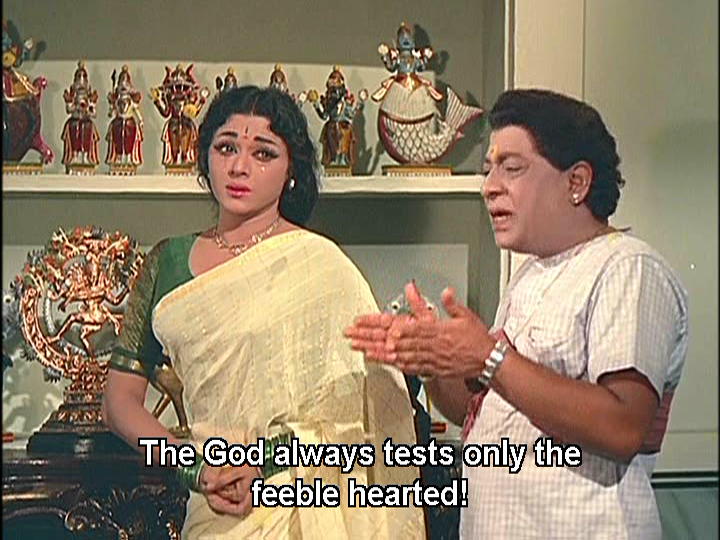
Padmini is Mohanambal, a beautiful and exceptionally talented bharatanatyam dancer. Sivaji Ganesan is the less beautiful but equally talented musician, nadaswaram player Sikkal Shanmughan. Crossing paths at a temple festival sparks fly between them but within minutes they go from this:

To this:

They challenge each other to a contest of dance versus music at some later date. So the stage is set for a fiery romance, riddled with misunderstanding, thwarted by pride and a meddling mother (Vadivambal, played by C.K. Saraswathi).

Mohana believes that dance is for everyone and for all occasions, inspired by the world around the dancer as well as a gift of god. Sikkal is more of a princess, demanding that his audience give him full attention and due reverence as he displays his gift. He believes art exists for god and for the artist. He refuses Mohana’s invitation to stay and watch her dance, but sneaks back later to see this.

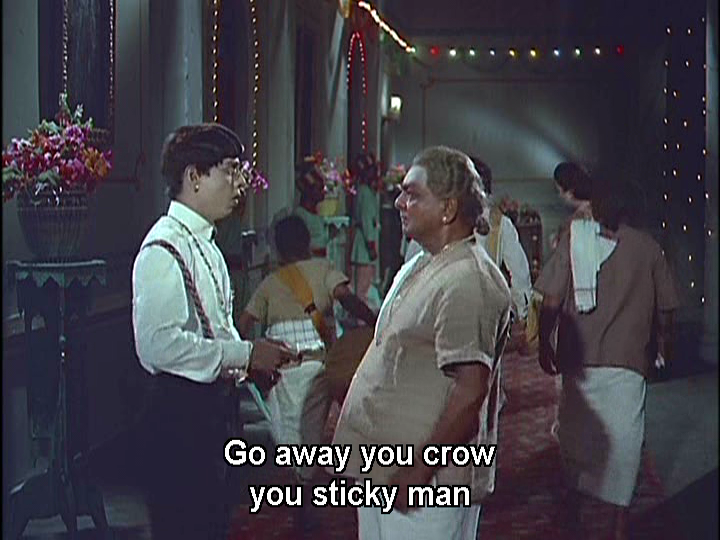
There are some interesting observations on women in the performing arts and Mohana is certainly subject to some assumptions by men who desire her beauty and talent. Her mother seeks to ensure a wealthy man as her daughter’s protector or husband, but Mohana rejects all offers even before her feelings for Shanmughan are an issue. Nagalingam (K Balaji) is one thwarted suitor and a kidnapping attempt results in a comedy fight scene that I could have done without. I don’t quite get the undersized guy with stupid hair as instant hilarity, and there are two of them (double the fun?). This diversion means Mohana and her group catch the same train as Sikkal who has been waiting in the hopes they might turn up.

Padmini is gorgeous and her dance training is evident in her deportment and expressions as she uses all of her skill in conveying Mohana’s emotions. She also does an exceptionally good eyelash flutter. Sivaji is more old school theatrical, and lays it on almost as thick as his makeup. But his somewhat rubbery face is wonderfully expressive, especially his eyes, and he does have palpable chemistry with Padmini. There is a delightful scene of wordless communication and voiceover on the train journey that is funny, romantic and beautiful.

There is lots of sparring between the two and she is not the heroine to fall in love and lose her sense of self. I liked seeing a young lady who was a bit of a brat, very self-confident, and who felt no need to be apologetic. I don’t think I would enjoy her half as much in real life, but she did keep my attention in the film. And there was no suggestion that she should give up dancing to be a servant of Sikkal’s muse. She was a dancer and was valued for her gift.

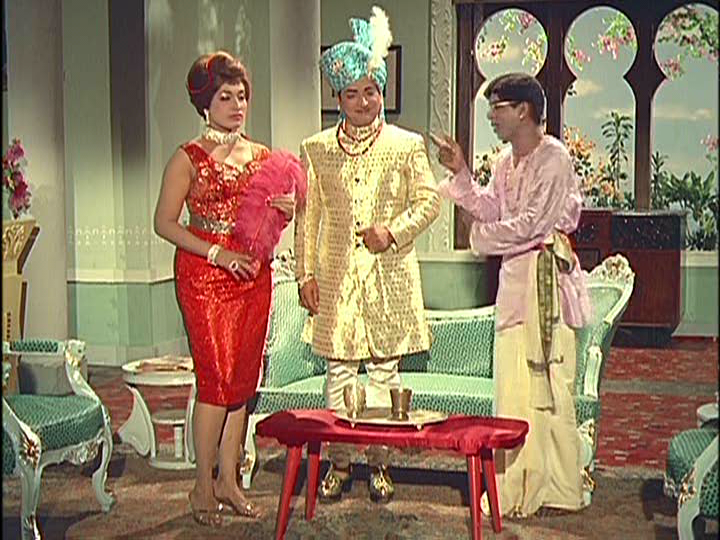
There are abundant comedy elements. Manorama is Jil Jil Ramamani, a folk dancer and girl of suspect virtue. Her ‘comic’ dances are strange, and perhaps the subtitle team decided to make sure we knew this was a modern film:

In addition to being the butt of many jokes, she does play a significant role at several points in the story. Manorama made her character both a caricature and quite sympathetic. I was left thinking Jil Jil understood herself and how others saw her, and she retained some dignity despite the silliness. Nagesh as Vaithy had a role that just irritated me. He is a Jerry Lewis kind of character, so if you like the style, you may have warmer feelings towards him than I do.

His presence extends the story with pranks and frauds, and a longwinded and obtuse approach to being a go-between. The supporting characters are pretty broadly drawn and usually played for comedic effect or buffoonery. There is some excellent face throughout.

There are pointed references to the issues of art versus money, the dedication of great artists and who owns art.  Sikkal storms out of a private party rather than be ‘owned’ by the landlord and plays an impromptu concert to the locals gathered outside. I particularly enjoy this face off where the classical versus modern question is settled judging by the smug expression on Sivaji’s face (wait for the white couple to turn up at about 4 min):

Mohana is pursued with increasing vigour by the landlord and the ensuing scenes are quite farcical. I was quite annoyed that Sikkal immediately assumed Mohana was playing him, without speaking to her or investigating. He just did the heroic leap to the conclusion that she was duplicitous and decided to feel sorry for himself. I might have been more tolerant of manly brooding in a more attractive character, but really I just wanted to slap him. He then departs to sulk with Jil Jil, now calling herself Rosarani, who owns a drama company. Word of this gets back to Mohana who knows about his misunderstanding but had hoped he might still be interested. Rather than giving up, judging or moping, she decides to confront him.

Jil Jil and Mohana show themselves to be more decisive and action oriented than many a filmi heroine. I have doubts over the subtitle translation of some of the relationships as people refer to the landlord wanting Mohana to live with him, but he is also referred to as a groom, there is mention of dowry and so on and he has a wife already. In one scene, Padmini begs him not to spoil both their lives and mentions women being enslaved by money. So I am guessing she would have been his mistress but perhaps the subtitle team decided to sanitise the arrangements. Regardless, her modesty and chastity helps to persuade the landlord to be a brother rather than a suitor.

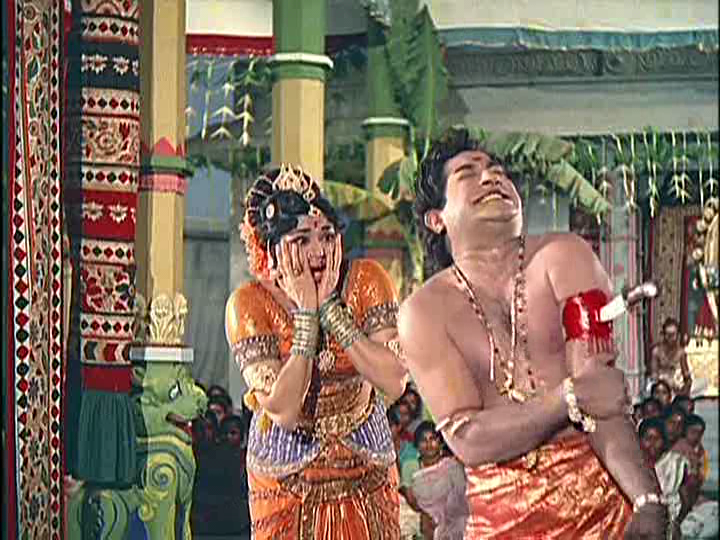
Mohana knew that the only way to keep Sikkal from leaving India with Jil Jil was to appeal to his artistic pride. The Thillana contest goes ahead. Nagalingam returns for skulduggery resulting in Sikkal taking a knife to the arm. Sivaji really milks the scene, thrashing around like a fish out of water for what seems like minutes. This injury prompts a further outbreak of overacting, and Sikkal gets another opportunity to feel sorry for himself again. Thanks to yet another smart competent woman (his nurse Mary) he begins to see that perhaps he has been a little narrow minded.

The finale is predictable but unravels over yet another complex scheme to sell Mohana, this time to a King. She defends herself, verbally and physically, and finds an ally in the very peculiarly accented Queen. Her chastity proves transformative once again, and the King decides to be a good husband.

Sikkal jumps to conclusions (yes, again!) and flings himself around chewing the scenery. This time Mohana has had enough and decides to resolve things. The climax is very filmi and over the top but the duelling diva personalities of the leads made it less unbelievable than it might have been.

This is such a pretty film. The ladies wear beautiful jewellery and costumes, there are lots of sparkly things, the temple locations and houses are lovely. It also has quite a timeless feel, with only a couple of scenes overtly placing the story in the late 1960s. The story is an overblown romantic melodrama but the theme of art and excellence gives the characters much more substance than I expected.  The female characters stand on their own feet, and have their own plans and desires. Padmini and Sivaji are exceptional and really made me care about their relationship even as their characters annoyed me sometimes. And of course, Padmini’s dancing alone makes this worth a look. Who won the contest you ask?  Art was the winner! 4 stars.