Chekka Chivantha Vaanam (2018)

Chekka Chivantha Vaanam

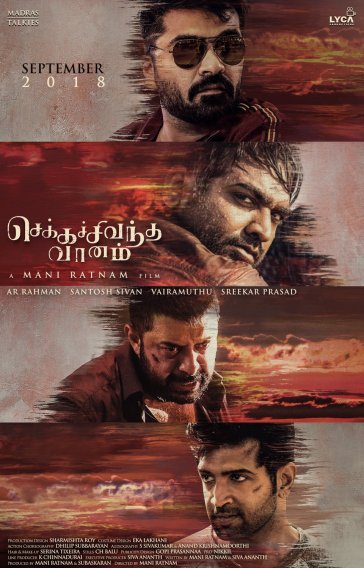
Mani Ratnam’s latest is a surprisingly conventional crime drama that pits three brothers against each other as they vie to take over their father’s gangster business. Unusually there is little character development for each of the brothers, so it does take some time to become connected to the film and get to grips with exactly who is who (and who is sleeping with who). However, the finale is excellent and does keep you guessing right up until the end, while Vijay Sethupathi, Arvind Swami and Jyothika are all superb throughout.

Prakash Raj plays the ageing gangster Senapathi who survives an attack by two assassins dressed as police officers at the start of the film. His wife Lakshmi (Jayasudha) is also in the car, and it’s interesting that their conversation prior to the attack mentions Sena’s infidelities rather than introducing the family members or focusing on the crime empire. However, it’s not until the end that this and other snippets of information come together to make a satisfying whole and many of the seemingly throwaway statements are much more revealing than they initially seem.

Sena’s three sons all return home as their father and mother are rushed to hospital and it doesn’t take long until they are all at each other’s throats, arguing over who will take their father’s place. The eldest son Varadan (Arvind Swami) complains that Sena treats him as just another henchman, when he feels that he deserves better and has the best claim to inherit his father’s empire. The middle son Thyagu (Arun Vijay) lives in Dubai where he spends most of his time on a yacht discussing real estate projects with wealthy Arab backers. He seems to be more a businessman than a gangster and his stylish dress and polished wife reinforce that impression. The youngest son Ethi (Silambarasan) is a drug and gun runner currently based in Serbia and definitely at the bottom of the pecking order, a fact he seems to accept without too much rancour.

None of these men appear to have what it takes to run a criminal network as they indulge in petty arguments and spiteful digs at each other. Each has their own flaws that seem to disqualify them for the top job. Varadan is the most like his father but he lacks initiative and follows a predictable and well-trodden path as he pursues his father’s attackers. Varadan immediately accuses his father’s rival Chinnappadasan (Thiagarajan) of being behind the attack but it seems to be the easy option and doesn’t require Varadan to be anything other than the thug he has always been. Thyagu is slick and more polished, but despite his cutthroat business skills, he seems to lack the violent mentality needed to maintain control over the motley collection of gangsters so, despite his egotistical belief that he is the obvious choice of heir, he seems unlikely to survive long in Chennai. Ethi is unpredictable and erratic, and doesn’t seem to have the necessary concentration span to be able to successfully run a crime business.

Rasool (Vijay Sethupathi) is Varadan’s childhood friend, and the two have remained close over the years despite Rasool being a police officer. At the start of the film, Rasool is suspended from the police force for an overzealous attack on a student, so he has plenty of time to help out his friend while attempting to get his suspension overturned. As the brothers squabble amongst themselves, Rasool is always there to help keep the peace, just as long as he stays off the alcohol.

Varadan is married to Chitra (Jyothika) who is loyal to her husband despite his affair with TV reporter Parvathi (Aditi Rao Hydari). She’s an incredibly strong character who seems determined to hold the family together through the sheer force of her willpower alone, but when the brothers finally descend into open warfare all her support is with her husband in spite of everything he as done. At one point I was hopeful that Chitra was going to turn out to be the last one standing, but alas that wasn’t to be and she stays true to her character until the bitter end. Thyagu’s wife Renu (Aishwarya Rajesh) is less supportive of her husband, particularly when she ends up in jail after drugs are hidden in their apartment, while Ethi’s shortlived romance with Chaaya (Dayana Erappa) seems to only be included to act as the catalyst for his later suspicions when Chaaya is shot and killed on their honeymoon.

Initially the brothers unit in their search for the men behind the attack on Sena, but after Sena’s death it turns into a free for all as Ethi and Thyagu team up in opposition to Varadan, while accusations fly as to who was the real culprit behind the assassination attempt. Chinnappadasan is also out for blood after the brothers target his family and kill his son-in-law while the police have also vowed not to stand-by and let the gangster take over the city. The death toll rises inexorably as the brothers get closer and closer to finally determining who will take Sena’s place as head kingpin and their various rivals also close in for the kill.

The problem here is that for most of the film the brothers are only lightly sketched and we don’t know why they have chosen to act as they do. The women in their life are even more broadly drawn with just enough detail to know who they are and how they relate to Sena and his sons. There is a daughter as well, but she appears only briefly during the celebration for her new baby and I didn’t even manage to catch her name. This lack of any real motivation for the brothers makes it difficult to relate to their characters and, since none of them are particularly likeable, it’s also hard to decide who to support in their struggle to take over the top spot. Some of the support cast also appear to be completely superfluous, and it’s not until quite late in the story that the reason for the inclusion of, for example, Parvathi or Chaaya, becomes clear. But once the final twist in the tale is revealed, suddenly everything makes more sense, and many of the scenes with Lakshmi, Chitra and the others take on a deeper meaning. As too does the squabble between the brothers, and that ensures Chekka Chivantha Vaanam is a much more intriguing film than it first appears.

A.R. Rahman’s music threads through the screenplay with different themes recurring as the characters come and go, and the songs mostly occur in snippets over pieces of the action. Santosh Sivan is in charge of cinematography and does a very capable job, although what is most interesting is what is not shown except in brief glimpses, almost too fast to catch. In keeping with the twist at the end, the final images of Rasool and the three brothers in a circling jeep at the top of a cliff are the most stunning. The ground is a rich red, while the sky is a vibrant blue and the sea a restless azure, making a vivid contrast between the stark but grandiose scenery and the petty, backstabbing action taking place in the jeep.

This is a film that I want to see again now that I know the ending. I suspect that there are clues scattered along the way although on reflection I can only identify a few, and I know that more will becone clear on a second watch through. I also didn’t catch the music as well as I should as I was concentrating too much on the action. The actors too appear much better on looking back, as the whole point of that lack of characterisation and interaction is only revealed at the end. It’s hard to say much without revealing the final twist but it’s the end that does make Chekka Chivantha Vaanam well worth watching and overall one of Mani Ratnam’s better films, despite the initial slow build.
Roja (1992)

Roja

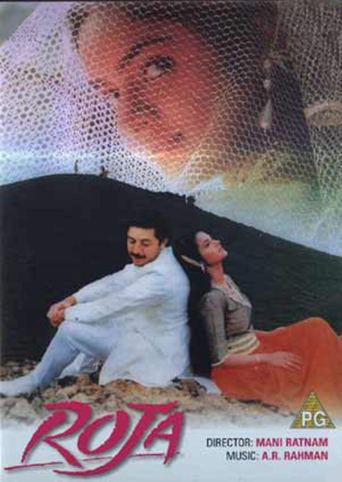
Mani Ratnam’s 1992 film Roja is the first of his so-called ‘terrorist-trilogy’; three films with a romance set against a political background of terrorist activity. Here he takes us to Kashmir, where the Tamil-speaking Roja struggles to plead her cause when her husband is kidnapped by Kashmiri separatists. This is a film primarily about the relationship between Roja and her husband but Mani Ratnam adds in a generous and slightly overdone slice of patriotism as well as providing some insight into the situation in Kashmir at the time. Most interestingly while depriving the Tamil-speaking Roja of a voice in Hindi-speaking Kashmir, the film gives the terrorists an opportunity to explain their thinking and the rationale behind their campaign. In addition to the stunning scenery and compelling story, Roja was the first film featuring a soundtrack by A.R. Rahman and it’s still ranks up there as one of his best. No wonder then that Roja won awards both nationally and internationally, and is still considered a classic today.

The opening credits roll over the sound of gunfire, helicopters and conflict, and the film starts with a bang as terrorist Wasim Khan (Shiva Rindani) is captured by the army in Kashmir. But the action quickly moves to a village near Tirunelveli, introducing Roja (Madhubala) in the beautiful song Chinna Chinna Aasai. It’s an effective contrast between the two worlds, and emphasises how easy it is to forget the violence in the north as we get pulled into the lives of the peaceful villagers in Tamil Nadu.

Cryptologist Rishi Kumar (Arvind Swamy) has come to the village with his mother (Sathyapriya) to meet his fiancée Shenbagam (Vaishnavi). He is first spotted by Roja and her younger sister who are favourably impressed with the sophisticated urbanite Rishi, but Shenbagam isn’t as smitten. She’s already in love with a local boy and persuades Rishi to reject the match – after which he tells Shenbagam’s family that he will marry Roja instead. Since Roja doesn’t know anything about her sister’s true feelings, she is horrified and angered by what she sees as a rejection of Shenbagam. It does seem surprising that Roja isn’t aware of her sister’s secret romance since otherwise they seem to have a good relationship, but perhaps Shenbagam is just very good at keeping secrets. She’s definitely champion of getting her own way, as in the end Roja has no say in the matter and she ends up getting married to Rishi.
Mani Ratnam captures the flavour of rural Tamil Nadu by involving the entire village in the vetting of the bridegroom and subsequent betrothal ceremony. No question is too personal and no subject off limits for the gaggle of aunties and uncles interrogating Rishi when he arrives, and to be fair he deals with their questioning well. Later, the gregarious group of aunties act almost like a Greek chorus as they chaperone Shenbagam and Rishi during their ‘private’ conversation and I love that Mani Ratnam involves them in the entire process, even in this song to celebrate the wedding and first night.

After moving to the city, Roja discovers the truth behind Rishi’s change of mind and her initial anger develops into an appreciation of his good qualities. This understanding deepens into romance, so when Rishi is sent to Kashmir for work, Roja insists on accompanying him rather than wait at home. She doesn’t seem to know much about the political situation in Kashmir, which is shown by her naïve questions to Rishi on their arrival. I find this lack of awareness interesting, and I wonder if this regional isolation can still exist to-day in the age of 24/7 news, Smartphones and the internet? I can’t decide if Mani Ratnam is trying to educate the rest of India about the Kashmir situation with these dialogues, or simply to show how much faith and trust Roja has in her husband, to blindly follow him without any idea of where she is going to end up. Probably both!

Once in Kashmir, the relationship between Roja and Rishi continues to bloom. There is excellent chemistry between Arvind Swamy and Madhubala and the developing romance is hot enough to melt the snow. Mani Ratnam cleverly uses teasing interactions between the two to deepen their relationship and show their obvious enjoyment in each other. But just as everything seems to be falling into place, Rishi is abducted by a group of masked men in a minivan. Roja immediately chases after the van, and it’s only when the van is long out of sight that she falls to her knees – even then, it’s more from disbelief at the situation rather than a gesture of despair. Roja is a woman of action and she’s not going to let the terrorists get away with their abduction.

While Rishi is held by the terrorists, Roja is determined to fight for his freedom, but she immediately runs into difficulties as she doesn’t speak or understand the language. As with Divya’s character in Mouna Ragam, she is also isolated by being so far away from home and familiar surroundings, however Roja has something to fight for and a reason to make herself heard. Eventually she is directed to Colonel Rayappa (Nasser) who is in charge of the search and who handily also speaks rudimentary Tamil. While Roja wants her husband home at any cost, Colonel Rayappa is more aware of the political realities of the situation and exactly what the terrorists demands to free Wasim Khan mean. The political discussions here are excellent, with Roja passionately arguing that the army has a duty to her husband as Rayappa tries to make her understand that the government will not willingly release a known murderer.

Meanwhile, Rishi tries to engage the terrorists by drawing their leader Liaqat (Pankaj Kapur) into conversation. Again, the politics of Kashmir are brought into the dialogues as Liaqat explains the separatists fight for freedom and independence, all of which makes little sense to the staunchly patriotic Rishi. Some of Rishi’s decisions seem quite extreme, such as when he demonstrates his patriotism in a situation where he knows it will only lead to a severe beating, or perhaps even death. Although, since he passionately opposes the release of Wasim Khan, perhaps that is actually part of his intention, but it’s not at all clear. Rather, for much of his imprisonment, the politics take second place as Rishi stares out of his barred window thinking about his wife.

Madhubala is outstanding here and her drive to find her husband along with the passion in their relationship come through very clearly. Her transition from rebellious village girl to determined wife is beautifully done, and she manages to show her character’s resilience tempered with despair exceptionally well. Arvind Swamy is just as good, aside from the brief forays into patriotism where the dialogue and actions do seem rather forced. Best of all are his interactions with Liaqat where the dialogues allow an exploration of the politics surrounding separatist violence in Kashmir. This theme is one that Mani Ratnam expands on much more in his later film Dil Se, but the seeds are sown here with at least glimpses of the separatists’ point of view. Liaqat too is a more sympathetic character than might be expected, although he’s marked as a ’bad guy’ by a rather large mole on his nose, which does at least make him easily identifiable when the terrorists are masked.

Roja has a perfect mix of engaging story, stunning scenery and beautiful music that all combine to produce a classic film. The actors are all excellent throughout and bring their characters realistically to life. Madhubala in particular shines as the central character and provides a strong focus to the story, while the mix of romance, action, suspense and politics is well judged to keep that focus clear.

Mani Ratnam always excels when he films relationships, but here he adds a wider viewpoint as the social problems within Kashmir intrude upon Rishi and Roja’s personal life. The juxtaposition of Roja fighting to reunite with her husband with Rishi’s attempts to persuade the terrorists to embrace a united India acts to bring the personal and the social aspects together and there is effective contrast between Roja’s love for Rishi, and Rishi’s patriotic belief in his country. That doesn’t mean that Rishi doesn’t love Roja, but his fight is to turn the terrorists from their course, while Roja is single-minded in her quest to find her husband. A.R. Rahman’s music is the icing on an already rich cake while Santosh Sivan impresses with his excellent camerawork. I love this film and each time I watch I am amazed all over again by the richness and depth of both the story and the dialogues. Simply brilliant! 5 stars.

Junga (2018)

Junga

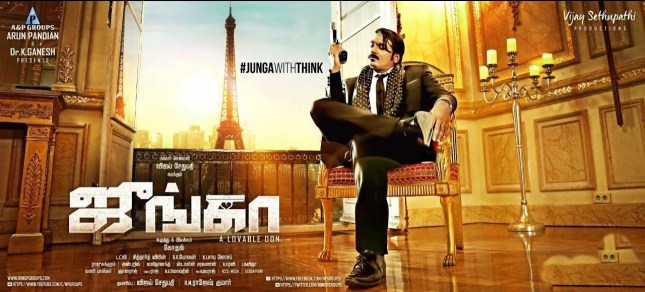
A Vijay Sethupathi film never fails to be entertaining even when, as in this case, the story fails to impress. Gokul’s latest is a comedy that alternates between some hilarious, laugh-out-loud moments and scenes that fall conspicuously flat, mainly due to the ridiculous plot. When the comedy is good, it’s very good, but when it’s bad it’s pretty meh and not helped at all by the glaring plot holes. Still, Junga is not meant to be taken seriously, and Vijay Sethupathi strolls through all the mayhem raising laughs with his take on a parsimonious criminal out to win back his family fortune.

The film starts with Junga (Vijay Sethupathi) being removed from jail by two policemen who plan to kill him in an encounter. Sadly, despite the presence of Rajendran as one of the officers, these are some of the least successful scenes in the film where the dialogue seems forced and not remotely amusing. Luckily this is only a brief introduction to allow Junga to begin relating his life story, which is where all the action happens.

The flashback shows Junga as a small-town bus conductor (all comparisons with Baasha are deliberate) whose love for a Telugu girl (Madonna Sebastian) leads to him taking on a persistent and unwanted stalker and his gang of friends. This foray into fighting shocks his mother who reveals that he is genetically predisposed to violence as he is actually the son of Don Ranga and the grandson of Don Lingaa; gangsters who lost all their money due to their extravagant celebrations and poor accounting skills. Junga’s mother (Saranya Ponvannan) and grandmother (Vijaya) bewail the loss of the family fortune, particularly a picture hall in Chennai which was Junga’s mother’s dowry. Junga vows to be a money conscious Don and heads back to Chennai to restore his inheritance along with his best mate YoYo (Yogi Babu).

Junga quickly builds up a reputation as a cheap option for those seeking intimidation or assassination skills, but fails in his attempts to buy back Cinema Paradise from its new owner, Chettiyar (Suresh Chandra Menon).  Plan B involves heading to Paris to kidnap Chettiyar’s daughter Yazhini (Sayyeshaa) and thus force him to hand over the theatre. Naturally all does not go to plan and Junga’s kidnap scheme is foiled by the Italian mafia who have their own plans for Yazhini.

The first half has plenty of excellent comedy, mainly based around Junga’s miserly tendencies and extreme economies to save money. The film is irreverently tongue in cheek and pokes fun at classic Tamil films as well as modern-day tropes and even at the actors themselves, most of which works well. Radha Ravi channels Marlon Brando as the head of the Committee of Dons who are morally outraged by Junga’s discounted thuggery while Yogi Babu provides solid back-up as Junga’s chief henchman.  The first half has some good fight scenes too along with the best of the songs, including the wonderfully colourful Amma Mela Sathiyam.

The second half falters when the action moves to Paris and the Italian mafia muscle in. What does work is Junga’s obvious pain when he realises just how much money he has spent and the various jokes around the confusion between Parry’s (in Chennai) and Paris (in France). Best of all are Saranya Ponvannan and Vijaya who swagger around as a brilliant double act and completely steal the show as Gangster Amma and Gangster Patti. They have the best lines as they try to shake down Chettiyar and it’s great to see Saranya Ponvannan have a chance to step out of her usual standard mother role, albeit in a small way.

What doesn’t work is the whole storyline with the Italian mafia and French police, although we do get a great fight scene with an umbrella and some good car chases. But there are just too many silly plot holes that stop some of the comedy dead in its tracks while the rather contrived romance between Junga and Yazhini doesn’t work at all. After good chemistry with Madonna Sebastian and an amusing end to that whole episode, the love story with Sayyeshaa is limp and anaemic without even the benefit of any comedy to lighten the romance.

As with Oru Nalla Naal Paathu Solren, Vijay Sethupathi gets to wear some outlandish costumes as part of his trip to France and when he plays the roles of his father and grandfather. There is plenty of moustache twirling along with flamboyant gestures which have become Vijay’s signature comedy style, but he is very funny in this persona and his charm and charisma are almost enough to carry the film through the problematic second half. Almost, but not quite. Thankfully, Vijay is ably supported by Yogi Babu and the double act of Saranya Ponvannan and Vijaya who ensure their scenes are funny and help to keep the plot (such as it is) moving along.

Junga is a film that works when the action is kept close to home with the comedy centred on Vijay Sethupathi and his Don Amma and Don Patti. The more action-based sequences disrupt the flow and don’t fit into the overall pace of the film, even though the fight sequences are well choreographed. They also drag out the film which is already overly long by the time Yazhini is kidnapped. However the songs are good, the comedy for the most part is very funny and Vijay Sethupathi is excellent in the title role. Junga isn’t consistent, but it is hilarious in parts and that, along with the enthusiastic cast make it worth at least a one-time watch.