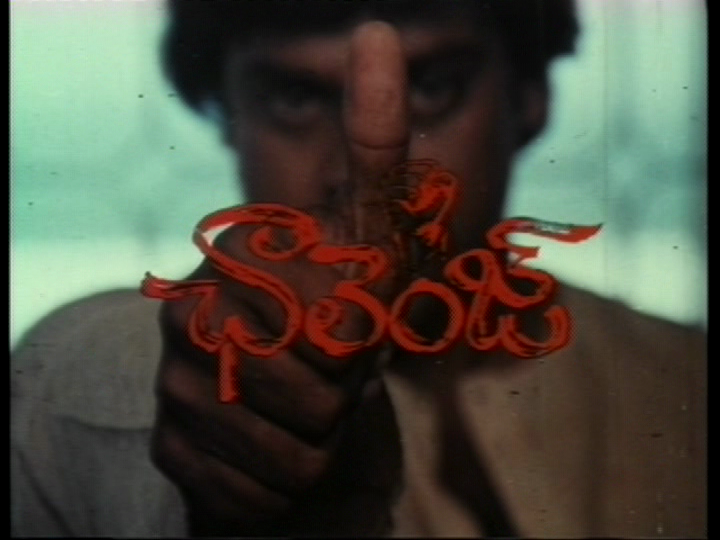
Challenge (1984)

Although the title conjures images of martial arts films and to me sounds as if it should be about a physical fight, Challenge begins rather conventionally with a dying mother whose son is desperate to get her medicine. However it quickly evolves into a more social drama as Chiranjeevi’s ambitious young entrepreneur Gandhi bets rich industrialist Ram Mohan Rao that he will make 50 lakh in 5 years despite his unemployed status. With Rao Gopal Rao, Vijayashanti and Suhasini Maniratnam along for his journey from rags to riches the film touches on poverty and unemployment, workers’ rights and even industrial espionage as Gandhi rises to his Challenge.

The opening scenes introduce Gandhi as a smart but penniless man who isn’t the type to back down or give up easily.  After his mother dies, he uses his intelligence to wheedle money for her funeral from Ram Mohan Rao’s daughter; but for all of his brain power Gandhi isn’t very canny and is easily swindled out of his windfall by the hospital mortuary attendant (Sai Kumar).

Although this introduces Mohan Rao and his ‘money can buy anything’ approach to life as well as his beautiful and more compassionate daughter Harika (Vijayashanti), both the money and Gandhi’s speech to the attendant become important towards the end of the film. I haven’t been able to read Yandamoori Virendranath’s original story but the screenplay uses a number of such incidents where apparently trivial events are used to illustrate different facets of Gandhi’s character and their importance to the plot only becomes apparent later on. It’s all very cleverly done, and I did have to go back and re-watch some of these early scenes to pick up on all the details, although perhaps I was just a little distracted by Chiranjeevi’s dancing!

Gandhi is a graduate with a first class degree and somehow feels that this means the government owes him a job. In fact he’s quite belligerent about his lack of employment but is rather taken aback when Lakshmi (Suhasini Maniratnam), a girl he has rescued from the river, takes him to task about his attitude.  It turns out that Lakshmi is a graduate herself, but rather than complaining about the lack of opportunity is working in a number of different jobs to maintain her independence. Her basic belief is that it’s more important to earn a living than worry about the status of the job and since she has such a practical and pragmatic attitude also sees no problem with offering space in her house to Gandhi. Although Gandhi is initially shocked by the suggestion that he should move in with a single girl, Lakshmi solves the problem by telling him not to think like a woman which quickly stops his objections. This song is another daydream and I do like how Suhasini gets to dance on Chiru’s back!

Gandhi ends up applying for a job with Ram Mohan Rao but at the interview is humiliated by the company owner, who is furious that Gandhi sent in his application without a stamp. However Gandhi is just as angry about the trickery used in the job advert and goads Ram Mohan Rao to such an extent that he challenges Gandhi to prove that money is not important. Gandhi vows that he will earn 50 lakh in 5 years and such is his belief that Gandhi will lose, Ram Mohan Rao promises the hand of his daughter Harika in marriage if Gandhi succeeds.
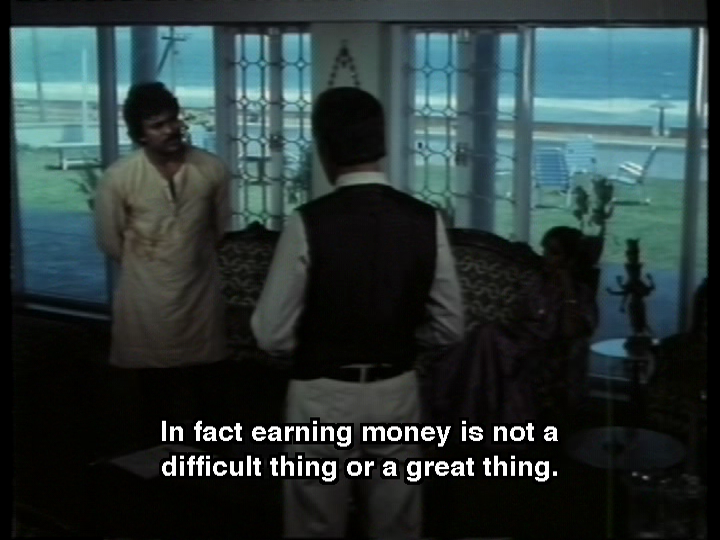
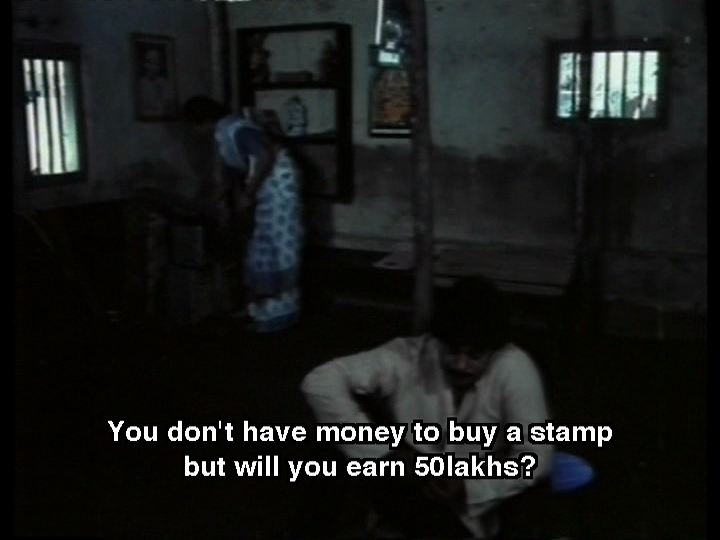
Game on then!

Gandhi makes the important distinction that he will make the money legally, although not necessarily honestly and with a coin he has been given by a beggar woman, he begins his rise to riches. However, as he becomes wealthier his attitude changes and he becomes more and more fixated on the money until nothing else, including his relationship with Lakshmi, seems to matter. Indeed it’s not even the money, but rather beating Ram Mohan Rao which becomes the driving force behind Gandhi’s various plans. This then is the real challenge –can Gandhi stay true to the ideas and principles he had as a poor man or will the power of wealth corrupt his values?
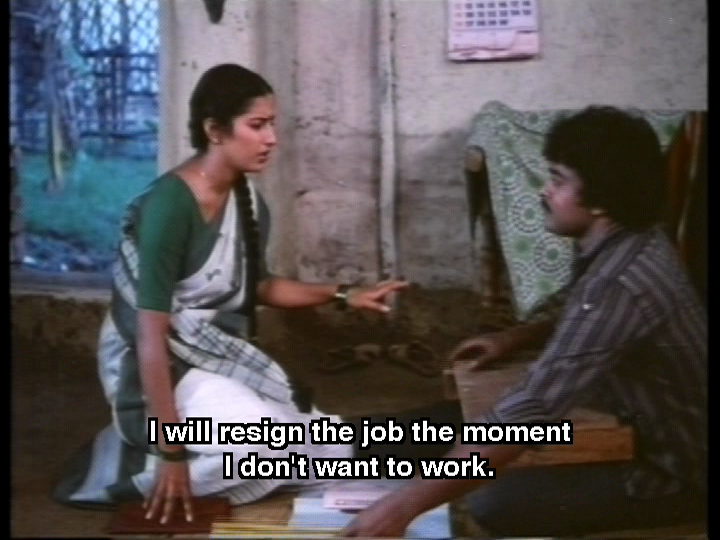
Lakshmi isn’t the only woman having some issues with Gandhi’s wager. Harika is initially appalled at her father’s pronouncement but as she meets with Gandhi, she gradually falls in love with him (who can blame her!) and she actively starts to help his cause. Since Ram Mohan Rao’s first action was to rip up the contract and set his goons after Gandhi, Harika has plenty of work to do in foiling her father’s plans to ruin Gandhi’s various business ventures. While Gandhi seems determined to win the bet and therefore marry Harika, he is still living with Lakshmi – although the two seem to have a strictly platonic relationship. To add more confusion, Lakshmi’s brother Hanumantha Rao (Gollapudi) and his wife Priyamvada (Silk Smitha) move in with Gandhi and Lakshmi. Hanumantha is secretly working for Ram Mohan Rao, while Priyamvada has designs of her own on Gandhi which seem to involve a rather short red toga and a rendezvous in the desert!

Chiranjeevi is riveting as Gandhi and his portrayal of the drive and determination with which Gandhi meets his various challenges feels authentic. Chiru made me believe in every aspect of Gandhi’s moral and physical struggle and I think this is one of his best performances.  A. Kodandarami Reddy has done a great job of developing such a complex story and has put a lot of detail into the characters of Gandhi and Laxshmi to make me feel every moment of their struggles. It’s a good story too and although there are a few points that require a little suspension of disbelief, the basic theme echoes stories of personal achievement that do occur in real life. The other lead actors are all excellent.  Suhasini is perfect as the strong-minded Lakshmi and she makes the most of her well written dialogues. Rao Gopal Rao is suitably villainous as Ram Mohan Rao and although Gollapudi is fairly irritating when he tries to be funny, he doesn’t appear often enough to make it a problem. I surprised myself and recognised a young  Rajendra Prasad, who has a small but important role as one of the graduates Gandhi employs as he builds his empire. Vijayashanti looks incredibly beautiful but her character is more than just the glamour element and she too has a strong role to play.

The songs by Ilayaraja are another highpoint. Generally they represent fantasies by the various women in Gandhi’s life and the upbeat music and dancing make a good contrast with the more grim reality of the story. Vijayashanti gets the best costumes and also probably the best line in the film – Mind it! Again it’s a shame that the film isn’t in better condition but at least Challenge is available with subtitles even if they appear at times to be rather literal.

I loved this film and it’s a great way to celebrate Megabirthday! Watch for what really is an outstanding performance from Chiranjeevi and his co-stars in a cracking good story. 4 ½ stars.
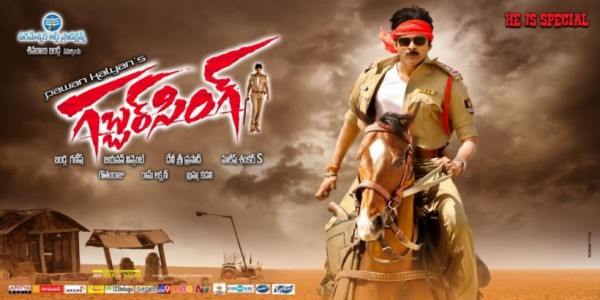
Gabbar Singh (2012)

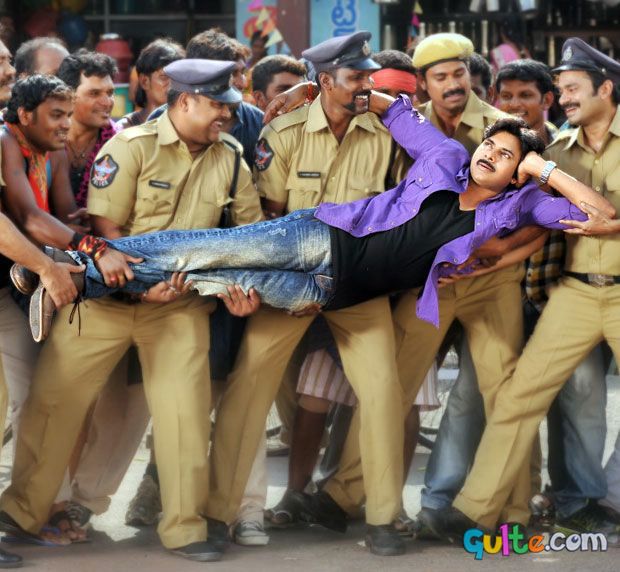
Pawan Kalyan fans in Melbourne seem to be the loudest, the most enthusiastic and to prefer shredding rather than recycling their newspapers. The air was full of strips of paper right from the opening moments of Gabbar Singh and the paper storm continued well into the second half. A packed cinema, cheerleaders up the front to lead us in our favourite Pawan Kalyan chants as everyone pushed and shoved their way in and plenty of whistles and cheers meant a great start to another adventure without subtitles.

It’s a novelty to watch a Southern remake of a Hindi film since so often the shoe is on the other foot and after Osthe in Tamil, Gabbar Singh is the Telugu version of Dabangg. The film follows the same basic plot, but many of the other roles have been limited to allow more focus on Pawan Kalyan’s character. It’s his film the whole way through and while he has the charisma and capability to carry it off, the story loses much of its focus by dropping the back stories of Gabbar Singh’s wastrel brother and the conflicts within their family.

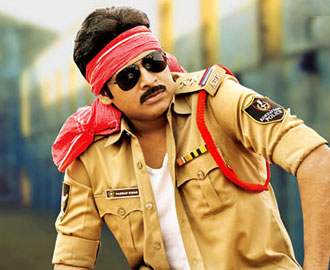
We start with young Venkat Ratnam Naidu and his stormy relationship with his adopted father Naidu (Nagineedu) who had married Venkat’s mother Suhasini after she was widowed. Naidu prefers his own son and makes no secret of the fact which gives Venkat a huge chip on his shoulder and a somewhat argumentative personality. Venkat ends up running away from his family, but returns years later as a police officer with the assumed name of his childhood hero, Sholay’s Gabbar Singh. He returns in style, renaming the police station after himself and single-handedly annihilating a gang of bank robbers after chasing after them on horseback so it seems safe to say that he’s not mellowed in the intervening years.

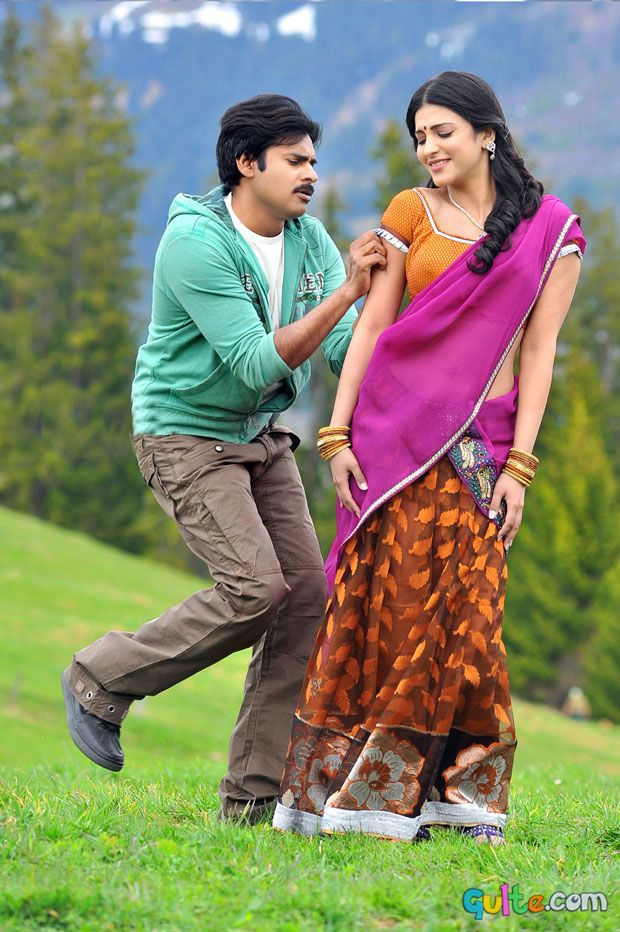
It’s not long before Gabbar Singh clashes heads with local rowdy Sidappa Naidu (Abimanyu Singh) and the feud between the two forms the plot for the rest of the film. In between all the gunfights and general mayhem, Gabbar Singh falls in love with Bhagya Lakshmi (Shruti Hassan) but her role is even more reduced than that of Rajo in Dabangg and Bhagya only appears briefly in a few scenes and a couple of dance numbers. Her friend, ably played by Gayatri, has almost as much screen time and judging by the audience reaction, seems to get the better lines too. Kota Srinivasa Rao pops up as Bhagya’s father but again the role has very little scope and he barely has any input.

Sidappa has political aspirations and Gabbar Singh disrupts his attempts to fund his career through various robberies and corrupt deals. Sidappa’s response is to have his henchmen beat him with clubs which is rather extreme but doesn’t really have too much of an effect on his arch nemesis. Abhimanyu Singh’s Sidappa is a typical Telugu goon and doesn’t have any of the flamboyance or appeal of Sonu Sood’s Chhedi Singh so the villain of the story is rather disappointing. As too is the item song. Although Malaika and the backing dancers did their best, Kevvu Keka just isn’t as catchy as Munni Badnam. I was also very disappointed that Ajay as Gabbar Singh’s brother only made a very brief appearance since he’s one of my favourite actors and I was hoping for more from him.

However the film was made totally worthwhile by a scene where Gabbar Singh forces the usual crowd of rent-a-goons to participate in a session of antakshari. This has to be the funniest piece of cinema I have seen this year and it had the crowd on their feet cheering for more! Generally the dialogue seemed to be of high quality since many of the lines had the audience applauding and both Ali and Brahmi’s comedic roles got plenty of appreciative cheers. Since I didn’t understand the dialogue I focused on the myriad of excellent details instead, such as the gun hood ornaments on Gabbar Singh’s 4WD and the incredibly happy and enthusiastic backing dancers. There is a reason why men in flak jackets are not often seen dancing and it’s a point well illustrated in the first song. Generally though the songs are good and Devi Sri Prasad’s music suits the feel of the film.

There is very little of Chubul Pandey in Pawan Kalyan’s Gabbar Singh. None of the mannerisms are there, although Gabbar Singh has plenty of the same chutzpah. The sunglass tricks are reserved for Brahmi apart from an opening scene where Gabbar Singh tosses his sunnies onto a colleagues face with impressive accuracy.  There are a few moments in one song in Switzerland where the normally smooth and co-ordinated Pawan Kalyan does seem to be channelling Salman Khan’s dance style, but thankfully not for long. I did feel sorry for Shruti Hassan dancing in the snow in sandals though.

The reason that Dabangg was such a hit was that it was a Southern style film incorporating plenty of the masala elements which have sadly been missing in Bollywood for some time with a hero who suited the part. Once that novelty element is removed and the film changed to a Southern locale and hero, the story is similar to most other Telugu films. The impact is further lessened by the South’s familiarity with the use of machetes, 4WD’s that roam in packs and acrobatic fight scenes and so Gabbar Singh doesn’t stand out in the same way as Dabangg, although it is more successful than Osthe. Harish Shankar has changed the screenplay to make the film suit his leading man and Pawan Kalyan is excellent as the unorthodox police officer in a rather more orthodox story. Gabbar Singh is still well worth a watch for his performance and I’ll definitely be looking out for the DVD to finally understand the dialogues and for that brilliant antakshari scene!

Kirathakudu (1986)

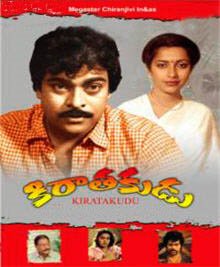
If Kirathakudu didn’t have Chiru and Suhasini in the leads I am not sure I would have persisted. The first hour or so is very trying indeed. But then I would have missed out on an unexpected reworking of John Carpenter’s 1981 classic, “Escape From New York”. If I see Chiru plus subtitles, the DVD is an automatic purchase so I didn’t read anything about the film before I watched it. There is a voiceover about criminals and the government, but the concept wasn’t well translated in the subtitles. Imagine my delighted confusion when it started to seem somewhat familiar.

Chiranjeevi is Charan, a poor rich boy who just wants his father (Kongara Jaggaiah) to show him some affection. Charan spends his time winning every possible sporting and aeronautical trophy, beating people up, carousing and brooding in his room.

https://www.youtube.com/watch?v=85q8IZ-c3hQ

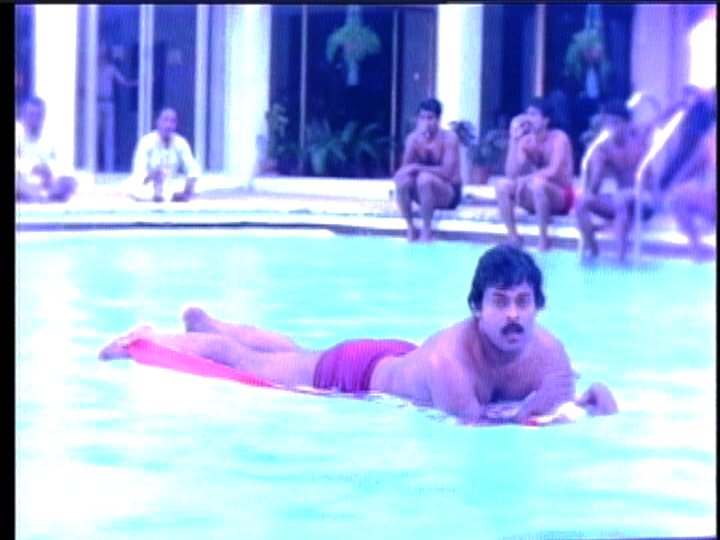
I enjoyed this sporting montage greatly, although it has prompted me to make a statement critical of Chiranjeevi.

His swimming style is splashy and inefficient and he would not have won a race against the under 9s in my swimming club. There – I’ve said it.

Maybe it’s not about winning the race, but about looking stylish on a lilo.

And making bad art.

He is a renaissance man, albeit one with questionable taste, a very bad temper and poor impulse control. He drinks heavily, and I think I was supposed to find this appearance a warning – but he looks so good!

Charan sees a quite unimpressive statue in a local emporium and runs afoul of Swetha (Suhasini) who has purchased the one of a kind piece. His reaction to finding out he can’t have it is extreme.

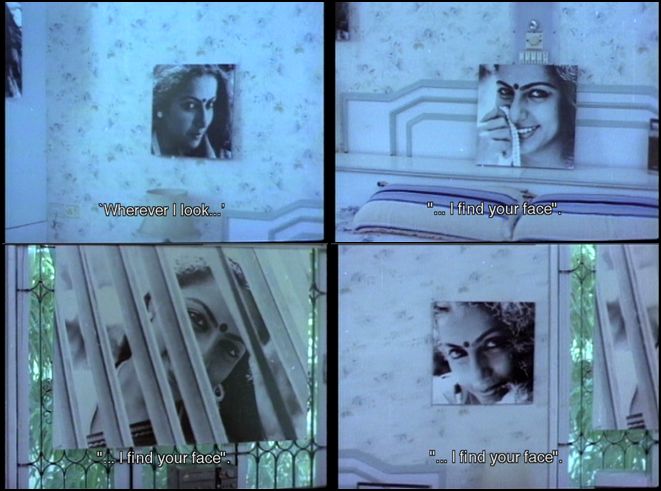
Swetha is a psychology student, and daughter of the local police chief. She is smart, self assured and is not intimidated by Charan. She is also a raging narcissist from the looks of her house – pictures of her adorn almost every wall.

It is interesting that Swetha is given career aspirations and a brain, and yet the dialogues are often very disparaging of women. Suhasini is such a graceful and intelligent actress that I was pleased to see her in a reasonably involved role. She is drawn to Charan both as an interesting psychological study and because he is Chiru – those eyes!

Charan goes off the rails due to the influence of vampy Hamsa (Silk Smitha). Only Chiru could make Charan watchable as he broods, rants and sooks over why his daddy doesn’t love him and then commits crimes as a cry for attention.  Showing that she is smarter than most people in the film, Swetha finds Charan’s hideout and dobs him in to the police. He kidnaps her in a dramatic getaway and their forced proximity accelerates the already budding love.

Having been ruined by a tramp, he feels that the love of a good woman will let him live like a decent person. Yes. Surely it would be unreasonable to expect him to take responsibility or just grow up. She then takes on the burden of reforming Charan and settles in for a lifetime of prison visits. I found their song fantasies quite amusing – Swetha was all flowers and pretty colours, while Charan was much more, um, hands on. One thing they did have in common was their terrible taste in art.

Silk Smitha is Hamsa.

Well, Silk’s arse does most of the work thanks to the constant upskirting camera, but she sneaks the rest of herself into shot occasionally. Hamsa is a Bad Girl who entraps Charan and forces him to turn smuggler (bad) and wear pleather (not so bad). Again, I had to growl a bit at Charan crawling out of her bed the morning after and treating Hamsa like dirt for giving him what he wanted.

Mothers in the film are sacred but women who have sex are evil  – so I wondered briefly about how these idiots thought babies were made. I am not exactly sure why sleeping with Hamsa would be enough to place Charan under Snake’s control, especially given his cavalier attitude to the law and society, but it seems he was besmirched and that was it. The bad girl is usually a thankless role, but Silk gets a few pithy lines and an excellent confrontational cheerleading dance.

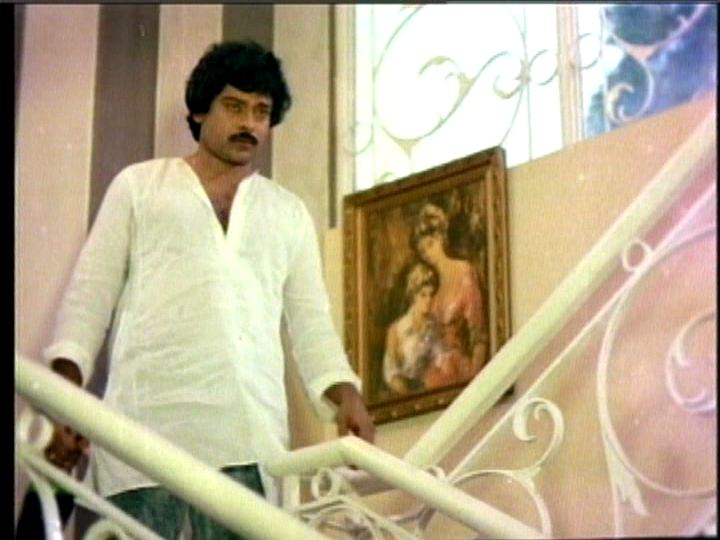
The second half of the film took a sharp turn towards awesome. Maybe because Chiru changed into this outfit?

The police need Charan’s help to take on Snake and rescue his dad (and the Top Secret papers) as they could not get into the badlands themselves. When Charan stole a car ferry and chuffed off about 10 seconds ahead of the cops, he managed to hide the ferry within walking distance of a sari shop and judging by the number of Swetha’s outfit changes, remain undetected for days. The man is a genius and I can see why the police appealed to him.

Armed with an array of gadgets and with deadly time release microcapsules implanted in his neck, Charan sets off to save the day. He lands a glider on top of a skyscraper in the crime quadrant, on a mission to rescue his father and protect Indian national security. He had to take a glider as there was no way in by land. In a puzzling development, Swetha and Baby (the cab driver played by Nutan Prasad) decide they have to follow him, and drive in through the front gate in a taxi, sedately avoiding the bombs planted along the route. While the residents look like a left over mob from a B grade post apocalypse horror movie, Swetha is able to glide around in her pristine sari without being spotted. The scenes in this second half are more closely aligned to the original film and the mood is both darker and more absurd.

Snake (Kannada Prabhakar) is the kingpin in the sealed off criminal zone. While John Carpenter recreated Manhattan as his prison colony, Snake has to make do with a warehouse complex a few minutes from the downtown area. He has possibly the best DIY lair and henchmen I’ve seen to date, and I enjoyed deciphering the very random graffiti.

Snake is also a psycho killer on a very short fuse.

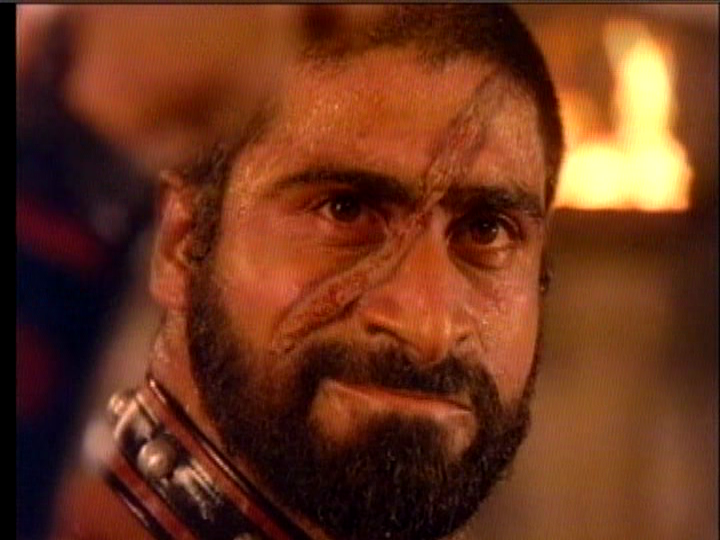
This guy is quite fascinating.

He plays his role of chief henchman with a blend of odd chicken inspired noises and statue postures, and walks with what I can only describe as a slow-mo mince. While wearing a dress (maybe toga).Who is he?

And the guy who would have been played by Bob Christo in a Hindi version of this is back! Last seen in Adavi Donga (the apple peeler Wolverine claws guy) here he is sporting a fake scar and some hideous trousers.

How does it end? Is there any doubt?

It’s a film by A Kodandarami Reddy so I expected crazy, and the second half delivers. I did have to chant the ‘it was made in 1985’ mantra a few times, but even allowing for that I was irritated by some of the dialogue relating to women and their evil powers. Grow up guys! Yandamoori Veerendranath gets a writing credit, but this is a reasonably faithful remake with the addition of loads of sentiment and a message about good family values.

Chiru and Suhasini inject a bit of class into their scenes, and the WTFery dial is set to 11. I’m totally biased due to Chiranjeevi but I’d give this a cautious 3 stars, for the curiosity value of the remake and for the dystopian second half.

Here is a snippet of Silk’s big song number – it is interspersed with the final action sequence so I won’t give away all the surprises!