R…Rajkumar (2013)

R...Rajkumar

Prabhu Dheva (where did the extra ‘h’ come from?), the dance guru, directing Shahid Kapoor, one of the few Hindi actors who can dance – surely that has to be a good thing?

R...Rajkumar

Well… the premise is there, but in delivery R…Rajkumar is not as good as expected.  While the dancing is excellent (and it is fantastic to see a director make full use of Shahid’s talents in that respect), there are a few too many distasteful misogynistic moments to make this film anything other than just OK.  Shahid makes a reasonable attempt at masala served southern style, and his goofy shirts, dreadful hair and love struck Romeo are entertaining if somewhat reminiscent of Siddharth in Nuvvostanante Nenoddantana.  Although Shahid does his best, the story is standard fare, and adheres strictly to the usual Telugu formula complete with cartoonish fight scenes and ineffectual heroine.  It’s such a shame when all the ingredients are there to make a much better film, if only a little more thought had gone into the screenplay.

R...RajkumarR...Rajkumar

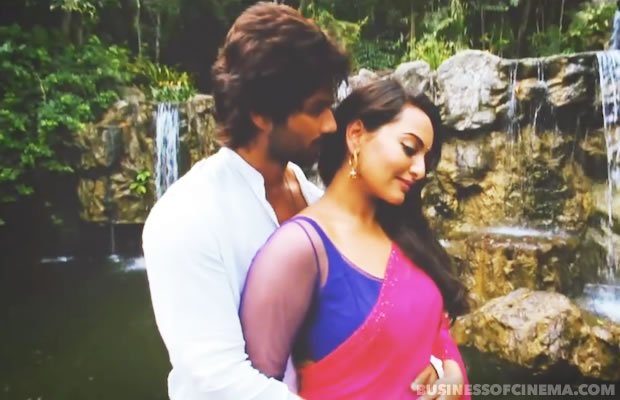
Romeo Rajkumar turns up in a small town where two rival gangs are battling for control of the opium trade, managing to arrive just at the right time to save Chanda (Sonakshi Sinha) from a stray bullet. Simultaneously he falls deeply in love with her after just one brief glance – so deeply in fact, that the mere sight of his ‘lollipop’ (gah!) is enough to halt him in his tracks.   And I do mean completely stop – no matter what – even when taking part in an assassination or when driving the getaway car after another attack on a rival gang. Much hilarious comedy ensues. Well, to be fair, it is funny the first time or two, but it just gets repeated a few too many times.

Rajkumar signs up with Shivraj (Sonu Sood) and soon becomes one of his top men in the fight against rival gang boss Parmar (Ashish Vidyarthi) becoming good friends with Qamar Ali (Mukul Dev) in the process.  The first half is full of outrageous shirts, bad hair and some amazing dance moves from Shahid along with a brief appearance from Prabhu Deva himself.

R...Rajkumar

But while Shahid is blowing kisses and generally making an idiot of himself, there are darker scenes such as an apparent rape in the police station which is treated as an everyday occurrence and not worthy of further mention.  Further threats of violence and rape against the heroine are also treated as comedy and while some of the lewd dialogue is funny, most is offensive rather than comical.

R...RajkumarR...Rajkumar

Sonakshi Sinha starts off as a feisty village girl with great attitude as she beats up a gang of louts who dare to wolf-whistle at her and her friends. She berates Rajkumar for his unwanted attentions repeatedly, until she manages to overcome her aversion to eighties hair and loud shirts and decides that maybe Rajkumar isn’t so bad after all. But that’s the end of any personality for Chanda, who rapidly becomes vapid and useless, totally unable to defend herself against her uncle and his plans for her marriage, and completely helpless in the face of Shivraj’s attempts to seduce her. It’s a role Sonaskshi Sinha has done many times in the past but she has less conviction in her character here, and it shows.  There is no energy in her performance and zero chemistry with her co-star which makes me wonder why Prabhu Deva didn’t pick someone like Trisha or even Charme Kaur (who turns up in a song) who surely would have brought more oomph to the role.

R...RajkumarR...Rajkumar

Equally disappointing is Sonu Sood who is less menacing and more buffoonish than expected as a gang boss.  Ashish Vidyarthi is even more of a caricature as his rival, while Asrani is actually rather restrained in his role as spiritual advisor to Shivraj.  It’s bitter sweet to see Srihari appear here as the über villain Ajit Taaka, in one of his last appearances.  Generally he’s fine in spite of a rather unconvincing storyline and one rather bizarre scene where he appears gyrating with some bikini clad women on top of a hotel in (supposedly) Hong Kong. Best to just ignore and move along – when did masala ever have to make sense?

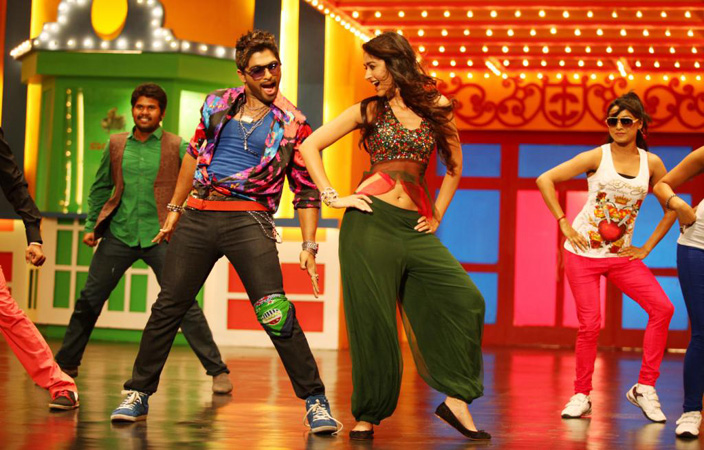
What does work well in the film are the songs by Pritam.  Prabhu Deva does an excellent job with the choreography, as for example here in Saree Ke Fall Sa where he uses the backing dancers and a few basic props to good effect.  The only exception is the last item song with Ragini Dwivedi and Scarlett Wilson which is shambolic with much less of a southern feel.

While the film initially feels like a series of short comedy sketches, everything slows down in the second half and becomes a little more serious with more fight scenes and fewer songs.  The inevitable final showdown is good, although I don’t think Shahid is quite as convincing in ‘back-from-the-edge-of-death’ recoveries as, for example, Shahrukh in Chennai Express, which does make the last fight scene funnier than I think it was meant to be. The film could definitely do with fewer rape references, and a more socially responsible hero would have made for less uncomfortable viewing.  Still, Shahid puts in a good performance and seeing him dance up a storm southern style, makes R…Rajkumar worth a watch, even if it doesn’t quite reach the heights I expected.

R...Rajkumar

Julayi

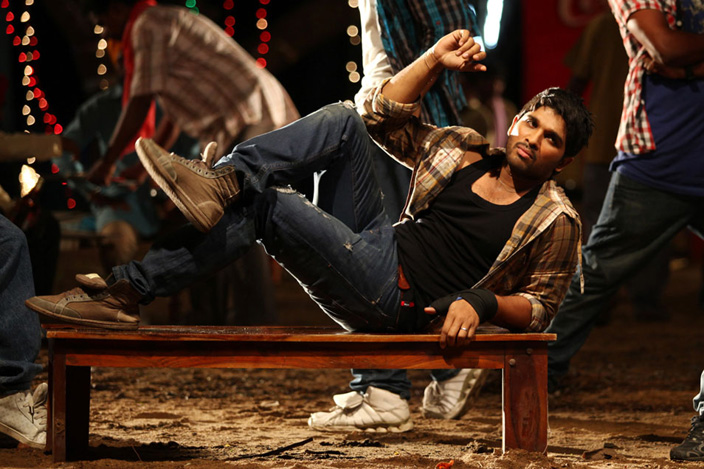
Trivikram films tend to focus as much on the dialogue as on the action, so it was inevitable that I missed the comedy that had the rest of the audience laughing and cheering through most of Julayi. Not that it really mattered. There was still plenty of great dancing, excellent action scenes, ample screen time for my favourite actor Allu Arjun, and a relatively easy to follow (if somewhat unbelievable) plot giving another enjoyable ‘adventure without subtitles’.

Ravi (Allu Arjun) starts as many a Telugu hero seems to do, by having an argument with his father (Tanikella Bharani in his customary role). Taking a cue from Chiru’s ‘money is easy to make’ speech from Challenge on a TV in the background, the argument seems to be based around Ravi’s lack of commitment to the conventional way to earn a living and ends with Ravi heading out to a gambling club. Since it’s raining heavily he cadges a lift, which just happens to be with a gang on their way to rob a bank. Because stopping to give someone a lift on the way to commit a major crime doesn’t seem like a risky thing to do at all – right?

Luckily for Ravi they seem happy to drop him off on a corner but that is their first big mistake. Ravi has awesome intuition, amazing powers of observation and a seemingly photographic memory and is able to lead the police to the site of the bank theft in time to partially foil the robbers’ escape. Head gangster Bittu (Sonu Sood) has already decimated his own gang, presumably to ensure a larger slice of the money, and Ravi helps lower the number still further by taking out one of Bittu’s trusted gang members (Shafi in a very brief appearance). This seems to spell war between the two, although the apparent destruction of the money and ensuring that Bittu is arrested and his plan foiled are also key contenders for the ensuing rivalry between Bittu and Ravi.

The bank heist is an odd mixture of some excellent ideas, such as the smooth way the robbers disable the cameras as they move through the building, and some gaping plot holes which just don’t make sense. This lack of logic reoccurs throughout the film where there is never any explanation for Ravi’s astounding ability to apparently read Bittu’s mind and predict how, where and when he will strike next. The police are also very ready to fall in with Ravi’s plans and have no objections any time he kills one of the gang. I was almost expecting that Ravi would be revealed as some sort of super-agent which might have explained the nonchalance towards his ever increasing body count and the willingness of everyone to follow his lead. But no, nothing quite so logical is allowed to intrude into the plot, or at least not that I could understand.

Sonu Sood is his usual impressive self as the villain Bittu, although he has a tendency to start cold and menacing but then over-do it just a tad and become almost comic. He too has amazing powers since he is able to interpret the sign language of his deaf henchwoman without even looking at what she is signing. It’s a talent she seems to share since she rarely looks at his replies either but at least she has better survival skills than the rest of the gang. To add some further complications, Bittu is collaborating with local MLA Kota Srinivasa Rao, who’s done some dodgy deal to cheat his investors and seems to be in it for the money. It’s the same crooked statesman role that Kota plays so well that now I don’t ever expect to see him without there being some dodgy deal involved.

The action moves to Hyderabad when Ravi is sent to ACP Sitaram (Rajendra Prasad) as part of a witness protection scheme. Ravi falls in love with a girl he sees at the bus-stop which results in a succession of songs, in fact almost the entire soundtrack one after the other, as Ravi attempts to win Madhu’s heart. Ileana started off well as Madhu and I liked her glasses and general look, but after Ravi takes her shopping and persuades her into contact lenses and Western clothes she just looks too thin and out of proportion. Although none of her outfits are terrible, the majority aren’t very flattering either and the curse of the Telugu film shoe designer strikes once again with a terrible pair of black boots.

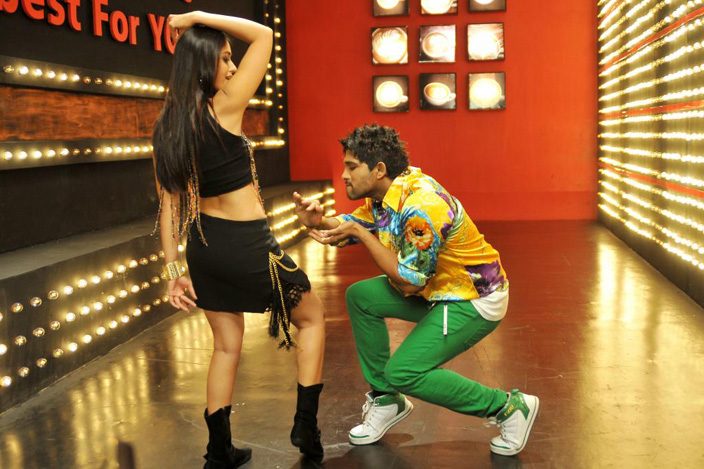
Bunny and Ileana have very little chemistry together and although there are some better moments in the songs, the romance never really takes off. The songs by Devi Sri Prasad are mainly pictured on Bunny who is energetic and wonderful to watch in better than usual choreography. For a change there are no special ‘feature moves’ – no sign of ‘the worm’ – and Bunny is given free rein to do what he does so well and just dance.  He also shows commitment to shiny multicoloured shirts which I did appreciate.

Every single possible comedy uncle turns up but thankfully their comedy is well integrated into the main plot and kept to a minimum. Trivikram seems to use most of the humour in snappy dialogues between  Bunny and Rajendra Prasad which were well appreciated by the audience. There is plenty of ‘action’ Bunny but a lot more ‘funny’ Bunny and both Allu Arjun and Rajendra Prasad work well together in these scenes. In fact the only major fail is Bunny’s hair which varies from OK in the frequent rain scenes (because it is flat and plastered to his head!) to really quite terrible with spikes at the back and flattened matting at the front. There is no hair continuity either and it becomes quite a distraction in a number of scenes as the number and position of the spikes varies – or perhaps I’m just becoming a little too obsessed. There is also the matter of his coloured contact lenses, but I’ll leave that rant for another time!

The film does look great, with some good use of locations in Dubai and reasonable special effects. The sets are also well dressed although Temple and I did have a discussion about the large assortment of really ugly ornaments that appeared on every desk. But there was commitment to family photographs and I did like the large picture of Michael Jackson in Ravi’s room. I liked the soundtrack before I saw the film and although it doesn’t sound too different from previous DSP soundtracks the music fits in with the general feel of the film. The songs could have been better paced though as there did seem to be a lot in the first half – not that I’m really complaining as watching Bunny dance is always worthwhile.

Julayi has plenty of action and strong performances from most of the cast which helps keep attention away from all the plot holes. Its slick and well filmed to make the most of Peter Hein’s excellently choreographed fight scenes. Definitely worth catching on the big screen if you can although I think this is a film that I will appreciate more with subtitles. Hopefully this doesn’t disappear into the same DVD black hole as Khaaleja and we do see a DVD release soon.

Dookudu

Another Adventure Without Subtitles! Dookudu is the much awaited release for ‘Prince’ Mahesh Babu and we knew it would be huge. We arrived early for the 8.30pm show, which gave us the opportunity to watch the staff deal with the problem of getting the first show crowd out through the 700 or so people crowding into the small foyer. Once people emerged, the waiting audience clapped and cheered them like they were rockstars, and it was a very festive atmosphere. As one lady said  – why come to the cinema unless you’re going to have a good time?

It was about 10pm before the film finally started, not that anyone was complaining. There was plenty of cheering, accompanied by the sounds of tearing newspaper, as everyone got ready for Mahesh’s appearance.  There was discussion about whether there might be the odd flash of elbow (Yes there was, and even a glimpse of princely tummy) and just how many shirts can Mahesh Babu wear and still manage to fight? (There is apparently no limit to what Mahesh can do, or how many shirts he can wear.)

The film starts with politician Shankar Narayan (Prakash Raj) who is so well loved by the people that we know he’s heading for a gruesome end. Sure enough he’s attacked and left for dead by his rivals who include Kota Srinivasa Rao, Sayaji Shinde and various other Telugu film baddies. Somehow Shankar survives, in a coma and hidden in a secret location, and he finally comes round some years later to a changed world. His son Ajay (Mahesh) is a policeman rather than a politician as his father had planned, a number of his friends and colleagues are dead and the family have moved out of their old house. However the doctor instructs Ajay not to shock or distress his father in any way, for example by telling him the truth, as this will be bad.

Mahesh is introduced in full throttle action hero style, complete with title song. He takes on a room full of bad guys with nothing but his comic timing, guns and a whole lot of biffo.  Ajay is a super cop – invincible and fearless. He is also quite prepared to play outside the legal system if that is what it takes. After one such scene we did have a quick discussion about the omnipresent singlet under all the layers of shirts, and whether it was actually bulletproof. Whatever the reason, the bad guys consistently fail in their efforts to eliminate our hero, while he has no such issues dealing with them. Mahesh can convincingly portray a furious rage in a very low key acting style, and he is also more than capable of bantering dialogue with the comedy uncles. It’s a role tailor made for him, and while he wears his police uniform a little on the baggy side the character is a perfect fit.

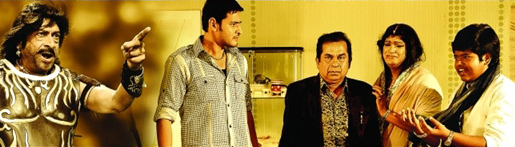
Ajay does a deal with Brahmi who’s taken over their house and in the process convinces him that he’s taking part in a reality TV show which forms a large part of the comedy in the film. Ajay pretends to be a politician and keeps his life as a policeman secret from his father, while all the time plotting revenge on his fathers attackers. It’s no wonder Ajay is always on a short fuse – he must be exhausted from all the pretending. And the killing.

Ajay finds out through another investigation that mafia boss Nayak (Sonu Sood) was involved in the assault on Shankar. It looks at first as if Sonu is about to reprise his role in Ek Niranjan as the stylish and psychotic villain, but sadly his wardrobe fails to deliver. Despite the nice cravats and the random and occasional application of grey to his hair and moustache, Nayak is a subdued and fully clothed villain who just loves his little brother a bit too much.  We enjoyed the Sheila ki Jawani dance break and we think Sonu did too, but it was shortlived. Most of the posturing is left to his faithful sidekicks played by Ajay and Subbaraju. That’s fine with us since they’re both Cinema Chaat favourites and we did enjoy watching the satin shirted Subbaraju try to mime to his boss that Mahesh was really an undercover policeman. Oh for a pen when you need one…

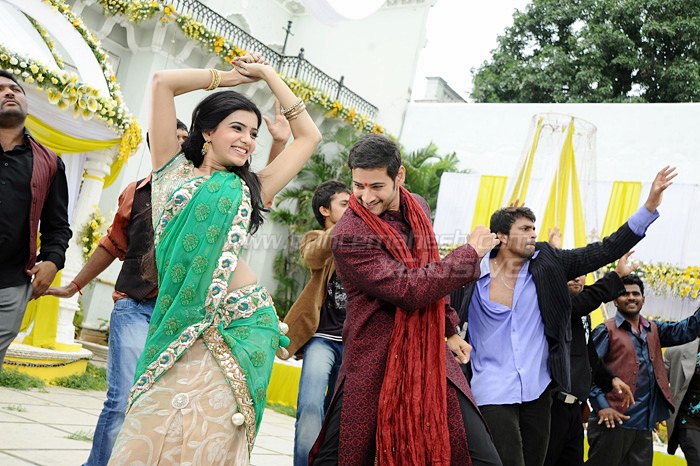
Along the way, Ajay takes his gang of trusty colleagues to Turkey, apparently just so he can say ‘Operation Istanbul’ as there is no other discernible reason for the location. He meets Prashanthi (Samantha), a fashion designer and, unknown to him, daughter of his clownish boss (Nasser). While Ajay and Prashanthi have the usual confusions before falling in love there is no substance to Samantha’s role and she’s soon side lined. There is little chemistry between Samantha and Mahesh, maybe because they spend hardly any time together on screen. Samantha looks beautiful, and wears whatever the costume department have dreamed up. That seems to be her sole purpose in the film as she doesn’t actually do anything.

There was more comedy with M S Narayana and one very funny skit where he took off a number of films including Magadheera and Robot. A little comedy can go a long way, but here it was integrated into the main story and with Mahesh adding to the comedy dialogue there were parts that were very funny, even to us non-Telugu speakers. The rest of the audience were roaring with laughter throughout the speeches. Master Bharath put in an appearance too. Was he necessary? Probably not. And yes there were some unfortunate stereotypes masquerading as comedy, but for the most it was entertaining.

The supporting cast was very strong, if largely underutilised. Shafi, Tanikella Bharani and Sudha had little to do, and Satya Krishnan was given maybe one line of dialogue. It’s a big budget film when you can hire some of the best and then not do anything with them!

The action sequences are excellent, and it’s hard to go wrong with a good impaling. Sreenu Vaitla has come up with several ways of illustrating the ‘eye for an eye’ concept, all of them extremely gory. The camera work and special effects were great and added impact on top of the already impressive stunts. We enjoyed the flashes of lightning when Ajay was beating Nayak to a pulp, and the changes of tempo in the film speed that underpinned the dramatic tension.

The song picturisations were less successful, and the songs by S.S Thaman are not so memorable on their own. Mahesh can dance reasonably well so it was disappointing not to see more use being made of his skills, and we wondered who decided it was a good idea to give him Abhishek Bachchan’s choreography. Chulbuli Chulbuli was spectacular with plenty of feathers and some enthusiastic backing dancers, although clearly ‘inspired’ by Kilimanjaro. The nightclub song lacked a good item girl but made very good use of the male backing dancers, grinning madly in satin pants and ruffles,  and had a giant guitar shaped light-up floor so that was pleasing. We must also congratulate the set designer for the impressive selection of chandeliers and lamps, especially the chandelier in the hospital ward.

Dookudu has a charismatic hero in a strong if silly storyline, and it is a technically excellent film in the mass entertainment style. It might not be the greatest film ever made, but it was  really fun to watch, especially with the awesome Melbourne audience.