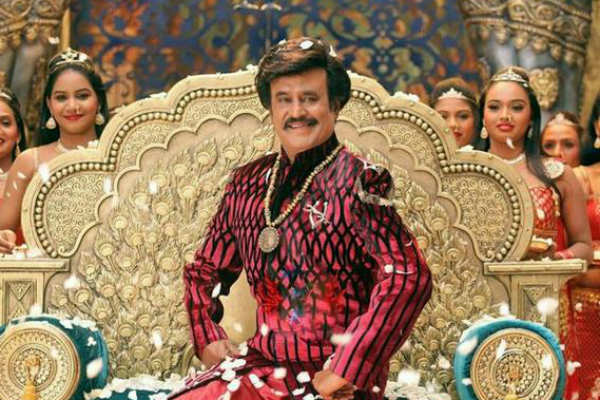
For The Love of a Man

Film poster

For The Love of a Man is a documentary primarily about Rajinikanth’s fans, directed by Rinku Kalsy, produced by Joyojeet Pal and partly funded through crowd-funding. It’s a fascinating glimpse into the obsessive world of the fans, and the extremes to which they go to show their devotion. Here we see the packed out fan shows at 1am in the morning on the day of a new Rajinikanth film release, 12 day long celebrations for the actor’s birthday and word-perfect recall of the dialogue from his films just as a taste of some of the extreme fandom on display. There are apparently 150,000 Rajinikanth fan clubs in India and the film looks at a couple of the clubs and a few of the fans in detail while trying to explain the phenomena that is Rajinikanth.

It is assumed that everyone has at least some idea of who Rajinikanth is, and while that is likely true for Cinemachaat readers, for most Westerners Rajinikanth is unlikely to be a household name. There is some discussion of the Superstar but it is minimal and I would have liked to see a little more of the background rather than just the bare tale of a bus conductor turned actor, turned Superstar. While there are a few excerpts from the Rajini’s films, these tend to occur when a particular movie is mentioned by one of the fans rather than in any chronological order and his rise to stardom is only briefly discussed. The other missing element is any input from the man himself which is understandable, but could possibly have given more context into the reasons why the fans behave the way they do.

Giant cut out

Rinku Kalsy has picked an interesting group of people who all have in common their total passion about the Superstar or as they all call Rajini – Thalaivar. There is G. Mani, an ex-gangster who changed his ways after watching Rajinikanth and is now a peanut seller, N. Ravi and his brother N. Murugan who run sweet shops in a small Tamil Nadu town and started life as uneducated orphans but followed the principles espoused by Rajini in his films to turn their lives around, and Kamal Anand, a mimicry artist who earns a living by impersonating the superstar for various functions and gatherings. There is also an auto driver who keeps pictures of Rajini in the front of his auto where most other drivers have pictures of the gods and an online fan club called Superstar Rajinikanth or SSRK for short.

Here there is fanatical devotion at its most extreme but although the film shows the lengths these people will go to for their Thalaivar, there is little insight into why Rajinikanth fans are so obsessed with their idol. There are a few academics who talk about the Dravidian movement and secularism as ways to explain the deification of movie stars such as Rajinikanth, but these discussions are rather superficial and don’t delve into ‘why Rajinikanth?’ in any detail. There is no discussion of his acting skills or even of his many philanthropic acts that the fans are so keen to emulate. Rinku Kalsy and her experts refer to his scruffy appearance, darker skin colour and roles as a common man that were so different to those undertaken by previous movie stars such as MGR or Gemini Ganesan. The fans however refer to Rajinikanth as simply a good man and try to follow his altruistic principles as much as they can; often despite their own, frequently quite poor circumstances. The feelings here are deep and emotions run high. Even when simply recounting the period of time when Rajinikanth was ill and admitted into a hospital in Singapore, N. Ravi can hardly contain his tears as he speaks of his distress. He even sent his brother to Singapore to report back directly and describes this period as the worst time of his life.
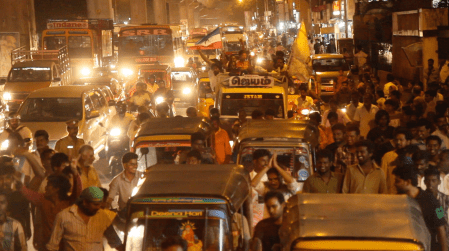
Film celebrations

Interestingly all the fans shown are men. There are a few women seen in the cinema watching Rajinikanth films, but for the most part the groups organising events for Rajinikanth film openings are exclusively male. G Mani’s long suffering wife Suganthi seems to take his fandom in her stride, including the revelation that he has pawned her jewellery to obtain money for another celebration and she doesn’t even seem to mind that he spends all of his income on his fan club rather than on their family. However the best line comes from the mimic artist who explains that despite making his living impersonating Rajinikanth, he himself is actually a Kamal Hassan fan!

It’s not all good works and birthday celebrations though. There is violence too, with a fans’ show resulting in broken windows at a cinema and G Mani’s mention of a long drawn out court case after a screen was destroyed at one of his fans-only screenings. It’s hard to understand even though I’ve seen the first night first show mania at first hand here in Melbourne, but the extreme reaction in Tamil Nadu suggests more than simple fandom. This is serious fanaticism with the followers believing that their hero can do no wrong and in many cases literally worshiping Rajini. One of the frequently expressed desires from many of the fans is that Rajinikanth should enter politics, not so unexpected given that many politicians in Tamil Nadu were movie stars but there is an absolute belief that he would bring better times for all in such a role.

For The Love of a Man is fascinating, at times disturbing and occasionally uplifting but does illustrate the intensity of fans in India. Like the banners and Rajinikanth cut-outs, the hero-worship is larger than life and really needs to be seen to be believed. The film was screened in Melbourne as part of the Indian Film festival and has been shown at a number of other festivals around the world but hopefully will get a wider release – well worth catching it if you can.


Kabali

Kabali

Pa Ranjith’s Kabali is a film that could have been made in 1986 and that is not entirely a bad thing. Rajinikanth stars as Kabali, a gangster released after 20 odd years in jail. His wife and unborn child are dead, killed by rival gangs. What will he do? It’s a lumbering gangster vs gangster story on a large scale, but with a very traditional approach to conflict resolution. A less extravagant looking film than Rajini’s recent outings, it makes up in international locations what it lacks in CGI pyramids.

Rajini is such a good actor I was pleased to see him in a more pared down movie. When Kabali was speaking to foes or minions he laid on the mass mannerisms with a trowel. But when he was with friends he was more nuanced, even funny, and I could kind of see why people loved and followed him. I liked the slightly anachronistic feel, as though time took a while to get going for Kabali again so he was still acting like it was the 80s. Kabali always wore a suit, and that is explained in more detail than almost anything else in the story. I did like the outfit with the scoop necked double breasted waistcoat and hat. Sidenote – I am pretty sure I saw a guy wearing one of Kabali’s pre-transformation 1970s shirts in a 2016 scene.

Now free, Kabali has flashbacks to seeing his wife. He would see Kumudhavalli (Radhika Apte) around the house and familiar places, chiding him then breaking into a loving smile. The way he drifted back to his past or lost track of where he was during these visions made his love and the depth of loss evident. Although his future and present never quite seemed as clear or in focus.

Radhika Apte had the small but important role as Kumudhavalli. Their relationship was established back in the day when Kabali was getting started as a community leader, and she left everything to marry him regardless of their class or caste differences. Unfortunately Pa Ranjith has little idea of how to structure a narrative taking place in multiple time periods and does a lot of telling before showing a flashback, then more telling again. Their scenes together are really nice and Radhika gives her character enough spirit to make an impression even in a limited time. She is 30 playing as a contemporary of a 65 year old, but the make-up team did what they could to remove those differences and Rajini’s wig guys got to trot out some old favourites.

I liked Dhansika as Yogi, although her character went off the boil once she had established her true identity. I couldn’t quite believe an ice cold mercenary could so quickly forget how to deal with a stranger at the door, and her kill rate dropped alarmingly. But Dhansika played her with more edge than I’m used to seeing, and I liked her performance. I also liked the guy assigned to look after them in Chennai who believed there was never not enough time to flirt a bit with the hot gun toting chick.

Kabali is a leader of a gang that only did good deeds (for Tamil people only, of course), but still killed his enemies without hesitation. He was a hero to Tamilians living in Malaysia and committed to helping them stay and thrive, but his views on other races in Malaysia went way past pro-Tamil jingoism and into bigotry on a number of occasions. And how was he going to actually make any money to keep things going? He had rules about not getting into drugs or hookers, but no clear business plan.

Kabali-Winston Chao

Rival (and Evil) Gang 43 had a business plan (import ALL the drugs), and a leader who may have been auditioning to be a Bond villain. Tony Lee (Winston Chao) had an inexhaustible supply of brocade jackets and contrasting bowties (I liked the high buttoned big lapelled peacock blue ensemble best, or maybe the pink), a robust vocabulary of curse words in multiple languages, and a desk shaped like a komodo dragon. Winston Chao looks like he is having a ball and really goes for it in the big moments, while generally being cool and psychotic. He and Rajini play off each other well and despite Tony being utterly despicable I looked forward to his scenes.

Santhosh Narayan’s soundtrack is firmly of the present day, and it suits the fast and crunchingly aggressive world of the story. Also I liked the blending of hip hop and more usual blokey Tamil hero dance styles. Rajini stuck to enigmatic walking and meaningful pointing.

Pa. Ranjith didn’t quite solve the problem of how to reveal the various twists so he had a crack at everything multiple times. Rajini did most of his acting sitting down, which made this quite a talky gangster flick. And these two things combined to make this a bit slow, and not as suspenseful as it should have been. There is a distinct lack of logic that means people and things are there or not there just because. I gave up wondering if the school actually did anything education related! All any student seemed to learn was The Free Life Salute which I don’t believe would be very useful. The fight scenes felt quite slow and sometimes repetitive. A better fight director or sharper editing might have made the difference, and at least given more variety of ways to splash the fake blood around.

The supporting cast is almost a who’s who. Nasser, John Vijay, Kalaiyarasan and hyperactive Dinesh Ravi are among the ranks of the notional “goodies”. The baddies boast Kishore, Mime Gopi (yes he was a mime) and a host of others. But remember this is a Tamil gangster movie so don’t go getting attached to anyone. That’s all I’m saying.

The subtitle team did a great job (thanks rekhs and harini!). Maybe because there wasn’t much challenge in the dialogues, there were also some descriptive captions of all the many types of laughter Kabali had at his disposal. Some of my favourites were: “Smug chuckle”, “Sarcastic laughter” and “Tickled pink laughter”. Yours?

If the film was a little shorter, and some of the show and tell had been show OR tell, Kabali could have been very good indeed. See it if you miss the mid 80s gangster genre, or you enjoy watching a larger than life on screen superstar. When it’s good it’s good, and when it isn’t you still have Rajini and Winston Chao…and those natty outfits. Magizhchi!

Lingaa

Lingaa

Finally it’s here! Friday was not only the Superstar’s birthday but marked the release of his latest film with director K.S. Ravikumar. There has been plenty of hype and expectation for this film, so did the team who gave us the hits Padayappa and Muthu deliver another blockbuster? Well….. mostly. This is a Rajinikanth film so we all know what to expect, and it goes without saying that the outfits will be stupendous, the songs lavish and attention firmly focused on the star in every scene.There is nothing much new about the story, but that’s not really the point, since it’s the entire spectacle and the heroism that’s important and there is plenty of that to be getting on with. Lingaa delivers most of the Rajni ‘formula’ characteristics we’ve come to expect, and with good performances from Anushka Shetty and Sonakshi Sinha there is plenty to enjoy in full masala style.

Lingaa

The film starts with the exploits of Lingaa (Rajinikanth), a thief and con-artist who, along with his merry band of Santhanam and Karunakaran, attempts a major heist at a jewelry exhibition. His outfits are classy and his concept equally sophisticated but Lingaa is foiled in his attempt to sell the jewels on by journalist Lakshmi (Anushka Shetty). Lakshmi is in search of the grandson of Raja Lingeswaran, the only one who can re-open a temple in her village and who just happens to be our jewel thief Lingaa.  Using tricks and flattery, Laksmi manages to get Lingaa to go to the village but not before she indulges in a full blown fantasy song with Rajnikanth as the pirate king come to recue her and her backing dancers, who perpetrate crimes on the high seas against the ruffle shirt amongst other fashion crimes.

Once in the village, Lingaa is taken aback by the respect shown to his grandfather, but since he himself feels no obligation to the man who lost all the family money, he is content to use the situation purely for gain. However in the course of events, Lingaa learns the full story of Raja Lingeswaran and exactly how he lost his money but won the respect of the people for his life-saving dam. We see all this in flashback mode with Rajinikanth also playing the role of his grandfather, in a beautifully drawn flashback to the 1930’s with period furniture and apparently CGI elephants. No mention though if all the horses, mules and buffalos were CGI too. Back in the thirties Rajni’s love interest this time is village girl Bharathi (Sonakshi Sinha) who has just as epic an imagination as Lakshmi, although she favours a more regal theme in her fantasy.

The thirties track starts with a superb fight scene on a train that features Dev Gill as a freedom fighter and touches on the Independence movement, the corruption and cruelty of the British Collectors, and the blind neglect of the Governors, the inequities of the caste system and the struggles of rural India as the farmers battle drought and flood. It’s a bit of a mish mash of ideas, but through it all Rajnikanth walks tall in some wonderfully spiffy costumes and what must surely be the best collection of sunglasses onscreen ever.

The film looks amazing with obviously no effort spared on the sets and outstanding costuming for Rajinikanth.  There aren’t all that many fight scenes, but they are all well choreographed and fit into the main narrative. The train fight scene is undoubtably the best with Rajni stylishly eliminating a train full of bandits with effortless ease, including a one on one with Rahul Dev on top of the train. The action scenes set in and around the building of the dam are also well filmed and the effects well integrated to give the impression of a truly massive construction.  The songs by A.R. Rahman are a little less successful, but since the dance numbers are mainly dream sequences, the total switch from the story is a little less disruptive. The songs which move the story forward such as the stirring Indiane Vaa more successful and the background music, also by A.R Rahman, is suitably evocative for each era. I do like the songs and actually like them more after seeing the visual to match, even with those ridiculous costumes in Mona Gasoline!

Sonakshi Sinha and Anushka Shetty don’t have a huge amount to do other than as the romance interest for the two Lingeswaran’s, but K.S. Ravikumar does give both of them a few important scenes in their relevant story lines. Santhanam and Karunakaran are also kept mainly in the background and when Brahmi makes a brief appearance early in the film it’s over almost before you realise it’s Brahmi. Still this means the focus is firmly on Rajinikanth and he makes the best use of every moment on screen with one liners, epic speeches and that twinkling smile.

Perhaps the only problem I have with Lingaa is the relative ineffectiveness of the villains, although I did appreciate the very normality of their respected self-interest. In the present day Jagapathi Babu does the honours while in the flash-back the actor playing the British collector is suitably sneery but a little too much of a caricature for me to completely believe in the character. The finale also seems a little rushed, especially since the computer graphics don’t work quite so well here as in the rest of the film. However it’s still Rajni doing several impossible things at once while saving the day and the girl (yet again) so for me it’s fine to accept the glaring unfeasibility of it all and just enjoy the spectacle.

I really enjoyed Lingaa, and loved watching Rajinikanth in the two separate incarnations of Lingeswaran. The comedy and action in the first half is interspersed with the insanely OTT songs while the second half is more sedate in keeping with the thirties backdrop. I am a big Rajinikanth fan which undoubtably colours my opinion, but this was fun and entertaining. Definitely well worth watching for the Superstar and those wonderful sunglasses!

Just as an aside, Lingaa was showing at The Astor here in Melbourne and when I left the cinema I was confronted by a sea of Jake and Elwood Blues lookalikes who were there for the 7pm showing of The Blues Brothers. From one iconic sunglass wearing movie superstar to an iconic  movie – it made my day!