
100 Days of Love

Poster

Has Dulquer Salmaan ever made a bad film? Judging by what I’ve seen so far it seems not! I’ve been steadily working my way through his back catalogue and I’ve yet to find one of his movies that I haven’t enjoyed. Jenuse Mohamed’s 2015 release 100 Days of Love is another to add to the list. Although the film does have a few flaws, the trio of Dulquer Salmaan, Sekhar Menon and Nithya Menen add plenty of charisma and appealing characterisations to an otherwise rather routine romance.  There is also a dash of mystery in the first half and a generous helping of comedy to ensure that 100 Days of Love is more interesting than it first appears and definitely worth a watch.

Dulquer is Balan K. Nair, an aspiring journalist and cartoonist who lives in Bangalore with his best friend Ummer (Sekhar Menon). On possibly the worst day of his life, Balan drunkenly posts a message on his ex-girlfriend’s Facebook page which results in a barrage of abuse and the loss of many of his friends. At the same time he loses his newspaper job to his nemesis Romanch Ramakrishnan (Aju Varghese) and to top it all off there is a torrential downpour just as he is on his way home from clearing out his desk. But this is where fate takes a hand. Just when Balan is at his lowest point, he meets Sheela (Nithya Menen) when the two try to hail the same taxi. While Balan lets Sheela take the taxi, she leaves behind a camera which starts Balan on his mission to find the girl with the beautiful smile.

Balan’s best friend Ummer stands by him, although this could simply be because Ummer is a classic computer nerd who doesn’t get out much. He runs a computer game store of sorts, and his life revolves around playing computer games, talking about computer games and dreaming about developing computer games. Jenuse Mohamed uses this obsession as an ongoing theme while Balan and Ummer try to track down the mystery girl from the cab. All they have to solve the puzzle are a few photographs they were able to develop from the camera and an incomprehensible game plan Ummer draws up on their wall.

Surprisingly they do manage to find the locations of the photographs and even track down the guy in one of the photos, although none of these successes bring Balan any closer to finding Sheela. Rather the opposite since Rahul (Rahul Madhav), the guy they identify, turns out to be Sheela’s fiancé who dramatically warns Balan away from any further contact. Naturally this has no noticeable effect on Balan other than his declaration that he will become Balan K Nair in truth and be the ‘villain’ of the story.

Where the film starts to falter is in the second half, when the focus moves away from Balan and Ummer to the love story between Balan and Sheela. Oddly for a film all about love, there is a distinct lack of passion in their developing relationship and despite a good rapport between Nithya and Dulquer  the romance never feels completely genuine. Although Balan is the very soul of romance, singing along to classic songs and quoting from films such as Casablanca, he takes a restrained approach to his courtship of Sheela. Further subduing any possible seduction is Sheela’s prosaic approach to life and her stated preference for the right credentials in any future life partner. Love to Sheela means arguments and misunderstandings, while for stability and contentment she wants the ideal husband. She defines her perfect match as someone from a good family, rich, has a good job and is handsome too. This is despite the example of her parents who had a romantic love match and whose story she relates to Balan without seeing any of the irony of her own stance. The suggestion is that this is ‘modern thinking’ cemented by the ubiquitousness of Facebook and social media throughout the film, but it doesn’t seem to fit the rest of Sheela’s characterisation or her general approach to life.

Adding to the mixed messages of the second half, Jenuse Mohamed introduces a second Dulquer as his own irritating elder brother and adds in some family problems with his parents. Rocky is as sexist and repulsively cocky as his name suggests and the inclusion of Balan’s family issues adds absolutely nothing to the story. Thankfully though Rocky’s appearances are brief and both Balan and Ummer have enough screen time to keep the story moving along.

Balan’s character is the redeeming feature throughout the second half and  Dulquer is effortlessly charming as he tries to win over Sheela. Balan has all the romance that is lacking elsewhere in the film and this song perfectly illustrates both his love for classic romance and his sentimental character.

Sekhar Menon makes a great sidekick and the partnership between him and Dulquer is easily the best part of the film. I don’t remember seeing him before in any Malayalam films, but I’ll definitely look out for him in future as he does such  good job with his characterisation here.  Nithya Menen on the other hand doesn’t sparkle as much here as I’ve seen her do in other films, but she does have a great smile and has plenty of opportunity to use it. Her character often seems emotionally immature, mainly due to the dialogue rather than her body language, but Nithya has good chemistry with both Dulquer and Sekhar making Sheela more personable than her role would suggest. The support cast are all good in their roles, although for the most part their appearances are brief. Rahul Madhav has little to do other than appear arrogant, and he does that well, but for me this was a missed opportunity to make the ‘other guy’ something other than a complete jerk.

Jennies Mohamed has tried to add in a few different ideas to rejuvenate a standard storyline but not all of them work. The search for Sheela is good and the inclusion of Balan’s day to day life helps make his character more appealing, but the rest of the characters don’t have the same attention to detail and as a result are less successful. There is still plenty to enjoy though. 100 Days of Love isn’t a perfect film, but the good first half and excellent performances from the cast make it well worth a watch. 3 stars
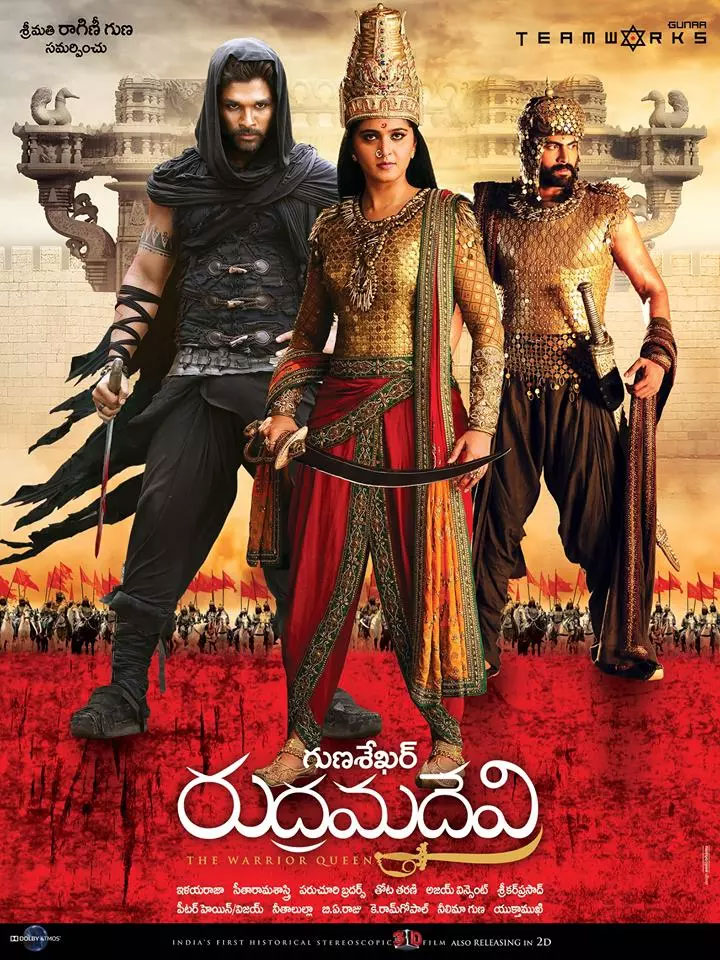
Rudhramadevi (2015)

Rudramadevi-Posters-2

If Rudhramadevi had been made in 1956 I’d have loved it, no question. But Gunasekhar struggles to realise his grand vision and the ripping story drags at times. The main cast give their all, but they can’t compensate for some poor directorial decisions and sloppy execution.

The first thing that hit me was the VFX. I thought it was maybe a deliberate stylistic choice as there are animated montages that look like a childs picture book. But it is just shonky quality, used too liberally, and with poor judgement. At least it distracted me from wondering what Marco Polo’s stuck on beard was made of. And why Marco Polo was in the film.

The story is so interesting this should have almost written itself. A girl is raised as a boy and keeps up the pretence to protect her kingdom for as long as she can. But Gunasekhar spends far too much time with the various enemies and uses loads of clunky “As you know Bob” exposition. I felt that there were some holes in the film and Gunasekhar was trying to paper over those gaps with other techniques including a Mega voiceover and a peasant who announced every new character with bio as well as voicing the people’s dissatisfaction with their rulers.

Anushka owns every frame she is in. She adjusts her posture and facial muscles so there is a clear distinction between Rudradeva and Rudhramadevi and is convincingly commanding. She has some weird darkening makeup on as a boy, but it does allow her to look stunningly radiant when she girls up.

Her closest female friends are Nithya Menen as her wife Muktamba and Catherine Tresa as The Other One Who doesn’t Wear Much, and there is a lightness and ease in the way Anushka moves as she drops the pretence and heavy armour undershirt to dance in the “Yay! I’m a girl” numbers. She did her damnedest in the tandav but while her expressions told a powerful story, her dancing was not as compelling. Rudhramadevi used Veerabhadra’s feelings for her to get him back on task, but she evinced far more concern about Muktamba’s reaction and wellbeing. That ruthlessness and emotional intelligence wasn’t really explored and I felt the film needed to reveal how she ruled, not just show a sequence of events.


I put that clip in just for some shirtless Rana. He looks so chuffed when he is prancing almost in time.

Rudramadevi-Rana Anushka

I knew a “Zorro” moment was nigh when Rudradeva wore a blue tunic done up with pink princess ribbons, and the gender reveal is a bit ho-hum. Veerabhadra took the whole “Dude, you’re not a dude” revelation quite well, all things considered. There is little sexual chemistry between Rudhramadevi and Veerabhadra, but the actors have a nice rapport, like childhood friends. I enjoyed moments like when Rana playfully tweaked Anushka’s nose as he said goodbye. While the writing skimmed the surface of characters emotional lives, the actors added their own flavour.

Gona Ganna Reddy (Bunny) and his horse seem to have ridden in from a different film; something more gothic perhaps or even a KPop music video (Jaejoong’s stylist may be moonlighting as a Telugu horse costume designer).  Bunny plays his character as unrelentingly dour and with one facial expression, but his one liners got the audience cheering. And he rarely blinks. It’s intense and unsettling after a while.

Rudrama Devi Posters

The support cast is huge. Hari Hara Devudu (Suman) and Murari Devudu (Aditya) are the Statler and Waldorf of villains. They sit back and critique everyone else but rarely do anything themselves, unless you count letting their allies die horrible deaths. Their brother Naga Devudu (Baba Sehgal) shows commendable willingness to really go for the snake theme. Nithya Menen is underutilized as Muktamba. I enjoyed her scenes with Anushka and thought her decision to respect the sacrifice and say nothing was interesting. This contrasted with the shouty peasants who just flat out refused to accept a woman, despite a rousing Prakash Raj girl power speech. Prakash Raj is in good form as Shiva Devaiah, the mastermind of the scheme that sees Rudhramadevi raised as the boy Rudradeva. Villain Mahadeva (Vikramjeet Virk) spends most of the film prancing atop a phallic tower made of polystyrene. Amusing, but you know a great hero or heroine deserves a genuinely scary bad guy and he is not the real deal no matter how many people he kills out of spite. Hamsa Nandini is slinky and duplicitous, the Bond girl of courtly spies.

Gunasekhar’s massed set pieces lack richness. If you arrange a formation of extras with one or two carefully out of position people for randomness, but then use that same formation scores of times over it ends up looking ridiculous with the pattern repetition of those supposedly random bodies. A critical battle scene started with a cool idea – one army emerging in a serpent formation as their opponents attacked in an eagle formation. But it went on forever and looked far too fake. I was reminded of the similar but excellent lotus and arrow scene in Magadheera.

One of the few actors I could imagine would happily rappel down a structure (possibly without even checking there was a rope), Bunny was plagued with dodgy wire work. Anushka was also caught so that her feet didn’t quite hit the ground or was frozen in awkward and unconvincing poses in midair. Maybe it was supposed to look good in 3D but I can’t imagine it would. And too many fight scenes and chases were sped up to slapstick comedy pace.

There is abundant weird CGI, possibly a workaround for the 3D version, although I should have remembered the effects in Okkadu. For example, when a drawbridge is being lowered they faked the cogs and ropes too which you’d think would be doable and cheaper for real. The climax scene as Rudhramadevi and elephant bring doom upon her enemies should be thrilling but it is just opportunity to crank up the bad CGI. The use of CGI elephants seemed unnecessarily frequent especially when in many scenes there was no obvious risk of physical harm to an animal – why not use a real one? And there seemed to be a bit of tusk whitening done in post production that was distractingly odd.

A big shoutout to the helmet and armour department. No design was too silly or impractical for them to try. I really wish I could find a picture of Bunny’s Glomesh helmet from the final battle, but you will just have to make do with Rana’s special dressing up armour.

Despite the negatives I really appreciate seeing Anushka as the lead with so much screen time in an awesome story. Bunny and Rana bring more interest to their characters than the screenplay demands. I would have liked to see more relationship development generally, and especially between the ladies given the story is of a woman pretending to be a man. I really wish the film had been better executed as I can see what it might have been, and the gap between what was delivered and that potential is frustrating.


O Kadhal Kanmani

O Kadhal Kanmani

Mani Ratnam’s latest film is a modern take on romance that works primarily due to the charisma and energy of the two main leads. Dulquer Salmaan and Nithya Menen breathe life into their respective roles as an ambitious game developer and an aspiring architect in Mumbai, and are helped along with excellent support from Prakash Raj and Leela Sampson. The romance is light and breezy for much of the first half, but the film falters a little in the second when events seem a little too contrived. However the relationship is sweet and beautifully developed, the characters are engaging and the ‘feel good’ factor is high making OK Kanmani simply a very watchable romance that lets you leave the theatre with a smile.

The film is set in Mumbai and Aadi (Dulquer Salmaan) immediately wins support for developing a new game set in Mumbai and made specifically with the denizens of that city in mind. I do like a good idea for the opening titles and OK Kanmani has an excellent start with the credits shown over an animation based on Aadi’s game.  Aadi’s initial enthusiasm is a bit of a worry, but he soon settles down to show his zest for life balanced with genuine care and compassion when he moves in as a lodger with Ganapathy (Prakash Raj) and his wife Bhavani (Leela Samson). Initially Ganapathy allows Aadi to move in under sufferance and presents him with a confronting list of rules and conditions. However Ganapathy’s gruff exterior hides a softer heart and it’s not long before Aadi comes to respect Ganapathy and appreciate the love and tenderness he shows for his ailing wife. The relationship between Ganapathy and Bhavani is the central core of the film and becomes the yardstick against which Aadi and Tara (Nithya Menen), and ultimately the audience, measure the strength of their own relationship.

Tara is working as an architect in Mumbai but has plans to attend university in Paris to further her training. Refreshingly she has no desire to get married, although she bases this on the failure of her parent’s marriage rather than anything more radical. However she has dreams and desires that are personal goals to achieve and she doesn’t base her worth on her marriage prospects. Aadi too has no desire to get married but does want a relationship with Tara, at least until she moves to Paris and he realises his dream of moving to the USA. Again, in contrast to most SI love stories, there is no stalking required here. Tara likes what she sees of Aadi and is happy to have a relationship with him until she leaves – no strings attached, just two people enjoying each other’s company.

Mani Ratnam is careful to show that the relationship not a one-sided affair, and that Aadi and Tara have an equal attraction to each another. Both characters have reasons to act as they do, and the equal development of both the hero and the heroine is a welcome departure from many recent films with their expendable and interchangeable heroines. In addition, both Tara and Aadi have a fairly casual attitude to their romance and it’s fantastic to have a female character that isn’t afraid of declaring her desires just as loudly as her male counterpart, and act on them too. Aside from giving both characters equal voices in the romance, Mani Ratnam also perfectly captures the delight and excitement of the early stages of their affair; helped along by the excellent on-screen chemistry shared by the two actors.

Aadi and Tara are independent and both are living away from their families, which gives them the freedom and opportunity to live as they please. They decide to move in together, and given the shortage of housing in Mumbai and the fact that Tara lives in a women’s hostel that means that they have to beard the lion in his den and face Ganapathy. However Ganapathy’s initial objections are overcome by the delight he sees on Bhanvani’s face when Tara sings with her, and as easily as that he agrees to the arrangement.  Naturally Aadi’s brother and Tara’s mother are appalled when they learn of the relationship and find out that the couple are living together. The couple also have to deal with the looming separation as Aadi gets his chance to move to the States and Tara’s date to start University is finalised. Weaving through their struggles is the example set by Bhavani and Ganapathy – proof that perhaps love can be enough.

Both Nithya Menen and Dulquer Salmaan are excellent and fit easily into their roles. Dulquer is a good fit for an enthusiastic but respectful young professional and there is no hint of the obsessive man-child more often seen in Indian romances. Nithya is perfect as the fiercely independent and strong-willed architect and provides a good partner for her co-star without straying into overly glamorous heroine territory. However Prakash Raj is the absolute star performer here and he easily steals the show every time he is on-screen. His facial expressions convey more than the dialogue and he has an easy rapport with Nithya and Dulquer while maintaining a perfect relationship with his onscreen wife. Leela Sampson is also superb and completely nails the quiet confusion required from her character while still maintaining her dignity. The scenes between Ganapathy and Bhavani are some of the most moving I’ve seen in recent times and are a good counterpart to the happiness and excitement of Tara and Aadi’s relationship. This second romance is what lifts the film above most love stories and compensates immensely for the somewhat disappointing end to the film. At least for me.

Spoiler alert – stop now if you don’t want to know how the romance ends and skip down to after the next images.


What is disappointing is that the film suggests that Aadi and Tara can only be faithful to each other and maintain their long distance relationship if they are married. I find the assumption that they would drift apart without that commitment a slap in the face for all the wonderful development of their romance that has gone before. I cannot see how marriage is the answer to their problem when they could have done exactly the same thing without getting married and probably had the same outcome – especially when the rest of the film does so well at banishing stereotypes and conventional attitudes. It’s a small point, but one that I found annoying given that it seemed so unnecessary – I have more faith and belief in the characters than it appears their creator does, although I did wonder if this was perhaps just a way to get past the censors given the live-in relationship portrayed – food for thought!

End of spoiler!

Aside from my minor quibble about the end of the story, OK Kanmani is a beautiful romance that perfectly develops a balanced relationship and deals with many of the trials and tribulations of modern life for a young couple. The characters are believable, the situations generally realistic and the performances exemplary from the entire cast. Add in the upbeat and catchy soundtrack from A.R. Rahman and O Kadhal Kanmani is definitely a film I recommend and one I will watch again and again.  Just wonderful!