Lion (2016)

lion-movie-posterIn an “only in the movies” story, little Saroo is separated from his big brother at a railway station near Khandwa, Madhya Pradesh. He accidentally takes a train that lands him in Kolkata, hundreds of kilometres from home. Living on the streets he evades some very unpleasant people and situations before being taken in to an orphanage. He is adopted through an organisation called ISSA and placed with a middle class Anglo family in Hobart, Tasmania. When Saroo moves to Melbourne for uni he starts to admit to himself that he really wants to know who he is. He can’t forget his family, especially his mum and older brother Guddu, and knows they must have been looking for him all these years. His friends suggest using Google Earth to try and find landmarks he remembered. It’s a struggle as Saroo deals with his feelings of betraying his adoptive parents, his complex relationship with adopted brother Mantosh, his whiny girlfriend Lucy (Rooney Mara), and the sheer time and energy to do the work. But he never completely gives up, and he does find his way.


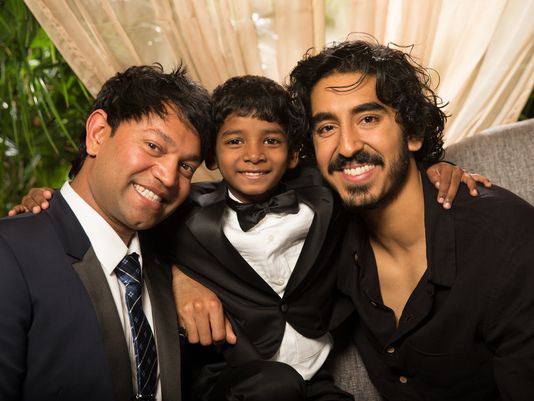
Lion is based on Saroo Brierley’s autobiography, The Long Road Home. I was fortunate enough to attend a preview introduced by Saroo and his mum Sue. They had input into the screenplay adaptation, and both said they were pleased with the results. Garth Davis uses landscape beautifully to reflect Saroo’s journey and to ground his memories. The scenery in Tasmania is pristine and lovingly shot, with a sense of order and calm. In contrast, Kolkata swirls with movement and energy as little Saroo (Sunny Pawar) darts through crowds and runs his heart out in search of home. The film is as manipulative as can be, but it’s the kind of emotional push and pull that made me want to buy into it. He’s a good kid, and you want him to be happy.

Sunny Pawar is that rarest of creatures – an Indian child actor I don’t want to slap. Apart from being ridiculously cute he conveys emotions with clarity and a sense of genuine feeling. Saroo couldn’t speak to anyone much about what had happened as he was a little kid, only spoke Hindi, was illiterate, and had no idea how to find his home. He was selected by Mrs Sood (Deepti Naval) as a good candidate for overseas adoption and before long, he had a new home.

Twenty years later, Dev Patel is Saroo. He has great hair, and a good Aussie accent. I’ve not been completely convinced by some of his past work but I felt he really inhabited Saroo and was just brimming with energy and life. He had a typically Australian slightly inarticulate, good natured, blokey feel about his character but could also show great depth of emotions. Patel’s scenes with Divian Ladwa who plays grown up Mantosh were full of love and disappointment and rivalry, being mean in ways you know will hit hardest, always internally comparing this brother to long lost Guddu. He had a strong connection with Nicole Kidman and David Wenham as his parents, and a relaxed playful rapport with the ensemble of his friends. The latter section of the film drags a bit as Saroo wallows in his angst, but it does make the payoff all the more sweet.

Sue’s dedication to having an adopted family made me slightly uncomfortable in the film, but not when I heard her speak in person. Possibly it was the tight close-ups of Nicole Kidman and her fierce emoting that made it seem too much. You know when you inadvertently see a display of intense emotion that was not meant for you, you just want to look away and give that person back their privacy. David Wenham has long been a favourite actor of mine. I would probably watch him watching paint dry, and find it fascinating. He plays John as a typical dad with a big heart and a few bad jokes, trying to keep his family of diverse and strong personalities together and happy through their ups and downs.

The casting really is excellent and I think it shows their commitment to getting things right. The Indian cast features some excellent character actors including Nawazuddin Siddiqui, Tannishtha Chatterjee, and Deepti Naval in small but impactful roles, with Priyanka Bose as Saroo’s birth mum Kamla. Melbourne girl Pallavi Sharda and local soapie actor Sachin Joab play a couple of Saroo’s uni mates. Abhishek Bharate delivers a good performance as Guddu, with a cocky swagger and a warm smile that made him so unforgettable for his little brother. Rooney Mara is stitched up with a fairly insipid role as Saroo’s girlfriend. Her character Lucy just doesn’t have the same complexity and depth as the others and she comes across as more of a plot device than a person.

I think Lion is going to be interpreted quite differently depending on your perspective. Many Australian viewers would have no idea who Deepti Naval or Nawazzudin Siddiqui is, so there’s that. I may have been the only person in the theatre to whoop when Prabhu Deva appeared on the telly in the background of a scene! And I doubt the 1980s approach to intercultural adoption, which was heavy on assimilation, will sit well with everyone. I was adopted as were several of my friends, and we all had diverse experiences and have made our choices about finding birth parents, so this resonates strongly with me. Sue is clear that she wants Saroo to tell her all about himself and what happened before the adoption, so it isn’t a case of ignoring his personal history. It’s more that there seemed to be no acknowledgement of his existing language or culture, only his misfortune of being a lost boy. Because the film jumps from the start to the end of Saroo’s personal journey, there is a whole other story in the middle that we don’t see. Saroo mentioned he might be working on a prequel so perhaps there will be a companion piece to come. Whatever your views, Saroo seems to have turned out to be a very generous and grounded young man who both his families are proud of.

See Lion for a beautiful story of identity and home and family, for the unashamed tugging at your heartstrings, for the excellent performances. Take some tissues because at least one of the Saroos will probably make you cry!
lion-all-the-saroos

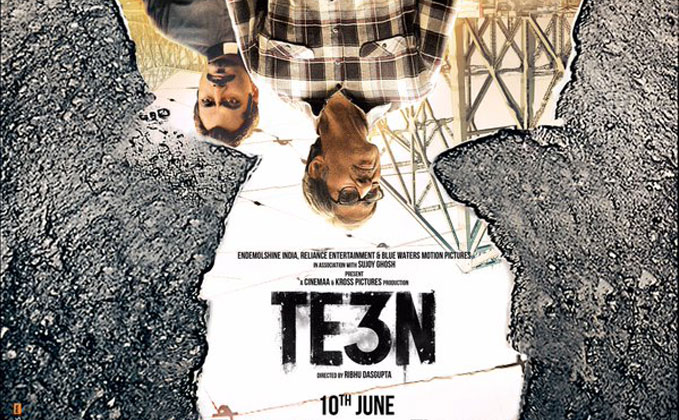
Te3n

te3n-poster

Ribhu Dasgupta’s Te3n is an official fully credited remake of South Korean thriller, Montage (2013, dir Jeong Geun Seop). I’ve seen the original so I was more interested in the how than the who or the what. Te3n is a solid remake of a decent film, so I still enjoyed it despite a couple of changes that I don’t think were at all necessary from a film or narrative perspective.

John Biswas (Amitabh) is an old man haunted by the death of his granddaughter Angela. She was killed in a botched kidnapping 8 years go, and the perpetrator was never caught. He spends his days haunting the police station and has nothing else in his life to sustain him. His wife Nancy (Padmavati Rao) is wheelchair bound and never leaves the house. John seems forgetful and vague, giving no energy to his present day and dwelling on the past. But when another child is kidnapped in exactly the same way, he believes he can catch the criminal and get justice (and revenge) for Angela. Sarita (Vidya Balan) has inherited the Biswas case file, and is leading the investigation into the latest crime. Sarita is smart but unimaginative when it comes to solving a complex problem. She will follow the leads and interpret the evidence in a logical and common sense way, not questioning whether she is being lead down the garden path. Martin Das (Nawazuddin Siddiqui) was the original investigator but he left the police force to become a Christian priest. He feels the guilt of his previous failure and the damage done to the Biswas family, and can’t keep away from the new case when Sarita starts her investigation. Although he used to do a fair job of evading John who only wanted to talk about the old crime. Martin’s zeal is less about John or Angela and more about his own personal guilt and need to atone.

It is almost a shot for shot remake of the original despite the new location, so I can’t really say much about Dasgupta’s directorial style. There were changes made in terms of which character did what. (In Montage, the mother of the first little girl is the one who purses the investigation and the police characters are a little different.) I feel that needed some more solid rewriting which didn’t quite happen. And because the film elevates Amitabh above all else, it ultimately buckles a little under the weight of a Star in what is otherwise a solid thriller.

Amitabh shows the best understanding of his character and the genre. I really liked his performance, and thought he built up the layers in John’s character well. There are scenes where he just becomes an old man, bewildered and a little out of step. As he steps up his own investigation, he sharpens up and seems to come into focus more. Because I knew that the original was slightly different, I was looking closely at the changed characters to see if the alterations were for the better. They really added nothing, except maybe funding, as I suppose it is still easier to get money for your movie if the Big B is your star than if Vidya is. But it also made me ask if women are overlooked in society the same way old people are. Maybe since they were both invisible to the people that mattered it actually did make sense.

I never fully understood why Martin had taken vows or why Sarita was a bit flirty with him, but I didn’t feel I needed to know all the details to appreciate the present circumstances. It felt like they split the original ex detective character a little between Martin and Sarita, and added some more emotional baggage for the sake of it. Both Vidya and Nawazuddin have garnered huge audience and critical support for their undeniable talents, but the material here lets them down a little. Their characters were sketchy despite their best efforts to add nuance and a sense of connection.

The story translated well to Kolkata. Pardon my saying so, but the Indian police and legal systems are not exactly a byword for judicial excellence so the scenes where things went wrong seemed almost inevitable. The bureaucracy and sheer time spent in nothing much happening also seemed quite realistic. Sarita was surrounded by mountains of old files and new ones, everything showing that the Biswas case was just one of many. The streets and old houses added to the mood with hints of things happening under the surface, out of sight. Despite the huge city setting, the characters all live their lives in quiet little pockets of their own making. The neighbourhoods and houses are lived in and have a sense of history and context that we are just glimpsing as we skim past.

The use of sound was excellent except for when a song like Grahan was forced into the mix. I did like the recurring use of Kyun Re during montages of uncertainty. I don’t know that the Amitabh version was needed as it was subtle as a sledgehammer, but it suited the moment. The ambient sounds and silences were far more powerful than the pretty generic musical stylings.

The investigations – John’s and the official one – are both quite logical and it all makes sense. Korean and Indian movies often share a sense of outrage at the lack of justice for victims of crime, and then go looking for that reparation outside of the system.

See this for a fairly restrained big budget take on an indie film subject, and for the well structured plot. It’s not the usual high level histrionics and it does showcase late career Big B in a role that lets him comfortably play to his strengths.

Badlapur & Theevram

As I was watching Sriram Raghavan’s Badlapur I was struck by a number of similarities to Theevram, a Malayalam film I’d watched just a few weeks before, so it seemed appropriate to write about them together. Both are films based on a story of revenge where the hero is forced into action by his perceived lack of justice, and both star an up-and-coming young actor surrounded by an experienced and proficient support cast. While Badlapur focuses on the obsession of revenge and the destructive consequence to Raghu (Varun Dhawan), Theevram is a more straight forward drama with Harsha (Dulquher Salmaan) playing a game of cat and mouse with Police Inspector Alexander (Sreenivasan) as he exacts his revenge. Both are good films in their own right but while I prefer Badlapur’s more ambiguous storyline, Dulquher Salmaan just pips Varun Dhawan in his portrayal of a man driven to the absolute extreme for revenge.

The story of Theevram is told in a non-linear fashion, and is actually based on a couple of real life murder cases. Sreenivasan plays a respected police officer who has an unfortunate dislike of autopsy although there is nothing lacking in his detective skills. He’s paired with a younger officer, the more impetuous Ramachandran (Vinay Forrt) and the two make a good team. The film begins with Harsha’s revenge and it’s not until later that we discover why he has been driven to this extreme. At the start we don’t know if he is a good guy or a serial killer, as without any explanation he systematically tortures and kills a man in his plastic coated cellar. His actions seem to be at odds with his day-to-day life as a piano teacher, however once Inspector Alexander comes to call it becomes clear Harsha was the victim of a crime. Most of the film is shot with dull and muted colours, but once a flashback sequence starts, explaining what has happened to Harsha to turn him into this cold and methodical man, suddenly the colours are full and rich. A rather obvious metaphor but one which is very effective.

Harsha’s wife Maya (Shikha Nair) was murdered by a company driver Raghavan (Anu Mohan) for her complaints about his speeding with her in the car. Her murder is pre-meditated and brutal, with Raghavan severing her head from the body to attempt to delay identification. He’s quickly arrested and sentenced to life imprisonment for his crime while Harsha struggles to cope with life without Maya. However, just as Harsha is starting to get on with his life, the circumstances of Raghavan’s family life allow the murderer to obtain an early release from jail. Very early. In fact he only spends 4 years behind bars before being allowed his freedom. Harsha and his friends Dr Roy (Vishnu Raghav) and Nimmy (Riya Saira) decide that Raghavan must die for his crime and set about planning the perfect murder.

Theevram rather controversially takes the view that murder for revenge is perfectly justified if the legal system has failed to properly punish the offender for his crime. Writer and director Roopesh Peethambaran delivers a story of vigilantism where the cold-blooded murder of a criminal is depicted as a good solution, and even acknowledged as such by the police. I can’t say that I agree with this view or with portraying Harsha as a hero for what he does, but the story is gripping and the plot cleverly developed. The contentious treatment of Raghavan is perhaps a way to start a discussion about such issues, and it’s interesting that he isn’t a completely black character. Raghavan does appear to try to look after his disabled wife and seems to be trying to turn over a new leaf after his release from jail. However his behaviour towards Nimmy suggests that the change may only be surface deep and he still has a poor attitude towards women.

Badlapur is a darker film where the lines between right and wrong are blurred and revenge is shown to be a weight dragging Raghu down. The first few minutes are brilliantly filmed, with a shot of a street, with people going their everyday business and the only sounds heard the traffic going past and snatches of conversations as vegetables are bought and gossip exchanged. However in the background there is a robbery, and as the two criminals leave the bank they force their way into a car parked outside where Misha (Yami Gautam) is just loading in her young son and her groceries. During the subsequent chase Robin falls out of the car, while Misha is shot and killed. While one of the robbers manages to escape, Liak (Nawazuddin Siddiqui) is left to face the music. After his wife’s murder, Raghu becomes a haunted and driven man, obsessed with finding Liak’s partner whom he believes fired the fatal bullet. However in reality the opposite is true. Liak was the man who, in the heat of the moment shot and killed Misha, although he never confesses, insisting that he was just the driver.

15 years later when Liak is diagnosed with terminal cancer Raghu is persuaded to plead for Liak’s early release in the hope that he will run to his old partner in crime. Raghu’s bereavement turns him into a cold, hard man who rapes and abuses Liak’s girlfriend Jhimli (Huma Qureshi) as part of his revenge. He’s so obsessed with the idea of finding the man behind his wife’s death that he lives a miserable life, alone and in fairly dismal circumstances. The tragedy has become what has defined the man and it seems as if only his plans for revenge keep him going.

Here, revenge is shown as something that corrupts. Raghu becomes more despicable than his enemy, killing Liak’s partner Harman (Vinay Pathak) and wife Kanchan (Radhika Apte) in cold blood. Liak himself is shown as a rather grey character, who seems to have more of a life than Raghu, despite spending most of it behind bars.

Dulquher Salmaan and Varun Dhawan both do an excellent job as young men devastated by their loss. The problem I have with Varun’s character is that it takes 15 years before he manages to achieve his revenge, and it seems unlikely that he could have maintained his rage so long. Varun tries hard but doesn’t quite manage to pull off playing a man in his forties although he does convey his preoccupation with finding Liak’s partner and his disconnection from normal life very well. Dulquher has an easier time of it, as his character only has to wait 4 years to exact revenge, and his protagonist is easier to dislike. Dulquher is also a man who has managed to move on with his life and although his world is duller without Maya, he would have been content to let Raghavan rot in jail if he’d just stayed there. His revenge is coldly plotted with great attention to detail but there seems to be little rage left – in fact little emotion at all.

Both films are made even better by their excellent support cast. Badlapur would have been less substantial and the revenge less ambiguous without the excellent Nawazuddin Siddiqui and his nuanced performance as the main antagonist. Sreenivasan doesn’t have such a consequential role, but his support and that of Vinay Forrt rounds out the story and ensures a satisfying plot. The films are brutal, both in the violence they depict and in the exposure of such deep despair but there are lighter hearted moments in both and it’s not all doom and gloom. There is just enough light to allow the shade space to deepen and both directors have paced their films well. The strength of both Badlapur and Theevram is in the portrayal of emotions and it’s heartening to see two young actors bring so much depth to their roles. I enjoyed both these films and recommend them for a combination of fine performances, strongly written characters and good storytelling. 4 for both.