Rekka (2016)

Rathina Shiva’s 2016 film is a by-the-numbers mass action film that relies heavily on Vijay Sethupathi’s charm and ability to fully inhabit a character, but still fails to deliver a completely engaging story. Rekka mixes the usual masala ingredients with a plot about a crusading lawyer on a mission to unite couples in love, but there is nothing here that hasn’t been done many times before. What does make the film worth a look is the spectacle of Vijay Sethupathi acting his way through a typical hero role complete with dramatic walking, slow-mo fight scenes and big song and dance numbers. Simply – Rekka is Vijay does mass!

The story follows Shiva (Vijay Sethupathi) as he kidnaps reluctant brides on their wedding day and reunites them with their one true love. Surprisingly he seems to find a large number of separated lovers in Kumbakonam and everyone seems to think that Vijay is performing a fine civic service with his matrimonial kidnapping business. However, he seems to have made a mistake when he kidnaps the wife-to-be of local gangster David (Harish Uthaman) who turns up at Shiva’s family home to discover exactly who has run off with his fiancée. David has more reasons to make him unhappy as his rival Cheliyan (Kabir Duhan Singh) has killed David’s younger brother, apparently as a way to up the feud between them. It seems an odd reason to take a life, but that’s not the most irrational plot point by a long way.

Shiva and his father Ratnam (K.S. Ravikumar) have seen David slaughter someone in cold blood in downtown Kumbakonam, so they know exactly what kind of person they are dealing with. With Shiva’s sister Kavitha getting married, David has the perfect opportunity for revenge with the result that Shiva agrees to kidnap a girl from Madurai and bring her to David as his new wife. What Shiva doesn’t know is that the girl, Bharathi (Lakshmi Menon) is engaged to Cheliyan and her father Manivasagam is a corrupt politician with an army of thugs of his own. Added in to all of this are the mysteries of Mala (Sija Rose), who appears to Shiva as a hallucination, and Selvam (Kishore), a down and out doctor that Shiva tries to help.

So far the story isn’t too bad. Standard masala fare but the fight scenes are fun with plenty of gravity defying, 4WD smashing antics and although Vijay Sethupathi looks awkward and uncomfortable in the big dance numbers, he looks much more at ease in the action sequences. However, things go downhill fast when he travels to Madurai and finds the girl he has to kidnap. Lakshmi Menon’s Bharathi is a few shillings short of a pound and literally just sets eyes on Shiva for a few seconds before deciding that he is the love of her life. Well, okay, I get that it’s Vijay and he is pretty cool, but Bharathi just looks and leaps into elopement without any more thought than a lemming when faced with a cliff.

A few seconds later and we see where Bharathi gets her craziness from, as her mother’s reaction to her proposed elopement is a directive to make sure she says goodbye to her grandmother. No, just no – anyone that ditsy would want the full-blown wedding experience even if she was the daughter of some bigwig in Madurai and already engaged to a ruthless gangster. Especially if she was the daughter of some bigwig in Madurai! Nothing about the whole elopement seems right and the developing love story between Bharathi and Shiva is hindered by the lack of chemistry between the two actors. Shiva just wants to get back his sister’s wedding and be done with the crazy lady, while Bharathi seems too mentally unhinged to know what she actually wants. None of it makes any sense, but then that is the beauty of mass masala – it doesn’t need to make sense!

There’s still the mystery of Mala, and the second half has a flashback sequence to explain why Shiva goes around stealing brides and why he feels so guilty about Selvam. It’s rather long winded and since Mala and Selvam are more peripheral characters, Rathina Shiva spends more time than seems necessary on this part of the story. The flashback does tie up a few loose ends but since it really doesn’t matter why Shiva kidnaps reluctant brides, it seems to be a needless diversion from the main story.

Lakshmi Menon’s Bharathi is disturbingly manic and makes some bad choices that further reduce the characters credibility. No-one could ever really be that dim as to run away with someone they had just met unless they were really in desperate circumstances, and Bharathi doesn’t appear to be distressed by her upcoming engagement at all. There is a vague explanation later, but it’s not particularly persuasive so for the most part I kept thinking Shiva needed to cut his losses and run far, far away.

Vijay Sethupathi really is the saving grace of the film and his presence makes up for a lot of the inadequacies of the script and screenplay. Somehow, even though he’s playing a mass hero, Vijay still finds moments where he is an ‘actor’ rather than a hero, with the result that Shiva is a more appealing character than expected. His introduction scene has him playing chess, not the usual activity of choice for most action heroes, and he has some good emotional bonding moments with his father. This is his film all the way, and he makes his character work, no matter how ludicrous the situation. He’s better than expected in the slo-mo walking scenes and absolutely fabulous in the fight sequences where he twirls villains around his head like batons and systematically smashes them into SUV’s, street stalls piles of boxes and any other staple mass prop that happens to be around.

The rest of the cast has less to do, but Harish Uthaman is fine as a generic snarling bad guy, although even though he has less screen time, Kabir Duhan Singh does appear more frightening and genuinely nasty in his role as Cheliyan. Sathish pops up as Shiva’s friend Keerai and is good in a role that requires him to tone down the comedy. D. Imman’s music is OK, but doesn’t make me want to re-listen to the soundtrack, while everything else about the film is pretty much as standard for a mass movie.

This isn’t a Vikram Vedha or even a Sethupathi, but it is a Vijay Sethupathi film and that makes it a touch above standard mass fare. A less demented heroine would have helped immensely but the standard story of good guy vs bad guy still works despite the distractions Rathina Shiva throws in the way. Not Vijay’s best film in 2016, but still worth a watch to see him in full-on mass hero persona wiping the floor with assorted bad guys and gangsters, while still keeping his trademark sweet smile. 3 stars.
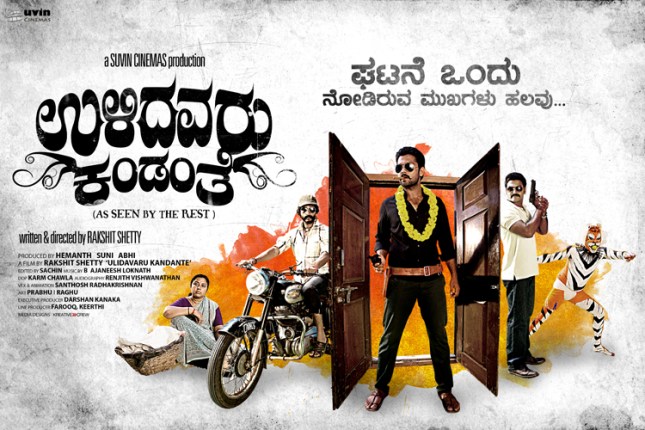
Ulidavaru Kandanthe

Ulidavaru Kandanthe-Poster

Not content with making a name for himself as an actor, in 2014 Rakshit Shetty turned writer and director with his foray into neo-noir crime drama in the excellent Ulidavaru Kandanthe. The English translation of the title is “as seen by the rest”, which refers to an incident seen from a number of different viewpoints that makes up the story of the film. Except it’s not quite as simple as that since the incident itself isn’t revealed until near the end, and even then, it’s not clearly defined. The inspirations are obvious, from Pulp Fiction to Sin City and many more gangster films in between, but it’s the way that Rakshit Shetty has (almost) seamlessly introduced a Rashomon style plot into a very Indian scenario that makes Ulidavaru Kandanthe an instant classic of the new-wave sweeping Kannada cinema.

The film takes the form of chapters based on a series of newspaper articles being written by Regina (Sheetal Shetty) where each interview she conducts gradually reveals more information about the characters and the incident itself. The plot revolves round an unseen MacGuffin that’s stolen by one of the main characters, although to be fair the entire incident is itself a MacGuffin since it’s the characters themselves and the random details of their lives that are the real focus of the story. As Regina interviews the people who were peripherally involved in the incident, we meet a cashew nut seller, a tiger man, a young boy and various gangsters who all have their own views of what occurred on the day in question. It all starts with an old story about 12-year-old Richi who stabbed another boy to death 15 years ago in defence of his friend Raghu. Richi was sent to a remand home for 8 years while Raghu disappeared, but one Krishna Janmaashtami, Raghu comes back.

The story unfolds in a non-linear fashion as each interviewee adds their perception of events. However, rather than just seeing a particular day, what Rakshit Shetty does is show the usual day-to-day events for that person going about their normal life. As far as the action goes, it’s the interactions with key players that inform us as to each major character’s role in subsequent events, but what we really get is an idea of the characters, their thoughts and beliefs and their own impressions of the people involved in the incident. This is partly why the film is so intriguing, as there is no clear-cut description of what actually happened on the fateful day. All we have are impressions, and eye witness accounts of parts of the day, but no-one knows exactly what happened and as the audience we are left unsure as to which version we should trust.

A number of events are shown more than once from different viewpoints, and the more times I watch the film, these repeated scenes throw up more and more questions! I love that my opinion changes slightly each time depending on whose testimony I decide to trust and that I still want to re-watch the film to see if I can spot any other clues. In fact, it’s not until the second watch that much of the film does start to become clear, and once the outcome is known, it’s possible to pick out foreshadowing and significant dialogue that seemed totally innocuous the first-time round.  It’s clever, but not so clever that the film is baffling first time round. It’s more that it becomes richer and more layered with subsequent viewings, and the subtleties of the writing are more easily seen.

The performances too are excellent and contribute to the film’s appeal. Rishab Shetty’s Raghu is somewhat subdued, but then he has escaped Bombay after stealing from his smuggling gang in a stark sequence very reminiscent of Frank Miller’s Sin City. His need to lie-low but desire to contact his mother are well portrayed and in the reunion scenes he is appropriately hesitant and unsure. Tara as Raghu’s mother Ratnakka is outstanding when she meets her son again after 15 years, but she is just as good when gossiping with her friends or selling fish around Malpe. Ratnakka’s story is a short film in its own right, and it allows us to fully appreciate her character and understand her reactions. Not that these are anything beyond what is expected – even down to the usual motherly insistence that her son have something to eat, but throughout Tara conveys Ratnakka’s feelings perfectly and does an excellent job in bringing her character to life. I like the way that Rakshit has given her a life outside of being a mother which gives her character more veracity and empathy.

While Raghu has returned in secret, Richie never left Malpe but instead has made a name for himself as an enforcer for local gangster Shankar Poojary (Dinesh Mangalore).  As Shailesha (Raghu Pandeshvar) puts it so succinctly when he meets Raghu in Bombay, Richie is still a bully and Rakshit Shetty plays him with all the swagger and bravado of a typical Hollywood gangster. It’s often a worry when a director plays a pivotal character as there is a tendency for everyone else to get pushed aside, but that’s not the case here. Rakshit is excellent and his Richie slumps into cars, hitches up his stolen police belt and ensures his reputation for violence is upheld while still ensuring that the rest of the cast are just as important to the story. However, Richie is still the centre of events as he interacts with all of ‘the rest’ from the title, including Regina herself who first saw him as a young by at the remand home. His two sidekicks Dinesha (Pramod Shetty) and Sudhi (Arun Prakash Shetty) have less to do, but each has enough small moments to ensure we have a good idea of their general characters and how they fit into the events of the incident.

My favourite characters though are Munna (Kishore) and Democracy (Master Sohan) who both have significant roles to play in the events of the day. Munna works on the boats as a mechanic, although he gets roped in to painting tigers as apparently that’s very similar to painting boats! Munna spends most of his afternoons following fish seller Sharada (Yagna Shetty) with whom he has fallen hopelessly in love. However, Munna never approaches her and is content to sit behind Sharada on the beach and follow along behind as she walks along the road. His romance adds a lighter note to the film, as does the character of Democracy and his friends who bring energy and life into the film.

I did mention tiger painting, and as part of the festival, one of the other main characters, Balu (Achyuth Kumar) is dancing as one of the tiger men. Achyuth is excellent in his role and the ambiguity of his character is one of the clever touches that Rakshit Shetty has added in to make the story even more captivating. Making Balu a tiger man was inspired and along with the Yakshagana drama ensures the film retains a uniquely South Indian flavour while incorporating many Hollywood themes.

My only issue with the film is that Rakshit Shetty tries to tie everything up neatly by linking events in Malpe to the item stolen by Raghu. I don’t think this works as well and almost seems superfluous given that it’s ultimately not as important as the characters themselves. However, that’s a small quibble and given how much I enjoyed the rest of the film, I’m happy to ignore the unrealistic coincidences and concentrate instead on the characterisations, dialogue and wonderful soundtrack.  It took me a while to track down a copy of Ulidavaru Kandanthe with English subtitles but it was definitely well worth the wait. This style of neo-noir may not be to everyone’s taste but for fans of the genre this is an excellent début from Rakshit Shetty and one I highly recommend. 5 stars!

Visaranai


“Give me the pink one. It’s my lucky lathi. Now let’s get them to confess”.

Vetrimaaran’s film takes a journey through the lawless side of law enforcement, where results matter and truth is often unwelcome. Adapted from M. Chandrakumar’s novel which was inspired by his own experiences, there is a relentless sense of doom pervading this story. Don’t get too attached to anyone!

Four Tamil men have come to Andhra Pradesh to work, sleeping rough in a park to save money. One night they are all picked up by the police. They are brutalised over and over but not told what they are suspected of doing and what they must admit to. It’s all a game to the cops but no one told Pandi, Murugan, Kumar or Afsal what that game is.

Afsal (Silambarasan Rathnasamy) is the youngest and weakest. Frightened of being hurt, and generally shy and inarticulate, Afsal triggered the arrests with a confession under duress and wavers most when under pressure. The four boys stick together and try to find a way out, trusting that their innocence will be recognised. Pandi (Dinesh Ravi) and Murugan (Aadukalam Murugadoss) are the stronger ones, with Pandi the more cynical and Murugan the more placid. Kumar (Pradheesh Raj) is injured badly early on and is a quiet, tense presence for most of his scenes.

The boys go on hunger strike and it seems to work. They are released, given money and told to come back to the station to sign a statement. They stop for a meal, eventually laughing at their strange fortunes. But when they go back, the sadistic Superintendent (Ajay Ghosh) says he couldn’t hit a starving man so he tricked them into filling their bellies. The beatings resume, more vicious than before.

I was struck by all the energy that goes into forcing confessions when maybe with the same expenditure of effort they could track down the real criminals. There is a discussion about finding someone else to take the fall but the boss is worried after all the injuries that the men will complain so he decides they must be found guilty. Eventually all the pressure works, especially the emotional blackmail from Pandi’s boss who knows it’s a set-up but encourages Pandi to take the easy way out for everyone’s sake. Including the police. These poor guys are expendable.

Pandi refuses to make a false plea once he is in front of a magistrate although his Telugu is not up to the finer points of his defence. Luckily for him there are Tamil Nadu police in another court so one is called upon to translate, and even more fortunately he recognises Pandi.  Inspector Muthuvel (Samuthirakani) explains the boys have jobs, never admitted fault, there is no evidence, and they’ve been beaten up for days on end. The magistrate knows Superintendent Rao has form for closing cases with false evidence and the boys go free.

Unluckily for Pandi and friends, the Tamil cops need their help in return. Sure enough, they help kidnap a high profile money launder KK (Kishore) from the courts. Back in Tamil Nadu, Kumar gets dropped off along the road but the others are taken to the station along with KK. KK tells Muthuvel that the last move in this game will be to tie up all the loose ends, like Muthuvel himself. And KK is a very smart man. About to leave, the guys are asked to clean the station building before they go. The ominous music says that was a bad idea, and I think Pandi knew it too.

Vetrimaaran mostly sticks with realism, creating a sense of the world just out of sight of the mainstream. The dark side is literally dark, with much of the film shot in night time and dimly lit interiors. The scenes are beautifully composed and I felt immersed in Pandi’s world, and the feeling of being entangled and lost. The spike of fear when the cops start torturing people is visceral, the relief when it stops and the terror of those waiting their turn also feel real. There is a foray into black and white for a couple of climactic scenes that struck me as annoyingly filmi. I wasn’t sure if it was censored because of all the gore or just cleverness, but regardless it was too tricksy. Other more successful visual metaphors were derived from the core of the drama – the movement between light and dark, between high and low places, people up to their necks in muck wading through sewers. The pace drags a little when the boys are hanging around doing the cleaning, and there is a little too much helpful exposition to get everyone on the same page, but these are minor issues.

Dinesh Ravi carries most of the film as Pandi was the enquiring mind, the calculating observer, and the loyal at heart.  His reactions and interactions with Samuthirakani give the story a centre and conflict that held the other strands together. Samuthirakani has gravitas and a wry humour that sparks up when Muthuvel is at ease. He is the cop who knows what is right, wants to be clean, but is coerced by his higher ups. Kishore is also impressive as the sly money man who can’t believe he will run out of friends or dollars. The dialogue is often sparse and meaning is layered through action and reaction. This is a man’s world. There is a budding romance (Anandhi as Shanthi), and a female cop (Misha Ghoshal) who deliberately forgets her phone so Pandi can call for help and that is it. All the supporting performances are good, but there are so many fleeting character appearances that the police dissolve into one huge despicable khaki organism.

I am not really surprised that the film failed to make the Oscars. A dog eat dog world with no hope of justice, and with the police at the heart of the darkness, seemed like a hard sell.

This is an accomplished film with some exceptional performances. It’s not an easy watch due to the casual brutality. It made me question why such a topic is still so current. And there is no moral or redemption to send you whistling on your way. Just death, lies, greed, and a promise of more of the same. 4 stars.