Yevadu (2014)

Yevadu

It’s unfortunate that Yevadu didn’t get a cinema release in Melbourne earlier this year, as I think it would be a better watch on the big screen with a fan audience. Vamsi Paidipally’s film takes the central concept from John Woo’s Face Off as a basis for his story, but other than that it’s a fairly standard mass revenge saga with plenty of associated mayhem. Charan plays the wronged Sathya, initially out for his own revenge, but then drawn into a different battle. The ideas are good, but the execution is flawed and Yevadu is no place for any rational thought. However if mindless entertainment with plenty of fights and some great dancing is what you are after, then it could definitely fit the bill.

Yevadu starts off well with Allu Arjun in the role of Sathya and Kajal Aggarwal as his fiancée Deepthi, although it’s rather a long set-up for the main story. Deepthi has been chosen by local Vizag Don Veeru Bhai (Rahul Dev) as the latest object of his desire, and saying no is apparently not a viable option. Veeru relies on intimidation and kidnapping his victims rather than natural charm, and while Sathya is happy to take on Veeru Bhai and his gang, Deepthi is rather more sensible and persuades her fiancé that it would be safer to leave Vizag. However Veeru Bhai’s brother (an enthusiastically vicious Ajay) and his merry band of gangsters catch up with the couple and Satya is left to die on the burning bus after Deepthi is murdered in front of his eyes. It’s a fairly brutal beginning but it neatly establishes the character of Satya as an angry and potentially violent man, but also one who is passionate and prepared to do anything for Deepthi.

Miraculously, Satya manages to survive, but is so badly burned that the only hope for his survival is some rather drastic surgery. Fast forward a few months and Sathya is heavily bandaged but recovering in a hospital. The big reveal is that he has been given a new face – amazingly without any scars, and has also managed to acquire a new body and a different voice to go with his altered look. Sathya (now Ram Charan) hasn’t become any more rational or any less angry however, and he runs away from miracle worker/ surgeon Dr Sharada to find Veeru Bhai and make him pay for Deepthi’s murder.

This part of the film almost makes sense, if you ignore the dodgy medicine and coloured contact lenses.  Charan portrays the part of a driven killer with plenty of maniacal determination that naturally follows on from the perpetually angry Sathya of the opening scenes. Sathya has lost everything he ever cared about and the only thing that matters is killing the men who murdered Deepthi, so a certain amount of focused aggression works well. However no amount of cleverly constructed vengeful violence can disguise the massive plot holes or complete lack of plausibility in much of the story.  Sathya somehow finds a change of clothes after leaving the hospital, as well as his motorbike and a camera, long before he goes back to his old flat where he might conceivably have picked such things up. That is, if they were still there after his months of recovery in hospital –  rather a stretch since everyone thought Sathya was dead. Thankfully there is plenty of great dancing to distract from the flimsy story.

Sathya does what any self-respecting Telugu hero would do and goes about taking his systematic revenge. Along the way there is some comedy with Brahmi and a very out of place looking Amy Jackson, but neither of these makes much impression and both serve mainly as a distraction for Veeru Bhai and his gang. Rahul Dev does plenty of sneering and lusting after various women, but after his initial introduction he’s not particularly impressive as a gangster. His gang aren’t ever shown indulging in any typical gang-like activities either, and there is no particular menace associated with any of the heavies. Ajay even sheds his violent persona and becomes part of the comedy, which suits him just as well but also dilutes any sense of threat from the villains.

Everything follows a straightforward and suitably vengeful path until the interval, when Vamsi Paidipally attempts to justify the face transplant idea and Sathya suddenly comes under attack from a different gang of thugs. It’s a change in direction, but that’s all as the film doesn’t become any more plausible or less over-dramatic, and there are just as many plot holes and inconsistencies.

While the disjointedness of the film is  odd, the problem I have with Yevadu lies more in the characterisation of Sathya. The story would be more convincing if there was a greater difference between the personalities of Charan (the original owner of the face) and Sathya, and additionally if each stayed true to those personalities throughout.  Sathya’s cold, controlled fury and drive to eliminate Deepthi killers to the exclusion of all else  suits the initial story, but much of that drive and anger vanish in the second half. While a certain loss of focus can be explained by the lack of a personal connection, Sathya becomes softer and too much like the character portrayed by Charan in flashback. Equally, although the character of Charan starts off as possibly a more intellectual character, as the story unfolds and he gets involved in fighting against the takeover of an area by a gang of thugs, Charan becomes just as cold and angry as Sathya. Keeping the two personalities more separate could have enhanced the idea of a changed face while the personality was still the same, but as it is Charan and Sathya are so similar that the change in face is almost irrelevant.

The second storyline is even more predictable and clichéd than the revenge story of the first half, although Vamsi Paidipally tries to compensate by increasing the volume of the background music and by repeating every significant shot at least three times. Subbaraju, Shashank and Kota Srinivasa Rao bring their usual competence to the roles of the villains but there isn’t anything novel about either their plans to bring a community to its knees or Charan/Satha’s attempts to foil their plans. The second half also suffers from a clunky romance with Shruti Haasan, which feels shallow and contrived after the intensity and passion of the earlier romance between Sathya and Deepthi.

In spite of my reservations about the characterisation and the relatively predictable second half, Yevadu is still a film that entertains. It’s all much larger than life, but the action scenes are well done and Sathya’s inventive methods of revenge are excellent. The various villains are mainly comical rather than particularly intimidating, although some of the minions are nicely evil, while the excessive over dramatisation is just fun! If you can leave logic behind, embrace the absurdity, and revel in revenge then Yevadu could be the perfect masala watch. 3 stars.

Govindudu Andarivadele

Govindudu Andarivadele

Soaring melodrama, fantastically colourful sets and Prakash Raj are the stand-outs from GAV. Add in Charan, who has definitely improved on his emoting, and you have the bones of Krishna Vamshi’s family drama that mostly delivers what it promises. There are plenty of emotional scenes as Abhiram (Charan) attempts to reunite his family in England with the rest of his estranged relations in India, and of course there’s some local trouble and a romance thrown in for good measure. While most of the film seemed to live up to Krishna Vamshi’s preoccupation with family values, there are a few scenes here that seem to be a hold-over from a less pc era, and stand out as glaringly sexist and just plain wrong. However the rest of the film is entertaining enough despite a storyline so overused that the lack of subtitles was really never an issue!

The story opens with a déjà vu from K3G as Abhiram demonstrates just how well he can play rugby when the opposing team fail to follow the rules of the game and actually attempt to tackle. Real rugby players end up covered in mud and crushed under a few tons of Welsh full-back in my experience, but apparently not in Vamshi’s world. Abhiram lives in a very nice pad in London with his father Chandrasekhar (Rehman) and his little sister whose name I didn’t catch. Unfortunately Chandrasekhar misses out on an appointment to be Dean of Medicine at a London University and interprets this as karma due to an old rift from his own father.  No academic politics in Vamshi’s world either then, I presume!

Overnight Abhiram decides that he will be the one to make all right for his father, and heads off to India to do what he can to bring the families back together. Sadly though, he doesn’t take time to remove his rather odd pony-tail which I can only assume must have been an attempt to look ultra-hip and cool – London-ishtyle. Not my favourite look for Charan, but it did grow on me as the movie went on.

GAV - Charan

Things definitely look up once Abhiram makes it to India, does all the usual touristy things, and then heads off to his grandfather’s village. Following the standard family reconciliation template, Abhiram makes contact with the rest of his family anonymously by pretending to be a visiting agricultural student who wants to learn from family patriarch Balaraju (Prakash Raj). Balaraju runs his family and the village with a benevolent but very traditional hand while stopping his brother (Kota Srinivasa Rao) from clearing and developing the area. Living in the wonderfully pink and majorly over-decorated mansion is also Chandrasekhar’s wastrel brother Bangari (Srikanth): a man with an unfortunate propensity for mesh singlets and garish shirts. Oh, and he drinks, gambles and tries to kidnap and rape his potential bride, Chitra (Kamalinee Mukherjee). This is one of those scenes that really should never have made it in to a film in this day and age, and it does feel completely anachronistic with the rest of the story. Equally disturbing is Abhiram’s use of some photographs he has taken of his cousin Satya (Kajal Agarwal) dancing in Western clothes as a way to blackmail her. This is straight out bullying and sexual abuse, and I find it hard to believe this got past the censors in an otherwise ‘family-friendly’ film. Thankfully Satya does manage to effectively deal with Abhiram’s harassment, but it makes their subsequent romance initially less believable and Abhiram appear as a bit of a prat.

The rest of the film is much better, and that’s mainly due to excellent performances from Prakash Raj and Charan. Prakash Raj is perfect as Balaraju and he knows exactly how to play the strict but compassionate head of a large family. He never puts a foot wrong and wrings every possible drop of emotion out of his time on screen. He even manages to make stick fighting and motorbike riding emotional events, as he unknowingly bonds with his grandson. Jayasudha is just as good as Abhiram’s grandmother, and again she manages to take her overly emotional scenes and tame them down to something more realistic and believable.

Charan gets a chance to show that he can play more than just an action hero and he definitely rises to the challenge. His Abhiram has more shading than other characters I’ve seen Charan play, and he conveys plenty of emotion and feeling in his speeches, even though I couldn’t understand a word! Despite the initially rocky start, there is plenty of chemistry and some major sparkage in the romance between Abhiram and Satya. Charan is one of the few actors that interacts well with Kajal in this respect and their romance really does light up the screen. Charan does manage to stick close to his real love though, as seen in this song mainly set in and around Petra. I wonder if it’s written into every contract that he must get at least one scene with horses? Kajal gets rather short-changed in the choreography here, although Charan doesn’t actually get to dance much either and sadly most of the songs have more emoting than dancing.

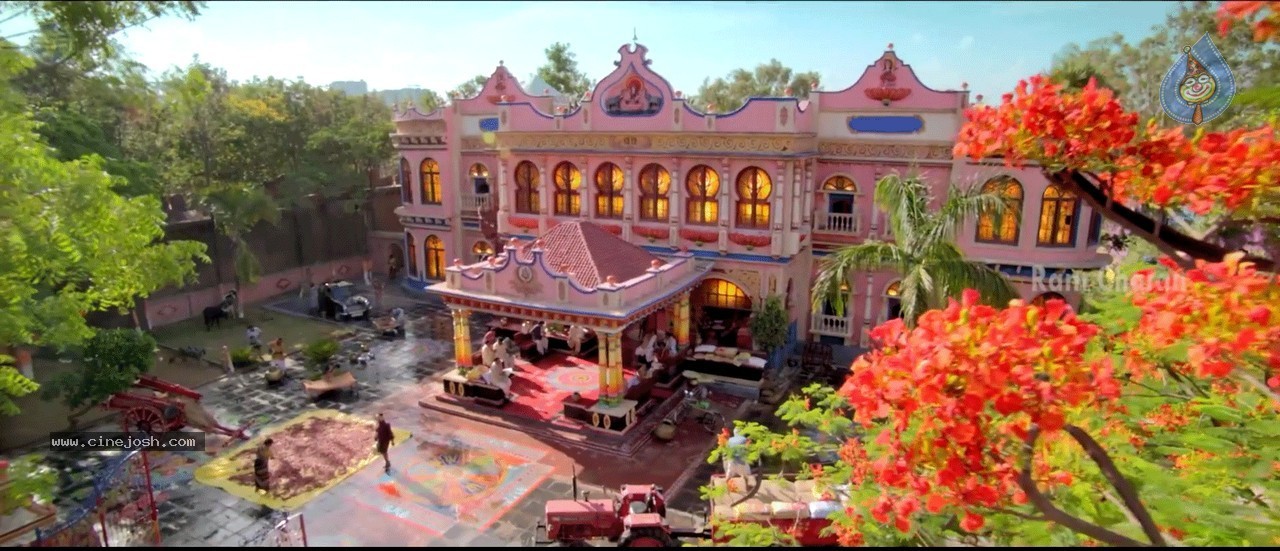
The rest of the cast are all capable and fit well into their roles. Rao Ramesh, Posani Krishna Murali and Adarsh Balakrishna are part of Kota Srinivasa Rao’s opposing family but never feel terribly menacing. Adarsh’s character is mainly just very shouty and aggressive, and the various fight scenes, which appear to have been structured around rugby tactics, aren’t up to Peter Hein’s usual high standard. The film looks gorgeous though. The pink palace is amazing – Satya has a stunning peacock painting on her wall, and most of the other rooms are similarly adorned with fantastical artwork and gorgeous furniture. I would live there!

GAV - the pink palace

The emotional quotient does head into overload at times and the ending is particularly excessive, but that doesn’t really seem to matter since the whole point of the story is overblown sentiment. As a straightforward family drama GAV works well enough despite the cliché-ridden storyline and the strong performances help push it over the line. Well worth watching for Prakash Raj and Charan, particularly when you can marvel at the wonders of the pink palace as a bonus.

Thuppakki (2012)

Thuppakki

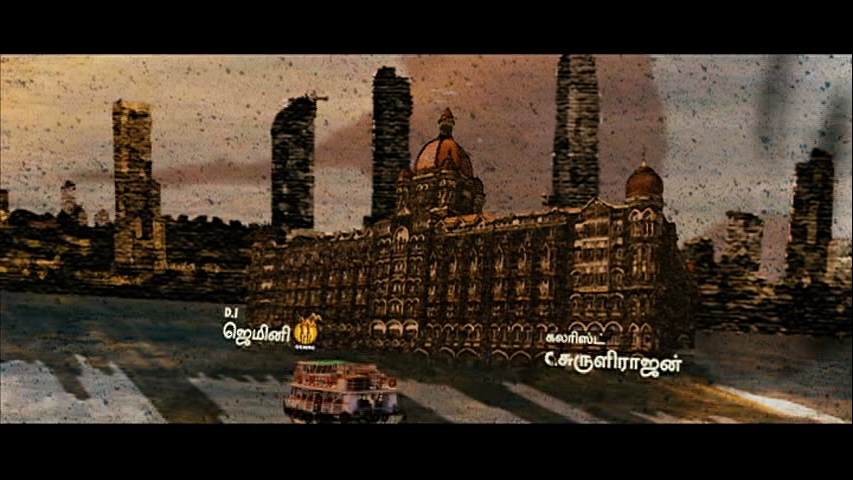
After the disappointment of 7 Aum Arivu, thankfully A. R. Murugadoss takes a step back in the right direction with Thuppakki.  With a story based on terrorist sleeper cells in Mumbai, the action is well written and cleverly plotted to build suspense and there are a number of surprising twists towards the end.  The resolution relies more on the hero’s intellect rather than the usual wham bam of most hero-centric Tamil films (although there are a few of those moments too), and Vijay is at home and comfortable in the role of a special operative in the Indian army.  I could have done without the rather dull romance track which didn’t seem to mesh well with the rest of the film, but essentially Thuppakki is one of the better Vijay films of recent times and is definitely well worth a look.  Great opening credits too.

ThuppakkiThuppakki

Vijay’ character Jagdish starts off well by proving that he can fight and dance during an unscheduled train stop on the way back to Mumbai to meet up with his family.  While most of the songs are forgettable with fairly dull choreography, this one is much more fun, although that may just be my preference for songs that allow everyone to join in.

Once back in Mumbai, Jagdish’s parents rush him off to a meeting with a potential bride Nisha (Kajal Agarwal), but Jagdish is initially not impressed by the traditional sari-clad and demure girl he sees.  However, it turns out that Nisha is in fact an athletic sportswoman with a mind of her own and a completely modern attitude.  Although this sounds promising, in reality Nisha’s love of sports is only explored in one unconvincing boxing match and in a song.  Her character is almost immediately submerged into a rather pointless comedy side plot involving Jagdish’s superior officer V. Ravichandran (Jayaram) and otherwise she remains firmly in the background.  The romance fizzles and after a terrible song in a nightclub it’s not surprising that Jagdish makes a run for it back to the terrorist in his closet.  The curse of the costume designer hits Nisha too, so it’s not all Kajal’s fault, but the whole romance track feels very much out of place with the rest of the film and doesn’t add anything at all to the plot.

ThuppakkiThuppakkiThuppakkiThuppakki

By chance Jagdish is involved in the capture of a sleeper cell operative who detonates a bomb on a bus.  Finding out that a senior police officer has been corrupted leads Jagdish to interrogate the terrorist himself, which reveals that our hero is not as clean cut as might be expected.  Jagdish has no qualms about torturing his captive and quickly learns of a plot to simultaneously detonate 12 bombs around Mumbai.    With the help of some army friends who just happen to be in town for a wedding, he takes out the 12 sleeper cells in a surprisingly tense chase sequence.  Needless to say this ensures that the leader of the terrorist group retaliates and heads to Mumbai to deal with the threat to his next plan – plan B having failed!

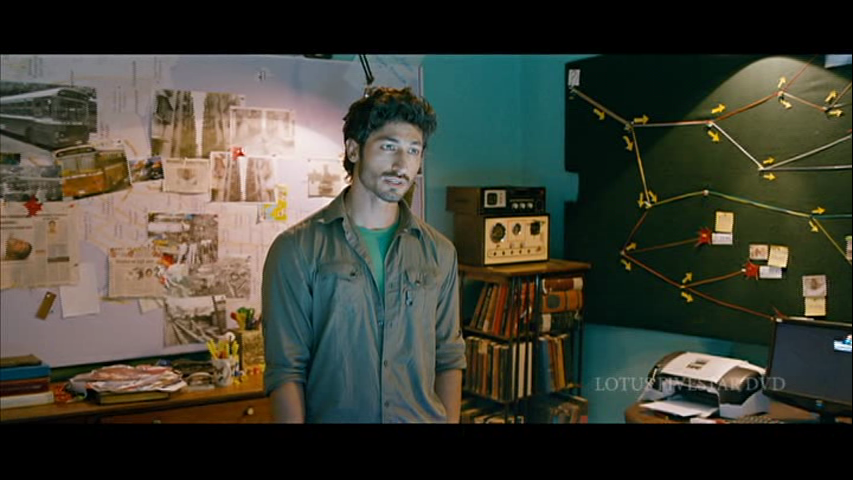
ThuppakkiThuppakkiThuppakkiThuppakkiVidyut Jamwal is excellent as the charismatic leader of the terrorists and his subsequent cat and mouse plot and counter-plot with Jagdish works well even if some of the set-ups are rather far-fetched.  Both Vidyut Jamwal and Vijay put in excellent performances and the dynamic between the two works well, although the final fight scene feels staged in comparison to the rest of the film.  There are also some odd moments where sometimes a Tamil track overlies Vidyut Jamwal’s dialogue in Hindi, while at other times subtitles are used to translate the Hindi and English words.  The Tamil voice-over seemed odd as I could still hear the Hindi words underneath and found that rather distracting, however it made much more sense that the terrorists and their sleeper cells in Mumbai would speak Hindi rather than be able to converse fluently in Tamil. The other problem I had with the film was the poor placement of songs, particularly in the second half.  This is the only other song where I enjoyed the picturisation, but it just pops up in the middle of the action and feels very out of place.

Jagdish isn’t a conventional movie hero and has shades of grey that make him a more interesting character.  He is cold and calculating in his dealings with not only the terrorists, but with his family and friends as well.  For instance, he thinks nothing of including his sister in the group of women kidnapped by the terrorists and is just as callous in his treatment of his fiancée.  But on the other hand he has a genuine affection for his friend, the long-suffering Police Inspector Balaji (Sathyan), and has an obvious passionate loyalty to his country.  In some ways he is no different to the terrorists he is fighting and the parallels between the two men provide another layer to the action.

ThuppakkiThuppakkiThuppakkiThuppakki

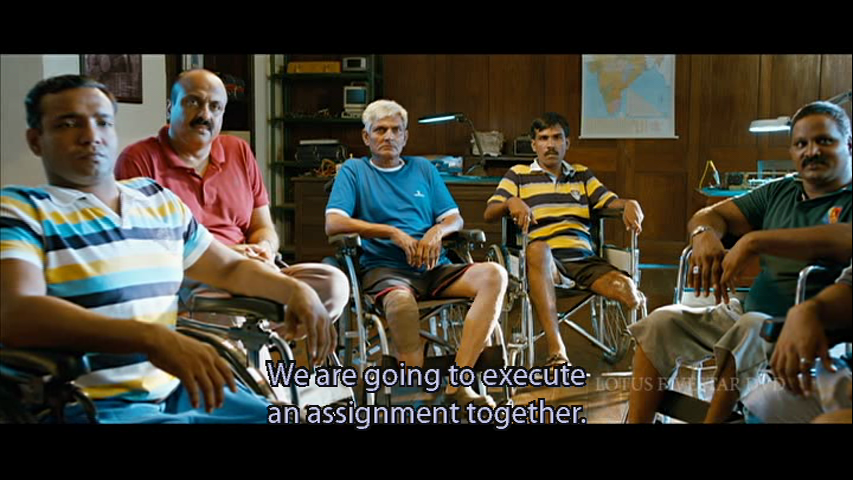
As seems to be his trademark, A. R. Murugadoss includes a message, and this time it’s a reminder of the sacrifice made by Indian soldiers at the front line.  He includes a group of soldiers disabled by their injuries as part of the cast, and the final song is dedicated to the Indian Army.  As an outsider it seems a little manipulative at times, but overall the sentiment is one I can share despite the sentimentality of the final scene.

Thuppakki combines a good screenplay with excellent performances from the main leads ably baked up by a competent support cast.  The cinematography by Santosh Sivan is up to his usual high standard and enhances the mood of the film.  A little less reliance on the standard formula (action + romance + comedy x 6 songs) would have made this a better film, but as it stands it’s still an enjoyable watch.  4 stars.

Thuppakki