
I had no luck finding a subtitled version of this film (legal or otherwise), which is a shame as I think that difficulty will stop a lot of people from watching. I’m not sure where Heather got her subtitled copy from. However this is the story of a dancer, often expressed in action rather than speech and many scenes required no further explanation.
The film uses a flashback structure so we actually meet the older Balu (Kamal Haasan) first. He is a disgruntled drunk and newspaper critic who, despite all his issues, demands a high standard for dance. He writes a scathing review of the latest dance sensation Sailaja (SP Sailaja), and rather than apologise when she confronts him, belittles her by showing her how it should be done.
Young Balu is a poor boy, dedicated to dance in many forms – and a purist. He wants to be successful but is held back by his dislike of the shallow sexified version of dance that is in demand (and is perhaps dismayed by the outfits).


Balu’s world is small. He has his mother, dance, and his friend Ragu (Sarath Babu). He also meets Madhavi (Jayaprada) who is wealthy and happy to be his patron. She gives him many opportunities, and becomes more than a sponsor in his eyes.
Each episode reveals something more of Balu’s character and how he came to be in his current situation. It’s a big challenge for a film maker, and in this instance it is handled beautifully by K. Vishwanath. The fragments fall together to make a cohesive story, and it is easy to follow the narrative.
Kamal Haasan is fantastic. Since we more or less know how the story ends before it begins, it really does require a great performance to keep a viewer engaged on the way to the foregone conclusion, and he delivers. Yes, there are some dubious wardrobe moments and bizarre posturing, but they were intentionally ridiculous, being Balu’s commentary on the commercialisation of dance. Balu dances his joy, pain and despair – he dances his heart out and it is hard to look away.


This is one of my all time favourite film dance sequences and I love it for its joyous emotion, simplicity and the brilliant editing. Despite his dedication to dance as a pure art form, Balu isn’t a total stick-in-the-mud. He adds some sweet comedic flourishes dancing with kitchen utensils, and plays up to his mother who dreams of seeing Balu on stage. Madhavi is impressed too!
Life seems set and success is just around the corner so naturally, I expected a tragedy. Because he is such a perfectionist and intolerant of things that don’t fit his vision, Balu is ill equipped to deal with setbacks. He falls into a bottle after losing his mother, missing his big dance debut and then learning that Madhavi is not free to return his love (she is married to a man who looked absolutely miserable in their wedding photos). His character frustrated me greatly. I could empathise with Balu, but I really wanted him to see sense and find a way to bend before he broke.
Sarath Babu’s role was small but he is a constant and reassuring presence and instilled Ragu with an air of integrity and generosity. I’m not entirely sure why Ragu stuck by his friend as he seemed to give endlessly to an often ungrateful sod. There were lively glimpses of Balu’s character in a couple of scenes that made me believe in the friendship, and perhaps I missed a lot in the dialogues.
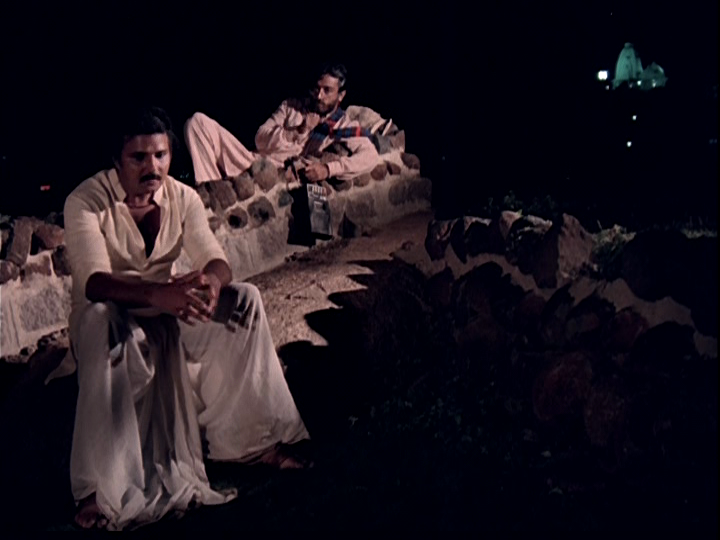

Madhavi tracks down her old friend and would be lover through the newspaper and Ragu. Her side of the story is also revealed through flashbacks. This episodic style seems apt as her love for Balu is revealed through her candid and perceptive snapshots of him long before either of them acknowledges any feelings. Jayaprada is lovely and manages to be light and funny as young Madhavi without being shrill or giggly, ably matching Kamal Haasan in the physical comedy.
She gives a sensitive portrayal of a woman who is tempted by a love she cannot act on and manages to be sympathetic despite having been, at best, deceptive by omission.


As it happens, she is Sailaja’s mother, and so Balu’s life turns back on itself as Madhavi secretly engages him as a dance teacher for the stylish but shallow girl.
The photograph motif is used a lot. One of the most moving examples is when Balu and Madhavi try to use the timer thingie to take a picture of themselves together. The photo fails and all that can be seen is a worried Madhavi and ghostlike blur of Balu. They joke that it wasn’t meant to be. Then when Madhavi departs with her husband, Balu takes and keeps a photo of the couple as a reminder to himself of what had to be. It’s one of the few pictures he takes; usually Madhavi was the one to give him beautifully composed portraits showing what he was to her.


Their reunion is full on filmi and yet simple as Madhavi confronts Balu while he is stinking drunk. Balu’s drunken cavorting avoids being a mockery of his dance despite being accessorised with a bottle, perhaps as it comes straight from his heart with no artifice. Madhavi lets Balu see her sadness and fear for him while he seems to give her an earful for not teaching Sailaja to be a better dancer. In so many ways, they haven’t changed a bit. Balu doesn’t know that Madhavi is a widow, and once more she struggles with the pressure of family against her desire to move forward with Balu in her life.
Sailaja is unhappy at this revelation about her mother’s past, but she should be practicing her dancing more than spying, and do a bit of growing up as well. Happily for her, she does come around to seeing the value in Balu’s teaching (which he does from a hospital bed). Her performance was probably the weakest for me in terms of acting, but her dance scenes with Kamal Haasan were much more satisfying. And SP Sailaja can sing, so she was certainly talented.

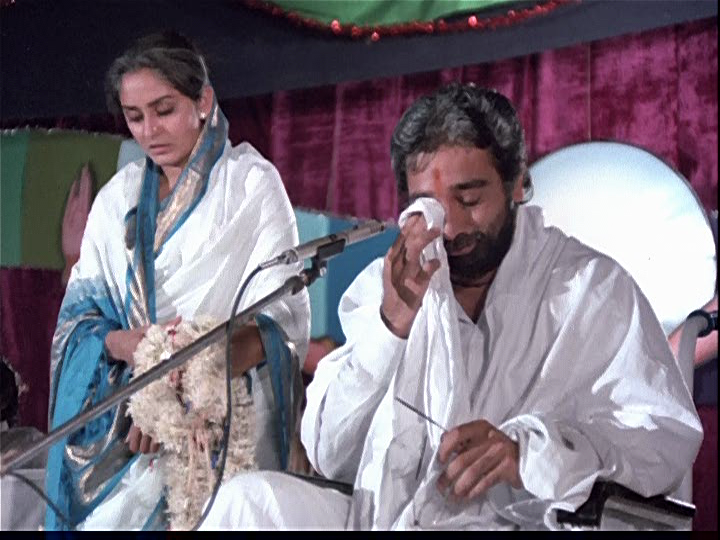
The structure of the story is solid, and the characters seem believable. The Illaiyaraaja soundtrack is integrated into the drama and the dances reveal so much of the characters’ inner lives they are essential to the film, not just a pleasant addition. The dance practice and performance scenes are filmed beautifully. I can’t comment on the lyrics by Veturi or the dialogues co-written by K. Vishwanath and Jandhyala (who wrote dialogues for Aaradhana) as I just made up what I thought was happening in some scenes.
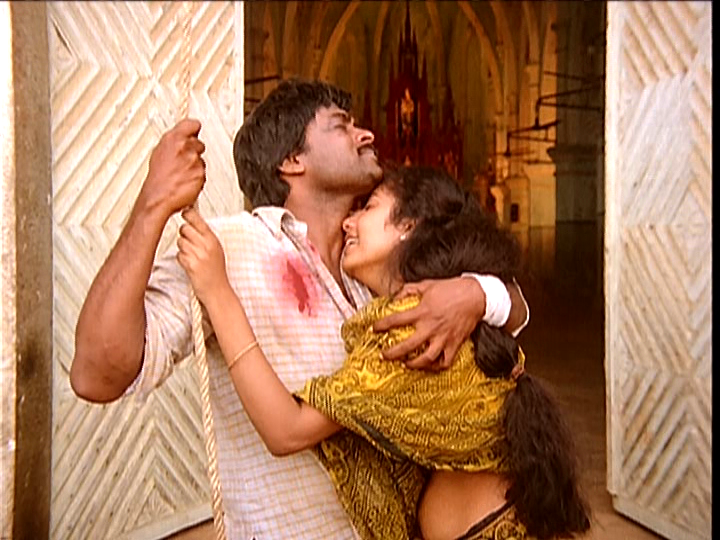
The ending is over the top but despite all the silly trappings the leads keep it (mostly) restrained to let their characters’ emotions shine through. If nothing else grabs you, this film captures some exceptional dance performances. I wish I could fully appreciate the characterisations, as I did feel disconnected at times due to my lack of language skills, but it wasn’t a huge issue.
I give Sagara Sangamam 4 ½ stars.
Heather says: This is such a beautiful film and although I keep returning to it time and time again to watch the incredible dance scenes, there is so much more to enjoy in this film. To start with the dancing, there probably isn’t anyone other than Kamal Hassan who could manage to make it all look so effortless. The classical dance scenes are superb, and even the contemporary song (with that truly hideous yellow suit) is well added in to showcase his skills. Jayaprada is beautiful in her dance scenes and S P Sailaja is excellent, but it’s still Kamal Hassan who draws my eye each time. I absolutely love the dance scene in the kitchen which is fresh, spontaneous and makes such good use of the setting.
Leaving aside the amazing dancing, this is a really well told story. An alcoholic ‘hero’ is unusual and, since I work in the field, I like that it’s a useful public health message as well. The romance between Balu and Madhavi develops slowly and naturally considering their joint love of the arts and despite the difference in their social standing. The use of photography to link the story together is cleverly done and every image adds a little more to the story. Sarath Babu is excellent as Balu’s long suffering friend, and his generosity provides a stark contrast to Balu’s increasing selfishness as he beomes dependant on the demon drink. However Raghu is not a perfect saint either since he doesn’t scruple to use Balu’s guilt against him as a way to blackmail his friend into teaching the spoilt brat Sailaja. Of course it’s all for Balu’s own good and the fact that he gets treatment for his sick wife Sumathi is a bonus. All of the supporting cast is excellent here and K. Vishwanath develops their characters in enough detail to make their actions understandable and relevant.
I really like the way each flashback occurs when something which is happening in the present triggers a memory of a past event by one of the characters. It seems very natural and helps to link the past and the present. The film is very much about the arts: Raghu is a writer and poet, Madhavi is a singer and Balu’s dream that they all perform together seems a natural extension of their friendship. It’s also an excuse to have some beautiful songs and once again Illayaraja provides music that I love and I just wish I knew what the lyrics meant. There are a few things I don’t enjoy quite so much. There are some really ridiculous co-incidences and the last few scenes are overly melodramatic. But then again this is a film from the eighties and we all know that wasn’t a time for restraint! This is a 5 star film for me.








 Cinema Chaat