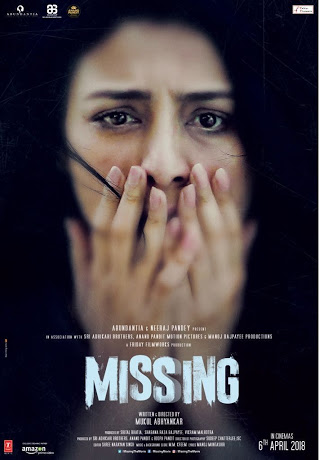
Missing (2018)

Missing has some things going for it. Well, Tabu and her outfits mostly.

Sleazy Sushant Dubey (Manoj Bajpayee) is on a business trip with Aparna (Tabu) and their three year old daughter Titli. They check in to a fancy resort in Mauritius and Sushant checks out the receptionist before fielding a call from another woman, Kamya (Neelam). It’s clear what his priorities are. But since no other options present, he resorts to sex with his own not very keen partner in an awkward scene that had all the sensuality of Greco-roman wrestling. When Aparna wakes in the morning she discovers that Titli has disappeared from their room. She flies into a panic, while Sushant seems a little too calm. The hotel staff are not very useful, and the police seem to have read the Keystone Cops training manual. Then there is the guy downstairs who seems to be obsessed with little girls. So what happened to Titli? And will her parents find her?
That sounds like the basis of a reasonable thriller. But sadly writer-director Mukul Abhyankar squanders both the idea and his cast in a messy, screamingly obvious film that signals every twist and turn. Just in case you managed to black out and miss anything, listen out for the blaring dun-dun-DUNH! at key moments. One of the twists was evident from the get go, and the only way a red herring could have been any more obvious would have required an actor to wear a red herring mascot suit.
Tabu is stunning as the stricken and slightly unhinged Aparna Did she harm her child, was she the target of a revenge plot, was it just a crime of opportunity, or is something entirely different playing out? Tabu shows great range, from raw and gut-wrenching fear to more subtle and calculating expressions as the truth of her relationship with Sushant is revealed. The film feels quite stagey and is exposition heavy, but she imbues even her more passive scenes with an inwardly focussed energy that constantly drew my attention. Aparna is much more complex than she initially seemed. I really wish the writing had been better. I liked her costumes, but I’m pretty sure I wasn’t supposed to be checking out the embroidery on her kurtis rather than fretting about the little girl.

I hated everything about Sushant so I guess that is an acting triumph for Manoj Bajpayee. Sushant was craven, opportunistic, and creepy. Bajpayee struggled with some bad writing both in terms of the dialogues and the logic of what Sushant was doing. His feeble obfuscation may have been supposed to build tension and create doubt but it was just annoying and often didn’t serve a purpose. I was so annoyed when the cops nearly pulled the pin just because Sushant claimed Aparna had become mentally ill after being diagnosed as infertile. It was typical of the lazy plotting that tried to jazz hands past inconvenient details, and showed everybody believing women are just a walking uterus with the sole purpose of popping out babies. Sigh. But I cheered up immensely when Sushant copped a tight slap. That made up for a bit of my suffering.
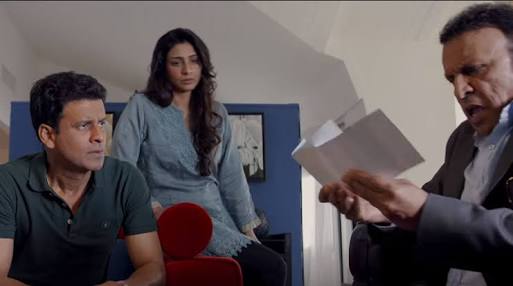
Annu Kapoor is atrocious as Inspector Budhu but the material couldn’t have helped. I was amused that everytime he threw in a few words of French (seeing as he was a Mauritian policeman with an entirely Hindi speaking team and suspect set) the subtitlers gave up and wrote [Foreign Language]. But at times it felt like the lead characters were all in different films, weirdly edited together. Their performances just didn’t gel.
I was so pleased to see Tabu back in a leading dramatic role. I wish the film had lived up to its potential and to the lead pair’s characterisations.

Shab (2017)

Shab

Shab was released last year but was only shown at the Indian Film Festival without a general release in Melbourne, so I’ve had to wait for the DVD release. I loved Onir’s previous films, I Am and My Brother Nikhil, so I was looking forward to this tale of love, lust and loss in the big city. Unfortunately, Shab doesn’t have the same instant impact despite strong characters and intertwining complex relationships. That complexity is part of the problem, since at times the connections are diffuse and confusing, but the main problem is with the dialogue, which often sounds contrived and unnatural. Shab ends up as a series of beautifully posed moments where the underlying relationships are only vaguely described and the expected passion surfaces only in brief spurts – usually from the supporting cast.

The film tells the story of Mohan (Ashish Bisht), a wannabe model from Uttarakhand who comes to Delhi to take part in a competition. Despite his impressive physique and tight silver shorts, Mohan’s small-town attitude fails to impress the judges and he’s sent packing from the show. Depressed and broke, Mohan finds his way to a café where the owner Neil (Areesz Ganddi) feeds him and gives him a place to wait until his bus leaves later that evening. However, Mohan has one last card to play, and calls one of the competition judges who invites him to her house. Sonal Modi (Raveena Tandon) is a rich socialite in an apparently loveless marriage with an industrialist who is rarely at home. She takes Mohan as a lover, christening him Azfar and deciding that he will be her ‘trainer’. Mohan seems happy enough with the arrangement – he’s dazzled by Sonal’s house and flattered by her attention, but as time moves on his arrangement starts to sour, as exemplified by his changing expression in the mirror where he practices his smiles before leaving to meet his lover.

Meanwhile Neil has problems of his own. His lover Nishant (Shray Rai Tiwari) treats their relationship casually and is also preparing to get married to satisfy the wishes of his family. Neil relies on his friend Raina (Arpita Chatterjee) for support as he weathers his on-off relationship with Nishant and she provides sensible advice and the odd kick up the arse when Neil becomes too maudlin to cope. But Raina has issues too. She lives with her younger sister Anu (Aniha Dhawan) who resents the time Raina spends at work when Anu is home from boarding school in Mussoorie. Raina’s life is shrouded in mystery for much of the film, with veiled references to her work outside of her regular gig waiting tables for Neil and strange encounters with people who call her Afia. She’s also good friends with Benoit (Simon Frenay), a French national who has just moved in to the apartment across from Raina and who works as a French teacher and a waiter in an upmarket restaurant. These five lives all become connected through their various friendships and relationships as they wrestle with their hopes and dreams while juggling the pressures of day-to-day life.

The best realised of the characters is Mohan, and newcomer Ashish Bisht is good as the country boy adrift in the big city. Ashish combines naiveté with charm in his interactions with Raveena Tandon and is also suitably desperate in his pursuit of designer Rohan Sud (Raj Suri), but his performance is let down by inconsistencies in the character. It doesn’t seem logical that Mohan should wait so long before approaching Rohan for a modelling job, and his romance with Raina never rings true. While Ashish nails the puppy dog looks and lusting from afar, when the relationship moves up a gear it appears false and unrealistic, which isn’t helped by Arpita Chatterjee’s disconnected performance. Mohan’s gradual realisation of his real relationship with Sonal is treated much better and helped immensely by Raveena Tandon who does a wonderful job with her limited role.

Raina is the thread that connects all the characters, but she’s the most disappointing and the character whose story is the least interesting. Her ‘secret’ is easy to guess after a few confrontations but her lifestyle is not well explored or explained. She works for Neil so it’s not clear why she still carries on in her previous line of work since money doesn’t seem to be an issue. There’s never any explanation of why she made the choices she did with Anu, and since most of those don’t make much sense it would have been interesting to try and understand her motivation. Similarly her rejection of Mohan seems odd given her advances towards him, although the whole relationship is strange and always feels manufactured.

Thankfully the other threads are better. Neil’s story is good, although there are a few too many coincidences that mar an otherwise interesting look at a same sex relationship that’s falling apart. The emotions here are given more screentime and appear much more genuine, while Areesz Ganddi’s portrayal of a man suffering through a relationship breakdown is realistic and believable.  Although Benoit’s story seems rather superfluous since a foreigner in Delhi can be expected to feel alienated at times, Simon Frenay is good and there are elements in his story that help develop the other characters. More could have been made of his antagonism towards Mohan and the reasons behind his dislike, but Benoit is generally inoffensive even if his story seems somewhat incomplete.

Each of the characters has a story that includes loss and feeling alone while surrounded by thousands of other people which should have been the basis for an interesting exploration of alienation in the city. However, the main reason it fails to engage and deliver on that expectation is the clunky and unrealistic dialogue. This doesn’t appear to be a subtitle issue either as even with my limited Hindi, I can understand enough of the dialogue to know it sounds stilted and unnatural. When Sonal taunts Rohan with comments about wanting Mohan in his own bed rather than on the runway, the remarks sound unbelievably immature. It’s also incredibly unlikely she would say anything like this since the two are supposed to be ‘best friends’. Conversations between Mohan and Raina sound equally forced and the only realistic dialogue is when Mohan discovers Neil is gay and blurts out that he doesn’t look ‘like that’. For the most part it feels amateurish and unlike Onir who is normally sophisticated and clever in his use of language.

On a more positive note, the film looks gorgeous and each set is perfectly staged with exquisite attention paid to detail. Ashish spends most of the time shirtless, but his clothes are a good reflection of his personality, including a truly terrible see-though shirt he buys for himself. Perhaps if the film had focused more on Mohan’s story this would have been a more satisfying watch. I would definitely have preferred to see more of Sonal’s story and less of Raina. As it is however, while it is beautifully shot with an excellent soundtrack, Shab seems no more than a superficial glimpse into a small portion of Delhi society. 2 ½ stars.

3 Storeys

3storeysArjun Mukerjee’s debut film is a collection of three stories featuring the residents of a chawl in Mumbai – the building is three storeys high too, hence the film title. Each tale is primarily based on one of the occupants, although the same people are involved in each story as the various residents dip in and out of each other’s lives. The chawl is the common thread that runs through each narrative as writer Althea Kaushal explores the premise that every face in the crowd has a story to tell.

The film starts with a young man trying to buy somewhere central and relatively inexpensive to live in Mumbai. His agent takes him to see Flora Mendonca’s apartment despite the exorbitant price she has put on the property. ‘Aunty’ Flora (Renuka Shahane) as she is known by everyone has lived in the chawl for most of her life since moving from Goa after her marriage. As ‘Aunty’ to everyone she is approached for advice, but her relaxed attitude and support of the other residents hides a tragic tale that Vilas Naik (Pulkit Samrat) entices from her over a cup of coffee. The events of the past are shown in flashback as Flora explains why she now lives alone and wants to sell her house for such a large sum of money. Renuka Shahane is convincingly made up to play an older woman, and she does an excellent job with her role – never dropping the ‘aunty’ persona despite the chilling twists to her story. This is my favourite of the three tales, and it’s probably the most successful as it mixes together drama and suspense in a plausible tale of sweet revenge.

The second story follows a battered housewife Varsha (Masumeh Makhija) as she deals with her abusive and alcoholic husband. Her friendship with a neighbour inadvertently leads to Varsha remembering her failed romance with Shankar (Sharman Joshi) that ended when her family objected to his job and status. While this starts well, the pace and tone are quite different from the first story, which makes this second tale drag a little, until the flashbacks start to instil some warmth into the romance. Masumeh Makhija is good as the woman who acceded to her families wishes, giving up the man she loves for their choice of husband, who turned out to be a very poor alternative. However, this story has been told many times before, and there isn’t quite enough in the twist to make part of the film as immediately engaging as the first. Still, the performances are good, and there is enough detail to ensure that the story is still entertaining despite the lack of novelty. What does work well are the emotion filled scenes between Varsha and Shankar after they meet again, where Masumeh Makhija manages to say everything necessary with her eyes and expressions and without saying a word.

The final story follows another well-trodden path, but the final twist here is better delivered and fits more easily with the flavour of the first tale. This is the story of teenagers Malini (Aisha Amhed) and Suhail (Ankit Rathi) who fall in love against the wishes of their parents. What initially seems to be religious objections from Suhail’s father and Malini’s mother turns out to be more complex and disturbing. One of the best performances here is from the actor playing Suhail’s mother, who is fantastic as she visits Malini’s mother and tries to keep her son’s whereabouts hidden from his father. It’s the actors who bring much of the spark into this story, and the reveal at the end is perhaps a little too contrived, although again it’s Suhail’s mother who makes the most impact here too.

Throughout the three stories there are glimpses of the other chawl residents, including the glamorous widow Leela (Richa Chadda) who also acts as narrator and her admirer Ganpat (Himanshu Malik). However, the film never develops a real sense of place despite all three stories being set in the chawl, and a number of shots moving from balcony to balcony as the story shifts protagonist. Disappointingly, more isn’t made of the location or the close-knit community, although when Althea Kaushal does on occasion introduce the neighbours into the stories, they add instant colour and depth to the film.

While the overall concept that every face has a story to tell sounds like a good idea, the problem is that not all stories are equally interesting. The three stories here are all quite different and don’t link particularly well, despite the best efforts of Arjun Mukerjee to connect them via their living space. This may be partly because the building seems so sanitised and not the typical crowded living space that I expect to see in Mumbai, meaning that the characters can live quite separate and segregated lives. But mainly the three stories don’t align due to differences in the pacing and mood, particularly with the second vignette that slows everything down rather too much. Some more integration between all the characters would have helped, including adding some of Leela’s final commentary earlier. For me that would have clarified expectations and made the film flow more smoothly. However, what makes 3 Storeys worth watching are the actors, particularly Renuka Shahane, while Ankit Rathi and Aisha Amhed do a good job for two newcomers. Despite the inconsistency of the screenplay, there is still a lot to like about each individual story and some of the character interactions are excellent.  Worth watching for Renuka’s turn as a older Christian widow, glimpses into each character’s past and a couple of surprising relationships.