Maattrraan

I’m a big fan and I expect a lot from K.V. Anand and his writing team of Subha but sadly Maattrraan fails to deliver despite the presence of two Suriya’s, the hint of a good story and the best efforts of all the cast.  I was expecting the worst when I read about that the plot involved conjoined twins since anything even vaguely medical in Indian cinema is always replete with the totally impossible and that’s exactly the case here.  As if the ridiculous medical themes weren’t enough to deal with, the second half also has plot holes and inconsistencies big enough to swallow a small asteroid while it treads a well-worn path without any real excitement or tension. Just to cap it all off, Maattrraan also has one of the most ridiculous and unsatisfactory endings I’ve ever seen in a Tamil film!

It’s not all bad though.  The first half is generally entertaining and the interaction between the twins is engaging, but when the best chemistry in the whole film is between Suriya and himself then you know things aren’t looking good.

Suriya plays conjoined twins Akilan and Vimalan, who are almost separate, but can’t actually be separated because they only have one heart between them – which is only the start of the questionable medical statements.  Vimalan is intelligent, quiet and studious and completely different from his drinking, smoking and music-loving brother. They tend to overlook the fact that only having one heart means they share the same blood supply so if one twin was blind drunk, the other one would be intoxicated too, but logic never really intrudes on their relationship.  The differences between the two would have worked well for two fifteen years olds but seemed a little out of place in two grown men, especially since Akilan seems to be channeling late seventies Rod Stewart most of the time.

But the relationship between the brothers is the best part of the film and Suriya convincingly plays the part of the conjoined twins making them seem real rather than the product of a special effects team.  The twins are the offspring of Ramachandran (Sachin Khedekar), a genetic scientist who was forced out of Russia by the end of the cold war.  After some financial difficulties he set up the increasingly successful business of Energion, an energy drink for kids which consistently outsells and out performs all its competitors.  Add in a suspected Russian spy who is actually a journalist reporting on the connection between Energion and a health supplement which had serious side effects in a group of young Russian athletes and the scene is set for some dodgy chemistry and dubious genetic manipulation.


The film tries to ramp up into an action thriller, but since we know the villain is the rather mild-mannered Ramachandran along with his faithful side-kick Dinesh (Ravi Prakash) there aren’t many thrills to be had.  The fight scenes, especially one at the end of the first half between the twins and an assortment of thugs in an amusement park, seem to drag on forever. Perhaps it’s the challenge of the conjoined twins but even in the later fights, Peter Hein’s choreography isn’t as effective as usual.

There doesn’t seem to be any real reason for Akilan and Vimalan to be conjoined twins other than a gimmick to grab our attention.  It’s difficult to tell without understanding the dialogue, but there wasn’t enough in their relationship to fully explain why most of the budget had to be spent on creating the duplicate Suriya effect.  Especially since the rest of the film seems to have suffered as a result.  K. V. Anand films usually have great explosions, thrilling chase scenes and innovative fight sequences, but here the best of them are muted and the helicopter crash in particular is a rather damp squib.  Two brothers would have worked just as well, and although I get the nod to the fact that their father was a genetic scientist and the sequences with Akilan missing Vimalan in the second half were good, it wasn’t enough for me to justify the conjoined aspect.
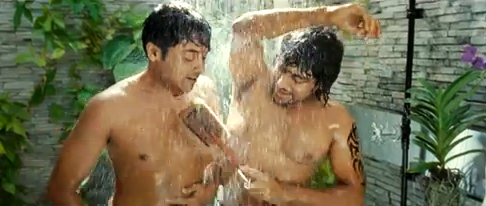
Kajol Agarwal plays the role of Anjali, who starts off interested in Vimalan but then seems to change her allegiance to Akilan without too much distress in the second half.  Rather more believably, Anjali is a Russian interpreter which at least allows her to feature occasionally in the action and Kajol is fine in her role. Since the other female protagonist is the rather stilted and uncomfortable-looking Russian journalist, Kajol is also the better dancer which gives you a clue that the dance sequences aren’t anything too great either.  Even Suriya appears awkward for most of the choreography and the best thing about the songs are Kajol’s beautiful saris and skirts.  One song appears to have been shot in the Fjords in Norway and the scenery is absolutely stunning but also totally overshadows any hint of romance between Suriya and Kajol.

The basic story could have worked well, but it’s buried underneath all the CGI and far too many irrelevant trimmings that work against building excitement or tension as the plot unfolds.  Suriya is excellent and worth watching but that’s not enough to hold Maattrraan together. If you can watch with a willingness to completely suspend disbelief and don’t mind the constant clichés then this is probably a film that you will enjoy.  Otherwise wait for the DVD where judicious use of the FF button will likely make Maattrraan more watchable.
Bheema

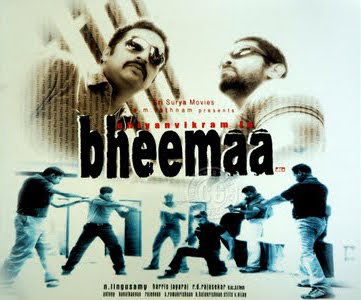
Bheema centres on the key players in a gang and their interactions with rivals and police in Chennai. It’s quite a sanitised version of the criminal underworld, and little detail  is revealed about the nature of how these guys make a living. But it has two fantastic actors at the forefront, a delightful bromance, and a focus on characters that makes the who and why of the story more interesting than the what.

Chinna (Prakash Raj) is the local hard man. He started small in a small town and has risen to become one of the biggest crimelords in Chennai. His business dealings are never overtly discussed but he is presented as a ‘good’ gangster. He looks after the defenceless, his guys don’t attack women and children, and he plays by ‘the code’. Prakash Raj is perfectly cast. He makes Chinna likeable, roguish, aggressive and menacing by turns. Chinna is under threat from an old associate (Raghuvaran) and has an uneasy and crumbling detente with the local police. Things are getting tougher, but he is not one to back down. There is a lot more to the character than just being a figurehead, and I liked the glimpses into Chinna’s past, his conversations with old advisors, his wife, even the police, that showed different facets. He thought through the consequences, he reacted emotionally to some situations and I could understand the loyalty Chinna inspired because he seemed real yet powerful. I always enjoy seeing Prakash Raj in a more substantial role, and this is one of my favourites.

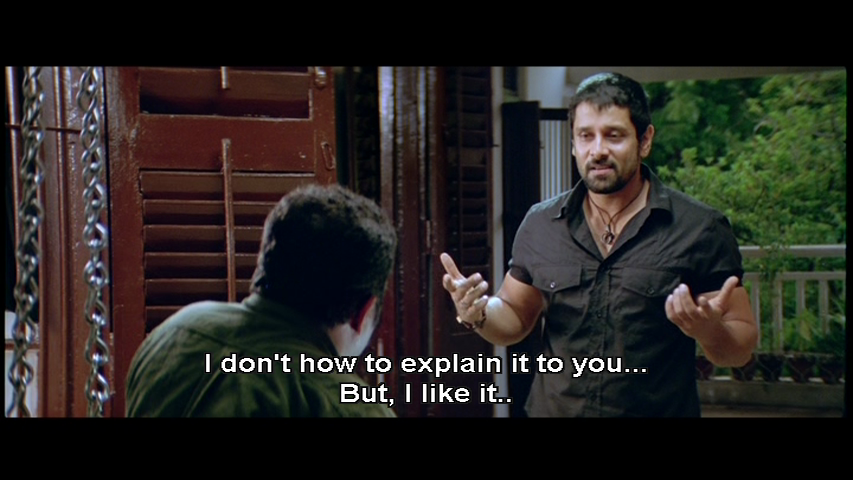
Sekar (Vikram) is an enigmatic figure, shadowing Chinna and despatching his enemies before Chinna can. The reason for his obsession eventually emerges via flashback, and it reinforces the notion that justice is not delivered by the law, and what makes a man is the ability to beat the living daylights out of another man. Sekar believes in instant justice, delivered as he sees fit. Even the police in Bheema argue that they can’t operate with the constraints of bureaucracy and low budgets, and have to break the rules to achieve what they see as justice. Sekar is given the name Bheema by the police in recognition of his strength and his role in Chinna’s life.

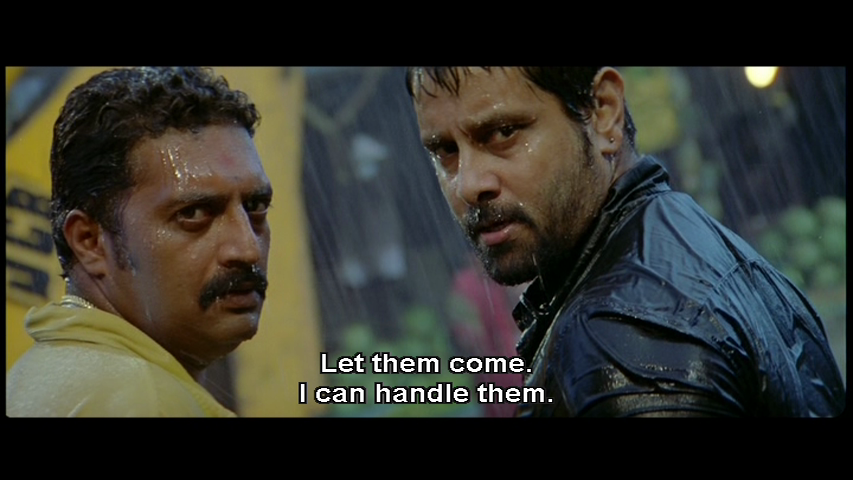
Sekar’s sole ambition was to one day join Chinna, his role model for strength and justice and a more satisfying father figure than his ineffectual policeman dad. I’ve often wondered why characters stick with their gangleader and don’t just leg it when things get crazy. Writer Sujatha provides a backstory and motivation that gives more to these guys than just being the good baddies. Vikram switches effortlessly from the full throttle action sequences to gazing mistily at Chinna or quarrelling with Shalu, and his physicality suits the invincible Sekar. Vikram’s rapport with Prakash Raj is one of my favourite things about the film and they play off each other very well.

It’s a man’s world, and sometimes in unexpected ways. Vikram steals the focus from the item girl in this song, and Prakash Raj is the one to be almost upskirted.

What sets Bheema apart from other grim gangster fairytales is characters having a life, or at least ideas, outside of the job. Chinna was in love with Padma but they drifted apart. Sekar, ever the loyal lieutenant, reunites them.

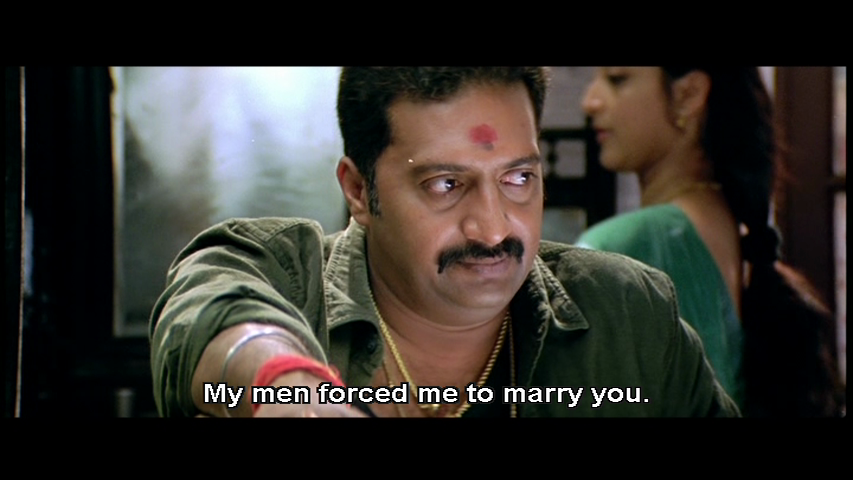
Prakash Raj does some delightfully girly fidgeting and stammering, and can’t hide either his happiness or trepidation at marrying his old flame.

Padma (Lakshmi Gopalaswamy) is gorgeous and her scenes with Chinna have a warmth and maturity that suits the slightly older lovebirds. They talk about the risks of her being part of his life, and she is firm in her assertion that she has no illusions. I found the dialogue rather flowery but the emotions came through and they seemed to have a deep mutual affection. He talks to Padma about Sekar, since Sekar is like family and Padma is in charge of the household. She and Chinna make fun of Sekar when they find out he is turning into a gooey romantic wittering about flowers, and their playful banter is another glimpse into the relationship.

Sekar loses his focus on being a thug when he starts to think of love and  Shalini (Trisha). He knows that his priorities have shifted and he can’t rely on himself to be as focussed, fearless and impulsive as he once was.  Chinna lets Sekar go, in a scene more like a breakup than an exit interview.

Unfortunately, Shalini (Trisha) is stupid and irritating for almost all her time in the story. I’m not sure why Indian film heroines characterise innocence by appearing to be dim-witted but Shalu is dumb as a box of rocks and about as interesting. Sekar falls through the roof into her courtyard one night, landing on her. Because of this, she decides he is the one, manufacturing reasons to be near him and imagining they share likes and dislikes based on absolutely no evidence. I did find her stalking Sekar mildly amusing just because it is a bit of turning the tables, but that was all I could see in her favour until quite late in the piece.

Once Sekar succumbs, Vikram and Trisha generate some chemistry and that made their relationship seem vaguely plausible. I liked that they had playful but still intimate scenes together as things developed, and it helped make up for the brain-dead start.

Chinna is a surprisingly sentimental old school don and sometimes that works against him, as he plays by rules others are starting to disregard. Sekar idolises Chinna and can’t abandon his old boss but feels compelled to take Shalini away. Once the other players sense weakness in Chinna, they start closing in. How will it all work out?

There are indicators. Shafi is in the support cast in Chinna’s gang. And Shafi does tend to play characters that bite the hand that feeds them. Also, I have developed a theory. In the imaginary Tamil Film Writing School in my mind, the compulsory class on ‘Ways to End a Film – Traditional (aka Everyone Dies (Rape Optional)’ is well attended. The final elective class ‘Ways to End a Film – Creative Writing (aka ‘No Rape, No Murder – stop being so lazy and think of something else’) falls the day after the big end of year dinner and people are either too hungover or they’ve already got enough credits to graduate, so most students don’t go. Thus there is generally one ending for a Tamil film, regardless.

I quite like the songs by Harris Jayaraj, but the picturisations of the romantic duets seem to exist mostly as a safe channel for the wardrobe department to vent their creativity.

The support cast includes so many reliable character players but the focus isn’t on them and I barely paid any heed to Ashish Vidyarthi, Tanikella Bharani, Shafi, or Raghuvaran among others. Chinna and Sekar dominate the story and Prakash Raj and Vikram likewise dominate the performances.

Linguswamy has directed an action packed film that doesn’t feel hurried or slapdash, and it is very satisfying to a point. The ending was a disappointment and yet almost exactly what I expected. The action scenes are typically excellent as is standard for this genre. There were some nice little extras – when Sekar belted a group of guys with a metal pipe, they chimed like bells as they dropped. The editing is good and the quick cuts and occasional use of effects enhance the sense of urgency or disorientation. It’s a very competent film and a pleasure to watch.

If you’re lukewarm on the South Indian gangster genre, this could be well worth a look. It has better than usual characterisations, some excellent performances and good production values. And one of the best filmi bromances. 3 ½ stars!

Heather says: I’m a fan of Tamil gangster films and usually enjoy anything by N. Linguswamy, but Bheema was rather disappointing all round. Instead of the usual well-developed storyline and strong characterisation I expect from such an accomplished director, Bheema staggers from fight scene to overdone fight scene without any real justification for the characters acting in the way they do. Rahguvaran is ineffectual as the ‘evil’ don Periyavar and his feud with ‘gangster with a concious’ Chinna seems clichéd and unimaginative. The second part of the film which concentrates on the new Police Commissioner and his vendetta against the gangs is more convincing but still seems formulaic and just not that interesting. The relationship between Chinna’s new lieutenant Sekar and the rest of the gang could have been made into something more exciting but instead it’s thrown in towards the end to try and spice up the climax. Something which only works to a limited extent. However, it’s good to see that Shafi continues his quest to always play the smarmy, self-satisfied sycophant and he does his usual thing here as one of Chinna’s men to good effect.

Despite the issues I have with the story, Bheema is saved to some extent by the excellent performances from Prakash Raj and Vikram who both breathe life into the film. I agree with Temple that their camaraderie feels very genuine and the interactions between the two do much to make up for the dreariness of the plot. Vikram’s character is very much the strong silent type and he does a good job with the rather dour Sekar, but Prakash Raj steals the show as the gangster with a heart. His romance is perfectly played and he brings out a human side to Chinna making him much more than just another world-weary gangster. Despite his good performance, Vikram looks rather over muscled here and I confess that I prefer him in more character driven roles such as in Pithamagan and Kasi where he has more range to work with. The one-man indestructible army of Sekar was just a little bit too much to take, especially with the distracting musical sound effects and overly loud soundtrack during the fight scenes.   The implausible relationship between Shalini and Sekar was another disappointment and the two never felt comfortable together –  odd, considering the considerable chemistry the two actors shared in Saamy. In fact there is much more sparkle between Chinna and Sekar!

Bheema does have a good soundtrack and there are moments where the film starts to grab your attention, but sadly they’re just not sustained. Worth watching once for Vikram and Prakash Raj but that’s all. 2 ½ stars.

Ayan

It took me a couple of films before I started to appreciate Suriya but after Pithamagan and Vaaranam Aayirami, I began to understand why so many people raved about him. The lovely Dolce recommended this film in a comment and after watching I am indeed a complete Suriya convert! Although the film is standard masala action fare with a paper-thin storyline, what makes it stand out are excellent performances from the lead actors and good well-rounded characterisations. In particular the scene-stealing Jagan Ayan is a surprise bonus in his role as a friend to Suriya’s character Deva.

The story follows a bad guys vs. good guys format although the good guys are smugglers and not exactly on the side of law and order. Suriya is Deva, an MSc graduate in computer engineering who works as a smuggler for his deceased father’s friend Dass (Prabhu). Despite his criminal activities, Dass has principles and refuses to smuggle drugs, preferring to deal in pirate DVD’s and diamonds. Now these seem to be at opposite ends of the smuggling scale to me, and I can’t imagine anyone being involved in both, but it’s not the most glaringly hard to swallow plot point, so it’s probably best not to dwell on it.

Dass is at the top of his game and apparently ranks as the number one smuggler in Chennai, a fact which does not go down well with his rival Kamalesh (Akashdeep Saigal). Kamalesh is a fairly pathetic villain, who has plenty of ambition but not much else going for him. Rather incongruously for a wannabe tough guy, he has very long hair, which he tosses back at every available opportunity and looks more like an aspiring supermodel than gangster. As far as criminal activities go he’s inept and bungling and, since Kamalesh looks like someone who wouldn’t manage to get an extra bottle of wine through customs let alone diamonds, his attempts to be top smuggler appear to be doomed to failure.

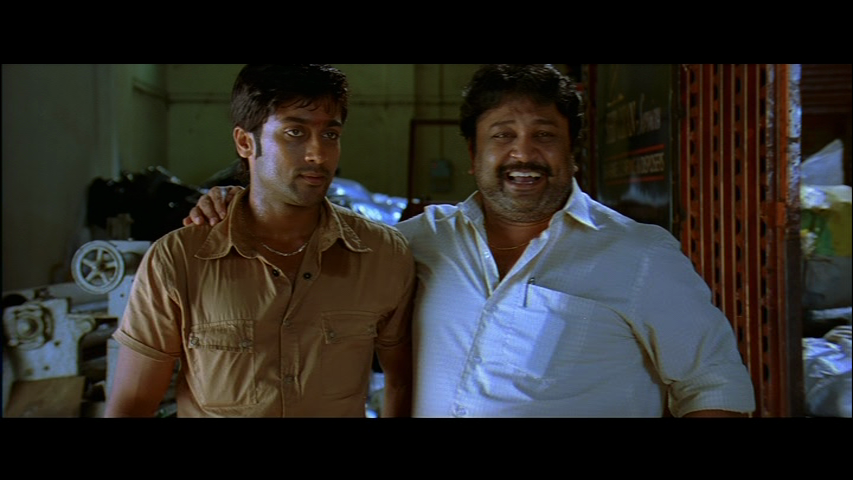
Chitti (Jagan Ayan) turns up as a hopeful member of the gang and after he does Dass a favour, is accepted into the group. He rapidly becomes an indispensable part of the team and Deva’s best friend, and the two have some excellent chemistry together. Jagan Ayan is brilliant as Chitti and I love the way his character is well developed and detailed for a non-hero role. Chitti has many shades of grey and this, along with the fact that his motivation is simply to make more money and enjoy life, makes him a more realistic character than expected from his first appearance.

Although Chitti’s character provides most of the comedy in the film, he does have a more serious part to play in the proceedings later and is just as good in the more dramatic moments. There isn’t a separate comedy track thankfully, and all of the comedy is integrated well into the main story. Deva also gets his fair share and this song features a number of ‘disguises’ worn by Deva – many of which are actually characters from his previous films. While I think he disproves the stereotype of heroes in drag and actually makes a passable woman, the long shaggy hair here is a definite no!

The other full time member of the group is Dilli (Karunas) who has a minor, but still vital, role to play and acts mainly as a driver for the others. There are a few other gang members who come and go, but the secret of Dass’s success seems to be in keeping his operation small and well hidden behind the front of a garbage disposal company. However in spite of all his precautions, the gang is continually raided by the police and Dass begins to suspect that one of the group is selling them out to Kamalesh.

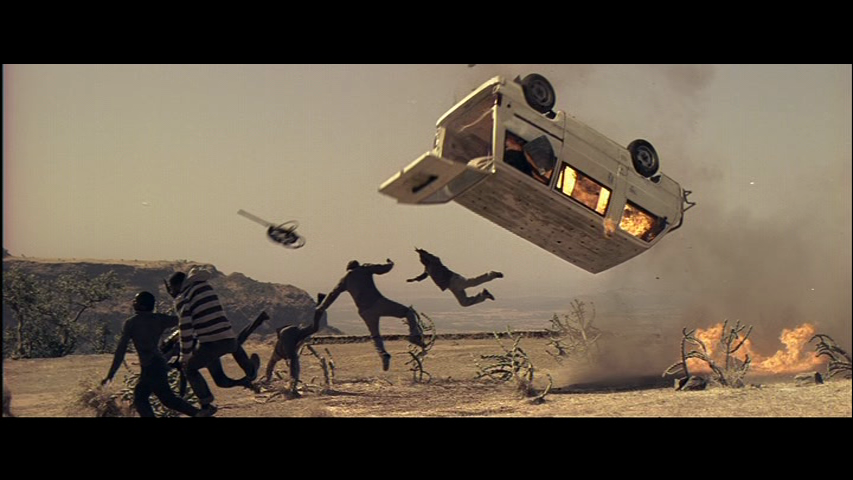
The diamonds storyline means that the action shifts to ‘The Congo’ in Africa although the filming apparently took place in Tanzania and Namibia. It does make a change from various European locations at any rate and director K. V. Anand seems to have involved quite a few locals to good effect. Although all of the film is very well shot, this section in particular features some excellent cinematography from M. S Prabhu. It also includes possibly the best chase sequence I’ve seen in a Tamil film so far. After Deva collects the diamonds via an inexplicably convoluted system of torn banknotes and secret codes, they are stolen from his hotel room. He chases after the thief who has a very large circle of friends available who keep passing the diamonds to each other and keep Deva always just one step behind. The chase has a number of parkour-inspired sequences and is cleverly directed by South African stunt co-ordinator Franz Spilhaus to look fast, slick and very convincing.

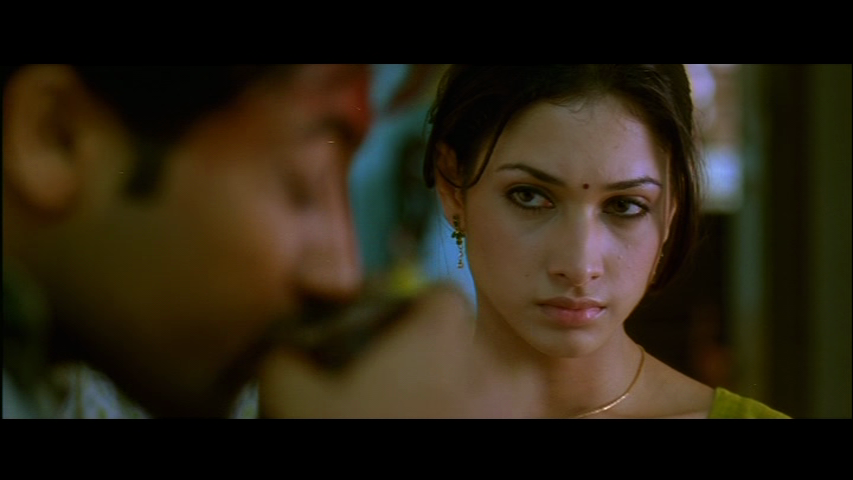
After all the action, time for some romance. Chitti has a sister, Yamuna (Tamanna) and everyone seems just as baffled as I was that they are actually siblings.

They look nothing alike, and the difference is mentioned quite a few times in Yamuna’s introduction. However Yamuna does appear to have rather good taste in men, considering that her room has a number of Shah Rukh Khan pictures on the wall (I approve!) and of course she falls in love with Deva. She’s not a shrinking violet either and is quite happy to pounce on Deva at every available opportunity. And really, who can blame her!

The love story is fairly straight forward without any major obstacles although Chitti has some of the best lines as he teases his sister and friend about their relationship. Suriya and Tamanna make a sweet and reasonably credible couple even if they fall in love rather quickly and the romance only makes fleeting appearances in the second half of the film. Tamanna looks beautiful and her character has plenty of personality which she conveys by some excellent facial expressions. I really like Tamanna as an actress and she manages to be more than just the love interest, which is always an achievement in such a very hero-centric film.

Just before the interval the traitor in the gang is revealed and once the plot twist is exposed the rest of the film loses most of the suspense and tension and becomes just another action flick. At least until near the end, where everything picks up again until the rather OTT climax fight.  The second half does tend to drag in parts and it’s not helped by the rather odd placement of the songs which mostly just disrupt the story. There is one terrible item song with Koena Mitra featuring a noticeable lack of dancing and dreadful lyrics which is used during a scene in a club and could very easily have been replaced with random dancing bodies for a more watchable effect. However a rather graphic depiction of the realities and consequences of becoming a drug mule is excellently done, and there are some great car chase sequences and explosions in the second half which almost make up for the meandering plot.

The film seems designed mainly to allow Suriya to show off his action hero persona and on that level it works well. He looks fit and capable and perfectly plays the action, romantic and comedy scenes, easily switching between the different moods and illustrating his versatility. The other characters are also well developed with both Chitti and Dass having plenty of input into the storyline and their presence also helps to define Deva’s character. Prabhas is excellent as Dass and injects a surprising amount of dignity into his role as a smuggler. The relationship between Dass and Deva is also nicely portrayed and there is genuine warmth between the characters. Renuka is good as Surya’s mother Kaveri and the other support actors all seem to fit well into their parts. Ponvannan also makes an appearance as Partiban, the harrassed Police officer in charge of customs at Chennai Airport who searches Deva on a fairly regular schedule. It’s really only Akashdeep Saigal who disappoints in both characterisation and dialogue.

Despite the unconvincing criminal Kamalesh, I really enjoy watching this film. There is plenty of action, good chemistry between Suriya and Tamanna, (although better between Suriya and Jagan) and the movie looks slick and polished. It just needs a snappier script and tighter story to make better use of the clever twists in the plot.  Still well worth a watch if you are a Suriya fan or enjoy a mass action film which keeps the action coming. 3 ½ stars for the action, story and overall film but 5 stars for Suriya!