Bajirao Mastani

Bajirao Mastani

Sanjay Leela Bhansali’s latest epic is another triumph for the set designers, costume makers, make-up artists and jewellers of whom there must have been legion. It’s not just visually spectacular either, with impressive performances from the main leads and a beautiful soundtrack and background score. In fact the story turns out to be the weakest link in an otherwise lavish spectacle since for an epic love story, the film is strangely lacking in romance. However the film still makes an impact and with strong female characters, glittering scenery and plenty of Ranveer Singh, it’s definitely well worth watching in the cinema if you can.

The opening scenes are imperially ornate and immediately set the scene for an epic tale of daring do and palace intrigue. Unfortunately there is subsequently rather less of the daring do, with few scenes of battle and the palace intrigue hinted at doesn’t come to anything either. Bajirao (Ranveer Singh) wins the post of Maratha Peshwar with some rather nifty archery, and immediately heads back to battle to continue the expansion of the Marathi kingdom. While out on campaign he comes to the aid of the King of Bundelkhand and after rescuing the kingdom from an army of invaders, Bajirao falls for the King’s daughter by his second Muslim wife, Mastani (Deepika Padukone).

Mastani is a warrior too and manages some impressive sword work herself, which is presumably why Bajirao falls for her. But what happens in Bundelkhand should stay in Bundelkhand and the trouble starts when Mastani follows Bajirao back to Pune, where Bajirao lives with his wife Kashibai (Priyanka Chopra) and his mother Radhabai (Tanvi Azmi). Radhabai is incensed that her family line should be polluted by a foreigner’s blood, particularly since Mastani is Muslim, and she deliberately humiliates Mastani at every opportunity. Radhabai is an interesting character with a little more depth that just a standard outraged matriarch and Tanvi Azmi is excellent as the embittered widow who feels she is fighting for her family’s honour. She is ably supported in her machinations by Bajirao’s younger brother Chimaji Appa (Vaibbhav Tatwawdi) and his eldest son with Kashibai, Nana (Ayush Tandon). Her outrage and vehement opposition to Mastani is perfectly vindictive and beautifully balanced by her warm relationship with Kashibai and her devotion to her son.

Ranveer Singh does a fantastic job as Bajirao to the extent that I don’t actually like his character much – impressive when I usually love every character he portrays. Here he is consumed by desire and mostly oblivious to the pain he causes others, making him too arrogant to be a completely likeable character. Bajirao is certainly a fearless warrior, but Ranveer gives him a compassionate side and also allows glimpses of insecurity through his relationship with Mastani.  However he doesn’t see the contempt with which his family views Mastani and seems oblivious to the threats against her life. He is more concerned with his role as Peshwar until he lets his desire for Mastani overcome his sense of duty and allows his obsession with her to rule his life. Ranveer shows little of the swagger and attitude from Kil Dil and Gunday, but transforms himself into an eighteenth century warrior with plenty of imperial remoteness and stately reserve, which may partly explain the lack of warmth in his relationships. Unfortunately Bhansali doesn’t show many battles, and in the few fight scenes Ranveer mainly sits on a horse and swings his curling sword, although he does manage a few good grimaces as he rides to battle. Maybe I watch too many SI films but I was disappointed at the lack of battle scenes and would have loved more action rather than the relatively bloodless clashes here.

As Mastani, Deepika is mesmerizing when she snarls her way through battle but she becomes flat and lifeless once she transforms into the love of Bajirao’s life, losing all her sparkle.  I find Bhansali’s depiction of Mastani in love as insipid and overly compliant. Where did all her passion go? There is definite chemistry between Ranveer and Deepika, but there appears to be little joy in the relationship and I’m not sure that smouldering looks and declarations of’ acceptance’ are enough to explain why Mastani submits to the many indignities heaped on her admittedly capable shoulders. A love that is strong enough to withstand such determined and murderous opposition should be grand, overwhelming and all-encompassing, but that just doesn’t come across in the relationship between Bajirao and Mastani, and that is the most disappointing aspect of the film.

The best of the main leads is undoubtedly Priyanka Chopra as Bajirao’s first wife. She has the passion and joy in her relationship with Bajirao that is lacking in his relationship with Mastani and gets to show all her rage and humiliation when she discovers Bajirao’s infidelity. Priyanka is brilliant here in a perfectly nuanced performance that gives her the opportunity to show passion, despair, hate and compassion and she gets it right every time. Kashibai is the more interesting character and with grace and beauty Priyanka makes the most of the opportunity given to her in a faultless depiction of a betrayed wife.  She gets to dance too, and if Pinga doesn’t quite reach the choreographic heights of Dola Re Dola, Priyanka and Deepika are both beautiful dancers and look absolutely stunning too.

I didn’t know the story of the warrior Bajirao and his second wife Mastani before watching the film, and I’m not sure that I know much more about them afterwards either.  Bhansali takes moments from Bajirao’s life (although for a film about a great martial leader there are few glimpses of this side of his character) and intersperses them with behind the scenes action in his household, but the narrative jumps hours, days and then years without any clear indication, resulting in a disjointed timeline. Each scene is individually good, but doesn’t always totally gel with the preceding or subsequent action, while the lack of passion and joy in the relationship between Bajirao and Mastani is disappointing. However the opulent sets and overall grandeur of Bajirao Mastani are of the overall high quality expected from Sanjay Leela Bhansali and ensure that the film is worth watching even if it’s not as engaging as I would have liked. I’d recommend watching for the visual impact and for the excellent performances from all the cast, especially Ranveer and Priyanka.

Mardaani

Mardaani

Mardaani is a crime drama from director Pradeep Sarkar and writer Gopi Puthran based around the investigation of a drug smuggling business and child trafficking ring in India. What makes it rather more unusual is that the cop chasing after the bad guys isn’t the usual rough, tough and unbeatable hero, but instead is the equally rough and tough but rather more pragmatically sensible Rani Mukerjee. As Senior Inspector Shivani Shivaji Roy, Rani takes on a crime boss and his gang when a young street vendor she has previously rescued goes missing. It’s a straight police procedural drama for most of the film but does veer off into overly melodramatic action for the last 15 minutes or so, presumably to add more commercial appeal. However Rani is superb, Tahir Raj Bhasin is excellent as the villain of the piece and overall the film works as an action thriller that is more realistic than most.

The film opens with the apprehension of a criminal by Mumbai’s Crime Branch, and the raid and subsequent capture nicely illustrate the rapport Inspector Shivani has with her team and the respect they have for her. They all joke together on the way to the raid but police officers Jafar and Morey still obey every order without question once the action begins. Dressed in a sari and noticeably understated make-up, Shivani is a cop who follows the rules when necessary, but also knows just how far rules can be bent without causing any visible stretch marks. She’s equally capable whether she’s on duty as a police officer, or at home looking after her family and is smart enough to reason her way through a case rather than bludgeoning her way to a result. The end product is a more realistic police officer and a more probable investigative team, at least as far as the world of cinema is concerned.

Shivani is married to Dr Bikram Roy (Jisshu Sengupta) and the couple look after her orphaned niece Meera (Avneet Kaur), giving Shivani a realistic and stable home life as well as illustrating that she is more than just a kick-arse cop with excellent multi-tasking skills. The person Shivani seems to care about most though is Pyaari (Priyanka Sharma), a girl Shivani rescued and placed in an orphanage and school after Pyaari’s uncle tried to sell her on the streets. When Pyaari disappears, Shivani accepts Meera’s assertion than Pyaari has been kidnapped, and given the truly frightening statistics given at the end of the film it does seem the most likely scenario. Shivani quickly establishes that one of the men associated with the orphanage is implicated in Pyaari’s disappearance and her subsequent investigations lead her to a drug dealer who is also part of the gang. From here it’s a short step to Vakil (Anil George), and the realisation that she has stumbled upon a large and well organised drug smuggling and human trafficking ring. Vakil is the face of the organisation and the man the drug dealers think is in charge, but standing in the shadows behind Vakil is the real boss, Karan (Tahir Raj Bhasin).

One of the reasons why the film works so well is the developing relationship between Shivani and Karan and the careful steps they take to outwit each other. Karan calls Shivani when her investigation begins to impinge on his organisation, and their subsequent phone conversations become an integral part of the story. At one point Karan introduces himself as Walter White, a nod to the Breaking Bad character, and a clear indication that he considers himself a criminal mastermind. Generally Bhasin plays Karan with an aura of cool authority mixed with genuine menace as he orders his various lackeys around and keeps track of his business empire. In scenes where the kidnapped girls are stripped, showered and basically dehumanised, it’s obvious Karan sees them purely as merchandise to be sold, a tactic that moves the film away from tacky voyeurism into a sinister and shockingly more realistic place. However when he calls Shivani, she refers to him as ‘the kid’ and remains cool and calm, refusing to rise to his threats or attempts at intimidation and it’s Karan who struggles to keep his composure. Shivani remains professional when dealing with Karan despite her fears for Pyaari, and it’s only towards the end that her self-control slides and she embarks on a more vigilante style of action.

While the film didn’t need quite so much focus on the plight of the girls, their abuse and degradation is effective in building outrage that is later used as a justification for Shivani’s unconventional method to bring Karan to justice. The film also loses some credibility when Rani morphs into a more typical filmi-hero and channels her inner Salman Khan for the last few scenes, taking the law into her own hands. It dulls the effect of the rest of the film, although there is some satisfaction is seeing the abused get their own back on their abusers. There is also a tendency for the film to become rather preachy towards the end with Shivani lecturing the police chief in Delhi when he is reluctant to pursue the human traffickers, but the statistics that play over the end credits are likely an indication of the point Pradeep Sarkar was trying to make. The details about the massive numbers of children who go missing and the extent of the child sex-trade are chilling and anything that raises awareness, and hopefully subsequent prosecutions and a downward change in these figures is welcome. It’s not all about ‘the message’ though, and for the most part the film is an action thriller with an engaging storyline.

Mardaani keeps to a standard storyline, but the plot is well structured with realistic characters and feasible action that keeps the film believable. Rani and Bhasin are the standouts but the support cast are all good, although the young actresses playing the girls do become overly dramatic at times. It suits the situation though and at least none of the scenes with the girls are remotely suggestive but rather reflect the brutality of the kidnappers instead. The film is a different approach to a police drama and while it’s not an overtly feminist film it is good to have a strong female character as the lead, particularly when she takes on a more traditionally masculine role so successfully. Worth watching for Rani, a more realistic storyline (at least until near the end) and Tahir Raj Bhasin, who will hopefully live up to the promise he shows here. 3 ½ stars.

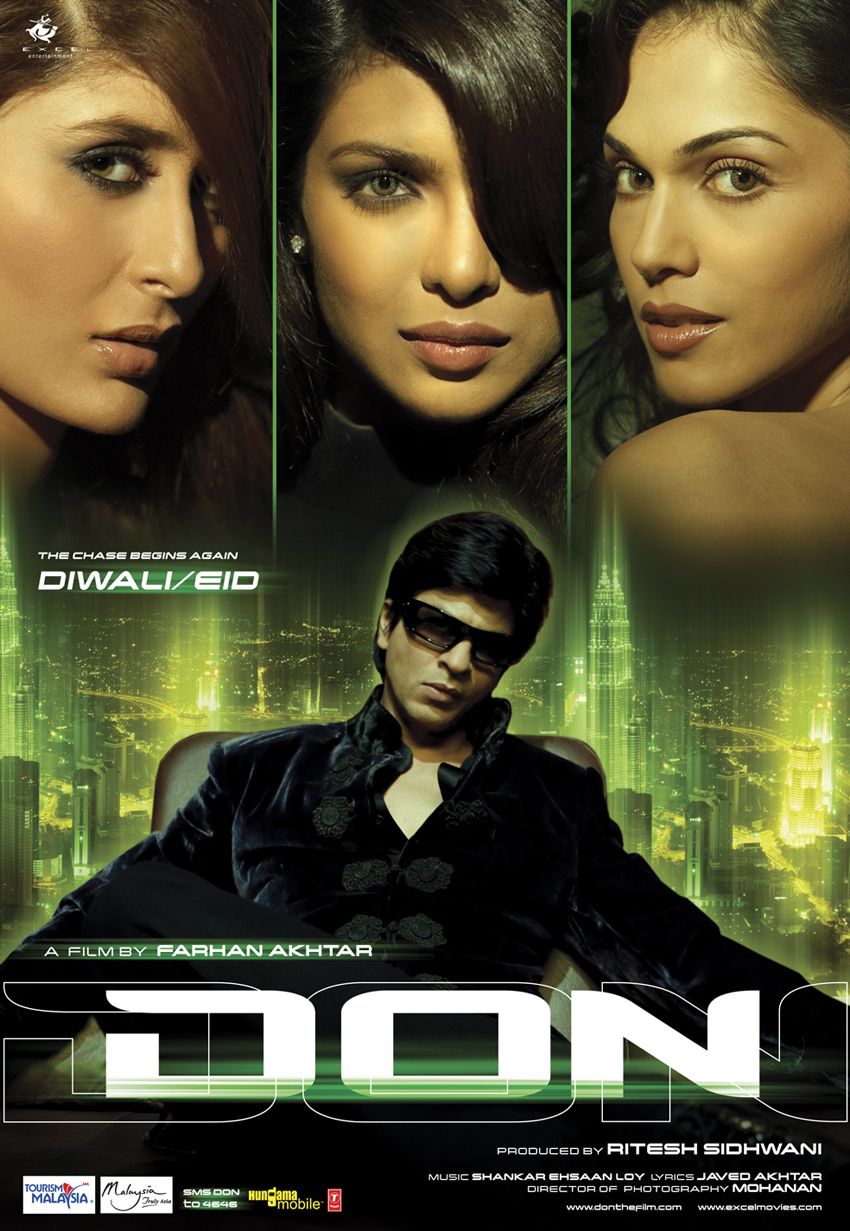
Don (2006)

Don

Normally I’m not a fan of remakes since they are generally nowhere near as good as the original, but Farhan Akhtar’s Don is the exception that proves the rule – at least for me. As much as I love the original Don with Amitabh Bachchan, Iftekhar, Helen and co, the remake slickly updates the story and adds a few new twists that make the end at least just that little bit better. I love Shahrukh Khan when he’s in anti-hero mode, and this is an excellent example of how good SRK can be when he’s being bad. There are a few misses, but overall good casting, clever writing and an excellent soundtrack make Don one of my favourite SRK films.

The remake follows the original 1978 Don fairly closely in terms of the screenplay but sets most of the story in Malaysia where Don (Shahrukh Khan) is the ‘most dangerous and cunning criminal’ in an organisation than spans the globe smuggling drugs. Don heads up the Malaysian arm of the gang and works for Singhania ( Rajesh Khattar), the rival of fellow ultra-elusive gang member Vardhaan. DCP DiSilva (Boman Irani) is on the trail of the criminals along with his colleague Inspector Verma (Sidharth  Jyoti) and Interpol Officer Vishal Malik (Om Puri).

Shahrukh appears to enjoy playing the utterly ruthless and callous Don and he seems to slip effortlessly into evil mode when required. His Don is perhaps a little too flamboyant and his fashion sense is rather quirky (those terrible ties-inside-the shirt!), but his panache and flair in the opening scenes when he imitates some ballet dancers and then a few moments later causes carnage and mayhem during a drug deal gone wrong is superb. He’s cool, collected and practical when it comes to getting rid of police informers and in dealing with recalcitrant gang members, but does show his softer side to Anita (Isha Koppikar) and a little more uncertainty with fellow gang member Narang (Pawan Malhotra). This shading makes Don more interesting and generates some empathy for what is really quite an unpleasant character at the start of the film.

One of the misses is the remake of the classic Helen number Yeh Mera Dil. Kareena Kapoor takes on the role of Kamini, the revenge seeking fiancé of gang member Ramesh (Diwaker Pundir), killed by Don for his disloyalty. Kareena just doesn’t have the vibrancy or class of Helen, and her seduction routine is clinical and passionless as a result. There’s no rage, no thirst for revenge or abhorrence at getting close to the man who murdered her fiancé and it ends up as nothing more than a lot of shimmying in a gold lamé dress.  It’s not surprising Don looks somewhat disdainful and fairly unimpressed throughout.

Priyanka Chopra is much better as Roma and at least looks as if she is capable of murder. At least up until she actually tries to kill Don at which point she seems to lose her mojo. Still, it’s a good effort and she does well in the songs too, although I think Isha Koppikar takes the honours here – plus who doesn’t love a giant disco mirror ball. Both Priyanka and Isha  look stunning and are obviously included to up the glamour quotient, but both do a good job in their roles and appear as strong and confident characters throughout.

Don is seriously injured and captured by the police during a chase in India which gives DCP DiSilva the opportunity to replace Don with a local entertainer Vijay (also SRK) who is the spitting image of the gangster. SRK’s Vijay is a tad more sensible than in the original, and Shahrukh makes him a very different character to Don. He even looks quite different, using facial expressions and body movement to emphasize the difference between the two characters – at least up until the surgery to make them both the same.

However, since only DiSilva and the fake Don know about the impersonation, when DiSilva is killed during an operation to catch Singhania it all starts to go pear-shaped for Vijay. As well as dodging the police and fooling the gang into believing he is Don, Vijay has to deal with Roma’s attempts at revenge and somehow get a disc with information about the gang to Malik to prove his innocence.   Meanwhile Jasjit (Arjun Rampal) is also out for revenge after DiSilva caused the death of his wife, adding more layers to the plot and a means to bring it all to a satisfactory conclusion.

The updated film has plenty of high powered car chases and some cool fight scenes which all work pretty well. There are a couple of escapes too – the first is rather unnecessarily convoluted, but the second is fun as it involves Don wrestling one of his gang members for a parachute while plunging to the ground after jumping out of a plane. Now if this had been a Southern Indian film, Don would have had a handy gun and some explosive to deal with the problem, but here he just has to fight it out while the ground spins giddily below and rushes every closer.

The film has a great soundtrack from Shankar-Ehsan-Loy which uses two songs and the general theme from the original film. The second remix is Khaike Paan Banaraswala which fares much better than the Helen remake number, and is a lot of fun – I suspect most of the direction here was asking SRK to act goofy and he manages to do so repeatedly!

https://youtu.be/SiUkZhz06aA?t=232s

Overall the casting is excellent and the support actors all seem to fit their parts well. Boman Irani is in sensible mode as DiSilva and he makes a good world-weary cop. I find he can be erratic, depending on the director and is often better in comedic rather than straight roles, but he does an excellent job here and suits the role. Om Puri is a little under used in a role that doesn’t give him much scope, but has a couple of good scenes with DiSilva where he is suspicious of absolutely everyone and he fits that character style perfectly. Perhaps most surprising is Arjun Rampal who I remember thinking was much better here than in any of his films I’d seen previously, and puts in an emotionally mature performance as a devastated man out for blood.

I went to the cinema prepared to be disappointed in Don and was instead surprised by how much I enjoyed the film, and still love watching the DVD. Expensive production makes the stunts work well and lifts the thrill factor, but none of that would matter without good performances and a well thought out rewrite of the story. The film works for me because of SRK and Boman Irani, but everyone has their part to play in making Don such an entertaining film. The Malaysian backdrop looks amazing, the soundtrack is great and the dialogue and stunts are brilliant. It may be a remake but it’s a great film in its own right and I love this version just as much as the original. 5 stars!