Reshma aur Shera

Reshma Aur Shera is one of my favourite films in any language. I don’t often like romantic tragedies as all too often I feel I’ve wasted my time watching people I don’t care for as they do idiotic things that could have been avoided if they weren’t so one dimensional or stupid. But each time I watch Reshma Aur Shera, despite knowing what is going to happen next, I fall in love with it all over again.

The love story is simple but engaging and Waheeda Rehman and Sunil Dutt light up the screen with their chemistry and brilliant acting. The tragedy comes from the spectre of death in a tribal feud set against the hope for change. Producer, director and star Sunil Dutt and writer Ali Raza created a full context for the lovers and that sense of place and family, the depth of the characters,  makes their predicament feel more immediate and of consequence. It also makes the film entertaining beyond just the romance, and it isn’t all gloom and despair. There is joy, fun and beauty too.

Reshma (Waheeda Rehman) is the daughter of Chaudhury of Pochina and Shera (Sunil Dutt) is the eldest son of his enemy, the Chaudhury Sagat Singh. These families have been picking each other off for years.
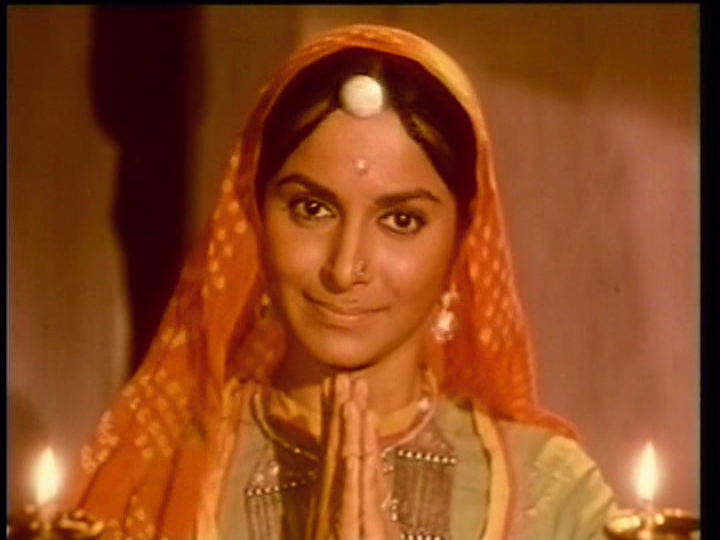
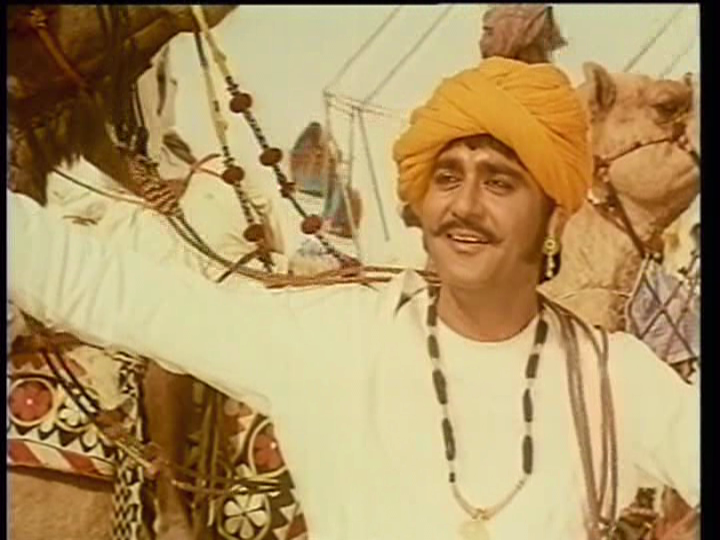
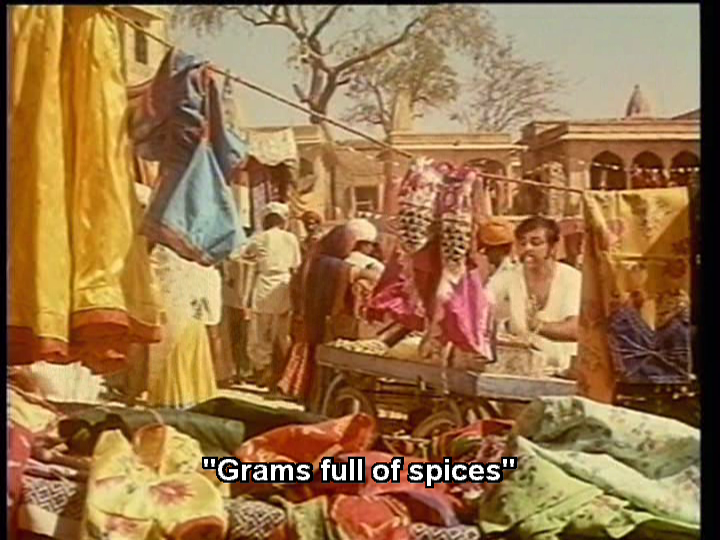
They meet at a fair in Jaisalmer, at the Durga Puja (she is also the presiding deity of the story). Shera fancies Reshma on sight and, like a good girl, Reshma coyly avoids him. The fair is wonderful looking, and I had moments of feeling I was watching a documentary rather than a set. There is so much to see with Reshma as she darts around enjoying the amusements, the snacks and the shopping.



The ecstatic music of a qawwali brings them face to face again, and in this heightened state a deeper emotional connection forms. I love this picturisation as it takes the viewer deep into the scene, with the vocals conveying the intoxication and pain of love. And it features a very young Sanjay Dutt (who developed his unique sense of rhythm early on it appears).

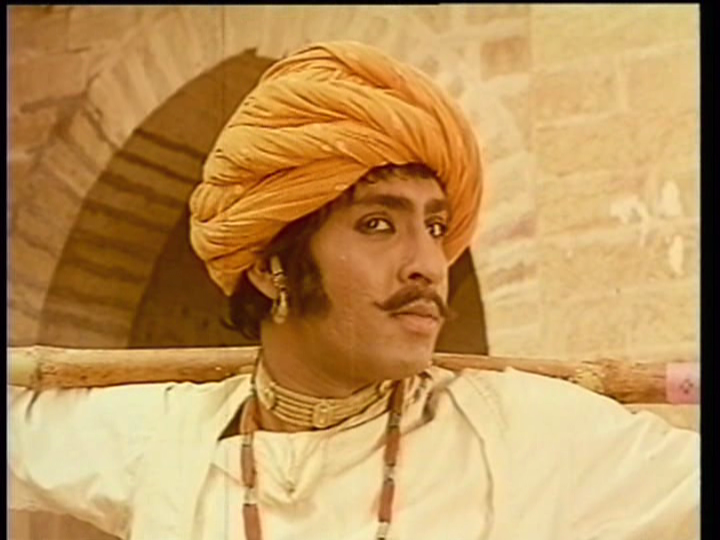
Once they discover each other’s identity, Reshma asks Shera to sacrifice her at the altar – a blood sacrifice not a marital altar. She wants to protect her brother Gopal (an outrageously handsome Ranjeet), and offers her life in place of his. Shera had already rescued Gopal from his own brothers earlier that day, proving himself honourable if unpopular with his kin and further impressing Reshma. Shera is determined their love will succeed and Reshma wants to believe.  They meet in the temple before leaving for home, and decide that they can have each other and bring about an end to the feud if they are careful.
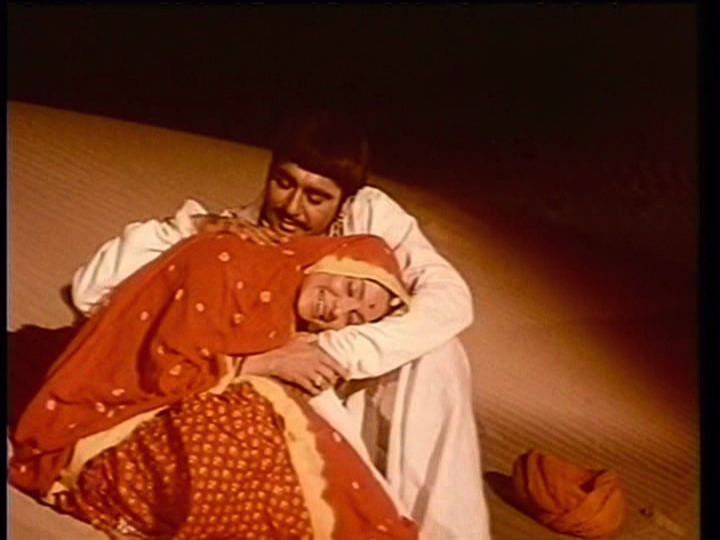
Back in their villages life goes on, except that Shera and Reshma sneak into the desert to meet at night. Despite the stalker-ish beginning to the romance, it is a passionate mutual attraction and they both have a share in conversations about their future.
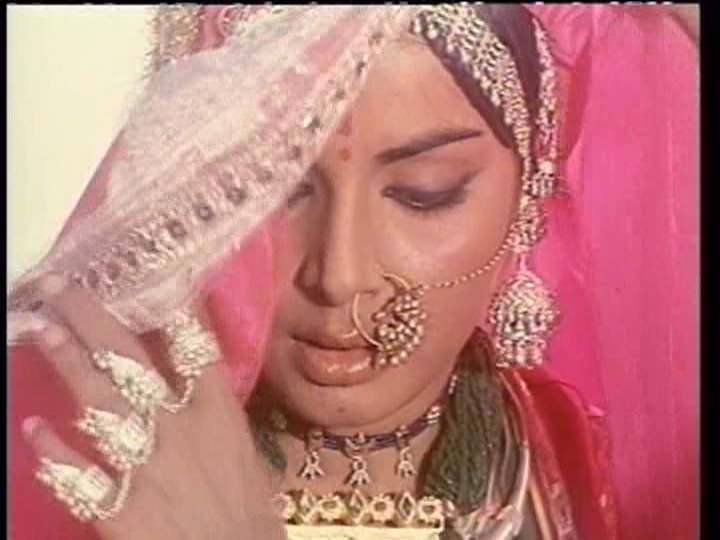
Family and friends are an important part of who Reshma and Shera are and why they do what they do. And the supporting cast is so impressive – Vinod Khanna as Shera’s nasty brother Vijay, Amrish Puri as an elder in Shera’s village, Jagant and Sulochana Latkar as Shera’s parents, the dashing Sudhir as the qawwali singer, Padma Khanna as an uninhibited nautch girl, Ranjeet as Gopal, Rakhee in a small but high impact role as Gopal’s wife, just to name a few.
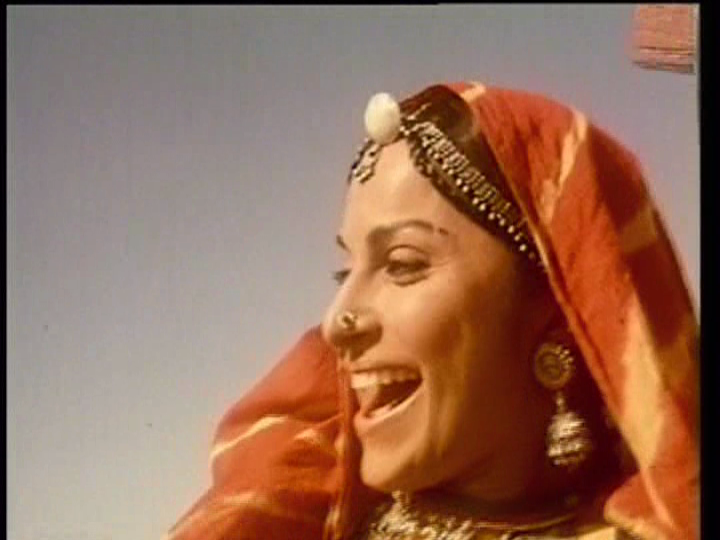
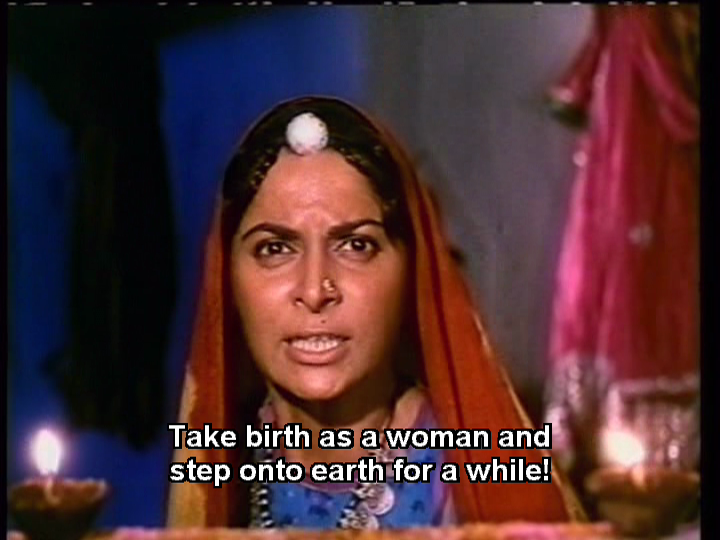
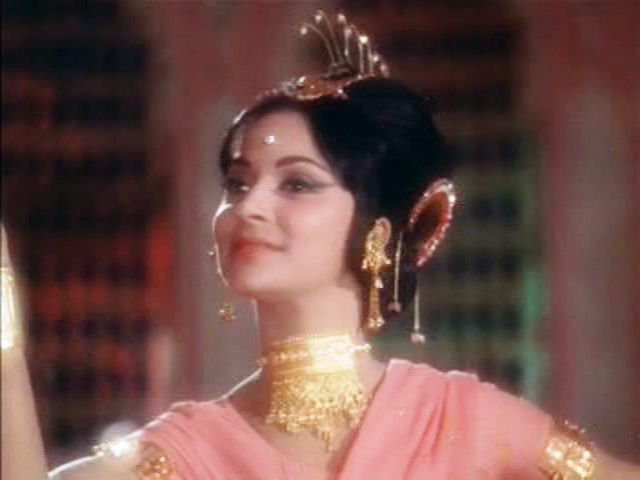
Waheeda Rehman is simply amazing. Reshma evolves from a pretty young thing, giddy with excitement, to a more sombre young woman passionately in love with an enemy.  She realises she should send Shera away for good, but cannot sever their bond. Finally running out of options, Reshma challenges Durga to prove herself by taking on life as a woman on earth and see how that feels. Waheeda is just magnificent as she demands help in return for all the sacrifices to the goddess. And Durga does give her an answer.
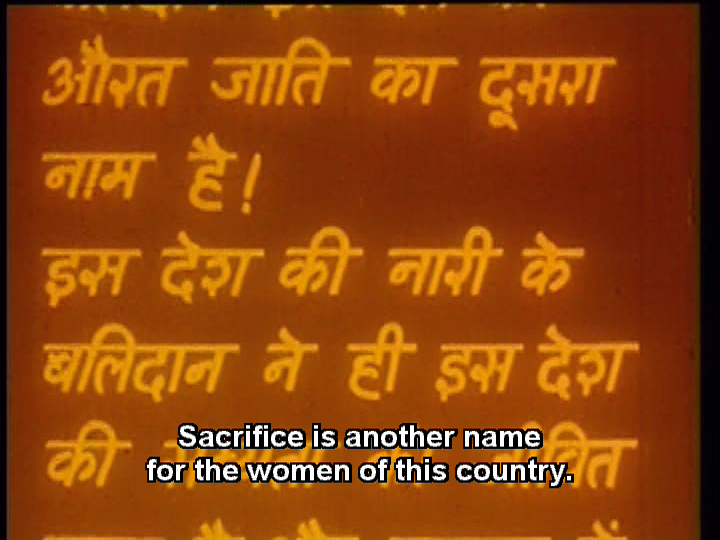
Despite a ponderous voiceover at the start of the film extolling the Indian woman’s virtue of sacrifice, Reshma is not a passive sacrificial offering but rather uses herself as a means of creating change. When she makes up her mind, she does it to save Shera and stop the feud from claiming everyone she loves. She is determined and forceful, a far cry from the blushing girl she was at the start. It’s a challenging role and she delivers a beautiful characterisation.

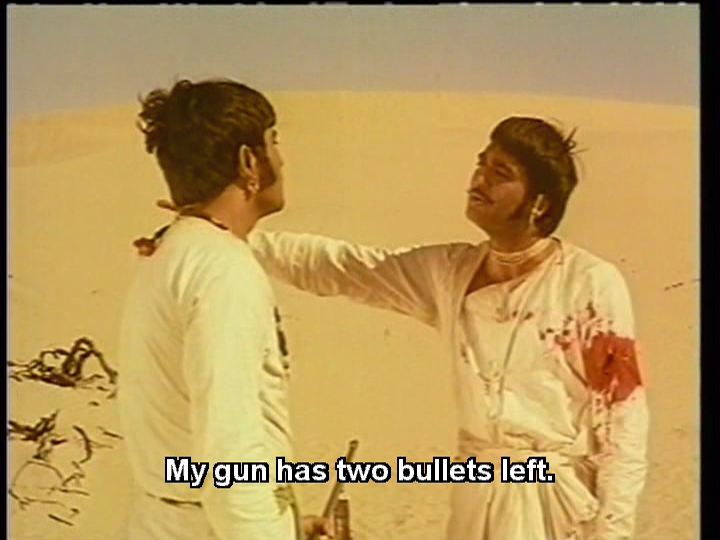
While I initially thought Sunil Dutt looked a little too mature to be Shera, he has a certain appeal and even plays some unexpectedly goofy and sweet moments. He transforms from a lad about the fair to a future leader challenging his own father. His internal conflict is evident – the Rajput sense of honour and the man who wants a happy and peaceful future with the love of his life. Shera seems to benefit from the close relationship he has with his mother and his respect for Reshma, being prepared to think outside the heroic norms. But where Reshma suffers loss after loss and creates a solution of sorts, Shera reverts to type becoming as vengeful and bloodthirsty as his father and brothers.
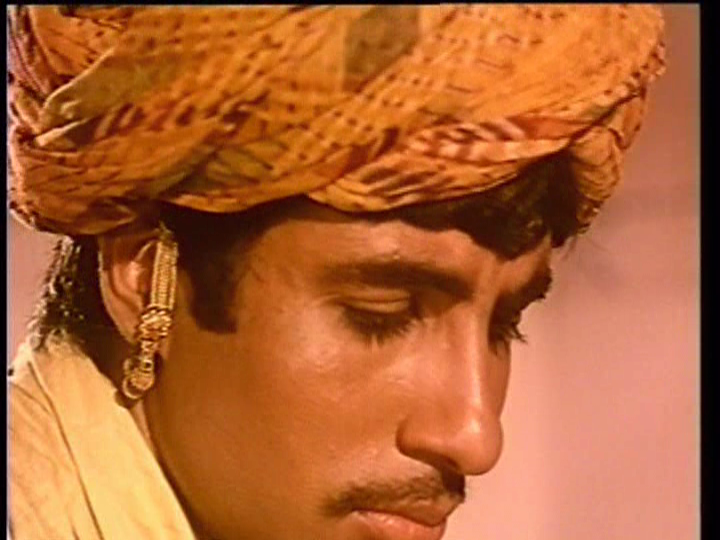
Chotu (Amitabh) is a mute and is neglected by brothers Vijay and Jagat unless they need his sharpshooting skills. He worships Shera who treats him kindly and seems to be his only friend. Amitabh’s performance is beautiful, quite restrained and very moving. Chotu is a sad and confused young man, following his father’s path. He is ultimately responsible for killing Reshma’s father and brother, and that sets the final train of events in motion. While Sagat Singh takes the boys to a brothel as reward, Shera swears vengeance on whoever the killer was.

Their mother (Sulochana Latkar) emerges as a powerful force. Initially she wants Shera to follow his father’s order and kill Gopal, putting her sons above all else. But once things implode, she takes matters into her own hands to save what is left of her family. She takes Chotu to Reshma’s village and offers him as a sacrifice. The confrontation in Reshma’s home is gut-wrenching. Chotu is traumatised and disgusted at himself, and Rakhee as Gopal’s widow faces a life in ruins. He wants to die, can’t bear the pain of betraying Shera and knows he is doomed. This sequence is the one that gives me a lump in my throat every time. I can identify with the motivations of all the characters, and it seems impossible to reconcile their needs.

Creative versus destructive energies underlies much of the character interactions and is often divided on gender lines.  Not that the women are all about popping out babies and nurturing – I mean that their energy seems more focussed on preserving their homes, and on renewal and regeneration. They might destroy something or someone, even themselves, to achieve it but they have a positive goal rather than just aiming for obliteration of an enemy.  The action in the film may generally follow the men but the women are making choices that drive the story. It’s also a film rich in symbolism and visual themes. The motifs of fire and circles reinforce the cycles of destruction and rebirth.

The cinematography is beautiful, and S Ramachandra captures the harsh light, the muted earth tones and the vibrant fabrics of Rajasthan. The costumes and jewellery are stunning, and the buildings look real and lived in, with glimpses of details in kitchens and bedrooms. Plus – lovely music by Jai Dev, choreography by Gopi Krishna (assisted by one Miss Saroj Khan), and playback singers Asha, Lata, Manna Dey.

My DVD is missing about 20 minutes of the complete film so there are a couple of large gaps, one of which probably shows the killing of Reshma’s family. It’s so frustrating but the story is still clear and you can fill in the gaps.

The first time I watched Reshma aur Shera I was stunned. I immediately wanted to watch it again but as with any decision about true love versus a passing fancy, I decided to give it some time. Love it is. It is such a captivating film, and a beautiful work of art. I cannot recommend it highly enough. 5 stars!

Katherine at Totally Filmi is coordinating a month long celebration of women in Indian cinema. Links will be collated at Delicious so keep an eye on that page for lots of other articles and blog posts to be added throughout March.

Chashme Buddoor (1981)

There is a joyful goodness in Chashme Buddoor that I don’t think would seem commercial enough nowadays when film comedy about female/male relationships seems to be mostly titillating or sleazy. Writer director Sai Paranjape has an eye for facets of speech and behaviour that she layers cleverly to make a slight story into a satisfying film. I can relate to the characters, their dilemmas and their sense of humour. There are filmi jokes, parodies and genuinely funny moments galore, plus a really nice love story.

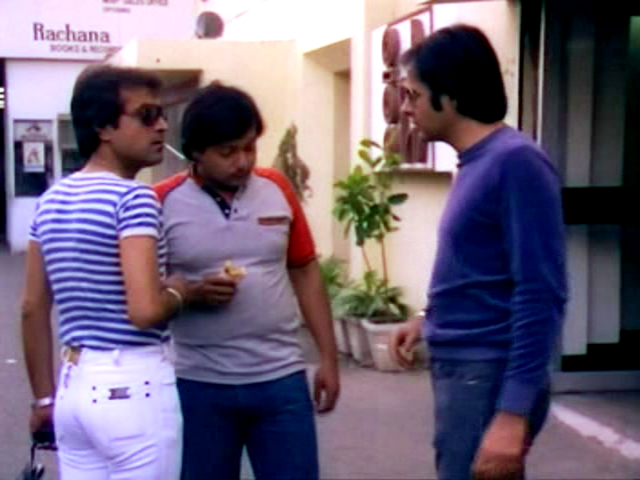
Two clueless friends, Omi (Rakesh Bedi) and Jai (Ravi Baswani) think that romance happens just like it does in the films, and remain resolutely impractical in their approach to love. Their misadventures and air of genial cluelessness is a foil for the more serious Siddharth (Farooq Shaikh). And the filmi tropes they swear by – stalking, harassment, loitering in parks –  all fail. It is genuine interest and getting to know another person that might just win the girl. Eventually.

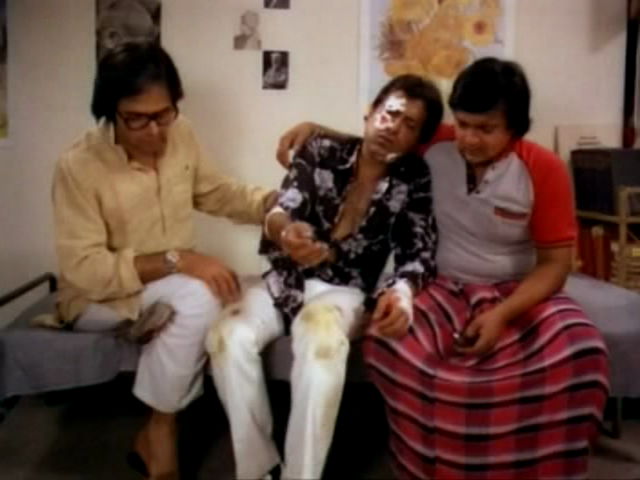
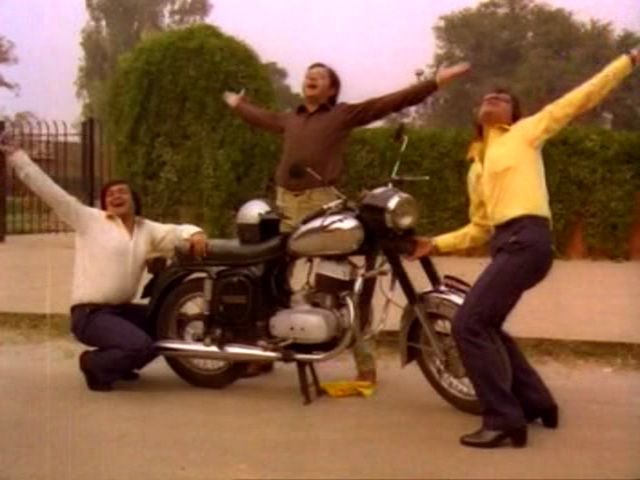
The three men share a small apartment, with all the usual trappings of bachelordom – a big empty kitchen, wall ‘art’ and the bare minimum in comforts. There are many enjoyable details in how they share cigarettes, their routine and schedules, their reliance on Siddharth to start the sole motorcycle. The male actors work beautifully in the ensemble scenes and each has a distinct style that suits their characters. It’s such a typical student household and they are each other’s family. Most of their experience with women is derived from ogling the rare female passerby from the balcony. Constantly in debt to Lalan Mian (Saeed Jaffrey) for their smokes, they alternate between bluff and avoidance as they try and get on with the important things. Like girls.

Neha (Deepti Naval) is one of the few real girls the boys meet. Omi and Jai set out to woo her, and despite having brilliantly scripted plans based on current best practice from the movies, both are sent packing.

Omi fancies himself a poet and Jai pretends to be the younger brother of a film producer. Each gets a song showing their version of events, and I am especially fond of this parody medley.

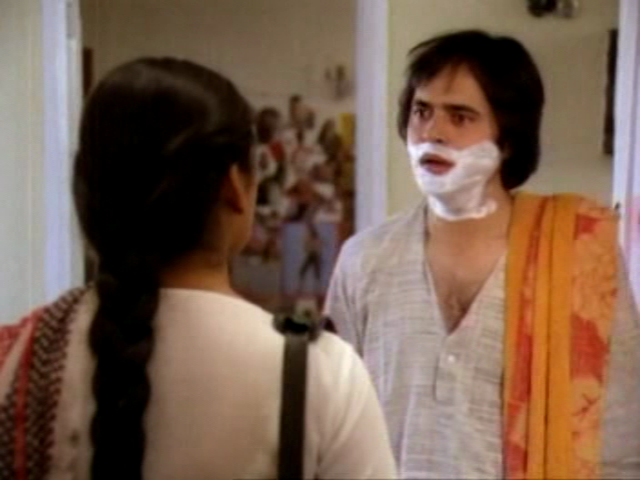
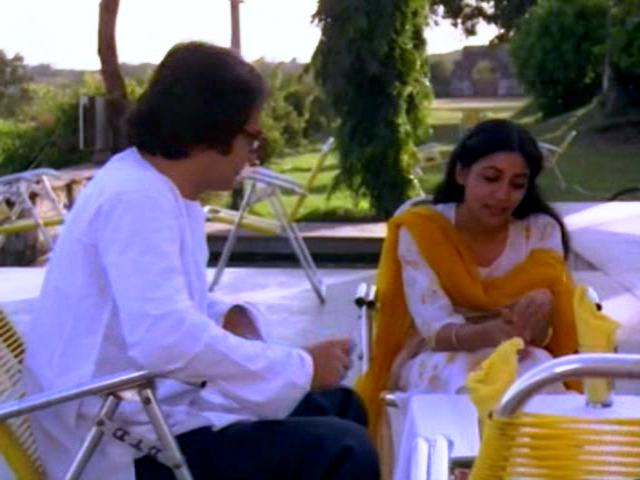
Quiet studious Siddharth meets Neha when she is working in door to door marketing, demonstrating Chamko washing powder. They have a shy stilted conversation in which Neha carefully tells Siddharth where she can be found in the evenings and he just as carefully listens and remembers. Obviously this is a fantasy.

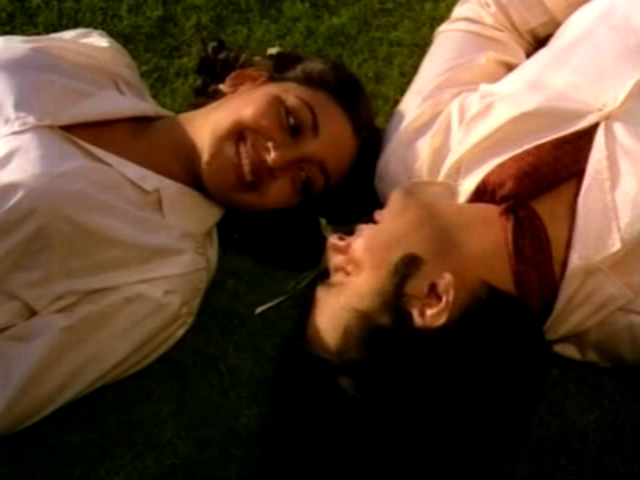
Their relationship grows through conversation and vast amounts of ice cream. Siddharth occasionally tries to act like his friends tell him to, but Neha challenges him and he immediately drops the posturing and admits he has no clue. It’s a nice unremarkable romance that grows unnoticed by friends and family. Until Siddharth gets his money order and decides to splurge on some fancy clothes. Blue velour? I know it was the 80s but still!

He is pleasant, abstracted but not anti-social and seems content to be the butt of his friends’ jokes. Unlike many other filmi heroes he can, and does, change course when he realises he needs to think of Neha as well himself. Farooq Shaikh is perfectly cast as the introverted and essentially good natured Siddharth, and also delivers the broad comedic scenes with playfulness.

Neha isn’t just sitting around waiting for a husband – she wants to study, has notions about her future and raises the subject of Siddharth with her dad to prevent him arranging an unwanted marriage. She is also quite clear on telling Siddharth that being a wife is not her immediate priority. Deepti plays her as a nice girl-next-door with a good amount of common sense, a dash of fun, and a smile that lights up the screen. She has a nice chemistry with Farooq too.

When the couple have the inevitable setback, Neha goes on despite her sadness and confusion. Siddharth is the one who loses his motivation, and unfortunately his friends decide to help him. And you will have to see the film to find out if they succeeded.

All the actors look right for their roles. There is no excess of glamour, or inappropriate wardrobe as far as I can tell. Saeed Jaffrey is lots of fun as Lalan Mian, the local paan stall owner and father figure. He can switch from berating Jai to lending him a bike so he can go chase a girl without pausing for a breath.

I loved his philosophical ruminations on debt and love, and he has such a twinkle in his eye. Leela Mishra as Neha’s grandmother seems to have a filmi streak like the boys, and has some very funny scenes. Vinod Doshi and Ranjan Grewal play Neha’s father and brother, and help show her as a girl with a sense of self worth and a warm and loving home. Even the waiter at Neha and Siddharth’s regular cafe approves with a smile. It’s all so likeable.

I mentioned the sly filmi references and tricks Sai Paranjape includes in her script. Whether she is having a character announce a flashback or using snippets of famous songs, she has a great instinct for comedy. I really enjoyed the special appearance by Amitabh in a demonstration of how to be suave as he sweeps Rekha off her feet.

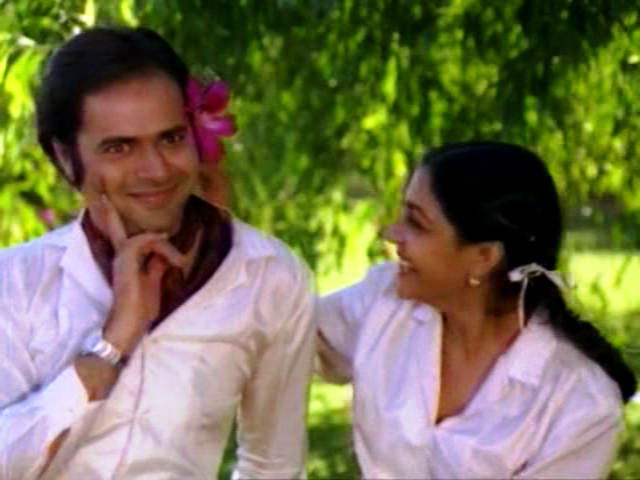
I like the soundtrack by Raj Kamal a lot. The songs ‘Kali Ghodi Dwar Khadi’ and ‘Kahan Se Aaye Badra’ are used beautifully to show hope and disappointment, and Yesudas’ vocals are very expressive. There is also a song in which Neha and Siddharth sing in a park about people who sing songs in parks. And the onlookers actually do react as though the couple are a bit mad. Although I think these kids may have been given conflicting instructions.

The upbeat love songs are not really remarkable, but I enjoy seeing ordinary people act in filmi ways and how that would play out in a real environment. Another thing that made me oddly nostalgic was a very silly kidnapping subplot. Thinking on all the news from Delhi of late about women being abducted and assaulted, it did make me wonder about whether the 80s were really more innocent times. There was certainly a lot less traffic.

I’ll tell you now I am horrified by the idea of David Dhawan remaking Chashme Buddoor. I cannot imagine him making a scene with an overweight grandma accidentally flicking through Playboy seem funny. I can certainly imagine him believing he can, but the execution is the key. I don’t think it is just because Sai Paranjape is female that I can relate more to this story. After all, a woman wrote the recent Ranbir Kapoor vehicle, Bachna Ae Haseeno, and I thought that was mostly male wish fulfilment rubbish. But I do think she has an understanding of the internal emotional life of her characters that makes for a more interesting film, especially when the people are the focus.

Sai Paranjape is smart without being too clever, makes fun of her characters but doesn’t humiliate them, and as befits a romantic comedy, there is a lot of affection and happiness. The actors are charming, and I laughed all the way through the film.

A full 5 stars!

Katherine at Totally Filmi is coordinating a month long celebration of women in Indian cinema. Links will be collated at Delicious so keep an eye on that page for lots of other articles and blog posts to be added throughout March.
Heather says: Chashme Buddoor is a very sweet film with realistic, likeable characters and a simple but effective story. I found it amusing rather than flat-out funny, but it did make me smile almost all the way through. The three flatmates are all well cast and it was great to see actors that I tend to associate more with smaller character roles get the screen-time they deserve.  I particularly liked Rakesh Bedi in this and his expressions alone were enough to make me start smiling before he even said anything. I think it’s the relaxed nature of the conversations between the friends and the way they interact with each other, but in many ways this film reminds me of the old British sitcoms of the seventies. I grew up watching (and loving) these and I got the same sort of ‘comfortable comedy’ feeling here.

As Temple has mentioned, a lot of the humour comes from the way many classic Bollywood conventions are parodied and there are many references to other films, although I’m quite sure that I didn’t catch them all. The parody song with Neha and Jai is just brilliant and I did enjoy playing’ spot the song’ as it went along. The main characters are all allowed to develop at their own pace and each has little quirks that make them seem like real people rather than conventional ‘filmi’ characters.  They’re also not at all glamorous and the guys either shop in the same store or seem to share shirts, which again falls in well with the whole student lifestyle portrayed. The splitting up of their room into three distinct areas by the various pictures on the wall was also something I remembered from my own days as a student in a shared room and was another very realistic touch.

I enjoyed all the music, especially the more classically based songs Kahan Se Aaye Badra and Kali Ghodi Dwar Khadi and agree that Yesudas’ voice works perfectly for these. The songs are all very well pictured as well, although there is a rather disturbing appearance by a bear in the song in the park which I really didn’t enjoy. All the actors were uniformly excellent and I particularly loved Deepti Naval as Neha. I was perhaps a little disappointed that she didn’t take more umbrage to Siddharth’s suggestion that she give up her washing powder job when they got married, but I could also see his point of view – it was a very good way to meet him after all! Chahsme Budoor is a very well made film with clever comedy and excellent performances. I cannot imagine a remake by David Dhawan being anywhere near the same quality or have any of the same subtlety. Much better to watch the original and step back to a simpler time. 4 stars from me.

Neel Kamal (1968)

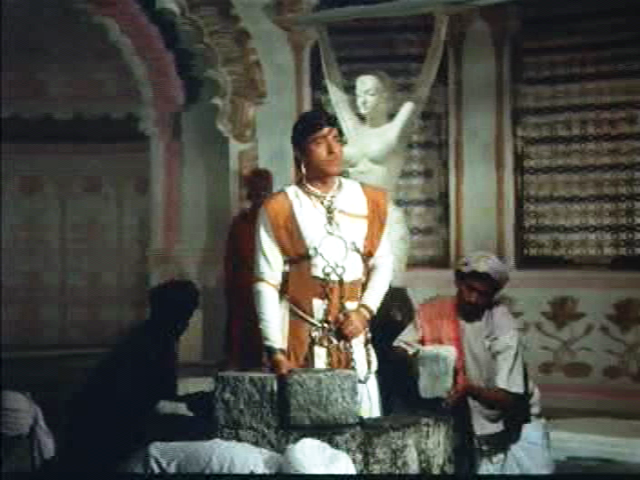
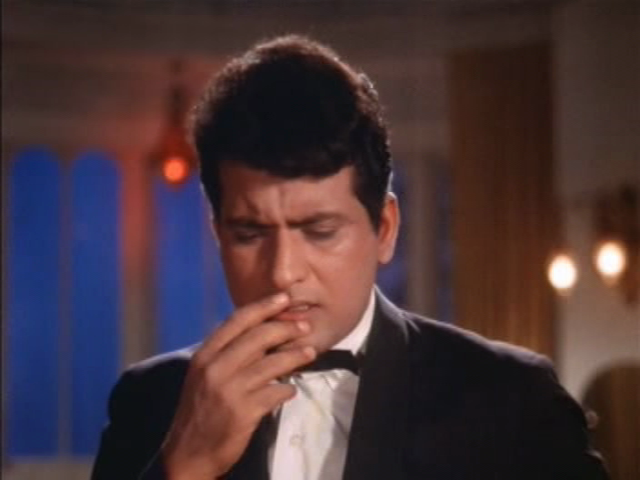
Rajkumari Neel Kamal (Waheeda Rehman) is in love with poet/architect/sculptor Chitrasen (Raaj Kumar). He designs a Rang Mahal for her father, and as a reward asks the king to give him Neel Kamal.  Instead he is walled up alive, and the king forbids anyone to mention Chitrasen ever again.

Sita Raichand (Waheeda Rehman) is a nice girl and good student. On a school visit to the ruins of the Rang Mahal she is overcome by a phantasm of music and dance. Thereafter she is afflicted with sleepwalking and has no recollection of why or where she goes.  She just has time for a very fun musical number before the drama kicks into melodrama.

She is lured out into the night by a voice, a voice beseeching his love to return.  Sita is the reincarnation of Neel Kamal, and Chitrasen is still waiting for her.

His voice is impassioned and yearning. This song is used in many scenes, and I particularly like this a cappella version.

The somnambulism is dismissed as something that may ruin her reputation and so needs to be hushed up rather than treated.  Her wedding is arranged with the help of a friendly local guru (David Abraham). As the doctor breezily assured Sita’s father, once she was busy running a household and looking after children she simply wouldn’t have time for any psychological affliction. Poor Sita. The name alone gives a clue that she will be tested over and over.

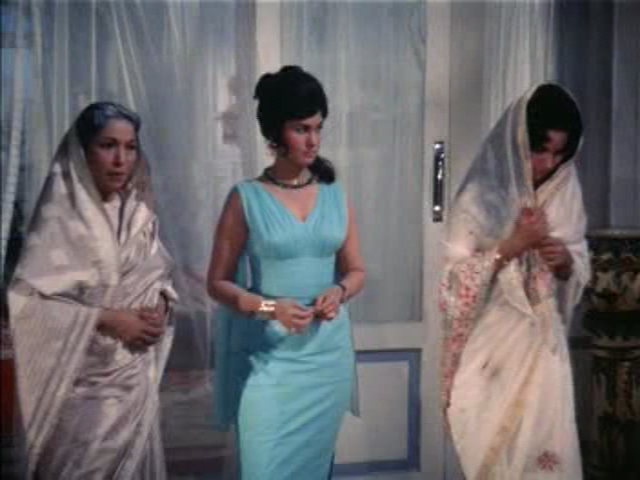
She marries Ram (Manoj Kumar) and moves in with his mother (Lalita Pawar) and sister Chanchal (Shashikala). Her sleepwalking continues, and no one seems to care about why or what is happening apart from the potential damage to their prestige. Ram is the kind of hero who instantly believes the worst of his wife just because his Ma says so. I have to admit Sita’s ability to walk, accessorise and elegantly drape a saree in her sleep may have made me suspicious, but surely they could have discussed it. Manoj Kumar is adequate but not overly interesting as Ram. I spent most of his scenes waiting for him to do the hand over face thing, but the closest he got was a half hearted effort (at 1 hour 28 minutes if you need to know).

Their relationship, apart from all the judgemental and non helpful rubbish, is affectionate and quite passionate. With Sita’s romantic choices limited to a dead man or a mummy’s boy, I was pleasantly surprised to see her in a more or less happy marriage.  Of course, this also makes her suspect in the eyes of the mother-in-law. If she likes sleeping with her husband there’s no telling what else she might be up to. The floozy!

The Thakurin and Chanchal are the real baddies in this tale, not poor ghostly Chitrasen. Like Cinderella’s ugly stepsisters they take every opportunity to harass and punish Sita, casting her actions in the worst possible light. The word ‘slut’ featured often in the subtitles. Adding to Sita’s woes, Ram goes away on work (after promising a doctor not to leave her alone ever) and the Thakurin sacks all the domestic staff putting Sita to work running the house.

Shashikala is great as Chanchal. She seems to relish her mean character, and her mockery of husband Girdhar (Mehmood) is cruel but funny. All the love (or the pheromones) in the air seems to have quite an effect on Chanchal. She seems destined for dissatisfaction as Girdhar is not quite the soul of passionate romance. Mehmood is both useless and pivotal to the drama. His ‘comedy’ is not even slightly amusing, but the hen-pecked loser of a husband is the one who finally takes action. I like Mehmood in the right doses, but this is not him at his best. Lalita Pawar’s character is more obsessed with izzat than about just tormenting her daughter in law but she teams up beautifully with Shashikala to be really horrid. And they are so mean – they even take all of Sita’s lovely clothes!

Although both Ram and her father profess to love Sita very much, neither of them seems to trust her at all. They easily believe the worst, or refuse to see the evidence in front of them. Neither man seems to place as much importance on her health and well-being as they do on her honour and how it reflects on them. Mr Raichand (Balraj Sahni) eventually makes an attempt to help his daughter but Sita by name Sita by nature; she refuses to fail her ‘test’ by leaving.

Sita is not a doormat though. She is strong although, in my opinion, misguided. She could go back to her father, but lots of dialogue about izzat and a weepy pre-wedding song seems to preclude that. She tries to mend her relationship with Ram, and asserts her rights as his wife, but he doesn’t support her when it counts. The ‘haunting’ by her past life love is really well executed. It is a gradual process, wearing down her energy and resilience so that it is easier for her current day bullies to best her.  Her nocturnal wanderings place her life in danger more than once, and she is often tired and confused by day.  Waheeda possesses an elegant beauty that cannot be disguised by a dowdy old saree. She shows the exhaustion and suppressed emotions as Sita struggles to make sense of it all, as well as the happy, radiant young woman in love. I really like her performance even though Sita is one of the characters I might occasionally like to slap some sense in to.

Raaj Kumar is not an attractive man, but his performance as Chitrasen is quite compelling.  From his brief appearance in the opening of the film he somehow makes a strong enough impression that Chitrasen is very present in the rest of the story. The loss and confusion he feels as he lingers in the space between life and death is palpable. He tells Sita that he was killed for love, but couldn’t die because of that love. He reminds her over and over of who he was to her, and tries to make her recall their life and the happiness they had. On the downside, he is not a dancer. And there are not enough artfully placed pom-poms in the world to distract from that. Warning – the following clip contains flashes of nipple (his).

Ultimately Neel Kamal/Sita can’t continue being torn between two lives. Will the past be too strong for Sita? And if Chitrasen wins his Neel Kamal, what happens to Sita? And what will happen with Ram and Sita and their marriage?

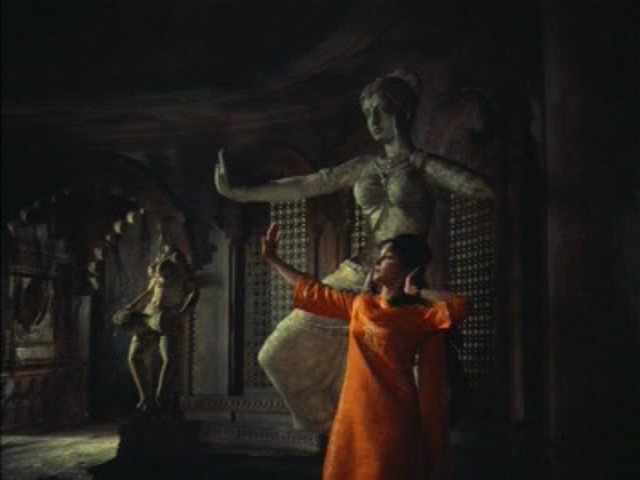
Despite finding much of the story quite trying, I really do enjoy this film. I’m not sure how to articulate this other than to say it is an engrossing and atmospheric film with the supernatural and reincarnation aspects flavouring the everyday drama. The sets are stunning, with ornate design and statuary, very nice chandeliers and excellent moody lighting. My DVD looks terrible in screencaps or I would inflict many many more interior design details on you. Waheeda’s performance is lovely, her costumes are beautiful and suit her character. The music by Ravi builds a mood of love and regret and Mohd Rafi is just perfect as the voice of loss and sorrow. It’s a pleasure to watch, even though I occasionally want to slap a few people rather hard.

I do have to make some small deductions for Ram being so annoying, the poor mental health practices, too much teary self sacrifice, and some witless comedy.  3 ½ stars!

Heather says: I was a little disappointed by this film. The opening credits led me to expect something a little more eerie and the lack of any spooky ghosts or macabre happenings was a bit of a letdown. Then the movie skipped forwards in time and any hopes of suspense were totally lost when no-one seemed to really care why Sita was sleepwalking or where she was trying to go. Since I also knew why she hearing a haunting melody and wandering around there was no suspense in these nightly outings either. I really got very little sense of atmosphere from the film apart from in the first rendition of the beautiful tujko pukare mera pyar song. To compensate for the rather pedestrian story though there were some wonderful performances. Manoj Kumar was very appealing as Prem even if his character did seem to be a bit of an idiot at times. Waheeda was beautiful and periodically did manage to get across the confusion and mental disruption than Sita was experiencing. However, like Temple I was frustrated by her continual acceptance of the abuse from her mother-in-law and sister-in-law without even attempting to either explain her problem or object to their treatment of her. It made her character a bit of a wet blanket which I don’t think was the intent. I also found that the story veered off into overly dramatic scenes and declarations just when it would have been more effective to cut the melodrama and concentrate on the more simple interactions between Prem and Sita. The worst issue though was the constant interruption of the main story by the characters of Mehmood and his wife. Although I love Mehmood, and some of his scenes with the excellent Shashikala were genuinely funny, these breaks in the main story totally disrupted the flow of the film for me.

I loved the opening scenes though and Raaj Kumar was fantastic as Chitrasen. He had so much charisma and it was a shame that there was little interaction between him and Waheeda until near the end, as they did some have convincing chemistry together. I was a little surprised at how attractive he was here actually as I can’t think of another film I’ve seen where he had the same appeal. But I am now looking for more!

The best part about this film was undoubtedly the music. The melodies are beautiful and both Mohammad Rafi and Asha Bhosle are at their wonderful best in the duets. Although it’s not a film I would particularly watch again, except for those opening scenes with Raaj Kumar, I love the music and keep playing the songs. 3 ½ stars (which is mostly for the music and a half star extra for Raaj).