3

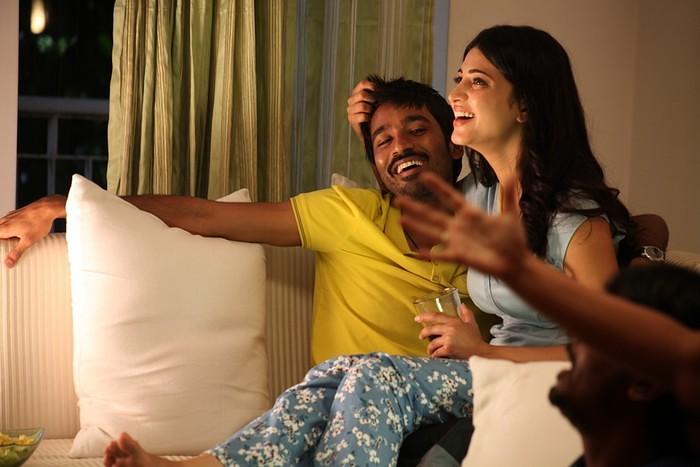
I’m a big Dhanush fan and since Shruti Haasan had impressed me in her last Telugu film, I was excited with the prospect of seeing them together in 3. In addition I wanted to see how Aishwarya Dhanush would approach her first film considering she had worked with one of my favourite directors, Dhanush’s brother Selvaraghavan on Aayirathil Oruvan a few years ago. The hype surrounding 3 since Kolaveri Di became such a hit seems likely to have been the reason that this was the fourth Tamil film to be shown here in Melbourne with subtitles and I really do hope that this trend continues. So it was with high expectations that I headed in to watch 3 and while the film as a whole didn’t quite meet them, the first half surpassed them easily.

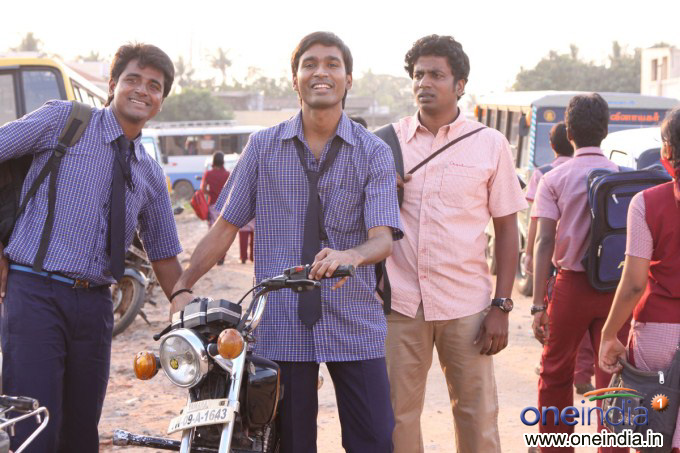
3 follows the lives of Ram and Janani who first meet while they are both at school and relates their romance through three stages of their life together. The two leads somewhat surprisingly don’t look too out of place in school uniforms and certainly with their attitudes and mannerisms they are convincing as high school students. But the real star of this part of the story is Siva Karthikeyan as Ram’s friend Kumaran.  The interactions between the two friends are very natural and the dialogues between the two as Kumaran deals with Ram’s sudden infatuation are snappy and very funny. They had the whole cinema in stitches and it was fantastic to be able to understand and laugh along with the audience for a change.

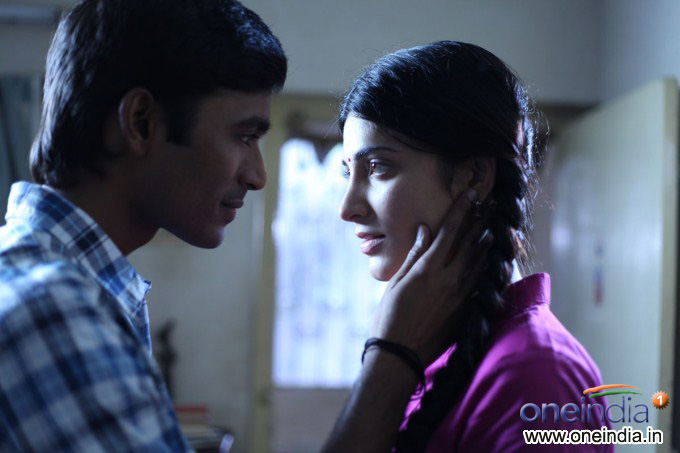
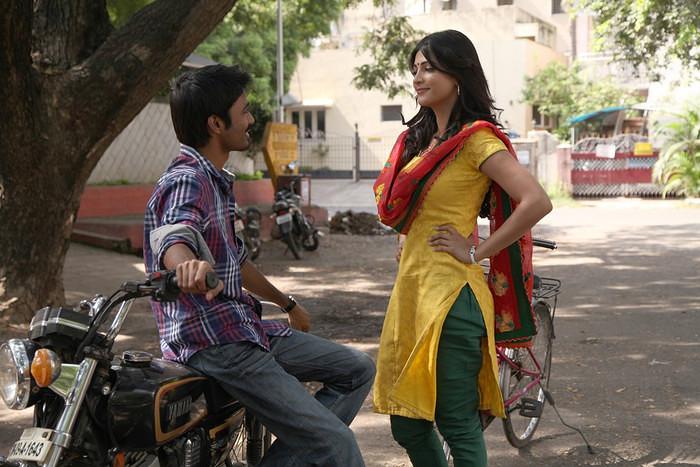
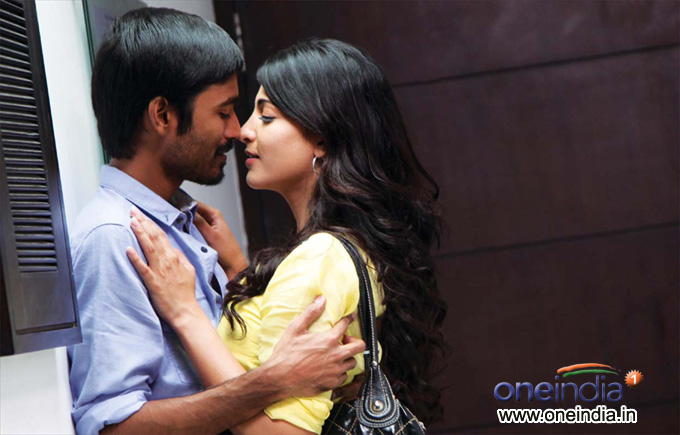
The love story progresses with the usual hurdles in the form of parents and familial expectation. Janani’s family are preparing to move to the USA and she has to deal with the prospect of leaving Ram just as she has realised her feelings for him.  Shruti Haasan excels here as the young girl infatuated with her lover but struggling to conform to her family’s wishes and she finally makes a decision in spectacular style. The young actor playing her sister is also very impressive and overall the romance is beautifully developed. Shruti and Dhanush have great chemistry together onscreen and their relationship progresses very naturally. The interactions between Ram and his father (Prabhu) were also very genuine and well written with plenty of humour and a real sense of the sincere relationship between father and son.

However the promise of the first half doesn’t carry through to the rest of the film. I can appreciate that Aishwarya wanted to show a total contrast in the second half but it gets carried to extremes and the screenplay starts to drag as the melodrama goes into overdrive. The film starts with a dead body and Janani in mourning before moving into flashback mode, so we all know that there isn’t going to be a happy ending – well this is a Tamil movie after all, but the story just doesn’t make sense.

Janini spends most of the second half crying and Shruti Haasan is not an actor who can cry prettily, so the excessive amounts of sobbing become wearing very quickly. The assured and determined young woman of the first half totally disappears and while it is likely a much more realistic reaction it doesn’t make for such interesting watching. Kumaran has also vanished from the story and Senthil takes over as the concerned friend trying to help. While Sunder Ramu puts in a good performance his character is generally less convincing as most of his actions aren’t consistent with the family relationships shown in the first half. Dhanush puts in another amazing performance but it’s a role he has done shades of before in Mayakkam Enna and Kadhal Kondein so while impressive, it does feel a little overdone in the last scene. The general idea of the twist in the story is good but it seems let down by the over the top screenplay and some very dodgy medicine and ethics.

What does work well is the music. Anirudh Ravichander’s background score fits the screenplay very well and the songs are well placed within framework of the film. Kolaveri Di is certainly not as expected and although there are a few odd moments, specifically with a blonde tourist, it generally succeeds and adds a bright moment to the otherwise very heavy second half.

The first half of 3 is a delight to watch and for that reason alone I think it is worth seeing in the cinema. The support cast are all excellent and while Shruti Haasan does overact later on, Dhanush is as impressive as ever with a very convincing performance. The film is let down by an unconvincing and over dramatic second half but there is still much to enjoy. As a friend remarked on twitter, if only the second half had matched the first this would have been a perfect film. It’s still good, and an impressive debut by Aishwarya Dhanush, but it could have been even better.

Vijetha

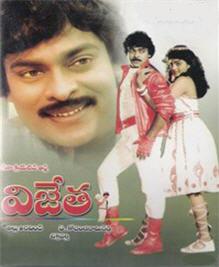
Just to whet everyone’s appetite for the Mega Birthday celebrations and get the party started, Vijetha is  more than just another cheesy masala film from the eighties. In reading about this film on imdb I discovered that Vijetha was just one of the eight films Chiranjeevi released in 1985. I think that this is an amazing number of film releases, but more so when you consider he had even more films released the preceding year, and just as many the following year. Thankfully this means that there are just so many more Chiru films to watch!

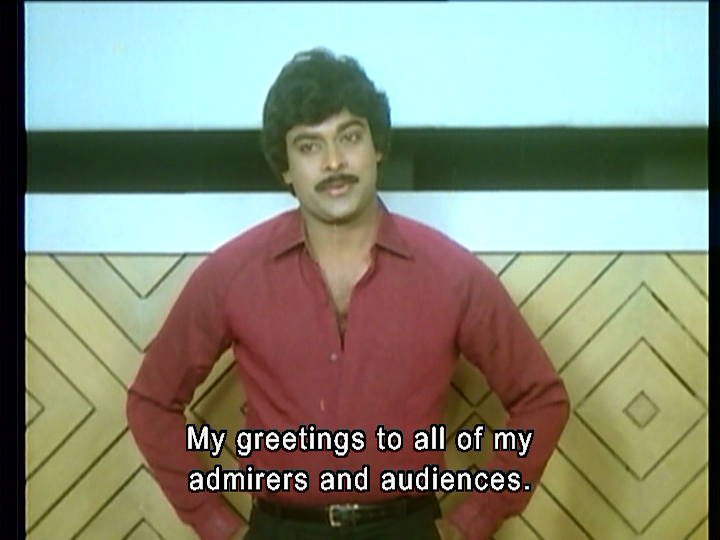
Chiranjeevi won his third Filmfare award for his performance in Vijetha and it’s a departure from his more usual action film. In fact, the movie opens with a message from Chiranjeevi to his fans explaining that the story is about a ‘boy next door’ character rather than an action hero, and it makes a great introduction to the story.

Vijetha tells the story of Madhusudhan Rao (Chiranjeevi), commonly known as Chinnababu, and his rather close-knit, but at times acrimonious family. With the death of his close friend, Chinnababu’s father Narasimham (Somayajulu J. V.) realises that the squabbling which occurs at the funeral may also happen at his own death. He decides to try to finalise the marriage of his youngest daughter Lakshmi as soon as possible, and to that end arranges a marriage with Sri Rangarao’s son Mohan, a doctor in Chicago. Mohan is planning to marry quickly and head back to the USA and it seems like an ideal match for Lakshmi considering her father’s wishes. The problem however, is that Narasimham cannot afford the required dowry, and so he appeals to his sons for help. But apart from his eldest son’s wife Saraswathi, the others are all disinclined to give any money for a marriage which they don’t see as being as important to them as their own comforts. There is much talk of duty and responsibilities but in the end Narasimham sees no other choice but to sell the family home. Finally after various attempts by the brothers to get the house for themselves, Chinnababu manages to save the day by taking a rather unusual and fairly drastic step to get the required funds and ensures his sister’s marriage goes ahead.

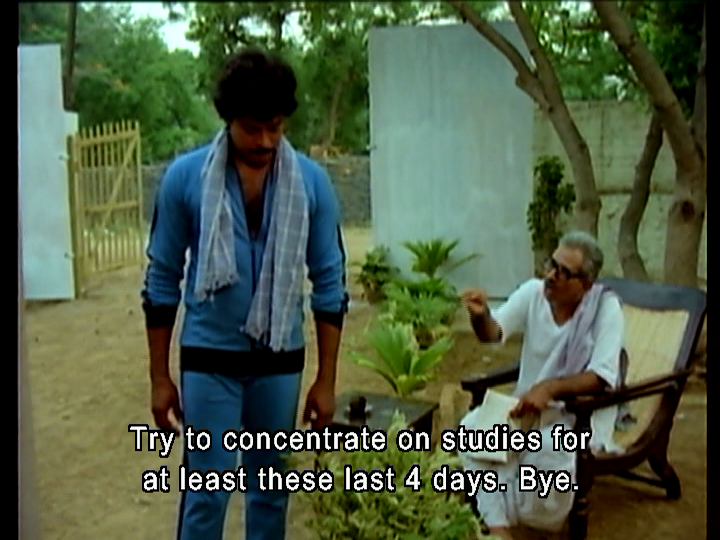
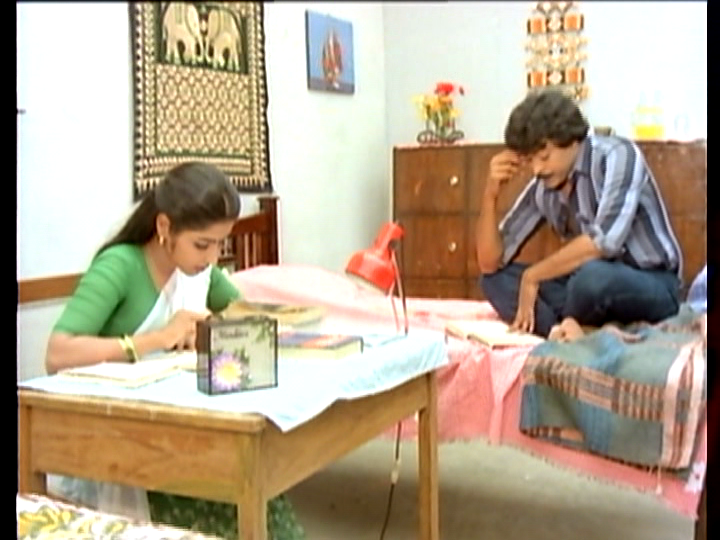
The film feels more like a modern-day soap-opera at times as it focuses on the interactions between the different family members and day-to-day life. Chinnababu is a student and aspiring football star, although his father despairs of him ever getting a job as he prefers playing his sport to studying. His eldest brother’s wife Saraswathi has practically raised both Chinnababu and his sister Lakshmi, and she keeps the peace between father and son. Although he’s perhaps a little deficient in studying, in other ways Chinnababu is a dutiful son – running errands for the other members of the family and supporting his father as much as possible.

Chiranjeevi does an excellent job of capturing the good-hearted if slightly naïve character of Chinnababu and does manage to portray a more normal slice of life rather than his more usual ‘over the top’ heroics. Although we do get some of those as well when Chinnababu comes to the rescue of Priyadarshini and her friends when they are harassed by some youths, and later on when a gang of thugs attempt to rob him. Bhanupriya plays the love interest Priyadarshini and in another departure from the norm, she stalks Chinnababu rather than the other way around. She lies in wait for him, goes to his football practice and is generally irritating in her shrill and persistent attempts to get his notice. In fact Priyadarshini’s character is incredibly annoying in the first part of the film, and the first time I actually liked her was when she encouraged Chinnababu to play football with the thugs (using them as the football) rather than trying to negotiate with them. Chinnababu initially has little time for her and seems appalled when she moves in to the neighbourhood.  However it turns out that a song with some strategically placed cutouts and a large number of cushions is the way to his heart – who knew it would be that simple?

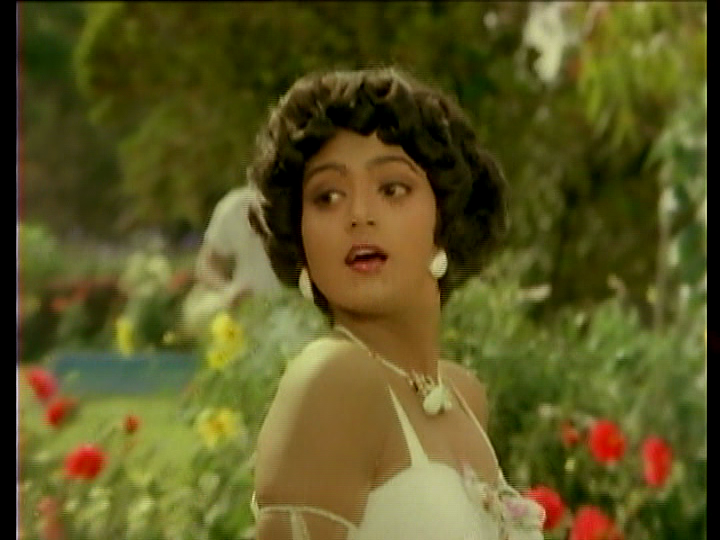
After this, Chinnababu seems to be resigned to his fate (maybe it was the gold pants that did it) and Priyadarshini becomes much more tolerable once she finally has Chinnababu’s attention. Bhanupriya is lovely despite some of her very questionable outfits, and she can at least match Chiranjeevi’s dancing. She must have really annoyed someone in wardrobe though as she has a particularly bad selection of wigs to wear too!

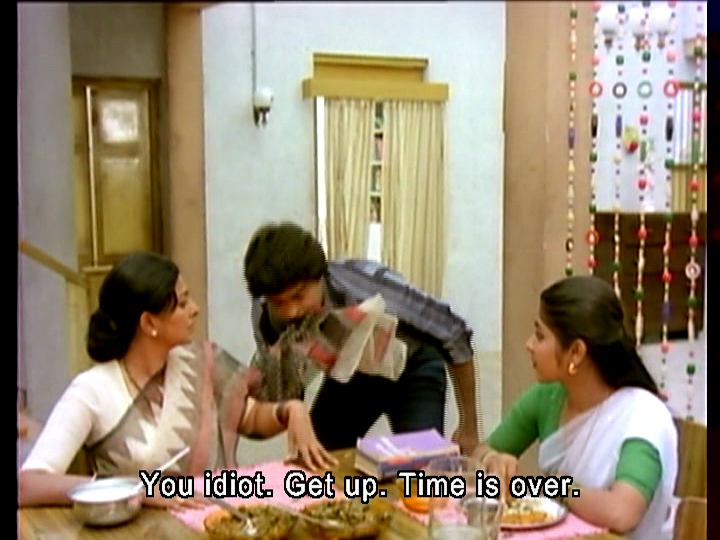
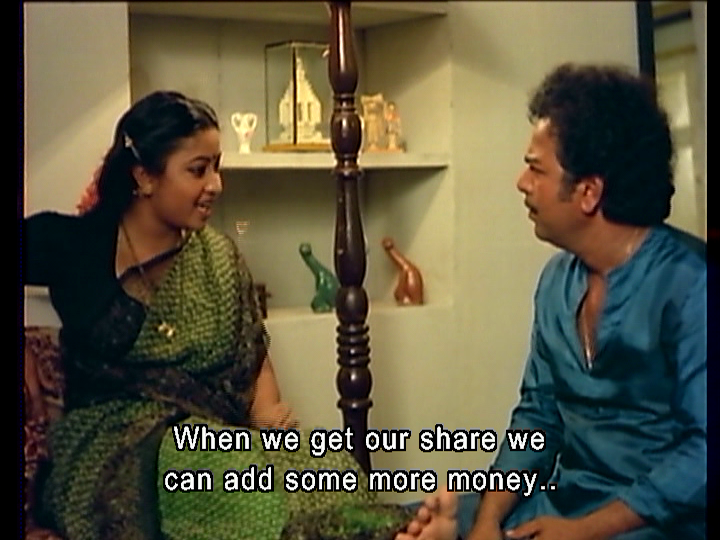
Sharada plays the eldest wife Saraswathi with real grace and poise. Her character works very well as the peacekeeper in the family and her level headedness is very much needed as everyone gangs up on Chinnababu as the only non-worker in the family. There is a classic moment early on in the film where Chinnababu uses her sari to wipe his mouth, and it just goes to show how much she thinks of him as she doesn’t react at all! I also love the set dressing in the film which adds to the ‘family at home’ atmosphere. There are plenty of ornaments, great pictures on the walls and even a medical model later in the film.  I would love to know what the brown and green ornaments behind the couple here are supposed to represent.

The three brothers show different but equally selfish characteristics and are ably aided and abetted by their various wives. The eldest brother (Ranganath) seems to be far removed from the petty squabbles of his siblings and is able to ignore the pleas of his father despite his wife’s more charitable views. The other two brothers are totally ruled by their wives who are wonderfully self-centred and money grabbing. Most of the comedy comes from their antics although veteran comedic actor Allu Ramalingaiah also turns up as a taxi driver who has some humorous dealings with second son and lawyer Narayana Rao (Nutan Prasad). Allu Arvind was the producer for Vijetha and it seems as if he got the whole family involved since his eldest son Bobby is credited as playing the son of Narayana Rao. There seems to be some confusion in some reviews as this film also marks Allu Arjun’s screen debut, but since he was only 2 years old in 1985 I think he actually appears as married sister Shanti’s son. The confusion is likely because of the very stylish sunglasses worn by Bobby below which do seem to be something Bunny would be likely to wear.

The film leans heavily towards family duty and respect but despite these heavy topics it doesn’t drag and keeps a light-hearted tone until near the end. Even then the self-sacrifice of Chinnababu isn’t dwelt on overly much and there is an appropriately happy ending. Director A. Kodandarami Reddy keeps a light touch and stops the film descending into too much sentimentality.  The best parts of the film are the songs by K. Chakravarthy and as ever Chiranjeevi is excellent in a seemingly never ending array of tight lycra outfits. This is my favourite and it seems to serve no other purpose other than letting Chiru strut his stuff – I totally approve!

Although the themes in Vijetha are of duty, responsibility and self-sacrifice, it’s still a fun watch and if nothing else there is the chance to see Chiru in shorts playing football. Some great songs and a very heart-felt performance from Chiranjeevi make it well worth the lack of fast paced action. 3 1/2 stars (it would have been more but Priyadarshini is just too annoying!)

Temple says:

I don’t quite see the opening statement quite the same way Heather did. To me it’s not so much that Chiru is playing a boy next door, as lots of his hero roles are those boys at heart, but he is playing a guy who struggles to assert himself and isn’t really a success at anything despite his potential. I think it is that perceived weakness that Chiru wanted his fans to identify with, and he challenged his detractors who may have thought he was a one trick pony. Mind you, Chinna is heroic in his own way. The short shorts and long socks is a difficult look, especially in yellow which I find is an unforgiving colour, but he manages.

There is some nice social observation tucked in amongst the fluffy filmi fun. This is a family where women have started to work outside the home and their behaviour towards Saraswati is quite masculine in some respects. The father is challenged by his children who have an overwhelming sense of entitlement. Work is hard to come by for the academically average, but class barriers also get in the way – Chinna wasn’t allowed to work as a peon in his brother’s office because it would look bad. Chinna is the product of Saraswati’s intelligent and emotionally supportive upbringing and his father’s strong morality. There is a lot of affection in the family – the father loves Chinna, and had a great time sneaking in to see him play a big match, but the pressure is on to see everyone settled in his lifetime. The question is when do offspring have to take up some family responsibility. It’s similar to, but much less dreary and vomit inducing than, Baghban (one of my most hated films) as the family starts to tear itself apart over money. And nicely symbolic as Chinna and his dad unwittingly compete with each other to save the family finances.

I don’t mind Bhanupriya’s character. Priya is supposed to be a ‘modern’ (i.e. badly dressed, persistent and opportunistic) girl who goes for what she wants. I think her attempts to win Chinna and impress his family are not as funny as they are meant to be, but generally played for laughs and she has good rapport with Chiru. Chinna has the closest relationship with the females in the family, there are lovely scenes as they discuss their hopes and fears together, and Chiranjeevi played Chinna in a natural and low key style. He had a few masala breakouts which I enjoyed immensely, and his flair for comedy is evident. I was so delighted when I recognised the Six O’clock song as I could enjoy it with better dancing (and outfits) and without the accompanying fear of Anil Kapoor from the Hindi version.

As romantic musical sports themed family dramas go, this is one of my favourites. 3 ½ stars.

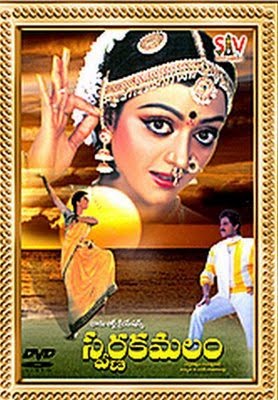
Swarnakamalam

Swarnakamalam has been highly recommended by several readers and other friends, and I saw Bhanupriya’s dances in the film on Minai’s excellent blog. I really like Venkatesh and Bhanupriya. They are appealing, both are good actors, and I always enjoy seeing them on screen. K. Vishwanath wrote and directed, and while this contains several themes in common with his earlier Sagara Sangamam, this is a far less satisfying film. There is some great dancing and a nice domestic setting that helps build the sense of who these people are. But I don’t wholeheartedly like the lead characters and I have issues with several points in the story. My DVD is mostly subtitled but occasionally I guess the subtitle team nipped out for a coffee or something and a few chapters were left untouched. Happily these were mostly scenes involving Tinku the annoying child sidekick, but perhaps there was something essential that I did miss.
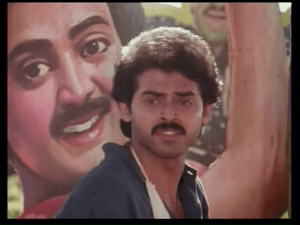
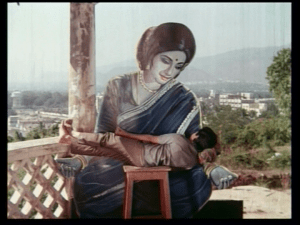
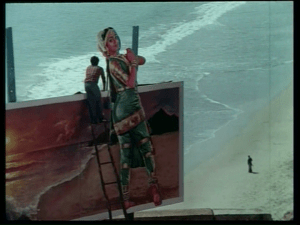
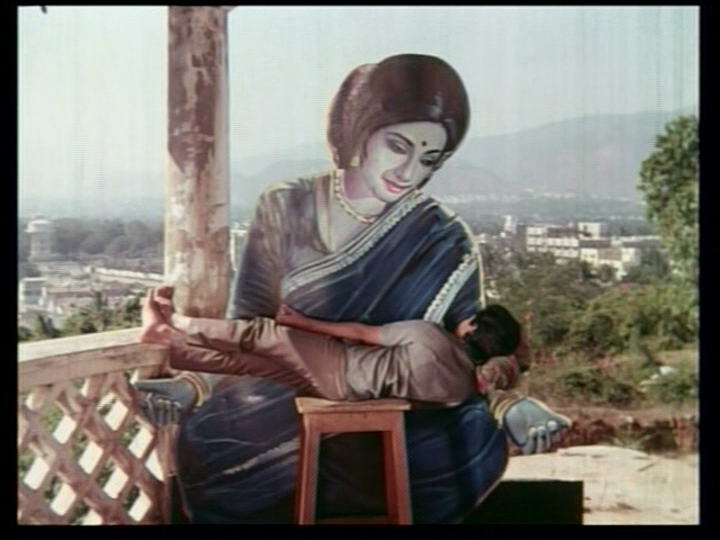
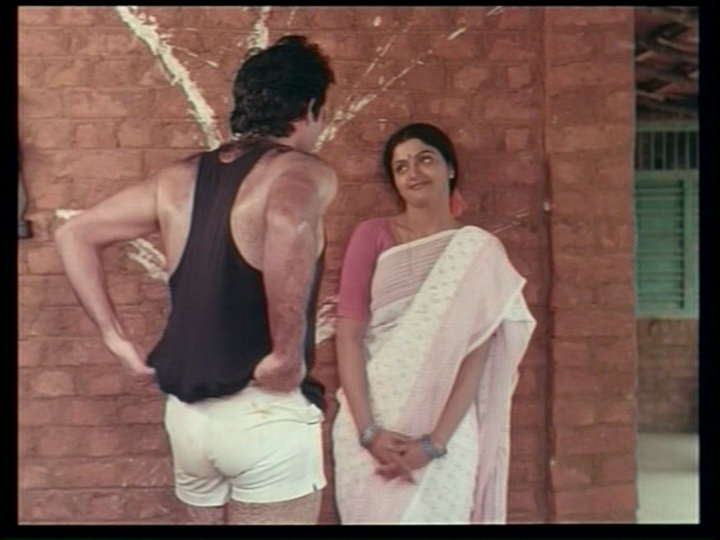
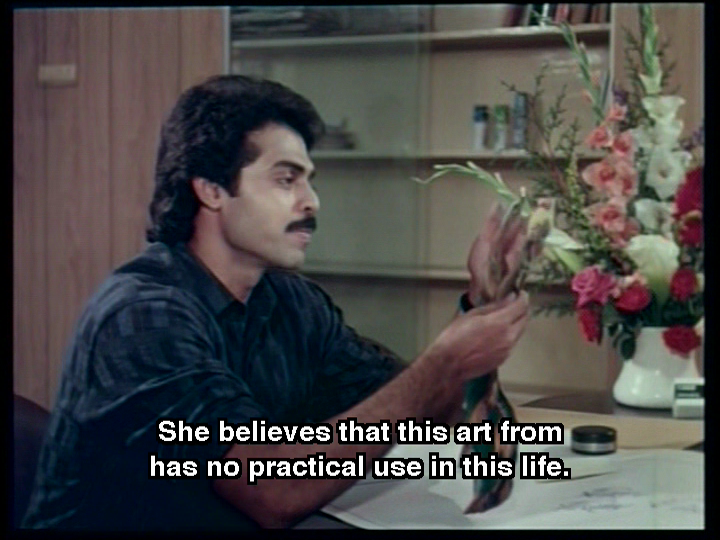
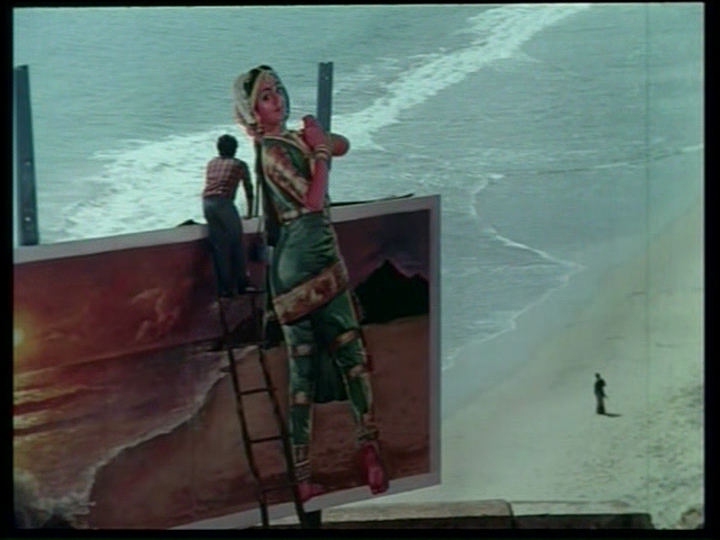
Venkatesh is Chandrasekhar. He is introduced as an artist who paints cinema hoardings and billboards. He has a sidekick, annoying young Tinku, and seems to get by from day to day. He cons his way into renting a room from a pious couple, and initially his character seems to be a bit shady. But as time goes by he seems to have contacts all over town, knows everyone, and can facilitate pension and passport applications. Venkatesh is a really likeable actor. He always seems to be acting with his co-stars rather than acting for the camera, and I love watching him in ensemble scenes as he never seems to switch off when he is in the background. Although I did find myself thinking ‘Oh it’s a good thing his back-hair is distracting me from the too short shorts’. See if you agree!
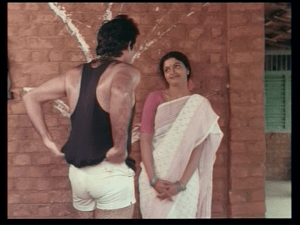
It’s a shame Chandrasekhar is quite unappealing once the superficial charm is taken out of the equation. He is controlling and a bit of a bully. He always knows best, and pushes people to do what he wants.

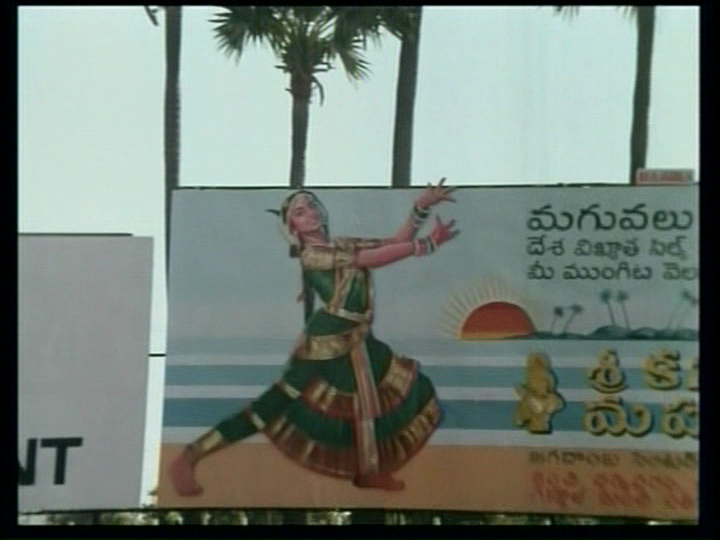
He also seems to be quite obsessed with Meenakshi and paints multiple hoardings with her image, and has loads of photos of her strewn about his studio which is a bit creepy. From his rooftop terrace he can see into his neighbours compound.
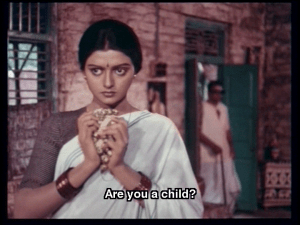
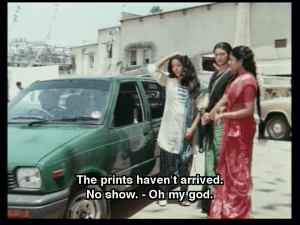
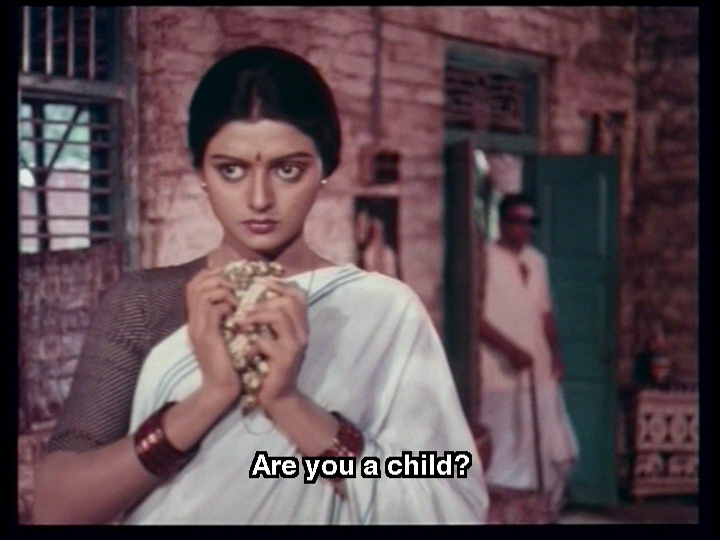
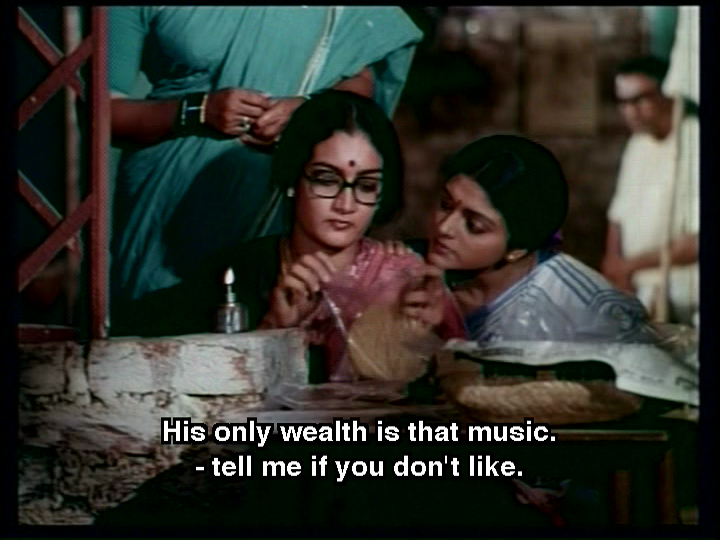
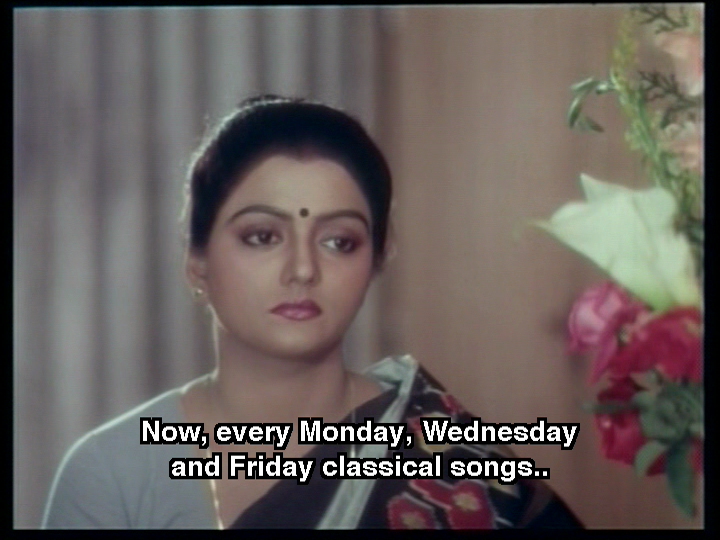
Bhanupriya is Meenakshi, the girl next door. She is the daughter of a celebrated dance guru, and lives in genteel poverty. She doesn’t see the point of dance as it doesn’t put food on the table. Her sister Savitri (Devilalitha) works tirelessly making and selling snacks, and singing with their father. Meenakshi just wants to escape the artistic life and get a job that pays for life’s necessities and a few luxuries. Of course, everyone around her seems to know better. Even allowing for the pressure, Meenakshi is a brat, and seems like a very young teenaged girl. She is sly, sneaks off to the movies and other outings,  and tries to get out of dancing by staging various misfortunes but never speaks to her father about her reservations. Once her father passes away, Meenakshi gets a job and seems to be set to stand on her own feet and live the life she wants. She is strong enough to confront Chandrasekhar about his actions but not strong enough to stop him from interfering.

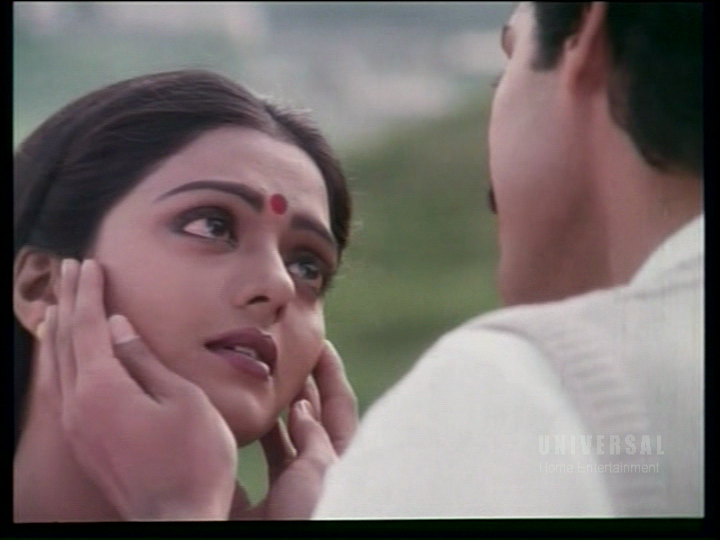
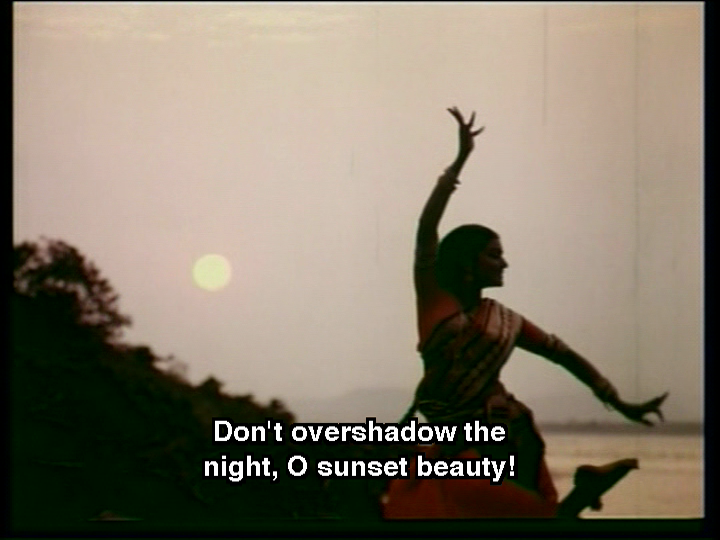
Bhanupriya is beautiful, and I loved the songs that featured her excellent dancing. But there was something about Meenakshi that I just couldn’t like as much as I wanted to and I blame that on the writing for her character. This is one of my favourite songs. I enjoy the way Bhanupriya is initially cranky about having to practice but seems to enjoy dancing more as the audience builds.

The supporting cast are mostly members of the household or compound. There is a pleasantly disorganised informality in the way characters wander in and past each other’s houses and share chores. I loved the set dressing that included little details like the knick knacks in the house.
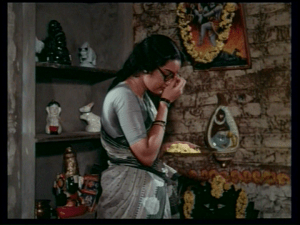
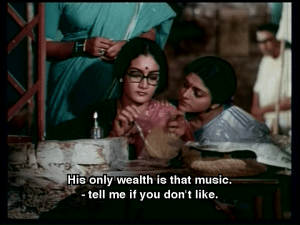
Savitri and the landlord’s son have a nice romantic sideplot that made me happy as theirs seemed like a genuine partnership founded on mutual affection and respect and they were nice people. There is a comedy sideplot involving Sri Laxmi and her unfortunate husband, and it was tolerable if not hilarious. Tinku, the annoying child sidekick, does have some nice scenes where he is copying Meenakshi’s dance, and becomes very focussed and joyful. The uplifting power of music and dance permeates the film.
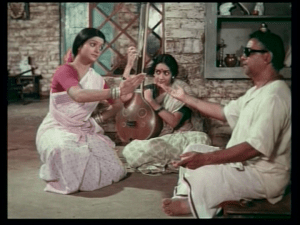

Director K Viswanath is known for his message films. But the message in Swarnakamalam seems to get a bit scrambled. Initially we are presented with the ideal of classical art, pure and beautiful. Bureaucrats are criticised for not paying pensions to senior artists and giving them their due respect. But then the message seems to be that art cannot be forced, it must come from the heart and be allowed to adapt lest it stagnate, so there is approval for Meenakshi’s rejection of her artistic heritage. Then Chandrasekhar decides that Meenakshi is born to be a classical dancer despite her own views and badgers her into performing, has her fired from a job she enjoys as it is supposedly beneath a great dancer and generally insists she be his perfect artist according to the ideals of culture and tradition.

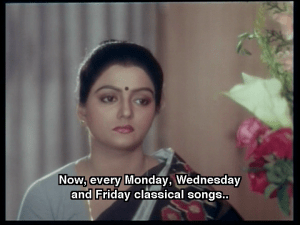
Meenakshi wants to dance when and as she feels like it, not as her whole life or for her living. She is railroaded into becoming a cultural performer in a fancy hotel and then Chandrasekhar sets her up with a wealthy American dancer and patron who wants Meenakshi to tour the US.  After a very emotional scene where she learns to value her father’s legacy and embraces the dance, admitting that dancing with love and commitment would make her happy and fulfilled, she is forced to choose between Chandrasekhar and success.

Chandrasekhar wrote Meenakshi a letter to read at the airport as she was about to set off on tour. He writes that no one else but him would ever tolerate Meenakshi’s lying and misbehaviour, no one else but him would force her to be a great dancer and every time her anklets chimed that was his voice, the voice of a man who loved her. I found it really manipulative in forcing a choice that didn’t have to be a choice. Why shouldn’t she have love and artistic success?

So the whole great art as its own reward idea seemed to go out the window, as did the independence of the artist. The message seems to be it’s OK to stalk someone, then bully them into a career they don’t want, until they realise they do want it, then you pull the rug out from under them. Venkatesh and Bhanupriya did have a lovely rapport on screen, but my liking for their performances is just for their acting,  and not the characters behaviours.
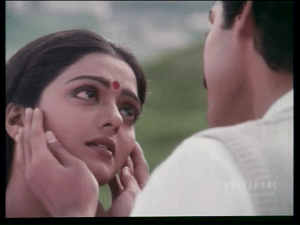
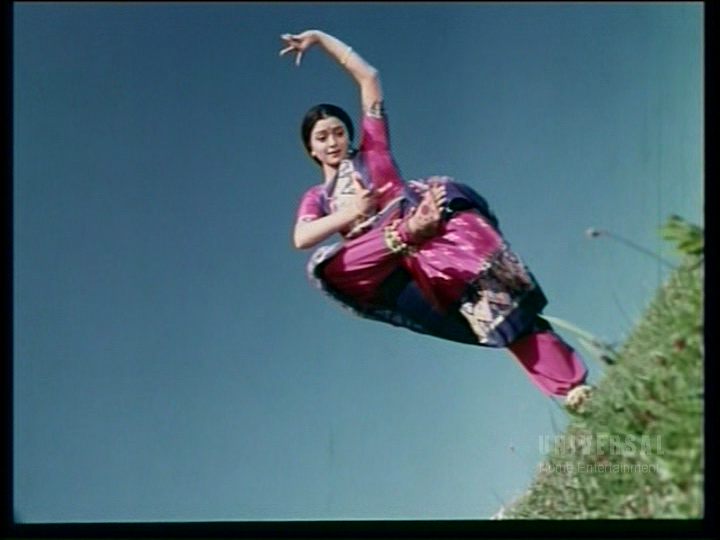
On a purely visual level, Swarnakamalam is gorgeous. The songs are delightful, and allow Bhanupriya to show off her skills and a range of beautiful classical dance costumes, and Venkatesh shows off his strolling and knitwear modelling in some beautiful locations.
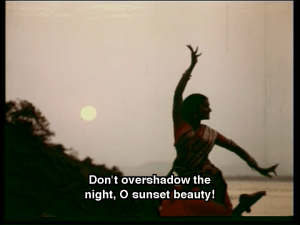
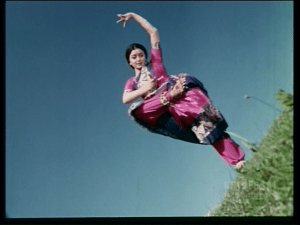
The framing of the dance scenes is meticulous and Lok Singh made the most of the scenery and the beautiful lines of Bhanupriya’s dancing. The music by Illayaraja is perfect for the context and the subtitles for the songs did offer some additional insights as well as being lovely.

Watch it for excellent performances and beautiful dancing, sadly not matched by the story or characters. I just can’t warm to the film, but I love the songs. 3 stars.

Heather says: This is a beautifully pictured film which focuses on the art of Indian Classical dance and to a lesser extent Carnatic music. I love the two sisters, Meenakshi and Savitri, and their very genuine interaction. It makes it very natural that the only person Meenakshi conveys her discontent to is her sister. Savitri’s placid nature means that she is happier and more settled, but she accepts Meenakshi’s view and does her best to help her attain her dreams after their father dies. This relationship and that of the two girls with their father makes a very solid foundation to the film. Enter Venkatesh as Chandrasekar – the interfering neighbour. If I was Meenakshi, I don’t think I would have had as much patience with Chandrasekhar’s meddling in my life. Although it’s clear that he has her best interests at heart he is determined to make her conform to his view of her. The film tries to point out that you have to have passion and belief in order to truly excel, and I’m not sure that Meenakshi really does have what it takes. She enjoys dancing for herself but doesn’t enjoy performing so it does seem cruel that everyone keeps forcing her, when all she wants is a normal life. I also agree with Temple that it was very stalker-ish for Chandrasekhar to paint her picture everywhere. I found that really creepy, especially considering that he was essentially also watching her all the time.  Savitri’s relationship seems much more genuine and is more enjoyable to watch develop. Top marks as well for showing the landlord’s son playing the violin properly. It makes me cringe every time I see someone massacring a violin on screen and this is a lovely change. Even if he isn’t actually playing the notes that we heard!
Despite my quibbles with Chandrasekhar’s character, I thinkthatVenkatesh was excellent in this role. He was passionate and devoted and really looked the part. Due to dodgy subtitles I didn’t get a clear idea of his relationship to Tinku but it was effective to have the comedy mainly between Chandrasekhar and Tinku rather than the usual obtrusive and subsequently unfunny ‘comedy track’. The humour between the couple with the wife devoted to blessing everyone was also funny and well integrated into the movie.

The standout of the film though is the dancing, and Bhanupriya was fantastic in these scenes. It was interesting to have real life dance guru Sharon Loven in the film, although her character didn’t really make much sense in the context of the rest of the story. The whole trip to America idea felt tacked on as a reason for Chandrasekhar and Meenakshi to finally admit what they felt for each other. I have 2 copies of this film and since they both had patchy subtitles and wouldn’t play right to the end I was quite frustrated by the time Meenakshi left for the airport. I watched the climax online with no subtitles and would love to know what was written in that last letter since Meenakshi’s decision at the end might make more sense to me. I was hoping she would leave and make a life for herself in America where she would finally be able to choose to do what she wanted to do. Still, the film looks beautiful and both the dancing and the music are excellent. Worth watching for those alone. 3 ½ stars.