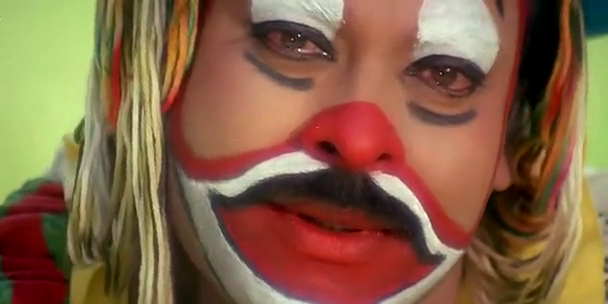
Sangarshana (1983)

I like a good socialist masala film. Sangarshana has surprisingly long interludes of sensible decision making and logical plot progression, plus loads of dancing and a very good cast. It’s highly entertaining and while the plot is fairly basic, it’s more rounded out than I expected. Lest that all sound a bit too straightforward, there are mysterious mute women, children separated at birth, a comic sideplot that hinges on romantic sabotage, family dramas, medical emergencies, flying somersaults, fight scenes and a bit of conflict resolution through disco.
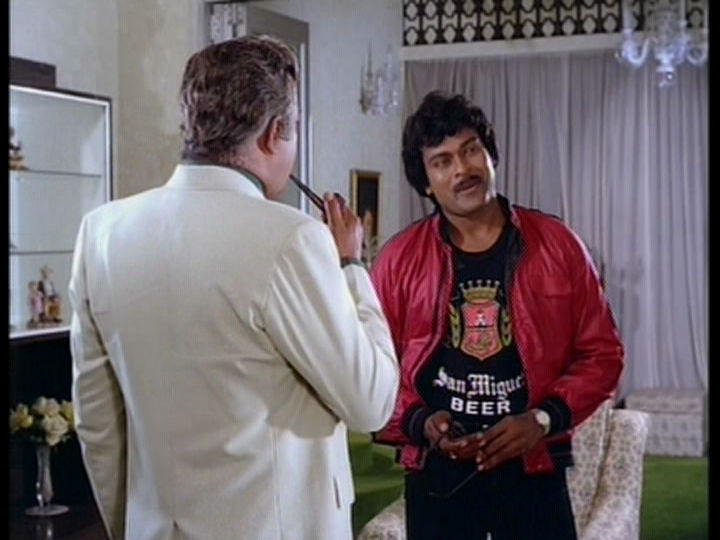
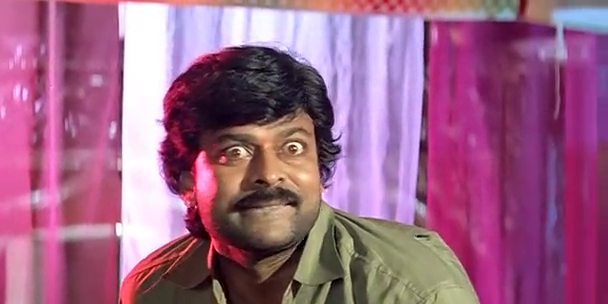
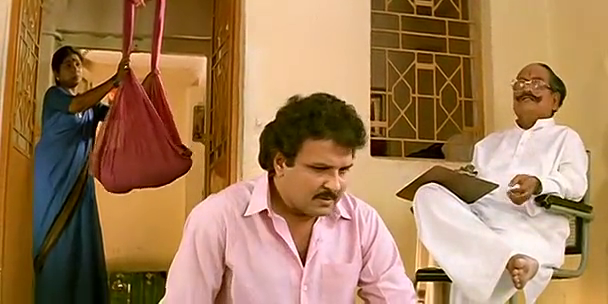
Dilip (Chiranjeevi) returns from America to live with his wealthy industrialist dad (Satyanarayana Kaikala). He is a nice enough guy but used to the easy life, and can’t really understand the struggle of workers in his family factory. He believes his dad is a good guy and that the workers should trust him and remember their station in life. Eventually Dilip comes to realise that his father is more interested in money than in the means by which he obtains it. To make matters worse, the local site manager (Rao Gopal Rao) reneges on offers of compensation for injured employees and overacts wildly.

My post grad studies were in Industrial Relations and I can confidently state that I never encountered that reaction to a workplace accident in any of the cases I studied.

Dilip renews his relationship with his childhood friends Shivam (Sivakrishna) and Radha (Vijayashanti) and their father, the supervisor Mr Krishnamurthy (Gummadi).
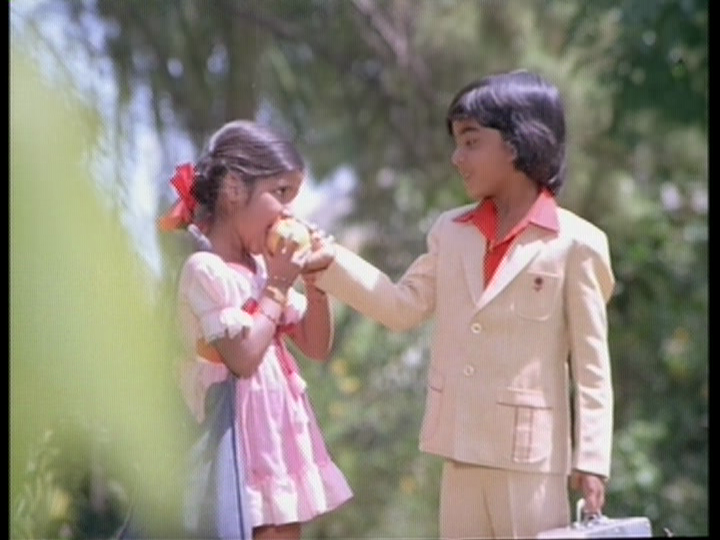
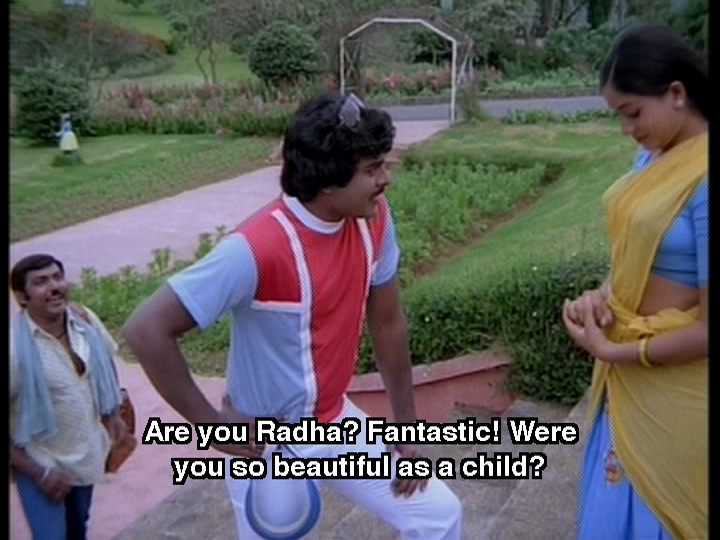
When he isn’t prancing about reminiscing with Radha, lifelong snappy dresser Dilip is prancing about romancing Rekha (Nalini) the daughter of his dad’s local business manager. Life is all twirling around on hilltops and dancing around trees. But then other issues start to take over. Shivam starts a union and tries to get fairer conditions for the other workers. Some of his demands seemed a bit out there (workers compensations is fine, but three months bonus?), and fights the good fight. Unionisation is not ideal for the owners as regulation and systems may bring their smuggling sideline to light, and they certainly don’t want to reduce their profits.

Once Dilip realises the extent of the illegal activities and his father’s role in the shady doings, things start to get nasty. He is thrown out of home, his relationship with Rekha is threatened as her father coerces her to give up Dilip, and there is much drinking and crying.

When Dilip is framed for Shivam’s murder, Chiru dials up the heroics as he becomes a furious young man and makes his enemies sorry they ever crossed that line.
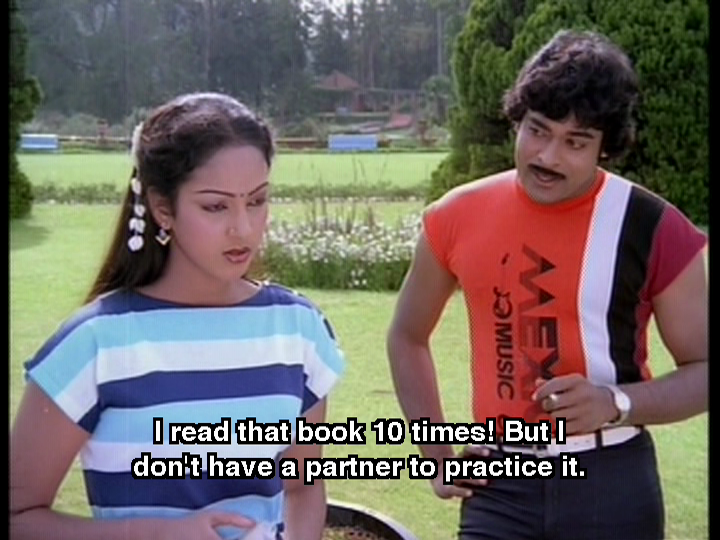
Chiranjeevi is very good as the showy Dilip who brings back expensive gifts and spouts some terrible English dialogues. He manages to be vain and likeable and the transition from easy confidence to anger and hurt betrayal is excellent. He is deliberately cheesy in some romantic scenes, adding a comic spark,  but brings genuine warmth and pathos when it is needed.

Oh those outfits make me weep, especially the poor backing dancers. But look at Chiru go! He dances up a storm and is handy in a fight. No wonder the ladies are lining up!
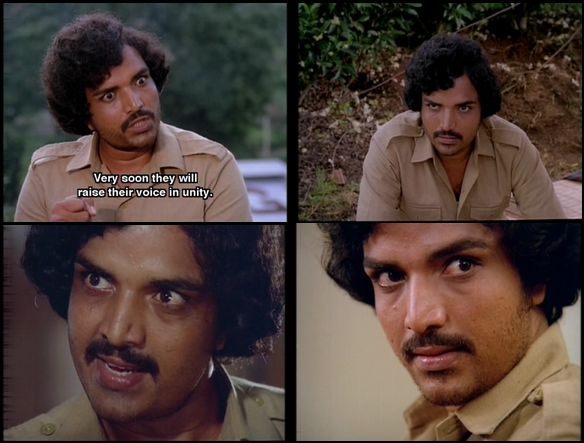
Sivakrishna has one expression for 80% of the film but since he plays an angry young man that works well enough. Allu Ramalingaiah is Varahamurthy, the comedy religious advisor who abets Rao Gopal Rao in his schemes. Varahamurthy has his own ideas about marrying his son Chalpai off to rich and lovely Rekha, while Chalpai has the hots for a voluptuous local girl. Those shenanigans constitute the comedy side plot and aren’t quite as painful as they might have been, although I did forward through most of it on a re-watch. Annapurna plays the mysterious mute woman who holds the key to a tangled family saga. Her revelations relieve Dilip of his sense of familial loyalty, and make him determined to bring his father and cohorts to justice.
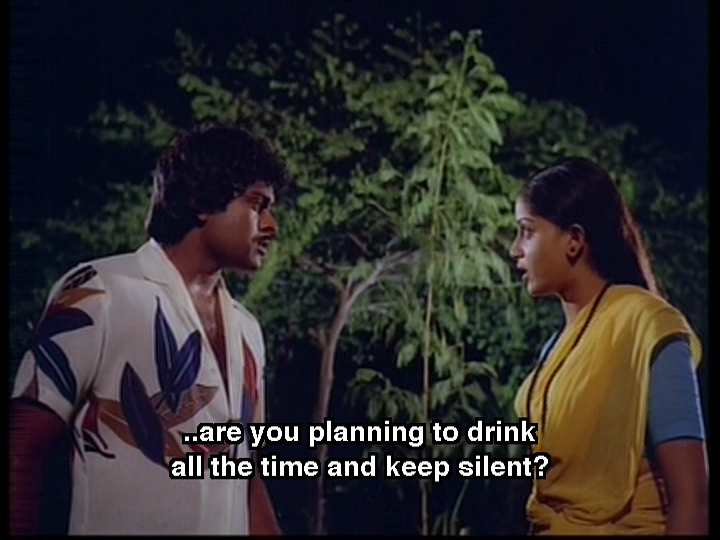
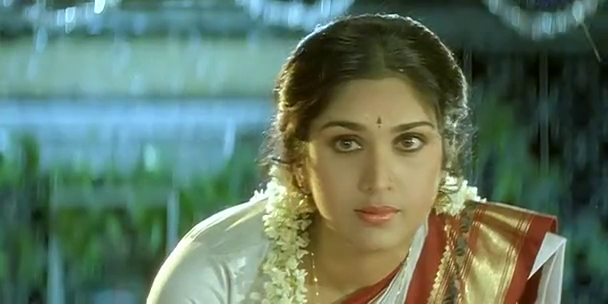
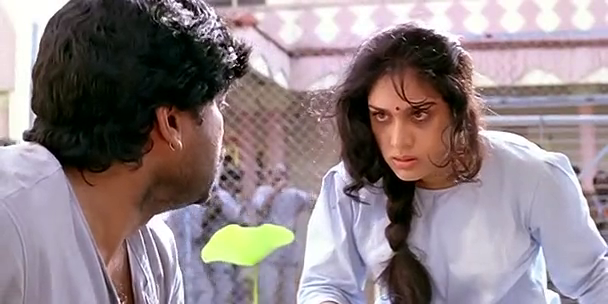
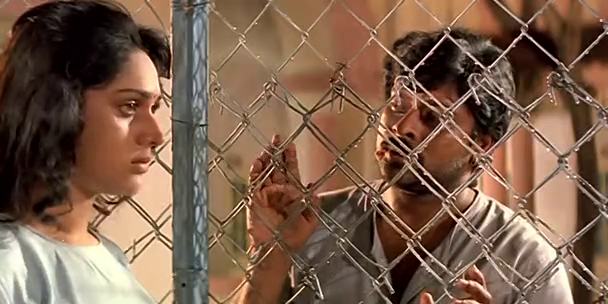
Vijayashanti is beautiful as simple village girl Radha. She loves Dilip and has a fair number of song induced fantasies about their love. But she is a sensible and nice girl who doesn’t let romantic notions carry her away. Radha is committed to her family and to doing the right thing, and doesn’t hesitate to call Dilip on his weakness when he is wallowing in drunkenness. When she sees that rich Rekha is more Dilip’s type Radha has a talk to herself and decides she has to move on. See? Sensible.

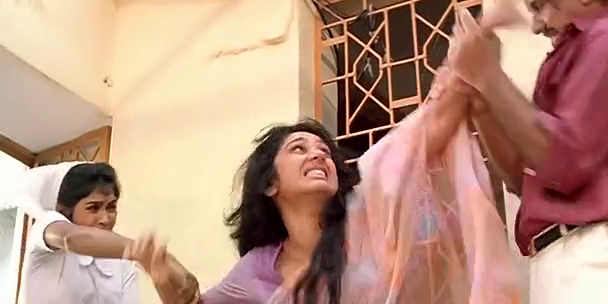
Nalini gets less emotional range but more hideous fashionable outfits as Rekha. Rekha is pretty, a bit spoilt, but once she decides Dilip is The One, she doesn’t back away without putting up a fight. Literally – check her out in this clip.

Nalini is good but didn’t make as strong an impression as Vijayashanti despite the biffo.

K Chakravarthy provided a range of songs that suited the mood and the characters. Radha and Dilip have more traditional duets while Rekha gets a more Westernised treatment. The choreography is energetic and certainly suits Chiru who gives it his all.

I love watching that song. It comes at a high point in the story and what I really enjoy is the slightly ragged energy that makes it look like people were having fun dancing and not just thinking about it as a scene.   

The interior sets are quite fabulous. Someone on the team decided that more is more in some cases, and I enjoyed playing ‘name that knick knack’ or ‘spot the repo old master’. The dedication to clashing patterns is also quite noticeable.
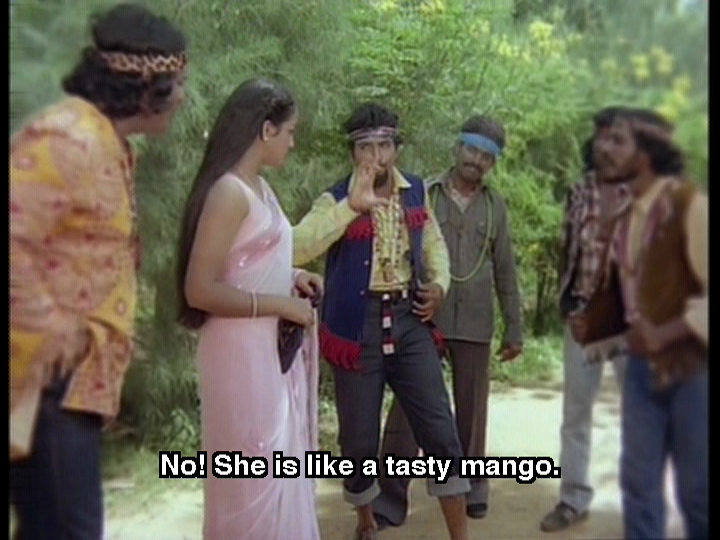
The western costumes are very 80s while the rowdies dress like a blind costume designer’s hippie fantasy.


One of my few quibbles with the film is that, as a result of what I assume is slacking off by the footwear team, Dilip often wore a pair of quite drab brown ankle boots that just didn’t go with his outfits.

The plot is quite cohesive and the lead characters are engaging.  Occupational health and safety, security for families of workers, a fair go and collective bargaining are things I have an interest in, so while this is very filmi it does throw some ideas around. Issues are explored in conversations, but nothing too heavy. The actors deliver good performances with the right balance of craziness and heart. Director K Murali Mohana Rao keeps things moving along and the story plays to Chiranjeevi’s strengths. 4 stars!

Subhalekha

Once again, dodgy VCD quality and no subtitles mean that I have probably made up a lot of the story. But it is the characters (and actors) who made Subhalekha so enjoyable for me, not just the plot.

It’s a K. Viswanath film, so there is a message. In this case it is dowry, shown in this film as an outdated and bad practice. This is illustrated through montages of newspaper stories as well as incidents in the story. He targets men in particular castes and professions and their demands for a high price, particularly when they have no financial need. But he doesn’t go completely filmi and say love is all you need. Arranged marriage is not the issue – it’s the financial pressure of high dowry demands that can cause massive debt and stress on families. The relationships in the film develop in a believable way (well, most of them), and it seems that the marriages based on mutual respect and affection will probably work out. There is also some very nice character based humour to enliven the story, and I really enjoyed it.

Murthi (Chiranjeevi) is a waiter at a big hotel. He is naturally helpful and generous but not a push over. Unless the one menacing him is a dog. I’ve noticed something in a few Telugu films now – the overdubbing of animals by what is clearly a guy in a studio saying ‘Raaargh’. But don’t take my word for it.

Chiru dances his way to safety, catching the eye of Rao (Arun), an industrialist staying at the hotel. As a result, Rao casts Murthi as the hero of an advert for Allwyn fridges. This clip shows Chiru’s experiments in various classical dance styles, and is that ad within the film.

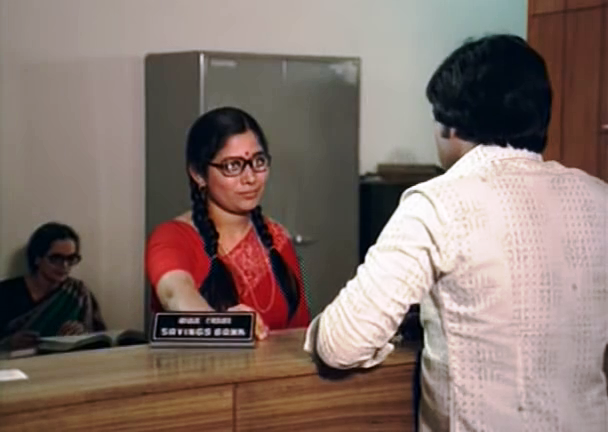
I like the exuberance, the vague attempt at accuracy and the expression on Chiru’s face throughout. I just love watching him dance. I laughed a lot in one scene when a lady in the bank started babbling over the ‘lovely, beautiful, wonderful’ Allwyn Hero when he came in to cash a cheque.

That would be me! And I’d totally buy that fridge.

Murthi exudes music and energy, singing his way through the day and even using song as conversation. He seems to be reasonably educated and working as a waiter was probably not his dream, but he does it well and picks up on opportunities. He deals with family problems, negotiates corrupt officialdom and is an everyman. Chiranjeevi gives Murthi a genial and easy going charm, with glimpses of the pride and self confidence that keep him going. That earnest vulnerability is worlds away from the mass hero style, and so endearing.

Also in the bank and checking Murthi out is Sujatha (Sumalatha). She is a serious young lady, a college lecturer, not a glossy glam heroine. She is due to be married to Mohan (Girish). The wedding negotiations stall over dowry. Her intended is from a rich family and has no need of money. Her father is forced to agree to the price, but Sujatha delivers a dressing down to prospective father-in-law Adisseshaya (Kaikala Satyanarayana) and the marriage is off. I really liked Sumalatha in Khaidi and she is impressive in this role too.  While being primped for her meeting with Mohan she brushes off her sister saying she wants to be what she is. Sujatha is resourceful, copes with setbacks and sometimes needs help, and is never a doormat. She and Chiranjeevi make a good couple, and I really liked their little disagreements and playful scenes.

Sujatha is sacked from her job and her parents throw her out when they decide she is having an affair with Murthi. Murthi is delighted she stood up for herself against the politician who refused to help his family. So he helps her find accommodation and they live in an idyllic version of poverty, with him acting as Sujatha’s household help. After insulting Adisseshaya, Murthi also loses his job, copping a beating along the way. Murthi uses his connections with Rao to get them both jobs – they never just give up. He might look after Sujatha, but she is an independent woman with her own earnings and a sense of worth. Murthi wants to see her settled, so approaches Rao who agrees to marry Sujatha. All this despite me knowing that Murthi loves her and she loves him. But I had faith it would all be set to rights.

It isn’t just the central couple that have their moments. Sujatha’s sister Lakshmi (Tulasi) is an impulsive and extroverted girl. She spots the ultra groovy Murali (‘Subhalekha’ Sudhakar), Adisseshaya’s other son – really, how could you miss him in those trousers? She is smitten and he cannot resist. They are mostly a comedy diversion, but since their antics are actually moving the plot along I quite liked them. Plus Murali’s dance moves are just hilarious (as is the decor in his room). Even though the sight of him made me giggle, Murali is a strong willed young man and sticks to his guns. Murali and Lakshmi conspire to prove a point and sort their families out, showing surprising sneakiness. I dither between thinking they are perfect for each other and wondering what will happen when disco dies or their hormones settle. But I enjoyed most of their scenes and thought they both had fun with their characters.

Mohan –the original groom for Sujatha – also has a surprise for his dad. While everyone was running around like headless chickens, he went and got married to Murthi’s sister. He did what he thought was right, and avoided his father’s veto by not asking for permission. The younger generation in the film are educated and have opportunities, so they are able to challenge outmoded practices.

The film is firmly anchored in realism and there is very little glamour or fancy apart from the characters’ own mild daydreams. The houses, workplaces and clothes all seem appropriate and not too new. There are nice interior details, and someone in the hotel had a thing for feature walls. The humour is integrated into the story and characters and there is little pointless comedic shtick. When Murthi returns to his village, he sees a line of people outside his home, and suspects something bad has happened. But they are only lining up for food his grandmother (Nirmalamma) is giving out. The scene unfolds beautifully with tears, overacting, and laughs, showing Murthi at home and his relationship with his family. Rallapalli and Allu Ramalingaiah have smallish roles but provide good foils for Murali and Murthi. I really liked the way the story plays out, and how the different characters all come back into the picture at the end.

KV Mahadevan’s music is pleasant. I never wanted to fast forward through the songs but I really can’t recall any individual melodies. This is not a big song and dance type of movie and the music does match the story and mood. I can only assume the lyrics also reflected what was going on.

This is such a restrained and well judged film I had to check again that it was indeed the same director that made the far less sensible Aapathbandhavudu! The last few minutes lost me a little as the story was resolved by booming voiceover while the action continued. I would have preferred letting the characters do the talking, but it is a satisfying film.

See it for a nicely balanced romance with a social message and of course for the excellent Chiranjeevi. 4 ½ stars! (A small deduction for the dire picture quality which annoyed me greatly).

Heather says:

Right from the very opening scene Subhalekha is a mesmerising film and surely only Chiranjeevi could make a small incident with a dog into such an entrancing piece of cinema. The story flows smoothly from one scene to the other and despite my very poor quality VCD copy, the quality of the film editing stands out. It’s very disappointing that Subhalekha isn’t available with subtitles, as although the basic story is relatively easy to follow, I am sure that I missed so much from not understanding the dialogues. There are quite a few long speeches where, although the general idea comes across due to the way the character speaks, it’s very frustrating not to know the details, especially since everything points to the dialogues being well written.

Chiranjeevi is excellent as the faithful and kind-hearted Murthi but Sumalatha puts in just as strong a performance. I found her scenes when she defies her prospective father in law gripping, despite the fact that I didn’t understanding a word! As much as I enjoyed the developing relationship between Murthi and Sujatha, the romance between Sujatha’s younger sister Lakshmi and Mohan’s brother Murali was easier to understand and probably for that reason their interactions were some of my favourite moments in the film. With his snazzy clothes and the huge over-sized glasses, so typical of the times, ‘Subhalekha’ Sudhakar was perfect in his role as the hip and trendy younger brother, and Tulasi was lovely as the rather feisty and adventurous Lakshmi. I also appreciated the quarrels between Murali and his father, and the declarative way Murali ended every argument with “I love her!” made me grin every time. I enjoyed all of the songs in this film, but my favourite was one pictured on Lakshmi and Murali as they cavorted around on the beach. It was only just overshadowed by Chiru’s excellent fridge advertising which was brilliant but not quite long enough for me. Just a little Chiru classical dance is never enough and I wanted more!

Films with a social message can often end up with too much preaching and not enough actual story, but that certainly isn’t the case here. The characters all seem to have genuine reasons for acting the way they do, even Adisseshaya is following convention rather than just being difficult and greedy (although of course he is that too), and it is all feels true to life. I do wish though that more discussions in real life could be held in the form of song in the way that Murthi communicates here.

This is such an excellent film that I am amazed it hasn’t been restored and re-released with subtitles. Despite the often poor quality of the VCD, Subhalekha is well worth a watch for some great performances and a well told story. Plus of course no-one does shy and bashful as well as Chiru! 4 ½ stars.


Aapathbandavudu

Aapathbandavudu is a melodrama by K Vishwanath that has a bit of action, a ‘will they won’t they’ romance, ‘medicine’ found only in films and some lovely MM Keeravani songs. The memorable performances by Chiranjeevi and Meenakshi Seshadri make their characters likeable and their predicaments seem meaningful. Even with the tear soaked dialogues, dubious plot devices and inexplicable decision making, it is very entertaining, sometimes funny, and often moving.  I admit my love of Chiru helped me get past the ‘oh no they didn’t!’ moments but there are interesting ideas and dialogues that help balance out the excesses.

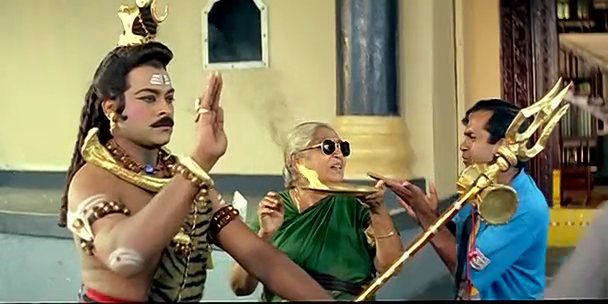
Good hearted low caste Madhava (Chiranjeevi) is attached to school teacher/poet (Jandhyala, who also wrote the dialogues) and his family. Apart from cow herding, Madhava is also the preferred Lord Shiva in district theatricals. Do not try and usurp his role – or this could happen to you:

Sigh. Did I mention this is a visually pleasing film?

Camera angles reflect the sense of elevation Madhava feels when he is compared to Lord Shiva, and he glows with pride at embodying the deity. But he is a country boy at heart and when his cow Ganga goes into labour his first thought is to get her off the train and into some privacy so she won’t be stressed. It’s a dynamic role that gives Chiranjeevi ample scope to use his mass hero shtick as well as delivering a nuanced performance. Most of the laughs come from situations and dialogues as well as Chiru’s knockabout physical comedy.

But I didn’t really need Madhava hamming it up in bovine (or ursine) ‘speech’.

People exploit Madhava’s generosity to make him fix their problems, but as Hema (Meenakshi Seshadri) says, it is usually him who pays the consequences. Despite his simplicity, Madhava is not stupid. He can find a loophole in an instruction as well as any lawyer, such as promising not to lay a hand on someone and still managing to rough them up. He takes on a local bigwig and employs a fighting style possibly inspired by Hanuman as well as Shiva, complete with his own vengeful song. In turn, the politician resorts to elaborate and inefficient methods to try and get Madhava out of the picture – including an attack by an enraged bull (mostly a fibreglass prop), and a murder attempt in a rigged performance. Luckily Hema realises what is going on and takes the guise of Shakti to protect Shiva. I love his dancing from around 5 minutes onwards as Shiva’s rage is unleashed.

But seriously – what is it with the rabbits?

Madhava has always called Hema a goddess, and when they dance as Shiva and Parvati he sees her as his goddess. He is very aware of the barriers between them.

Meenakshi gives Hema a distinct character and intelligence, and her emotional development is well portrayed. She is becoming physically as well as emotionally drawn to Madhava, and is both disturbed and excited by these feelings.  Hema tells Madhava she wishes he had the sense to understand what is in people’s minds, but he doesn’t. There is yearning and dreaming on both sides.

The first section is mostly rural romance with a caste barrier and a few dishooming fights, and I really didn’t expect the twist to take the form it did. Have a happy song before things get dark.

Hema’s father dies suddenly in the middle of a ceremony to honour Madhava. Chiru is brilliant as he shows the overwhelming emotions surging through the grief stricken and furious Madhava. He crafts a clay lingam and berates Shiva for his neglect despite all the prayers and offerings.  A kindly priest points out that just as Madhava could destroy what he had made, man is god’s creation and god has a right over our lives too. That seems to comfort him, but Hema is just devastated.

While Madhava is away, Hema visits her sister Lalita (Geetha) and baby niece. She is assaulted by her lecherous brother-in-law and Lalita is killed when she tries to intervene. The police are paid off and that is that. The shock, her grief over her father and sister, fear of a repeat attack – all these things cause Hema to become unstable. She exhibits extreme aggression towards men and is committed to a psychiatric hospital as her family cannot cope. Apparently a punch-up and a food fight is all it takes to fake insanity, so Madhava is soon an inmate and watching over Hema. Most of the inmates act happy and childlike and mental illness is made to seem harmless.

Rape and mental illness should not be used as cheap entertainment fodder, and there are disturbing abuses of power by characters in the film. What I liked was that other characters found these incidents as reprehensible as I did, and tried to get some justice. The mental patients had a right to decent treatment. Hema wasn’t blamed for being attacked or having a breakdown, and her family never abandoned her. There was some empathy shown for the damaged people. Not everything was swept under the carpet, but the powerlessness of the average person in the story was so frustrating.

Meenakshi plays traumatised Hema as intensely angry and determined to fight any perceived threat, which includes all men. When the drugs kick in she becomes empty eyed and withdrawn. She can’t recognise Madhava as her friend but she does eventually recognise she can trust him. When a staff member tries to rape Hema, Madhava defends her and is given shock treatment as the doctors think he is psychotic.  He is further accused of being the rapist, and his suffering is palpable as is his desperation to help her.

Chiranjeevi adds an extra layer of pretence as he switches from Madhava to Madhava (over)acting crazy, and there is a marked deterioration in his appearance once he is an inpatient.  On that note, while the idea of Chiru dressing up and having himself delivered to me in a box has some appeal, this costume may have caused the more fragile patient to have a bit of a setback. But the dancing is great!

Madhava manages to spend some time with Hema and uses a very ugly doll to reignite her memories of home and loved ones, sparked by a favourite lullaby. Compared to some of the other goings on in the asylum that struck me as quite sensible and therapeutic, and indeed she is soon released.

Madhava is left beset by fear and sadness. He has given everything he can, including selling his herd to get money to help the family, and may have ruined his own life. He berates himself for his stupidity in a powerful speech to his reflection, but can’t see any way out of this mess, or the asylum.

The ending is so filmi incredible but I still found myself on the edge of my seat. Just how could it possibly work out? And why on earth were so many people overcome with bad luck and bad judgement all at once?

There are no comedy uncles as such. Brahmanandam is Madhava’s friend and provides some physical comedy but largely this is a straight character role for him and they share a nice rapport. Allu Ramalingaiah as the uncle resents Madhava’s position in the family and has a sharp tongue when voicing his disapproval. Like Brahmi, his role is dramatic, not the comedic turn I expect from him. Sarath Babu as Sripati wants to do what is right, and is the sympathetic ‘other guy’. There is something reassuring about Sarath Babu and having him as a friend does seem to make the good guys that much more resilient. Jandhyala is very fatherly, and suits his role as the unfashionable teacher and poet who refuses to cheapen his art.

The emphasis is more on characters than causes although the film does say something about caste, dowry and other facets of society. It is wildly melodramatic, but the writer and actors invest in the central characters and there is plenty to enjoy along the way.

My DVD cover says this is a ‘must see movie before you die’. I’m not sure about that, but I encourage you to at least look at the song clips. The village scenery is pretty and beautifully filmed, the music is lovely and the dancing is excellent. But really, this is all about the performances by Chiru and Meenakshi and they won me over from the start.

3 ½ stars!

Sorry Chiru.  4 stars?

4 stars!

PS – thanks tolly for the recommendation all those months ago – where are you tolly? It’s been ages!