Yaadein (1964)

1964-Yaadein-poster

There is something almost hilariously over the top about the set up for Yaadein, as the title credits declare this a “one actor only film”. But it is Sunil Dutt at the helm and in front of the camera, and he made some very interesting films and film choices over the years. Yaadein is neither as bombastic nor simple as it seems at first glance, and doesn’t come across as a vanity project.

The camera tracks through an empty house with a lovely romantic melody accompanying the fluttering draperies and stylish interiors. A man comes home on this dark stormy night and finds the house empty, his wife and children gone. Being a Hindi film hero, Anil (Sunil Dutt) assumes the worst.

He wanders around calling for his wife Priya but the place is deserted. He looked quite terrified when he wandered into the kitchen and there was no dinner left for him. What on earth!

He gets a phone call and spends a few minutes chatting with someone and seems to be cheered up after the call. But his game of manic hide and seek around the house soon turns to melancholy as he flirts and declares his love for…a statue. And then through phone calls, a note, and a lot of talking to himself we learn that he and Priya had a huge row recently, that she is good as gold and he is not so much and there seems to be another woman in his life.

Dutt uses lots of tricky camera angles, shifting perspectives, lots of sound effects, and uses objects to trigger more of Anil’s introspection and reactions. It’s appropriately noir-ish when Anil’s thoughts turn dark. Akhtar ul-Iman wrote the script and I wish that I’d had subtitles as I missed a lot of detail, but think I got the gist of it. Anil is demanding, pleading, bargaining and eventually depressed as he works through something akin to the Kübler-Ross model.

He is full of bravado when he yells at the empty house that he can cook with his own hands and straps on an apron. Then he moves on to trying to boil a kettle. Well. He is going to need building maintenance to sort out the flood in the kitchen. He is useless, especially when distracted by memories of Priya.

He relives their early relationship when he was first bowled over by Priya, wandering around extolling her virtues and mumbling “Kya Ladki Hai!”. Anil is a sensual man who appreciates the heady days of new love and physical passion. He was overjoyed at the birth of his son but hadn’t stopped to think about actually raising a child and what that might mean to his lifestyle. Especially the no late nights rule, which he breaks almost immediately, and the separate beds. At one stage Anil does a very cheesy striptease, and although there is no Priya in the scene I could feel her total lack of interest.

Despite this being a One Actor Film, there are other actors involved. There are phone calls, party guests and other characters heard but not seen in flashbacks. I couldn’t recognise all the voices and caricatures though. We see Shyama, the probable other woman as one of many airy gas filled guests at a party. I love the stylised caricatures and balloon people that stand in for other characters. A party scene is filmed in front of a very 60s cartoon panel depicting a jazzy party. Vasant Desai’s music is lush and melancholy, a perfect match. And Sunil Dutt really doesn’t miss a beat no matter what he is acting at.

His longing for Priya is palpable but when she refuses to have sex he pokes her with a hairpin and has a childish tantrum. He was a spoilt manchild himself and while he loved his kids he resented the way they forced new priorities and demands that aren’t all about him into his blissful life.

The emotional waves seem to flood in a bit suddenly. I mean, he could have just called her parents and asked if they knew where she was, or gone out to have a look. He seems so utterly sure they are gone forever despite all the things she has left in the house – her hairbrush, clothes, jewellery, her lipstick that he tastes as though he is kissing her again. But the emotions do ring true even if I think the person having them might be overdoing it. He does go a bit over the top but we are not seeing Anil’s physical reality, more his remembered events and emotions with all the distortions of time and memory, and with himself firmly at the centre.

He passes out after a particularly energetic flashback to his kids tormenting him. Finally he is attacked by toys. The snarling mechanical lion is not all that terrifying but Dutt emotes fiercely enough for both of them. His disturbance turns into a full blown breakdown, and he becomes suicidal partly because he has been abandoned and partly because he knows he doesn’t deserve another chance.

Sidenote: There is a very silly game based on the actor William Shatner. The rules are simple. If someone shouts “SHATNER” at you, you have to overact whatever you are doing at that moment. And at times I wondered if there was a prototype of that game called “DUTT”.

Despite her absence, it is the woman who shapes the movie. The gap she leaves in Anil’s life, the way he has taken her for granted, the infidelities and inconsiderate behaviour he regrets. He realises he was incredibly lucky to have her and it is devastating to him, who has always been so suave and devil may care, that losing her may be all his own doing. Everything that is good and real in his life is represented by his unseen but ever present wife. But will she return? And what will she do if she sees the mess he has made of their home? I’d have turned around and walked back out if it was me!

Despite the heavy subject and the intense focus on Anil, Yaadein is not a chore to watch and it doesn’t feel claustrophobic. There is suspense, humour, some facepalm moments, and some beautifully sensual and romantic scenes. I’m not sure I’d watch it over and over, but I certainly recommend it as an engaging artistic project made by an interesting director who had a clear and individual vision. 4 stars! (a little upgrade from my original thought of 3 ½ for the sheer vision and commitment)

Godhi Banna Sadharana Mykattu

GBSM poster

The past few years have seen a number of promising new directors appear in the Kannada film industry and Hemanth Rao is another to add to the list. His début film Godhi Banna Sadharana Mykattu has the benefit of an excellent cast, but the well-written story is beautifully developed and the blend of emotional drama, suspense and humour is perfect. At first glance it may appear rather dark as Anant Nag plays an Alzheimer’s patient who goes missing, with Rakshit Shetty as his increasingly desperate son, but there is plenty of joy in the film too and the emotional highs and lows are cleverly balanced. This is one of the best films I’ve seen this year so far, and as icing on the cake, it even has grammatically correct English subtitles!

What makes Godhi Banna Sadharana Mykattu such a good film is that Hemanth Rao tells a simple story exceptionally well. It’s just a bonus that the characterisations are superbly done and the dialogue is moving and funny while still sounding realistic and plausible. Venkob Rao (Anant Nag) is a widower who has developed Alzheimer’s and although he can remember his long ago past, his short-term memory is gone. Venkob’s son Shiva (Rakshit Shetty) has moved to Mumbai to work and placed his father in a nursing home since Venkob can no longer live by himself. The pressures of work and the distance that separates them mean Shiva rarely sees his father but when he comes back to Bangalore to seal a business deal he takes Venkob shopping for new clothes. The frustrations of dealing with an elderly and confused man while trying to buy him clothes and simultaneously talk business on the phone is eloquently portrayed here in just a few short scenes and Siva’s impatience is just as authentically portrayed. It’s nicely done and while Shiva comes across as an angry and harried man, Anant Nag gives Venkob dignity and occasionally lets a hint of mischievousness peek through that gives an insight into his personality before the Alzheimer’s disease took over.

After reaching breaking point, Shiva bad-temperedly drops Venkob off outside the nursing home and speeds away for a business dinner, but in the time it takes for the security guard to reach the front gate Venkob vanishes. Shiva immediately takes his frustrations out on his father’s doctor at the home, Dr Sahana (Sruthi Hariharan) threatening to ruin her career and sue the home although he was the one who didn’t take proper care of his father.  Dr Sahana is no pushover and hits back with Shiva’s abandonment of Venkob and his lack of engagement despite her calls and emails about his father’s progress. The dialogue is perfect, the reactions genuine and both Rakshit Shetty and Sruthi Hariharan are completely believable in their roles as they start the search for Shiva’s missing father.

Elsewhere a government official has been murdered and Ranga (Vasishta N. Simha) and his assistant Manja (Ravikiran Rajendran) have been given the job of disposing of the body. However their path crosses with Venkob when a brief stop along the way allows him to slip into the back of their truck. Unfortunately the truck crashes and when a good Samaritan Kumar (Achyuth Kumar) stops to help, Ranga and Manja steal his car and haul both Kumar and Venkob along as hostages. With Kumar and his family locked up in their house with Venkob and the two villains, tension starts to rise as Ranga’s boss tells him to kill everyone and move on. Meanwhile Shiva is still searching for his father with the help of Dr Sahana and through her eyes Shiva starts to see his father in a new light. The physical search becomes a way to reconnect with his past and possibly his father too if he can ever manage to find him.

Anand Nag is absolutely brilliant as a 66 year old man with Alzheimer’s, but the rest of the cast are just as good. Vasishta Simha is superb as a career criminal who is fine with disposing of bodies but struggles with the idea of cold-blooded murder. Since his potential victims include Kumar’s wife and young son as well as the effectively harmless Venkob, his reluctance is perhaps rather understandable. Ranga is not a killer and his emotional turmoil is perfectly shown, particularly when Venkob starts to confuse Ranga with his son Shiva and tries to give him advice. His memory may be gone, but Venkob can recognise a soul in distress and his attempts to console the man who is trying to kill him are heart wrenching. Despite this, Hemanth Rao keeps everything from getting too emotionally bogged down by including small moments of perfectly nuanced humour that fit surprisingly well into the story. It would be easy to use Venkob’s condition to generate some cheap laughs, but instead we are laughing with Venkob rather than at him, and it makes all the difference to the mood of the film. As well as the sudden lapses back into confusion by Venkob, the excellent performance by Achyuth Kumar makes this part of the film memorable for all the right reasons and the mix of tension, drama and humour created is spell-binding.

Although some of the scenarios are rather far-fetched (it’s hard to believe for example that Sahana has time to go jauntering off searching for a patient and abandoning her case load at the home), nothing about the film feels too contrived and the story moves smoothly between the search for Venkob and  the cooped up criminals. Rakshit Shetty puts in another commendable performance after Simple Agi Ondh Love Story, with an accurate portrayal of a man searching for his father and finding himself along the way. Sruthi Hariharan is just as good here as she was in Lucia and I thoroughly enjoyed her performance here as the down to earth and practical Dr Sahana.

The music was a little too loud at times in the cinema, but the songs from Charan Raj are all lovely and at the right volume suit the mood of the film perfectly. The cinematography too by Nanda Kishore is good with some great visualisations of the mental distance between Venkob and Shiva. This is one of those rare gems where everything just comes together, with story, cast, characterisations and all the technical aspects flawless and perfectly executed. It works because Godhi Banna Sadharana Mykattu is quirky and different but at heart is a tale that will resonate with audiences. The story jumps between father and son and between present and past. There is the contrast between one man’s search for his father and a relationship that appears to be lost, and another’s search for his conscience and a way out of a bad situation. This is film-making at its best and I can’t wait to see what Hemanth Rao comes up with next. Highly recommended – you don’t want to miss this one!

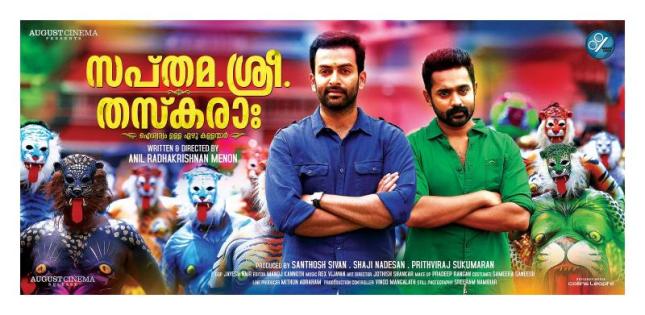
Sapthamashree Thaskaraha

PosterIn his second film Sapthamashree Thaskaraha, Anil Radhakrishnan Menon takes a number of ideas from various Hollywood heist movies and expertly gives them an Indian flavour with a collection of memorable characters and an appropriately Keralan setting. It’s an entertaining film with more comedy than I expected in a crime thriller, and as with North 24 Kaadham it’s the clever characterisations that stand out. The story is well written with some clever twists and engaging dialogue while the heist itself, although improbable, is not completely impossible. Anil Radhakrishnan Menon keeps the action tense during the heist scenes but manages to add in plenty of genuinely funny moments too, while the excellent cast work well together to make a better than average movie.

The film starts with one of the ‘seven good thieves’ of the title disclosing his crime in a church and his rambling confession becomes the narrative for the film. The priest in the confessional is ably played by Lijo Jose Pelissery, more commonly found on the other side of the camera, but he does an excellent job here as the fascinated recipient of Martin’s (Chemban Vinod Jose) recollections. It’s not just a bare rendition of events either, as there is some excellent comedy woven into these scenes and both the priest and Martin add snippets of background information as they go along.

The seven thieves meet in prison where they are all sharing the same cell. This does seem a little strange to me given the variety of their crimes, although perhaps the common theme is that they all have relatively short sentences. Martin is a fairly inept thief, mainly involved in petty crimes and hindered by his assistant Gee Varghese (Sudhi Koppa) whose incompetence in the art of crime is reflected in his wardrobe choices. Martin’s journey to jail introduces another two characters, Narayankutty (Neeraj Madhav) and Krishnan Unni (Prithviraj) who both stand out as different from the other prisoners on the bus. Narayankutty is intimidated by the other inmates, and as his back story is revealed it becomes obvious that he’s basically a computer geek with little awareness of the real world. He was convicted of supplying a camera secreted in a soap box to a couple of peeping toms, although it’s clear that he never thought about why the two men wanted such a thing. However his talents ensure he is invaluable to the team later when his computer expertise is vital for their convoluted robbery plans. Neeraj Madhav seems perfectly cast as the nerdy Narayankutty with his generally bemused attitude and facial expressions underlining his naiveté while his attempt at distraction during a bodybuilding contest is just hilarious.

Three of the prisoners have a connection to Pious Mathew (Joy Mathew), a wealthy local businessman who has acquired his money through a series of illegal extortions and schemes. Krishnan Unni attacked Pious when he was involved in the death of Krishnan’s wife Sarah (Reenu Mathews) and it’s for this assault that Krishnan is serving time in jail. Prithviraj has the longest and most detailed backstory here and his character is also the brains behind the operation, but despite this the film doesn’t make him the central hero and Prithviraj doesn’t appear as the ‘star’. For much of the film Krishnan Unni is just a member of the gang, albeit the one who organises the heist and delegates roles to each of the other thieves.

Nobel Ettan (Nedumudi Venu) is in jail after his family owned chit fund collapsed owing a significant amount of money. He lost everything, including his son to suicide, after being conned by Pious who also stole most of the fund money. Nobel’s plight is the reason that the thieves unite against Pious, although the lure of big money is probably the major factor in their decision. The final connection to Pious is through ‘Leaf’ Vasu (Sudheer Karamana), a driver and hit-man for Pious until he sustained a head injury that left him mentally incapacitated. Despite his confused state Vasu remembers where Pious keeps his money and that’s enough information for the rest of the gang to start making plans to rob the crooked businessman on their release from jail.

The final two gang members are Salaam (Salaam Bukhari) and Shabab (Asif Ali). Salaam is a Hindi-speaking magician who has many useful skills and an acrobatic girlfriend Paki (Flower Battsetseg) who is also drawn into the plot. Shabab is mainly shown to be a capable fighter with a strong sense of justice whose finest moment comes when he lures Pious’ brother Christo (Irshad) into a fight with a group of tiger men. There is something very satisfying about watching a group of men with tiger faces on their bellies turn round and suddenly become menacing after having been dancing only moments before.

After their release the thieves set up shop in Nobel Ettan’s house and organise their plan to break into the Charity hospital where Pious and his family keep their ill-gotten loot.  Luckily Noble Ettan’s daughter Annamma (Sanusha) works at the hospital, and with her help and the skills of the seven thieves the intricate robbery starts to take shape.

The first half is relatively slow as the various characters are established, but the film doesn’t drag due to a good mixture of action and comedy in the back stories. Some of the stories are longer than others, and Prithviraj’s does include a song which isn’t entirely necessary but does fit well into the narrative.

The second half has just as much comedy but also increased moments of tension, particularly during the robbery itself where Ammanna’s nervous participation provides a good contrast to the antics of Martin outside the hospital. However there are a few sequences which drag on a little too long, such as repeated shots of the church procession, which break up the momentum and reduce the impact of the heist scenes. It’s the individual performances and characterisation of each of the thieves that make the film so watchable. Each has a reason to be included and all of the actors fit perfectly into their roles. Nedumudi Venu for example is blissfully unaware of his wife and daughters’ displeasure when he brings the released prisoners to his house, making it even more plausible that he was easily fooled by Pious and swindled out of his business while Sudheer Karamana includes repetitive mannerisms and childlike behaviours that make Vasu a more convincing character.

Joy Mathews as the main villain is nicely smug and vindictive with no redeeming features, which makes it easy to enjoy his discomfort and that of his equally nasty brothers at the end, and in true Robin Hood fashion, all the thieves have enough good qualities to ensure that the audience will be on their side. It’s simplistic but works due to the quality of the cast and good writing of their characters.

There are only a few songs in the film penned by Rex Vijayan and they are mainly used as background while the gang scurry around getting everything they need for the heist. Jayesh Nair’s cinematography is excellent and I love his use of bars, windows and other framing effects to heighten the claustrophobic atmosphere and increase tension as the film reaches its conclusion.

There is much to like in Sapthamashree Thaskaraha. The mix of different characters works well to keep the story moving forward as each takes part in the robbery. The set-up gives a clear insight into each character and the final heist is a good mixture of clever plot, heightened tension and a good dash of humour to wash it all down. I loved the final twist – of course there’s a final twist – which reminded me of British films such as Shallow Grave and Lock Stock and Two Smoking Barrels, which are also comedy/thrillers that end not quite as expected. Highly recommended – 4 stars.