Gautamiputra Satakarni

gautamiputra-satakarni-poster

For his latest film Krish takes inspiration from historical figure Gautamiputra Satakarni; a king who ruled in the South of India a couple of thousand years ago. Since little seems to be known about his reign, Krish is free to take the few major events that have been recorded and develop these into a plausible story, which he does reasonably well. The film follows Satakarni (Balakrishna) through a number of battles as he consolidates his rule over Southern India, and then moves north to tackle the invading Greeks. As a historical epic, there is plenty to enjoy but the film doesn’t shed much light on the man behind the warrior king despite a few diversions into his relationship with his mother and wife.

Over the opening credits, the young Satakarni declares that the only way to stop the petty wars between neighbouring kingdoms is for one man to conquer them all and thus unify the country. Needless to say, even at such a young age, Satakarni knows that he is the right man for the job and as the film begins the adult Satakarni has already embarked on his campaign. He starts off small by conquering a few neighbouring kingdoms (Milind Gunaji is good as one of the kings here) and then turns his sights towards the north, sending emissaries to King Nahapana (Kabir Bedi). Unsurprisingly Nahapana doesn’t respond well to a demand that he peacefully submits to becoming a vassal of Satakarni, and the scene is set for war!

Satakarni alienates his wife Vashishthee (Shriya Saran) when he takes his young son along to battle which allows for the development of some tension between the two. At the same time, Satakarni is shown as having great respect for his mother Gautami Balashri (Hema Malini), whom he has left to govern while he is off fighting his battles. These two relationships allow for more emotional and character-driven scenes to balance the battles that form the rest of the film. These are epically grand and give Balakrishna plenty of opportunity to make declarations (they’re much more dramatic than mere speeches) while looking imposing in armour and carrying a large sword. He has the gravitas and spectacular moustache required to play the ruler of the Satavahanan empire, although his age does seem to slow him down in the action scenes.

I enjoyed watching Balakrishna as Satakarni and this was a good choice for his 100th film. The character allows him to behave as the usual style of Telugu hero (unstoppable one-man army) but this time he does have an army to back him up. He’s also impressive in the more emotional scenes and his delivery of the epic speeches is very well done. Shriya Saran is also excellent as Satakarni’s wife and makes an impact despite her limited amount of time onscreen. There is the excitement of her reuniting with the king after time apart, their happiness together and then the shock of her young son heading into battle. Although at times she does emote just a little too much, at least the historical nature of the drama allows her to do so. The historical aspect also makes the sight of an older and portlier Balakrishna chasing Vashti around the royal bedchamber a little more acceptable, although I was reminded of portraits of the English King Henry the Eighth and his procession of younger wives. I find Shriya Saran can be a bit hit and miss, but here she is a definite hit and the relationship between her and Balakrishna works much better than expected. Hema Malini too is very good as the dowager queen, dealing with the pesky problems that crop up while her son is away subduing the realm. She does this with grace and style, looking regal and definitely projecting an aura that she is not to be trifled with.

After subduing Nahapana, the next challenge for Satakarni is the army of invading Greeks led by Demetrius. While the scenes where Satakarni plots his campaign are well delivered, the battle scenes are a little more patchy. For the most part when the camera is showing close ups of the action the battles look superb, but there are a few glitches between the CGI and staged fight scenes. These are mainly errors of perspective where there is a CGI view of massed warriors which moves in to show a smaller group of men and horses surrounded by green fields. For the most part the effects are well integrated into the live action and the battles do look good, but the few errors do divert attention away from the overall spectacle. The other problem is that a couple of the battles go on just that little bit too long. Some of this is due to repetitions of the same scene, as for example during the storming of the walls of Nahapana’s citadel but some just seem overly drawn out while Balakrishna indulges in some heroics which would mean certain death on a real battlefield.

There is plenty to enjoy in Gautamiputra Satakarni, even with the slightly uneven mix of plentiful epic battles and intermittent emotional drama. Balakrishna exudes power and authority while the appropriately grandiose costumes and palace sets seem to paint the time period well. Not that I would know if they were wrong, but judging by the paintings in museums I’ve seen while in India, this all looked pretty good! The soundtrack by Chirantan Bhatt is also excellent and to his and Krish’s credit, the songs don’t feel out of place in the narrative. However at the end of the day there is no real insight into the characters and the all too brief glimpse of Satakarni’s achievements only leads to more questions. This isn’t an attempt to detail the life of a famous ruler or to tell the story of a kingdom, but instead is a series of vignettes of what might have occurred, without delving too deeply into the why. Too, Balakrishna plays Satakarni as a regular Telugu hero with all the unlikely ability to stop an army single handedly so the story never feels quite as realistic as it should. But once the drums start beating and the swords clash that seems unimportant – the spectacle and grandeur of ancient India sweep across the screen and Gautamiputra Satakarni charges to victory!
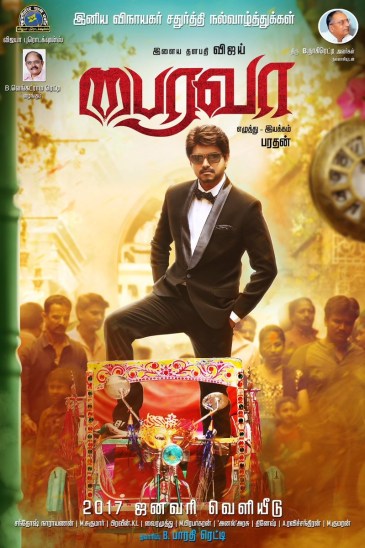
Bairavaa (2017)

bairavaa

Step into the cinema at any point during Bairavaa and you could be forgiven for mistaking it for almost any of Vijay’s previous films. The only thing that seems to vary in these masala outings is his attire, while everything else (love interest, villain, ‘comedy’ friend, evil henchmen etc) is identical. In his latest mass film Bairavaa, even the trusty masala formula fails to deliver as expected mainly due to poorly realised villains and dull, repetitive fight scenes. Not even the songs are inspiring and it’s only Vijay’s presence and on-screen charisma that makes it possible to sit through the full 169 minute run-time. There are some laughs, one or two fight scenes that work a little better than the rest and a couple of good songs but overall Bharathan’s latest release fails to impress.

Bairavaa (Vijay) is a recovery agent for a bank who don’t seem to mind that he uses rather direct methods to reclaim outstanding funds. This leads inevitably to the first fight scene as the bank manager sends Bairavaa out to collect money from a thug who likes to play cricket. The fight itself is quite cleverly choreographed with Vijay imitating cricket stars and using a cricket ball instead of his fists to flatten thugs, but despite the novelty it isn’t particularly exciting and there is absolutely no sense of suspense. It’s a given from the start that Bairavaa will be walking out of there with the money and that all of the rowdies will be writhing around on the floor. And that’s the problem with almost every other fight scene in the movie too. Even when the numbers of rent-a-thugs get upped and then upped again, there is no stopping the one-man army that is Bairavaa. The fights become an unending parade of rowdies being thrown up, down and around in slow-mo while Bairavaa barely breaks into a sweat. The exceptions mainly come in the second half when there is a little more at stake, but overall, even with a few stylish moves thrown in here and there, the fights are mostly monotonously predictable and uninspiring.

After meeting Malarvizhi (Keerthy Suresh) at a wedding and falling instantly in love, Bairavaa discovers she has a problem back home in Tirunelveli after she is attacked by a gang of thugs at Koyambedu bus station. This leads to a flashback that explains her predicament and why she is being targeted by businessman and self-styled champion of education PK (Jagapati Babu). PK is aided in his various criminal activities by Kottai Veeran (Daniel Balaji) and his merry gang of rowdies, while Malarvizhi is supported by her sister (Sija Rose), grandfather (Vittal Rao) and Uncle Narayanan (Thambi Ramaiah). Malarvizhi has taken PK to court to prove that he was responsible for the death of her friend Vaishali (Aparna Vinod) in his substandard medical college and that the college’s explanation for her death is completely untrue. PK has been warned by the judge that the upcoming final hearing should not interrupt Malarvizhi’s studies or endanger her health with the result that instead of killing Malarvizhi, PK tries every possible method of intimidation to make her break down and give up her fight. Naturally Bairavaa takes up Malarvizhi’s cause and immediately starts to oppose PK and his allies.

Sadly PK is a one-dimensional villain who does little other than sneer at the camera and order his seemingly self-replicating gangs of thugs to put an end to Bairavaa. His henchman Kottai Veeran has a little more to work with, but both men are purely obstacles to be overcome in Bairavaa’s pursuit of the girl. There is presumably some sort of message in the revelation that some private colleges are purely money making exercises and Malarvizhi does her best to promote the cause of independent women everywhere, but at the end of the day she is reliant on Bairavaa to defeat the thigs. Her methods of contacting solicitors, providing evidence and the like are casually destroyed by PK and Kottai Verran using methods that seem unlikely to work in real life. Malarvizhi is a fairly typical Tamil heroine in that she has some backbone and a promising career but still falls for the hero in less time that it takes her to find the bus home to Tirunelveli. I’ve yet to see Keerthy Suresh in a role that I think she can do justice too, and this doesn’t seem close. She looks uncomfortable in the songs and while there is some reasonable chemistry between her and Vijay it’s much like the rest of the film – pedestrian and predictable.

There are a number of other threads that seem to have been added to and appeal more to the modern market. Harish Uthaman appears as Malarvizhi’s abusive brother-in-law Prabha who has the world’s fastest rehabilitation after he gets beaten up by Bairavaa. Generally the police and judicial system are honest and the comedy is kept to a minimum with Bairavaa’s friend Shanmugam (Sathish) having only limited time onscreen. Thambi Ramaiah as Malarvizhi’s uncle Narayanan has even less time on screen, which in this instance is definitely for the best.

The songs too are disappointing and often oddly placed although Vijay’s dancing is still the highlight, but even here the energy seems subdued. At least until Papa Papa which is definitely the pick of the bunch. I can usually find something to enjoy in a Vijay film, despite the often wafer-thin plots, but I was hard pressed to find much in Bairavaa. It’s a strictly by the numbers mass film with little animation and even less ingenuity. At 169 minutes Bairavaa does feel like an endurance test and much could have been shortened (all those slow-mo fight moves and echoing repeats!) to improve the film flow. One strictly for the fans, and even then be prepared for a less than thrilling experience.

Lion (2016)

lion-movie-posterIn an “only in the movies” story, little Saroo is separated from his big brother at a railway station near Khandwa, Madhya Pradesh. He accidentally takes a train that lands him in Kolkata, hundreds of kilometres from home. Living on the streets he evades some very unpleasant people and situations before being taken in to an orphanage. He is adopted through an organisation called ISSA and placed with a middle class Anglo family in Hobart, Tasmania. When Saroo moves to Melbourne for uni he starts to admit to himself that he really wants to know who he is. He can’t forget his family, especially his mum and older brother Guddu, and knows they must have been looking for him all these years. His friends suggest using Google Earth to try and find landmarks he remembered. It’s a struggle as Saroo deals with his feelings of betraying his adoptive parents, his complex relationship with adopted brother Mantosh, his whiny girlfriend Lucy (Rooney Mara), and the sheer time and energy to do the work. But he never completely gives up, and he does find his way.


Lion is based on Saroo Brierley’s autobiography, The Long Road Home. I was fortunate enough to attend a preview introduced by Saroo and his mum Sue. They had input into the screenplay adaptation, and both said they were pleased with the results. Garth Davis uses landscape beautifully to reflect Saroo’s journey and to ground his memories. The scenery in Tasmania is pristine and lovingly shot, with a sense of order and calm. In contrast, Kolkata swirls with movement and energy as little Saroo (Sunny Pawar) darts through crowds and runs his heart out in search of home. The film is as manipulative as can be, but it’s the kind of emotional push and pull that made me want to buy into it. He’s a good kid, and you want him to be happy.

Sunny Pawar is that rarest of creatures – an Indian child actor I don’t want to slap. Apart from being ridiculously cute he conveys emotions with clarity and a sense of genuine feeling. Saroo couldn’t speak to anyone much about what had happened as he was a little kid, only spoke Hindi, was illiterate, and had no idea how to find his home. He was selected by Mrs Sood (Deepti Naval) as a good candidate for overseas adoption and before long, he had a new home.

Twenty years later, Dev Patel is Saroo. He has great hair, and a good Aussie accent. I’ve not been completely convinced by some of his past work but I felt he really inhabited Saroo and was just brimming with energy and life. He had a typically Australian slightly inarticulate, good natured, blokey feel about his character but could also show great depth of emotions. Patel’s scenes with Divian Ladwa who plays grown up Mantosh were full of love and disappointment and rivalry, being mean in ways you know will hit hardest, always internally comparing this brother to long lost Guddu. He had a strong connection with Nicole Kidman and David Wenham as his parents, and a relaxed playful rapport with the ensemble of his friends. The latter section of the film drags a bit as Saroo wallows in his angst, but it does make the payoff all the more sweet.

Sue’s dedication to having an adopted family made me slightly uncomfortable in the film, but not when I heard her speak in person. Possibly it was the tight close-ups of Nicole Kidman and her fierce emoting that made it seem too much. You know when you inadvertently see a display of intense emotion that was not meant for you, you just want to look away and give that person back their privacy. David Wenham has long been a favourite actor of mine. I would probably watch him watching paint dry, and find it fascinating. He plays John as a typical dad with a big heart and a few bad jokes, trying to keep his family of diverse and strong personalities together and happy through their ups and downs.

The casting really is excellent and I think it shows their commitment to getting things right. The Indian cast features some excellent character actors including Nawazuddin Siddiqui, Tannishtha Chatterjee, and Deepti Naval in small but impactful roles, with Priyanka Bose as Saroo’s birth mum Kamla. Melbourne girl Pallavi Sharda and local soapie actor Sachin Joab play a couple of Saroo’s uni mates. Abhishek Bharate delivers a good performance as Guddu, with a cocky swagger and a warm smile that made him so unforgettable for his little brother. Rooney Mara is stitched up with a fairly insipid role as Saroo’s girlfriend. Her character Lucy just doesn’t have the same complexity and depth as the others and she comes across as more of a plot device than a person.

I think Lion is going to be interpreted quite differently depending on your perspective. Many Australian viewers would have no idea who Deepti Naval or Nawazzudin Siddiqui is, so there’s that. I may have been the only person in the theatre to whoop when Prabhu Deva appeared on the telly in the background of a scene! And I doubt the 1980s approach to intercultural adoption, which was heavy on assimilation, will sit well with everyone. I was adopted as were several of my friends, and we all had diverse experiences and have made our choices about finding birth parents, so this resonates strongly with me. Sue is clear that she wants Saroo to tell her all about himself and what happened before the adoption, so it isn’t a case of ignoring his personal history. It’s more that there seemed to be no acknowledgement of his existing language or culture, only his misfortune of being a lost boy. Because the film jumps from the start to the end of Saroo’s personal journey, there is a whole other story in the middle that we don’t see. Saroo mentioned he might be working on a prequel so perhaps there will be a companion piece to come. Whatever your views, Saroo seems to have turned out to be a very generous and grounded young man who both his families are proud of.

See Lion for a beautiful story of identity and home and family, for the unashamed tugging at your heartstrings, for the excellent performances. Take some tissues because at least one of the Saroos will probably make you cry!

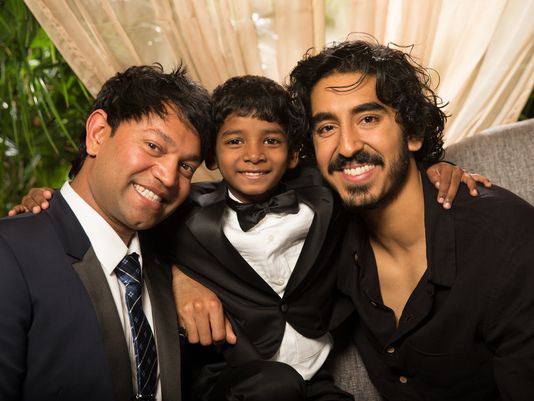
lion-all-the-saroos