Traffic (2011)

Traffic

When it first released in 2011, Rajesh Pillai’s Traffic was hailed as a new genre in Malayalam cinema and one of the first so-called ‘New Generation’ films. Bobby and Sanjay’s story doesn’t have a traditional heroic-centric plot, but instead uses a collection of everyday characters and a combination of a non-linear first half with a more traditional road movie in the second to come up with a novel action/drama. Despite the more Western style, this is still a very Indian film with references to wide-spread corruption, the power of celebrity and the chaotic nature of the Indian road system at the heart of the story. Interestingly, the film is based on real-life events in Chennai which are referenced in the film, proving that real life is often more dramatic than fiction.

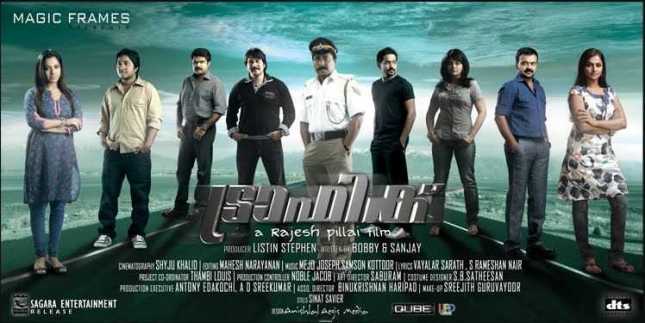
Traffic begins with a car crash, then goes back a few weeks to introduce the main characters and the events that lead to their presence at a particular crossroads at 8.50am on 16th September. First there is Siddharth Shankar (Rahman), a movie star who has little time for his family, wife Shruti (Lena) and daughter Priya (Namitha Pramod). Siddharth has people who do things for him and he expects his celebrity status to smooth his way through life which, for the most part, it does. At one point Siddharth is interviewed while his daughter and wife watch, rolling their eyes at his generic answers which suggest he is a devoted family man. But when Priya gives the interviewer questions to ask about herself, Siddharth obviously hasn’t a clue, stopping the shooting and asking Priya for the answer before repeating it on camera. It’s an excellent example of the disconnect between the actor and his family, and illustrates his complete unawareness of the chasm he has allowed to develop between them. It’s not so much arrogance as a simple belief that he is the most important person in any situation, so when later, Siddharth is attempting to throw his weight around and suddenly realises that here is a situation where all his star-power is useless, it’s a major shock to his ego. Particularly when combined with a few home-truths from his wife in a rousing dialogue where she finally points out his shortcomings and failures as a father. Shruti has some of the best dialogues in the film and Lena does an excellent job in portraying her emotional upheavals as the story unfolds.

Secondly there is Reehan (Vineeth Sreenivasan), who has just scored the job of a journalist at TV station Indiavision and is scheduled to interview Siddharth on the day of the accident. Reehan has some issues with his doctor father (Saikumar) but seems to be finally finding his place in the world with his new job. He has a girlfriend Aditi (Sandhya) who is looking for her second chance at happiness with Reehan. The two seem very much in love although her recently divorced status and different religion mean that Reehan hasn’t told his parents about their relationship. All in all, they are a regular family and their reactions when disaster strikes seem completely normal, even down to Reehan’s mother obsessively replaying the last video she took of her son before his big interview. That interview was rescheduled by Siddharth and to make it in time Reehan asks his friend Rajiv (Asif Ali) to take him in to the studio on the back of his bike. As a result, they both reach the intersection in time for the accident.

Dr Abel (Kunchacko Boban) is a cardiac surgeon driving to pick up a new car for his wife Shwetha’s (Remya Nambeesan) birthday. Abel seems happy and contented with his life, and it seems coincidence that his route to the car show room takes him along the road to the intersection where the accident occurs. It’s not until later in the film that events in the lead-up to the accident become significant and explain his subsequent actions as he escorts a donor heart from Kochi to Palakkad.

Finally, there is traffic policeman Sudevan (Sreenivasan) who is about to restart work after a suspension for taking a bribe. Ironically, he himself has to pay off an official to get his job back and Sudevan is exquisitely aware of the irony of his position. He initially took the bribe to pay for his daughter’s education, but is upset and disappointed that she has little time for her father, preferring to spend time with her friends. It’s a fairly typical teenage situation, but for Sudevan who is smarting under his suspension, her lack of empathy with his sacrifice cuts deep. Sudevan too is on the road at the time of the accident with his wife (Reena Basheer) on his bike, but Sudevan’s involvement comes later when he gets the chance to redeem his reputation if he can pull off the drive of his life.

After the accident one of the casualties is left in a coma and not expected to survive. There is an ethical dilemma to overcome as the victim’s heart may be transplanted and used to save a life, but only if the family agrees. Naturally, there is plenty of drama as the family want to wait until the very last minute, even though there is no hope for recovery. On the other hand, the doctors know that time is critical and they need an answer as soon as possible if they are to have any chance to donate the victim’s heart.

Then there is the issue of getting the heart from Kochi to Palakkad, a distance of 180km with only 2 hours to make the journey over congested roads. Police Commissioner Ajmal Nazar (Anoop Menon) has to weigh up the risks to his men as they attempt to reach the hospital in time with the benefit of saving a life and racking up some good PR for his department. In the end, it’s head surgeon Dr Simon D’Souza (Jose Prakash) who manages to convince the Commissioner that he has the choice to make history if he can accomplish the journey. Obviously, a convincing argument as Ajmal uses it on his men too, with the result that Sudevan steps up to drive the heart and Dr Abel to the hospital in Palakkad.

From here on it would seem to be smooth sailing, bar some excitement as the car tries to traverse roads that weren’t built for speed or easy overtaking. But there are more unresolved issues that mean the car goes AWOL en route and the final outcome remains in doubt almost up to the final frame. Rajesh Pillai succeeds in keeping the tension mounting with the search for the missing vehicle and continues to build suspense even after the car is found, as the delay means that they may not reach the hospital in time.

The hyperlink approach of the first half reveals snippets of each character, establishing some sense of their personality and giving an explanation of why they are on the road at the time of the accident. Jumping from one character to another also sets up the foundation for various links between the characters that are revealed as the story progresses. Despite the piecemeal approach, the relationships are all well-defined and the very normalness of the characters ensures they are relatable and generally understandable in their subsequent actions. In fact, the only part of the story that seems overly contrived is the reason for Sudevan and his vehicle to drop out of contact but that is balanced by the use of Siddharth’s star status to get his fans to help with clearing the roads – a nice touch that seems entirely plausible and works well as a result.

The road trip follows a more linear storyline with a relatively predictable path, although Rajesh Pillai does generate thrills by adding crowded streets and poor road conditions to the mix. There are some flashback sequences that break up the journey too and keep the story from dragging. However, the end is quite abrupt and sadly not all the stories get a conclusion, notably the fate of the young woman who caused the crash in the first place and the outcome for Dr Abel and his wife. However, the resolution for Siddharth and Sudevan is nicely done and the idea of redemption through being given a second chance is explored well. I also don’t think it’s necessary that all the stories are brought to a final conclusion – this is more of a brief snapshot into the lives of a group of strangers and as such not everything needs have a clear-cut ending.

The attention to detail in the parallel stories at the start ensures the film gets off to a good start and the good mix of believable drama, well-portrayed emotion and plausible action keeps it engaging throughout. It’s a major plus that so many of the women are strong characters- Shruti, Aditi (and yay that her divorced status isn’t a major issue, just part of her backstory) and Fathima Babu as Reehan’s mother. The rest of the cast are all excellent in their roles and the background music from Mejo Joseph and Samson Kottoor suits the screenplay well. There are only a few songs and while they aren’t terribly memorable themselves, they are used well in the narrative giving more insight into some of the relationships and characters. Subsequent films have further developed the New Generation genre but Traffic still has plenty to recommend it and well deserves its reputation as a trend-setter. 3 ½ stars.

Delhi Belly

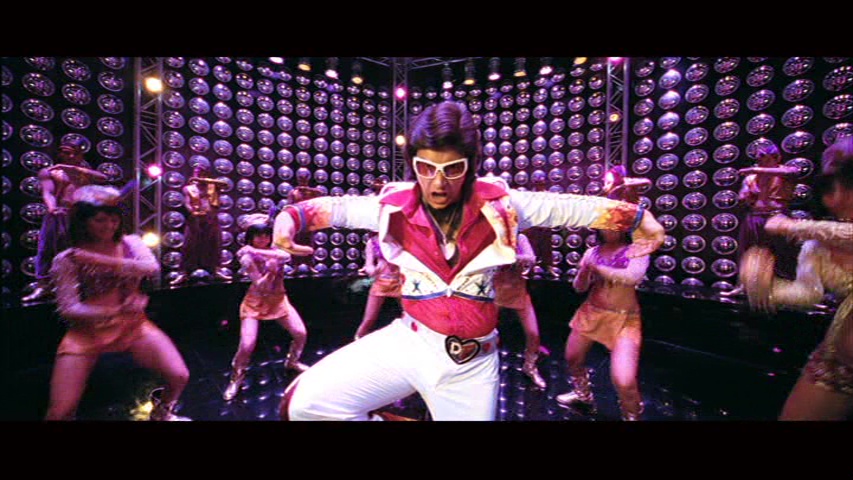
Abhinay Deo loads up Delhi Belly with self-conscious references and imagery of Bollywood and “India”. The opening sequence includes Rishi Kapoor prancing in a blinding white suit from the medley from Hum Kisise Kum Nahin intercut with a slick airport and some slum kids. I wanted to like this. I like the caper genre, I like Guy Ritchie films (of which this is heavily derivative), and I even quite like Imran Khan. But it feels a bit empty, like a film set in India and made for people who have never been there themselves.

Note: I watched the Hinglish version of the film which is heavy on the profanity, with some characters swearing as much as I do. I believe the Hindi version is not quite as graphic.

Tashi (Imran Khan) is a journalist of sorts, interviewing starlets he despises when he isn’t writing up serious crimes. Tashi’s flight attendant girlfriend Sonia (Shehnaz Treasurywala) does a dodgy deal with Vladimir to drop off a package to a local address. Of course the package contains smuggled diamonds. Nitin (Kunaal Roy Kapur) is a perve, and a photographer, as well as Tashi’s sidekick and roommate. The other flatmate is Arup (Vir Das in a terrible wig), the geeky graphic artist charged with making a banana look happier but not too happy. Menaka (Poorna Jagannathan) is a journalist colleague who is there because someone has to have a crazy ex-husband who wants to hunt Tashi down. Tashi tells Nitin to drop off the package to Somayajulu (Vijay Raaz) but Nitin comes down with Delhi Belly, and sends Arup to drop off the package AND his stool sample. Yeah, you can pretty much guess the rest.

The film is stylised, with quirky sound and visual effects emphasising the comedy and dramatic beats. It’s meticulously planned, with all the intersecting plotlines and near misses neatly plotted. And that is one of the problems I have with Delhi Belly. While it is visually accomplished and great to look at, there is not enough fizz or life in the story or the characters.

There is an overabundance of trashy puerile boy humour that might put some people off, but at least it is frank about sex and avoids unnecessary coyness. And as you would expect from the title, there is scatological and toilet humour galore, and that is carried over to Raj Sampath’s soundtrack. The bad language and smutty jokes are largely for shock value and not driven by a genuine insight or moment. That is what I found distasteful and even worse, boring. Making a man run down the street while wearing a burqa is not champagne comedy. One rare comedy highlight is Arup fantasising about breaking up a wedding in his Disco Fighter avatar (and announcing his equal opportunity approach to oral sex) before bursting into song. It’s a little bit Mithun and a little bit Wedding Singer post the break up.

Imran Khan is stuck with a character who doesn’t seem to have much motivation but ends up in an ever more threatening and strange set of circumstances. His nice middle class boy aura never really leaves him, no matter how squalid the surroundings, and I never quite believed in Tashi. I did like his Rajinikanth shirt though. Tashi is apparently acceptable husband material to a wealthy middle class family but he chooses to live in a hovel and not really have much of a career. How does that work?

Imran has no chemistry at all with Shenaz or Poorna which is disappointing considering Tashi gets very hands on with them. Imran and Kunaal Roy Kapur are much more fun together. But despite Kapur’s rambunctious performance and occasional zingers I got so tired of Nitin and his digestive tract that I wanted his scenes to be over NOW. And Vir Das was sort of reprising his role in Go Goa Gone so I felt he was a bit underutilised. And his wig was truly terrible and a great distraction.

Shenaz Treasurywala delivers an entertaining performance in a role that didn’t demand one. Sonia is a confident upper middle class girl. She can afford to be nice to almost everyone because other than choosing a lipgloss she doesn’t have much to tax her brain with. Poorna Jagannathan plays Menaka as more of a world weary cynic, but again she will go out of her way to help a hopeless boy. As mentioned, I couldn’t see the appeal of Tashi to either lady and given they formed a mild love triangle it would have been better if there was more chemistry.

Leading the villains, Vijay Raaz and the gang of henchmen do their best to be OTT. I appreciated their commitment, and some scenes had real tension. But the film couldn’t commit to playing it straight so there were forays into unnecessary slapstick that fell flat. Often literally. A dishonourable mention goes to Rahul Singh as Menaka’s ex. His character was so unpleasant it was hard to believe such a smart confident girl would have married him against her family’s wishes, and his acting was completely suited to the role.

I have to mention Aamir Khan’s appearance as Disco Fighter in the closing song. Aamir is one of the film’s producers and according to the goss, attended some special advance previews to find out why audiences weren’t responding to the film. But his disco antics are there for added box office appeal, not for the film and not for fun. And not because the world needs any more actors in blackface. Jeez. Anyway, it’s not like he needs any more proof he is a terrible dancer so I guess he really likes his nephew.

It’s a clever but ultimately joyless effort. The film lacks the verve of proper masala embodied by Rishi’s performance in the opening visuals. Great masala films crackle with the energy and velocity of dodgem cars and roller coasters, not the methodical progression of chess. 2 ½ stars!

Baahubali 2: The Conclusion

Baahubali-2-Poster

In the lead up to possibly the biggest Telugu film release this year, the question I wanted to know wasn’t so much, ‘why did Kattappa kill Baahubali?’, but rather, was Baahubali 2 going to be worth the wait? And the answer has to be a resounding yes! Rajamouli breathes new life into the traditional story of sibling rivalry and dynastic disputes, ensuring that The Conclusion is every bit as exciting as The Beginning. There is the same epic scale, fantastical scenery and gravity-defying action sequences plus plenty of Prabhas and Rana in fine flexing form. Best of all, this time round Anushka gets to prove that’s she’s just as much of a warrior as the guys and she completely kicks butt as the beautiful princess Devasena.

Rajamouli’s commitment to blood and gore starts right from the opening credits where a number of key events from the first film are loving re-created as CGI ceramic statues – including a torso and detached head with spiralling blood. You just know it’s going to be spectacular when even the opening credits have such exquisite attention to detail – and it just keeps on getting better.

Logically, the film begins where we ended last time, with Kattappa (Sathyaraj) relating the story of his father to Mahendra Baahubali (Prabhas). Straight away we’re swept back into the flashback and the conundrum of who will rule Mahishmati – Amarendra Baahubali (Prabhas) or Bhallala Deva (Rana Daggubati)? Although at the end of Part 1 Sivagami (Ramya Krishnan) declared that Amarendra would be King, Bhallala is still plotting and scheming along with his father Bijjaladeva (Nasser) ensuring that the path to the throne is likely to be littered with dead bodies. Once Amarendra leaves for a whistle-stop tour of the kingdom before his coronation, the way is clear for Bhallala to plan his brother’s downfall and even if the story is relatively predictable, it’s how we get to that final betrayal that really matters.

On his tour, Amarendra travels through the vassal kingdom of Kuntala where he meets Devasena for the first time and falls in love. The romance is beautifully developed, from the moment when Amarendra sees Devasena wielding a sword and is completely smitten, to a sequence where, in the middle of a battle, he teaches her how to fire multiple arrows at the same time. It all unfolds very naturally with little of the sexism of the previous film – this is a more equal partnership and both treat it as such right from the beginning. Anushka is completely mesmerising as Devasena and has as much arrogance and belief in her own self-worth as Sivagami, ensuring that the two have some powerful clashes that almost outdo the fights on the battlefield. Here is all the back story we wanted that explains how Devasena could survive for those 25 years chained in front of the palace with her all-consuming desire for revenge. My favourite part is Devasena’s reaction to Bhallala’s sleazy commander-in-chief when he harasses the women at a temple. She believes in swift and pertinent justice, which got a huge cheer from the cinema and totally won me over to her side for the rest of the film.

Ramya Krishnan is wonderfully regal as Sivagami, ruling in declarative sentences and still disinclined to believe that her son could possibly be evil. Rajamouli gives Sivagami the chance to show a little maternal guilt over her clear preference for her nephew over her own child, making her seem just a little more human. Later, she has doubts and struggles to reconcile her perception of Amarendra as the ‘perfect prince’ with his combative stance when he dares to question her decisions about Devasena. Some of her choices seemed a little unlikely when compared to the wily and competent ruler from Part 1, but factoring in her determination to uphold the law and the universal truth that a mother tends to believe her child, her decisions are within the realm of possibility at least.

Another big plus is CinemaChaat favourite Subbaraju as Kumara Varma, Devasena’s cousin. Although his character is initially played for laughs, there is a serious side too, as despite not being a fighter or showing any signs of a courageous heart, under Amarendra’s influence he finds the strength to fight back when necessary. In Rajamouli’s world, heroism is infectious and it’s not just the god-like heroes with super-human endurance who can make a difference, ordinary people can stand up and fight too. The theme continues when the film moves back to the present day, although not so well-defined, but it’s good to see a move away from a completely hero-centric storyline and more substantiative support characters.

I adore Prabhas and he is completely amazing in both roles here. As Amarendra he is fierce and combative, but also shows off his comedic skills along with a more romantic side to his character when he meets Devasena. The fight scenes are superb and I like that Amarendra has a handy, portable, travelling axe that is more effective than expected – it’s also a nice contrast to Bhallala Deva’s more ostentatious lawnmower of death and massive telescopic mace. Amarendra also shows commitment to science and engineering, taking the first steps to introduce Mahishmati to an industrial age with various contraptions he builds. Some of these are more practical than others, but obviously the skill is genetic since his son comes up with some similarly inventive ideas when faced with the challenge of attacking the city walls back in the present day. There is plenty of shirtless flexing too, although Prabhas mostly keeps his chest under wraps until later in the second half when he has to compete with Rana!

Of course, the strength of any hero is only as good as the villain he faces and Rana is excellent as the devious and amoral Bhallala. This time he is more obviously evil and deliberately choses the nastiest method he can to undermine Amarendra’s reputation with his mother. He’s also still a magnificent warrior, and the final battle scene with Mahendra in the present day is powerful and compelling as the two slug it out in front of the massive golden statue.

The final conclusion in the present day is fairly short and seems somewhat rushed with little dialogue or preparation before Baahubali heads off to tackle Bhallala. Disappointingly, Avanthika (Tamannaah) only has a very brief appearance during the final battle and no significant interaction with Baahubali at all. I like the symmetry between the start and the end of the film with Devasena’s fire-walk for justice, but I would have preferred a little less flashback and more of Baahubali’s reaction to his origins before the final battle. That battle is awesome, but also seems to finish rather abruptly, so I’m hoping (probably in vain) that we might perhaps get a Baahubali 3 that does delve into the relationships of the present day a little more.

I enjoyed M.M Keervani’s music, although I was too caught up in the visuals and catching the subtitles to really appreciate the full scope. However Hamsa Naava and Dandaalayyaa are both beautiful on the big screen and I loved the martial theme of Saahore Baahubali.

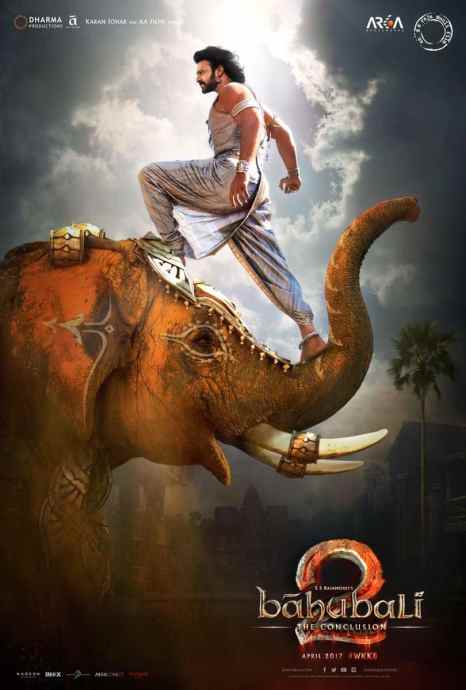
The visuals are stunning and although the CGI isn’t as slick as a HW production, it still looks amazing due to the sheer scale of the images. Although there may not be a waterfall this time, instead there is a beautiful palace in Kuntala, a stunning boat that turns into a flying swan surrounded by cloud horses and a totally epic coronation where a cast of thousands almost bring down the palace with their enthusiasm for Baahubali. The action too is on a grandiose scale. Aside from the titanic battles, Amarendra Baahubali surfs on the back of cows with flaming horns, rides on an elephant and fights almost without even looking at his opponents. It’s truly epic, particularly when combined  with the uplifting themes that justice will prevail and real courage comes from those who believe in truth. With amazing ability to draw you so completely into his world, Rajamouli delivers another enthralling story that needs to be seen on the big screen to fully appreciate his vision. Don’t miss it!

Temple says:

Well, now we know where all those engineering grads with filmi connections end up…They built the kingdom and weaponry of Baahubali 2!

The thing I have long admired about Rajamouli is that even when I know what is going to happen, he crafts the drama and visuals so beautifully that I still care enough to be on the edge of my seat. It was a big ask to follow up the cliffhanger of the first film and not lose the dramatic propulsion to the finale and largely, he nailed it. There are some draggy bits but they weren’t actually dull so I didn’t mind having a bit of leisure to admire the design and occasional flourishes of whimsy. Finally, a director who gets how and when to use a swan boat (even if it looks like a top heavy chicken), and what a fantasy sequence can look like when you don’t try and make it all from painted polystyrene! I do wish they’d done something about Nasser’s rubber chicken claw hand though.

Prabhas is a delight, giving his characters both gentle goodness and a steely core, with the bonus of excellent nonchalant posing. Rana makes Bhalla a despicable and venomous man, but not completely incomprehensible in his motivation. I liked their dynamic together, and they just go all in on the fight scenes. Anushka is one of my favourites and I was so excited to see her character given some depth and competency, as well as all the usual accoutrements of a kickarse heroine. I think Prabhas can evince chemistry with anything or anyone, but Anushka gave Devasena such a liveliness that their scenes crackled with life. I actually didn’t mind that Tamannaah only appeared to kill a few baddies at the end. Based on the first film, she just didn’t stand up to Anushka or Ramya Krishnan and Avantika wasn’t integral to this part of the epic. I was glad she reappeared as a warrior though, not simpering in a sari. Subbaraju did a bit of simpering and flouncing so I guess he made up for that, with his OTT posturing settling into a more genuine will to do the right thing. And what is not to admire about Ramya Krishnan, who has been a charismatic and slightly terrifying presence in films for so long. She is amazing and Sivagami is a great fit for her.

Despite all the Ye Olden trappings, this is a pure masala film. The classic themes of family, orphans, loss, justice being separate from law, duty, and insta-love are all there. Rajamouli knows these conventions and tropes and he is so deft at throwing them into new and glittering configurations. He coaxed some truly epic characterisations out of his modern day urban kid actors, and allowed some of the old hands to shine. Yes there is some dodgy CGI and yes some actors are less impressive than others but it just works. Trust me.

Don’t nit pick. See it on the biggest screen you can. Enjoy!