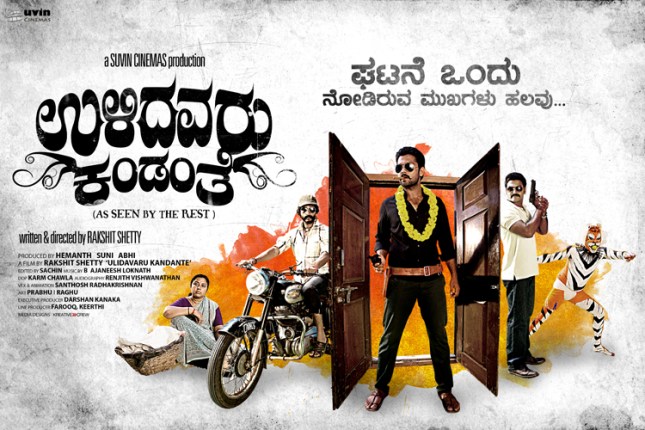
Ulidavaru Kandanthe

Ulidavaru Kandanthe-Poster

Not content with making a name for himself as an actor, in 2014 Rakshit Shetty turned writer and director with his foray into neo-noir crime drama in the excellent Ulidavaru Kandanthe. The English translation of the title is “as seen by the rest”, which refers to an incident seen from a number of different viewpoints that makes up the story of the film. Except it’s not quite as simple as that since the incident itself isn’t revealed until near the end, and even then, it’s not clearly defined. The inspirations are obvious, from Pulp Fiction to Sin City and many more gangster films in between, but it’s the way that Rakshit Shetty has (almost) seamlessly introduced a Rashomon style plot into a very Indian scenario that makes Ulidavaru Kandanthe an instant classic of the new-wave sweeping Kannada cinema.

The film takes the form of chapters based on a series of newspaper articles being written by Regina (Sheetal Shetty) where each interview she conducts gradually reveals more information about the characters and the incident itself. The plot revolves round an unseen MacGuffin that’s stolen by one of the main characters, although to be fair the entire incident is itself a MacGuffin since it’s the characters themselves and the random details of their lives that are the real focus of the story. As Regina interviews the people who were peripherally involved in the incident, we meet a cashew nut seller, a tiger man, a young boy and various gangsters who all have their own views of what occurred on the day in question. It all starts with an old story about 12-year-old Richi who stabbed another boy to death 15 years ago in defence of his friend Raghu. Richi was sent to a remand home for 8 years while Raghu disappeared, but one Krishna Janmaashtami, Raghu comes back.

The story unfolds in a non-linear fashion as each interviewee adds their perception of events. However, rather than just seeing a particular day, what Rakshit Shetty does is show the usual day-to-day events for that person going about their normal life. As far as the action goes, it’s the interactions with key players that inform us as to each major character’s role in subsequent events, but what we really get is an idea of the characters, their thoughts and beliefs and their own impressions of the people involved in the incident. This is partly why the film is so intriguing, as there is no clear-cut description of what actually happened on the fateful day. All we have are impressions, and eye witness accounts of parts of the day, but no-one knows exactly what happened and as the audience we are left unsure as to which version we should trust.

A number of events are shown more than once from different viewpoints, and the more times I watch the film, these repeated scenes throw up more and more questions! I love that my opinion changes slightly each time depending on whose testimony I decide to trust and that I still want to re-watch the film to see if I can spot any other clues. In fact, it’s not until the second watch that much of the film does start to become clear, and once the outcome is known, it’s possible to pick out foreshadowing and significant dialogue that seemed totally innocuous the first-time round.  It’s clever, but not so clever that the film is baffling first time round. It’s more that it becomes richer and more layered with subsequent viewings, and the subtleties of the writing are more easily seen.

The performances too are excellent and contribute to the film’s appeal. Rishab Shetty’s Raghu is somewhat subdued, but then he has escaped Bombay after stealing from his smuggling gang in a stark sequence very reminiscent of Frank Miller’s Sin City. His need to lie-low but desire to contact his mother are well portrayed and in the reunion scenes he is appropriately hesitant and unsure. Tara as Raghu’s mother Ratnakka is outstanding when she meets her son again after 15 years, but she is just as good when gossiping with her friends or selling fish around Malpe. Ratnakka’s story is a short film in its own right, and it allows us to fully appreciate her character and understand her reactions. Not that these are anything beyond what is expected – even down to the usual motherly insistence that her son have something to eat, but throughout Tara conveys Ratnakka’s feelings perfectly and does an excellent job in bringing her character to life. I like the way that Rakshit has given her a life outside of being a mother which gives her character more veracity and empathy.

While Raghu has returned in secret, Richie never left Malpe but instead has made a name for himself as an enforcer for local gangster Shankar Poojary (Dinesh Mangalore).  As Shailesha (Raghu Pandeshvar) puts it so succinctly when he meets Raghu in Bombay, Richie is still a bully and Rakshit Shetty plays him with all the swagger and bravado of a typical Hollywood gangster. It’s often a worry when a director plays a pivotal character as there is a tendency for everyone else to get pushed aside, but that’s not the case here. Rakshit is excellent and his Richie slumps into cars, hitches up his stolen police belt and ensures his reputation for violence is upheld while still ensuring that the rest of the cast are just as important to the story. However, Richie is still the centre of events as he interacts with all of ‘the rest’ from the title, including Regina herself who first saw him as a young by at the remand home. His two sidekicks Dinesha (Pramod Shetty) and Sudhi (Arun Prakash Shetty) have less to do, but each has enough small moments to ensure we have a good idea of their general characters and how they fit into the events of the incident.

My favourite characters though are Munna (Kishore) and Democracy (Master Sohan) who both have significant roles to play in the events of the day. Munna works on the boats as a mechanic, although he gets roped in to painting tigers as apparently that’s very similar to painting boats! Munna spends most of his afternoons following fish seller Sharada (Yagna Shetty) with whom he has fallen hopelessly in love. However, Munna never approaches her and is content to sit behind Sharada on the beach and follow along behind as she walks along the road. His romance adds a lighter note to the film, as does the character of Democracy and his friends who bring energy and life into the film.

I did mention tiger painting, and as part of the festival, one of the other main characters, Balu (Achyuth Kumar) is dancing as one of the tiger men. Achyuth is excellent in his role and the ambiguity of his character is one of the clever touches that Rakshit Shetty has added in to make the story even more captivating. Making Balu a tiger man was inspired and along with the Yakshagana drama ensures the film retains a uniquely South Indian flavour while incorporating many Hollywood themes.

My only issue with the film is that Rakshit Shetty tries to tie everything up neatly by linking events in Malpe to the item stolen by Raghu. I don’t think this works as well and almost seems superfluous given that it’s ultimately not as important as the characters themselves. However, that’s a small quibble and given how much I enjoyed the rest of the film, I’m happy to ignore the unrealistic coincidences and concentrate instead on the characterisations, dialogue and wonderful soundtrack.  It took me a while to track down a copy of Ulidavaru Kandanthe with English subtitles but it was definitely well worth the wait. This style of neo-noir may not be to everyone’s taste but for fans of the genre this is an excellent début from Rakshit Shetty and one I highly recommend. 5 stars!

Baazigar

Abbas-Mustan’s 1993 thriller is an out and out classic. It is a freemake of “A Kiss Before Dying”, but loaded up with all the requisite masala ingredients. Starring Shahrukh Khan in an award winning turn, along with Kajol and Shilpa Shetty, it is also high on filmi glamour.

Ajay (Shahrukh) is a nice boy who lives with his widowed Ma (Raakhee). She is suffering from some kind of post traumatic disorder, and Ajay pretends his deceased father and little sister are still alive and well, trying to preserve his mother’s happy memories. He is also secretly dating Seema (Shilpa Shetty), daughter of the filthy rich Madan Chopra (Dalip Tahil). It’s all very sweet until Ajay also turns up as playboy race driver Vicky and starts dating Seema’s younger sister Priya (Kajol). When Seema apparently commits suicide, Priya cannot believe it and keeps pushing to find her killer. There is a long flashback explaining Ajay’s hatred of Madan Chopra. Vengeance and overacting begets more vengeance and overacting, and Ajay/Vicky sets an increasingly convoluted plot in motion.

Ajay is initially presented as sympathetic. He has helped his mother through some traumatic times. His powers of manipulation and maybe self-delusion are also visible from the start. Good Boy Ajay is altogether too bouncy and hyper. I do like a bit of moderately evil Shahrukh, and SRK is much more believable as Vicky/evil Ajay than he ever is as puppyish Ajay. I like the intensity and calculation that he brings to his villainous side, and the flashes of stifled rage under the plausible charm. It’s an interesting character because first we see him as likeable and even heroic by filmi son standards and he maintains that pure motivation even as his actions become more and more reprehensible. Shahrukh really builds the layers of deceit while retaining enough sincerity that his relationships seem real. So much conflict. Also, the transformative power of a contact lens is really something. In some scenes it may be used to show the duality of his nature, in others just a costly error.

It pains me to say this but SRK cannot hold a candle to Chiru in the horseback or cape swishing stakes. I think the hat was to stop his hood blowing back. And he has no dynamic swish control of his cape. But compared to Manic Pixie Bride Kajol he does seem to get the better deal.

Shilpa Shetty is not given a huge acting challenge with Seema, but she is pretty and lively, and has a warm rapport with Ajay. She is a victim of 90s camera work and if you don’t recognise her butt instantly it might take a while before you realise it is indeed Shilpa arriving on the scene. Serious Fashion Question. Were zippers really such a novelty or was that moment in Kitabein Bahut Si just another chance to focus on Shilpa’s shapely derriere? I recall odd zippercentric choreo from some other films around this time so who knows. I suspect the answer is obviously the latter.

Kajol makes a bad girl entrance, strutting around, shouting, and snapping a belt like a whip, and cannot communicate in anything less than a shriek. She even expects big sister Seema to ditch her exams just to go be rich and idle at the races. But as Priya experiences more real emotions – loss, grief, anger and romantic love – Kajol takes it down a notch. Priya becomes more subdued but also harder, and she starts to notice, and question, some of the little details that don’t add up. She thinks she has a lead when Seema’s friend Ravi says there are photos from a party that show Seema and her mysterious boyfriend. But the killer hears of this and follows Ravi, staging another suicide. Priya takes matters into her own hands when her father, her fiancé, and even her old friend Karan (a policeman with a sad crush on Priya), all tell her to drop any investigation. It’s quietly impressive for a heroine to disregard the men in her life so thoroughly.

Raakhee is impressive as Mrs Sharma. She had minimal dialogue but her suffering was evident, as was her painful realisation about her beloved son. It’s all about loving your family…I felt bad for Priya that even if she stuck by Vicky to the end, she still got shut out by a filmi Ma.

Dalip Tahil plays Madan Chopra with spite and a dash of sleaze. He is very urbane and successful, and his daughters (who really were old enough to form memories but seemed not to have any clue) had no recall of how he became so wealthy. The veneer cracks as soon as his good name is threatened by scandal or by the complicated revenge plot, and Madan becomes a snarling dog in an expensively hideous microfibre suit. Siddharth Ray is chunky and despondent as Inspector Karan. And if ever there was a story that did not need Johnny Lever, this is it.

The Anu Malik soundtrack is so familiar, and so cheesy. Ah, the porno sax background version of Yeh Kaali Kaali Aankhein. But the picturisation on SRK and Kajol is iconic, taking place in one of those not for profit nightclubs that sacrifices paying patron seating for a dance floor the size of an ice rink. Even Batman seems to be a fan.

Ajay’s own crimes are shown with more realistic detail, and somehow the struggle adds to the disturbing attraction repulsion thing Shahrukh has going on. He is given to exposition and declaiming and I quite liked his line :“You are like the invalid who needs crutches to walk but has no hands to hold them” Food for thought. Overall though the film takes an energetic but not very realistic approach to the action and violence. Bullets cannot kill a man but drop a fishtank on someone and they’re a goner. The finale is full throttle and the props department lashed out for a really big tin of red paint.  It’s almost 20 minutes from the first gunshot to the very end.

If you’ve already seen Baazigar, maybe it’s time to dust it off for a rewatch. Some things in the film haven’t aged so well as its stars. The story wouldn’t work in our digital/social media world as Facebook would have tagged Ajay before he knew it. And people today answer their own phones which they carry everywhere. But if you are one of the 973 people on earth who haven’t seen it yet, maybe it is time to experience this classic. 4 stars! (Johnny Lever, you cost the movie a star. You and your comedy sidekicks. Repent!)

Visaranai


“Give me the pink one. It’s my lucky lathi. Now let’s get them to confess”.

Vetrimaaran’s film takes a journey through the lawless side of law enforcement, where results matter and truth is often unwelcome. Adapted from M. Chandrakumar’s novel which was inspired by his own experiences, there is a relentless sense of doom pervading this story. Don’t get too attached to anyone!

Four Tamil men have come to Andhra Pradesh to work, sleeping rough in a park to save money. One night they are all picked up by the police. They are brutalised over and over but not told what they are suspected of doing and what they must admit to. It’s all a game to the cops but no one told Pandi, Murugan, Kumar or Afsal what that game is.

Afsal (Silambarasan Rathnasamy) is the youngest and weakest. Frightened of being hurt, and generally shy and inarticulate, Afsal triggered the arrests with a confession under duress and wavers most when under pressure. The four boys stick together and try to find a way out, trusting that their innocence will be recognised. Pandi (Dinesh Ravi) and Murugan (Aadukalam Murugadoss) are the stronger ones, with Pandi the more cynical and Murugan the more placid. Kumar (Pradheesh Raj) is injured badly early on and is a quiet, tense presence for most of his scenes.

The boys go on hunger strike and it seems to work. They are released, given money and told to come back to the station to sign a statement. They stop for a meal, eventually laughing at their strange fortunes. But when they go back, the sadistic Superintendent (Ajay Ghosh) says he couldn’t hit a starving man so he tricked them into filling their bellies. The beatings resume, more vicious than before.

I was struck by all the energy that goes into forcing confessions when maybe with the same expenditure of effort they could track down the real criminals. There is a discussion about finding someone else to take the fall but the boss is worried after all the injuries that the men will complain so he decides they must be found guilty. Eventually all the pressure works, especially the emotional blackmail from Pandi’s boss who knows it’s a set-up but encourages Pandi to take the easy way out for everyone’s sake. Including the police. These poor guys are expendable.

Pandi refuses to make a false plea once he is in front of a magistrate although his Telugu is not up to the finer points of his defence. Luckily for him there are Tamil Nadu police in another court so one is called upon to translate, and even more fortunately he recognises Pandi.  Inspector Muthuvel (Samuthirakani) explains the boys have jobs, never admitted fault, there is no evidence, and they’ve been beaten up for days on end. The magistrate knows Superintendent Rao has form for closing cases with false evidence and the boys go free.

Unluckily for Pandi and friends, the Tamil cops need their help in return. Sure enough, they help kidnap a high profile money launder KK (Kishore) from the courts. Back in Tamil Nadu, Kumar gets dropped off along the road but the others are taken to the station along with KK. KK tells Muthuvel that the last move in this game will be to tie up all the loose ends, like Muthuvel himself. And KK is a very smart man. About to leave, the guys are asked to clean the station building before they go. The ominous music says that was a bad idea, and I think Pandi knew it too.

Vetrimaaran mostly sticks with realism, creating a sense of the world just out of sight of the mainstream. The dark side is literally dark, with much of the film shot in night time and dimly lit interiors. The scenes are beautifully composed and I felt immersed in Pandi’s world, and the feeling of being entangled and lost. The spike of fear when the cops start torturing people is visceral, the relief when it stops and the terror of those waiting their turn also feel real. There is a foray into black and white for a couple of climactic scenes that struck me as annoyingly filmi. I wasn’t sure if it was censored because of all the gore or just cleverness, but regardless it was too tricksy. Other more successful visual metaphors were derived from the core of the drama – the movement between light and dark, between high and low places, people up to their necks in muck wading through sewers. The pace drags a little when the boys are hanging around doing the cleaning, and there is a little too much helpful exposition to get everyone on the same page, but these are minor issues.

Dinesh Ravi carries most of the film as Pandi was the enquiring mind, the calculating observer, and the loyal at heart.  His reactions and interactions with Samuthirakani give the story a centre and conflict that held the other strands together. Samuthirakani has gravitas and a wry humour that sparks up when Muthuvel is at ease. He is the cop who knows what is right, wants to be clean, but is coerced by his higher ups. Kishore is also impressive as the sly money man who can’t believe he will run out of friends or dollars. The dialogue is often sparse and meaning is layered through action and reaction. This is a man’s world. There is a budding romance (Anandhi as Shanthi), and a female cop (Misha Ghoshal) who deliberately forgets her phone so Pandi can call for help and that is it. All the supporting performances are good, but there are so many fleeting character appearances that the police dissolve into one huge despicable khaki organism.

I am not really surprised that the film failed to make the Oscars. A dog eat dog world with no hope of justice, and with the police at the heart of the darkness, seemed like a hard sell.

This is an accomplished film with some exceptional performances. It’s not an easy watch due to the casual brutality. It made me question why such a topic is still so current. And there is no moral or redemption to send you whistling on your way. Just death, lies, greed, and a promise of more of the same. 4 stars.