Branded to Kill (1967)

Made on a low budget and in no time at all, Branded to Kill (Koroshi No Rakuin) is a delirious and highly stylised gangland film about a killer who has a seriously bad trot at work. I was lucky enough to see this at one of the free screenings of classics at the Japanese Film Festival in Melbourne. And in a world going mad, why not add a bit more madness!

Funny, vicious, and daft by turns, Suzuki Seijun’s make it up as you go direction, the input of eight co-writers who all seem to have Ideas (the Hachiro Guryu), and Kimura Takeo’s strong visual sense make this a gripping and yet incredibly silly B movie. Some scenes were instantly recognisable due to homages in more recent films, and a little bit of creative license with the Bond franchise.

The film jolts along in a series of episodes to tell the story of Hanada (Shishido Joe), the Number 3 hitman. He would like to be Number 1, and is generally quite efficient and creative. But one day he is distracted by a butterfly landing on the barrel of his gun, and accidentally shoots an innocent bystander. He goes on the run, sometimes aided by death obsessed Misako and sometimes hindered by his wife Mami (Ogawa Mariko). Eventually Number 3 kills many other numbers, Number 1 is sent to kill Number 3. Number 1 must not take a lot of contracts. He likes to spend a lot of time on destroying his target’s spirit before he kills them so he moves in with Hanada. A ridiculous and suspenseful game of cat and mouse ensues.

The characters live in funky modern apartments and dress in conservative but very 60s fashion. Except Mami who is usually naked. I actually didn’t recognise her at first when I saw her with clothes on. They drive cars with fins and hang out at nightclubs. Misako (Mari Annu) is obsessed with death and fills her apartment with dead creatures, especially butterflies and birds. Hanada’s methods are effective and surprisingly entertaining. There’s a cool trick with shooting up a drainpipe and some nice work making his escape on top of a miniature hot air balloon. When Hanada has a breakdown the screen dissolves into stylised animated graphics showing his confusion and panic. And the music is jazzy and sometimes incongruously chipper. It’s a decidedly modern film, with the endless ranking of hitmen and underworld niceties one of the few nods to tradition that manifests.

Hanada is not a good man, or a particularly likeable one, but I found myself cheering him on at times. Shishido manages to be lugubrious and comedic at once, largely due to his chubby chipmunk face. He is obsessed with sex and the smell of boiled rice is his aphrodisiac of choice. Hanada and Mami seem to share a penchant for uncomfortable sex in precarious locations, and that is about it. She hooks up with his boss Yabuhara (Tamagawa Isao), and eventually tries to kill Hanada. She was probably cold and tired of shagging while dangling off the top of the staircase. And some of his habits were gross. That crop top may be one of his worst decisions among so many other really bad decisions. Hanada knows someone will come to kill him, but he isn’t Number 3 for nothing and he managed a spirited defence. Even in the midst of all the impending doom there are moments of bright joyfulness as when Hanada starts playfully chasing a balloon, and a few “ew!” moments like Number 1 going Number 1 because they hadn’t yet worked out a toilet protocol, or Misako basically being flame grilled. It’s quite a rollercoaster.

Misako is the opposite of Mami in many ways. She is passively waiting for death, and wants Hanada to kill her. She sleeps with him to seal the deal but he then decides he loves her so he won’t kill her even though she only submitted in order to get him to kill her. I tell you these people have issues. Misako’s apartment is littered with dead butterflies and birds, in a kind of goth twist on crazy cat lady syndrome. Mari Annu is deadpan and her eyeliner game is strong. She drifts through scenes as though she already knows how everything will end and doesn’t care. Ogawa Mariko is passionate, fiery, and always wanting more. They are so completely opposite that neither character seems at all real.

In a film made from improbable and inadvisable actions, I still have some questions. I can accept that perhaps a belt buckle may stop a bullet. I could just about accept that a ladies hairband might perhaps deflect a bullet. But I cannot accept that firing a gun from inside a car will not break the windscreen but still kill a man on the outside. And, if you were hiding from a hitman, would you drive a convertible with the top down? Was Hanada dangling upside down from the ceiling trying to shoot a sniper? Some things really deserve to be explained. But you’ll need to see it to believe it when it comes to the ending.

The film is bordering on insane and I can easily believe nobody knew what they were about to shoot. It’s such a mess but it is oh so assured, stylish, and bleakly funny. 3 ½ stars!
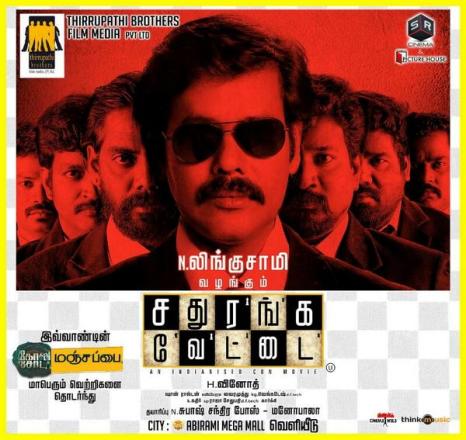
Sathuranga Vettai

sathuranga vettai poster

H. Vinoth’s Sathuranga Vettai is an amusing crime caper that follows the exploits of con-man Gandhi Babu as he persuades a large number of gullible people to part with their cash. Naturally, this does not come without consequences and the later part of the film deals with Gandhi’s redemption and his attempts to break free from his life of crime. This is an impressive début for H. Vinoth and despite a tendency to veer into overly dramatic territory towards the end, the film well worth watching for some great dialogue, good characterisations and Natarajan Subramaniam and Ishaara Nair in the lead roles.

The film is divided into different chapters, each describing a con run by Gandhi Babu (Natarajan Subramaniam) and his merry band of helpers, Guru (Dharani Vasudevan), Kumar and Selvam. The first starts with Gandhi and his gang persuading businessman Chettiyar (Ilavarasu) to buy a rare snake which, they tell him, can be sold on at a much higher price. Of course, the snake is a pig in a poke and is anything but rare, but what is more surprising is how superstitious and gullible Chettiyar is, given that he is supposedly a rich businessman with thriving rental and retail investments. I found it hard to believe that he would really believe that a snake could understand him and lose weight because it was homesick, but it did make for some great comedy in the first few scenes. The film also quickly introduces Gandhi’s simple philosophy – the easiest way to deceive people is to find those who are greedy and want to make a fast buck and in his defence, there does seem to be plenty of greedy people out there.

The second con is better realised and seems rather more plausible. This time Gandhi and his followers set up a mass marketing Ponzi scheme selling miracle water to gullible investors. A young woman, Bhanu (Ishaara Nair) approaches Gandhi for a job as she cannot afford to invest in the scheme and Gandhi immediately sees her potential. Her innocence and flair for persuading others to invest makes Bhanu a valuable asset for the gang, but she has no idea that they are all snake-oil salesmen and that their venture is all a con. Gandhi’s seeming altruism leads Bhanu to start to fall in love with the con-artist but once his true activities are revealed, Bhanu is left to deal with the aftermath as Gandhi and his gang skip town with the money.

The next con sees Gandhi arrested and jailed for his crimes. While he is tortured by the police, his gang work hard to bribe the various complainants and ensure Gandhi’s release.

Although their efforts pay off, Gandhi is kidnapped by a gang lead by Vallavan (Vallavan) who have been employed by one of the victims of Gandhi’s previous con. Suddenly the fruits of Gandhi’s criminal past are brought home to cause him more problems and the only way he can escape the gang is to work another con for them. After a convoluted series of deals and double deals Gandhi manages to escape and finds Bhanu who still has feelings for him. But the gang is still on the look-out for Gandhi and his idyllic life with Bhanu is shattered once Vallavan and Senthil catch up with the couple and force Gandhi to carry out one last con.

The story is a good blend of action and drama, with enough comedy to keep the proceedings from ever getting too serious. The final scenes are overly melodramatic as Bhanu goes in to labour while gang member Thillagar (Ramachandran Durairaj) is told to kill her as the rest of the gang force Gandhi to dig his own grave. However, the rest of the film isn’t quite so theatrical, and some of the cons are entirely plausible and seem quite realistically portrayed.

Natarajan Subramaniam is excellent in the lead role and seems perfectly cast as the smooth-tongued salesman with the gift of the gab. He dons different disguises and different accents as part of the role, while his ability to appear cold and calculating works well to give the character credibility. It makes his gradual change of heart once he finds Bhanu and slow realisation that there could be another way of life seem more plausible. H. Vinod gives Gandhi a tragic back story which didn’t seem to be totally necessary but again does make his final redemption more likely, given that up to his meeting with Bhanu his general philosophy is that nothing you do is wrong as long as you don’t feel guilty. His early experiences, described here in animation, do at least give Gandhi an emotional response to work with and overcome his otherwise cold persona. One of the best things about Gandhi’s character is that although he is a criminal, he is totally hopeless when it comes to physical violence. As a change for the usual ‘hero’ in this type of role, Gandhi is regularly beaten up and has no capacity to defend himself whatsoever outside a verbal stoush. That seems quite likely for someone who relies on his wits and ability to run and makes Gandhi a more sympathetic character than expected.

Ishaara Nair is also excellent although at times her character does seem a little too good to be true. She has good onscreen chemistry with Natarajan and the two work well together as a couple, even if for much of the time I felt that Bhanu was much too good for him and deserved more. The rest of Gandhi’s gang are good, particularly as sellers of the miraculous magic pearls, although they have limited screen time. Vallavan and his gang have more to do, and Ramachandran in particular is excellent as a gangster with a heart, even though he keeps it well hidden from the rest of the gang.

Overall this is a clever and rather different film that relies on good writing and excellent characterisations to tell an engaging story. The sheer ordinariness of the characters works in their favour and the simple con schemes are plausible enough to keep the story more realistic than most. The music from Seth Rogan mostly fits well into the narrative with the songs featured on Bhanu and Gandhi’s relationship, apart from one early in the film that’s set in a bar that doesn’t work quite as well. K.G. Venkatesh ensures the film looks good too with plenty of beautiful shots of the countryside surrounding Madurai. H. Vinoth has delivered an excellent first film that delivers in terms of both story and characters. 4 stars.

Anaarkali of Aarah

Avinash Das’ Anaarkali of Aarah is a powerful and highly entertaining film with a strong thread of feminism in action, not just in speeches. And Anaarkali is a kickarse woman who compelled my full attention.

Anaarkali (Swara Bhaskar) is a folk performer, singing and dancing her way through innuendo laden songs for appreciative male audiences. She is loud and proud in both appearance and action, and genuinely loves what she does. She lives in a small world in a small town, and is happy and confident strolling the streets and turning men’s heads as she sashays by. But one of her troupe’s patrons, Dharmender Chauhan the VC of the local university (Sanjay Mishra), is obsessed with Anar. At a high profile police event he gets dangerously drunk and invades the stage. Anaarkali and her ‘friend’ and business associate Rangeela (Pankaj Tripathi) try to put Dharmender off but he persists in trying to rape her on stage. She is frightened and angry, and slaps him hard, adding a mouthful of curses for good measure. Can a woman really get away with defending her honour when the men around her don’t see that she has any? Can a woman assert autonomy over her body when men don’t think she has the right to say no?

Mild spoiler – in this film world, she might. But even if you know the ending this journey is really worth taking.

Anar is a wonderful character and Swara Bhaskar is brilliant in the role. Anaarkali is not a fallen woman, she doesn’t need or want redemption. She’s a star in her particular field, and she thrives on the glitz and attention. When Anaarkali struts down the lanes near her home she tosses her hair and sways for her public. When she’s at home she’s foul mouthed and a bit goofy.

Anaarkali is an astute judge of character and mood, usually knowing when to be abrasive and when to simply listen and let the situation deflate. And then she realises that there is such a thin line between acclaim and notoriety and the line is drawn by men in power. Bhaskar delivered a layered performance, showing Anar’s stagecraft, her public persona, and her domestic side and the fluidity with which she switches between them. When Anaarkali lost her home and her troupe I felt her profound and debilitating grief. But Anaarkali is a strong and pragmatic woman. There is no attempt to paint her as a virgin prostitute who only dances. She is frank about her industry but retains the right to choose who, when, and where she has sex with a client. There are men in her life but far from waiting for a white knight, Anaarkali was pretty set on rescuing herself. I might want to be friends with Swara but I’d probably be slightly scared of Anar’s acerbic wit.

It was telling that when the police went into damage control, it was to protect the VC not uphold the legal rights of an assault victim. And also telling that the men near rioting when the show was cut short were not protesting in support of Anaarkali, they were furious because they were denied a spectacle. She is accused of bringing about her own downfall due to arrogance. Nobody seems interested in telling the VC not to be so rapey or allowing her to file charges against him. Sadly I didn’t find much of this to be a stretch of the imagination. Sanjay Mishra is vile as Dharmender, but in a very restrained and slimily real way. The VC’s entitlement is sometimes breathtaking. He only sees Anaarkali as a mirror of his own desires, and nothing is more important to him than his own gratification. He is so convinced she must submit to him, ostensibly because he is crazed with love but really because he is so rich and influential she has no right to refuse. Mishra’s scenes with Anaarkali seethe with anger (mutual), fear (hers), and thwarted desire (his).

Rangeela is an interesting character. He defends Anaarkali but will sell her out in a heartbeat. I tried to believe that was to protect the rest of his motley troupe but even so. When she needed him, he was a weasel. Pankaj Tripathi is solid in the role although I felt maybe some of his character’s story might have been cut and that I wanted to know more about his relationship with Anar. Mayur More is sweet and funny as Anwar. He adores Anaarkali and music. Their dynamic is more cute and flirty, with Anaarkali taking a while to see him as a young man rather than a kid. He tries to step up to look after her but he respects her wishes when she wants to resume singing. Hiraman is a devoted fan of Anar’s and he helps her get her mojo back through a recording gig. I really loved Ishteyak Khan’s performance. He was subtle but radiated love and pride when he was near Anar. His silent and dogged anti-bromance with Anwar was also fun to watch. It’s a really good ensemble cast with everyone fully inhabiting their roles.

Avinash Das has written a strong screenplay and delivered it with an assured visual interpretation. The lighting and composition underscores the drama but isn’t so stylised that it distracts from the performers. This is a small and vivid world and beautifully realised. The story rockets along but there is room for some directorial flair with a nice loop from an early flashback to the finale. Whoever cast the playback singers did an awesome job as the tones and style matched so well I never once thought it was anyone but Swara Bhaskar singing. The songs are full of double entendres that are sexual and also relate to the social position of a woman in Anaarkali’s job. When she sings her final song it is an awesome middle finger to the patriarchy.

I’d had this film on my list to write about for a while but then conversations with a Twitter friend and reading Anu’s review seemed to be a sign to get a wriggle on.

See this for a genuinely female centric film that has a fairly sound feminist position, and a rousing good yarn into the bargain. Swara Bhaskar is fearless and imbues Anar with an unapologetic sensuality and strength of purpose. 5 stars!