Ira (2018)


Ira posterIra is billed as a thriller but unfortunately it rarely manages to elicit any suspense or excitement as it plods through an investigation into the murder of a politician accused of corruption. All the elements are there, but the execution is clunky with the sort of dialogue where the characters carefully explain to each other exactly what they are doing and why. Unni Mukundan is good as the main lead, but the rest of the cast get little opportunity to make an impression while director SS Saiju seems to have let the film take its own meandering course.

The film starts with a crowd of reporters waiting outside a hospital for Minister Chandi (Alencier Ley Lopez) to quiz him on a corruption scandal within his administration. However, the mood quickly changes when the minister dies of a heart attack during his check-up and the plot thickens when junior doctor Aryan (Gokul Suresh) is accused of his murder. Right away this seems strange. Why would reporters gather for an interview at a hospital when the intended interviewee is there for a check-up? Surely this is ghoulish and unethical. Also odd is the speed with which the police decide that the death was murder and not a heart attack, since there never seems to be an autopsy or any internal investigation. The decision to blame Dr Aryan is also difficult to understand, since there are a few other potential suspects who never seem to be considered at all. However, the media are quick to follow-up with the story and move quickly to suggest Jacob Chandi (Shanker Ramakrishnan) as his father’s successor in politics.

The police torture a confession from Dr Aryan, but that’s pretty much the whole extent of their investigation and they almost vanish from proceedings to allow Special Investigator Rajeev (Unni Mukundan) free rein to carry out his own enquiry. This mainly consists of speaking to various work colleagues of Dr Aryan at the hospital while some of the other gaps in Aryan’s history are explained in a good flash-back.

However, what’s particularly annoying is the treatment of these character witnesses at the hospital. All are female and are solely defined in terms of their relationship with Aryan despite both having taken part themselves in the events on the day of the murder. Nurse Tara (Neeraja) and Kavya (Mareena Michael) go through exactly the same process of denying any romantic relationship with Aryan before carefully explaining how wonder Aryan was and how happy they were to work with him. Even his girlfriend Jenny (Niranjana Anoop) is simply seen as ‘the girlfriend’ even though she is also Jacob Chandi’s daughter and her relationship with Aryan may provide a possible motive for her grandfather’s murder.

After ignoring plenty of potential clues and viable suspects, the second half starts with an extended flashback that develops some backstory for Rajeev. Unfortunately, it takes a long time to reach the point where any of this is relevant to the main story and the central character, Karthika (Mia George), is just as poorly written as Jenny and Tara. From here the plot continues to unravel as coincidences abound, and the bad guys reveal their secrets at opportune moments for no good reason. Saiju throws in a few songs at random moments and adds key characters late in the screenplay, adding to the overall haphazard feel of the film.

Performance wise everyone is fine, although for the most part the roles are straight forward without too much emoting required. Unni Mukundan has the most to do and is generally good as a police officer investigating a crime. Niranjana Anoop and Mia George have the best female roles, but they are simply there to provide a reason for Aryan and Rajeev to act the way they do, so there is little else for them to do once that reason has been established. Gokul Suresh is fine as the rather naïve Dr Aryan, although the character is too one-dimensional to say anything more than he gets across the idea of wrongly accused innocence well.

Disappointingly, Naveen John’s story just doesn’t feel plausible and there are too many plot holes and contrivances to allow any suspense to develop. Small details are explained by the characters in blatant disregard for the cardinal rule of ‘show, don’t tell’, while other crucial points are introduced and then completely ignored. There is a really important message at the very end of the film too, but it’s glossed over so quickly that I’m not even sure if this was added intentionally or not. Ira isn’t a terrible movie and it’s even reasonably well filmed, it’s just very average without anything that stands out to mark it as sufficiently different from the great commercial sea of current Indian cinema.


Rangasthalam

Sukumar’s Rangasthalam is a sprawling rural epic set in the 80s and chock full of plot. There’s probably enough for two films, but despite being 80s influenced in running time too, I found it highly engaging.

Chittibabu (Charan) hires out a water pump to service the village crops. He’s a bit dim and lazy, very proud and impulsive, but essentially a decent bloke. And he has a hearing impairment that he is ashamed of. His inability to hear unless shouted at is used for comedy but also is important in keeping him a little isolated and clueless. When golden boy big brother Kumar (Aadhi Pinisetty) comes back from Dubai, he is appalled by the corrupt lending and eviction scam run by the local association. He gets the support of MLA Dakshina Murthy (Prakash Raj) and decides to run for President, setting up a colliion course with the incumbent (an evil eyed Jagapathi Babu). And meanwhile Chittibabu has fallen for the lovely Ramalakshmi (Samantha Akkineni). But does he have the time or the capacity for love when he has heroic duties to attend to and a brother to protect? And if it isn’t the President pulling all the strings, then who else might be involved? What is a simple man to do?
Charan was instantly recognisable even in the long aerial shot that opens the film. His hair is magnificent and deserves an acting credit. But apart from the mane of glory, he delivers a solid performance. Chittibabu is quite childish and demanding, but has a generous heart. He is only able to devote himself to one task or thought at a time though, which meant that the relationship with Ramalakshmi kind of disappeared for a while as he was busy with other matters. Charan and Samantha had a nice rapport and I quite liked seeing the man be disconcerted and flustered by being on the receiving end of some determined attention. And he did some truly excellent lovestruck prancing. But he is an 80s style mass hero and will not be winning any awards for feminism. The fight scenes are intense and brutal, with only a few fancy effects to diminish the reality. Predictably Charan excels in the action and dances, but that solid physicality also translated well to his character.
Charan and Aadhi were really nice as brothers. It would have been very easy for Sukumar to make Kumar the saintly one and Chitti the dumb one but they each had some elements of the other one’s personality and their little fights and jokes seemed natural and lively. Chittibabu had to grow up a bit through the film and Charan handled that quite well. I thought the hearing aid Kumar got for him was used nicely as an indicator when he decided to put personal vanity aside. Aadhi played Kumar with less bravado and more empathy than the younger sibling. His reactions when things turned violent seemed genuinely fearful, and true to the character. He found a groove to work in as the second fiddle in the film but the star of the family who absorbed all their attention.
Samantha made Ramalakshmi funny and warm, the kind of girl that would always be in the thick of the chatter when there was a break from work. She wasn’t impressed by Chittibabu despite his obvious attraction to her, and somehow was the only person in the village who didn’t know he was hearing impaired. The comedy of errors stuff went on a bit too long, but I enjoyed her uninhibited enthusiasm, especially in Rangamma Mangamma where Ramalakshmi took on some of the typical hero pursuit song shtick. Samantha’s face is so expressive that even the terrible subtitles didn’t interfere too much with her scenes. The moment when she weighed up her father’s emotional blackmail against Chittibabu’s open door on their future was darkly funny and so good to see. It was sad that she along with almost every one else was then sidelined for a substantial chunk of the story. Because Hero stuff.
Jagapathi Babu is the villain this film needed. He infuses every scene with a menacing sociopathic coolness, and has no need of pointless histrionics. He has ample followers to carry out his wishes and can keep the dirty business at arm’s length. He’s like a shark. Something sends a chill down your spine on first sight, even if he doesn’t seem to be an immediate threat. Prakash Raj has a small but pivotal role, and is his usual reliable self. Brahmaji is his usual angry self as a government official. It’s good that some things never change. Mahesh Achanta, Rohini, and Anasuya Bharadwaj are notable in the large ensemble.
Sukumar did some interesting things within what does feel like a solid 80s mass drama. The women were often in the background but when it came to crunch time there was no fuss as they took a more active role or their expressions gave the men permission to act. Rathnavelu’s cinematography created a beautifully rural idyll with long sweeping views of the landscape but moved away from fixed camera positions in the action scenes, giving it a more modern and dynamic feel. The soundtrack is exactly what you’d expect, which is not a bad thing. I liked Charan’s dancing and thought he did well in the folk influenced choreo, maintaining his Mega cred while staying in character.
I learned some new phrases thanks to the (possibly drunk) subtitle team. I hadn’t heard of the Dazzle King or even the Mangoose, but now I feel they sound like something I should have known. And I will be wary of doctors offering the “eternal injection”. I know subtitles are a luxury, but surely someone read them before they were published. No?
I thoroughly enjoyed Rangasthalam. It’s a big meaty story that takes its time. The casting is good, the visuals are great, and in mass style the film has a bit of everything. Recommended!

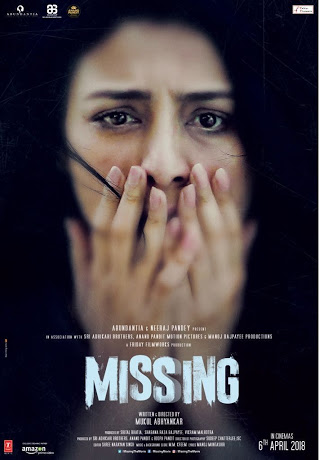
Missing (2018)

Missing has some things going for it. Well, Tabu and her outfits mostly.

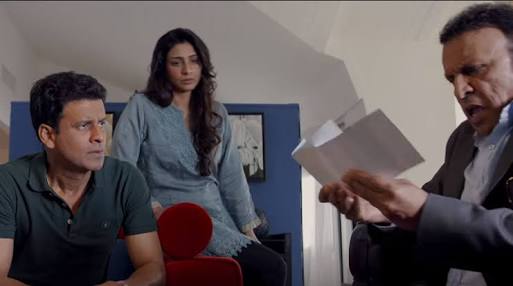
Sleazy Sushant Dubey (Manoj Bajpayee) is on a business trip with Aparna (Tabu) and their three year old daughter Titli. They check in to a fancy resort in Mauritius and Sushant checks out the receptionist before fielding a call from another woman, Kamya (Neelam). It’s clear what his priorities are. But since no other options present, he resorts to sex with his own not very keen partner in an awkward scene that had all the sensuality of Greco-roman wrestling. When Aparna wakes in the morning she discovers that Titli has disappeared from their room. She flies into a panic, while Sushant seems a little too calm. The hotel staff are not very useful, and the police seem to have read the Keystone Cops training manual. Then there is the guy downstairs who seems to be obsessed with little girls. So what happened to Titli? And will her parents find her?
That sounds like the basis of a reasonable thriller. But sadly writer-director Mukul Abhyankar squanders both the idea and his cast in a messy, screamingly obvious film that signals every twist and turn. Just in case you managed to black out and miss anything, listen out for the blaring dun-dun-DUNH! at key moments. One of the twists was evident from the get go, and the only way a red herring could have been any more obvious would have required an actor to wear a red herring mascot suit.
Tabu is stunning as the stricken and slightly unhinged Aparna Did she harm her child, was she the target of a revenge plot, was it just a crime of opportunity, or is something entirely different playing out? Tabu shows great range, from raw and gut-wrenching fear to more subtle and calculating expressions as the truth of her relationship with Sushant is revealed. The film feels quite stagey and is exposition heavy, but she imbues even her more passive scenes with an inwardly focussed energy that constantly drew my attention. Aparna is much more complex than she initially seemed. I really wish the writing had been better. I liked her costumes, but I’m pretty sure I wasn’t supposed to be checking out the embroidery on her kurtis rather than fretting about the little girl.

I hated everything about Sushant so I guess that is an acting triumph for Manoj Bajpayee. Sushant was craven, opportunistic, and creepy. Bajpayee struggled with some bad writing both in terms of the dialogues and the logic of what Sushant was doing. His feeble obfuscation may have been supposed to build tension and create doubt but it was just annoying and often didn’t serve a purpose. I was so annoyed when the cops nearly pulled the pin just because Sushant claimed Aparna had become mentally ill after being diagnosed as infertile. It was typical of the lazy plotting that tried to jazz hands past inconvenient details, and showed everybody believing women are just a walking uterus with the sole purpose of popping out babies. Sigh. But I cheered up immensely when Sushant copped a tight slap. That made up for a bit of my suffering.
Annu Kapoor is atrocious as Inspector Budhu but the material couldn’t have helped. I was amused that everytime he threw in a few words of French (seeing as he was a Mauritian policeman with an entirely Hindi speaking team and suspect set) the subtitlers gave up and wrote [Foreign Language]. But at times it felt like the lead characters were all in different films, weirdly edited together. Their performances just didn’t gel.
I was so pleased to see Tabu back in a leading dramatic role. I wish the film had lived up to its potential and to the lead pair’s characterisations.