Seethakaathi

Seethakaathi

Vijay Sethupathi is known for his tendency to choose rather more unconventional roles and for his 25thfilm he takes on the character of an ageing theatre actor in Balaji Tharaneetharan’s Seethakaathi. The film is a refreshing mix of theatrical performances, comedy and drama underlying a satirical look at the film industry and despite only appearing for roughly forty minutes of the almost three hour run time, Vijay Sethupathi is the heart and soul of the film. Mouli, Rajkumar and Sunil Reddy play the other major characters, perfectly blending comedy and drama as the story moves through the world of theatre, into the film industry and finally ends up in a court room. It’s a novel tale that’s difficult to discuss without revealing the core idea that makes it such a wonderfully quirky and offbeat film, but it’s well worth investing the time to watch Seethakaathi in the cinema to appreciate the attention to detail and sheer inventiveness of the story.

The film starts with a series of scenes from theatrical performances featuring acclaimed actor Ayya Aadhimoolam (Vijay Sethupathi). These begin with his early career and progress through the decades via various classical scenes before ending with the elderly actor performing the lead role of Aurangzeb. As the actor ages, the setting for the plays changes too, starting with an outdoor performance under the stars, moving to a packed house in a new theatre and finally to a sparsely attended show with the theatre hall shabby and showing its age and lack of funds. Watching from the wings is Ayya’s friend Parasuraman (Mouli), while his fellow actors revere Ayya and provide partisan support for the performances. This opening section is focused firmly on Ayya as the lead actor in each theatrical vignette and Vijay Sethupathi is simply incredible, holding the audience attention though long classical speeches and in truth being the mesmerising and captivating theatre actor he plays. The ageing process is well done too and the prosthetics and make-up ensure Vijay is convincing as an elderly man, although it’s his posture and slow, considered movements that authenticate his portrayal.

Despite his success, Ayya lives simply and uses an auto to get to and from the theatre. He is shown as caring deeply about his grandson and takes care of his extended family of actors and theatre workers too. Early on in his career when he is offered film roles, he declines saying that he prefers to work in front of a live audience, however, with the theatre becoming less popular, Ayya is convinced firstly to advertise his shows in the local paper, and then later to ‘appear’ in films. However, when he fails to show, first in Director Sundar’s (Bagavathi Perumal) film with Saravanan (Rajkumar) and then later for producer/actor Dhanapal (Sunil), Ayya and Parasuraman are drawn into a court case.

Balaji Tharaneetharan adds his quirky brand of comedy to the scenes set within the film industry and there are cameos from film directors Mahendran and Bharathiraja along with some other unexpected faces. In Balaji’s cinematic world, directors are shown as having the short end of the stick; having to pander to their lead actor’s whims while placating their producers and walking a fine line between creativity and farce. The producers on the other hand are more unethical and grasping, with profit being the only interest for most, while fame and fortune quickly corrupt even the most innocent of actors. Adding Ayya into this world produces some wonderful comedy and Sunil in particular is excellent in his début role. His comic timing is superb and with some excellent slap-stick added, he really has some of the funniest moments in the whole film.  The difference between the slowly decaying artform of the theatre and the brash and opportunistic world of cinema is used to good effect, both for comedy and drama.  Even the courtroom scenes have plenty of humour which helps to keep the action moving along, despite the overall length of the film.

The female roles here are more peripheral with Archana having little to do as Ayya’s wife Lakshmi while Ramya Nambeesan, Gayathrie and Parvathy Nair all have one or two important scenes, but then they move into the background for the rest of the film. However, on the plus side there are no unnecessary romances and none of the female roles are there solely for glamour – in fact quite the opposite, despite the setting of the film industry. A few other faces appear briefly including Karunakaran as a lawyer but the action in the second half is mainly focused on Sunil and Mouli.

The story is enhanced by Govind Vasantha’s music which fits well into the general ambience of the film and provides contrast between the worlds of the theatre and the film industry without ever being too intrusive. Cinematographer T.K. Saraskanth provides plenty of warmth and nostalgia in the theatre scenes, well-seasoned with a patina of age, while the film shoots are brighter in keeping with the more brash attitudes and modern outlook. The pace of the film changes too. The early theatrical scenes are allowed to run as they would do in a conventional theatre without any chopping and changing, but as the story moves into the present day and into the film industry the pace picks up and humour is added. Just like in any film, action moves from one location to another instead of the steady and unchanging location of the theatre. It’s another contrast that highlights the differences between the two worlds, despite both being involved with acting and the telling of stories. Another plus point are the subtitles which are grammatically correct and in beautifully visible yellow font. Thanks to Aarti Sivakumar for following in Rekhs footsteps and enhancing the dialogue by making it easily read and totally understandable.

Overall, Seethakaathi is a novel story told in an unconventional way. The early slow-paced drama eases into more commonplace action although the premise behind the plot is still unusual and one that raises further questions about the nature of art. The disappearance of the main lead so early is a bold step that pays off thanks to the good writing and accomplished performances from the rest of the cast, while Vijay Sethupathy’s performance, although short, is so amazing and incredible that the memory infuses the rest of the film. I loved every minute of this film and was surprised to realise the length as I never felt that it was dragging or that anything was unnecessary to the plot. I would have liked more Vijay Sethupathi (of course!) but the rest of the cast are simply excellent and the story works incredibly well as is, while I felt the whole point was to have the impact of the early theatrical scenes overlay the rest of the film. I haven’t seen Balaji Tharaneetharan’s earlier film Naduvula Konjam Pakkatha Kaanom as I’ve never been able to find a copy with subtitles, but I will definitely be looking out for his next release. Highly recommended for Vijay Sethupathi, the exemplary cast and an offbeat approach to an unconventional story.
Sudani from Nigeria

Sudani from Nigeria

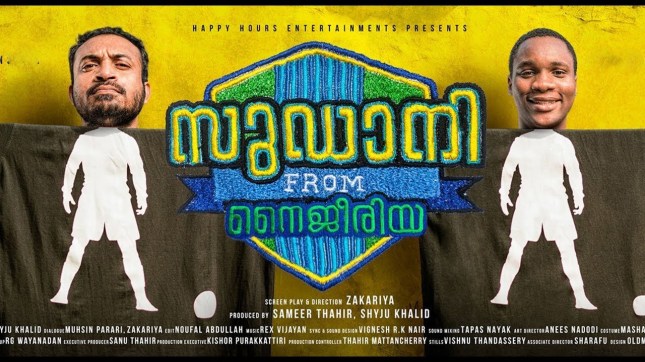
Sudani from Nigeria is the heart-warming début film from director Zakariya Mohammed that released in March this year. On the surface it’s a simple story about a Sevens football team from Kerala but underneath there is a thoughtful exploration of the relationships between each of the characters and an occasionally rose-tinted reaction of the local villagers to a foreigner in their midst. The film is charming and funny, while the idea that differences in language, culture and religion can be overcome with just a little compassion is definitely one worth spreading. Soubin Shahir stars alongside newcomer Samuel Abiola Robinson, but it’s the supporting cast who make the most impact and bring much of the warmth and humour to the film.

Majid (Soubin Shahir) manages a Sevens football team on a shoestring budget, paying the players out of their winnings each week. But since they play in a local league there is barely enough to ensure each player gets a share, let alone provide any money for essentials such as petrol for the team van. Majid doesn’t have any other job either, so he’s reliant on his mother for a roof over his head, although his estranged relationship with his mother’s second husband makes this difficult. Majid refuses to speak to his stepfather (K.T.C. Abdullah) and goes out of his way to avoid meeting him whenever he returns home. This isn’t as often as might be expected since his stepfather doesn’t live at home, but works as a security guard some distance away and stays there during the week. All of this puts a lot of strain on Majid’s mother Jameela (Savithri Sreedharan) who struggles with her son’s attitude and her husband’s absence. Luckily she has her friend Beeyumma (Sarasa Balussery) for company and with their down to earth humour and solid approach to problems, the pair are the heart and soul of the film.

Despite his financial woes, Majid has managed to recruit three African players, all called Sudani by the locals despite none of them actually being from Sudan. Their star striker Samuel Abiola Robinson tries to explain that they are actually from a different African country, which leads to Samuel being called ‘Sudani from Nigeria’, or Sudu for short.

The African players all seem to live together in a small flat in the town and overall the team seems a typical local side, with everyone knowing everyone’s family and all pitching in to keep the side going. Things get complicated when Samuel is injured during an accident, leading to a period of extended bed rest. Majid’s financial problems mean that the team cannot afford to pay for Samuel to stay in hospital, so instead Majid brings Samuel home to his mother and asks Jameela to look after him. Samuel speaks little Malayalam and mainly converses in broken English, while Jameela and Beeyumma don’t speak or understand English at all and only ever speak to Samuel in Malayalam. Nevertheless, a bond grows between Samuel and his carers, while everyone in the village comes around to speak to the injured striker and welcome him into their community.

The film works well due to the gentle mix of comedy and drama, with a slice-of-life approach that suits the simple story. Attention is given to develop all the characters, even those who only have a small role such as the marriage broker, who is arrogant and secure in the knowledge that he has all the power in his transactions with Majid, or the busy nurse in the hospital who berates Majid and his friends for not alerting her to an issue with Samuel’s drip as they are all too busy watching football on their mobile phones. Even though they only brush up against Majid and Samuel for an instant, each of these roles is important and everyone has their own story to tell. Zakariya Mohammed develops the different relationships well and the interactions between the different characters are beautifully written and filmed. It’s all these small details and the interactions between the characters that make the film work – Jameela arranging a ceremony for Samuel when his mother dies, even though she is Muslim and he is Christian, an elderly man demonstrating yoga positions for Samuel and a young couple who come to take a selfie with the foreigner. Each of these scenes feels incredibly real and genuine, while a light touch of humour and the occasional hint of trouble keep the film from ever feeling too saccharine sweet.

Soubin Shahir is excellent as the football-addicted team manager, who has devoted his entire life to football and his team, despite the effects such devotion has had on other aspects of his life. His difficult relationship with his step-father is woven throughout the narrative and provides a jarring but powerful counter note to the friendship that develops between Majid and Samuel. Soubin brings a number of key elements to his character including a certain nerdiness that has left Majid as a football manager rather than a player and star of the field, bashful attempts to find a wife, a constant awareness of his money problems and a determination to look after Samuel even as he ignores his step-father. Samuel Abiola Robinson has a more difficult role in some respects as he literally has little voice in the film, but he still does a good job at making Samuel an empathetic character. Much of this is down to his smile and determination to get back to playing football. There is a flashback to give some understanding of his situation at home, but it’s his bewildered acceptance of Malayalam village traditions that makes the most impact as he tries to cope with Jameela, Beeyumma and the rest of the villagers.

Savithri Sreedharan and Sarasa Balussery are simply brilliant as Majid’s mother and her best friend, and their method of looking after Samuel is hilarious and at the same time very touching. Their mannerisms are perfect for the characters and although they appear as typical village mothers, there is so much more to each that Zakariya cleverly explores with his screenplay and Muhsin Parari’s excellent dialogues. They each bring a mix of comedy, compassion, drama and warmth that works perfectly and provides a solid backbone for the rest of the story. The rest of the support cast are just as good with Navas Vallikkunnu, Ashraf Thangal and Abhiram Pothuval very funny as  Majid’s friends Latheef, Bavakka and Kunjippa and Aneesh Menon as rival football manager Nizar. Together they all form a tight-knit community that all work together despite having few resources to fund their passion.

Cinematographer Shyju Khalid ensures the film looks fantastic and Rex Vijayan’s songs and background music suit the mood, in particular the enthusiastic anthem to football!

The mix of characters, touches of humour and focus on relationships all ensure Sudani from Nigeria is a touch above the usual village-based drama and although the story might not hold any surprises, the film, and particularly the finale definitely draw on the heart strings. Adding football into a Malayalam film was a new thought for me as I hadn’t realised the popularity of the sport in Southern India, but it works well to add action and a dash of excitement too. If you like your sports films to be more about the action off the field, or prefer a novel approach to family and relationships, then this could be the film for you. 4½ stars.

One Cut of the Dead

Ueda Shinichiro’s One Cut of the Dead was a highlight of the recent Japanese Film Festival in Melbourne, and possibly my favourite film of the year. It’s a budget horror flick, a movie about movie-making, and a sweet story about the shared love of things that can bring people together.

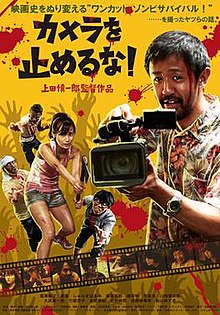
Opening with Director Higurashi making a low budget zombie movie in a spooky abandoned facility, the film quickly takes a turn as the cast find themselves under attack by “real” zombies. He sees this as an opportunity to get genuine emotion and real horror from his cast so he will not stop shooting and actually pushes the actors into more peril. Bloody, profanity laden, decidedly B movie, unintentionally funny, the story speeds to its conclusion. All in one epic 37 minute take. But then the clock winds back and we get to see how Higurashi and his crew came to be in this place, all the planning and preparation for their movie, and what motivated them to do it. And finally, Ueda takes us back to the day of filming, but this time we see the things happening on and off camera and what that means for Higurashi and co.

The director Higurashi is completely over the top, threatening his performers and demanding they keep filming even when their life may be at risk. He has one shot at making the film and will do what it takes to deliver. I really enjoyed Takayuki Hamatsu’s performance as he would swing from politely earnest to literally spitting with rage and back, all in the service of his film. His relationship with his sulky teenaged daughter Mao (played by Mao) and retired actress wife Nao (Shuhama Harumi), who are both on the set, gives the film an unexpected sweetness amidst all the gore and dismemberments.

Akiyama Yuzuki and Nagaya Kazuaki play Chintatsu and Ko, the stars of the film. I enjoyed their deliberately bad acting in the movie within the movie, and the contrast with their vacuous celebrity sides. When things started to go awry they were the least prepared and therefore, among the funniest. Shuhama Harumi’s Nao is a walking cliché in some respects, intoning warnings and urban legends straight out of every other horror movie. Her hobby and practical application of her skills almost brought the house down, and her character really comes to life in the latter part of the film. The rest of the cast includes stock types like the has-been actor who drinks to steady his nerves, the goofy AD who never challenges an order, the finicky cameraman, and his enthusiastic assistant who just wants a chance to try her style.

Things move at a frenetic pace but there are beats where you can simply enjoy what’s going on before plunging back into the thick of it. I was constantly delighted by small details like the appearance of a hankie wiping blood spatter off a lens as the cameraman gamely ran in pursuit of a screaming actor and zombie.

The narrative structure is brilliant and the editing is timed to perfection. Things that looked like bad acting or glitches in the movie might later be seen in a different light and instead make you want to cheer for this game little bunch of movie crazy people. The jokes were sometimes funnier from the second perspective too, which is quite an achievement. Dolly Parton once said it takes a lot of money to look this cheap. Ueda Shinichiro has managed to make a highly technical and polished film look like it was made on a shoestring, but in a good way. It’s a tribute to the spirit of making do.
I flinched, I groaned, I cheered, I laughed so hard I cried. If you can stand a lot of swearing and fake blood splashing around, see this.