Oh Baby (2019)

Oh Baby is a remake of Korean film Miss Granny, and although I haven’t seen the original, it appears that director Nandini Reddy has stuck fairly closely to the original story. The film is a fantasy rom-com where an acerbic older lady is changed to her 24-year old self and given a second chance to make her dreams come true. Both Samantha as the younger Baby and Lakshmi as the elder version are excellent and thanks to their performances and the rest of the lead cast this is an entertaining and light-hearted watch.

Baby (Lakshmi) is basically a typical grandmother. She organises everyone in the family, spoiling her grandson Rocky (Teja Sajja), mothering her son Nani (Rao Ramesh) and terrorising her daughter-in-law Madhavi (Pragathi). Not content with ruling the roost at home, she also runs a café in the same college where her son teaches physiotherapy and routinely trades words with her long-time friends Chanti (Rajendra Prasad) and Sulochana (Urvashi). While she adores her son, Baby has a soft spot for Rocky since he is an aspiring musician and Baby once wanted to be a singer too, but had to put her career on hold when she was widowed shortly after giving birth to her son. When Madhavi is hospitalised with stress after dealing with her mother-in-law one time too many, Baby is berated by her granddaughter Divya (Aneesha Dama) who telle her that she is the reason behind Madhavi’s collapse resulting in Baby deciding to leave the family home. But first she has to have her picture taken just in case it’s needed for her obituary and check in on Rocky’s first real gig, during which experience she is magically restored to her youth as the now 24-year old Swathi (Samantha).

Swathi finds lodgings with her old friend Chanti and his prickly daughter Anasuya (Sunayan) who has never liked Baby. Through various coincidences Swathi hooks up with her grandson Rocky’s band and is given the opportunity to finally fulfil her dreams of becoming a singer when the group are given a wild-card entry into a music competition. In the meantime, Nani mourns the loss of his mother, while Chanti, initially distressed at losing his friend, works out what has happened and is keen to support Swathi (much to the horror of Sulchana and Anasuya). There is also a romance of sorts as Vikram (Naga Shourya), the producer of the music show, is also entranced by Swathi and her rather unusual approach to life. But unfortunately Swathi’s new-found youth is not permanent and the situation with her family requires resolution, so it seems as if Baby will have to sacrifice her dreams for the sake of her family once more.

The comedy hinges on the rejuvenated Baby acting as if she is still a cranky old lady, and this is where the movie really excels. Lakshmi is superb at setting up the character of Baby in the opening scenes. She is deliciously insulting and knows just what to say to most get under her victim’s skin, while at the same time appearing to be solicitous and concerned. It’s a masterful performance, brilliantly funny and a side-splittingly accurate portrayal of everybody’s worst nightmare of an ageing relative. When she becomes the youthful Swathi, Samantha takes over and delivers a simply superb performance, perfectly encompassing an old woman stuck in a young woman’s body. Her movements, her walk, and her absolute delight in having normal bowel movements again are spot-on, best encompassed in the title song where Baby re-invents herself as Swathi.

Also integral to the comedy is Chanti as Baby’s long-time suitor, first desperately leading the search for her and then clandestinely trying to support Swathi in her quest for stardom. Rajendra Prasad is terrific here and shows off his impeccable comedy timing while providing the necessary support for Samantha and Lakshmi. Although his romantic overtures are frequently OTT, they are integral to his character and Rajendra ensures that he is always funny despite being rather over-enthusiastic.

Where the film is less successful is in the emotional aspects. Although Ramesh Rao is believable in his role as Baby’s son, the rest of the family are broadly drawn and Madhavi’s illness in particular is quickly brushed over.  Rocky’s blind self-ambition tends to strike a slightly sour note too since he continually compares Swathi to his grandmother, but doesn’t seem too upset that Baby has apparently vanished. Nani teached geriatric physioteherapy which is also used to point out that old people deserve a better deal in society, but again this goes nowhere and has little impact. As too the background story of Sulchana which could have been better used in the screenplay.

The romantic angle also doesn’t fit well, mainly because it’s not clear if this is supposed to be serious or played more for the comedy aspect. As a result, the romance feels disconnected to the rest of the story and ends up as a mild distraction that splutters into nothing at the finale. Another issue is the music which is surprisingly disappointing for a film all about a wannabe singer. Apart from the title song, most of Mickey J. Meyer’s songs, although pleasing enough, are just not up to the challenge of delivering the kind of memorable hits needed for this kind of movie.

However, the film works best when Samantha or Laksmi are front and centre, and thankfully this is the case for almost every scene. It’s fantastic that in to-day’s mostly male-centric Telugu cinema, this is a film that is focused almost entirely on its female leads and works entirely because of that focus. Samantha is simply luminous, she looks gorgeous as Swathi and yet still remains hilariously funny, delivering her one-liners naturally with faultless timing. I always like Samantha and she was the main reason for watching the film, but I was surprised at just how good she was, almost entirely carrying the film with only Lakshmi occasionally outdoing her performance.

Although not everything in the film works, Oh Baby is definitely worth watching to catch Samantha acting as an old lady, and to see Lakshmi light up the screen once more. It’s funny when either of the two are onscreen and with Rajendra Prasad and Rao Ramesh providing able support, the film is better than average. For me this was a great film for the holiday season and a good all-round family entertainer. 3 ½ stars.
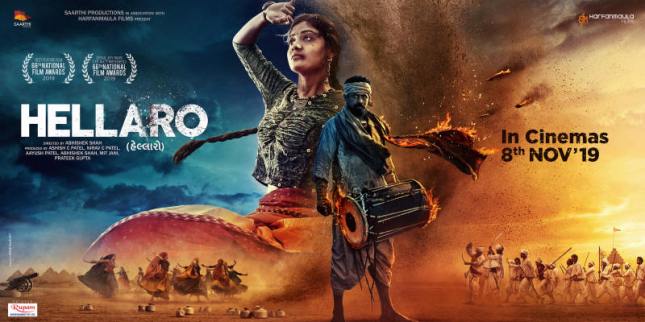
Hellaro

Despite winning the National Award for Best Feature Film, I hadn’t heard much about this film until it was recommended to me by a friend living in the UK. Luckily Hellaro was also released here in Melbourne, and I was able to watch this Guajarati film on the big screen last week. And what a treat! Hellaro is a beautiful film, steeped in the vibrant colours of Kutch with an amazing soundtrack and excellent performances from all the cast. The story is simple, but powerfully compelling and overall, it’s an absolute joy to experience at the theatre.

The end titles advise that the film is based on folklore and both the telling and the subject matter fit into that style of story. Hellaro is a tale about female oppression and the struggle to overcome patriarchy as the women of a small village in Kutch try to escape their controlling and violent menfolk. The women are kept virtual prisoners by the men, and rarely leave their homes except to collect water from a small lake close to the village. Singing and dancing are banned, along with sewing and anything that might bring joy to the women’s dull and barren existence. New bride Manjhri (Shraddha Dangar) enters into this misery with her soldier husband Arjan (Aarjav Trivedi), who has been allowed home from the border for his wedding. On his wedding night he explains the rules of the village to the educated and city-bred Manjhri and advises her to cut her own wings and horns as it will hurt more if he has to do it himself.

Being educated and from a more liberal family, Manjhri raises questions about the village customs. The only chance she gets to speak to the other women is during their daily trek to the lake, but even then the women are conservative and hesitant to step out of their restrictive roles. On the way to fetch water one morning the women find a man dying in the desert and after initially avoiding any contact, they finally revive him with the water they are carrying home. Manjhri takes the lead in this rescue as many of the women are frightened and want to leave the man to his fate, well aware of the consequences if their husbands find out they have helped a male stranger. Manjhri’s compassion is quickly rewarded as the man they have rescued is a dholak called Mulji (Jayesh More), who is persuaded to play his drum for them, giving the women a chance to escape their day to day reality and experience freedom.

In the village the women hide in their houses as the man dance garba with swords, twirling their moustaches and ironically praying to a female goddess for rain. In the desert the women dance garba to the beats of Mulji’s drum in a brief moment of happiness and release from their suffocating lives in the village. The mix of music and colour is intoxicating and yet violence is never far away with the ever-present threat that the men will find out exactly what the women are doing.

Although the story follows a linear path, there are layers within the basic tale and adding in caste politics and the fate of widows in rural India adds more depth and texture to the plot. In Hellaro, writer/director Abhishek Shah and co-writer Prateek Gupta have taken a simple idea and crafted a vibrant screenplay that’s enhanced by Saumya Joshi’s dialogues. Small details build on each other, crafting a detailed picture of a world that really could be any time or anywhere, adding to the fairy-tale atmosphere of the film. The women are superstitious and some believe that their ‘sin’ of dancing may be the cause of various mishaps around the village, while others are fully aware that the men are the source of all their troubles. Throughout the film, the characters are mostly painted as either black or white, but each of the women have defining traits that round out their characterisations to some extent. While they are still mostly brief sketches, each of the actors shows personality and ensures each character is seen as an individual.

The men are less well defined and are mostly seen as brutal and violent although a couple are shown in a little more depth. Bhaglo (Maulik Nayak) travels routinely between the village and the city and as a result is rather more cosmopolitan in his views. He entertains some of the villagers by re-telling the stories of the movies he has seen, although the men are more interested in the bedroom scene from Bobby than hearing about Basanti dance in Sholay. Bhaglo’s open-mindedness and awareness of the women’s situation is well contrasted with Arjan’s more traditional view, despite both men having travelled outside the boundaries of the village.

As the dholi, Jayesh More has few dialogues, but he is pivotal to the story and is excellent in the climax sequences. Shraddha Dangar is fantastic in the role of Manjhri, but all the women are superb and I wish I knew more about them to be able to differentiate individual performances. Mehul Surti provides the wonderful music while choreographers Sameer and Arsh Tanna spin magic with their brilliant garba routines. Cinematographer Tribhuvan Babu Sadineni captures the harshness of the desert, but also its beauty, along with the fantastic colours of the women’s clothing and the details of the house interiors. The film looks amazing in every frame and it’s this mix of music, colour and performances that make Hellaro such a memorable experience.

The only downside is that this a rather simplistic view of patriarchy with mostly very binary characters. The few who do show more complexity are still mostly good; that is progressive, understanding, empathetic and believers in equality with little or no negative traits. Those who are bad show few redeeming qualities, but in reality most people are rarely quite so black and white and societal divisions are not as clear or as clean as they are in Hellaro. What does feel more contemporary though is the banding together of the women over a common source of happiness, along with the determined but passive way in which they fight back. Their taking a stand feels realistic and plausible, while the overall joy of dance that is so integral to the film is perhaps the one thing that will unite both men and women.

Hellaro really is a beautiful film in terms of the framing of the shots, the music, costumes and choreography. Although the subject matter is often ugly, the exuberance the women show while dancing and the wonderful imagery ensure that this is a film that will stay with me for a long time. Highly recommended, especially if you can find it in the cinema.

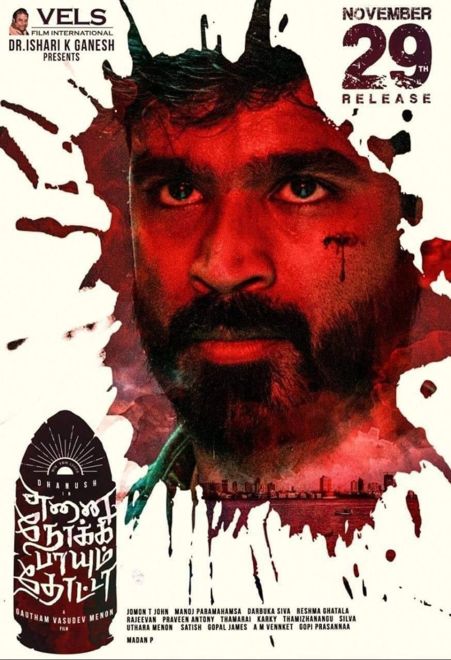
Enai Noki Paayum Thota (2019)

Gautham Menon’s latest film Enai Noki Paayum Thota has a number of similarities with his 2016 release, Achcham Yenbadhu Madamaiyada (Sahasam Swasaga Sagipo), but the formula doesn’t work as well this time around.  Dhanush manages to hold the erratic story together, but there is too much that has been seen before for this film to really make an impact. However, the songs are good, the action sequences work well and Dhanush is charming in the romance sequences, making Enai Noki Paayum Thota worth at least a one-time watch.

Raghu (Dhanush) appears to be a fairly typical student from a rather well-to-do family until the day he meets and falls in love with aspiring actress Lekha (Megha Akash). He is immediately smitten (we know because there is a voice-over that tells us so), but the relationship is initially slow to develop, partly because Raghu is rather awed by Lekha, but also because he isn’t totally sure of his own feelings and appears to prefer a more restrained approach. However, once Raghu makes his move, the romance progresses swiftly and Lekha seems equally head over heels in love with Raghu. That does strike a discordant note since there doesn’t seem to be any reason for Lekha to pick Raghu out of all the scrawny students watching the film shoot in their college, particularly since Raghu doesn’t go out of his way to make her notice him. There is no effort to explain her actions either, but then Lekha generally has very little will of her own in this film and ultimately, she isn’t important except as a reason for Raghu to search out his brother and beat up lots of ‘bad guys’. This film is all about Raghu, and Lekha is just the means by which he gets to show off his survival skills.

The romance itself, although beautifully filmed, is also rather less than satisfying. There is some chemistry between Dhanush and Megha in the songs, but that seems to be muted everywhere else, and the love story just isn’t completely convincing. I can buy that Raghu is besotted by Lekha, but Megha Akash doesn’t seem to be able to generate the same amount of emotion or attraction that Dhanush brings to his role. Since we learn early on that Lekha is being abused by her manager Kuberan (Senthil Veerasamy), this does lead to the conclusion that perhaps the relationship is developed by Lekha to get away from a bad situation rather than being a true love match. There are mixed messages from the dialogue too. Raghu says he’s a good man and doesn’t want to take advantage, but that doesn’t stop him from kissing Lekha when the opportunity presents. Then Lekha says she cannot live without him, but leaves when pressured by her manager, and doesn’t contact Raghu at all for years. It all makes it difficult to empathise with either character or even care if they will manage to meet up again.

Adding to the plot is Raghu’s missing brother Thiru (Sasikumar), who left the family many years ago after a tragic accident. Thiru has been AWOL ever since, but when Lekha finally gets back in touch with Raghu, she reveals that she is staying with Thiru and that he is in trouble. Further muddying of the plot happens with Kuberan’s links to various shady underworld deals, and just in case he wasn’t despicable enough, the years have turned him into a wife-beater and potential rapist who wants to exploit Lekha by pimping her out. It’s all just a bit too much, and the emotional blackmail used to coerce Lekha into staying with Kuberan is equally heavy handed and overly filmy.

There are also a large number of coincidences in the film that further dilute the story. Lekha just happens to meet up with Thiru in Mumbai, a crowded city where it can be difficult to meet up with someone even when you’ve arranged a meeting! It seems too good to be true that Lekha stumbles across someone who is actually an undercover cop, and the rationale seems contrived and simply unlikely. Also conveniently, Raghu follows his brothers trail easily despite minimal information and is able to find the evidence he needs right under his nose, although no-one else has been able to figure it out. And then there are a lot of close shaves with bullets (the title is taken quite literally here) that are rather too miraculous to be true as well.  The different ‘modes’ also generated some laughter in the cinema, particularly ‘beast mode’ which seemed to be an excuse to add some action sequences, although these are well choreographed and work well within the overall story. A word too about the subtitles, which were in yellow and easy to read font, but which appeared to be literal translations in parts, which simply didn’t make sense in English. So, some of the issues I had with the story may just have been due to not understanding exactly what was going on.

The film released late in Melbourne, and I’d read a couple of comments on social media about the voice-overs by Raghu throughout the film. On watching, these do make a sort of sense since the film is Raghu’s life story and his internal monologue helps clarify his thoughts and motivations. To his credit, Dhanush puts enough emotion into his performance to compensate for the lack of actual dialogue between characters, however the voiceovers also isolate the story to just Raghu’s view of the situation, reducing the rest of the cast to bit players in Raghu’s story. Ultimately this affects the all relationships; between Raghu and his family, his brother Thiru and even his relationship with Lekha, since the main view the audience sees of each is through Raghu’s own thoughts.

The focus of the story is firmly on Raghu, and Dhanush puts in an excellent performance, once again transforming himself into a fresh-faced young student and then appearing as an older and wiser version later in the film. He has the energy and acting talent to make his role believable, despite all the odd coincidences, but his character still doesn’t connect well with the rest of the cast. I don’t think this is just because of the monologues, but seems to be a more fundamental problem with the writing. All the other characters appear only through their connections with Raghu and only rarely interact with anyone else. Sasikumar, who should have been a powerful influence in the film ends up with very little dialogue and the lack of a convincing relationship between Thiru and Raghu makes his parts of the story clunky and awkward. Events mean that their relationship never gets any better either, while Raghu’s parents and sister have less screentime and therefore proportionately even less connection with Raghu.

Megha Akash looks beautiful but seems very constrained and lacklustre, especially when compared to Dhanush. Gautham Menon seems determined to make her a victim here, and perhaps I’ve just had enough of this tired trope, but it was frustrating to watch Lekha continually wait for someone to rescue her. Raghu’s Mumbai-based friend Meera (Sunaina) has more gumption, at least initially, but frustratingly she’s also quickly reduced to a victim with little further part to play in the story.

The entire film revolves around Raghu, but this narrow focus makes it difficult to invest in the story or the characters, and it’s really only Dhanush’s performance that makes any kind of impact. While he is front and centre, the film works reasonably well, but there are too many irritating issues with the other characters to make this a truly engaging film. Worth watching for Darbuka Siva’s songs and Dhanush’s skilled performance, but unfortunately there is little else here to be excited about.