Navarathri

Navarathri-Savitri in Navarathri

Savitri starred in both the 1964 Tamil Navrathri (dir. A.P Nagarajan) and the 1966 Telugu remake (dir. Tatineni Ramarao) and she is lovely as ever. What makes it particularly difficult to choose one over the other film is her leading men – Sivaji Ganesan (1964) and Akkineni Nageswara Rao (1966) – who each bring their own style to the proceedings. So I won’t pick.

That is so pretty with the Golu, the girls dancing and their sarees. The Telugu song is a bit more sparkly so I always pick that one.

Savitri is Nalina (Tamil) or Radha (Telugu). I’m going to just refer to her as Savitri throughout. After that lovely happy song, Savitri is told her father has fixed her marriage. She is already in love, and has no idea that her dad has unwittingly accepted a proposal from her boyfriend. Oh the drama. She runs to see the boy, only to be told he has gone to get married. She runs away, unable to face life as another man’s wife. Her character spends 9 nights wandering. She encounters different characters, all played by the leading man, who represent different aspects of human behaviour and emotion. These are named slightly differently in each film so I will just list them by night.

The film is more of an allegory than a realistic portrayal. Despite having lots of detail presented about who these men are, there is not a lot of depth to all the characters. The actors focus on the key emotion of the episode rather than trying to create nuances. Sivaji Ganesan is charismatic and is always instantly recognisable in this tour de force. ANR is generally better suited to low-key roles, but he also plays the various men as types. It is highly entertaining and stylised.

Night 1. A flamboyant widower interrupts Savitri as she contemplates suicide and drags her back to his house. Both ANR and Sivaji played this character as an eccentric, lonely man. The widower is devoted to his dead wife and little daughter (played by Kutty Padmini in both versions, I think). When compared flounce for flounce, there is little to separate the actors in this episode. I kept thinking of Snagglepuss.

Night 2. Tricked by a brothel madam, Savitri has to fend off a drunkard with a sob story. Savitri is determined, fierce and has a good throwing arm. Sivaji played this role as a wild eyed, plaid pants wearing letch with mood swings. ANR did a gorgeous self-parody as a self-pitying Devdas and for that, he wins my vote.

Night 3. Picked up by the police, Savitri is taken to a mental hospital. Both actors play the doctor as gently considerate and interested in why she was faking madness. I enjoyed ANR’s reactions to Savitri’s odd gesticulations and speeches. Sivaji is more of a generic saint in a white wig. Placed in a ward with several other women exhibiting different manias, Savitri joins in the various set pieces each inmate delivers and their song and dance medley. The Telugu patients (including Suryakantam, Chhaya Devi, Jamuna and Jayalalithaa) are funny and energetic, and I recognised most of the songs they used so I enjoyed their section a lot.  Manorama features in the Tamil film where the dancing and singing is more subdued but still fun. I’m usually averse to using the mentally ill as comedy fodder, but there was something good-natured and kind in this episode that helped me put my qualms aside.

Night 4. Frightened that the police had come for her, Savitri runs again. She meets a lurking gunman, out for revenge against the men who tortured and killed his brother. Savitri tries to persuade him to stop but he is killed by his enemies. It’s his character who has the most obvious demons to fight in this Navarathri. Both ANR and Sivaji play him with swagger and bluster. ANR had a little more vulnerability while Sivaji showed more of the wounded pride and ferocity. Both died spectacularly and both had to deal with interesting makeup and costumes. I guess it depends on whether you prefer a stripy t-shirt or a stripy lungi.

Night 5. Savitri contemplates suicide again. She is saved by a kindly villager and his sister who worry that she had been possessed by an evil spirit. A comedy conman arrives to fleece her poor but honest benefactors and Savitri decides to give him a taste of his own medicine. Nagesh originated the role in the Tamil verison while Relangi played in the Telugu film. I prefer Relangi in almost any role to Nagesh in most things! I think ANR does poor man with heart of gold so very well.  For this section, the Telugu film is the winner for me.

Night 6. Savitri sees an old man crawling along a path and goes to help. A formerly rich man, he is now a leper and shunned by all his family and associates. Savitri doesn’t let her revulsion at his physical state stop her from behaving with compassion and integrity. I really like that at around this stage in the movie, Savitri has stopped just passively absorbing help and is not only thinking about how to sort out her own life but is actively supporting other people. The makeup department were a bit more effective in 1966, and ANR does vulnerability so well. The Telugu film gets my points for this episode.

Night 7. A theatrical company is in need for an actress after theirs elopes. Savitri agrees to help them and the play goes on. I don’t think anyone can beat Sivaji Ganesan in Ye Historical Outfits and he looks like he has a ball in this turn as the rural actor/director. ANR is very good and his dancing has a higher comedy value, but the portentous dialogues flow so nicely in the Tamil film. Savitri is lovely in both films as she matches her leading man step for step.

Night 8. Whoever thought either of these men should wear short shorts should be given a severe talking to. Playing a policeman playing a hunter ANR and Sivaji both opt for a braying laugh, military bluff heartiness and those shorts. I think they used the same footage of the tiger in both films. Savitri masquerades as a man. She is not even slightly convincing, but her expressions are funny and her Telugu characterisation is enjoyably pompous. I think Sivaji’s shorts are both more terrifying (baggy, poor camera angles) and hilarious (baggy, poor camera angles). The Tamil film is a little more dramatic and better paced at this stage so I prefer that.

Night 9. In which we discover that intended groom/disappearing boyfriend Anand or Venu (Telugu) is of course Sivaji or ANR. Savitri has nice rapport with both actors and the reconciliation scenes were both funny and heartfelt by turn.  The wedding goes ahead and all the ‘other men’ turn up (except the dead gunman). Happiness prevails!

This slideshow requires JavaScript.

I slightly prefer the Telugu soundtrack by Chalapathi Rao T as it is a little more filmi and festive but the songs in the Tamil film are quite soulful so it does depend on my mood. I have the Telugu DVD with subtitles but have only seen the Tamil film without (it’s on Youtube). The stories are identical but of course, the dialogues will differ somewhat. Despite having different directors, there are only differences in a few scenes. It’s interesting to see so little of the second director in the remake – when I first saw the films I assumed AP Nagarajan did both.

I have some minor doubts. How did Savitri keep finding new sarees with impeccably tailored blouses? And she seemed to be wandering in circles yet no one could find her. But nothing detracted from enjoying her journey and her realisation that she could go home and be happy.

I really like both films, and have rewatched them a couple of times. Savitri is brilliant as Nalina/Radha and despite the focus being on the men, her performance is varied and her characterisation develops beautifully. Both Sivaji and ANR are in fine form and make the task of playing nine roles seem effortless. Choose your favourite cast, choose on language, choose the songs you like most, choose your own adventure! 4 stars!
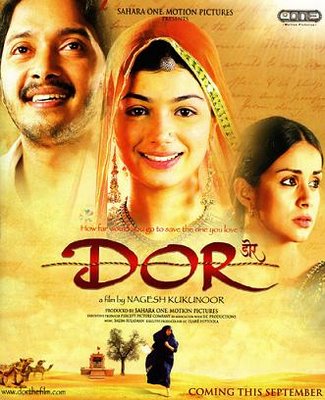
Dor (2006)

Dor

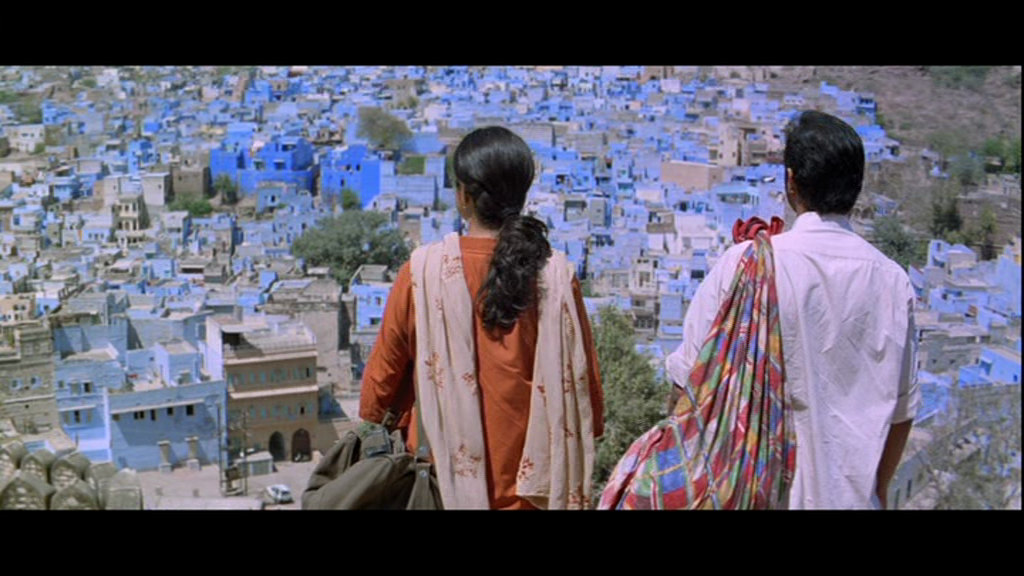
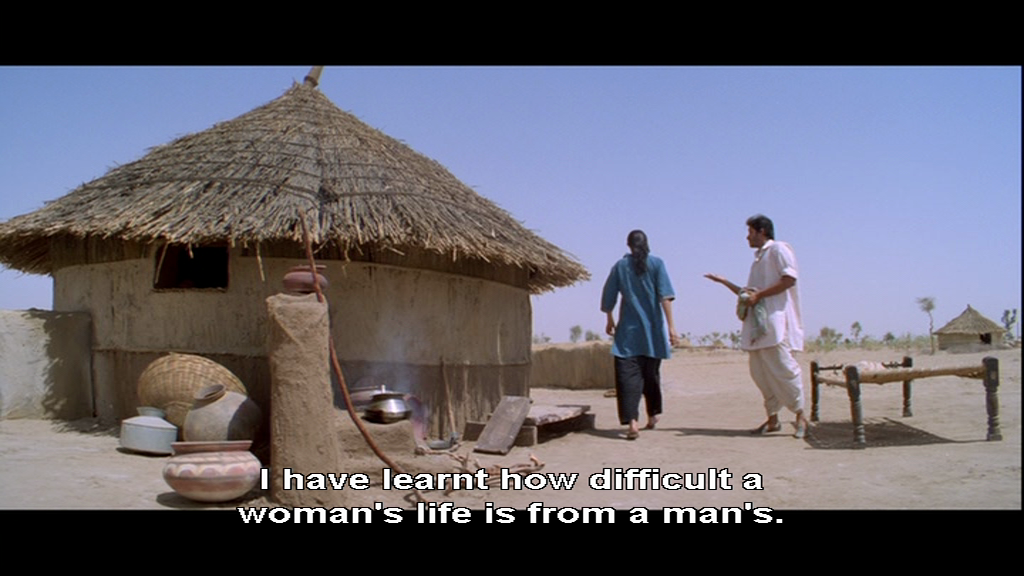
Dor is one of those rare gems in Indian cinema – a film with strong female characters and an engaging story that keeps you hooked right to the end. There are excellent performances from all the cast and the visuals are stunning with beautiful shots of Himachal Pradesh and Rajasthan.  It’s a story that contains many aspects of love and friendship, but it also shines a light on the life of women in rural India and the harsh realities of losing the protection of a husband in a patriarchal society. 

The film tells the story of Zeenat (Gul Panag) and Meera (Ayesha Takia), two completely different women in matters of personality and culture, and how their lives become intertwined.  Despite their many differences the two women also have some commonality as they are both recently married and their husbands have left to work in the Middle East.  In the opening scenes, director and writer Nagesh Kukunoor uses similar events in the lives of the two women to illustrate differences in their temperament and situation which rather neatly gives the bare bones of the plot, as well as introducing the characters.

DorDorDorDor

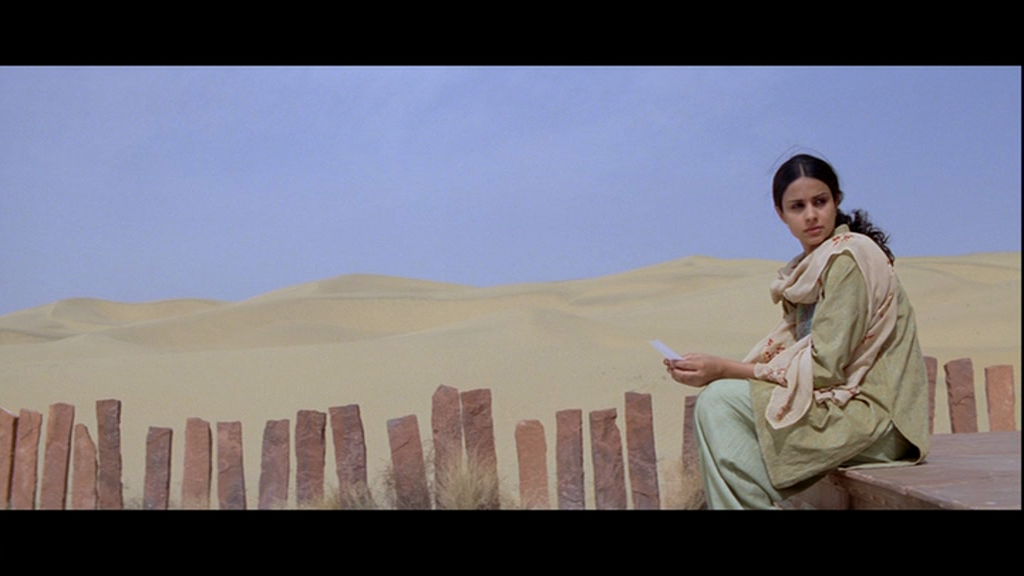
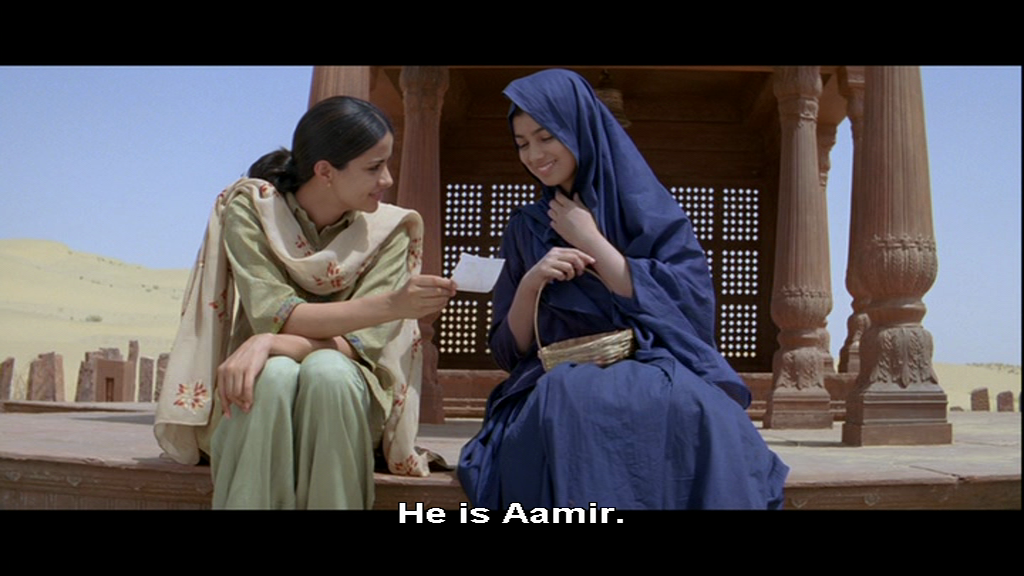
Gul Panag suits the character of Zeenat and perfectly captures her stubborn independence.  Zeenat is a Muslim woman from a small town in Himachal Pradesh who is determined to live life on her own terms and maintain her freedom.  For example, when her suitor Aamir (Rushad Rana) comes courting Zeenat rejects his advances in favour of repairing her house – personally I would have put him to work! This down-to-earth practicality and lack of sentimentality is repeated throughout the film which has the effect of making the few romantic moments much sweeter as a result of their rarity.

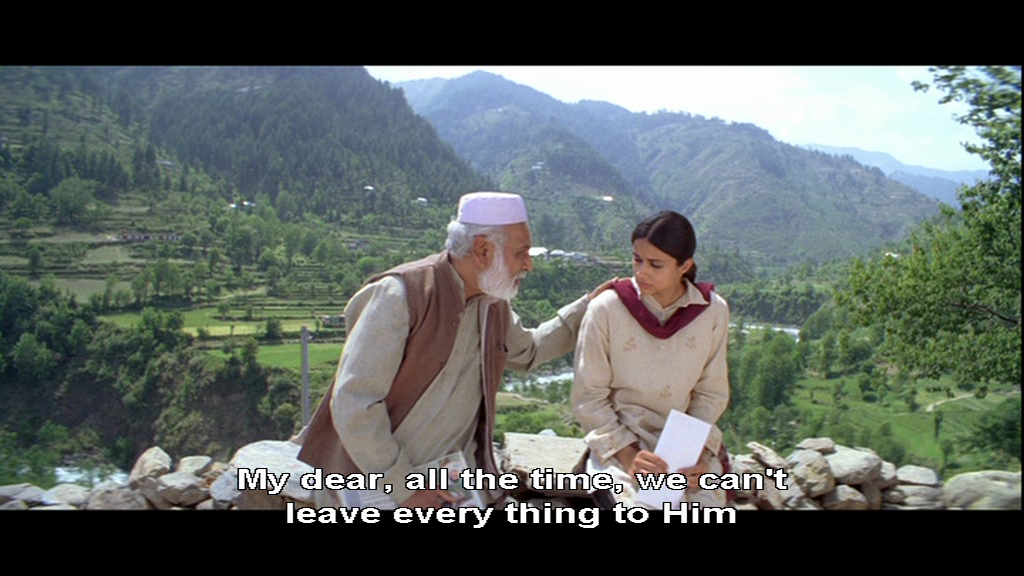
Despite her independent nature, Zeenat does love Aamir and when word comes that he has been detained in prison for the suspected crime of killing his room-mate, she immediately springs to his defence.  Zeenat is convinced that the death must have been an accident and is dismayed to learn that Aamir has been sentenced to death unless she can obtain a pardon from the wife of the dead man.  Zeenat has a close relationship with the local Imam and takes his advice on how to track down the young woman who may be the means to Aamir’s freedom. 

DorDorDorDor

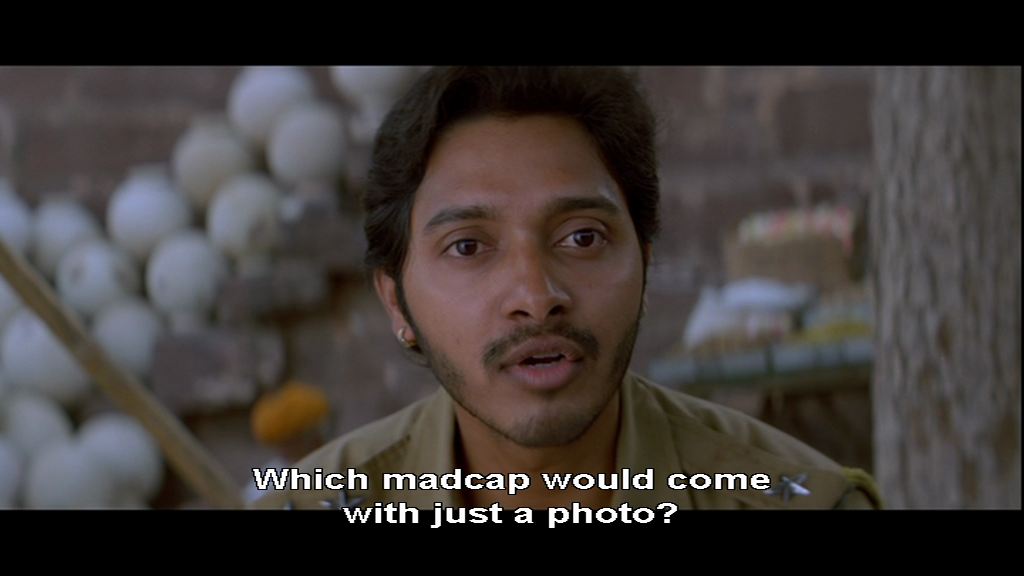
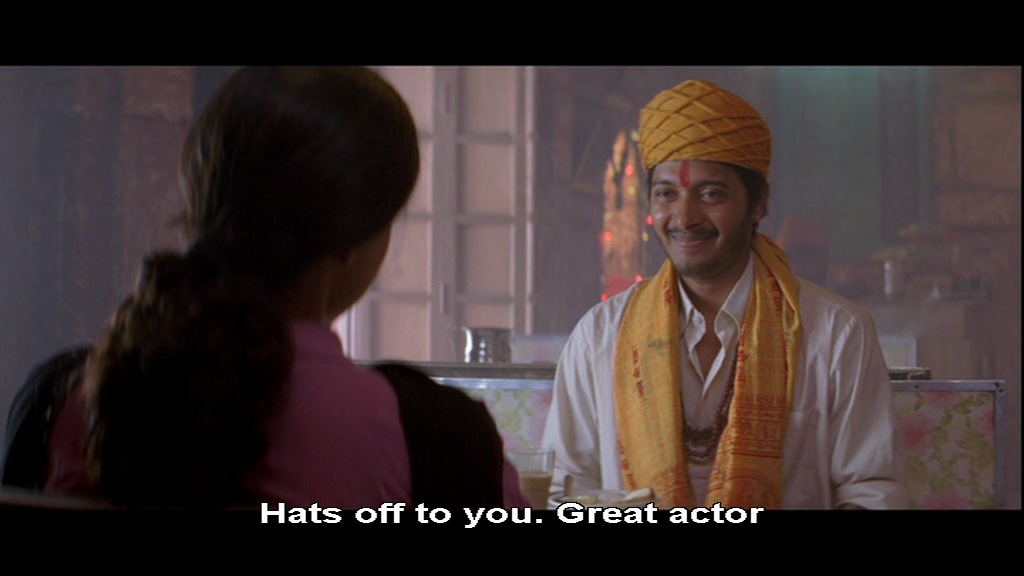
Although she doesn’t know anything about the woman’s whereabouts, Zeenat heads off to Rajasthan with a small bag, a photograph of the two men and a huge amount of determination and optimism.  Her faith in the universe seems to be answered when she meets up with a Behroopiya (Shreyas Talpade) despite the fact that at their first meeting he tricks and robs her.  However it is the Behroopiya who does manage to lead her in the right direction to find Meera. 

DorDorDorDor

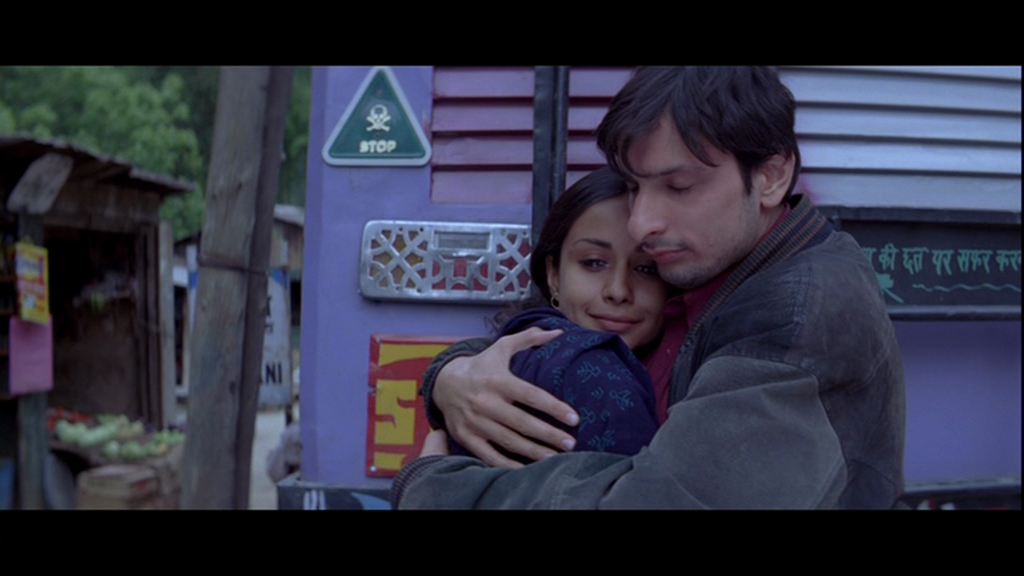
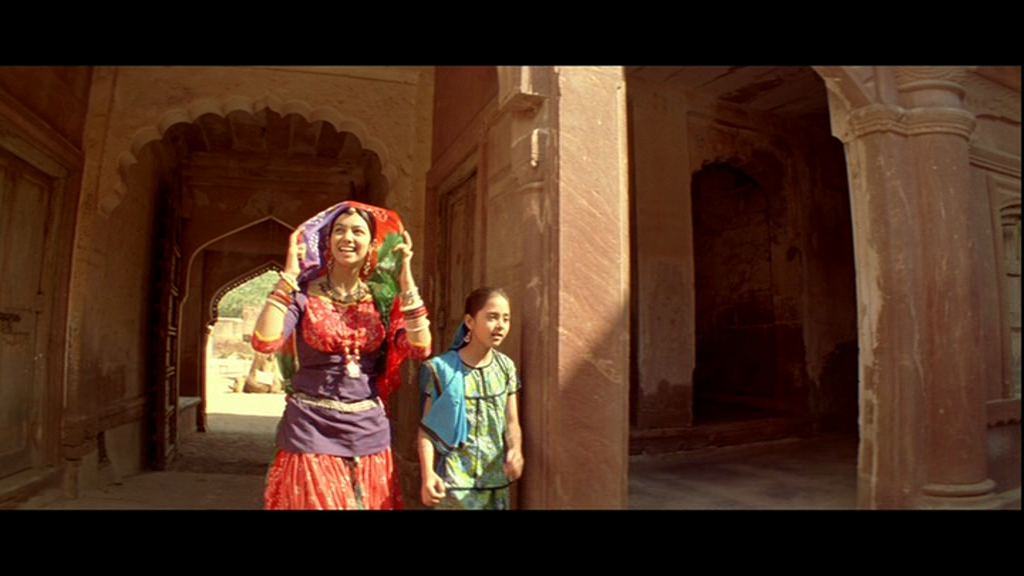
Throughout the opening scenes with Zeenat, we are also introduced to Meena and her very different outlook on life.  Meera is happily married to Shankar (Anirudh Jaykar) and has no problems living within the confines of a strictly traditional family in Rajasthan.  Ayesha Takia portrays Meena as young and innocent, flirting as she dances joyously for her husband, and becoming upset that he is leaving to work abroad.  Her youth is also shown in her pride that it is her husband who is earning the money which will buy back the family’s ancestral home.  However as the story progresses and Meena finds out that Shankar has been killed, she exhibits maturity along with strength and resilience as her world crumbles around her.

DorDorvlcsnap-2013-09-28-17h50m19s6Dor

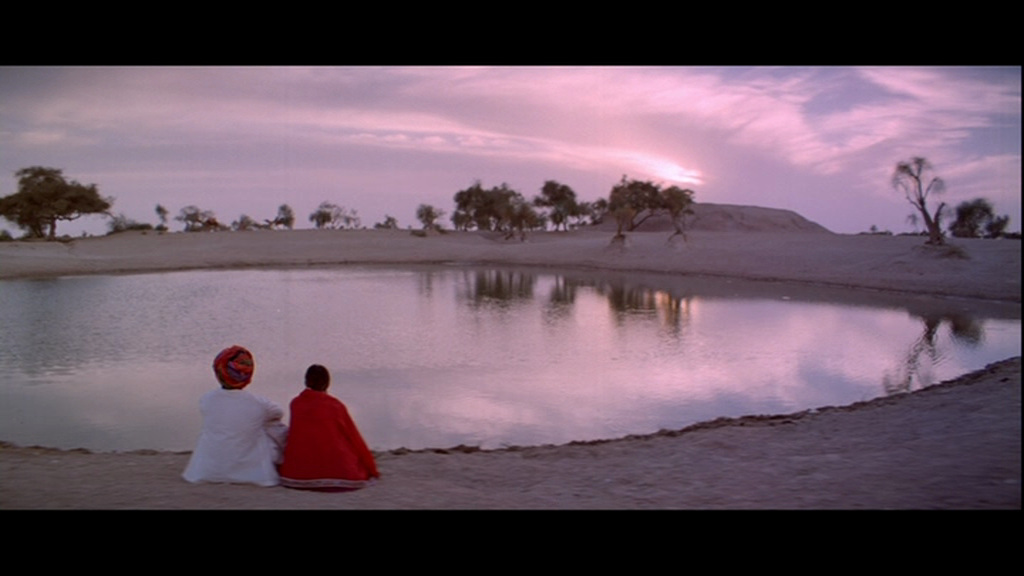
Ayesha Takia is very impressive in a role that demands  her character go through a major upheaval in her life and cope with the aftermath.  She makes the transition from young wife to virtual living non-entity as a widow very naturally and brings out every emotion as Meera has to deal with her new status in life.  Her reaction to the suitcase of her husbands clothes is perfectly nuanced and her moments of joy as she discovers friendship are beautifully acted.  It’s not surprising that she won a number of awards for her performance here.  One of my favourite moments is when she dances in the desert with Zeenat and the Behroopiyah – perfect!

Although at times the contrasts between the two women seems a little too contrived, for the most part the juxtaposition of their different lives works well. The grief and devastation shown by Meera for the double blows of the death of her husband and her loss of freedom is realistically portrayed while Zeenat’s self-contained grief is tempered with her determination and drive to save her husband at all costs.  Both actors seem very well suited to their roles, and Shreyas Talpede adds just the right amount of comic relief as the Behroopiya.  This character appears to be some kind of a guardian angel or possibly just an embodiment of Zeenat’s subconscious, as he watches over Zeenat and gives her advice.  It’s effective, especially when added into the more dream-like landscape of Rajasthan. 

DorDorDor

DorThere is one misstep in the film with the director playing a sleazy businessman who is renting the house in Rajasthan.  His repellent suggestion to Meera’s father in law feels filmi and false compared to the rest of the screenplay, although otherwise both Girish Karnad and Prateeksha Lonkar are excellent in the roles of Meera’s in-laws.

The background score by Salim – Sulaiman Merchant is beautiful and although there are no song and dance numbers the dancing within the film is spontaneous and just wonderful. This is another excellent song which shows Zeenat’s journey from Himachal Pradesh along with Meera’s symbolic journey from wife to widow.

Although not credited, Dor is based on a Malayalam film Perumazhakkalam which perhaps explains the quality of the story.  I’m still trying to track down a copy of this original film with English subtitles as it also won numerous awards and I’d like to compare the two.  However, Dor is still an enchanting film and the two leads ensure that the quality of the acting is as impressive as the screenplay and Sudeep Chatterjee’s gorgeous cinematography.  Although there is an underlying theme relating to the plight of women and their lack of value in some parts of India, it’s counterbalanced by Zeenat’s fierce independence and fighting spirit, so Dor never feels too preachy or morally worthy.  it’s a simple tale, beautifully told and I thoroughly recommend it.  4 ½ stars.

Dor

Phata Poster Nikla Hero

phata-poster-nikla-hero-poster

Shahid Kapoor is just so likeable. Rajkumar Santoshi should thank his lucky stars he landed a lead actor who could partly overcome some of the major flaws with his patchy action comedy. I didn’t hate the film, but I’m glad I saw it on ‘Tightarse Tuesday’ when tickets are half price and my expectations are that little bit lower.

Vishwas Rao (Shahid) is a young man who has been obsessed with film heroes all his life. His Ma Savitri (Padmini Kolhapure) is a strong woman who raised him alone, working as an auto driver to pay the bills. She has her own reasons for wanting Vishwas to be a good policeman. He wants to be an actor, and when events conspire to send him to Mumbai it seems he might be getting closer to his dream. Dressed as a cop for a photo shoot, he is mistaken for the real thing and his double life starts. A police inspector to his mum and feisty ‘Complaint’ Kajal (Ileana D’Cruz), and a struggling actor to everyone else, Vishwas is headed for comedy complications. Especially once the mob and an expat terrorist get involved. Hijinks ensue.

Phata-Poster-Nikla-Hero- a very filmi boy

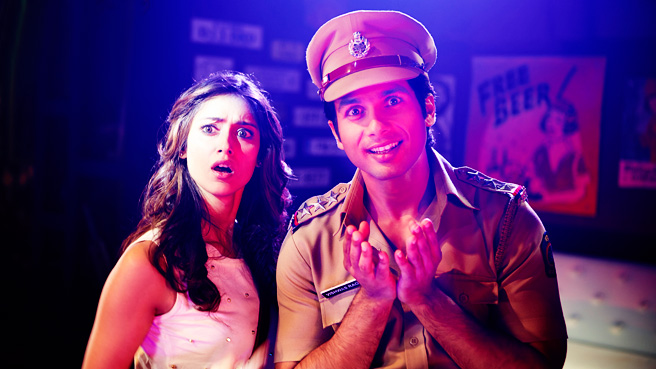
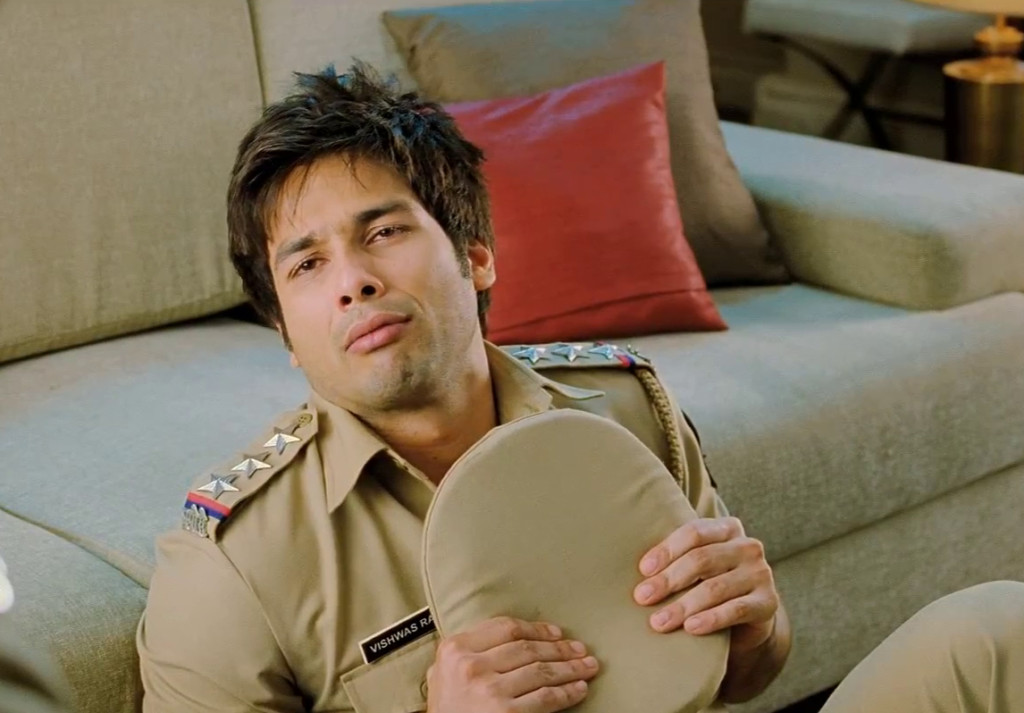
Shahid is required to play broad range of emotions from juvenile comedy to emotionally distraught mummy’s boy and steely eyed action hero and he does it all with aplomb. The comedy is not to my liking but I respected his effort to make it all work. The action scenes have the flavour of the month South Indian style, right down to the dramatic earth tremors when Vishwas stamps his foot and the extremely aerodynamic rowdies he despatches. Shahid dances his way through these scenes rather than fights, and I think a bit more grunt was warranted to live up to the mass standard. He declaims heroic threats with conviction and does puppy eyes with the best of them. No one feels sorrier for themselves than an Indian film hero, and Shahid oozed self pity as Vishwas contemplated a life of not being a big movie star. And he does get to dance a bit which made me happy. Especially a wildly silly pole dancing prelude to a confrontation with the bad gang. It’s a great role for him to show off his acting and have some fun.

phata-poster-nikla-hero-Ileana

I liked Ileana’s role as Kajal, the social worker and love interest. She has her own thing going on, and initially is only interested in Vishwas as an honest policeman in a force overpopulated by corrupt idiots. But she is drawn by his innate goodness or perhaps the way he fills out his rented uniform.

phata-poster-nikla-hero-dynamic duo

Their romance develops and is a part of their lives but it isn’t the whole story and is taken for granted rather than overplayed. Ileana is expressive and lively, occasionally veering towards the Genelia Line (beyond which lies Manic Pixie/Escaped Psychiatric Patient territory).  She only does one really stupid thing, and even that was because Vishwas didn’t think to tip her off before she spoke.

The real heroine is Vishwas’ mother Savitri. She is the kind of filmi ma who sees trouble and immediately tucks her pallu at her waist and wades in to help. She raised Vishwas on her own after her husband, a corrupt cop, took off. I think Savitri had read the “Nirupa Roy Guide to Filmi Parenting” but applied her learnings selectively. She laid on the emotional blackmail when she thought Vishwas was doing the wrong thing, and wasn’t averse to invoking god and suicide when he baulked. But as she came to understand her son rather than just seeing her idealised boy, she changed her mind. Their relationship was the emotional core of the film, not the fluffy romance. I also liked seeing a single parent family where the mother had dignity and her own income and wasn’t existing on some nebulous mix of charity and whinging.

phata-poster-nikla-hero-no need for subtletyPhata-Poster-Nikhla-Hero-Shahid

Where the film lost me was partly the comedy. I did enjoy the film references from an excellent cameo by Salman Khan, Shahid’s impressions of yesteryear heroes, right through to Vishwas paraphrasing the famous “Mere paas Maa hai”. They even worked in a Salman style tearing off of shirt, very appropriate for the Chulbul Pandey obsessed fake policeman!  But there are too many comedy uncles and so much slapstick. I started off enjoying a scene where a fat middle aged don and a fat middle aged cop started fighting but were puffed within a few blows. It was funny and believable as these old adversaries tried to face off. But then it went on and on and on, then added another bumbling policeman and there was a kind of bumble-off and that went on for too long and meanwhile there was a timebomb ticking away but hey, let’s go back to the bumble-off. There are ways of building tension and using comedy to defuse it while still maintaining the momentum. Santoshi doesn’t seem to know any of them.

Phata-Poster-Nikhla-Hero-colour and movement

The soundtrack by Pritam is serviceable. None of the songs have made much of an impression on me for the music alone. “Tu Mere Agal Bagal Hai” is more memorable for the excellent colour and movement and Chihuahua inspired choreo, and Dhating Nach for the inexplicable inclusion of Nargis Fakhri as the item girl. The thing I remember most is not the soundtrack so much as the background soundtrack. It is such a busy, noisy film. Every single gesture is underscored with a chord, a whistle, a trill, a whole freaking orchestra duelling in every conversation. Bosco-Caesar handled the choreography and when they could get Shahid on his own, they gave him decent material to work with. But I guess they gave up on the ladies and went for draping them over trees, or Shahid, in preference to actual dance steps.

Overall I felt that Rajkumar Santoshi couldn’t decide what to concentrate on so he just did a bit of everything and thought that was vintage masala style. Good masala still has pace and purpose. If a character is leading a double life, that can be revealed to heighten the drama or add a twist. But in this case a “twist” was revealed before it needed to be, then was reiterated by several supporting characters in conversations with each other. It was clumsy and again, made the pace drag. Also I take issue with villains who have no sound business plan and seem to plot destruction just for the sake of being bad. Also – what kind of doomsday bomb needs a sophisticated detonator but also has a big red “on” button and an equally big blue ‘off’ button? A comedy bio-weapon, that’s what. I didn’t find it all hilarious and I couldn’t take the supposed jeopardy very seriously.

This is an honest, if unsuccessful attempt at a good all round entertainment and I liked some elements a lot. If you’re a Shahid fan, you’ll like his performance regardless. If you have a tolerance for stupid comedy and slapstick, you’ll find much more to love than I did. Worth a watch, but would be just as good on DVD.