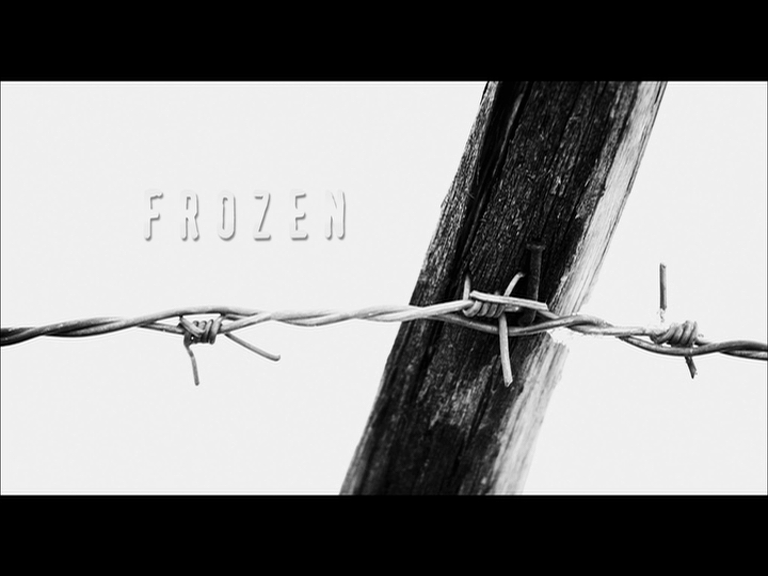
Frozen (2007)

Frozen-title

Shivajee Chandrabushan’s Frozen is a lyrical and often dreamlike film. Shot on location in Ladakh and released in black and white, it’s a story told as much through the stunning visuals as through the slightly clunky screenplay. I’ll state upfront I don’t have much of a view on the political background, and I am sure a homegrown audience would have a deeper understanding that would colour their viewing. I found the film satisfying on face value as a story about family, the effects of change, and the challenge to maintain integrity.

Karma (Danny Denzongpa) is an apricot jam maker, a widower living with his family in their ancestral home near Leh. He knows he has to try and keep up with the times, but that is easier said than done. He bought a machine to speed up his jam production but it doesn’t run reliably. He has mounting debts as his business deteriorates, loans cannot be repaid on time, and the interest is crippling. His daughter Lasya (Gauri) is wilful and an attention seeker, while Chomo (Aungchuk) is her little shadow. The siblings spend their days playing with their dog Singhe, running around in the woods, or going to visit their mother’s memorial, high on a neighbouring hillside. Lasya is growing up and Karma knows he should settle her marriage before all his debts are called in, but he resists taking any action, hoping he can keep providing for her. One day the army arrives on his doorstep to set up a camp. Their peaceful valley is suddenly full of trucks and electric lights, threats of violence by ‘the enemy’, and his land is no longer worth anything.

The pace, and price, of change is evident. The crowd at a festival is dotted with camera wielding tourists in Gore-Tex, hideous denim replaces the traditional woollen clothing, and motorbikes replace ponies. The army officers talk about the enemy and how the valley is no longer safe, but Karma only sees the place he grew up. His land is now covered in barbed wire, the silence broken by constant truck traffic. The officers also complain about how all the food in the market is being bought by ‘them’ to cause shortages, a sad situation for the jam maker who cannot sell his wares.

Danny Denzongpa is just wonderful. He doesn’t have much dialogue and manages to convey so much through Karma’s expressions, his pauses before responding, and his stillness. Karma’s Buddhist philosophy is the foundation of his character. He uses every challenge as a means of practising what he believes in, and his integrity is as substantial and present as the mountains.  When Karma realises loan shark Dawa is proposing to trade Lasya in return for more money, there is a long beat before he meekly nods. Danny shows his revulsion, anger and resignation all in a flicker of expression, with no sign of any 70s masala filminess or his more recent villainous styling.  I’m always happy to see Danny rock up in any film, and I particularly enjoyed this very gently shaded characterisation.

Gauri is pretty and lively, and gives Lasya a case of chronic resting bitch face which suits the character perfectly. She is starting to want more than her life in the remote homestead but it is clear she loves her father and her little brother. The local Romeo, who is actually called Romeo, (Shakeel Khan) takes a fancy to her. While she likes his attention she seems to like the opportunities to explore the world that come along with a boyfriend with a motorbike more than she likes the boy. Lasya is a typical teenager in a not so typical setting. Her energy sometimes manifests as anger, even when she doesn’t really know why. Karma does his best to teach her to guard her mind, to understand how to address her fears.

Little Chomo is the typical baby brother. He follows his big sister and lets her both bully and make a pet of him. Aungchuk doesn’t have to say a lot but he has an expressive face and droll comic timing. He is a loner, only ever hanging out with his sister or silently tagging along after his dad. I wondered about why he seemed to be on the periphery all the time and how he felt about his isolation, and liked the way his story unfolded.

Sita (Anuradha Baral) helps Karma run his house and feed his kids. She is obviously very fond of them and does her best to keep things running. Salim (Sanjay Swaraj) is in the same boat as Karma, with maxed out loans and little prospect of getting back on his feet. Colonel Shyam (Aamir Bashir) and the Rinpoche (Sonam Stobgias Gorky) are different kinds of influences in Karma’s life. The bad side of modernisation is represented by the parasitical loan sharks; sleazy Dawa (Rajendranath Zutshi) and sweary Sharma (Yashpal Sharma).

Karma and Lasya interact with lots of people but I wouldn’t say they were very close with anyone other than Sita. On a rare day out, Lasya explores a fair and it is great fun to see what she sees, and check out the crowds and entertainment, even a glimpse of the cham dancers from Thiksey Gompa. One day I’ll get there myself!

The film sometimes feels a little disjointed as it is more a series of vignettes and images, ranging from realism to more fanciful compositions. That adds to the dreamy nature as scenes shift and the focus moves from character to character. I read somewhere that Shivajee Chandrabhushan is a climber, and he certainly captured the things I love about the mountains. The landscape is both exhilarating and confining, and the vast skies and stark light often have an otherworldly effect. The environmental upheaval mirrors the turmoil in Karma’s life, and the changing seasons are a reminder of how little time he may have to protect his family. The epilogue was a bit tricksy after such a sincere story, and I would have been just as happy for the film to end without the final scene. Having said that, I liked that I was left with questions and possibilities and not just a plot tied up with a bow.

This is a film for a contemplative evening, when you can just immerse yourself in the flow of images and see where it takes you. And a rewarding film for the Danny Denzongpa fans. 4 stars!

Rana Vikrama

Rana-Vikrama-poster

Time for another adventure without subtitles; this time the Puneeth Rajkumar starrer Rana Vikrama that released earlier this year in India and showed this weekend in Melbourne. Written and directed by Pavan Wadeyar, it’s an action movie that follows a fairly predictable path but is kept moving along by the Power Star’s charismatic presence and some good action sequences. Throw in some better than average songs, a dash of comedy, and Rana Vikrama is a more entertaining watch than the opening scenes would suggest.

The story starts with a rather over the top British Officer in the last days of the British Raj. As expected, the Viceroy (Vikram Singh) is obnoxious, controlling, vindictive and just plain evil, although since Vikram Singh overacts and has been inexplicably dubbed by someone with an East European accent he ends up more comical than villainous. Unfortunately he’s not the only victim of the poor dubbing as a number of later scenes supposedly set in London feature reporters and lackeys also badly dubbed into grammatically incorrect and oddly accented English. Skipping over these technical issues, Vikram Singh chews the scenery for a while and eventually attempts to kill upstart villager Vikrama (Puneeth Rajkumar). Naturally he is no match for the tough local who wins the day despite being beaten, weighed down by chains and shot. Twice. Take note Hollywood – that’s how hard it is to kill a real hero!

The film then flashes forward to the present day where Vikram (Puneeth Singh again) is an aspiring police officer. Despite his obvious physical fitness, he is rejected by the enrolment officer time and time again however Vikram is determined to succeed, somewhat against the wishes of his fiancée Paaru (Adah Sharma) who would prefer him to stay with her. Vikram is thrown a lifeline by the Home Minister (Girish Karnad) who appoints him as a police trainee and sends him off to investigate a missing reporter somewhere in the border between Karnataka and Maharashtra. After a few hiccups Vikram finds the spot where workers in chains are toiling away in what appears to be an open cast mine, and makes short shrift of the numerous thugs and villains overseeing the project in classic filmi hero ishstyle.

The village has been keep secret for many years due to the nefarious dealings of none other than the British Viceroy’s descendant and the richest man in Britain, Jonathan (Vikram Singh again). He’s just as prone to overacting as his grandfather but with less reason, since he’s supposed to be a successful if rather unscrupulous businessman. However once Jonathan discovers that his secret has been discovered he jets in to India and prepares to get rid of Vikram once and for all.

Before we can get to the ultimate showdown however, there is a flashback sequence which explains the opening scene and also exactly why Jonathan’s family wants the land. Vikrama is married to Gowri (Anjali) for this sequence and the couple share good chemistry making this a better pairing than Puneeth Rajkumar and Adah Sharma in the present day. Anjali also gets to swing a sword and her feisty nature fits well into the storyline making her a more memorable and likeable character. I love this song featuring Gowri and Vikrama, which has the added benefit of a gigantic drum as a stage for Vikram’s dance moves. There is always something very special about oversized musical instruments in a dance number!

Generally the songs from V. Harikrishna are catchy and the choreography and picturisations are effective with some excellent costumes and imaginative settings. The songs also fit well into the narrative, something which is often more hit and miss in an action film, but they do work well here. If only such attention to detail had carried over into the dubbing and present day Anjali’s make-up to turn her into Vikram’s grandmother. This basically doesn’t work, and casting an older actress instead would have been a better option given that Gowri has little to do in these sequences other than look old and frail (which she doesn’t) and point dramatically at significant moments in the story. There is also a heavy reliance on clips of TV news reports which dulls the impact of some of the more dramatic scenes, although overall S. Vaidhy’s cinematography is impressive.

Although the film doesn’t cover any new ground and the heroic antics are far-fetched and fairly improbable, Rana Vikrama is still fun to watch. The action sequences from Ravi Verma are well thought out and the Power Star perfectly fits the role of a rough and tough police officer. It’s Puneeth Rajkumar’s film all the way and he does an excellent job of holding the story together despite the caricature of a villain and the rather OTT final sequence. I would have liked a little more care with some of the more technical aspects, but it’s still an entertaining film and one definitely worth catching on the big screen if you can.

Pandaga Chesko (2015)

Pandaga Chesko

This is the first film from ‘Energetic Star’ Ram that I’ve seen in the cinema, a fact that seemed surprising until I realised that Ram’s last film release was in 2013. I’m always wary with films billed as comedy, and Pandaga Chesko isn’t an exception to the rule that they should be approached with caution. However, surprisingly it isn’t Brahmi’s stale sleazy comedy that’s the biggest issue here, or the usual surfeit of comedy uncles with no real role in the story. Rather, the plot itself is tired, repetitive and well past it’s use by date. The story follows a young NRI’s return to India to attempt to reunite two families – sound familiar? Attarintiki Daredi, Govindudu Andarivadele and a whole host of other films have told this story before, and told it better. However Ram is personable and definitely energetic, although his performance and the best efforts of the support cast aren’t quite enough to save the film from being anything more than a one time watch for me.

Ram is Karthik, an NRI living in Portugal and a successful businessman running his own business. His success is enough to make him a candidate for marriage with Anushka (Sonal Chauhan) who is also a successful businesswoman although from her behaviour it seems barely conceivable that she could organise a two-ticket raffle let alone a business empire. But as her ability to play rugby to win a sports club presumably shows, she is a woman of hidden talents and a rather surprisingly slutty wardrobe for a business tycoon.

After Karthik and Anushka meet and decide that a merger would give them both the best chance to succeed in their respective businesses, Karthik learns of a complaint against his factory in India and heads off to fix the problem a month before his wedding. He’s also found out about a feud in his mother’s family, and despite not having shown any family feelings up until now, decides that while he is back in India he might as well sort out that little problem too.

However it’s not going to be as easy as Karthik thinks. For a start, no sooner does Karthik see Green Army founder and activist Divya (Rakul Preet Singh) than he falls in love with her. And the family feud proves to be tricky too, particularly when Karthik confuses the issue by including various other people pretending to be someone else. And muddying the waters further is Weekend Venkat Rao (Brahmi) sent to bring Karthik home for his wedding with Anushka but who spends his time indulging in cheap and nasty comedy instead.

Most of the comedy is in the dialogue so I didn’t find the film as funny as the rest of the audience, and since the physical humour mainly comes courtesy of Brahmi it’s generally crass and not particularly amusing. M S Narayana does have a small role but is generally not well used, while Abhimanyu Singh is reasonably funny in his role as a bumbling goonda in love with Divya. Divya and Karthik get some of the better comedy scenes too, although I don’t think all of it was actually supposed to be funny! They do make a likeable couple though and their scenes together are the most enjoyable part of the film.

The best performances come from the veterans in the cast including Jayaprakash, Sai Kumar, Raghu Babu and Pavitra Lokesh to name just a few of the large support crew. The feud between Karthik’s uncle and his erstwhile best friend is fairly standard fare but the actors give it their all and this part of the film works well. Rakul Preet Singh is good and has plenty of chemistry with Ram that serves their romance well, but Sonal Chauhan is a disaster in a role that doesn’t suit her and is badly written to boot. Ram doesn’t get much chance to show off his acting skills here either but he does well with what he is given – and if nothing else he does have good wardrobe choices and an energetic dance style. However even the choreography isn’t novel and although the songs from S Thaman are fine and generally well placed they don’t stand out as anything special.

Overall Pandaga Chesko does raise a few laughs but is let down by the disappointingly derivative and formulaic story. It’s frustrating since the film is well made with a great cast and generally good performances which do at least go some way towards making up for the tired plot. It’s not a terrible film, and it mainly works as a comedy, but it just needs a newer angle on a familiar tale and perhaps a few less comedy uncles. Worth watching for Ram and his energetic dance sequences, the romance scenes between Karthik and Divya and Arthur Wilson’s excellent cinematography.