Kaakka Muttai

Kaakka Muttai

Kaakka Muttai is a little gem of a film that premièred at the 2014 Toronto International Film Festival and subsequently screened at a number of Film Festivals around the world before winning two National Awards earlier this year. It tells the story of two young brothers and their quest to raise money to buy a pizza when a new shop opens up in their area. However this isn’t as easy as it sounds. The two boys live in a slum area and finding enough money for their day-to-day necessities is difficult, never mind Rs. 299 for something as exotic as a pizza. As they set about achieving their goal, the story touches on poverty, corruption in politics, globalisation and the daily cons run by locals in the area, but mainly it’s the story of two young boys and their quest to buy their very own pizza.

We never find out the real names of the two brothers in the film as they refer to themselves as Periya Kaakka Muttai (big crow’s egg) and Chinna Kaakka Muttai (little crow’s egg) after their habit of eating crows eggs when they can find them. Chinna KM (Ramesh) tempts the crows down from a tree with rice secreted away from under his mother’s watchful eye, allowing Periya KM (Vignesh) to climb up and find the eggs. Their nest robbing is one of the early scenes and the charm of the two brothers is captured by Periya KM’s response when he finds 3 eggs in the crow’s nest – he divides them up as one egg for each of the brothers and one left for the crow – such equality!

The two brothers live in the slums with their mother (Iyshwarya Rajesh) and their grandmother (Shanthi Mani) while their father (Nivas Adithan) is in jail. They live in a small one room shack which is clean, tidy and incredibly well organised despite the surrounding squalor on the streets. Much of the family’s money goes to a lawyer, who is supposed to be working to free their father, but there seems to be no progress in securing his release. There is never any mention of the father’s crime or how long he has been in prison which deliberately keeps the audience in the world of the children who also have no idea what their father has done and don’t seem to care.

This technique of showing their world through the eyes of Periya KM and Chinna KM is one of the charms of the film. Life is simple for the brothers. They look for the crows’ eggs on a waste piece of land where their friends play cricket, spending the rest of their day collecting coal along the railway lines and selling it to supplement their mother’s meagre income.  Like all children they ask their mother for things well outside what she can afford; a TV and a mobile phone seem impossible when she cannot even afford to send the boys to school but the brothers happy go lucky approach to life seems to serve them well. However one day the developers move in and the land where the crow makes its nest and the children play is cleared to make way for a new pizza restaurant. Despite being forced out the children are ecstatic when the new pizzeria is completed and movie star Simbu comes to open the restaurant and eats the first slice of pizza. Watching him enjoy the novel dish is enough to convince the brothers that this is something they need to try for themselves and they begin the arduous task of raising the necessary money to buy their own pizza.

They are aided in their venture by a friend from the railroad tracks. Pazharasam (Joe Malloori) or Fruitjuice as the subtitles decide to translate his name, works on the railways but is happy to talk to the two boys and helps them find coal to sell. It’s obvious to the audience that the coal he leads them to is not free for the taking, but Periya KM and Chinna KM don’t seem to realise that this isn’t just a pile of forgotten coal and are deliriously happy that they have found the means to raise enough money to finally buy pizza. However they are quickly brought back down to earth when the restaurant security immediately calls them slum kids and refuses to let them in to buy their pizza even though they have sufficient funds. Just having the money isn’t enough and Periya KM and Chinna KM have a new goal – to raise enough money to buy new clothes that will allow them to entry to the pizzeria and their dream of pizza.

Vignesh and Ramesh are perfectly cast as the two young brothers and have plenty of impish charm and infectious energy as they roam around their area. There are plenty of note-worthy moments and small vignettes that give the whole film a feel good factor that is normally missing in films about slum dwellers. Watching the brothers wash clothes (Chinna KM wets the bed every night) allows Manikandan to juxtapose the younger brother throwing up wet clothes for his older brother to catch and hang up with a moment where the elder is distracted by watching a plane go past in the sky. His younger brother hits him in the face with the next item and the laughter chases away that brief moment of dreaming by Periya KM. There is another where Chinna M finds a toy watch in the scrap yard where they sell their coal and then takes it to a watch maker to make it work – the mix of Chinna KM’s delight in something so small as the watchmakers magnifier and his innocence as he tries to understand why his watch doesn’t work makes for beautiful cinema.

And Manikandan keeps them coming – there is the grandmother trying to make pizza for the boys when she discovers how desperately they want it, the boys attempting to sell their dog to raise money and their friendship with a richer kid who they speak to across the barrier of a metal fence. The physical barrier is nowhere near as daunting as the social divide which keeps Periya KM and Chinna KM firmly in their place but their determination is inspiring. Iyshwarya Rajesh too puts in an incredible performance as the boys’ mother and perfectly balances pride, ethics and desperation as she tries to cope without her husband and bring up her boys as best as she can. Later scenes of her interactions with the local politician and with the police are perfectly done to give her grace and dignity in trying situations and the conversations between her and the grandmother are beautifully natural. In fact all the performances are excellent with each member of the cast seemingly perfectly in their roles. Other stand-outs are Ramesh Thilak and Yogi Babu as the two local conmen trying to make a quick buck out of the brothers misfortune and Babu Anthony as the pizza shop owner, while Joe Malloori and Shanthi Mani are simply brilliant.

Manikandan makes an impressive début with Kaakka Muttai, not just writing and directing the film but also responsible for the cinematography. At any rate he makes the slums look much better than expected, giving them an almost magical appearance as seen through the eyes of the two brothers, although there is plenty of grim reality there too. However our eyes tend to slide past the garbage and debris, maybe because no-one else seems to notice it either. Manikandan seems to be an expert in multi-tasking and perhaps it’s his control over so many aspects of the film that explains why Kaakka Muttai is so completely satisfying too. The story shows the negative aspects of poverty but also illustrates that there is beauty everywhere, even in the slums, and that people are people, no matter where they come from.  I totally loved this film and particularly the two KM’s who remind me so much of the children I work with in India every year. I love their optimism and resourcefulness, and most of all their wonderful smiles and endless joy. Sure, this is a sugar coated view of the slums and there is little of the expected violence and absolute despair, but as a look at poverty through the eyes of two young boys it’s a winner all the way. Don’t miss it! 5 stars

Kaakka Muttai

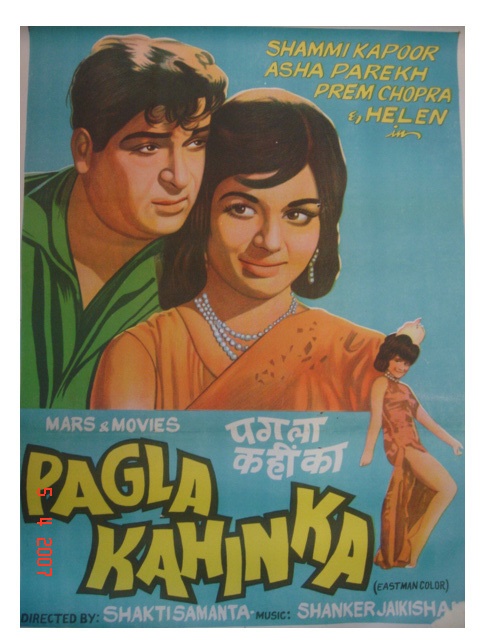
Pagla Kahin Ka (1970)

Pagla Kahin Ka poster

I was supposed to be posting a review of a Jayalalitha film but I feel she has had quite enough publicity about now, and I shan’t add to it. Then I thought I would swap in something more upbeat as the world has been quite a trying place, but I remembered Pagla Kahin Ka. It has the perfect 70s cast, some great songs, and Shakti Samanta at the helm. But it’s a mostly sad story about love, friendship, and loss. I discovered this via the excellent Memsaab, and if you follow that link to her review you will also find a link to a subtitled download of the film.

Sujit (Shammi) and Shyam (Prem Chopra) are in a hotel nightclub band, and Jenny (Helen) is their featured artiste. Sujit and Jenny are madly in love and building plans for their future. Sujit proposes but Jenny is reluctant due to their different status. There are also rumours that Sujit is mad but Jenny doesn’t see his wildness as a problem.

Hotel boss Max (K.N Singh) is less enthusiastic about their union as he will lose his eyecandy and probably the associated income. Max and Shyam come to blows and Max is killed. Sujit takes the blame and pleads insanity, his sad past going a long way to convincing the judge despite his useless lawyer (Bhram Bardwaj). He goes to the asylum, leaving Shyam who is secretly in love with Jenny.

The asylum is full to the brim with overacting extras that make the place seem like a true Bedlam. Sujit is genuinely depressed and worried by his incarceration and his memories of his father who was committed following a breakdown. But that isn’t enough as he is meant to be an insane murderer and Shammi (over)indulges in some of his “crazy” acting. Shalu suspects he is faking and takes his case on.

Shalu asks him what would happen if Jenny had forgotten him. Oh the foreshadowing…

Meanwhile Shyam seems to be keeping things from Jenny and trying to make her doubt Sujit, and also keeping Sujit isolated. Things come to an emotional crescendo when Shalu hints at her feelings for Sujit, envying Jenny her love, at the same time Jenni is being raped by Shyam who has had enough of waiting. As if Prem Chopra was ever going to play a wholeheartedly good friend! Poor Sujit. He only has two real friends, and now things can never be the same.

Sujit’s release coincides with Shyam and Jenny’s wedding. Jenny looks very pretty and utterly miserable and I was pleased to see the movie gives the “marry your rapist” solution the side eye. At the wedding reception Madhumati dances a love triangle themed song in a very Helen-y outfit. And Sujit, clueless about why or how or even what but still wishing his dearest friends happiness, has a multi instrumental breakdown.

Now genuinely losing it, he is unable to process the shock and betrayal he feels at losing the friendship and loyalty that had been his foundation. Shalu sees the shocking difference in Sujit this time and immediately grasps that something devastating has happened. The other inmates welcome him back, some gently chiding him and some seeing his return from a cruel and inhospitable world as inevitable. It’s a nice change of tone from the more comedic first stint and Shammi plays it beautifully. He is heartbreaking as Sujit tries but fails to grapple with the facts, knowing there is something seriously awry but unable to process it or do anything to help himself.

Jenny visits Shalu and tells her the truth, hoping that Shalu will help set things right with Sujit. Shalu is quite conflicted through all of this as she can now see her chance with Sujit but is bound to try and treat him. Asha Parekh smiles approximately three times through the film, but her chemistry with Shammi is spot on. She shows a gentle empathy and tenderness with him and despite some questionable doctor patient interactions, I was glad to see someone wholeheartedly for Sujit. And he does blossom under her care, eventually regaining his memories and feeling robust enough to deal with losing Jenny.

He is able to declare his love for Shalu. But he still sees Shyam as his great friend and Shalu decides she must dispel that illusion so he can really move on. And by move on, I mean move on to her.

Does anyone ever run up against Prem Chopra and survive unscathed? Not Helen, sadly. Sujit and Shalu appeared to need about, oh, a nanosecond to deal with Jenny’s fate. I understood the plot point needed to be resolved but that was callous. And without wanting to be too spoilery I was hoping that random tree was sturdy and her aim was good.

Anyway.

The soundtrack is a delight and Shankar Jaikishan run from rollicking cabaret numbers to songs of quiet yearning. Helen gets a couple of good dances in before marriage and sarees end her career, and I liked seeing Madhumati as a clear Helen substitute and dancing up a storm. Shammi has always had great musicality and while he sometimes overdoes the hairography he really sells the swooning romance of the ballads.

See this for a star cast in a not so typical story, and for the bonus of Helen in a substantial if thankless role. Despite the downbeat elements, ultimately this is a story about finding your happiness where you can and learning to trust (but not indiscriminately, and never Prem Chopra). 4 stars!

CityLights (2014)

CityLights

In his reworking of Sean Ellis’s award winning social drama Metro Manila, Hansal Mehta moves the story from the slum areas of Manila to the seedy streets of Mumbai. It’s a tale of grinding, remorseless poverty and the desperation such hardship brings, but there are some lighter moments too and the film morphs into a crime drama about half way through. City Lights is perhaps not quite as effective as the original in telling the story of a young naïve family and their move from the country to the city in search of a better life, but what the story has lost in adaptation is more than made up by the strong performances from the lead actors Rajkummar Rao, Patralekha and Manav Kaul.

City LightsCityLightsCityLightsCityLights

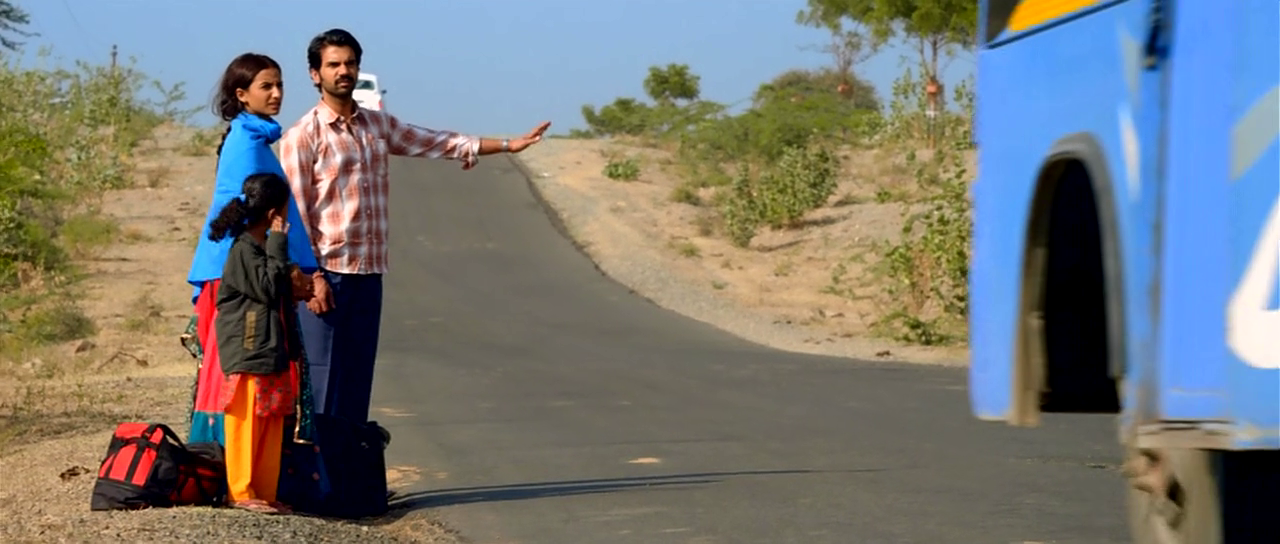
The story opens in Rajasthan where Deepak Singh (Rajkummar Rao) has a clothing shop in a small town that he is forced to close when he cannot afford to pay off his debts.  Since there appears to be no hope for any work in his village, he sets off for Mumbai with his wife Rakhi (Patralekha) and small daughter Mahi. Rakhi is reluctant to move, once in the city she seems less naïve than Deepak so perhaps she is well aware of the difficulties of trying to live in Mumbai, but ultimately she has no say in the decision. These first few scenes are full of light and laughter, and in just a few brief moments Hansal Mehta paints a picture of a happy family where there is a lot of love and hope that better days will come.

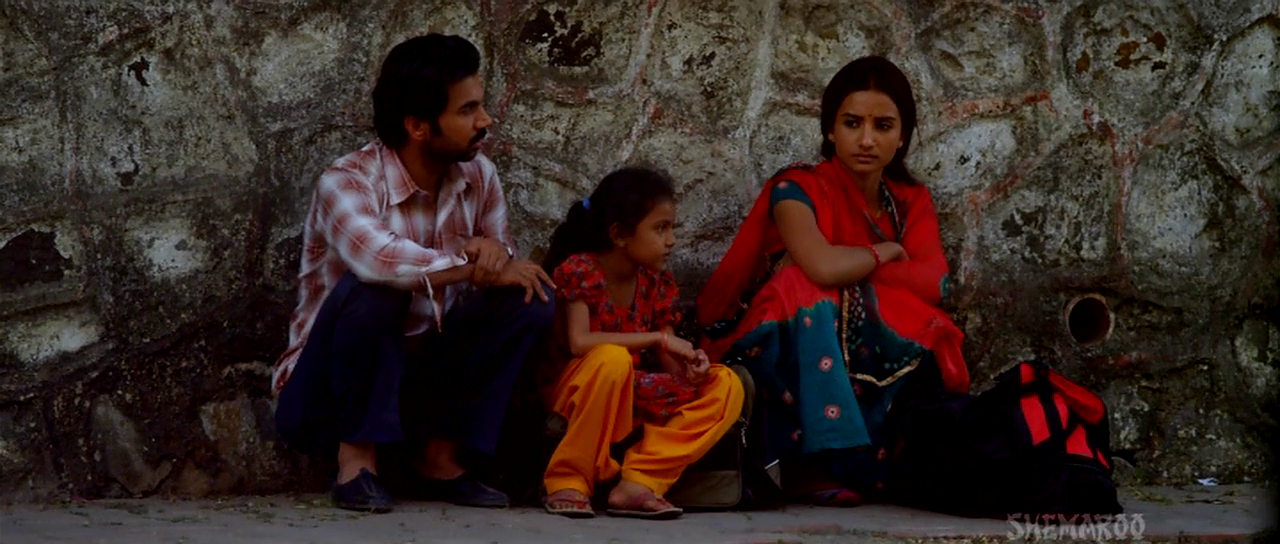
Deepak plans to meet a friend from his army days in Mumbai, but when Omkar fails to turn up at the railway station the family has to find their way in the big city alone. After being swindled out of what meagre funds they have, a chance meeting with a bar dancer leads them to a temporary refuge in a half constructed building.  While Deepak spends his days trying to find any kind of a job anywhere, Rakhi manages to get employment as a dancer in a bar. However this is not work she finds easy to reconcile with her conscience and she continually struggles with the leers of the men and their attempts to get more from her than she is willing to give. Deepak too is not happy about his wife’s job either, but the family is in such desperate straits that he has no other option but to let Rakhi work. Both actors do a fantastic job here of getting the depth of their emotions across using facial expressions with excellent body language and minimal dialogue.

Although their situation seems unlikely to improve, the couple never give up hope, even if it’s a very compliant and resigned kind of hope. There are no impassioned speeches or battles against authority here, but rather calm acceptance of their place in society and the belief if they just keep trying then eventually God will provide a solution for them. It’s frustrating viewing at times when Deepak is unable to push himself forward when looking for work and Rakhi cannot put aside her inhibitions to make more money when she is dancing, but they are simple everyday people and Hansal Mehta portrays them just the way they are. No more, and no less.

Their blind faith appears to work and things start to look up when Deepak gets a job as the driver for a security firm. The money seems good, and Deepak’s new partner Vishnu (Manav Kaul) even offers the family a place to stay. However Deepak comes to realise that his new partner had an ulterior motive for recommending him, and it is Deepak’s innocence and naiveté that got him the job rather than his previous army experience. Vishnu has a plan which needs the co-operation of his partner, and he’s been waiting for an innocent like Deepak to manipulate into following his commands. Deepak is reluctant, but when Rakhi loses her job in the bar it seems as if he has no other option but to go ahead with Vishnu’s plan if he wants to make sure his family survives.

Rajkummar Rao and Patralekha both suit the role of poor immigrants to the city. They both look skinny and malnourished with beaten down postures and downcast eyes, and both achieve that calm acceptance that extreme poverty seems to bring. It’s only with each other that they seem able to look straight ahead and even then Rakhi rarely looks her husband in the eyes. Both exude innocence effortlessly, even in the rather ham-handed treatment of their love scenes, and Rajkummar Rao in particular never puts a foot wrong. Manav Kaul is also excellent in a role that gives him plenty of opportunity to develop his character. He’s the man who knows the ways of the city, and is patently more sophisticated and knowledgeable than his partner from the country. He has a wife and a mistress, but despite his city veneer he also deeply resents the people whose money he delivers every day and despises his own circumstances. In his way, Vishnu is just as desperate and defined by his poverty, even if it’s not as extreme as that experienced by Deepak and Rakhi, and Manav Kaul does an excellent job with the characterisation.

The film does have a couple of songs which are either used over montages of the couple’s life in the city, or to highlight certain moments in their lives. The problem is that the music and lyrics are overly dramatic, particularly in scenes where the actors have already displayed plenty of genuine emotion and the music ends up detracting from rather than enhancing their performances.  The track below which plays over Rakhi’s dancing and Deepak’s drinking in a bar does work better, but most of the other songs are too loud and intrusive to suit the action. The film is also very dark at times; to the point where it is difficult to see what is happening let alone the actors expressions, while the final climax seems rushed and too contrived compared to the rest of the story.

These small issues aside, the film is an insightful look at the dark side of Mumbai and the realities of living in unrelenting poverty as Hansal Mehta successfully translates Sean Ellis’s story from the Philippines to Indian soil. Rajkummar Rao is definitely the standout as he once again completely immerses himself in his character and delivers an amazingly realistic and believable performance as he did in Shahid. Manav Kaul and newcomer Patralekha are also impressive in a film that raises questions about morality, ethics and poverty even if it does turn a tad Bollywood at the end. 3½ stars.