Sardaar Gabbar Singh (2016)

poster

I didn’t expect great things from Sardaar Gabbar Singh, so wasn’t surprised when it turned out to be a formulaic action flick that’s overly reliant on Pawan Kalyan’s star power.  What the makers of Sardaar Gabbar Singh seem to have missed is that Dabangg and its Telugu remake Gabbar Singh were successful because they poked fun at the traditional herocentric films of the seventies and eighties. Here was a hero who wasn’t pure and honourable but instead was a bit crooked himself and out to look after No 1 above all else. If other people happened to benefit from that self-interest, well and good, but that wasn’t the main motivation behind Officer Chulbul Pandey’s vendetta against Chedi Singh. And therein lies the problem with Sardaar Gabbar Singh. While the first half gets off to a good start, by the time the story is starting to take shape Gabbar Singh (Pawan Kalyan) turns out to be just too, well, good. He’s not selfish enough, not corrupt enough and not greedy enough to win our hearts the way Chulbul Pandey did in Dabangg. For all it’s faults though the film does have an entertaining first half and the big budget ensures top-notch fight scenes and well constructed sets. It’s just a pity the rest is so pedestrian and clichéd.

The story is threadbare thin and follows a by-the-numbers good cop vs. evil landlord format with a beautiful and hapless princess thrown in to add a little glamour. After a cute opening scene to prove that Gabbar Singh has always stood up for himself (even as a child when sleeping under a Sholay film poster on the streets), he next appears as a rough and tough cop determined to bring his own form of justice to bad guys everywhere. Luckily for Gabbar Singh the crooks haven’t learnt that they need to attack en masse rather than one at a time if they want to have any chance of winning, so right from the first fight, he has little difficulty in overcoming an entire gang all by himself. At least the fight is well choreographed and Pawan Kalyan is funny as well as competent while taking down the latest collection of inept gangsters. His success means that Gabbar Singh is shipped off to a town in dire need of some law and order, with his best mate since childhood Samba (Ali) dragged along too.

The villain of the story is cartoonishly over-the-top evil and sadistic, while his crimes are varied and myriad. Bhairao Singh (Sharad Kelkar) has destroyed the local farmland by mining after viciously disposing of the villagers who happened to be living there. He’s also taken over the roads for his own use, intimidated the locals by killing anyone who opposes his rule and maintained a triad of lieutenants who commit various other crimes in his name. In Bhairao Singh’s sights is the land owned by Princess Arshi Devi (Kajal Aggarwal), as another potential site for a mine – although the concept of prospecting to discover if there is anything worth mining never seems to cross his mind. In the meantime, Gabbar Singh has the princess herself in his sights while simultaneously attempting to win control of the town back from Bhairao Singh. Adding to the impressive cast line-up but not necessarily to the plot, Mukesh Rishi plays the role of General Hari Narayana, guardian to the princess who is trying to secure a deal with hotelier Ramesh Talwar (Rao Ramesh) to save Arshi’s palace and secure her future.

Gabbar Singh is a one-man army capable of overcoming a seemingly never-ending parade of thugs while dodging bullets, speeding trucks, horses and everything else that comes his way. He wins back the local school for the children, fights against oppression and is prepared to give up the girl of his dreams because of her higher station in life. In short he’s a paragon of everything that is right and good, and that really just makes him rather dull and uninteresting. Thankfully Pawan Kalyan has the charisma and screen presence to make something more of his character, but even he can’t save the overlong and drearily predictable second half. Even the fight scenes start to become dull as Pawan Kalyan shows off his martial arts skills (impressive) and the thugs repeat the same mistakes over and over again.

Another problem is the character of Bhairao Singh who is basically a caricature of an ‘evil overlord’ and is only required to curl his lip autocratically and look down his nose at everyone else to play his part. Although Sharad Kelkar has an impressive sneer and can flare his nostrils when required, it’s not a demanding role and he’s too cartoonish to be a properly intimidating villain. The usual suspects who appear as his multitude of henchmen and assistants are not on screen for long enough to make an impression, while Brahmaji appears as police officer who seems to suddenly back Bhairao Singh for no apparent reason. Surprisingly, although Ali and Brahmi provide much of the comedy they are both fairly subdued and practically disappear in the second half leaving Pawan Kalyan to supply the humour as well as the action. For me the most interesting character is Gayathri, Bhairao’s wife. It’s a small role but Sanjjanaa makes the most of her time on screen and conveys a lot of meaning though her body language and eyes, making more of an impact than many of the other seasoned actors around her.

Devi Dri Prasad’s songs work well in the first half, especially the title track and Tauba Tauba which has the best picturisation and is fun to watch.

However the romantic songs in the second half are poorly placed and slow the pace considerably. They’re also very unimaginatively shot in the snow-covered peaks of Switzerland which for me is just a cliché too far.  Otherwise the film looks beautiful with Arshi Devi’s palace looking stunning and Kajal dressed in amazingly beautiful costumes and jewelry. The village does look as if it’s somewhere in the Wild West instead of India, but there are plenty of doors, boxes, miscellaneous carts and glass windows for the thugs to be thrown against, so it serves its purpose well.

Sadly Sardaar Gabbar Singh fails as a follow-up to Gabbar Singh, with the only link being the lead character’s name and occupation. The industry self-referential comedy that made Dabangg such a success is missing and there is little to recommend it other than Pawan Kalyan and a couple of good songs. While the first half is entertaining, the film badly loses its way after the interval and becomes yet another overlong and repetitive action film. It’s not terrible but given the team behind the film it’s disappointing that this is the result. One only for fans.

Kali (2016)

Kali

I’ve been looking forward to the combination of Dulquer Salmaan and Sai Pallavi onscreen in Sameer Thahir’s Kali, and thankfully they don’t disappoint. It’s an interesting film too, with a simple but effective screenplay from Rajesh Gopinadhan, following the story of a young man who cannot control his temper and the unexpected consequences of one of his episodes of rage. The first half sets the scene for a compelling thriller in the second half and with excellent performances from all the actors, Kali is definitely well worth a watch.

The film starts with a violent fight at a roadside restaurant. It’s beautifully choreographed and includes the displeasure of the restaurant’s resident cat whose meal is disrupted by the conflict. The snarling cat adds a touch of wildness and lawlessness to the fight that’s echoed later on in the film when the action returns to the restaurant. The short but vicious opening also sets the scene for another fight, although this one is less physical but equally damaging in its own way.

Siddharth (Dulquer Salmaan) is a man with a very short fuse and the simplest of things makes him lose his temper. After the fight at the restaurant, the next round is between Siddharth and his wife Anjali (Sai Pallavi). Anjali is seen leaving their house in tears and carrying a suitcase, while inside Siddharth is angrily throwing objects at the wall. It’s a scene of domestic life that rings true, particularly since Anjali isn’t staying around to accept any abuse and sensibly heads for the door. However it’s late at night and Siddharth at least doesn’t leave his wife walking down the road by herself, managing to pick her up in their car even though he’s still clearly very angry indeed.

The film moves into flashback to show how Siddharth has always been quick to lose his temper, even as a child, and how the years haven’t mellowed his reactions at all. Throughout his time as a student and even during job interviews, Siddharth shows no patience and absolutely no control over his angry reactions. He’s a man who reacts first and rarely thinks about the consequences of his behaviour. It seems strange that Anjali does stick with him and it’s hard to believe that Siddhartha hasn’t had any previous problems as a result of his behaviour. No-one ever seems to react badly to his outbursts for example. What’s good about the flashback though is that there is little about the love story between Siddharth and Anjali. Their romance is simply a fact, and the film instead shows Anjali’s struggle to cope with Siddharth’s temper outbursts and her attempts to keep him on an even keel. Many of the situations are drawn from routine day-to-day hassles and while Siddharth’s irritation is understandable it’s his inability to control his reactions that make him such a difficult person to deal with.

There is a kinder side to Siddharth too though, and he’s not all rage and temper. He does make some attempt to keep his temper and tries to control his frustration with his bank customers using a stress ball Anjali gives him, with at least some partial success. However he has an incredibly irritating colleague in Prakashan (Soubin Shahir) who is deliberately provocative and obnoxious, although Siddharth does his best to ignore him as much as possible. Dulquer Salmaan and Sai Pallavi have excellent chemistry in their scenes together which makes their relationship believable. It’s easy to see why Anjali stays with Siddharth despite his anger management issues – the two are clearly in love and outside of his temper tantrums Siddharth is a caring and attentive husband. I love the end of this song where Anjali dances with Siddharth in their living room. It seems very natural and spontaneous, plus Sai Pallavi is simply gorgeous in that red sari!

The film steps up the pace in the second half when Siddharth and Anjali find themselves in a frightening situation as a result of Siddharth losing his temper with truck driver Chakkara (Chemban Vinod Jose) on the road. The couple end up at the restaurant seen in the opening scene of the film where Siddharth’s anger puts him and Anjali in real danger and Siddharth has to curb his natural aggression to try to ensure their safety. The tension rises steadily as the situation escalates further out of control and both Gireesh Gangadharan’s cinematography and Gopi Sundar’s music work well to add further pressure.

Dulquer Salmaan does a fantastic job of conveying his rage without going too far and over dramatising his outbursts of temper. Despite his ever-present anger he manages to make Siddhartha at least a partially appealing character  and I even found myself in sympathy with him as I was just annoyed by Prakashan and the bratty child that visited Siddharth’s house! Dulquer also is excellent in the latter half of the film and allows his inner struggle to show clearly on his face as he deals with the staff and clientele at the restaurant. It’s another brilliant performance and despite the negative tones I thoroughly enjoyed his characterisation here.

After her critically acclaimed début in Premam, I wasn’t sure what to expect from Sai Pallavai but she puts in another fantastic performance in Kali.  Her frustration and disappointment with her husband come across beautifully and she gets the level of embarrassment and distress just right when Siddharth loses his temper in public.  On top of all that she still manages to have great chemistry with her co-star and makes their relationship believable too. She’s just as good in the second half and her terror and helplessness are a major factor in maintaining the tension in the latter part of the film.

The support cast are also uniformly good with Vinayakan and Chemban Vinod Jose perfectly cast as the main villains of the story. They effortlessly exude menace and both have great evil grins and good use of their expressions to help increase the tension every time they appear onscreen. Soubin Shahir is incredibly annoying as fellow bank employee Prakashan and as such manages to win Siddharth some sympathy for having to deal with such an idiot on a day-to-day basis! However thankfully Prakashan is never too over the top and Soubin Shahir doesn’t just play his character for laughs but actually makes him a more plausible character than expected.

Kali is a film of two halves. The first sets up the situation for the rest of the movie, and concentrates on the personality of Siddharth and his relationship with Anjali. It’s a well constructed observation of human interactions and the painful cost of unreasoning rage and unsociable behaviour. The second half on the other hand is an out-and-out thriller where the characters are more broadly drawn and the action tense and frightening. And yet, despite the different pace in the first and second halves the film works well as a whole story and makes for an enthralling two hours of cinema. Highly recommended.


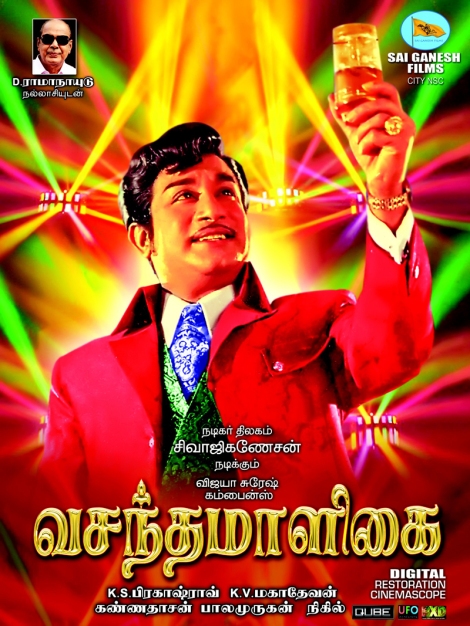
Vasantha Maligai (1972)

Poster

It’s been a while since I watched some seventies masala, and what better way to indulge than K.S. Prakash Rao’s wonderfully dramatic Vasantha Maligai. Sivaji Ganesan and Vanisri star in this adaptation of Koduri Kausalya Devi’s novel about a rich prince and his romance with a middle class woman working to support her family. Like all good masala films there is a dash of everything – romance, tragedy, filmi medicine, an evil overlord, oppressed villagers and even a comedy cook, but it’s the performances from the cast along with some beautiful songs that make Vasantha Maligai well worth a watch.

Anand (Sivaji Ganesan) is the alcoholic younger son of a royal family and the film opens with a song detailing his drunken antics on a plane where Latha (Vanisri) is working as an air hostess. The opening scenes focus on Anand with Latha merely a figure in the background concerned about fastening seatbelts when the plane hits turbulence, so it’s a surprise when the next scene shows Latha returning home to her family and attention moves to her situation. I like this way of building anticipation for the next meeting between the two, while providing the back story that establishes Latha’s character.

Latha is the main wage earner in the family as her brother (Sreekanth) is a wastrel and her father (Major Sundarrajan) is crippled from an accident. Her mother (Pandari Bai) is unhappy about Latha’s job and persuades her to look for something safer where she doesn’t have to risk life and limb in an aeroplane every day. However, Latha’s subsequent venture into employment turns out to be much more dangerous than her work as an air hostess and Anand returns to the story when he rescues Latha from her amorous new boss. Anand just happens to be grooving the night away in the same hotel celebrating his birthday party, and our hero is such a style icon that he even takes time during the ensuing fight scene to fix up his hair – such panache!

Despite his drunkenness and playboy appearance, Latha accepts a job as Anand’s personal secretary where her kind heart and overall decency start to have an effect on his behaviour. However Latha is also proud and her self-esteem leads her to appear arrogant, particularly when she clashes with Anand’s servant and drinking buddy Panchavarnam (Nagesh). Nagesh is determined to keep Anand drinking to ensure his own supply of grog, while Latha is equally determined to wean Anand off the demon drink and make him a useful member of society. In the end it’s Latha’s concern for his well being that starts to win Anand over but it’s not until he injures Latha during one of his drinking binges that he finally starts to mend his ways.

While Anand is intent on drinking himself into an early grave, his elder brother Vijay (K. Balaji) terrorises the local villagers who work on the estate. Vijay is a nasty piece of work and Balaji has a great demonic laugh and seems to be thoroughly enjoying his role as a brutal despot. His wife Vimala is equally evil and plots to get rid of Latha before she can redeem Anand, although whether this is to keep her husband in control of the estate or just because she is a horrible person is hard to decide. I’m not sure who the actress is playing Vimala but she has a great sneer and is wonderfully condescending in her attitude to just about everyone else although she does seem to care for her husband and child.

Her concern is valid since Anand secretly builds a wonderful palace for the woman he adores, although he refuses to name her until the building is complete – no surprises for who his secret love is, although he does win marks for the way he finally reveals his love.

I know tastes were different back in the seventies but even then surely this would be considered over the top pastel décor:

There are endless ornate pillars, arches, and latticework with tacky silver statues practically everywhere. The indoor pool has giant lotus flower fountains, and the room where Anand reveals the face of his true love is full of mirrors (expected) and revolving pillars (totally unexpected) that don’t seem to have any purpose whatsoever. And what else will they ever use this room for? Latha however is enraptured by the palace and the discovery that Anand loves her, ending up leaping through the gardens in true masala romance style in the gorgeous song Mayakkam Enna.

However there is still a long way to go before the end and Vimala and Vijay manage to turn Ananad against Latha, ultimately resulting in Anand becoming very ill. According to his doctor his cough and general malaise are caused by his sudden drop in alcohol consumption, and no-one ever mentions his chain smoking habit as a possible issue. Aah – the seventies – life was so much simpler back then – unless you were the heroine in a masala movie of course. Poor Latha has many more trials and setbacks to endure before true love wins out, and she has plenty of opportunity to practice her emoting skills while enduring gallons of fake tears. Although she does have the benefit of industrial strength no-run mascara to ensure her make-up stays perfect despite all the crying.

Sivaji Ganesan is perfect as the hero and makes the most of both his drunkenness and his illness later in the film. He spouts dramatic lines and clutches at his chest, a convenient pillar or a chair while gazing adoringly at his glass of brandy one minute, and then switches to amused indulgence as he watches Latha try to make him work the next. It’s not all just over the top drama either, he does have some moments where the subtle raise of an eyebrow is just as effective as his later histrionics and he manages to make his character more than just a typical rich playboy. Balaji too is effective in his role as the elder brother, although I would have liked to have seen a little more interaction between the two brothers.

Vanisri looks gorgeous and wears some stunningly beautiful saris that stand out, even in the opulent surroundings of the palace. She does wear a couple more than once too, which fits nicely with her character needing to work for a living. Her Latha is a determined young woman with plenty of attitude and no tolerance for bad behaviour. I like that even when she is distraught she still fights back and has no hesitation in saying what she thinks, no matter who she is speaking to. She has good chemistry with Sivaji Ganesan too, and the romance between the two works well despite the limited time they have together as a couple.  The support cast are all good too, with Nagesh a good fit as Anand’s upstart servant, although the comedy track between him and the cook (V.K. Ramaswamy) is rather less successful.

The songs by K.V. Mahadevan are beautiful and T.M. Soundararajan provides the voice for Anand, ensuring the songs are just as dramatic as the action.

The film looks gorgeous too – the colours of the fab costumes are vivid and bright, even in my unrestored copy and I love the seriously over the top décor of both palaces. The bar in the palace is as seedy as in any hotel, Anand’s bed is a glorious ornate version of a gondola, and I almost didn’t notice the stuffed animals in the main hallway with the enormous and imposing staircase taking centre stage. This is exactly what I want from my masala films – determined hero, tragic heroine, plenty of melodrama, beautiful costumes and sumptuous settings. Vasantha Maligai delivers on all fronts and is even more readily available now that the film has been digitally restored and re-released. Highly recommended. 4 stars.