Paleri Manikyam

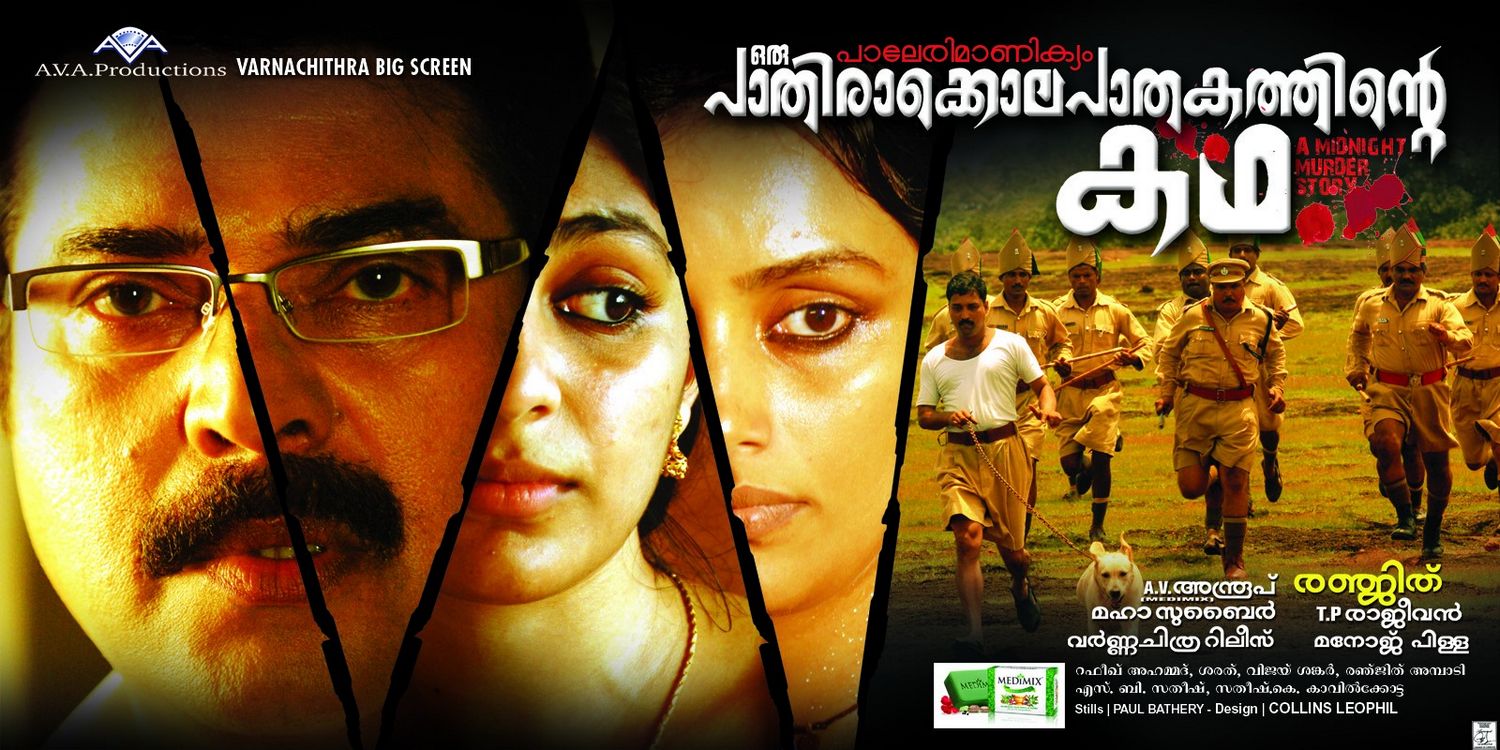
paleri_manikyam_poster

Haridas (Mammootty) is a detective and writer, on holidays in Kerala with his girlfriend Sarayu (Gowri Munjal). He is mildly fixated on an unsolved murder that took place the night he was born, over 50 years ago. A girl called Manikyam (Mythili) from his village of Paleri was raped and killed. Sarayu is a crime analyst and she offers to work with him on the mystery.

Haridas goes back to Paleri and does a lot of exposition by talking to the camera, and sometimes to Sarayu. He walks through events on the fateful night as he knows them, threading in amongst the action from that day. It’s a bit like a stage drama, with him as the narrator.

Her brother and father carry Manikyam to a nearby town for the police investigation. It’s obvious that her mother-in-law Cheeru (Shweta Menon) is lying about something and her husband Pokkan (Sreejith) seems by turn guilt ridden and vengeful.

Haridas and Sarayu discuss the initial investigation including that the post-mortem was rewritten and a crucial report went “missing”. Things keep getting murkier.

Pokkan and Cheeru seem shady, but it looks like someone was keen to get Pokkan out of the way and make sure Manikyam didn’t go to the village to watch the drama with everyone else. The powerful landlord, Ahmed Haji (Mammootty in the second of his three roles in the film) is an obvious suspect but no one seems to think the police will actually go there.

Soon there is a manhunt as the police follow their chubby, happy Labrador around the village. I did like that there was a small scene dedicated to the merits of various dog breeds as tracking animals, with the Telugu trained Labrador the clear winner. Maybe I’d believe that if it was tracking a biscuit…

Ahmed Haji’s flunkey Velayuthan (Vijayan V Nair) tries to escape the village, but insists he didn’t kill her. He says Pokkan killed his wife in a jealous rage on finding her with an ex-lover, and he helped cover up the murder by making it look like a suicide. Cheeru accuses Velayuthan of abducting Manikyam and eventually leaving her hanging for Pokkan to find on his way home. And then Superintendent Manalathu (Sasi Kalinga) coaches Velayuthan on who the third man is, naming Muthuvan Ahmed. There are conflicting stories everywhere, although Ahmed Haji seems to be a constant. So many people silently conspired to ruin poor Manikyam.

Haridas reveals he is an illegitimate son of Ahmed Haji. He only knew him as a name revealed on his 18th birthday. But he won’t back down from investigating just because of that connection. It’s interesting that despite Haji being such a feared figure, no one spotted the spitting image likeness of his bastard son. Or did they know, and say nothing? Haridas keeps digging, meeting people who had been living in the area when Manikyam died, including Keshavan the barber (now played by Srinivasan).

Haridas is researching for his own curiosity, not because he is passionate about justice for Manikyam. He wants to be the one who knows it all, and to put his own obsession to rest. No one seems overly outraged at Manikyam’s fate or disturbed by Cheeru’s fall from grace. I liked his account of the night his mum told him about his biological father, but loving your mum is not proof of moral compass ownership. Haridas is not so very different to his father – he is sleeping with a married woman and lying to his wife. He just does it in a more socially accepted way. I didn’t like Haridas as a character but Mammootty gives him such intelligence and a keen understanding of human nature that I couldn’t take my eyes off him.

Cheeru is devoted to her son Pokkan, but there is always something a bit evasive about her expression. It wasn’t a surprise to know that Ahmed Haji had demanded her for himself, but their story was not quite what I expected. She is excited and frightened by Ahmed Haji and their mutual attraction, and she has insane chemistry with Mammootty. Cheeru’s transition into prostitution is depicted as a matter of circumstances and lack of options rather than a huge moral failing. Shweta Menon is brilliant and makes the shifts in Cheeru’s emotional pitch and strength seamlessly.

I appreciated that the extended flashbacks gave Mythili an opportunity to do more than play dead. She created a vivid character and I could see why Manikyam’s death was still haunting the village in so many ways. It was all the more tragic seeing the happy new bride and realising what was happening around her. But I am not sure all the flashbacks to the actual rape were needed – it would have been as powerful and less voyeuristic to move on or show other angles of the story, or give more insight into how other characters reacted to the brutal event. I didn’t need to keep seeing it, and Mythili’s portrayal of her fear and pain was disturbingly realistic.

Gowri Munjal is effective and understated in her scenes, although Mammootty dominates the dialogue and focus. In fact in some scenes I was wondering if she was there, out of view, or he was happily declaiming alone. They have the chemistry of friends with benefits, not a raging passionate affair, and I liked her pragmatism about his lying ways. Sarayu’s marriage has drifted away and her partner lives overseas. Haridas doesn’t seem too fussed when her husband Goutham calls out of the blue, instead encouraging her to go hear what he has to say.

It’s almost pointless to say this, as it is the norm for Malayalam cinema, but Paleri Manikyam is visually lovely. I had to rewind a couple of times because I was too distracted to read the subtitles properly. Manoj Pillai has the camera duck and weave through the crowds of onlookers, letting the viewer spy on the goings on. At other times the visuals jump around from frame to frame, perhaps a representation of Haridas’ inner state. There are some lovely setups too including two boats passing each other, one with Manikyam as a corpse and the other with her as a bride just 11 days earlier. Ahmed Haji puts down a bottle only to have Cheeru fill that space in the shot; Cheeru as a refreshment to be consumed when he desired it.

There is a huge ensemble of actors playing varous people around the locale.  Writer-Director Ranjith adapted his screenplay from a novel which was in turn based on an actual event. He was so keen to find people who looked and sounded authentic, he ran training camps and chose three relatively unknown actors from the area. He also cast a heap (that’s a technical measurement) of established theatre actors. The standard is uniformly high. Sreejith is wonderfully expressive as the slightly slow and bewildered Pokkan, especially when he returns home a sad and broken man. I wondered what became of him. Musthafa is quietly fiery and a bit sarcastic as young Keshava, the barber who though Communism would overcome caste. The actor who played Manikyam’s brother was also excellent, his grief and anger palpable. The only unnecessary role was actually Mammootty’s third, that of his half-brother Ahmed Khalid. He could have been played by another actor without diminishing the story or Mammootty’s fine accomplishment.

The ending is downbeat and ominous, although many loose ends are tied up. See this for the intriguing structure and slow revealing plot given great voice by the talented cast. You’ll need some tolerance for the violence and the bleak view of a woman’s worth in those days (and ask yourself how much things have changed). 4 ½ stars!
Shaan (1980)

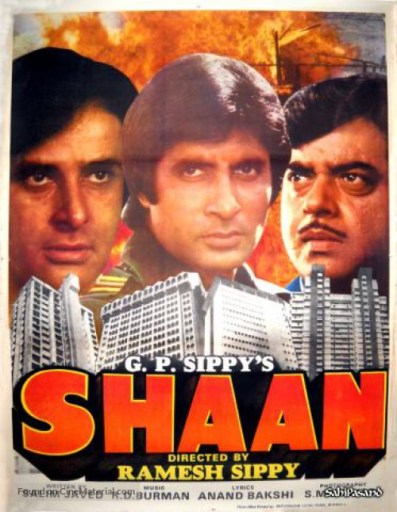
poster

5 years after his masterpiece Sholay, Ramesh Sippy returned to the big screen with the big action adventure Shaan.  Written by Salim-Javed, the story is a suspense thriller with many of the film elements seemingly inspired by a hotchpotch of James Bond films. Just have a look at the Bondesque opening title sequence for instance.

The movie is still Bollywood at heart though with Amitabh Bachchan and Shashi Kapoor playing two personable rogues at odds with a police officer who also just happens to be their older brother. In addition to the sibling conflict there is a villain with a fabulous island lair, car chases, helicopters, sharks and even a man-eating crocodile thrown into the mix, adding up to a great masala movie and one definitely well worth a watch.

Vijay (Amitabh Bachchan) and Ravi (Shashi Kapoor) are con-artists who make a living by fleecing money from corrupt officials and small time crooks. A little in the style of Robin Hood except that Vijay and Ravi keep the money rather than giving it to the poor. However the shoe is on the other foot when they themselves are conned by uncle and niece team Chacha (Johnny Walker) and Renu (Bindiya Goswami). To get their money back Vijay and Ravi join up with Renu and Chacha to carry out a daring jewellery heist, but are again pipped at the post by fellow thief Sunita (Parveen Babi).  Sunita not only manages to steal the necklace before anyone else but has an audacious method for getting it out past the police search; although I do think recovery might have proved a little difficult if things hadn’t gone exactly to plan. Her introduction is rather fab too as she appears in a wonderfully sparkly dress with glamorous backing dancers who have silver tassels everywhere, even on their boots.

Needless to say Sunita is added to the merry band of thieves who go ahead with another con based on the old ‘holy men walking on water’ scam. This time though they are caught by Police Officer Shiv Kumar (Sunil Dutt), who goes ahead and arrests Vijay and Ravi, even though they are his two younger brothers. Above all else Shiv is a police officer sworn to uphold the law, and that is what he does. Shiv’s character is established early on when he rescues some hostages in a beautifully choreographed action sequence. His wife Sheetal (Rakhee Gulzar) shares the same values although she has a soft spot for Shiv’s two brothers and is altogether more forgiving than her husband. However, once the brothers are released from jail they make a vow to ‘go straight’ and move in with Shiv and Sheetal in their house in Mumbai.

While Vijay and Ravi have been in jail, Shiv has been making inroads into the criminal empire of a villain known only as Shakaal (Kulbhushan Kharbanda) and his efforts are starting to seriously impact on criminal business. Shakaal sends an assassin Rakesh (Shatrughan Sinha) after Shiv and his family, but after two attempts on Shiv’s life fail, Shakaal ups the ante and sends his henchman Jagmohan (Mac Mohan) instead. After one of the best kidnap attempts I’ve seen onscreen, Jagmohan manages to spirit Shiv to the island hideaway while leaving everyone else totally baffled as to Shiv’s whereabouts.

Shakaal’s lair is absolutely wonderful and mixes many of the best elements from various other villain hideouts. It’s located on an island some 300km off the coast of India but in reality was filmed on the island of Steep Holm near the UK. The lair has long corridors with rough-hewn rock for walls but fancy modern automatic doors and nifty surveillance cameras. Shakaal lords it over his minions, Blofeld-style in a conference room with a rotating circular table and a retractable floor, underneath which lurks a man-eating crocodile. This allows Shakaal to indulge in a form of roulette to dispose of unsatisfactory employees or anyone else he doesn’t like. Meanwhile sharks (and the odd oversized goldfish) can be seen swimming past the green tinted windows for extra menace. Adding to the ambience in a large audience hall is a massive golden statue of an eagle, and Shakaal has a throne strategically placed underneath for those moments when you just have to be seen to be the head villain! And of course there are plenty of panels with flashing lights and hidden switches– everything your discerning villain could require for world domination, although Shakaal has more modest aims despite his grandiose lair and petulant manner.

Shakaal has his own distinctive look too combining his bald head with black or white military style tunics featuring his ‘S’ logo prominently displayed. His henchmen all wear identical smart white suits, and later on his henchwomen are attired in silver miniskirts and fetching black blouson style shirts – always good to see a properly style-conscious villain!

Shakaal finally manages to dispose of Shiv although it takes him quite a few attempts and the stage is set for Ravi and Vijay to avenge his death. Naturally this involves infiltrating Shakaal’s lair with a song and dance troupe (how else could you possibly sneak into an impenetrable hideaway?) which also features the inimitable Helen leading the way in this excellent song.

There is a lot going on in Shaan, but the plot follows a mostly logical and clear progression building up to the grand showdown in Shakaal’s lair. The comedy works well, the romances are mainly just an excuse for a few songs, but the action sequences and special effects are first-rate. The camaraderie between the two brothers is one of the major assets to the film and Shashi and Amitabh have great chemistry together. Perhaps it’s the enmity between Amitabh and Shatrughan Sinha, but even once Rakesh turns on Shakaal and joins the brothers, there is still just a frisson of tension which makes the shaky relationship between the marksman and the brothers that little bit more believable. Generally the addition of Rakesh halfway into the film is a masterstroke, adding uncertainty to the second half and also an opportunity for another good car chase and action scene. Rakhee Gulzar is also excellent as Shiv Kumar’s wife, both in playing a steadying influence to the brothers and as the grieving and vengeful widow. She has a major part to play in the final proceedings too and she plays her role with grace and elegance throughout. Bindiya Goswami and Parveen Babi have rather less to do, but they get a chance to throw a few punches in the final scene and both do a good job with their rather limited roles.

Kulbhushan Kharbanda is fantastic as a rather different kind of villain; smiling and soft voiced one moment and angry the next. It’s a definite departure from the more usual thuggishly violent criminals and the more subtle psychological approach works well here and enhances the cracking good story. Kulbhushan Kharbanda uses his smile to project chill and menace while his initially affable demeanour serves well to mislead both friends and foes alike. It’s a great performance and Shaan is worth watching for his character alone, even without the good story, excellent action and R.D. Burman’s memorable songs. I love every minute of Shaan and recommend viewing for a great all-round entertainer. 4 stars.

Ab Tak Chhappan (2004)

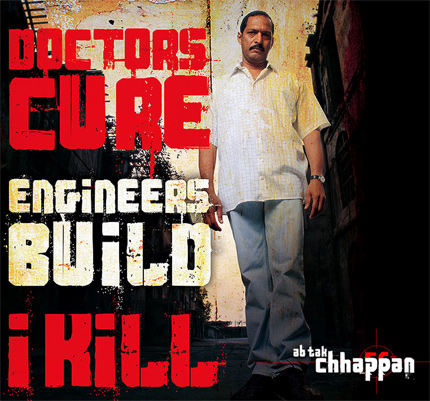
Ab Tak Chhappan Poster

The film opens with a pile of clothes and shoes on a beach, and someone whistling “For He’s A Jolly Good Fellow”. A man is wading in the sea, maybe suicidal, maybe cleansing his sins. Or just washing off the bloodstains on a nice sunny day.

Sadhu Agashe (Nana Patekar) is an encounter specialist. He is honest and pragmatic about what that really means, and is untroubled by any ethical concerns. He is doing a necessary job as the legal system cannot stop gangsters, so extreme measures are required. The cops are basically just another gang in the Mumbai ecosystem. Within the department there are people jostling to take over his prime position. Imtiyaz (Yashpal Sharma) is a sook who wants to be the top cop but lacks Sadhu’s instincts and connections with the useful informers. Shukla (Nakul Vaid) is the wide eyed newbie, determined to deliver justice through state sanctioned murder.

Zameer (Prasad Purandare) is an offshore crimelord, running operations from his luxurious Malaysian retreat. He has a random Australian girlfriend and a strange attachment to Sadhu Agashe, who he often calls for a chat. The cat and mouse game between cop and crim is tense and disarmingly friendly by turns. New Joint Commissioner Suchak (Jeeva) has a different agenda from outgoing Mr Pradhan (Dr Mohan Agashe) and the department has to learn to navigate the new landscape. When Sadhu Agashe is put on the other side of the gun, he uses all the resources at his disposal to try to outwit his adversaries.

Nana Patekar is both ordinary and charismatic, and delivers a compelling performance that carries the film. Agashe is a public servant tasked to kill bad guys and has no obvious ethical issues with his job description. He believes he is taking care of a problem afflicting the general population, the people he swore to protect. His simplicity is deceptive, a man who acts first and stops to feel and care later. His relationship with wife Nammo (Revathi) is loving with lots of nagging and joking in a comfortable couple-y way. She is a political science teacher and yet exhibits no qualms about what her husband does, or the potential danger to herself and their son. I know they have been married for years but I still expected that when Shukla brought his fiancée Vaishali (Hrishitaa Bhatt) over for dinner that they may talk about what it meant, or at least how to get blood out of clothes. It was just such a non-thing in their lives. Revathi is elegant in a comfortable middle class way that suits Nameeta, not blingy or impractical looking. Revathi doesn’t get a lot of dialogue but her silent interactions and bustling about the home show Nammo is the cornerstone of his life. She is warm and grounded which plays well against Nana Patekar’s sharper edges. When people break the unwritten law that keeps family and dependants out of the fray, they mess with the only thing that could influence Sadhu Agashe to be moderate.

Yashpal Sharma and Kunal Vijayakar have prominent supporting roles and play the world weary seen-it-all-before cops to perfection. Justice is not their priority, hitting their targets (literally) is more important.  Nakul Vaid is suitably wide eyed as the rookie on the team. Agashe sees potential in the kid, and shares his jaded wisdom with his protégé but I wouldn’t say the boy was all that innocent to start with. Looking queasy when you shoot someone is not necessarily an indicator of moral fibre. Jeeva is threatening and oozes corruption as Suchak who disrupts the team with his new agenda. Mohan Agashe is weary and understanding as Sadhu’s old boss, the only man he really trusts and respects. Their conversations shed light on Agashe’s motivation and his view of the world, and point out the dangers if he sets a foot wrong.

Shinit Amin set his story in the non-glamorous Mumbai of films like Company and D, a dog eat dog city. Traffic is constant, everyone knows everyone else, the honour code is fairly strong. No matter what happens, gangsters and cops all stop to watch the cricket and even a hardened criminal should be entitled to a cup of tea and a lift home after he has been beaten to a pulp. There are rules. And then there are laws. The film was produced by RGV and it is like the sensible version of (the very disappointing) Department. There is an internal logic, cause and effect, nothing happens out of blind coincidence or guess work.

The background score by Salim-Suleiman is dramatic without being too obtrusive. Their soundscape helps create a sense of urgency and velocity as the protagonists travel through the hurly-burly of Mumbai.  The camera also navigates the rabbit warren of streets homes and office, giving a feeling of being a fly on the wall. Faces are often framed in close up but off centre, maybe to underscore the unknown and secret sides of human nature. Or maybe just because it looks cool. There is a lot going on in the background and periphery as people go about their work and daily business. It’s a lively yet very contained filmi world.

There is a lot of violence and death in the film, but it is almost understated. The characters hardly notice the carnage, so nor did I. I was more interested in the why than the what. And the implication of the corruption of the system and the internecine conflicts was far more frightening than a shooting.

This is a solid film with a well thought out plot and excellent performances. It’s not uplifting but neither is it completely depressing. It is a different way of looking at that filmi chestnut – where do you look for justice? And does doing something bad to prevent something potentially worse ever work out? 4 stars!