Chatrapathi

There are three reasons that we ended up watching this film. It’s an S.S Rajamouli creation. It was name checked in the opening sequence of Desamuduru. The other was a throwaway remark by our good friend The Mahesh Fan: “Once you’ve seen Prabhas fight the CGI shark there’s not much else to it.” And she said that like it was a bad thing! We ordered the DVD immediately.

The film is a familiar ‘hero looking for lost mother’ tale intertwined with a search for social justice and a jealous half brother to flesh out the storyline.  Some time is spent setting up the back story for hero Shivaji (Prabhas). Separated from his doting step-mother and jealous step-brother after fleeing Sri Lanka, he and the other men who made it across the sea are working as bonded labourers to a local thug Baji Rao. By the time young Shivaji has grown all the way up into rather lanky Prabhas, apathy born of despair seems to be well entrenched into the refugees.  Inspired by his mother’s stories of the heroic Chatrapathi and traumatised by the brutality inflicted by the strong on the weak, Shivaji is truthful, defends the innocent and has never given up on finding his family. He also has a shell necklace given to him by his mother. This will become Very Significant.

But it’s the shark scene we were hanging out for! We applaud Rajamouli’s dedication to the CGI predators in his films. It really is fabulous, and this shark is a scene stealer. It growls!


This very silly episode gives Prabhas a highly memorable heroic entrance scene. It sets Shivaji up as resourceful, capable, tough, resilient and with exceptional lung capacity.

Life is cheap in this refugee settlement, and Katraj (Baji Rao’s man) rules the roost. The level of violence, both implied and actual and especially against women and children is very confronting. It does serve to illustrate the inhumanity of the thugs in charge, the general lack of support for the under classes and most importantly for a film of this type, it allows the hero to arise from the masses. The sight of a child lying near death as people watch on is not easy to view as a light entertainment.

The romantic interest, Neelu played by Shriya, works at a local government office and after some supposedly comic misunderstandings (she thought they thought she was a prostitute, puns on the words “repu” meaning tomorrow and “rape”) locates the necessary file but not the actual address of the missing mother.  Unknown to Shivaji, his mother and brother are alive and well and not far away. And his brother Ashok still doesn’t like him one little bit. Romance blooms. More rape jokes and sadism pranks ensue. And Bhardam, Shivaji’s oldest friend on the settlement and the voice of caution and moderation is killed.

Corruption and rowdyism are the bane of Shivaji’s people and the film takes a darker note when he becomes a popular leader and takes up the ruthless methods of the people he wants to displace.


The fight scenes are brutal and gory, leaving nothing to the imagination. The violence is cartoonish and unreal but still seriously dark. He takes to kidnapping, extortion, bombs and guns with no hesitation. The shocking end to a confrontation with his brother Ashok then propels the story into a final escalation of score-settling.


Neelu and Shivaji’s friends disappear into the background of the story, often appearing as silhouettes or blurry figures as the second half of the film is pure Prabhas revenge-o-drama. The machinations of Ashok continue to drive some truly bizarre behaviour and Shivaji is no closer to regaining the love of his mother. Baji Rao’s brother muscles in on the action to become the new face of evil and gives Shivaji another enemy to fight.  The final scenes include a travelogue of Hyderabad’s temples and a catalogue of lies, tears and betrayals before things go up in flames. Literally.

In the nick of time, Shivaji’s mother recognises the Very Significant shell necklace. Everyone who is still alive at the end of the film gets the life they deserve.

The fight scenes are beautifully choreographed and filmed, but may be too bloody for some tastes. The same care was given to the songs but Prabhas is not as comfortable dancing as he is in stunts and fights. The camera work in all the action sequences was excellent and really conveyed a sense of an epic struggle between heroic and villainous forces.

The support cast were effective although very much in support. Ajay played his usual sidekick role, and had a bit more range as his character was both a thug and a caring older brother. Kamal Kamaraju was another of Shivaji’s inner circle but mostly just had to stand around looking cross. Venu Madhav was the comic relief and supplied a few laughs especially in his “Anniyan” skit. Shriya was typically girly and shrill as the heroine but also displayed some good comic flair and had a few scenes allowing her to be a bit feistier. The mother (Bhanu Priya) was an irritatingly passive and trusting character for the most part, although conveyed the anguish over her sons very well. Ashok (Shafi) was a bit less successful in making his character seem at all real or memorable. He missed the mark on showing both the madness of twisted jealousy and the neediness of the overlooked son and just went for bug eyed, grimacing and grinning for comedic effect.


The soundtrack worked really well and suited both the drama and the performers. In particular, the Mumaith Khan item number was great fun and was tailor made for her. The backing cast and dancers all seemed to throw themselves into it with enthusiasm. The Chatrapathi chant that accompanied Shivaji added that element of mythical heroism, and suited the epic nature of the underlying themes.

Finally, a special shout out to whoever designed Prabhas’ outfits. We do want to know what they were on when they chose some of the shirts! It’s a bit cruel to put a tall lanky man in lolly pink and then make him dance like he means it.

Temple says: Chatrapathi is entertaining enough due to Rajamouli’s ability to make the most cliched story seem fresh and Prabhas’ likeable screen presence. The film is all his and it works most of the time. The story was secondary to the heroics and flexing, and the supporting characters were given little range. I am frequently bewildered by the White Queen style ability of a filmi mother to believe six impossible things before breakfast and this film continues that trend. Ashok’s character was a sketch rather than a fleshed out role and Shafi did what he could— but it felt like a missed opportunity as a bit more depth there would have added to the tension of the final scenes. I know Heather can’t stand Shriya but I think the heroine roles are generally written as irritating air-heads so I try to make allowances . On my personal scale of how annoying was Shriya? this is one of her least irritating roles (perhaps as there was no stupid meringue hair). I quite like the soundtrack and the songs were highlights as they were often a respite from the gore and gunshots.  Mumaith Khan is a favourite as she always looks like she is having such a great time and is totally in on the joke. I love that the South Indian heroes know that they can’t avoid dancing so regardless of their comfort levels, they just do it. I always giggle at the sight of Mahesh Babu in a lunghi (something about those long skinny pale legs) and now I can add Prabhas to the list of men who should stick to wearing trousers please!

This isn’t a film I will re-watch over and over, although the shark fight was on high rotation for a while. There was something endearingly Parvarish-like about the special effects in that scene, and I love that Rajamouli had his shark snarling, snapping and almost literally chewing the scenery. I give this 3 and 1/2 stars.

Heather says: Prabhas is a hero very much in the style of early Amitabh Bachchan in this film.  He is the ‘angry young man’ who is searching for his mother and will let no obstacle stand in his way.  Unlike Amitabh though, he makes a fair attempt at dancing!   In the first half of the film Shivaji is truly the hero with his drive to always do the right thing, and of course his constant search for his step-mother.  His switch from the hero of the docks to violent thug is quite abrupt and rather confronting, and he seems to be almost a  different character.  I did enjoy Ajay’s slightly more sensitive role here, and I like the way that both young Shivaji and the grown up version had the same mannerisms.  There really should have been no need for an identifying significant necklace!  This film also has one of my favourite lines, at least according to the subtitles: ‘trust your whiskers’!

Shriya is still not my preferred actress – there is just something about her that irritates, and I was quite relieved when her character was sidelined in the second half of the film. On the other hand, I thoroughly enjoyed Shafi’s characterisation of the jealous step-brother Ashok.  Especially when he has some money and can indulge his terrible taste in clothes and become as obnoxious as he has clearly always wanted to be.  Overall I felt the story works well, providing there is some major suspension of disbelief that Shivaji couldn’t find his step-mother even though she lives close by! Plus there is that shark scene, which really is fantastic! 3 1/2 stars from me.

Brindaavanam

We can now confidently state that at least in Melbourne fans of one star do not seem to watch the films of another star.  As we picked up our tickets for this week’s adventure without subtitles, we encountered more questions about whether we were in the right cinema, and concern that we were about to see a film that we wouldn’t understand.  This is despite being at the same cinema at the same time every time there is a new release. We did advise everyone that we knew there were no subtitles and that it was in Telugu.  They did seem reasssured when we were able to name the stars in Brindaavanam. So we were given our tickets and took our place in the theatre.

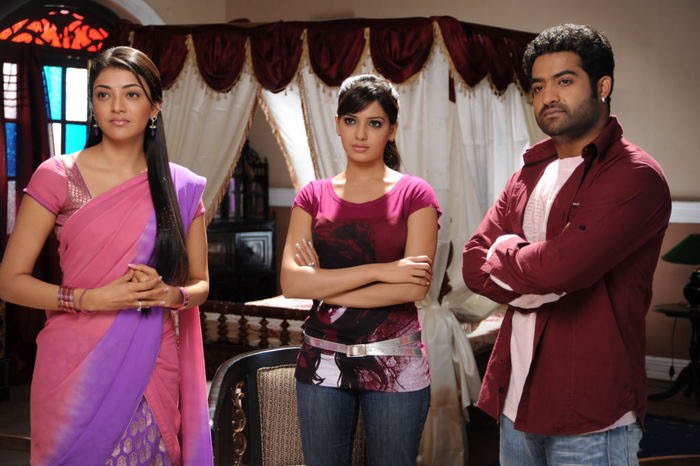
The film opens with a typical hero entrance by Tarak and an awesome fight scene which included some nifty bike moves.  Tarak, as Krish, is the son of a wealthy industrialist and lives a privileged life lacking for nothing.  He also has a girlfriend who is allegedly studying engineering but looks more like a fashion model in the form of Indu, played by Samantha.  For some reason she asks Krish to help her college friend Bhumi fend off an unwelcome suitor by pretending to be Bhumi’s boyfriend.  Now everyone knows this is a really bad idea, but perhaps she thought that her friend was too traditional to appeal to the sophisticated Krish.  It did seem strange that the two were friends, since they appeared quite different in their clothes and attitude, but perhaps this was explained in the dialogue. Or not.

Off our hero goes, leaving behind his fancy cars and superbikes to take a bus into the countryside. There was an opportunity for another fight scene using the bus as a weapon, which was great fun, and there were machetes galore to our amusement.

When they finally reach their destination, Brindaavanam, we find out that it is a beautiful house sumptuously decorated and furnished, but home to an unhappy family, divided and feuding with itself.  Krish resembles Krishna – flirting with the girls, alternately charming and infuriating the family members, pulling practical jokes, fighting, dancing and generally stirring up mischief while also righting wrongs.

Prakash Raj with the ‘Amrish Puri Eyeballs of Hate’ (TM PPCC) plays the head of one branch of the family, while Srihari heads up the other side.  Their father is the only one who can talk to both sides of the family as everyone else communicates by machete and there are many convoys of black jeeps travelling over the bridge between the two houses.

The wardrobe department excelled once again. There are two brothers who have an amazing array of psychedelic shiny shirts, possibly the left overs from Solomon in MAGADHEERA, worn in combination with clashing lunghis.  Venu Madhav plays another member of the family with the same bad taste in outer wear, while Krish has an impressive selection of T-shirts and stripey jumpers.

The set design is just stunning, especially the interiors. There is also a veritable Noah’s ark of animals featured including chickens, geese, cows, goats, a turtle and even rabbits!  We did have to pity the poor animal wrangler who obviously had instructions along the lines of – just get the goats to run through here in a diagonal line between the dancers.

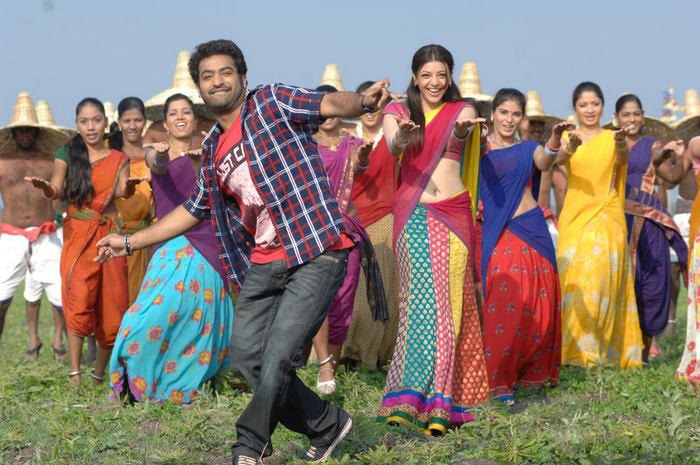
The dancing is excellent, although there was a little too much of skanky skin show in the first number. The visual effects and editing in the song picturisations were impressive and really suited the music.  We liked the songs before seeing the film, and they improved on screen with the expected excellent choreography and brilliant dancing by Tarak.  We did particularly like the bouncing men in their over large straw hats in the Eyi Raja song, and the colourful Vachadura. The traditional appearance of NTR via special effects was used very well and provided a fun conclusion to the film.

The dialogue was obviously very amusing as the audience was laughing throughout the speeches, and we suspect that there were a lot of older filmi dialogues included.  The second half did drag a little as the story was reiterated a few times as the various characters found out about Krish’s charade, but there was some excellent emoting from Srihari and Prakash Raj to make up for this.  In fact, Prakash Raj got to balance his Eyeballs of Hate with his excellent Googly Eyes of Love. Ajay was in great fighting form as the crazy suitor, but once again was destined not to get Kajal as his bride.  Tarak gives a high energy performance, with his usual excellence in dancing and physical scenes.  Both female leads fit their characters well despite those characters lacking any depth. Prakash Raj and Srihari make the most of their roles as feuding brothers.  The action sequences, by Peter Hein with a special fight choreographer also credited, were awesome, with plenty of bodies exploding from the inevitable jeep convoys, and machetes in practically every scene.

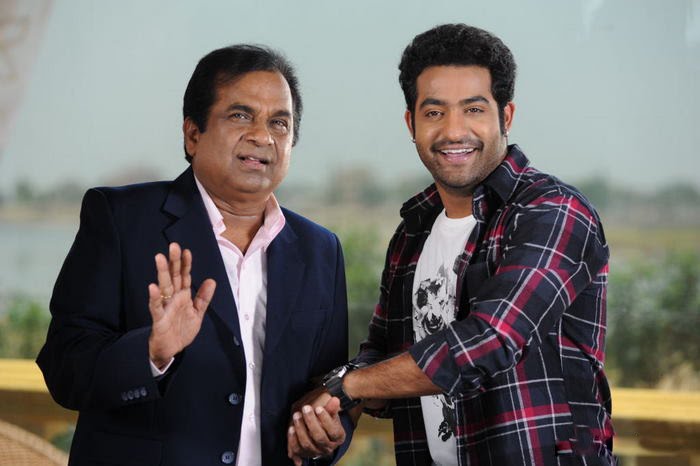
This was a good all round entertainer of a film.  We enjoyed it, and the audience’s reaction to the appearance of Brahmi’s bald spot!  We give this film 4 stars!

Avakai Biryani

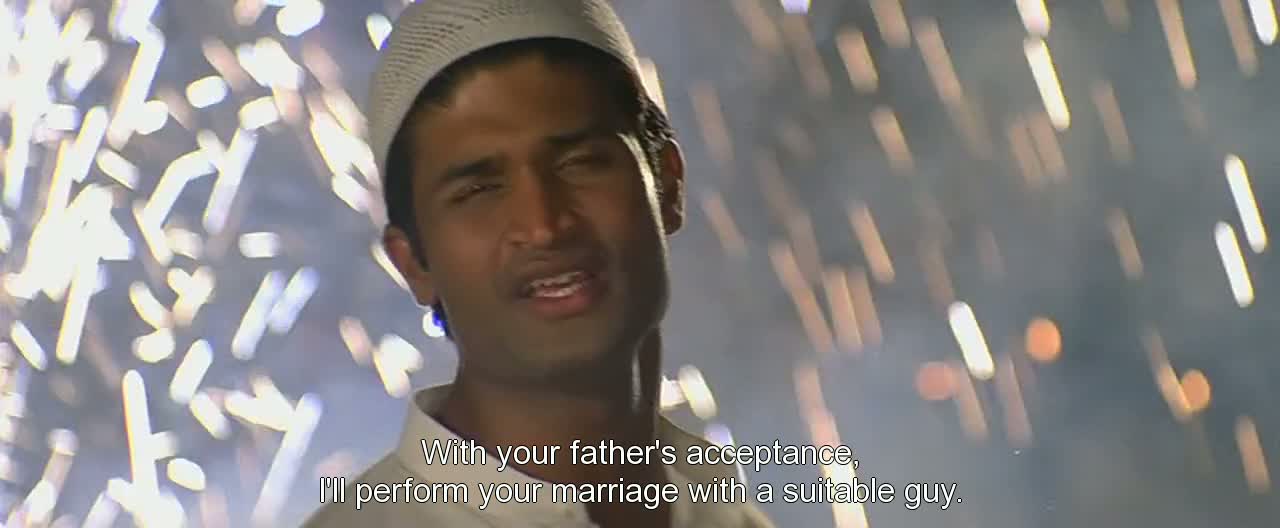
Avakai Biryani is not only a boy meets girl romance; it is also a romance of a filmmaker and the country he clearly loves. Written and directed by Anish Kuruvilla, a protégé of Sekhar Kammula, it is a simple story that relies on a strong script, excellent characterisation and deft execution to lift it above the clichés.

Akbar Kalam is a Muslim, an auto driver, a student and an orphan. He is caught between worlds and striving to make his way. He lives in a charity cottage, works for Master-ji the local big-wig, and dreams of getting his B.Comm despite failing his exams several times. His exam record is a running joke in Devarakonda.

Spirited graduate Lakshmi (Bindhu Madhavi) and her Brahmin family arrive in Devarakonda needing to start over after losing their fortune. Lakshmi starts making and selling her signature avakai and tries to get her father motivated to get back on his feet.

They both belong and yet they don’t, both making the best of what they have, and so a friendship grows. Lakshmi agrees to tutor Akbar and he helps her fend off unwanted attention from Babar – a leader in the Muslim community and a man with a predilection for satin pajamas. I seriously doubt Akbar was failing only because of his English skills, but Lakshmi doesn’t give up on him as quickly as I would have!

The handling of diversity in the Devarakonda population seemed to me to be very well done. I don’t have the expertise to comment on the reality of this portrayal but can say that as a narrative device it works extremely well. While religion does draw a line through the community, it is depicted as one among many divisions in this village. There are lines of caste, creed, financial status, education and of relationships. Characters cross these lines and back again as the business of making a living and getting the chores done is uppermost and there are few moments of speechifying. The lines of division become much sharper when marriage is in question, and that underpins much of the story.

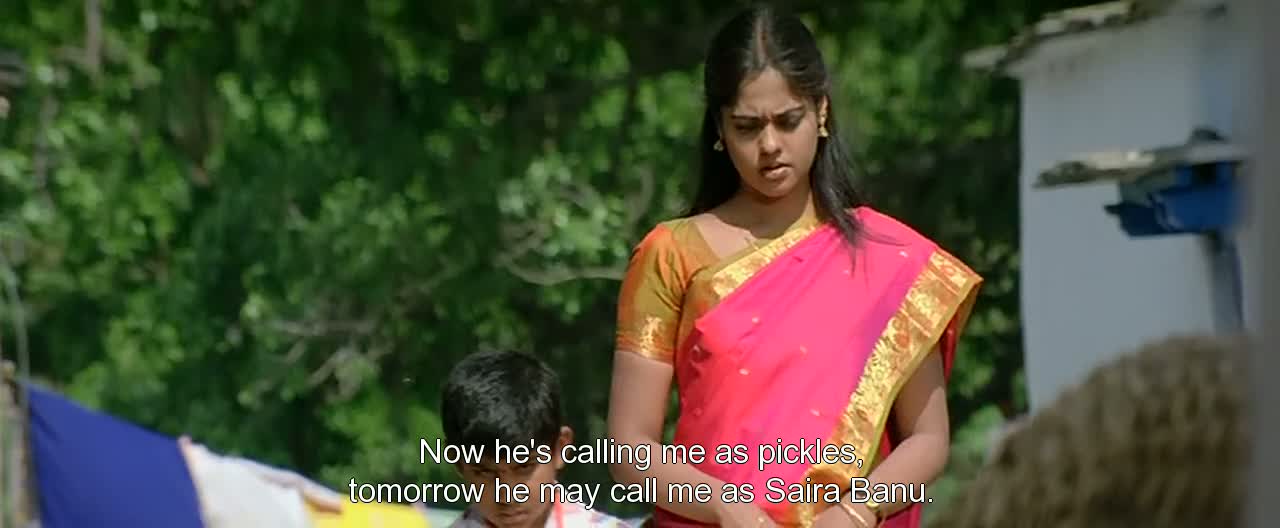
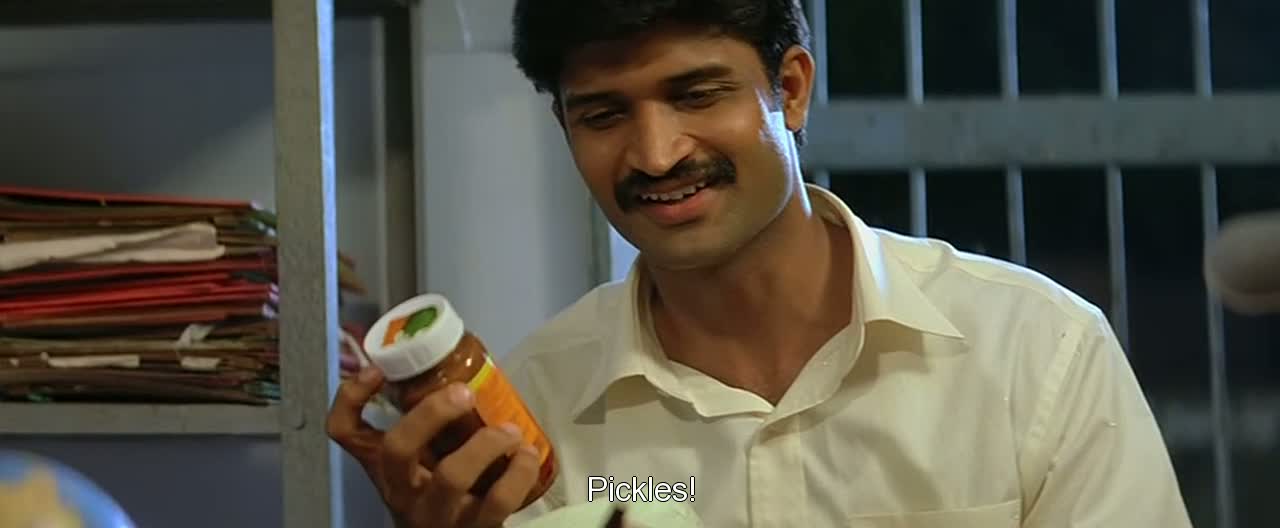
We see where this is heading a long time before Lakshmi and particularly Akbar seem to. I have my doubts as to how long a boy and girl can hide any “friendship” in a small community, but their roaming around does give Kuruvilla the chance to show the beauty of rural Andhra Pradesh. The growing relationship seems natural and unforced and is not based on any love-at-first-sight or stalking. He calls her Avakai (or as my subtitles have it, Pickles), referring to her identity but also to her hopes for building a future. Their love grows from knowing and valuing each other.

The obligatory spanner in the works comes from the ongoing tension with Babar which is fuelled by testosterone, religion and politics. Babar tries to use religion as a lever to force Akbar to back down but fails as the hero decides to do what’s right for the whole village in a scene with shades of SRK in Swades.

Threats are made, scuffles take place and things boil over between the two men. There is only one way for honour to be satisfied. By an auto race around the village! I know some people rolled their eyes at this episode but it rang true to me. I just rolled my eyes at the sheer stupidity and very boyish behaviour.  Oh and it allowed Kamal Kamaraju to get his shirt off, which I suspect is a legal obligation for any Telugu film hero.  And there was an explosion, which may also be a compulsory element as well as a machete flourish.

Having established his right to stay in the village, managed a scheme to bring mains water to Devarakonda and finally passed his exams, Akbar has one last obstacle – getting Lakshmi. Despite acknowledging his help and decency towards them all, her family refuse to consider him as a suitor because of his religion and because of his limited prospects. Akbar and Lakshmi simply go their separate ways. Her family pressure is too much to withstand, and he has no family to offer them shelter or support.

This is a total spoiler so stop now if you don’t want to know how it all ends.

Akbar throws himself into work, builds on his success in politics and becomes a respected member of the local council. Two years on, Lakshmi’s father hears him speak at a political meeting and apparently undergoes a change of heart on hearing successful Akbar still speak of Lakshmi with feeling. She sends Akbar a jar of pickles with a note asking him to meet her. He looks radiant with joy as he realises the note is from Lakshmi and she is doing well.

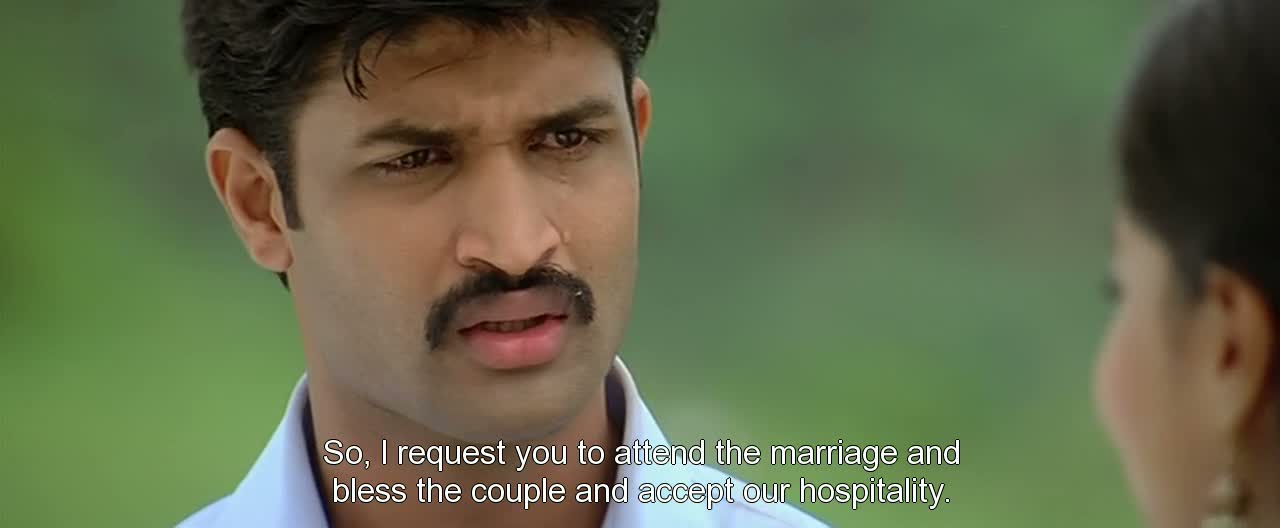
They meet, she pretends not to mind his dodgy moustache, and then hands him a wedding card. There are tears on both sides before he sees the card is for their own wedding and that’s it. Happy ever after time. I expected a bit of anger from Akbar at this cruel trick but I think it’s already clear who really wears the pants in this relationship.

Surprisingly I don’t think this ending was either a cop out or disgraceful behaviour by her dad. Neither Akbar nor Lakshmi had the resources to throw family aside and go it alone. I can imagine it would be hard to marry off an opinionated educated girl especially if people began to talk about her relationship with the Muslim boy. She may not have had many takers after all. And why wouldn’t career success influence a father who has experienced losing everything and seeing his family suffer? Anyway I liked the resolution. No fireworks, just happiness and relief. I really liked that the girl was fully involved in choosing her own path and went in with eyes wide open.

The cinematography is beautiful. The colours are lush and welcoming; the village is dilapidated and picturesque. Kuruvilla paces the story well and doesn’t resort to the predictable speeches and characters. Both leads look good but not too glamorous. Their dancing is not brilliant but it seems entirely suited to the characters so their emotions were the real focus, not fancy footwork.  The music blends with the story and the songs are used well, with matching choreography from Prem Rakshith

All the support cast are effective and resist descending into total caricatures. The actors who play Akbar’s best friends are great fun, particularly Praneeth as Sondu who is the embodiment of the fiery spirited party boy that loves his booze, good times and his mates.

I have said before that romance is my least favourite genre. Often I find the plots too silly and the characters poorly acted or insufficiently interesting for me to care about how they are going to navigate the ridiculous story. Avakai Biryani is a successful film for me. It has substance and some thoughtful commentary in addition to charm and pretty visuals. The leads give good solid performances, and the supporting performers are excellent. I give this 4 stars! Temple (Heather will post a film review soon. Don’t panic!)