Maro Charithra (1978)

This classic film can be briefly described as bi-lingual Romeo and Juliet set on the beaches of Vizag. From the engaging lead pair of Kamal Haasan and Saritha, the strong supporting actors, to the bold black and white cinematography, catchy soundtrack and fab 70s fashions, this K Balachander film is stunning.  But be warned – Romeo and Juliet never lived happily ever after and this film stays true to its inspiration.

I haven’t identified all the actors in the cast as the information isn’t on my DVD and online sources don’t seem to match actor with character so please let me know who I’ve missed out.

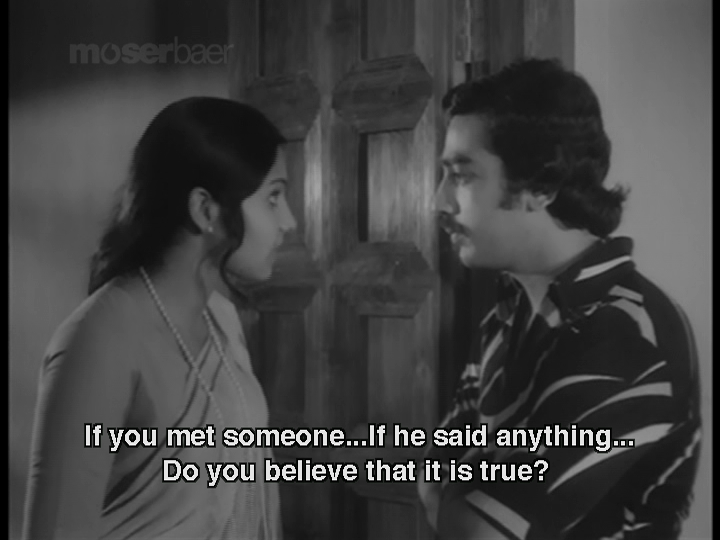
Kamal Haasan is Balu, a Tamil Brahmin lad who moves in next door to Telugu speaking Swapna played by the lovely Saritha.
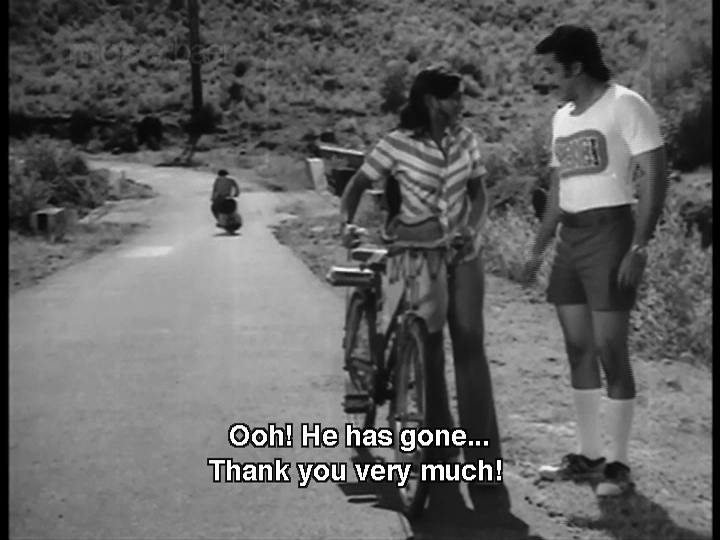
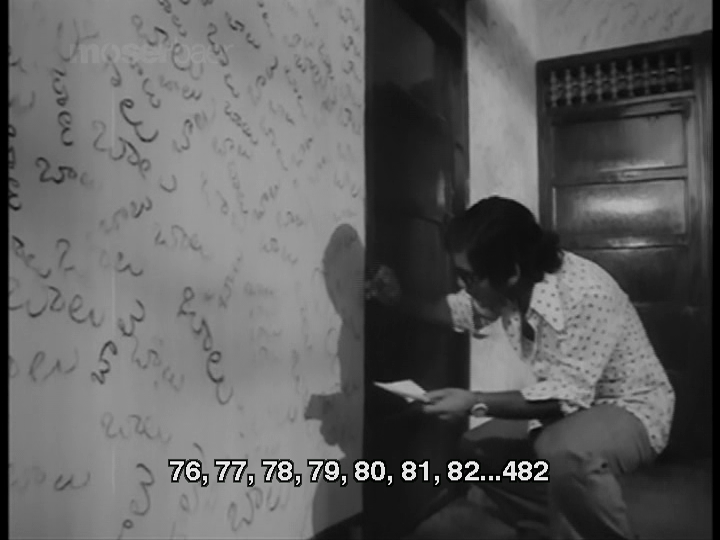
They feel an instant attraction, but cannot communicate easily through speech so improvise a language of percussion, mime, light switch flicking and of course dance! I don’t know whether I was happy or disheartened to see the one and only Learn Telugu in 30 Days text book. Surely things have changed since 1977? If not in romance, then at least in school books?

Saritha is beautiful, headstrong and a minx. I’m glad this was filmed in B&W as I suspect what looks striking in monochrome might have been horrifying in colour! Swapna is a modern girl, quick to deal with unwanted attention from the creep in the bookshop and proud of her academic achievements. She and her father read (badly subtitled) Shakespeare to each other; indeed, Romeo and Juliet are mentioned. Saritha has an earthy physicality and she lights up when Swapna is happily in love. Her character keeps unfolding which is impressive in a fairly simple story.
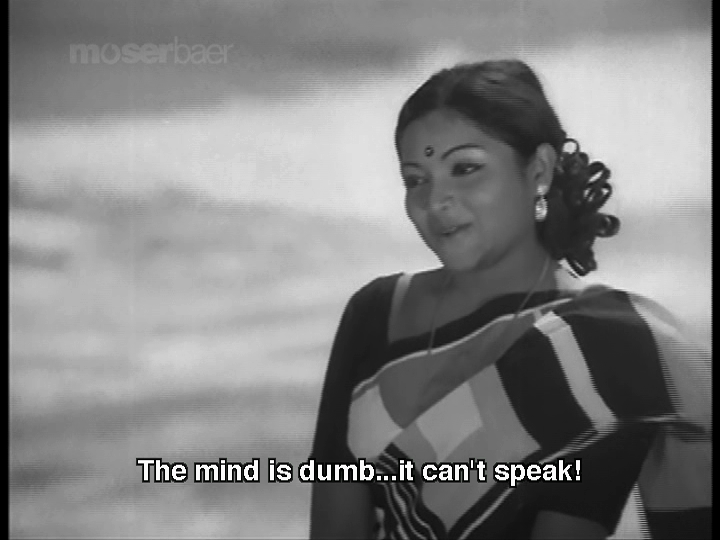
Kamal Haasan is his usual cocky self and at times bears a distracting resemblance to Siddharth. Balu is a self centred layabout, happily sponging off his family and using his charm to keep his mother on his side. His high waisted flares are enough of a disincentive for me, not to mention the shorts, but Swapna is made of sterner stuff. Balu’s reactions are always hasty, and usually about him and what he wants.

Once his temper cools he is quite rational, but he never seems to learn this about himself and so his character development is not particularly strong. He totally loses himself in the classical dance sequences which reflect the inner turmoil of his character, and they are beautiful to watch as well as adding some emotional depth to Balu.

Nothing can remain secret for long, and Balu and Swapna don’t try very hard to be discreet, as the rocks and trees covered in their graffiti shows. She is pursued by the sleazy bookshop guy who happens to have a penchant for secret photography. He shows some very candid photos to Swapna’s parents with predictable results. As befits Romeo and Juliet, their families disapprove and seek to pressure the youngsters into marrying within their caste. The young lovers undertake to separate for a year to prove that they aren’t just infatuated. Once they are forced apart, the film becomes a lot more interesting as the story expands beyond the fresh faced puppy love and the supporting characters show some surprising qualities.

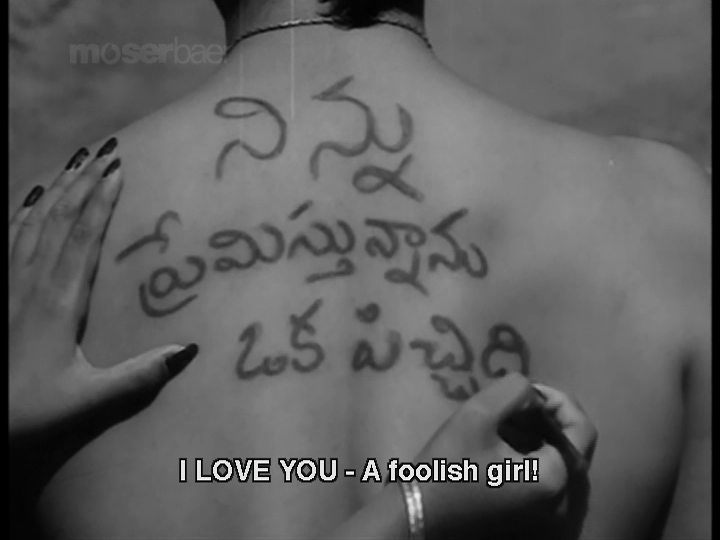
Swapna alternates between plaintive and defiant but never loses her resolve. Her behaviour at times frightens her parents who can’t understand her obsession let alone her bizarre actions. She drinks the ashes of a photo of Balu mixed in her coffee, she scrawls his name thousands of times on the walls. Her parents try to entice her away from Balu by dragging rich cousin Pattabhi into the household, but she plays him for a sucker and never wavers.
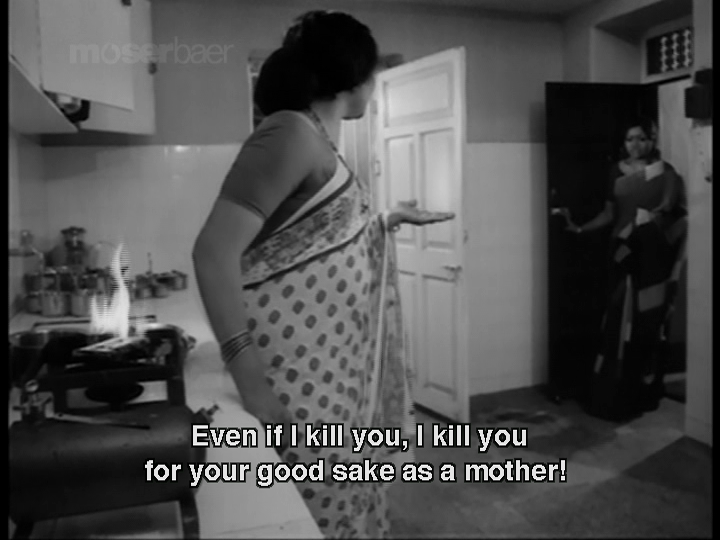
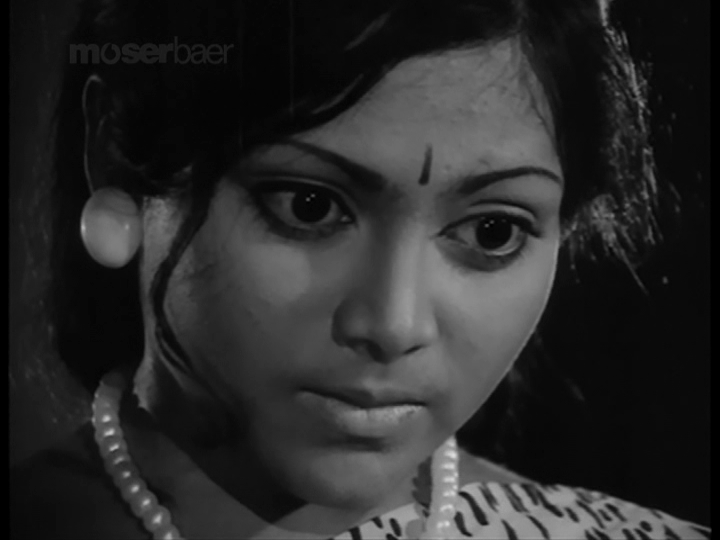
Balu is sent to Hyderabad to work for Hari Babu. Hari Babu takes Balu to a party at Reddy’s, a dissolute character with a band of freeloading friends which includes Balu’s neighbour in the lodging house, Papa. Her first scene includes a fairly detailed conversation about the effects of caffeine on the digestive tract and a flash of belly so it’s obvious from the get go she isn’t a shy girl. She wears trousers, goes to Reddy’s boozy parties and smokes. Papa pursues Balu and falls in love with him. When she realises that he is lost to her, she initially begs for him to sleep with her just once and after being rejected again, schemes for revenge. Considering all this, her character is surprisingly sympathetic and is even admired (with reservations) by her drinking buddies.

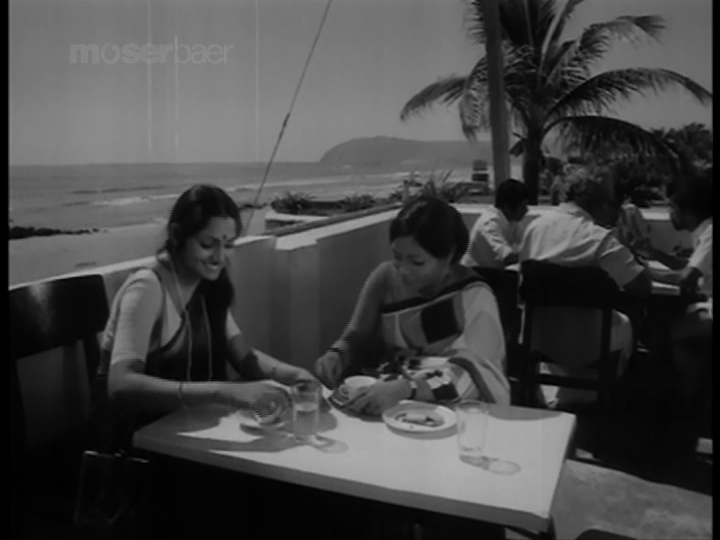
Also in the background of Reddy’s set is his sister Sandhya (Madhavi). A widow and an accomplished dancer, not quite a Mrs Robinson figure, she is a sympathetic presence for Balu. She helps him learn proper Telugu and to channel his energy, hormones and emotions into some beautiful dance sequences. She is drawn to his sadness and passion, and their common interests make a closer relationship seem inevitable.

After a misunderstanding over Swapna’s relationship with Pattabhi, Balu turns to Sandhya. Their affair is shown as a very matter of fact thing – they weren’t a couple and now they are, and a wedding is on the cards. No one seems terribly shocked by this relationship, except Papa who wants Balu for herself. Sandhya is shown as a resourceful woman who got on with life after her husband died, and isn’t needy or pathetic.

Sandhya discovers Balu’s unsent letters to Swapna, and takes herself to Vizag. She sees immediately that Swapna had never betrayed Balu and was waiting for him to return.  Instead of just  going home and getting on with her own wedding, she reassures Swapna that Balu has been faithful and will come back to her.  Sandhya’s anger in the scene where she sends Balu away with a flea in his ear and a ticket for the train is so moving. I felt that she identified with the girl who was going to lose her love, and partly hated Balu for cheating her on an emotional level. Contrast that with Balu’s immediate descent into self pity and woe, and I really had to cheer for the strong female characters that dominate the action.
Papa, Sandhya and Pattabhi are all swept aside by Balu and Swapna’s True Love. It’s a raw deal for Sandhya who seems a decent person, and sure to make her life that bit more difficult in the aftermath. There is a level of arrogance to the argument that love means never having to deal with the consequences for anyone other than your soulmate.

After giving signs of a happy future finally, the universe then aligns every possible obstacle and circumstance to prevent the marriage. As expected in a Romeo and Juliet inspired tale, the lovers come to a brutal, senseless, tragic end. The sleazy bookshop guy seizes his chance, and Swapna is brutalised in a sickening yet brilliantly edited sequence at the same time that Balu is attacked by paid rowdies. I really was on the edge of my seat through the final twenty minutes or so, hoping that the youngsters might make it even while knowing that a happy ending was never on the cards.

The film opens with disembodied voices talking over scenes of the places Balu and Swapna spent time together, almost like ghosts who couldn’t let go of their lives. It’s a scene that haunted me after the end titles had run. I have to give this 4 and 1/2 stars – for the stunning visuals, the charismatic lovers and the sheer skill of a film maker who could keep me watching even when I knew I didn’t want to.

Here’s a bonus clip for you – The dancing starts about 1 minute in:

Pournami

I’ve become quite fond of Prabhas. Not in a ‘he’s so hot‘ fangirly way. But he is likeable on screen and his presence in a film does seem to promise a commitment to entertainment.  Pournami is colourful, visually pleasing, sentimental and rather silly. Just what I have come to expect from Prabhas in fact!

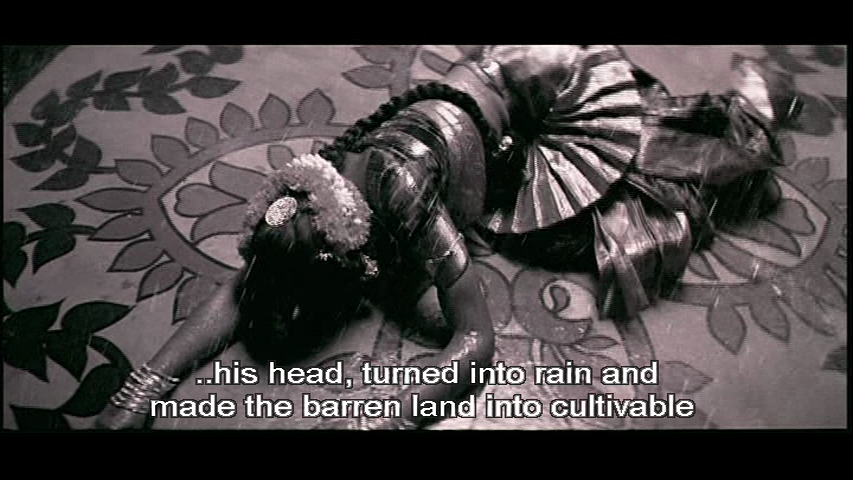
The film opens in 1953 and centres on a family with a long affiliation to a local temple. Many years back there had been a drought that threatened the livelihood of all in the surrounds. One woman had the strength and stamina to dance for Lord Shiva and was rewarded with rain. From that date, her family repeated this ritual every 12 years and her female descendants were trained to dance.

So it was a bit of a surprise to me that it all came as a surprise to the girls in the 1953 family that the eldest daughter, Pournami, was going to have to perform the ritual in 10 years time. Surely it might have rated a mention during dance lessons? Continuing the journey through time, we emerge in the 60s or thereabouts. Pournami has gone missing before the ritual must be performed. Her sister Chandrakala always wanted to dance but was overlooked. Chandrakala is now played by Charmme and she is reasonably convincing in the dance sequences. She is a Cinderella type figure – persecuted by her horrible stepmother, teased by local bullies and overlooked by many.

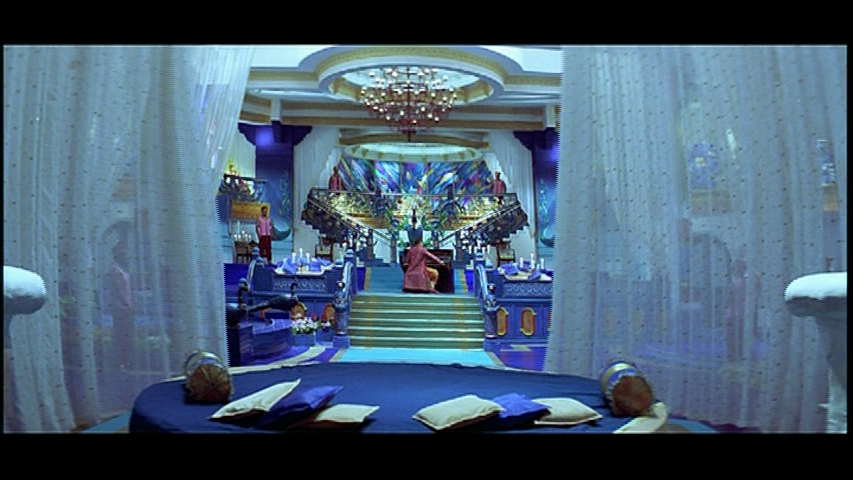
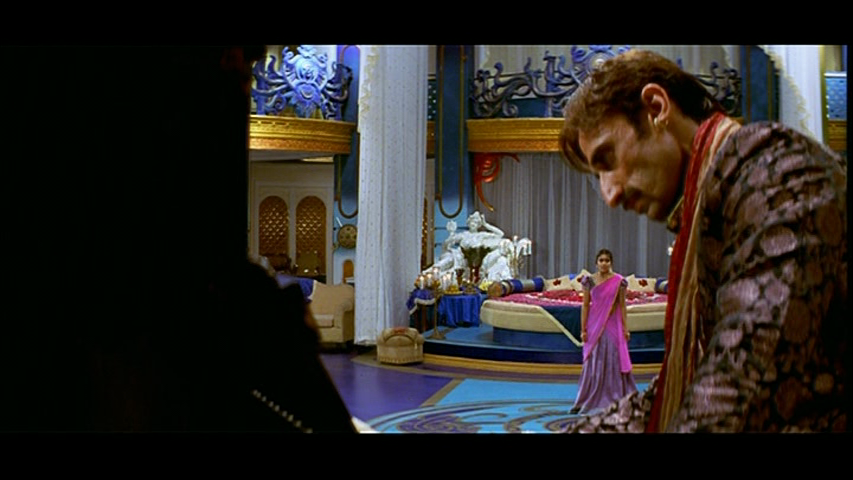
But where is the drama? Hello evil landlord! I do not in any way approve of evil landlords intent on deflowering young ladies who should be saving their strength to dance for Shiva. However, Rahul Dev has an excellent palace, a resident orchestra and generally believes himself to be a god or at least the equal of one. It is all highly entertaining. Pournami did a runner to avoid being kidnapped by Rahul Dev and he is now intent on claiming her sister.

But where’s the hero? Hello Prabhas in eye-catching plaid pants and rock n roll rebel attitude. Adding to the fun, we learn he is an ‘English Dance’ teacher, Sivakesava. Hmm…is that a Significant Name? Sivakesava rents room with Charmme’s family and opens his dance school.

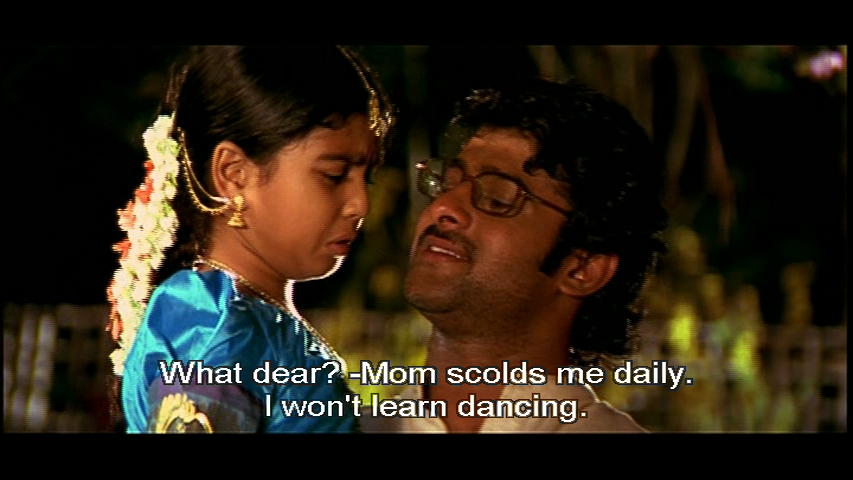
In between dance classes and dodging the local nymphomaniac, he encourages Charmme to dance, sometimes with quite amazing results. He seems to have mysterious powers over Chandrakala – little things like making her teeth glow in the dark and resisting her attack snake. But he uses his powers for good, and for fixing fuses, so we need not be alarmed on her behalf. I was amused by his gramophone – it’s just not rock n roll as I know it!

All the threads seem to be drawing together, but why? Who is Sivakesava and why is he intent on protecting the upcoming ritual? An extended flashback reveals that he met and fell in love with Pournami (played by Trisha) after she fled the village. She had joined a troupe of travelling performers, and her amazing dance talent, or perhaps her skimpy outfit, caught his eye. Pournami continues to practice her classical dance in her spare time. In a very pretty scene under the full moon, she gives ample evidence that the odds of pleasing Lord Shiva will be improved if she doesn’t dance for him.

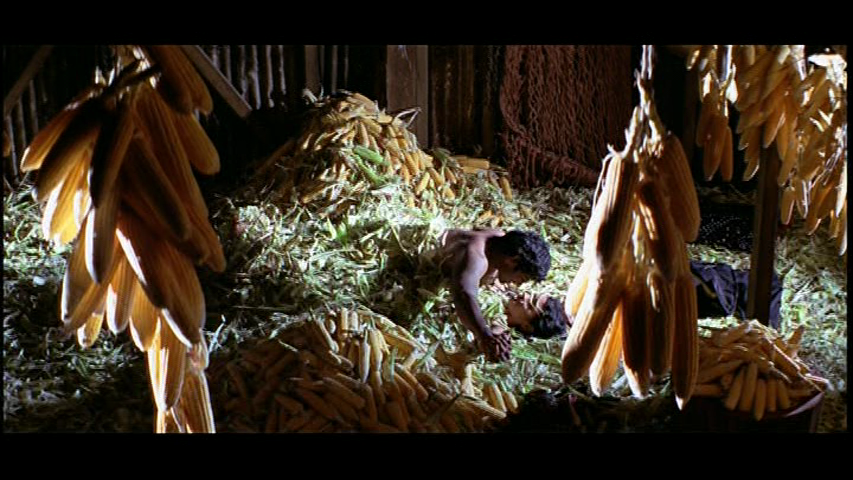
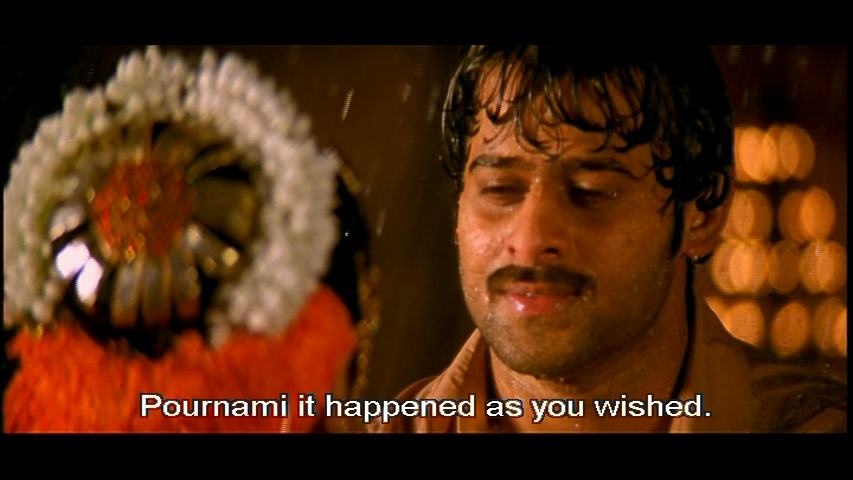
It turns out that Sivakesava was from a family who had a blood feud with the other big family in the region. He was sworn to avenge his brother and then would no doubt be hunted down in turn. Pournami became a victim in this feud, sacrificing herself to save her husband on their wedding night. The wedding night scene may mean I never look at corn in quite the same way ever again. Yes, that was corn with a c.

His past life continues to pursue him, never giving him a clear path to his heart’s desire or letting him subside into anonymity.

Chandrakala is abducted by Rahul Dev and he shows why he needs that piano and keeps an orchestra on standby. There is nothing funny about kidnap and rape in reality, but when the villain is improvising a melody to the tempo of Charmme’s footsteps it is very entertaining and adds to the cartoonish effect, as does his balletic fighting style. Naturally Kesava comes to her rescue again, and his actions cement her feelings for him.

Thus the other crucial episode unfolds – Kesava feels compelled to tell Chandrakala about his past with Pournami and why people from his old life, particularly his fiancée Mallika (Sindhu Tolani with a terrible hairdo), are still pursuing him. Chandrakala takes up the challenge to dance at the festival, motivated by love of her sister, of her father and for Kesava.

The finale at the temple is visually stunning and yet daft in equal measures. Which really sums up the whole film so it is perfect.

Although Pournami’s name and presence infuse the film, Trisha is overshadowed by Charmme and Prabhas. This is mostly due to the structure of the film – her story is told in isolation from the present time drama and we aren’t so involved in her relationships with anyone other than Sivakesava. In a film about dancers, Prabhu Deva gave Trisha some beautiful picturisations but her dancing was not as strong as Charmme’s and that aspect didn’t convince me. She looked lovely and her acting was as convincing as the role allowed. When Pournami appears to take over during the final dance it is shown as a way for everyone, including her spirit, to find closure. Trisha uses her very expressive face to communicate her sorrow and joy at this final encounter with her loved ones.

Charmme irritated me in the first half of the film, but I think she was meant to be a troubled teenager who was a bit bratty so I suppose that was a win. Her portrayal of a growing love for Sivakesava was done well, and I could see her puzzlement and annoyance turning to appreciation of the man who supported and protected her. She was a little tougher than your average filmi heroine, and her demonstrated snake wrangling skills make her more than a match for the average thug. Although the hero had to step in and help her finish the ritual, his help would have been for nothing if she hadn’t had the fortitude to keep going and stay focussed. Finally, she saves Kesava’s life and through that act wins the right to his future as his past finally lets go. I felt a bit sad for Chandrakala at the end as once again she will be the understudy for her sister, only this time in life.

Despite the story being ostensibly about the girls, this is a Prabhas film. He is at the centre of all the action and subplots, and once he arrives in town he is on screen for most of the film. He is convincing as both the kick arse hero and the misty eyed lover, and seems to have fun in the retro dance sequences. His relationship with both the heroines was played well, and there is a marked difference in his interaction with each of them. It’s a typically fun Prabhas performance. And his costumes… They make a statement all on their own.

The supporting cast were fine, with Rahul Dev, Brahmaji and Mukesh Rushi the standouts. Sunil is sweetly funny as Pournami’s brotherly friend and Ajay is reliable as a local thug. The soundtrack by Devi Sri Prasad is enjoyable and suits the story. Of course the songs are a visual delight as I expect from a Prabhu Deva film. The sets, the costumes, the locations are all beautiful and add a fairytale quality.

The film has a happy ever after ending, with signs of the new generation ready to maintain this lovely tradition. With any luck they’ll have a new landlord before the next festival!

See Pournami if you like the stars, plaid pants, excellent set design, pretty song picturisations and a dollop of overacting. I give this 3 and ½ stars.

Happy

So what do you select to watch next when your eyes have just been opened to the world of Telugu cinema by MAGADHEERA? I decided to stick with the Chiranjeevi extended family and, after seeing a few clips of Allu Arjun dancing on Youtube, picked Happy as my first foray into his films. Now if you’re like me and have watched a lot of song clips and then subsequently the film you will understand why I didn’t have high hopes for Happy. Allu Arjun looks great and is an amazing dancer, so I have to confess I was fairly sure that he wouldn’t be able to act – after all, no-one is perfect. Boy was I wrong!

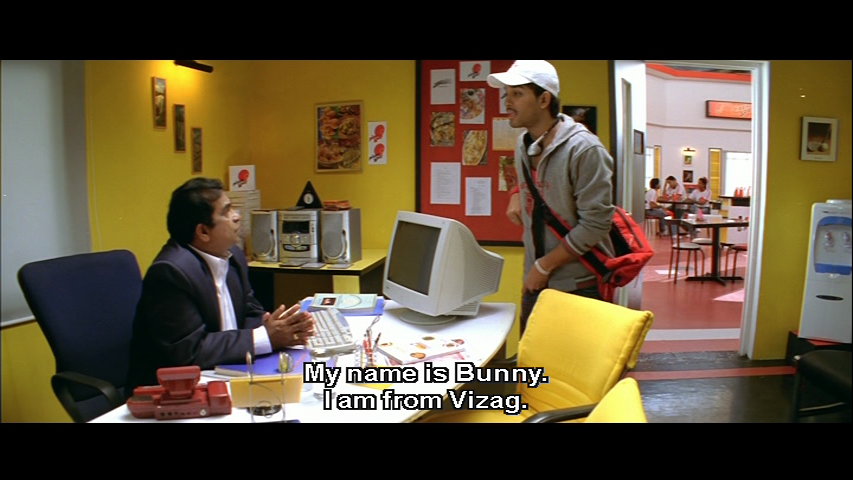
Happy stars Allu Arjun as Bunny, a happy-go-lucky orphan from Vizag, who comes to Hyderabad to study. He lands a job and digs at a pizza restaurant when he singlehandedly defeats a gang of students intent on causing trouble. This was early in my current Telugu film watching obsession, but I was still able to recognise Brahmi as the pizza joint manager, and was starting to realise that he has a contract to appear in every single Telugu film ever released. The restaurant also features a DJ, music system and a drum kit, making it possibly the first cross over night club/restaurant in Hyderabad. These do all come in useful however when Bunny announces that he can only fight to music. This ploy also gives us Venu Madhav in a brief comedic cameo role. (note the Chiru T-shirt!)

I think this first song was really commissioned by the Hyderabad tourist agency as it showcases the highlights of the city. It works for me and I would visit if they could assure me that I would get to see Bunny dancing at all the local sightseeing spots just like in this clip.

Bunny’s nemesis is the quiet and dedicated medical student Madhu, played by Genelia in a much less shrill role than usual. This is the film where I realised that Genelia is a very good actress when she doesn’t have to jump around squealing excitedly. I really wish directors would use this quieter and yet much more expressive side to Genelia more. Madhu’s father is a caste leader with political ambitions and holds the view that as women have no place in the workforce, there is no need for his daughter to study. Faced with this opposition, Madhu keeps her head down and tries to be as inconspicuous as possible in the hope that her father will continue to ignore both her and her marriage arrangements until she has finished her degree.

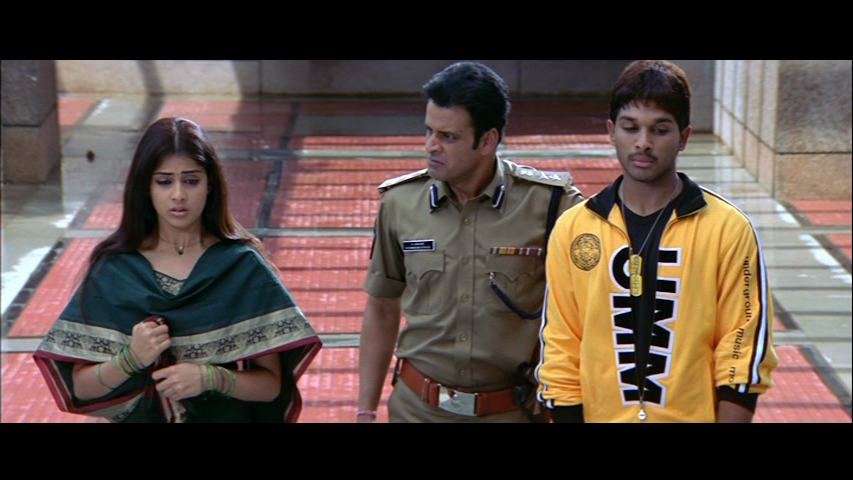
Bunny and Madhu clash from their very first meeting, and a series of misunderstandings makes sure that they each think the worst of each other.   When Madhu’s father decides that her studying is bringing her into too much contact with others outside her caste, he arranges her marriage to DCP Arvind  – Manoj Bajpay in a rather more comedic role than usual. In a dramatic meeting Madhu accuses Bunny of ruining her life, so he decides to try to prevent her marriage. Yes, it does all sound very familiar, but the twist here is that Arvind supports Bunny’s plan and the two erstwhile enemies end up married and sharing a flat together.

Despite their marriage, Bunny and Madhu are still sworn enemies and they draw a line down the middle of the apartment to demarcate each other’s territory. They continue to harass and annoy each other and Bunny delights in stepping over the line both literally and figuratively to annoy Madhu. This part of the film will be very familiar to anyone who has a younger sibling as the pranks the two play on each other are very juvenile and reminded me of living with my brother. It is also extremely funny and the two actors are excellent at keeping the sparks flying without ever becoming too ridiculous.

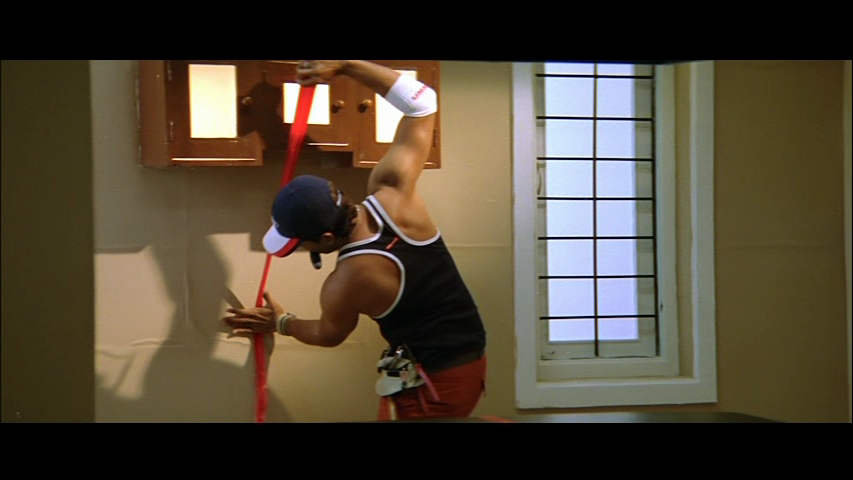
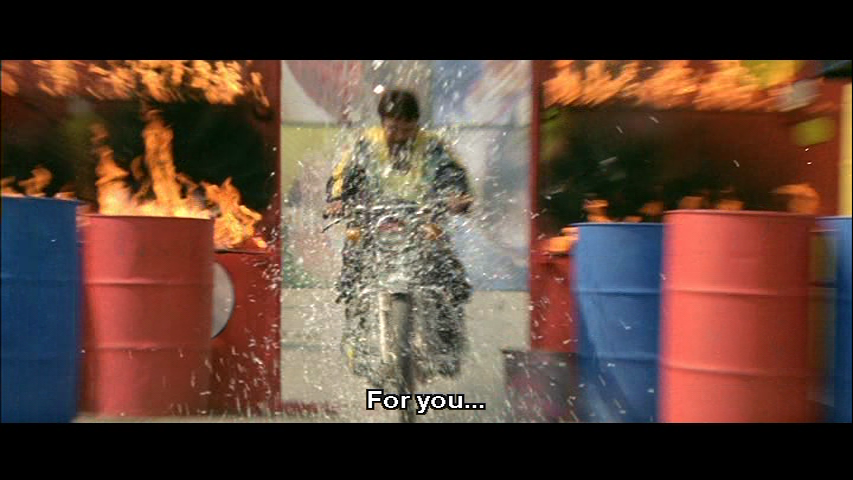
 Over time the inevitable happens and Bunny falls in love with Madhu. In typical filmi–style devotion he will do absolutely anything for her except to tell her his feelings. Due to his apparently amazing bike skills, Bunny gets a job as a stuntman in the movies and manages to juggle his pizza delivery with leaping over cars and through explosions in order to have money to pay for Madhu’s studies. He slowly acquires more bandages and bruises as the stunts get more and more dangerous although the bike seems to come through everything unscathed. Just when it looks as if the film is building up to a final romantic and ‘happy’ conclusion there is a real chance of pace. My theory is that the director Karunakaran realised that he has only a day left to film but plenty of money left in the fight and make-up budgets. So instead of the expected fluffiness, there is almost a full movie’s worth of drama, action and fisticuffs in the last few minutes of the film, along with buckets and buckets of blood. It was a little unexpected after all the comedy and romance of the preceding two and a half hours, but it certainly makes the end memorable.

After watching a number of his  interviews I am quite sure that a lot of this character is Bunny’s real extrovert persona. His performance seems totally natural and spontaneous throughout the film and he excels at conveying his character as much through his posture and mannerisms as through the dialogue and actions. I didn’t even find the coloured contact lenses as distracting as usual and, being an optometrist, contact lenses are often the first thing I notice. Despite the masking quality of coloured plastic, Allu Arjun can deliver every emotion using his eyes. It seems to be another family trait as the entire clan appear to have the most expressive eyes in the industry. The fight scenes are reasonably well choreographed, although they don’t have the slickness of Bunny’s more recent films. But where Allu Arjun really rules is on the dancing stage. He really is an amazing dancer and although there are only a couple of dance tracks in this film, he is totally mesmerising.   The music by Yuvan Shankar Raja is catchy and overall works well for the young characters and the happy feel of the film.

Genelia was a revelation to me in this. Previously I’d seen her in a couple of Hindi films and one other Telugu film, where she was generally hyperactive with piercing dialogue delivery. Here she has great chemistry with Allu Arjun in their scenes together and deliveres an excellent performance as the struggling student. She makes the most of her emotional family scenes and is believable as the daughter trying to live up to her father’s expectations while vowing to fulfil her mother’s dreams. Really a good decision by Karunakaran to allow her to be more subtle and showcase her acting talent in this way. Manoj Bajpay indulges in the most scenery chewing I have seen from him, but as always carries his role off with flair. The other support actors all do well enough and a couple of Bunny’s friends make an impression with their roles.

Happy is still one of my favourite films and I re-watch it if I need a pick me up after a bad day. It has comedy, action, drama, great dancing and fantastic performances from the leads. It doesn’t try to be anything other than a masala entertainer and as such it works very well. It would be a five-star movie if it wasn’t for that ending which is just a bit too over the top and ridiculous, even for me.  4 ½ stars.